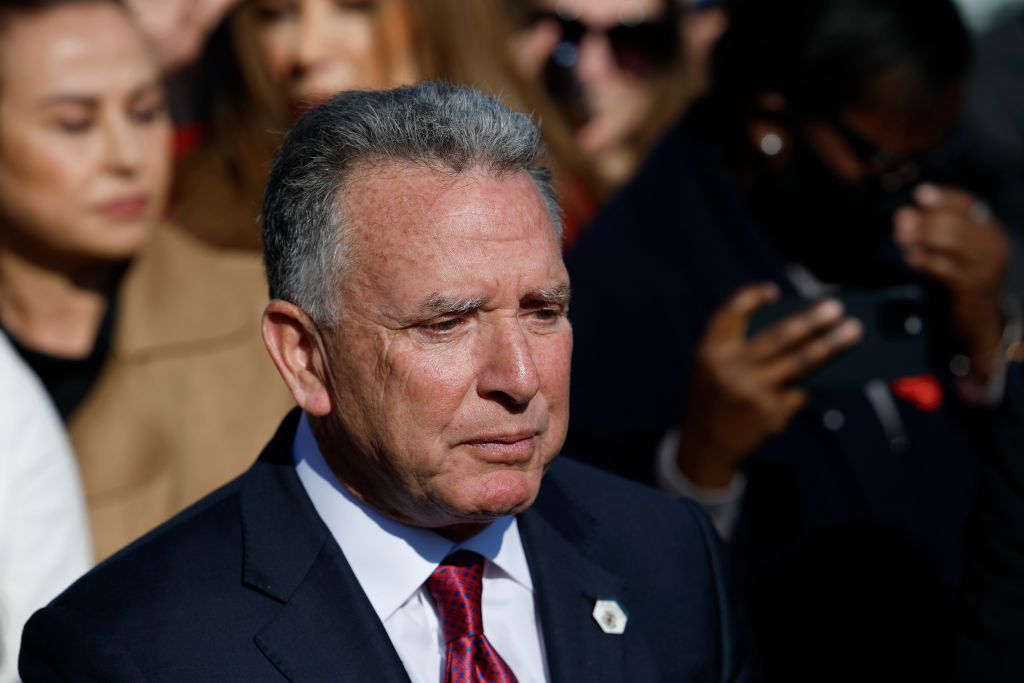
Steve Witkoff, the successful real estate investor who has emerged as Donald Trump’s key negotiator in the Middle East, has a gift for understatement.
As the first phase of the Gaza ceasefire agreement winds down, the two reluctant negotiators are further away from resolution than ever. Hamas still demands that Israel withdraw completely from the Gaza Strip and release all remaining Palestinian prisoners from Israeli jails. Israel continues to insist on the end of Hamas’ control of Gaza and the exile of its leaders from the region.
Witkoff’s analysis: “It’s hard to square that circle.”
To say the least.
If anything, Witkoff’s job has only become more difficult over the last several days, as Hamas’ escalating mistreatment of their captives finally reached a breaking point for the Israeli government. For weeks, the soon-to-be-released hostages were paraded through grotesque carnivals in which they were humiliated in front of lines of armed gunmen. But days before the first phase of the ceasefire was scheduled to conclude, Hamas lowered their already-execrable conduct to new depths of depravity.
Not only did the terrorists force the departing hostages to kiss their captors in a horrific parody of appreciation, but they also required two of the remaining detainees to publicly witness their fellow captives being set free and to read a coerced statement for a propaganda video requesting their own release. Even worse was the heartbreaking fate of Ariel and Kfir Bibas, the tiny brothers who Hamas leaders claimed were killed by an Israeli aerial attack. Forensic examinations showed that the boys — four years and nine months old when kidnapped — were killed by their jailers with their bare hands. Most painful of all was the fate of their mother Shiri, also abducted and murdered last year, who even in death was subjected to a final act of cruelty when the coffin ostensibly containing her remains instead held the body of an unidentified Gazan woman.
Under such humiliating circumstances, Israel’s decision to refuse the release of the Palestinians scheduled to be set free should be unsurprising. But in a political climate in which the hunger for the freedom of the remaining Israeli hostages has become a crescendo, it should be recognized that Hamas’ deliberately insulting conduct was also precisely calculated. The terrorists understand the pressure that Benjamin Netanyahu is now facing to make no further concessions to them, which greatly increases the likelihood that the next phase of the ceasefire will never take place.
Into this standoff steps Witkoff, who recognizes the near-impossibility of reconciling the diametrically opposed conditions from Israel and Hamas for any forward movement. But he and his boss want a normalization of the relationship between Israel and Saudi Arabia now more than ever, and he knows that the Saudis will only take that step if Netanyahu or his successor agree to the creation of a Palestinian state.
Witkoff recognizes the near-impossibility of reconciling the diametrically opposed conditions from Israel and Hamas for any forward movement. But he and his boss want a normalization of the relationship between Israel and Saudi Arabia now more than ever.
Every atrocity that Hamas carries out makes it that much more difficult for Israel’s leaders to convince their voters that the Palestinians should be rewarded with a state of their own. Most Israelis would see a two-state solution as a complete and total capitulation to the terrorists and are even less likely to accept such a surrender when the most recent atrocities are so fresh in their minds.
Hamas’ leaders are barbarians. They are beneath our contempt. But just as they did last October, when they sensed progress toward an agreement between Israel and Saudi Arabia and took unimaginably violent steps to block it, they have demonstrated a dreadful and ghastly geopolitical savvy that allows them to prevent their own destruction.
They are worried by an American president who seems willing to employ significant force to demand an end to the hostilities. They understand that an extended ceasefire would be the first step toward a broader regional agreement that would exclude them. So once again they are doing everything they can to destroy any potential for progress. Right now, neither Witkoff nor Trump, any more than their predecessors, seem to know what can be done to stop them and get a Saudi deal back on track.
Dan Schnur is the U.S. Politics Editor for the Jewish Journal. He teaches courses in politics, communications, and leadership at UC Berkeley, USC and Pepperdine. He hosts the monthly webinar “The Dan Schnur Political Report” for the Los Angeles World Affairs Council & Town Hall. Follow Dan’s work at www.danschnurpolitics.com.