On the occasion of the 74th anniversary of establishment of the modern State of Israel, also known as Yom Ha’atzmaut, here’s a little-known story about Israel that’s worth sharing:
For decades, post-revolutionary Iran has made Israel, “The Little Satan,” its sworn enemy (in addition to the United States, also known as “The Big Satan”). In Iran, Zionism is punishable by death. Travel to Israel, or as it’s called on Iranian passports, “the occupied Palestine,” is forbidden.
On the morning of September 19, 1995, a plane carrying 174 passengers left Iran, bound for the vacation island of Kish in the Persian Gulf, which is likened to the Iranian Riviera.
Months earlier, Reza Jabbari, a 29-year-old Iranian flight attendant, had asked to leave his job, but his request was denied. For six months, Jabbari had contemplated defecting, but needed a way out of Iran.
The Boeing 707 departed from Iran at 9:20 a.m. Over an hour later, as the Iranian pilot prepared to land on Kish Island, Jabbari, armed with a pistol, entered the cockpit and hijacked the plane.
He demanded that it be diverted to Zahran, Saudi Arabia, but the Saudis wouldn’t allow it. Jordan, perhaps? King Hussein refused. And then, Hussein called then-Israeli Prime Minister Yitzhak Rabin. Israel and Jordan had signed a peace treaty the previous year in 1994.
The plane was headed toward Israel, Hussein warned. Rabin had a clear policy against aiding hijacked planes, but there was a big problem: A crash was imminent. “What was reported to me was that the plane had little fuel, and I did not want to be a partner or to bear responsibility for the crash of a plane full of passengers,” Rabin said at the time.
According to Israel Radio, the pilot pleaded with air traffic controllers: “We must make a crash landing or land in Israel. We must land in Tel Aviv. We cannot proceed. Did you copy? We are low on fuel. We are a hijacked aircraft. We must make a crash landing.”
Whereas the Saudis and the Jordanians flat-out refused a landing, Israel said ‘yes’ to a hijacked plane from Iran, the world’s number one state sponsor of terrorism. Rabin agreed to an emergency landing, not at Tel Aviv’s Ben Gurion Airport (in case there was a bomb on board), but somewhere more remote.
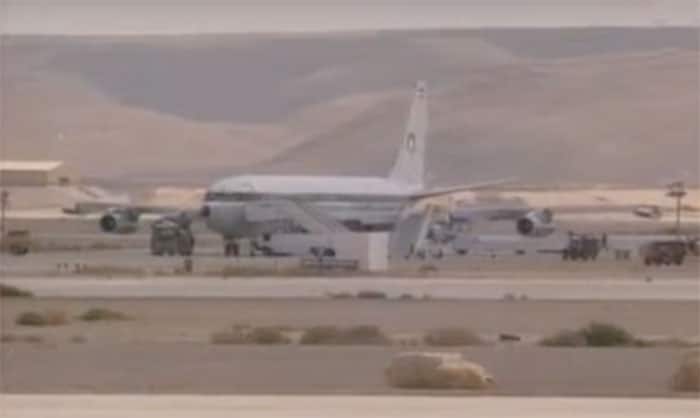
Shortly thereafter, the plane arrived at Ovda, a Negev Desert military air base 18 miles away from Eilat, in southern Israel. Negotiations between Israel and the hijacker lasted three hours. Finally, all passengers (and the flight crew) departed the plane and set foot on Israeli soil. Some of those passengers were Iranian officials and even military officers, accompanied by their wives and children.
Jabbari, the hijacker, placed the gun on the tarmac and surrendered. He only expressed a few words: “I’m sick of Iran.”
Jabbari was taken to an Eilat police station and interrogated. “Sentence me and put me in jail,” he said. “I’d rather be in an Israeli prison than go back to Iran.” Jabbari understood exactly what was at stake.
Jabbari was taken to an Eilat police station and interrogated. “Sentence me and put me in jail,” he said. “I’d rather be in an Israeli prison than go back to Iran.” Jabbari understood exactly what was at stake: “Send me back and I will be sentenced to death,” he told Israeli police. “In Israel, I would be spared.” He was investigated on charges of air piracy, weapons possession, hijacking and infiltration, and admitted to all charges.
In an interview with the Associated Press at the police station, Jabbari said, “I believe the people of Iran do not deserve to be in such an oppressed situation. I wanted to make it public and announce it to the world.” He said he never intended to hurt passengers or the crew.
Jabbari pleaded to stay in Israel. Incredibly, so did five other passengers. Apparently, life in post-revolutionary Iran wasn’t exactly paradise. And since this was the Middle East, the incident became quickly politicized.
Some Israelis instantly recognized an opportunity to use the passengers as leverage for the release of Israeli pilot Ron Arad, who had crashed in Lebanon in 1986. In 1988, Arad had been “sold,” yes, sold, to Iran, and Israel had tried nearly everything to bring him back.
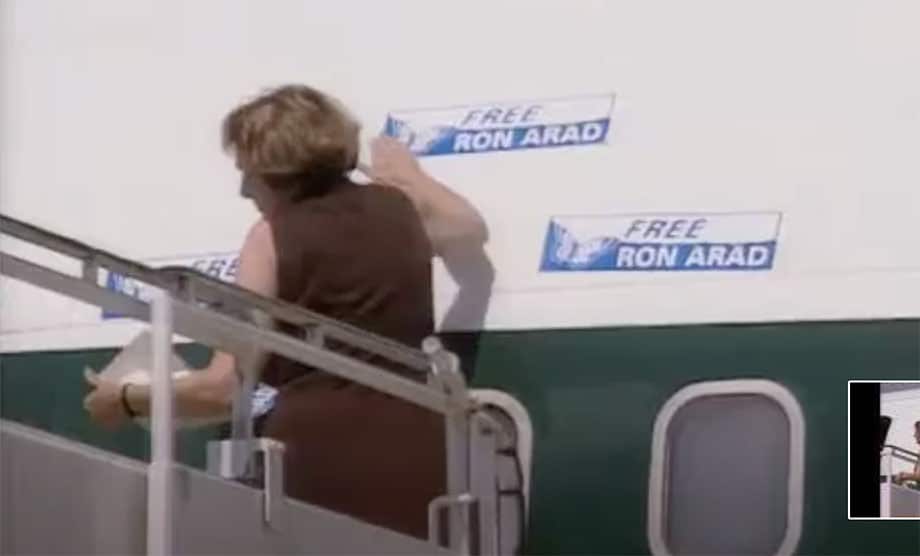
In a series of heartbreaking images, Arad’s mother, Batya, who immediately made her way to Ovda air base, could be seen plastering “Free Ron Arad” stickers on the grounded plane. Video footage shows her hanging a huge banner at the foot of the plane that reads, “Please release Ron Arad.” She even met some of the passengers and asked them to sport the stickers. “Look into my eyes,” she said. “I am Batya Arad, Ron’s mother. My son is imprisoned in Iran.” It was both devastating and extraordinary.
The regime in Iran was fuming, to say the least, and accused Israel of having advanced knowledge of the hijacking. Iranian Parliamentary speaker, Ali Akbar Nateq-Nouri, announced on state-run Tehran radio that the delay in returning Jabbari indicated “the Zionist regime’s terrorist nature.” Naturally, Iran demanded Jabbari’s immediate extradition. For his part, Jabbari was deeply worried about retaliation against his mother, three brothers and a sister back in Iran.
The passengers and flight crew spent nearly 30 hours at the air base. Some of their fears of being in Israeli hands were quelled when Israeli soldiers brought them lunch and ice-cold drinks. Photos showed some of the male Muslim passengers praying on rugs in the terminal. On September 20, the plane flew back to Tehran, without the hijacker. A release agreement for neither Jabbari nor Arad was secured. The passengers arrived back in Iran after a stop in “the occupied Palestine,” a stop which they previously never could have imagined.
An Israeli court sentenced Jabbari to eight years in prison for attempted hijacking; he served half of that sentence. Upon his release, he made two announcements: First, he intended to live in the serene city of Eilat in southern Israel. Second, he was going to convert to Judaism. His first job? A security guard in an Eilat store. Yes, the hijacker became a security guard. And he came to Israel at a pivotal time. A month-and-a-half after Yitzhak Rabin allowed the plane to land in Israel, rather than letting it crash, he was assassinated at a rally in Tel Aviv.
In Eilat, Jabbari found a community — specifically, Iranian Jews who had escaped to Israel decades prior. “I feel like I was born here,” he told the press. “I am completely Israeli.” In 2000, a photographer captured images of Jabbari selling athletic shoes in Eilat.
In researching this story, I received a Facebook message from an Iranian-Israeli Jew who knows Jabbari personally. Of course, I asked for an interview.
She told me that Jabbari now divides his time between Tel Aviv and the Philippines, and promised to ask him if he would speak with me. Shortly after, she told me that he wasn’t interested “yet.” Jabbari’s exact words? “Nothing good will come out of it.”
I understood, and I didn’t press further. It looks like Jabbari only wants to move forward, fiercely protective of everything he has built. In that way, he might be truly an Israeli.
Tabby Refael is a Los Angeles-based writer, speaker, and civic action activist. Follow her on Twitter @RefaelTabby