fbpx

May 4, 2022

A Legacy of Basketball and the Holocaust in ‘By the Grace of the Game’

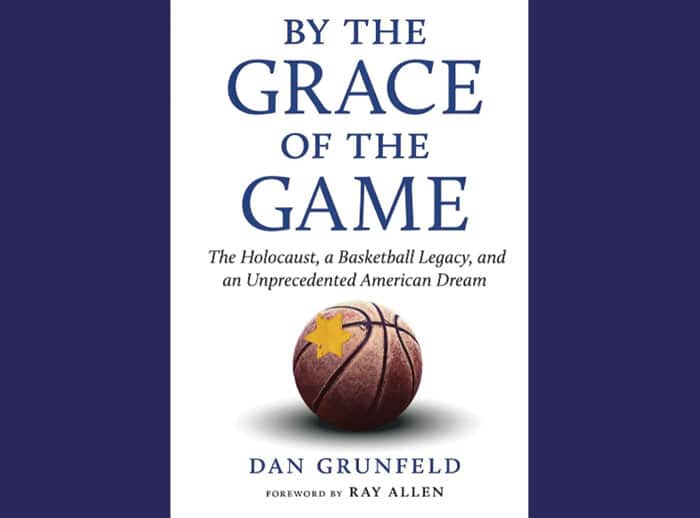
By chance, several weeks ago someone — I can’t remember whom but please identify yourself so I can say thank you — dropped Dan Grunfeld’s autobiography at my home. 

By chance, I took it on a red-eye flight to Florida for a speaking engagement. 

By chance, I could not fall asleep, so I opened the book and read it through the night. I simply could not put it down.

Dan Grunfeld is the son of Ernie Grunfeld, who had a storied career in basketball. An All-American athlete at the University of Tennessee where he starred with NBA Hall of Famer Bernard King, and an Olympic Gold Medalist, he then went on to an NBA career with the New York Knicks, the team of my youth. His post-retirement career in broadcasting and as general manager of the Knicks and several other teams, was no less impressive. I was always keenly interested in Ernie Grunfeld, a proud, committed Jew, who played in the NBA long after Jews had starred as players. In my youth Jews were Commissioners and owners, mostly coaches—great ones such as Red Auerbach of the Celtics and the Knicks’ Red Holtzman, whose jersey hangs over the rafters at Madison Square Garden, the number 613, his career victories as a coach, emblazoned on it.

Dan Grunfeld’s birth was planned around the Knicks schedule; he was born during a homestand, and his father returned from a road trip just in time for his bris.

Dan Grunfeld’s birth was planned around the Knicks schedule; he was born during a homestand, and his father returned from a road trip just in time for his bris. Yet, little did I know of his father Ernie’s back story. The son of Holocaust survivors, who had endured both Nazism and Communism, his parents were Hungarian immigrants who came to the United States to enjoy freedom and opportunity, living modestly, working intensely trying to make a better life for themselves and, much more importantly, for their children. They worked with even greater intensity after their older son Leslie died of leukemia and all that they had was their son Ernie. Little did I also know that Ernie grew up in the neighborhood adjacent to my New York City home playing in the very same school yards where I played, attending Forest Hills High School as did my sister. 

I grew up with these immigrant parents and heard their Hungarian, German, Dutch, Russian, Yiddish and Polish accents in English and how they spoke to their spouses in their native languages. I went to school with their children from whom so much was expected. They had to justify their parents’ sacrifice and to make good on the bet they made in coming to America. Remember how Alexander Vindman thanked his parents at the Trump impeachment testimony? Children of immigrants often negotiated the world of America for their foreign-born parents.

Ernie Grunfeld made good in the urban sport of basketball. A star with his body and an NBA lifer because of his mind and his work ethic, he was admired for his fair play. He did so as an identified proud Jew, exalting in his heritage, which he received from his parents’ pain and transmitted to his son with privilege.

The author tells the story of three generations of his family, his grandparents, and most especially his grandmother whom he unabashedly adores and with whom he spent enormous quantity and quality of time as she lived near his campus at Stanford, and he lived with her as he recuperated from a shattered knee that had to be rebuilt if he was to resume his basketball career. 

The younger Grunfeld grew up with basketball. He shot hoops at Madison Square Garden as a kid and he dared as the son of a champion athlete to follow in his father’s footsteps as a competitive athlete. One can read this book as an ordinary sports biography and be much impressed by how competitive Grunfeld was with himself and his opponents, but not his father. One comes to understand how hard he trained, how much he worked and how deeply he loved basketball. One cannot fail to feel his heartbreak when at the peak of his career he was injured and then doubled down on his career, working unceasingly to come back, knowing on some level that he could never come back all the way. He played professionally in Germany, Spain and Israel and briefly in the NBA for the Knicks, the team he loved as a boy, the very team where his father was a player, broadcaster and general manager before being fired unceremoniously at the end of a long leisurely dinner at an Italian restaurant.

One can read this book as a Jew and again be impressed by the quality of his Jewish identity. That is who he is. Not particularly religious, he is nevertheless in synagogue for the High Holidays, and his wife is Jewish. When invited to play for Germany, he put the offer on hold until he spoke with his grandmother. Neither he nor she were willing to forget — but she will not hold the sons responsible for the sins of their fathers and certainly not for their grandfathers. The Maccabiah games are his Olympics. When he plays for Israel, he is at home. He has no need to explain why he is not playing on Yom Kippur. Shabbat dinners are as natural a part of his life as the streets of Jerusalem or the beaches of Tel Aviv. He has Israeli relatives, Israeli friends. Israel is the Jewish homeland, his homeland, which enabled his grandparents and father to leave Romania.

One can also read this book as the Holocaust memoir his grandmother, whom he so lovingly called Anyu, and grandfather Anu did not write, but he felt duty bound to tell. 

One can also read this book as the Holocaust memoir his grandmother, whom he so lovingly called Anyu, and grandfather Anu did not write, but he felt duty bound to tell. Notice the subtitle, “The Holocaust, A Basketball Legacy and an Unprecedented American Dream.” The Holocaust comes first in the title, and it looms ever so large throughout the book. 

Grunfeld’s book is the story of Hungarian Jews living basically untouched while the Hungarian government was allied with Nazi Germany and then following the German invasion of March 1944, ghettoization in April, and deportation to Auschwitz beginning May 15, 1944. His grandmother survived in Budapest at a critical moment due to the good graces of Raoul Wallenberg. She was the recipient of the Schutz Pass, which seemingly gave her Swedish affiliation protection, while his grandfather was “fortunate” in quite another way. 

Before the Germans invaded Hungary — this is a history the government of Hungary is seeking to repress — the Hungarians sent many Hungarian Jews to slave labor camps. Though they suffered under harsh and difficult conditions and many died, these men avoided the fate of Hungarian Jews after the German invasion — deportation to Auschwitz, the fate that awaited most of Apu’s and Anyu’s family. 

He experiences his grandparents in a way that his father could not. His father dealt with their vulnerabilities, their pain, their weakness, perhaps even, though he would never express it, their inadequacies. Grunfeld experienced their strength, their tenacity and their wisdom. That may be the greatest distinction between the 2Gs, children of survivors, and the 3Gs, the grandchildren.

Grunfeld’s grandmother makes traditional Hungarian dishes and Grunfeld consumes them even beyond his enormous capacity as a growing athlete. One of the endearing qualities of this book is the unquestioned love that grandmother and grandson have for one another and the very Jewish feeling that love is expressed in food. Though I do not know the dishes, Grunfeld writes so compellingly that you can almost smell them. He should have included the recipes. Jewish immigrant homes like Italian and Greek ones, center around the table, life revolves around the meal. The kitchen is the family’s anchor. 

So I read this book as a kid from Queens who walked the streets that Ernie Grunfeld walked and played in its schoolyards. I read it with admiration for the tenacity, toughness, discipline and gifts that took one from those school yards to the NBA. I read it with appreciation for a son who can follow in his father’s footsteps and yet chart his own course, who understands the privilege of being his father’s son and is not intimidated by his father’s giant shadow. I read it as a Jew enjoying the naturalness and the ease of full acceptance of one’s Jewish identity with pride and gratitude, and I read it as a Holocaust scholar who appreciates how different the third generation is from the second and how deeply they can embrace the survivors, understanding full well how their grandparents can view them as their triumph over Hitler, which they so very much are.


Michael Berenbaum is director of the Sigi Ziering Institute and a professor of Jewish Studies at American Jewish University.

A Legacy of Basketball and the Holocaust in ‘By the Grace of the Game’ Read More »

An Open Letter to Harvard President Lawrence Bacow

Dear Harvard President Bacow:

In response to the Supreme Court’s grant of review of the decision of the United State Court of Appeals for the First Circuit in Student for Fair Admissions v. President and Fellows of Harvard College, which decision held that Harvard could consider race in its admissions process, you circulated a letter to the “Members of the Harvard Community” defending Harvard’s use of race in the admissions process and arguing that “[t]hose who challenge our admissions policies would ask us to rely upon a process far more mechanistic, a process far more reliant on simple assessments of objective criteria.”  Each of us, you add, is “more than our numbers, more than our grades, more than our rankings or scores.”

With all respect, you have not fairly presented the argument of those who oppose racial preferences. Critics of racial preferences do not argue that admissions should be mechanistic, turning solely on grades and test scores.  Indeed, using race as a factor is what is mechanistic, since it is a fact beyond the individual’s ability to change. Just as no one should suffer in the admission process for the uncontrollable accident of racial or ethnic identity, no one should benefit thereby, either.

Overcoming social and economic adversity, whatever one’s race, would be a far better marker of the quality of an applicant because it would inform Harvard of the lived experiences of the specific individual it is considering.

Critics of racial preferences disfavor those preferences because race is not a good marker of anything important. Standing alone, it tells one little about the specific person being appraised. Overcoming social and economic adversity, whatever one’s race, would be a far better marker of the quality of an applicant because it would inform Harvard of the lived experiences of the specific individual it is considering.

Indeed, for all of Harvard’s emphasis in the Court of Appeals on diversity, its student body is surprisingly uniform economically and socially.  

Indeed, for all of Harvard’s emphasis in the Court of Appeals on diversity, its student body is surprisingly uniform economically and socially.  According to data available on Google, 15% of Harvard students come from families of the top 1% in earnings, 67% of Harvard students come from the top 20% of income earners.  Only 4.5% come from the bottom 20% of earners. Clearly, most of Harvard’s Black students are not from families in the lowest quintile of earners since 18% of its students are Black while only 4.5% of Harvard’s students come from that quintile.

Harvard emphasized in the Court of Appeals that it also gives special consideration to athletes, the children of faculty, staff, and alumni, and even relatives of donors.  But these categories of applicants are very different from a race-based category for two reasons. First, and most importantly, they are not even arguably prohibited by law.  Second, as the Court of Appeals noted, Harvard defended these practices on the grounds that they either tell Harvard something important about the character of the particular applicant or serve an important interest for the functioning of the University. Referencing Harvard’s arguments, the Court of Appeals noted that giving preferences to athletes allows Harvard to admit students who have demonstrated “discipline, resilience, and teamwork.” Giving preference (Harvard calls them “tips”) to so-called “Legacy” applicants, that is, the children of Harvard graduates, “helps to cement strong bonds between the university and its alumni [and] encourages alumni to donate their time and money…  [G]iving tips to the children of faculty and staff is important to workforce retention.”

Surprisingly, while giving preference to athletes and children of faculty, staff, and Harvard alumni and donors, and while having a student body heavily biased in favor of the economically and socially well off, the Court noted that Harvard rejected increasing the weight it places on socioeconomic background in admissions. The Court quoted Harvard’s argument that giving greater weight to socioeconomic background “would not further Harvard’s diversity goals.  Harvard believes that excellence can and should be found in all backgrounds and determined that focus on socioeconomic circumstances that outweighed all other factors could equally reduce the depth and breadth of the Harvard class as well as its excellence in many dimensions.” (Internal quotation marks omitted.)

Of course, socioeconomic circumstances should not “outweigh” all other factors. But Harvard’s conclusion misses the whole justification for racial preferences. Race itself has no bearing on any quality that an admissions office should care about. Either race is a proxy for some quality that arguably does matter – for example socioeconomic hardship, inferior schools, lack of intact family, difficult environment – in which case Harvard should select for the quality and not for the proxy; or Harvard regards race itself as an essential, determining characteristic of the individual.  And that is simply racist.

Very truly yours,

Gregory R. Smith

HLS ‘68


Gregory Smith is an appellate attorney in Los Angeles and an occasional contributor to the Jewish Journal. 

An Open Letter to Harvard President Lawrence Bacow Read More »

One Israel Story You’ve Probably Never Heard

On the occasion of the 74th anniversary of establishment of the modern State of Israel, also known as Yom Ha’atzmaut, here’s a little-known story about Israel that’s worth sharing:

For decades, post-revolutionary Iran has made Israel, “The Little Satan,” its sworn enemy (in addition to the United States, also known as “The Big Satan”). In Iran, Zionism is punishable by death. Travel to Israel, or as it’s called on Iranian passports, “the occupied Palestine,” is forbidden. 

On the morning of September 19, 1995, a plane carrying 174 passengers left Iran, bound for the vacation island of Kish in the Persian Gulf, which is likened to the Iranian Riviera. 

Months earlier, Reza Jabbari, a 29-year-old Iranian flight attendant, had asked to leave his job, but his request was denied. For six months, Jabbari had contemplated defecting, but needed a way out of Iran. 

The Boeing 707 departed from Iran at 9:20 a.m. Over an hour later, as the Iranian pilot prepared to land on Kish Island, Jabbari, armed with a pistol, entered the cockpit and hijacked the plane. 

He demanded that it be diverted to Zahran, Saudi Arabia, but the Saudis wouldn’t allow it. Jordan, perhaps? King Hussein refused. And then, Hussein called then-Israeli Prime Minister Yitzhak Rabin. Israel and Jordan had signed a peace treaty the previous year in 1994.

The plane was headed toward Israel, Hussein warned. Rabin had a clear policy against aiding hijacked planes, but there was a big problem: A crash was imminent. “What was reported to me was that the plane had little fuel, and I did not want to be a partner or to bear responsibility for the crash of a plane full of passengers,” Rabin said at the time. 

According to Israel Radio, the pilot pleaded with air traffic controllers: “We must make a crash landing or land in Israel. We must land in Tel Aviv. We cannot proceed. Did you copy? We are low on fuel. We are a hijacked aircraft. We must make a crash landing.”

Whereas the Saudis and the Jordanians flat-out refused a landing, Israel said ‘yes’ to a hijacked plane from Iran, the world’s number one state sponsor of terrorism. Rabin agreed to an emergency landing, not at Tel Aviv’s Ben Gurion Airport (in case there was a bomb on board), but somewhere more remote. 

Shortly thereafter, the plane arrived at Ovda, a Negev Desert military air base 18 miles away from Eilat, in southern Israel. Negotiations between Israel and the hijacker lasted three hours. Finally, all passengers (and the flight crew) departed the plane and set foot on Israeli soil. Some of those passengers were Iranian officials and even military officers, accompanied by their wives and children. 

Jabbari, the hijacker, placed the gun on the tarmac and surrendered. He only expressed a few words: “I’m sick of Iran.”

Jabbari was taken to an Eilat police station and interrogated. “Sentence me and put me in jail,” he said. “I’d rather be in an Israeli prison than go back to Iran.” Jabbari understood exactly what was at stake.

Jabbari was taken to an Eilat police station and interrogated. “Sentence me and put me in jail,” he said. “I’d rather be in an Israeli prison than go back to Iran.” Jabbari understood exactly what was at stake: “Send me back and I will be sentenced to death,” he told Israeli police. “In Israel, I would be spared.” He was investigated on charges of air piracy, weapons possession, hijacking and infiltration, and admitted to all charges. 

In an interview with the Associated Press at the police station, Jabbari said, “I believe the people of Iran do not deserve to be in such an oppressed situation. I wanted to make it public and announce it to the world.” He said he never intended to hurt passengers or the crew. 

Jabbari pleaded to stay in Israel. Incredibly, so did five other passengers. Apparently, life in post-revolutionary Iran wasn’t exactly paradise. And since this was the Middle East, the incident became quickly politicized. 

Some Israelis instantly recognized an opportunity to use the passengers as leverage for the release of Israeli pilot Ron Arad, who had crashed in Lebanon in 1986. In 1988, Arad had been “sold,” yes, sold, to Iran, and Israel had tried nearly everything to bring him back. 

In a series of heartbreaking images, Arad’s mother, Batya, who immediately made her way to Ovda air base, could be seen plastering “Free Ron Arad” stickers on the grounded plane. Video footage shows her hanging a huge banner at the foot of the plane that reads, “Please release Ron Arad.” She even met some of the passengers and asked them to sport the stickers. “Look into my eyes,” she said. “I am Batya Arad, Ron’s mother. My son is imprisoned in Iran.” It was both devastating and extraordinary.

Screenshot from YouTube

The regime in Iran was fuming, to say the least, and accused Israel of having advanced knowledge of the hijacking. Iranian Parliamentary speaker, Ali Akbar Nateq-Nouri, announced on state-run Tehran radio that the delay in returning Jabbari indicated “the Zionist regime’s terrorist nature.” Naturally, Iran demanded Jabbari’s immediate extradition. For his part, Jabbari was deeply worried about retaliation against his mother, three brothers and a sister back in Iran. 

The passengers and flight crew spent nearly 30 hours at the air base. Some of their fears of being in Israeli hands were quelled when Israeli soldiers brought them lunch and ice-cold drinks. Photos showed some of the male Muslim passengers praying on rugs in the terminal. On September 20, the plane flew back to Tehran, without the hijacker. A release agreement for neither Jabbari nor Arad was secured. The passengers arrived back in Iran after a stop in “the occupied Palestine,” a stop which they previously never could have imagined. 

An Israeli court sentenced Jabbari to eight years in prison for attempted hijacking; he served half of that sentence. Upon his release, he made two announcements: First, he intended to live in the serene city of Eilat in southern Israel. Second, he was going to convert to Judaism. His first job? A security guard in an Eilat store. Yes, the hijacker became a security guard. And he came to Israel at a pivotal time. A month-and-a-half after Yitzhak Rabin allowed the plane to land in Israel, rather than letting it crash, he was assassinated at a rally in Tel Aviv.

In Eilat, Jabbari found a community — specifically, Iranian Jews who had escaped to Israel decades prior. “I feel like I was born here,” he told the press. “I am completely Israeli.” In 2000, a photographer captured images of Jabbari selling athletic shoes in Eilat. 

In researching this story, I received a Facebook message from an Iranian-Israeli Jew who knows Jabbari personally. Of course, I asked for an interview. 

She told me that Jabbari now divides his time between Tel Aviv and the Philippines, and promised to ask him if he would speak with me. Shortly after, she told me that he wasn’t interested “yet.” Jabbari’s exact words? “Nothing good will come out of it.”

I understood, and I didn’t press further. It looks like Jabbari only wants to move forward, fiercely protective of everything he has built. In that way, he might be truly an Israeli. 


Tabby Refael is a Los Angeles-based writer, speaker, and civic action activist. Follow her on Twitter @RefaelTabby

One Israel Story You’ve Probably Never Heard Read More »

The Rumor Mill

Like most schools, mine were rumor mills. There was no social media but kids talked and were cruel.  When we heard things about other kids, not knowing if they were true or false, we rolled out the filth anyway. I didn’t know it was wrong to say things about other kids. I didn’t know that in Judaism, it was up there with murder. 

Here’s the slogan: “Rumors Hurt People.”   Now that I know the extent of the pain it can cause, I have regrets.  

When I was growing up, most everyone had a mother and a father, but then there was Nat. Nat was the one Black kid in our school and as far as we knew, Nat had no parents. He lived in the Brooklyn Industrial School Association and Home for Destitute Children, which eventually changed to the Brooklyn Home for Children, and later Forestdale. The home was once an orphanage and didn’t mix their kids with the local public-school kids. At some point, they mixed us all together. 

Most, if not all of us, didn’t know any Black kids and knew less about Nat. What we did know was Nat was amazing at punchball and had lightning speed. But he could go from laughing to very angry in a second. If angered, his fists would quickly spring into loaded position. 

None of us ever went to visit Nat at his home nor do I remember Nat ever coming to any of our homes. We knew where he lived and when we would walk past someone would say, “That’s where Nat lives”. But beyond trying to peek through the fence, we never went in. 

I imagine it was lonely for him.  And it must have been hard for Nat seeing all of us, mostly white Jewish kids, dressed well and going back to our nice homes even though some of these nice homes were hell for a lot of us and possibly worse than Nat’s situation. But he didn’t know that. 

There were rumors that many of the kids that lived at the Home were bad kids. Dangerous kids. We assumed Nat was one of those. We never knew that, by us spreading this rumor, it also made us dangerous kids. We never knew how we might be hurting Nat and others in the rumor mill. Those rumors made us all afraid of and keep a distance from Nat. 

Once, one of the teachers made Nat an assistant school crossing guard.  A coveted position. The guards got to wear a white plastic strap across their chest with a shiny tin AAA badge. Nat looked cool and was proud of his job.   One day, one of us got into an argument with Nat.   He was incredibly upset at us, took the plastic strap off his chest and threw it at us. Because of the freezing temperature, when the plastic belt hit the ground, it broke into a dozen pieces. Nat was responsible for the belt. He had to return it in good condition or pay for it. He lost the crossing guard job, the one job that made him feel special. After throwing the belt, all I remember was Nat running back home. If it were me, I’d have been crying. 

I am not sure most of our parents knew of Nat.  Nat was simply not “one of us”. And I know he knew it. How could he not?

A year or so later, when we all moved on to Junior High School, Nat disappeared from school. Did he get sick? Did they locate a parent of his? None of us have any idea how his life did or did not turn out. When I speak to my classmates and Nat’s name comes up, we all hope Nat has had a good life.  I hope Nat found the love he deserved.

I know how much rumors hurt me as a kid. Nat, wherever you are, I am truly sorry for my part in the rumor mill.

Loshon hara (evil speech) is one of the areas I have gravitated towards correcting in my life. I know how much rumors hurt me as a kid. I know how people saying nasty things about me felt and made me cry.  Some are with me to this day. Nat, wherever you are, I am truly sorry for my part in the rumor mill.


Mark Schiff is a comedian, actor and writer, and host of the ‘You Don’t Know Schiff’ podcast.

The Rumor Mill Read More »

A Loving Farewell to the Beverlywood Bakery

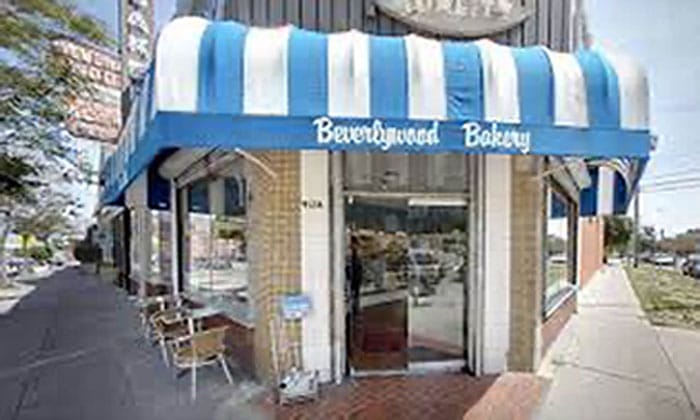
If Joni Mitchell were Jewish or even if she wasn’t (which she isn’t) she would be writing a song about the Beverlywood Bakery on Pico Blvd. with the birdhouse on the roof. It’s closing this week; they’re paving over the Pink Box Bakery and putting up a parking lot. We’re not sure if it’ll be a parking lot. My guess is the rent got so exorbitant it was just too much for the good old Beverlywood Bakery to exist. 

As it goes, so goes with it my heart although it is impossible to pave over my memories. Such incredible memories both of unmatched taste and an aroma that sweetened the entire neighborhood. 

Even more than that, of family because that is where I went with my mother, Sylvia, three, four, five times a month or more if there were Jewish holidays coming.  I’ll never forget as a little boy holding her hand, walking into that multicolored tiled space with the sun blaring through those huge windows and, of course, the lovely women behind the counter telling my mother what they told every mother and her children, “What a lovely child, would you like a cookie?” I beamed at the chocolate sprinkled cookies she handed me and savored every little morsel. 

The Beverlywood Bakery opened in 1946 and, until its closure on April 30, was considered the oldest bakery in Los Angeles.  We began going there in the late 1950s, when I was about five years old, and it became our go-to spot for years to come.  Much of that had to do with the selection of Jewish-style bakery goods and their perfect creations: from birthday cakes to bagels to hamantaschen — you name the sweet, floury confection and they had it.

Behind the counter were the most zealous, efficient, and hard-working women, always there to take your order and ring it up.  You took a ticket (!) and waited in line.  They may have remembered you from last week, or not.  It didn’t really matter. You paid in cash or check and received your luscious treats in a perfectly wrapped pink box or plastic bag with a tie.

Of course, my mother always bought a challah and corn rye (sliced medium, please) and some Danish for a nosh. Later, in my teens, I discovered the dense magnificence of their chocolate chip rolls, the big ones packed with chocolate chips that if you heated in the oven for a little bit the chocolate would melt through them, and they would be so soft and gooey and would match up perfectly with an ice-cold 8-ounce glass of milk. 

When my older brother, Bruce, turned 16, he and I would drive over to the bakery and Charlie’s Deli next door to get our usual lox, cod, and bagels from the two stores for our ritual Sunday morning breakfast.  Charlie’s was a family operation run by three generations.  We knew the boys at the counter from school.  Bruce would go to Charlie’s for the schmear and fish, and I would go to the Bev Bakery to get a dozen onion bagels.

My mother, who lived in her Beverlywood home into her 90s, would always bring a bunch of pink boxes to our home, I guess to make sure her grandsons knew what truly good sprinkled cookies taste like. Until last week, if I found myself in the neighborhood, I’d run over to buy some chocolate chip rolls, a rye bread, packed, of course, in a pink box or two.

The bakery is baked into my soul. It is such a huge part of my upbringing, such a big part of my Jewishness.

The Beverlywood Bakery is baked into my soul. It was just pure, unadulterated joy (except for some of the ingredients I guess). It is such a huge part of my upbringing, such a big part of my Jewishness, my neighborhood and my mother’s desire to make me and the rest of the family happy through the food we ate and the rituals we had.

By the way, my mom couldn’t bake a lick but she knew where to buy the best stuff. The Pink Box Store will be sorely missed, and no one will ever have those kinds of memories again. But they’ll always be with me.


Richard Leivenberg is a Los Angeles native and a long-time writer who attended Hamilton High School, UCLA and UC Berkeley.  

A Loving Farewell to the Beverlywood Bakery Read More »

To All the Young Moms on Mother’s Day

When I had my first child, she fit seamlessly into my life. I could still have a normal schedule because she’d take long naps during the day and barely wake up at night. She was an infant when the pandemic hit, so there wasn’t anywhere to go. I had lots of time to dedicate to being a parent. I got this, I thought. I was ready for number two. 

When I gave birth four months ago, I thought the new baby would be just like my first one. But I quickly learned that she wasn’t. She wouldn’t nap during the day and refused to go to sleep unless I was holding her. As soon as I put her down, she’d wake up. One day, she only napped for 40 minutes. This is crazy, I thought. Don’t babies need a lot more sleep than this?

I wanted to not be frustrated, to have more patience, but I didn’t. As a working mom, it was extremely difficult to tend to my baby every few minutes. On top of this, my two-year-old started acting out because she wasn’t the baby anymore. I had to stop her from hitting our dogs, sleeping in our bed and getting back on the pacifier. 

My husband is incredible and we split responsibilities pretty evenly down the middle. But when our baby is crying because she wants to breastfeed or our toddler is saying, “mommy, mommy” over and over, he just can’t fill in for me.

Young moms have more pressure than ever on them these days. Not only do we have to work, but, at the same time, we have to pretend that our lives are perfect, especially on social media.

Experiencing all this, I realized something: On top of our duties at home, young moms have more pressure than ever on them these days. Not only do we have to work, but at the same time, we also have to pretend that our lives are perfect, especially on social media. We have to bounce right back to our pre-pregnancy weight with the “nine month in, nine month out” challenge, smile in every picture and not talk about how difficult it is to have little children at home. We’re not supposed to show weakness. 

Recently, one Friday afternoon, I saw the clock ticking down to Shabbat and felt the pressure to get everything in order as my baby cried, my toddler whined, my dog barked and work emails came in all at once. I was cooking dinner and couldn’t remember how long the food had been in the oven. I was afraid I was going to ruin the roasted chicken and we’d all go hungry. There were so many things going on and anxious thoughts in my head that it felt like the neurons in my brain were darting back and forth like a pinball. 

Then, I shut down. I ran to our room and hid under the covers. I cried. I prayed for it all to stop. For there to be silence. I’d never felt so overwhelmed in my life. 

Eventually, of course, I calmed down, with my husband’s help and getting a little bit of time to myself. But I’m telling this story because we shouldn’t feel pressured to also keep all of our insecurities, worries, stress and shortcomings private. That makes everything worse. When we share, we feel better, and we can also make someone who is experiencing the same challenges feel less alone. Being a mother of young children is isolating enough. Why isolate ourselves even more by keeping it all inside? It will only eat us up over time. We deserve better.  

I want my fellow young mothers to know that even if you feel like the world doesn’t see you, I do. I understand. We will get through this time – not always with a smile on our faces – but certainly with much more joy than we thought was possible. Being a mother is the biggest challenge and the greatest gift. By taking care of ourselves and sharing our struggles, we will prevail. 

This Mother’s Day, treat yourself to some time at the spa. Talk to your fellow mommies about what’s happening in your life. Recharge your batteries, and show up for your family as your most authentic self. 

This Mother’s Day, celebrate yourself for the beautiful, bright and shining light that you are.


Kylie Ora Lobell is the Community and Arts Editor for the Jewish Journal.

To All the Young Moms on Mother’s Day Read More »

Biden’s Immigration Trap

In the Democrats’ fight to maintain their congressional majorities this fall, there is perhaps no more daunting obstacle facing them than the controversy surrounding undocumented immigration.

The combination of President Biden’s low approval numbers and historical trends in midterm elections that strongly favor the party that does not hold the White House makes the Democrats’ goal a difficult one, even under the best of circumstances. But voter unhappiness over inflation, a Democratic base dissatisfied with the lack of progress on their priorities, and the ongoing distraction of war in Ukraine combine to make that task even more formidable

Unfortunately for Biden and his party, the immigration crisis looks like it will worsen before it gets better. Border authorities recently announced that they had arrested more than 210,000 migrants at the Mexico border in March, a 24 percent increase from last March and the highest monthly total in more than twenty years. Not only are Republicans moving aggressively to hold Biden’s feet to the fire on the issue, but many of his fellow Democrats who are preparing to face voters this fall are leveling their own criticisms toward a president of their own party.

Biden inherited an immigration infrastructure that had been gutted over the previous four years. He promised comprehensive reform on his first day in office, stopped construction on a border wall, and quickly reversed several Trump-era restrictions. But he maintained other changes that his predecessor had instituted, including the utilization of a 1944 public health law called Title 42 which allowed the U.S. government to expel more than 1.7 million migrants who had hoped to apply for asylum as a way of protecting against the threat of the coronavirus.

Now, Biden administration health officials have indicated that these restrictions can be lifted, potentially creating an immense increase in the number of immigrants attempting to cross the border. The result could be a replay of the chaos that the administration faced early in Biden’s term, when overwhelmed border staff struggled to remain control over huge numbers of migrants attracted by what they hoped would be more welcoming policy changes under the new president. 

Several Democratic Senators up for re-election this year have raised doubts about the plan to repeal Title 42, including Catherine Cortez Masto of Nevada, the first Latina to ever serve in the U.S. Senate. The critics represent border states like Arizona and Northern locales like New Hampshire. The group is comprised of both progressives and centrists. The one thing they all have in common is a vulnerable path to re-election, along with an awareness that Biden’s public approval ratings on immigration policy are scraping bottom.

These endangered incumbents were then joined by an even more improbable voice, when Senator Chris Coons of Biden’s home state of Delaware spoke out against the policy change too. Coons is the president’s closest friend in the Senate, so he was exceedingly polite in expressing his concern. (“My hope is that will be reconsidered appropriately” was all Coons said.) But even well-mannered opposition is still opposition, and Coons’ statement almost certainly reflects broader concerns among congressional Democrats.

Biden’s party is deeply divided over this issue. At the same time that party centrists are pulling away from Biden on Title 42, progressives are warning him that an already dispirited Democratic base would be enraged if Trump’s policy is not reversed as planned.

Meanwhile, Republicans smell political blood. Texas governor Greg Abbott was forced to back down from his plan to require additional truck inspections at the border when it threatened to shut down his state’s agricultural sector. But other GOP leaders are now seeking to tie Biden’s immigration policy to the increase in fentanyl coming across the border. Expect to hear about this link almost non-stop until November.

Biden will need to find a way to reverse the current trend quickly for his party to avoid being swallowed whole by the immigration debate this fall.

A motivated Republican Party challenging divided Democrats on one of Biden’s weakest issues is not a recipe for midterm success. Six months is a long time in politics, but Biden will need to find a way to reverse the current trend quickly for his party to avoid being swallowed whole by the immigration debate this fall.


Dan Schnur is a Professor at the University of California – Berkeley, USC and Pepperdine. Join Dan for his weekly webinar “Politics in the Time of Coronavirus” (www.lawac.org) on Tuesdays at 5 PM.

Biden’s Immigration Trap Read More »

An Israeli Brunch Idea for Mother’s Day

Rachel and I have lots in common — culture, friends and philosophy. But there’s one thing we really differ on. Rachel will host a big Friday night dinner and then she will host thirty people for an epic Sunday brunch.

Much as I love Sunday brunch, I’m too tired from all the Shabbat cooking and hosting. I much prefer to have my husband Alan bring me breakfast in bed. Usually a fried egg on toast and a big mug of Earl Grey tea. It’s perfect!

In fact, the only Sunday of the year that you’re guaranteed to see me cooking in my kitchen is Mother’s Day. It’s become a tradition to host a big Sunday brunch in my garden.

At the top of the menu is my grandmother’s green frittata. I sauté a couple of onions and allow them to slowly caramelize. I chop lots of Italian parsley, baby spinach, green onions and juicy red tomatoes and combine all the ingredients with a dozen eggs. You drop the omelet mixture into a sizzling frying pan and the frittata becomes golden and crispy on the outside.

Along with the smoked salmon board, the whitefish board, the breads and lots of salads, we always have freshly baked scones. Simple ingredients like two cups of sifted flour, a stick of butter, two tablespoons of sugar, a pinch of salt and a cup of milk and a 15-minute baking time make scones easy to whip up. They are so very scrumptious, especially with fresh whipped cream and strawberry jam.

This year Mother’s Day falls closely on the heels of Yom Ha’atmaut, so Rachel and I were inspired to add an Israeli element to our Sunday brunch: flaky crispy burekas baked with a salty feta and egg filling. We serve them with squares of feta garnished with honey and pistachios and creamy labne garnished with grated tomatoes and freshly picked oregano from the garden. Dried oregano or za’atar will work as well.

Nothing is more Israeli than burekas. Wherever you go in Israel, you’re guaranteed to find burekas. At the Shuk, the supermarket, the gas station, at Aroma, at stands set up in the middle of the mall. They’re ubiquitous and for good reason — they’re perfect for snacking and filling as part of a meal. They come with all sorts of fillings — potatoes, cheese, mushroom, spinach and feta — and one is better than the next.

Like every good Sephardic grandmother, my mother always bakes burekas for her grandchildren. The only difference is that she gets really inventive and healthy with the fillings — she combines finely chopped spinach and kale with exotic mushrooms and mashed potato and freshly ground spices. You never know exactly what it is that you’re eating, but it’s always delicious. (My nieces and nephews have sophisticated taste buds thanks to her adventurous creations.) Burekas are super easy to make, especially with store bought puff pastry. Just lay out the pastry in small squares, lay out the filling, fold into a triangle (for cheese filling) or a rectangle (for mashed potato) or a crescent (for spinach and cheese). Sprinkle with sesame seeds and most importantly, bake in a very hot oven, so the dough becomes extra flaky and golden and crispy. We hope you have fun trying our recipe.

Happy Mother’s Day to all the women in the world who nurture souls and bring love into the world.

Happy Mother’s Day to all the women in the world who nurture souls and bring love into the world.

– Sharon

Burekas

1 16oz package frozen large puff pastry squares or 2 sheets Pepperidge Farms frozen puff pastry
2 large eggs
2 cups crumbled feta
Black and white sesame seeds for garnish

  • Preheat the oven to 425°F.
  • In a bowl, beat one egg and feta until smooth and well combined.
  • Line a baking tray with parchment paper and place puff pastry squares on top.
  • If using puff pastry sheets, roll out on a floured surface and cut into nine equal squares.
  • Place two tablespoons of the feta mixture on one half of each puff pastry square, leaving half an inch edge all around.
  • Fold the dough over into a triangle and press down the edges to seal. If the edges are hard to seal, add a bit of water to wet the edges and seal.
  • Use a fork to crimp the edges for a pretty design.
  • In a small bowl, beat the second egg. Brush the egg onto the top of the burekas and sprinkle with sesame seeds.
  • Bake until golden, about 15 minutes.
  • Unbaked burekas can be frozen and baked directly from the freezer at 425°F.

Sharon Gomperts and Rachel Emquies Sheff have been friends since high school. The Sephardic Spice Girls project has grown from their collaboration on events for the Sephardic Educational Center in Jerusalem. Follow them on Instagram @sephardicspicegirls and on Facebook at Sephardic Spice SEC Food. Website sephardicspicegirls.com/full-recipes

An Israeli Brunch Idea for Mother’s Day Read More »

Jewish Groups Denounce Upcoming UCSD SJP Event Featuring Taher Herzallah

Jewish groups are denouncing UC San Diego’s (UCSD) Students for Justice in Palestine’s (SJP) upcoming event featuring American for Muslims in Palestine (AMP) Director of Outreach Taher Herzallah.

The event is scheduled to take place on May 4. Stop Antisemitism wrote in an April 30 post on their website that Herzallah has defended Hamas’ rocket attacks against Israel as “an oppressed people’s audible cry for help” and described a picture of a bloody Israeli soldier as “the most beautiful site.” He has also disrupted David Friedman’s confirmation hearing in 2017 as the United States Ambassador to Israel as well as disrupted former Israeli Ambassador Michael Oren’s speech in 2010 at UC Irvine; Herzallah was arrested both times. Stop Antisemitism has dubbed Herzallah as “The Hateful Heckler.”

Additionally, Herzallah’s speaking event at Northeastern University on April 28 was either canceled or moved off campus, according to Stop Antisemitism. The university did not reply to the Journal’s request for comment as to what exactly happened with the event.

“We applaud Northeastern University and President [Joseph] Aoun for not allowing a dangerous antisemite like Taher Herzallah to appear on their campus,” Stop Antisemitism Executive Director Liora Rez said in a statement to the Journal. “We request UCSD and Chancellor [Pradeep] Khosla affirm their commitment to keeping UCSD’s Jewish students safe on campus and follow in the footsteps of Northeastern.”

Additionally, UCSD campus Jewish groups sent a letter to Khosla echoing the same criticisms of Herzallah as Stop Antisemitism, and noted that Herzallah will be speaking again on May 9 at an event sponsored by UCSD’s Division of Arts and Humanities. “Our Associated Students voted to adopt the International Holocaust Remembrance Alliance’s working definition of antisemitism. The values supported by this speaker would be in clear violation of this resolution,” the letter, which was obtained by the Journal, states. “This university has an obligation to make students feel safe on campus, and as of now, the Jewish community does not feel safe.”

Karen Parry, Executive Director of Hillel San Diego, also said in a statement to the Journal, “Hillel of San Diego is extremely concerned about Taher Herzallah coming to speak twice this month at UCSD, first through Students for Justice in Palestine on May 4th and again, sponsored by the UCSD Division of Arts and Humanities, on May 9th. Herzallah has repeatedly called for violence and has said ‘Israelis have to be bombed.’ His provocations are blatantly discriminatory and antisemitic. The fact that a speaker who espouses antisemitic rhetoric is coming to campus as a UCSD endorsed speaker is heartbreaking and truly damaging to Jewish students.” She added that the Hillel “is engaging with the UCSD administration to address the quasi-endorsement and support of Herzallah’s messaging and to ensure the safety of Jewish students on campus.”

StandWithUs CEO and Co-Founder Roz Rothstein similarly said in a statement to the Journal, “Providing a platform for convicted criminals like Taher Herzallah, who advocate violence against Israelis and delegitimize the existence of the State of Israel, gives the impression of legitimizing such views. Even if freedom of speech principles mean that such hateful expression is protected, the UCSD administration should use its own voice and urgently issue a statement unequivocally condemning Herzallah’s statements of support for violent antisemitism and assuring Jewish, Israeli and non-Jewish students who care about Israel (or —-who feel connected to Israel) that his invitation by SJP is in no way reflective of the university’s position and his bigoted, antisemitic expression is contrary to the values of UCSD.”

SJP UCSD defended their decision to host Herzallah, telling the Journal that the claims of antisemitism against Herzallah are “totally baseless.” “It has been pretty typical of Stop Antisemitism to label any and all critique of the Occupation [as] anti-semitic,” the group said. “This is despite the fact that some of the most outspoken voices and groups on the issue are in fact Jewish and in many cases identified at one point with the Occupation.” They pointed to Miko Peled, B’Tselem, IfNotNow and Jewish Voice for Peace as examples, calling them “great resources that we stand by.”

AMP and Khosla’s office did not respond to the Journal’s request for comment by publication time.

Jewish Groups Denounce Upcoming UCSD SJP Event Featuring Taher Herzallah Read More »