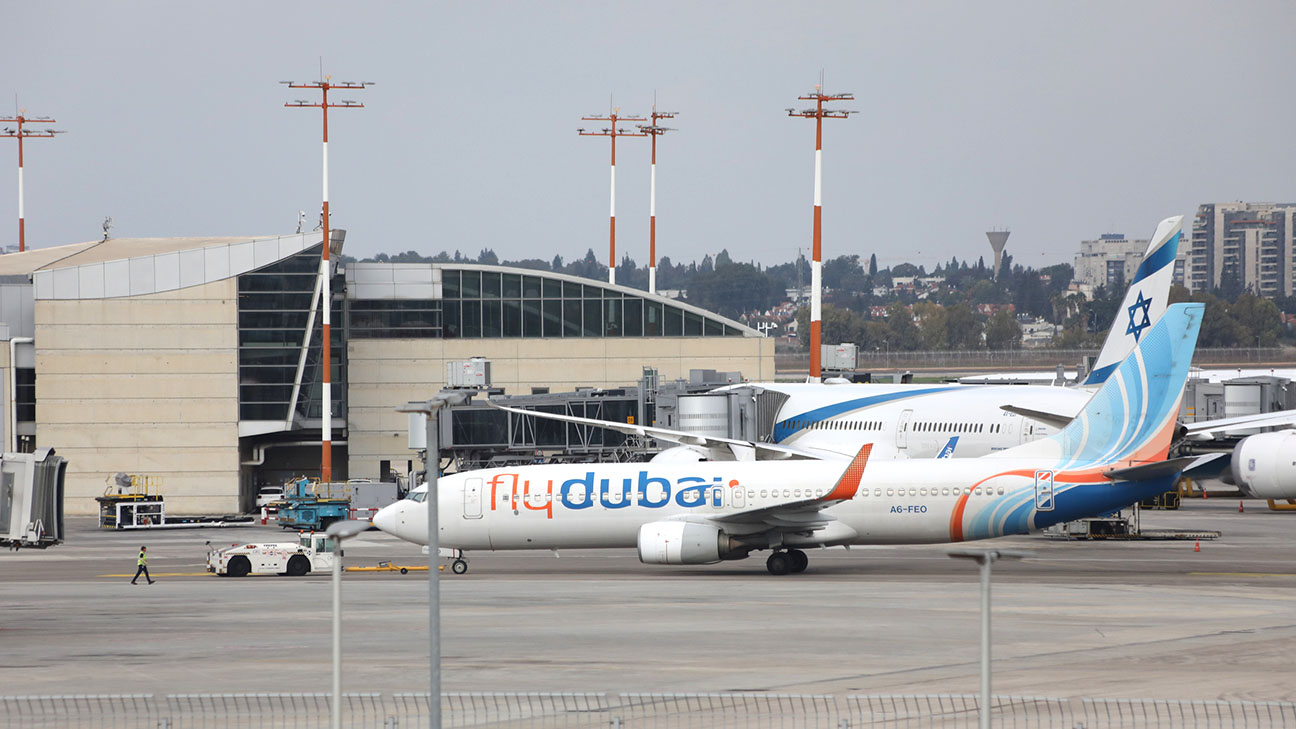
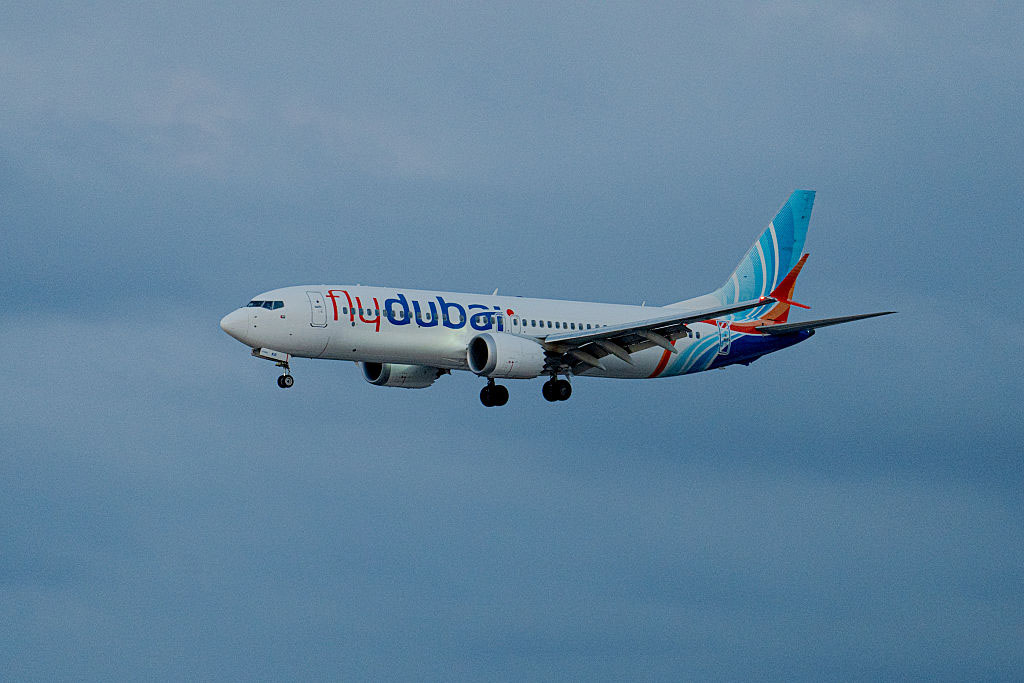
A FlyDubai flight bound for Tel Aviv made an emergency landing in Saudi Arabia on Wednesday after a violent confrontation in the cockpit left both pilots injured, sent the aircraft into a sharp descent and prompted Israel to scramble fighter jets.
Israeli officials spent much of the day examining whether the incident aboard Flight FZ1073 was an attempted terrorist attack. FlyDubai confirmed that a physical confrontation took place in the cockpit while saying the motive remained “under investigation.”
The aircraft was traveling from Dubai International Airport to Ben Gurion Airport when the emergency unfolded about 90 minutes into the flight as it entered Jordanian airspace. It diverted into Saudi Arabia and landed at Prince Sultan bin Abdulaziz Airport in Tabuk, in the northwestern part of the kingdom.
Both pilots were injured and taken to a hospital after the landing. Accounts from passengers differed on who provided medical care aboard the plane. One passenger said an Israeli dentist treated the stabbed pilot, while other accounts referred to a doctor and nurse providing first aid.
“All passengers are out of danger, Prime Minister Benjamin Netanyahu said in a statement Wednesday afternoon.
The pilot who stabbed them has been arrested and is currently being questioned by the Saudi authorities,” Netanyahu said. “We are in close contact with the relevant authorities to ensure the continued safety of the passengers and their safe return to Israel.”
Netanyahu also said, “One of the pilots apparently tried to crash the plane with everyone aboard.
I salute the heroes on the flight from Dubai who displayed resourcefulness and courage.”
Defense Minister Israel Katz described the incident as a terrorist attack.
“The grave incident on the FlyDubai plane was a jihadist terrorist attack attempt, which was thwarted only thanks to the bravery of several Israeli passengers who broke into the cockpit, overpowered the terrorist and, with their own hands, restored control of the plane to another flight crew who was present there,” Katz said.
“According to the initial information in our possession, the terrorist had one intention: to crash the plane with all its passengers,” Katz said, as Israeli officials increasingly described a possible terrorist or nationalist motive in the hours after the landing.
“According to the initial information in our possession, the terrorist had one intention: to crash the plane with all its passengers.” – Israel Katz
FlyDubai acknowledged the incident in a statement.
“A physical confrontation occurred in the cockpit,” FlyDubai said. “The motive is under investigation,” FlyDubai said.
The airline also said, “The aircraft has landed safely in Tabuk (TUU), and all passengers are safe and accounted for.”
The exact number of passengers aboard remained unclear Wednesday afternoon. One figure put the number at 174, including 27 children. Other accounts referred to around 150 Israeli passengers or more than 100 Israeli passengers.
Images and videos from the flight circulated on Israeli and social media throughout the day. One image appeared to show a passenger wearing a blood-soaked shirt. Other images appeared to show passengers involved in restraining the suspected attacker.
Accounts also conflicted over exactly what happened between the two pilots.
Israeli officials identified the suspected attacker as an Omani co-pilot and said the captain was attacked during the confrontation. Another account said the Omani co-pilot was himself stabbed during the struggle before being subdued by the captain, identified in that account as an Indian national.
Israelis near the front of the cabin rushed toward the cockpit while additional pilots traveling aboard the plane were seated farther back. Passengers and crew members entered the cockpit area, restrained the suspected attacker and helped return control of the aircraft to two reserve FlyDubai pilots were aboard as passengers.
“I was already screaming ‘Shema Yisrael’ and saying, ‘I can’t die, I’m my mother’s only daughter, I can’t do this to my mom,’” a passenger identified as Miriam told reporters. “We were all sure that we wouldn’t get out of here alive,” Miriam said.
The landing placed a plane full of Israel-bound passengers on Saudi soil despite Israel and Saudi Arabia having no diplomatic relations. Saudi Araba is not a signatory to the Abraham Accords, but following the 2020 Abraham Accords, which established relations between Israel and the United Arab Emirates and Bahrain, Saudi Arabia allowed Israeli airlines to cross its airspace on flights to and from the two Gulf states. In July 2022, Saudi Arabia broadened that policy by opening its airspace to all qualifying commercial carriers, allowing Israeli airlines to use Saudi airspace on routes to and from destinations beyond the UAE and Bahrain.
The the roughly three and a half hour Dubai-to-Tel Aviv route is about 1,323 miles.
Photos published after the landing also appeared to show damage to the aircraft’s rudder. The cause of that damage had not been established Wednesday afternoon, and no available source established that the descent caused it.
The aircraft transmitted squawk code 7700, signaling a general emergency, followed by code 7500, indicating unlawful interference with an aircraft. It later returned to 7700.
Flight-tracking data showed a sudden descent of close to 14,000 feet in less than 30 seconds before the first emergency signal was transmitted. A wider portion of the flight data showed the aircraft dropping from about 34,000 feet to 14,000 feet, at one point registering a descent rate near 30,976 feet per minute.
The incident triggered security consultations involving Netanyahu, Katz and senior Israeli military and intelligence officials. The Israel Air Force scrambled fighter jets while authorities tried to establish what was happening aboard the aircraft.
Attention then turned to how to return the passengers to Israel.
El Al informed Israeli authorities that it was prepared to send a rescue aircraft, while officials also considered the possibility of using an Israeli civilian or military plane.
Saudi authorities were not permitting an Israeli evacuation operation at that stage. It remained unclear whether Saudi Arabia had rejected a specific request involving an El Al aircraft or Israeli military plane.
FlyDubai sent its own replacement aircraft to Tabuk.
Mossad reportedly completed background checks on the replacement FlyDubai crew and approved the aircraft’s departure for Israel. Saudi Arabia, meanwhile, was refusing to permit a separate rescue flight aboard a chartered Israeli aircraft for passengers who did not want to board the Emirati carrier.
By late Wednesday afternoon, some Israeli passengers were still refusing to board the FlyDubai replacement flight. Some wanted to return aboard an Israeli carrier, while another account said passengers were uncomfortable boarding another FlyDubai plane with a non-Israeli pilot.
There has been no statement from the Saudi central government as of 5:00 pm Israel time. Authorities at Tabuk airport confirmed that both pilots had been hospitalized, while Netanyahu said the suspected attacker was in Saudi custody and being questioned.
The United Arab Emirates government had also issued no public statement on the incident as of Wednesday afternoon.
The investigation remained underway as conflicting accounts persisted over the identities and nationalities of the pilots, who stabbed whom, the suspected motive, the exact number of passengers aboard and the sequence of events inside the cockpit.
This is a developing story.
Brian Fishbach is reporting for the Jewish Journal from Tel Aviv.