So now that we are past Rosh Hashanah’s shofar blasts, and the intense self-reflection and fasting that comes with Yom Kippur, it’s time to embrace our third major holiday just around the corner. That’s right, you guessed it: Sukkot is here! And there is something wonderfully strange about the objects Judaism hands us on Sukkot. At a moment when American culture is engaged in an anxious debate about men and masculinity, Judaism does not hand men a weapon, a trophy or a throne. It gives us a fragile hut, a palm branch and a piece of fruit. There is deep wisdom for men in Sukkot and its ritual objects.
There are real reasons to worry about men. In 2024, over forty-five thousand Americans died by suicide, and the suicide rate among males was nearly four times that of females, according to the Centers for Disease Control and Prevention. At the same time, our discussion of a “male loneliness epidemic” requires some nuance. A 2025 Pew Research Center study found that men and women report loneliness at roughly equal rates. The more revealing difference is what happens when they are hurting. Only 38% of men said they would be very or extremely likely to turn to a friend for emotional support, compared with 54% of women. Men were also less likely to turn to family members or mental-health professionals.
The problem, in other words, may not simply be that men experience loneliness. It may be that too many men have been taught to suffer alone.
Into that void has stepped an online industry eager to tell boys and men what being a man supposedly requires. Parts of the so-called “manosphere” offer a seductive formula: Become harder, richer and more dominant; stop caring what other people think; treat vulnerability as weakness; regard women as adversaries; measure your worth through money, sex, physical power and status. Research into these online communities has found strains of content promoting rigid ideas of manhood, male dominance and misogyny, while other research has documented manosphere spaces in which misogynistic attitudes and adversarial views of women can proliferate. Let’s not forget about the blatant antisemitism pervasive throughout these online spaces. The American Psychological Association has warned that these communities can reinforce restrictive ideas about masculinity and gender.
We should understand why such messages appeal to some men before simply condemning the men who hear them. They offer belonging to the lonely, certainty to the confused and an identity to boys who are asking one of adolescence’s oldest questions: What does it mean to become a man? An added layer for the boys in our communities makes the question: What does it mean to be a Jewish man? If healthy communities like ours do not offer compelling answers, someone else will.
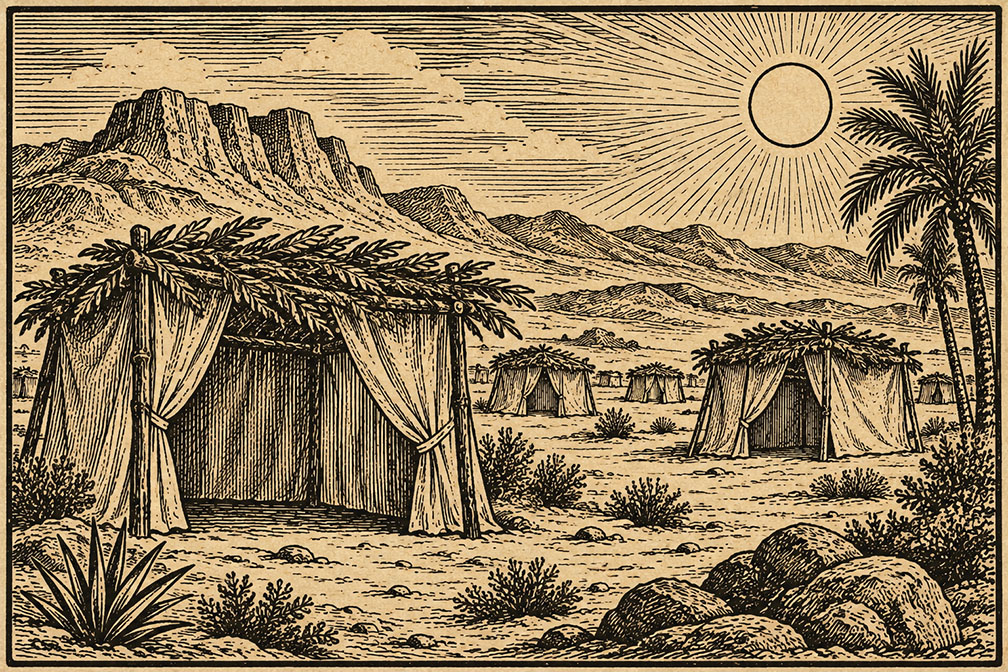
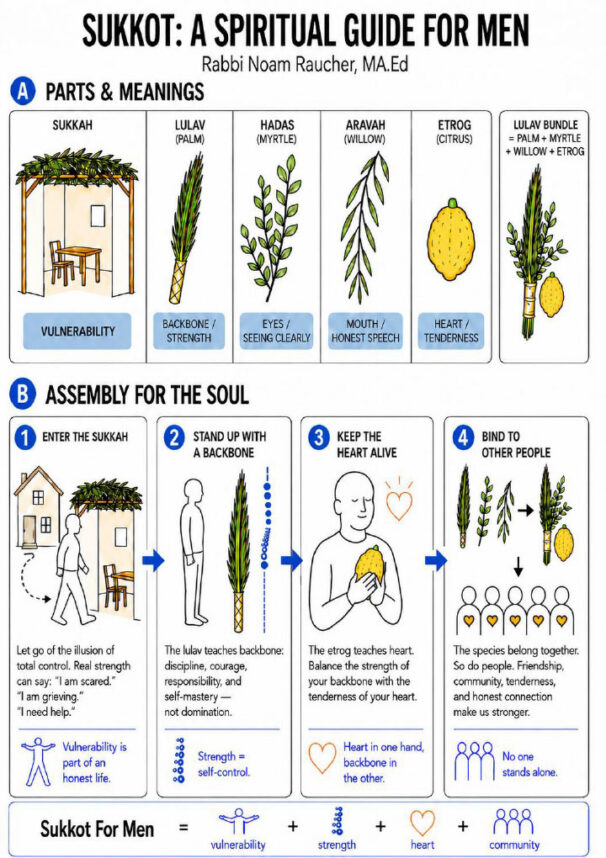
Sukkot offers one. The first symbol is the sukkah itself. The Torah commands us to leave our homes and dwell in sukkot for seven days (Leviticus 23:42–43). The rabbis describe the spiritual reversal even more forcefully: during Sukkot we make the sukkah our permanent dwelling and our house temporary. Rava explains the command as leaving the fixed (keva) residence, for a temporary (arai) dwelling (Sukkah 2a; Mishnah Sukkah 2:9). That is an extraordinary lesson for men.
Much of traditional male identity has been built around providing stability: build the house, earn the money, protect the family, know the answer, fix the problem. These can be noble responsibilities. But they become dangerous when responsibility mutates into a solid belief that a man must never appear frightened, uncertain or dependent upon anyone else.
The sukkah dismantles that illusion. Its roof leaks. Its walls shake. We can feel the wind through it. And we are commanded not merely to visit this vulnerability but to live inside it. The sukkah teaches that vulnerability is not the opposite of strength. It is part of an honest life. A strong man can say, “I am scared.” “I am grieving.” “I need help.” And/or, “I don’t know what comes next.”
In an age when male suicide remains so alarmingly high, teaching men that asking for help is somehow unmanly is not merely foolish. It can be deadly. Research continues to associate greater conformity to restrictive masculine norms with lower levels of psychological help-seeking. Jewish communities therefore have an obligation that goes beyond sympathy. “Do not stand idly by the blood of your neighbor,” Torah commands (Leviticus 19:16), a verse the Talmud understands as requiring intervention when another person’s life is in danger (B. Talmud Sanhedrin 73a).
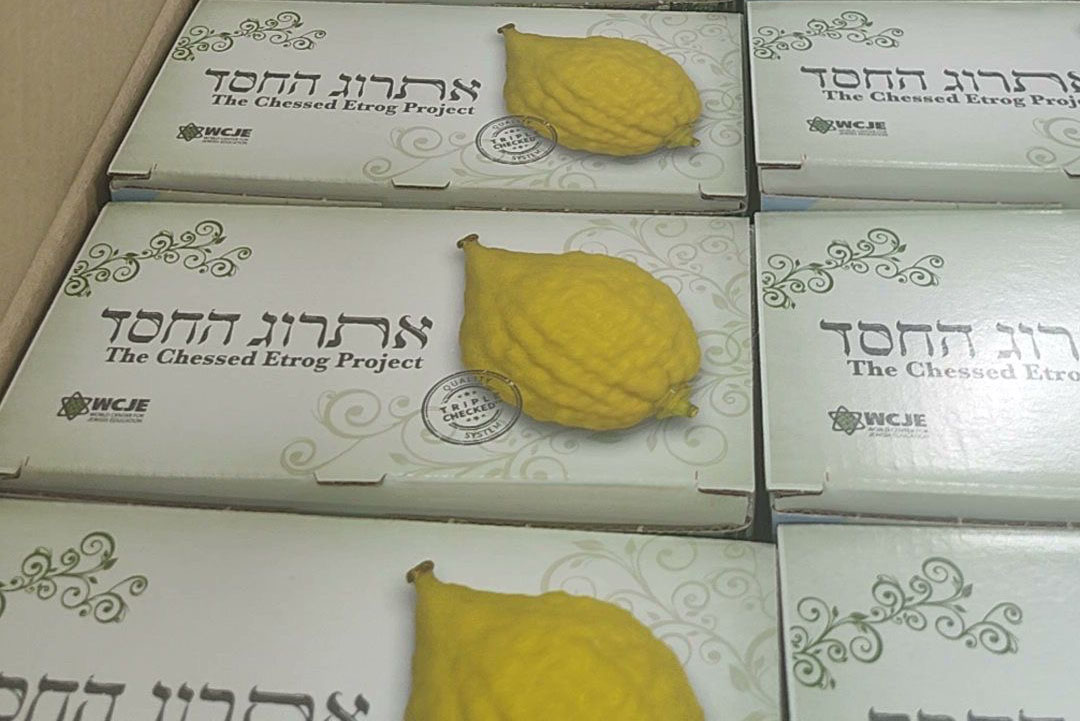
Then we pick up the lulav. Jewish lore offers a remarkable interpretation of the Four Species. The lulavresembles the human spine; the myrtle leaves resemble the eyes; the willow resembles the mouth; and the etrog resembles the heart (Vayikra Rabbah 30:14). Men need spines.
We should not replace an unhealthy masculinity with a masculinity afraid of strength itself. Boys and men, like everyone else, need courage, discipline, responsibility, physical confidence, the willingness to protect others, and the capacity to stand firm when a crowd is moving in the wrong direction. But Judaism radically redefines what strength means.
Ben Zoma asks, “Who is mighty?” His answer is not the man who defeats everyone around him. It is the person capable of mastering his own impulses (hakovesh et yitzro – Pirkei Avot 4:1). That is almost the precise opposite of the type of masculinity being sold by many online influencers. Their version of power is domination. Judaism’s version begins with self-mastery. Can you control your anger when humiliation would feel satisfying? Can you hear “no” without becoming cruel? Can you exercise sexual restraint and ask consent? Can you admit wrongdoing? Can you defend someone weaker than yourself? Can you remain responsible when nobody is applauding? That is having a backbone.
But the lulav is incomplete without the etrog. The Midrash identifies the etrog with the heart. That may be the most urgent piece of the entire image. A man can have a spine and still be emotionally hollow. He can be successful, disciplined, muscular, financially secure and completely unable to tell another human being that he is hurting.
The goal of Jewish masculinity should never be to choose tenderness instead of strength. It is to refuse the choice altogether with one’s backbone in one hand, and heart in the other.
And even these cannot fulfill the mitzvah alone. The Four Species must be brought together. Another midrash imagines them as different kinds of Jews—people possessing different combinations of learning and good deeds—and concludes that they must be bound together so that each can help compensate for what another lacks (Vayikra Rabbah 30:12). That, too, is a message men desperately need.
The Surgeon General’s landmark advisory on social connection warned that isolation and inadequate connection carry serious consequences for both physical and mental health. We cannot answer that problem merely by telling individual men to become more emotionally articulate. We have to build places where male friendship can actually happen: synagogues, men’s groups, teams, study partnerships, dinners, volunteer projects and intergenerational relationships where men can speak honestly without embarrassment. FJMC International helps to make all that possible in many different ways.
Sukkot gives us an alternative to the lonely strongman. Build a sukkah and admit that you are vulnerable. Pick up the lulav and develop a backbone. Hold the etrog and protect your heart. Bind yourself to other people. That is not a weaker masculinity. It may be the stronger one we have been looking for.
Rabbi Noam Raucher is Executive Director of FJMC International.