“An act of antisemitic hatred.”
That’s how French President Emanuel Macron described the recent chopping down of a tree in a Paris suburb that had been planted in memory of Ilan Halimi, a French Jew who was tortured to death by a Muslim gang in 2006.
Ironically, the French authorities initially denied the antisemitic nature of the murder, despite ample evidence. The government also insisted on keeping the trial of the killers behind closed doors, on the grounds that two of the 27 defendants were slightly under 18 years of age. The Halimi family suspected the authorities were trying to downplay the role of antisemitism in the killing.
Today, however, there is no dispute that the crime was motivated by antisemitism. And now France’s president says that the chopping down of the Halimi memorial tree also qualifies as antisemitism.
One wonders if Macron would be willing to acknowledge the role of antisemitism in numerous French actions and policies in past decades.
For example, if cutting down a tree is antisemitic, was it antisemitic to protect an indicted Nazi war criminal?
For more than a year after World War II ended, the French authorities allowed a notorious Nazi collaborator, Grand Mufti Haj Amin el-Husseini, to reside in a comfortable villa in a Paris suburb—even after he was indicted as a war criminal by the government of Yugoslavia, for assisting the Nazis in various ways, including committing atrocities.
When international pressure for the Mufti’s arrest intensified in 1946, the French allowed him to “escape.” The Palestinian Arab leader boarded a TWA flight to Cairo and was granted asylum in Egypt.
Is it antisemitic to say that all Jews are “domineering” (dominateur)? That’s what French president Charles DeGaulle said at a press conference in 1967. He alleged that Jews “through the ages” acted like “an elite people, sure of itself and domineering,” and thereby “provoked—caused, more exactly—a tide of ill-will in certain countries and at certain times…”
DeGaulle insisted he was not antisemitic. A poll by the French magazine L’Express found 44% of the French public agreed with what DeGaulle said about Jews. No doubt they, too, would have denied being antisemitic.
How about protecting modern-day killers of Jews, and condemning Israel for fighting them? Is that antisemitic? The French government condemned Israel for killing Arab airplane hijackers during its rescue at Entebbe in 1976. The following year, the French detained and then quickly released Munich massacre mastermind Abu Daoud, enabling him to find haven in Algeria.
Yet when Islamist terrorists struck in Paris—rather than against Israeli Jews—hypocritical French leaders used language that they denounced when Israeli officials spoke similarly.
French President Francois Hollande said the ISIS attacks in Paris in 2015 were carried out by “barbarians,” towards whom France should show “no mercy.” The French responded to those attacks with air strikes on medical clinics, a soccer stadium, and a museum that were near ISIS terror encampments in Syria. Yet last October, President Macron declared an arms embargo against Israel because some civilians in Gaza were harmed as a result of Hamas barbarians embedding themselves in medical clinics and other civilian sites in Gaza.
Today, President Macron waxes indignant about the Halimi tree, while threatening to recognize the “State of Palestine.” One might ask which is more antisemitic—cutting down a tree, or rewarding the mass murder, torture, and gang-rapes of 1200 Israeli Jews?
It should be noted that there are separatist movements active in the northwestern French region of Brittany; in Savoy, along the French-Swiss border; and on the French-occupied island of Corsica. But Macron has not said a word about recognizing their claims to statehood.
According to the IHRA definition of antisemitism—used by 46 countries, including the United States—one example of antisemitism is “Applying double standards by requiring of [Israel] a behavior not expected or demanded of any other democratic nation.” In the case of Macron, it’s even worse—he’s demanding that Israel do something which he himself is not willing to do. And it’s something much more consequential than cutting down a tree.
Dr. Seuss, the beloved creator of children’s books such as The Cat in the Hat, once drew a remarkable cartoon on the subject of France, Jews and trees. It was in 1942, when Seuss was the editorial cartoonist for the New York City newspaper P.M.
That summer, the Nazi forces occupying France began the mass deportation of Jews from France to Auschwitz. The collaborationist French government headed by Prime Minister Pierre Laval helped carry out the mass arrests.
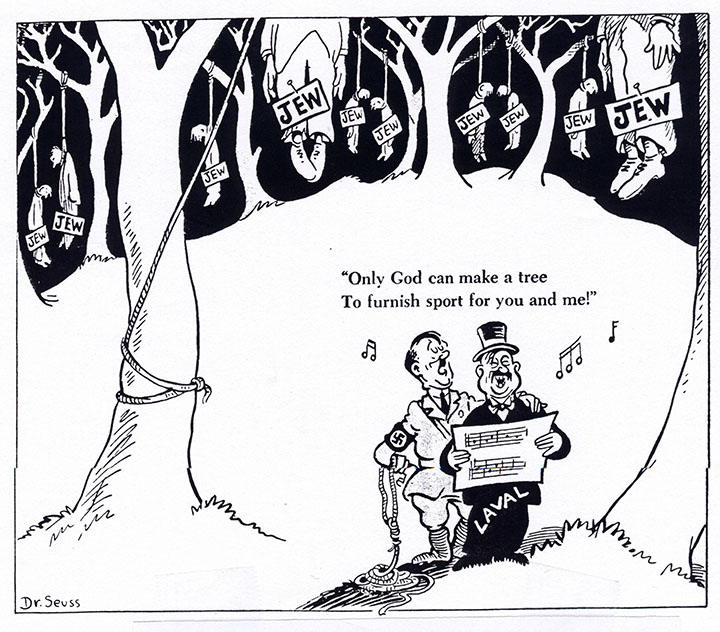
In P.M., Seuss drew a cartoon showing Laval and Hitler, in a forest, singing the words of the famous poem “Trees,” by Alfred Joyce Kilmer. All around them, the corpses of dead French Jews hang from the trees. Seuss showed Laval and Hitler adding a line of their own to the poem, describing the murder of the Jews as “sport for you and me.”
Killing Jews for “sport” has been all too common throughout history, whether by the Nazis and their helpers in 1942, the Munich Olympics attackers in 1972, the killers of Ilan Halimi in 2006, or Hamas in 2023. The best way to honor Ilan’s memory is both to condemn those who desecrated his memorial, and to stand up against all those who commit anti-Jewish atrocities.
Dr. Medoff is founding director of The David S. Wyman Institute for Holocaust Studies and author of more than 20 books about Jewish history and the Holocaust. His book The Road to October 7: Hamas, the Holocaust, and the Eternal War Against the Jews will be published on October 1, 2025, by The Jewish Publication Society / University of Nebraska Press.)

France, Antisemitism and Dr. Seuss
Rafael Medoff
“An act of antisemitic hatred.”
That’s how French President Emanuel Macron described the recent chopping down of a tree in a Paris suburb that had been planted in memory of Ilan Halimi, a French Jew who was tortured to death by a Muslim gang in 2006.
Ironically, the French authorities initially denied the antisemitic nature of the murder, despite ample evidence. The government also insisted on keeping the trial of the killers behind closed doors, on the grounds that two of the 27 defendants were slightly under 18 years of age. The Halimi family suspected the authorities were trying to downplay the role of antisemitism in the killing.
Today, however, there is no dispute that the crime was motivated by antisemitism. And now France’s president says that the chopping down of the Halimi memorial tree also qualifies as antisemitism.
One wonders if Macron would be willing to acknowledge the role of antisemitism in numerous French actions and policies in past decades.
For example, if cutting down a tree is antisemitic, was it antisemitic to protect an indicted Nazi war criminal?
For more than a year after World War II ended, the French authorities allowed a notorious Nazi collaborator, Grand Mufti Haj Amin el-Husseini, to reside in a comfortable villa in a Paris suburb—even after he was indicted as a war criminal by the government of Yugoslavia, for assisting the Nazis in various ways, including committing atrocities.
When international pressure for the Mufti’s arrest intensified in 1946, the French allowed him to “escape.” The Palestinian Arab leader boarded a TWA flight to Cairo and was granted asylum in Egypt.
Is it antisemitic to say that all Jews are “domineering” (dominateur)? That’s what French president Charles DeGaulle said at a press conference in 1967. He alleged that Jews “through the ages” acted like “an elite people, sure of itself and domineering,” and thereby “provoked—caused, more exactly—a tide of ill-will in certain countries and at certain times…”
DeGaulle insisted he was not antisemitic. A poll by the French magazine L’Express found 44% of the French public agreed with what DeGaulle said about Jews. No doubt they, too, would have denied being antisemitic.
How about protecting modern-day killers of Jews, and condemning Israel for fighting them? Is that antisemitic? The French government condemned Israel for killing Arab airplane hijackers during its rescue at Entebbe in 1976. The following year, the French detained and then quickly released Munich massacre mastermind Abu Daoud, enabling him to find haven in Algeria.
Yet when Islamist terrorists struck in Paris—rather than against Israeli Jews—hypocritical French leaders used language that they denounced when Israeli officials spoke similarly.
French President Francois Hollande said the ISIS attacks in Paris in 2015 were carried out by “barbarians,” towards whom France should show “no mercy.” The French responded to those attacks with air strikes on medical clinics, a soccer stadium, and a museum that were near ISIS terror encampments in Syria. Yet last October, President Macron declared an arms embargo against Israel because some civilians in Gaza were harmed as a result of Hamas barbarians embedding themselves in medical clinics and other civilian sites in Gaza.
Today, President Macron waxes indignant about the Halimi tree, while threatening to recognize the “State of Palestine.” One might ask which is more antisemitic—cutting down a tree, or rewarding the mass murder, torture, and gang-rapes of 1200 Israeli Jews?
It should be noted that there are separatist movements active in the northwestern French region of Brittany; in Savoy, along the French-Swiss border; and on the French-occupied island of Corsica. But Macron has not said a word about recognizing their claims to statehood.
According to the IHRA definition of antisemitism—used by 46 countries, including the United States—one example of antisemitism is “Applying double standards by requiring of [Israel] a behavior not expected or demanded of any other democratic nation.” In the case of Macron, it’s even worse—he’s demanding that Israel do something which he himself is not willing to do. And it’s something much more consequential than cutting down a tree.
Dr. Seuss, the beloved creator of children’s books such as The Cat in the Hat, once drew a remarkable cartoon on the subject of France, Jews and trees. It was in 1942, when Seuss was the editorial cartoonist for the New York City newspaper P.M.
That summer, the Nazi forces occupying France began the mass deportation of Jews from France to Auschwitz. The collaborationist French government headed by Prime Minister Pierre Laval helped carry out the mass arrests.
In P.M., Seuss drew a cartoon showing Laval and Hitler, in a forest, singing the words of the famous poem “Trees,” by Alfred Joyce Kilmer. All around them, the corpses of dead French Jews hang from the trees. Seuss showed Laval and Hitler adding a line of their own to the poem, describing the murder of the Jews as “sport for you and me.”
Killing Jews for “sport” has been all too common throughout history, whether by the Nazis and their helpers in 1942, the Munich Olympics attackers in 1972, the killers of Ilan Halimi in 2006, or Hamas in 2023. The best way to honor Ilan’s memory is both to condemn those who desecrated his memorial, and to stand up against all those who commit anti-Jewish atrocities.
Dr. Medoff is founding director of The David S. Wyman Institute for Holocaust Studies and author of more than 20 books about Jewish history and the Holocaust. His book The Road to October 7: Hamas, the Holocaust, and the Eternal War Against the Jews will be published on October 1, 2025, by The Jewish Publication Society / University of Nebraska Press.)
Did you enjoy this article?
You'll love our roundtable.
Editor's Picks
Israel and the Internet Wars – A Professional Social Media Review
The Invisible Student: A Tale of Homelessness at UCLA and USC
What Ever Happened to the LA Times?
Who Are the Jews On Joe Biden’s Cabinet?
You’re Not a Bad Jewish Mom If Your Kid Wants Santa Claus to Come to Your House
No Labels: The Group Fighting for the Political Center
Latest Articles
Memorial at Saban, Soraka Medical Center Mark Three Years Since Oct. 7; ‘Fauda’ Panel
Vegetarianism and Impossible Utopias
A Bisl Torah — Bar Mitzvah Lessons
A Moment in Time: October 7 – Beyond Black and White
Thorns and Thistles and Two Trees in the Garden of Eden
Print Issue: Making Jewish Fiction New Again | October 16, 2026
Rabbis of LA | Rabbi Taff and Aliyah
First of two parts
Michael Douglas Memoir, ‘One Helluva Ride,’ Is a Helluva Read
At 82, Douglas has survived cancer, is married to the love of his life, Catherine Zeta-Jones, has been in iconic films including “Wall Street” and “Basic Instinct” and grew up with the pressure of having a famous father, the legendary actor Kirk Douglas.
A Burst of Inspirational Art in Hadassah
What makes them special, in addition to their ethereal beauty, is that four of the paintings are of women; two others, while abstract, appear to reference the female.
‘We Had a Mission to Tell the World Our Story’: ‘Fauda’ Creator Avi Issacharoff
It is Episodes 7 and 8, which take viewers back to Oct. 7, that have generated some of the strongest reactions from audiences around the world.
Three Years Later: 1-in-5 Israelis Report Severe Mental Health Impairment
PTSD diagnoses among children and adolescents in Israel rose almost 2.5-fold after Oct. 7. Clalit Health Services is reaching out to thousands of patients each week who have not reached out for any mental health treatment.
Jewish Charter Schools Take a Step Forward
The possibility of tuition-free Jewish religious education is moving closer to reality.
Jon Polin Wants Answers, Not Revenge, Three Years After Oct. 7
One day before the three-year anniversary of the Oct. 7th attacks, the father of slain hostage Hersh Goldberg-Polin called for a national commission of inquiry, spoke about what comes next for him and Rachel, and said punishment for Israel’s failures is not what he seeks.
Oct. 7 Survivors Share Stories of Loss, Courage and Resilience
The memorial event was organized by StandWithUs in partnership with the Israeli-American Council (IAC), American Jewish Committee (AJC) Los Angeles, Temple of the Arts, the Consulate General of Israel and The Jewish Journal.
“Seeing Reality Clearly”: Noa Tishby’s Oct. 7 Address
This speech is my honest look at where we are as a Jewish community.
Beit Issie Shapiro Gala Celebrates Resilience, Independence and the Power of Possibility
Among the evening’s highlights was an inspiring address by Israeli Paralympic champion Moran Samuel, 44, whose remarkable journey from tragedy to triumph captivated the audience.
Proposition 37: The California Middle-Class Homeownership Act and the Future of Jewish Community in Los Angeles
Housing costs affect whether younger families can remain near grandparents, educators can live near schools and congregations can sustain participation across generations.
Challahs in the Air — Rainbows Everywhere
Someday, I hope to make this rainbow challah with my granddaughters.
Table for Five: Noach
World Gone Wrong
Making Jewish Fiction New Again
In a climate of anti-Jewish censorship, a new fiction imprint from Wicked Son will play a part in determining the future of Jewish fiction in America.
Rosner’s Domain | Meet Galit: Israel’s Decider
If we are right, this election will be decided by a right-winger who agrees with her government on almost everything, except how hard to push.
Torah Portion: Noah
Here is yet another example of the Torah’s eternal relevance.
Noah’s Ark: Building a World of Giving
The enduring lesson of Noah’s Ark is that a better world is built not simply by insisting upon our rights, but by embracing our responsibilities.
Abraham and the Tower of Babel: What Is the Connection?
Human beings are fraught with many inclinations, some good, some bad, including the desire for particular societal outcomes, grand visions, monolithic ones — exemplified by the Tower of Babel — not guided by Godly right and just action.
Pray Go On
I’ve never been able to pray, whatever that is. I remember trying to back when I was a kid in church but always kept hearing TV theme songs in my head.
Three Years After October 7, Israelis Parallel Americans’ Post-9/11 Mood Swings
Such confusion and frustration three years later is logical.
More news and opinions than at a Shabbat dinner, right in your inbox.