The Los Angeles County Department of Parks and Recreation unveiled a historical marker at Crescenta Valley Community Regional Park in La Crescenta on Aug. 18 that includes an explanation of the park’s historical ties to Nazis.
The new marker takes note of the park’s past, acknowledging that “in the years before World War II” and “as Hitler and the Nazi Party rose to power in Germany, supporters of Hitler at times paraded in this park.”
[Peter Dreier: A tale of two cities – Charlottesville and La Crescenta]
The unveiling followed a controversy that arose last year from the installation, and subsequent removal, of a previous sign at the entrance that read, “Welcome to Hindenburg Park,” recognizing former German President Paul von Hindenburg, a World War I hero who appointed Hitler as chancellor in 1933. The installation of that sign angered Jewish community members who knew of Hindenburg’s history.
Mona Field, an Eagle Rock resident and former member of the L.A. Community College District board of trustees, who is Jewish, was among those who advocated for the removal of the Hindenburg Park sign, which was paid for by the Tricentennial Foundation, a nonprofit German-American heritage organization, with the county’s approval. The sign was removed last May, about one month after its installation.
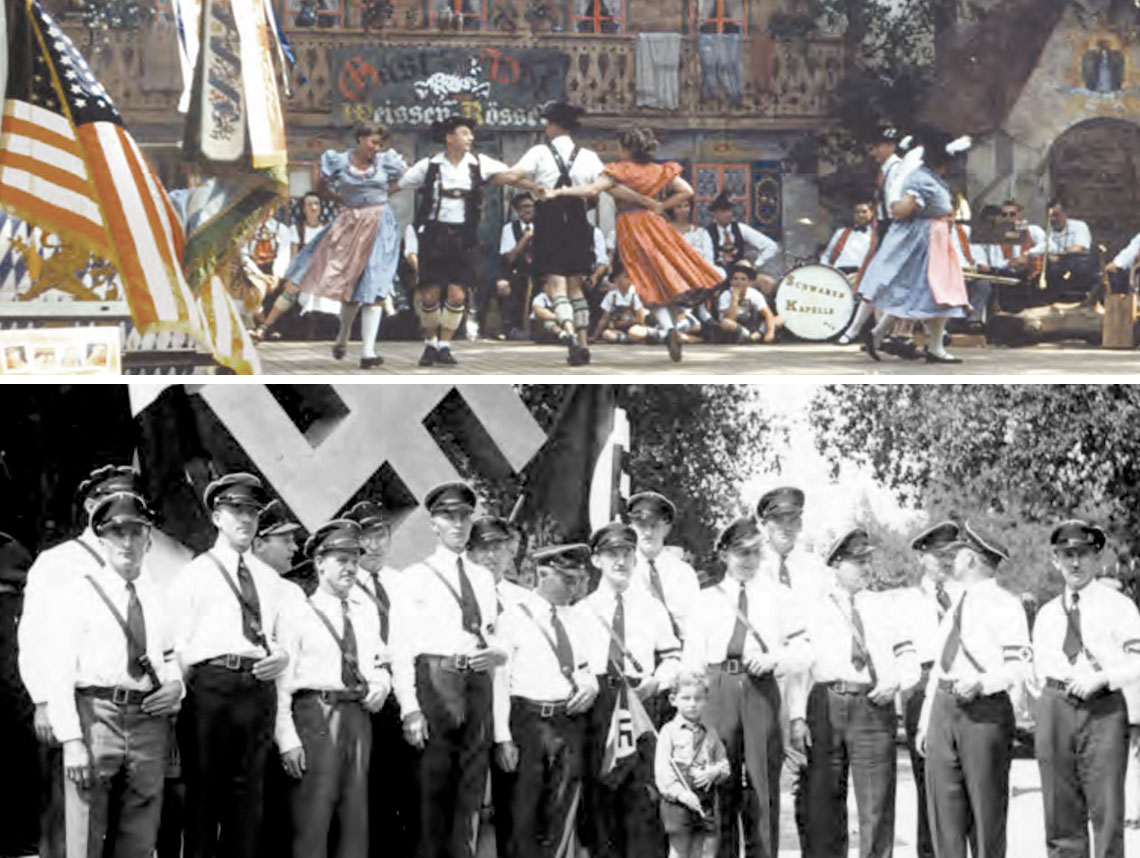
Hans Eberhard, 85, the German-born chairman of the Tricentennial Foundation, was 17 when he immigrated to the United States in 1949. At that time, Crescenta Valley Community Regional Park was a private park owned by the German-American League. As Hindenburg Park, it was the setting for dances, picnics and other community events for Germans in the area.
“Probably in the late ’50s, I started to go to the Hindenburg Park,” he said. “When I first came [to Los Angeles], I didn’t know anybody here. People get to know you and find out you’re from Germany, that you’re German, [and say] ‘We have an affair, come on down.’ ”
By paying for the earlier sign, Eberhard said he was attempting to honor the park’s history. But part of that history — in the years before World War II, during Hitler’s rise to power — included rallies staged by the German American Bund, a pro-Nazi group.
Following the removal of Eberhard’s sign, the L.A. County Commission on Human Relations appointed an ad hoc task force to create a replacement historical marker. Eberhard and Field, who both attended the unveiling, were among the people on the task force.
Field was instrumental in developing the language for the new marker, which features text, photographs and captions. It is titled “German-American History at Crescenta Valley Community Regional Park.” The photographs include an image showing members of the Bund party, in 1936, posing before a flag with a giant swastika. The photo is courtesy of the special collections and archives of the Oviatt Library at Cal State Northridge, which maintains an archive titled “In Our Own Backyard: Resisting Nazi Propaganda in Southern California, 1933-1945.”
Eberhard, who is not Jewish, is concerned that the image of the swastika could foment anti-Semitism.
“The history [as depicted by the marker] is OK. What I don’t like is the picture with the big swastika. I think that attracts undesirable elements. That’s a little offensive, don’t you think?” he said, suggesting that there might be other ways to convey what happened in the past.
Field said she did her best in working with multiple interests in creating a marker that reflects a part of history that has implications today as the United States debates the ascension of neo-Nazis.
“My thing is not to confront people,” she said. “My thing is to fix a problem.”
Jason Moss, executive director of The Jewish Federation of the Greater San Gabriel and Pomona Valleys, also attended the new sign’s unveiling. He said he was pleased that after more than a year of debate, Field’s and Eberhard’s task force overcame differences and created something tangible.
“What I love about the marker is that it captures the true history of what took place at the park,” he said. “The ad hoc committee was able to come together and work through something that was very difficult, and in the end, I don’t think history was whitewashed.”