fbpx

August 24, 2017

What are They REALLY Saying About Camp Neshama?

Camp Neshama is summer camp for Jewish young adults, running Sept. 1-4th, 2017, in Running Springs, California, and generously sponsored by The Alevy Family. The retreat may be the best Jewish young professional weekend in America. (Full disclosure – my wife Rachel Bookstein and I started the camp 6 years ago.)

We asked some of the participants of last summer’s camp to tell is what they REALLY thought.
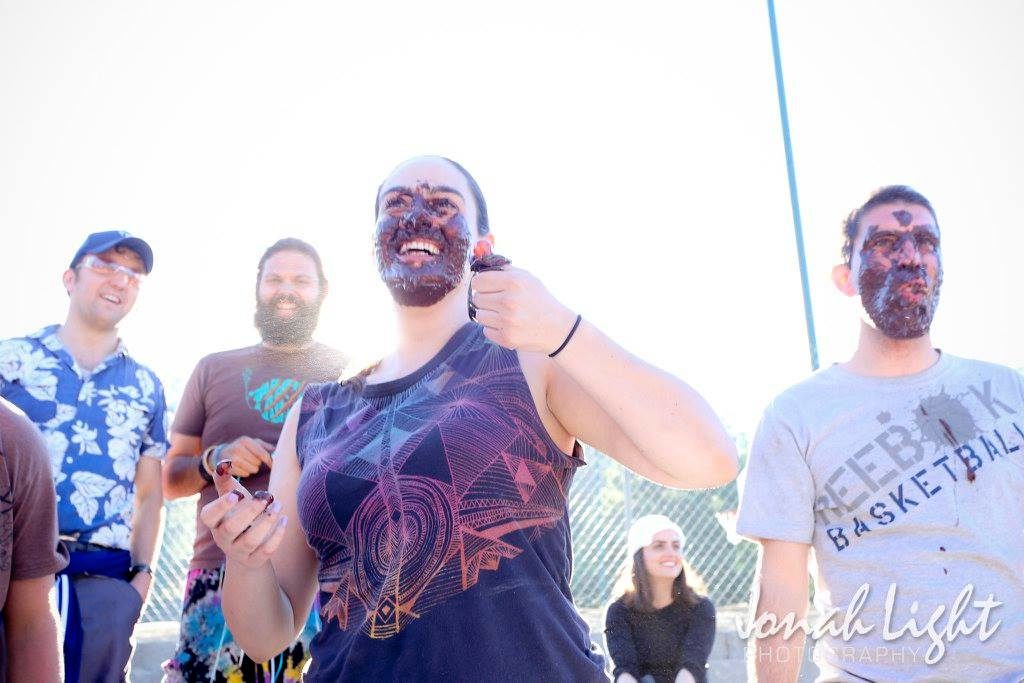
She found the ring in the pudding, in 7 seconds.

These are the unedited comments. The writers are from all kinds of backgrounds and each one had an amazing time. One of them also got married to a person they met last summer – can you guess which one?

I feel sad that it’s over! I’m in USA 1 year and in the first time I had an amazing time that made it so special for me. Spiritual w amazing people and helped me to be connected to my roots w keeping Shabbat and the nature , could not ask more than that. Thanks!

Azy from Encino wrote, “I enjoyed every minute of the retreat! From the food to the participants and activities!!! What a great place to make connections and new friends!”

Julian, from South Africa said, “Super happy that I have many new people in my life!”

A Jewish woman from Reseda, “Sad to leave, looking forward to the next one…It was wonderful. Beyond our expectations. My friends and I had a blast”
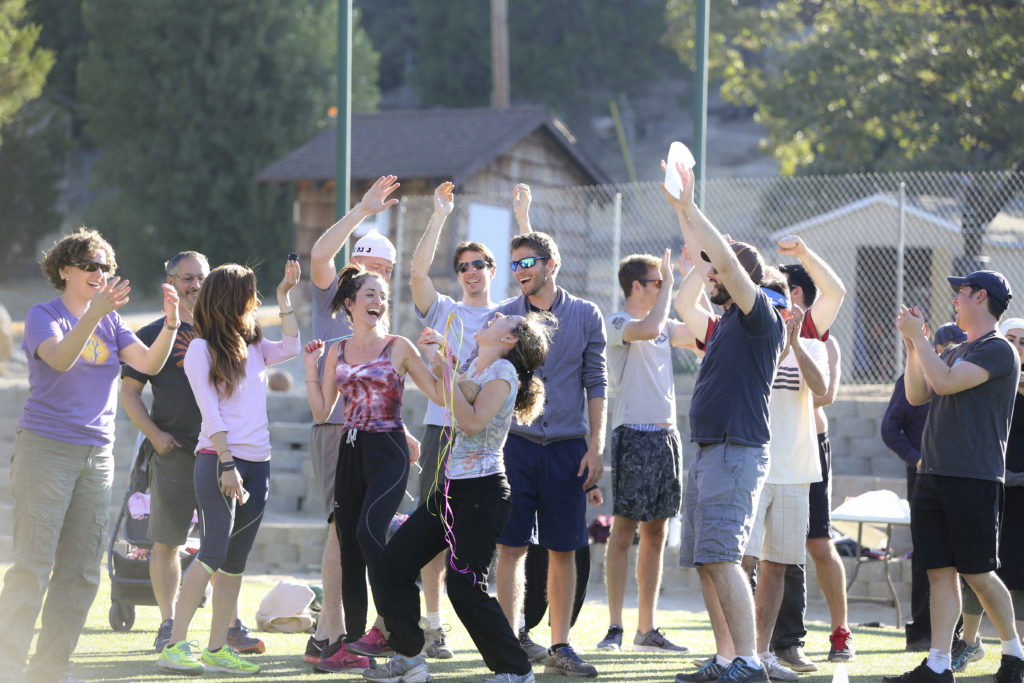
Field day competition heating up!

A 33 year old woman who grew up in LA said that, “It was a truly unique, reviving, fun, sweet and soulful experience”

A 29 year-old professional from Newport Beach told us, “I expected to experience spirituality being close to nature and share it with Jewish peers. I felt that I worked on my mind to my breath often during the program, which was easier to do since I focused in it when everyone was doing it during yoga or meditation. I feel that I kept active and attended programs I was interested in without having to wait too long for a program in the day-long agenda to do what I wanted to do.”

Ronen climbing up the tree for the Zip Line

Miriam from LA said, “It was a wonderful experience. The setting is lovely. The retreat center is comfortable, enjoyable, interesting. I loved talking to the young people. They were so open and serious about sharing and being heard. Everything was well planned. The meals were fun and delicious. The staff was efficient and very pleasant. The religious services were meaningful. The Booksteins and the volunteers were very accessible. The talks were interesting. We were observers of the sports events, and that was fun. We want to help in any way we can to make more Shabbatons/Retreats successful.”

Shloyme, an artist and businessman from LA told us, “It’s was so Amazing, Relaxing and got me closer to nature H’Shem and to some people in my community.”

Shante from Tarzana, “One of the most amazing Shabbaton I have ever been to. There was so many different activities at all times. All the staff were really helpful and friendly. The accommodations were great as well. “

Esther, who met her husband on the retreat, told us, “I’m blown away by the positive energy I experienced. Such wonderful people.”

Archery? Yes, archery!

An anonymous participant said, “I had a blast!! Literally the time of my life!”

Judy from LA said, “Expected a relaxing, fun event. The program far surpassed my expectations. It was INCREDIBLE!

Ronen, originally from NY, now in LA, said, “It was a very fun and beautiful experience. I enjoyed all the activities, the people who were there, the atmosphere. All in all it was a really great time. Now that I am back to LA it feels a little weird, however I realize even more that I want to marry a girl who has a strong connection and understanding of Judaism.”

Saar, who came from San Jose, told us, “It was incredible meeting everyone at camp and engaging with them even though I knew only one person prior to coming. I enjoyed having a plethora of activities to chose from at every point in the day. Hope to come to future camps like this.”

Yoga with Yogi Marcus

A participant from Irvine, “I had the best experience of my life. spiritual, socializing, relaxing, meeting new friends and the activities were awesome, and food was delicious. I enjoy the nature around the camp.”

Julia, from LA, had a lot to say. “I’m thrilled to have had the opportunity to attend your wonderful Shabbaton! I enjoyed the incredibly kind, thoughtful new friends I met, the beautiful campus, and the wide range of activities that balanced out our spirituality and athleticism 🙂 I thought it was a wise choice to not limit attendance to Singles — this added a pleasant family atmosphere in which one could get to know others in our community without the relationship label. The table decorations and Shira’s flowers made meal-times sweet, and the smartly-paced schedule gave everyone something to do at each hour of the day.”

Spaces are limited for this program, so people interested should apply ASAP!

For more information visit campneshama.org

Photos by Jonah Light

What are They REALLY Saying About Camp Neshama? Read More »

Elul 3: Harlene Winnick Appelman

Harlene Winnick Appelman

“I wear prayers like shoes. Pull them on each morning to take me through uncertainty.” writes Ruth Forman, contemporary poet, in a work called I Wear Prayers Like Shoes. The poet goes on about the shoes: “They were mama’s gift to walk me through life. She wore strong ones.”

Imagine if everyone in the world were walking around on prayers! Truth is everyone has a shoe story: new shoes for that first day of school, new shoes for the High holidays, new shoes for a job or a new fitness program or a birthday, ball or wedding. And, in fact, those shoes and the stories that that go with them shape the steps by which we approach each day, each task or each event.

Putting on shoes each day is an act of faith. It shows purpose, determination, and a willingness to encounter the future. Elul is a month designed to take a faith inventory. What prayers would be included in your prayer shoes? What is the nature of the prayer shoes that you would give to a loved one?

The next time you have a chance for a leisurely conversation, ask about shoe stories. It’s a great topic for conversation!


Harlene Winnick Appelman is Executive Director of The Covenant Foundation.

Elul 3: Harlene Winnick Appelman Read More »

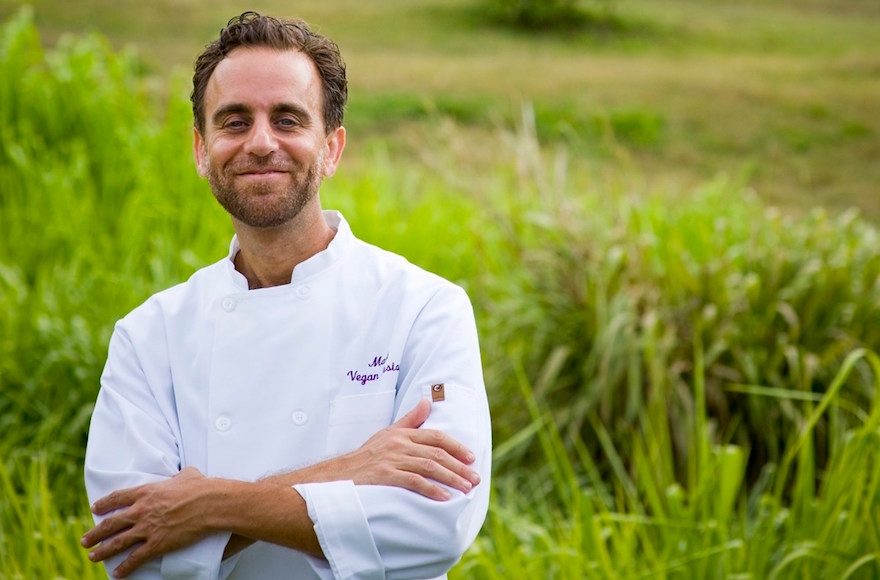
Chef wants to make vegan cooking the ‘new kosher’

With the temperature in the mid-80s, it was not the night to kick off Shabbat dinner with chicken soup, or rather, given our family’s eating mishegas, vegan chicken soup (yes, there is such a dish). So where or whom do I turn to for a seasonal alternative?

Answer: Chef Mark Reinfeld, who as the “30-Minute Vegan” has a series of books filled with recipes that I’ve found are sure to come out right and always taste great. (Reinfeld most recently authored “Healing the Vegan Way: Plant-Based Eating for Optimal Health and Wellness.”) When vegetarian and vegan newbie friends ask me to recommend fail-safe cook books, Reinfeld’s are at the top of the list.

So for this sultry Shabbat, I chose Raw Peaches and Cream Soup (don’t get fatootzed about the word “raw”), which turned out to be a hit with a Friday night dinner crowd that included rabbis, an Episcopal priest and their spouses.

I was lucky to meet up with Reinfeld on a very un-summer night in February near Boulder, Colorado, where he lives. There he told me about growing up in a traditional Jewish family in Stony Brook, Long Island, that kept kosher and ate chicken every Friday night.

After Reinfeld spent his junior year at the London School of Economics, which he followed with a backpacking trip across Europe, he found he just couldn’t embark immediately on his plan A, attending law school right after college.

After his acceptance into New York University Law School, Reinfeld deferred his admission and decamped one more time to Europe. In Paris, he worked as an au pair. In the mornings, he helped his charges with their homework. But he spent his afternoons walking the streets of the French capital “holding a baguette and bottle of wine,” as he likes to put it.

From there he traveled to Amsterdam and Berlin. Forrest Gump-ishly, he witnessed the fall of the Berlin Wall, then managed to hit Prague in time for the Velvet Revolution that brought down the ruling Czech Communist Party. His next stop: Kibbutz Mishmar HaEmek in Israel, where he worked with (and then ate) chicken five and sometimes seven days a week.

Reinfeld’s cauliflower and mushroom tacos (Courtesy of Reinfeld)

Reinfeld remembers the kibbutzniks chasing and catching the chickens in vast shed-like coops, then handing them over to the volunteers.

“We’d have to take them out to a truck,” he recalls. “The chickens were screaming and their legs were breaking in your hands. That is precisely when I realized that I couldn’t do this, and I couldn’t eat them. So I gave up chicken cold turkey.”

Reinfeld laughs before describing another I-can’t-eat-animals-anymore epiphany: It happened when he bonded with cows in the field next to the kibbutz.

Back in America, Reinfeld started law school, dropping out after the first semester when he realized this wasn’t the direction he wanted his career to take.

“I didn’t have a plan B,” he notes.

Somehow the spirit of his maternal grandfather, Ben Bimstein, a caterer who Reinfeld describes as a “culinary genius” and a renowned ice carver, guided his next move.

“Until his dying day,” Reinfeld says of Bimstein, “he was still carving ice in his wheelchair with his oxygen tank and something like a chainsaw.”

Reinfeld loaded his possessions into his car, drove west until he hit San Diego and landed a kitchen job at the natural foods grocer Jimbo’s. From there he quickly became a meatless entrepreneur, starting Blossoming Lotus Personal Chef Service in Malibu, California, and ending up, with the help of angel investor Bo Rinaldi, as the co-owner and chef of the award-winning Blossoming Lotus restaurant in Kauai, Hawaii.

With Rinaldi, Reinfeld wrote “Vegan World Fusion Cuisine,” garnering honors including a Gourmand World Cookbook Award for best vegetarian cookbook in the USA.

By this time, Reinfeld also was a practitioner of Vipassana, a type of Buddhist meditation, and actually started his restaurant while observing an 18-month period of silence. (“I could type very fast in those days,” he says, laughing.) That didn’t take him away from Judaism, and in a 2013 article for ReformJudaism.org titled “Vegan is the New Kosher,” he outlined the Jewish basis for a plant-based diet.

Reinfeld couples the Talmudic principle of “tza’ar ba’alei chayim” (Bava Metzia 32), which prohibits cruelty to animals, with Genesis 1:29: “God said, “Behold, I give you every seed-bearing plant that is upon all the earth, and every tree that has seed-bearing fruit; they shall be yours for food,” and urges Jews to make the compassionate choice.

“The reality is that factory farm-produced meat, eggs, and dairy (whether kosher or non-kosher) are raised and treated in a way that is a blatant violation of the principle of Tza’ar Ba’alei Chayim,” Reinfeld writes.

Mark Reinfeld spent time on a kibbutz. (Courtesy of Reinfeld)

A philosophy major as an undergraduate, Reinfeld says he understands that animals kill and eat animals, and that some people eat animals out of necessity.

“If you saw a lion pouncing on a gazelle, you may wince, but you know it’s part of nature and you’re not going to sit the lion down and say ‘I think you have anger issues, why don’t you try tofu?’” he says.

Inhabitants of remote fishing villages in Alaska or isolated tribes with limited access to adequate protein must fish or hunt.

“Where there’s necessity,” Reinfeld says, “there is a different moral issue, but when we have a choice of how much violence we bring into the world through our food selection, and we know we can meet our body’s nutritional needs, eat tasty food and minimize our environmental impact,” then one can draw a different line.

Back on the mainland, Reinfeld continues his vegan entrepreneurship. Called “the male equivalent to a vegan Rachael Ray” in a Publisher’s Weekly review of “Soup’s On,” a cookbook in his “30-Minute Vegan” series, Reinfeld is dedicated to popularizing vegan eating and living and compassion toward animals. Through his Vegan Fusion company, he offers consulting, chef services, culinary workshops, and chef and cooking teacher training internationally and online.

In July, Reinfeld was inducted into the Vegetarian Hall of Fame.

Time for another late summer Shabbat dinner — and the soup. I promise you, it’s a snap to make and takes minutes. And I also guarantee that you won’t be able to tell the difference between cashew cream, a staple of vegan cooking, and the “real” thing, heavy cream.

My Episcopal priest friend, a regular at our Shabbat table, loved the soup, and weighed in after his last spoonful: “Honest and fulfilling. Not a sweet, cutesy, fruity thing.”

Raw Peaches and Cream Soup
Serves 4

Ingredients:

Sweet Cashew Cream:

3/4 cup chopped raw cashews
3/4 cup water
1 1/2 tablespoons raw coconut or agave nectar or sweetener of choice, or to taste (I used agave)

Raw Peach Soup:

7 ripe peaches, pitted and chopped (5 cups)
1 1/2 cups fruit juice (try apple)
2 tablespoons raw coconut nectar, agave nectar or pure maple syrup (which I used), or to taste
1 tablespoon freshly squeezed lemon juice
1/4 teaspoon ground allspice
1/8 teaspoon ground cinnamon
Pinch of sea salt
2 teaspoons mirin (Reinfeld says this is optional, but I’d recommend it as well. Mirin is a Japanese sweet rice wine that is easy to find.)
2 tablespoons chiffonaded fresh mint, for garnish

Preparation:

Place the cashews in a small bowl with ample water to cover. Allow them to sit for 20 minutes. Drain and rinse well. (This is why Reinfeld is such a practical vegan chef: Most vegan recipes instruct you to soak cashews overnight.)

Meanwhile, place all of the peach soup ingredients, except the mint, in a strong blender and blend until creamy. Transfer to a bowl.

Place the cashews in the blender with the water and the coconut nectar (or whichever sweetener you’re using) and blend until very creamy. Transfer to a small bowl.

Garnish each bowl of soup with a drizzle of cashew cream and top with fresh mint before serving.

Variations:

* It would be a raw foodist’s call to 911 — yes, this is how Reinfeld writes — but you can grill the peaches until char marks appear, about 5 minutes, lightly basting with melted coconut oil before blending.

* Replace the peaches with nectarines, mangoes, blueberries or papayas. (I tried several batches with blueberries, which also worked well, although less sweet than the peach. You might try to prepare two versions, and delicately place them side by side in each soup bowl, in a yin/yang design.)

* Replace the apple juice with orange, pineapple or mango juice, or a combination of your favorites.

* Create differently flavored Sweet Cashew Creams by adding 1/2 cup of fruit, such as blueberries, strawberries or mango.


Elisa Spungen Bildner is 99 percent vegan [she cheats on ice cream]. She is a member of the board of 70 Faces Media, JTA’s parent company.) 

Chef wants to make vegan cooking the ‘new kosher’ Read More »

Jewish Mother 2.0

My teenage son would not be excited about my writing this at his desk, or my being in his room at all. But he started high school last week and I can’t believe it.

Ours is not an empty nest, but I know how soon it will become one, and I just wanted to sit with his stuff around me. I’m lying about that last part. There is no way I could long for my son’s “stuff” because it’s everywhere: the sneakers, the headphones, the endless stream of water glasses he fills to the top with ice, sips and abandons.

No, I am sitting in his room because I am hoping to be inspired. I am sitting in the exact spot where my desk used to be before we ripped out my office to put in his private lair — I mean bedroom. I did a lot of writing in this small corner of our house over the past decade, including a book about the need for laughter in marriage.

Dumb, dumb, shortsighted, dumb.

It’s not that we don’t need to laugh in marriage; we most definitely do, but a mere few years later I see now I was focused on the wrong family dynamic. The relationship you really need to pull out the clown car for is the one with your teenager.

I first heard the phrase “family dynamic” in a therapist’s office in Connecticut, circa 1975. I remember all four members of my family squeezing onto a couch across from an ancient-looking woman, probably 40, dressed in soft separates and nodding a lot. We had just moved from New York City, a decision only my father was happy about. I was still young enough to roll with it, but my mother, a native New Yorker like the one Donna Summer was singing about in her top-40 hit, was eating scrambled rage and toast for breakfast, and my sister was in the middle of her 13th year, already hit by the hormonal wrecking ball of being a teenager.

That was, I have no doubt now, the straw that broke the Klein camel’s back.

To date, our family dynamic is healthy enough without an outside ringleader, mostly because we find laughing together as therapeutic as my mother found spending her Saturdays at Loehmann’s. The unit is fine, but as the school year kicks off, I’m the one who’s feeling meshugge. Not just because I can’t stop the march of time, but also because I can’t seem to find the line between concerned parent and overbearing Jewish mother, a cliché I am deathly afraid of becoming. If you’ve seen any Woody Allen movie made before he married his girlfriend’s daughter, you would be too. He always features at least one loud, nagging, unattractive Jewish mother who is eating something greasy while telling her children to “stand up straight,” “do something about the pimples” and “marry rich.” In fact, I go out of my way to behave quite the opposite as a mother: I proudly aspire to be  “underbearing,”

The boys are back in school this week, which means I am privy to a lot more parenting conversations that I often feel I have to slowly back away from for fear of exposing my laissez-faire style.

“What do you mean you don’t read your son’s texts after he goes to bed?” one of the moms I know from temple asked me recently.

“I mean I don’t read my son’s texts when he goes to bed.”

“But … but … ” she looked at me like there was a burning bush in my house that I was ignoring.

“I’m not going to walk in his room and grab his phone after he’s asleep,” I added.

“Walk in his room? You let him keep his phone in his room at night?” another one chimed in.  “Haven’t you seen ‘Screenagers’ ”?

“Um … no. And yes. He keeps it in a charger by his window.”

“I’ll bet he does,” the first one said.

“What kind of a Jewish mother are you?” No. 2 added, tossing her highlighted hair back and laughing.

“A lame one, I guess,” I said, half-jokingly while heading to my car, breaking a non-peri-menopausal sweat.

Will my fear of becoming a Jewish cliché be my son’s undoing? Leaving him vulnerable to cyberpredators? To a debilitating lack of sleep as he scrolls endlessly in the wee hours of the night? To a stream of naked selfies from girls that he forwards to his friends — and then gets caught and arrested for trafficking in child porn?

I suddenly found myself looking back fondly to a simpler time when being a Jewish mother meant worrying that your precious child was going to get sick from snot-nosed kids on the bus, or that he didn’t get enough lox on his bagel. Or praying to God silently — sometimes not so silently — for him to find a nice Jewish girl to marry.

That’s how I ended up at his desk, you know, to write, of course. And, perhaps, to take a more “CSI: Teenager” approach to my Jewish mothering.


Dani Klein Modisett is a comic and writer, most recently of the book “Take My Spouse, Please.”

Jewish Mother 2.0 Read More »

I used to be an ‘impure’ Jew, too

Last week, an Israeli family vacationing at the Aparthaus Paradies hotel in Arosa, Switzerland, came upon a sign at the entrance of the hotel pool that read:

“To our Jewish guests

Women, Men and Children

Please take a shower before you go swimming and although [sic] after swimming. If you break the rules, I’m forced to cloes [sic] the swimming pool for you.”

Another sign on the refrigerator in the hotel lounge addressed “our Jewish guests” and stated that the refrigerator would be open only from “10 to 11 a.m. and from 4:30 to 5:30 p.m. I hope you understand that our team does not like being disturbed all the time.”

It did not take long for news outlets ranging from The Jerusalem Post to CNN to report the incident and a flurry of outraged social media posts from Jews worldwide to decry that the signs were clearly anti-Semitic. Some people did not initially believe that the story was real.

Addressing various Swiss and Israeli media, hotel manager Ruth Thomann insisted that the pool sign was misunderstood, explaining that she had put it up because “some of these guests went swimming with clothes on, with T-shirts, and didn’t take a shower.”

I can only assume that she was referring to more observant Jewish guests who entered the pool wearing T-shirts in observance of their modesty restrictions.

As for the note, Thomann added that since the establishment regularly accommodates Jewish guests who wish to keep their own kosher food in the hotel’s refrigerator, she was only trying to clarify matters for the kitchen staff.

“I used the wrong words,” she concluded, boasting, “We have lots of Jewish guests, and they have been coming here for 40 years. I would not take Jewish guests if I had a problem with them.”  

Her attempted clarification could have been more comforting if not for that last assurance.

The signs have since been taken down, and Thomann said that she understood why they sparked accusations of anti-Semitism, saying, “I made the [pool] sign without sensitivity and now I am paying for it dearly.” Still, she promised, the hotel “will have lots of Jewish guests next year.”

Israeli Deputy Foreign Minister Tzipi Hotovely called the incident “an anti-Semitic act of the worst and ugliest kind.”

I am not certain of either Thomann’s innocent intentions or that the signs displayed anti-Semitism at its “worst,” and that is only because I was born a Jew in the Islamic Republic of Iran.

Identity is a filter, and I read and process every news story related to anti-Semitism, whether in Switzerland or Virginia, through the lens of an Iranian Jew. And like most Iranian Jews, I know about the concept of impurities, or nejasat, and specifically, of Jewish impurity, because it has existed in Iran, whether as state law or in the ugly psyche of an anti-Semitic citizen, for centuries.

I have always found the physical concept of the literal dirty, impure Jew to be much more stinging than other anti-Semitic notions, because it paves the way for very real physical humiliation, separation and, in many cases, violence. No one wants to walk the earth as a seemingly contaminated or polluting force.

In a chapter titled, “The Impure Jew” in the acclaimed book “Esther’s Children: A Portrait of Iranian Jews,” Hooshang Ebrami expounds on a series of nejasat laws against the Jews of then-Persia beginning in the 16th century that included the following unbelievable restrictions, most of which are unknown to Jews around the world today, including American Jews in Los Angeles who never may have asked their Iranian-Jewish friends or co-workers about anti-Semitism in Iran. These restrictions included, but were not limited to:

• Jews were not allowed to use public baths.

• Jews were not allowed to open shops in the bazaar or city streets.

• Jews were not allowed to leave their homes on rainy days, lest their impurity mix with the water and touch a Muslim’s skin.

• Jews were not allowed to purchase fresh fruits and certainly were not allowed to touch any goods at Muslim bakeries.

• Jews were forbidden from painting their homes white, because the color signified purity. They were also forbidden from riding white donkeys.

• The street-facing doors and the walls of Jewish homes had to be shorter than those of Muslim homes, so that Jews literally had to crouch in a humiliating fashion when they entered their dwellings.

It is important to note that violations of these restrictions were punishable by death.

Most American Jews today also are unfamiliar with the tremendous impact that European anti-Semites, most of them spies who were disguised as citizens ranging from merchants to teachers and had entered Persia in the 16th century and beyond, had on convincing thousands of Muslim Persians that Jews were physically contaminated.

Ebrami notes that the impact of Spain’s Inquisition and “Purity of Blood” movement, which focused heavily on the impurity of Jews, was “unquestionable” regarding the Jews of Iran, “because in the period when European agents were extremely active in Iran, the most repulsive set of anti-Semitic regulations was issued by the Shiite clergy — regulations that drove the ‘impure’ Jews into progressively more wretched living situations.”

Of course, no religious or ethnic group with such seemingly dirty traits would have been totally free to live among and mingle with the general population, which explains why the Jews of most cities, including Tehran and Shiraz, lived in their own Jewish quarters, although some of them inevitably lived there even before the nejasat notions began because they understood that separation from Muslims also would aid their safety and survival.

At the beginning of the 20th century and the constitutional revolution of Reza Shah Pahlavi, laws relating to Jewish impurity diminished and the Jewish quarters of various cities shrank in size as more and more Jews felt a relative sense of freedom and mobility to climb social, educational and economic ranks. The last person in my family to live in the mahaleh, or those Jewish quarters, was my great-grandmother. Today, they are but mere narrow alleyways that echo the pain of memory and injustice. How I wish that I could return to Iran and visit the old mahaleh in Tehran carrying a Book of Tehillim and my precious American passport.

Yet, the concept of the najis, impure Jew was an idea difficult to remove from the minds of many Iranians, even as decades passed and Iran modernized under the shah’s son, who was ousted during the 1979 Islamic revolution.

As a 5-year-old in 1950s Golpayegan, a city in the province of Isfahan, my father once stood in the outdoor bazaar and ran his small hands over some supple grapes. When the shopkeeper saw this, he asked my father not to touch any fresh fruit or produce. When my plucky father asked, “And why not?” the man responded, “You know why not, boy.” It was a small community and most everyone knew who was Muslim and who was Jewish.

Twenty years later, while studying in the United States during the late 1970s, just before the revolution, my father lived near campus with a fellow Iranian who was a Shiite Muslim. Based on a hunch that the man was uncomfortable sharing physical space with a Jew, my father deliberately threw his “impure” status all around the apartment. In fact, each time that his roommate would step out of the shower in his towel, my father would give him a friendly slap on the back and ask him how he was doing. This would send the young man back into the shower to decontaminate himself. When he re-emerged, another “brotherly” slap awaited him, until he had showered three or four times. This happened on a monthly basis.

By the time I was growing up in Iran and entered the women’s public bathhouses with my mother in Tehran in the 1980s, no one bothered to ask whether we were Jewish, although I did notice that some merchants at the local bazaar seemed very uncomfortable when my mother squeezed the persimmons and apricots. The more they grimaced, the more she squeezed.

My parents are fantastic.

Of course, after the Islamic Revolution and as if on cue, the Ayatollah Khomeini made official statements regarding Jews and Christians, otherwise known as “People of the Book,” by decrying that “non-Muslims of any religion or creed are najis.

As mentioned, most Iranian Jews are familiar with the concept of nejasat. In her April 7, 2017, column for the Journal, author Gina Nahai recalls how in the 1980s in Los Angeles, she was seated next to an old, Iranian Muslim woman, who gathered her coat and tried to inch as far away in her seat from the contaminated Jew as possible. She goes on to say that in the 1990s, during a book talk in Portland, Ore., one female Iranian Muslim — a dentist, at that — confirmed that Jews were actually najis. They also have small tails, she declared, without repudiation from a single soul at the event.

The connection between Iran and Switzerland is not lost on me, although I am less interested in the authenticity of Ruth Thomann’s explanation and more energized by the outrage of the Jewish community. Ultimately, the incident in Switzerland points to a very real, valid and heightened sensitivity on the part of Jews worldwide against even the seemingly smallest acts of anti-Semitism, whether in Europe, the United States or most anywhere else, with the exception of the Middle East, where anti-Semitism is a sad given.

A part of me wants to believe Thomann, although I would be more convinced if, by next Rosh Hashanah, she actually set up a structure near the hotel pool that featured a kosher mikveh for the visiting Jewish men and women.

As for me, I am moved and relentlessly grateful for the little things, such as living my existence in America, running my hands over as many cucumbers as I like at Whole Foods, and walking tall and upright through the doorway of my home after a relaxing afternoon ride on my snow-white mule.


Tabby Refael lives, writes and walks in the rain in Los Angeles.

I used to be an ‘impure’ Jew, too Read More »

Events in Los Angeles from August 25-31: Nina Shallman, Rekood Music Fest and more

FRI | AUG 25

SHABBAT IN THE PARK

Bring a picnic and join more than 15 temples, schools and organizations for Shabbat. There will be family activities, including arts and crafts, plus a drum circle, a social action project, Torah talks and a concert by the Capa’im Band. 4:30 p.m. Free. Warner Center Park, 5800 Tapanga Canyon Blvd., Woodland Hills. shabbatinthepark.com.

MUSIC, SINGING AND SPIRIT

Share a Shabbat service with the music  of Bryce Emily Megdal and her fellow musicians. Megdal, a cantorial soloist and a student at the Academy for Jewish Religion, California, is a rising singer-songwriter on the Los Angeles Jewish music scene. Registration in advance is required. 7 p.m. Free; register at eventbrite.com. Hollywood Temple Beth El, 1317 N. Crescent Heights Blvd., West Hollywood. htbel.org.

SAT | AUG 26

“CHALLENGES & OPPORTUNITIES: ISRAELI-ARAB REGIONAL COOPERATION”

Shira Efron, an associate policy researcher at the Rand Corp. with extensive experience investigating domestic policies in Israel and geopolitical trends in the Middle East, will speak on “Challenges & Opportunities: Israeli-Arab Regional Cooperation.” Seating is limited. 9:30 a.m. Shabbat service; 11:30 a.m. lecture. Free; RSVP to info@beverlyhillsjc.org or call (310) 276-4246. The Beverly Hills Hotel, 9641 Sunset Blvd., Beverly Hills. beverlyhillsjc.org.

SUN | AUG 27

NINA SHALLMAN

Singer-songwriter Nina Shallman, who began to play the piano at the age of 6 and started to write poetry soon after, will perform a show for those age 21 and older. 8 p.m. $10. The Hotel Cafe, 1623 Cahuenga Blvd., Los Angeles. hotelcafe.com.

REKOOD MUSIC FEST

Iggy Azalea and Lil Dicky

End the summer with a night of music featuring live performances by artists such as Iggy Azalea and Lil Dicky (aka David Burd), plus DJs, special guests, dancing, drinks, giveaways, food vendors and an open bar for the first hour. The Friends of the Israel Defense Forces Young Leadership music fest is in partnership with Israeli American Council Lead, a network of young professionals. 8 p.m. Tickets start at $150. Address given upon ticket purchase. Downtown Los Angeles. rekood.com.

BEACH YOGA

Watch the waves and feel the ocean air while practicing your favorite yoga pose. Join the Young Adults of Los Angeles (YALA) Yoga Cluster for “Yoga on the Beach With Brad.” Bring a towel or yoga mat. Walk up Marine Street to Lifeguard Station No. 29. 10:30 a.m. $15 (cash only). Santa Monica Beach at Marine Street. yala.org.

JUDEA BOWL

Wissot and Kliger


Bring a picnic dinner, blankets and lawn chairs for a summer concert at a private home in Moorpark. Enjoy the sounds of Rabbi Cantor Alison Wissot and Cantor Yonah Kliger, with cantorial colleagues Ilan Davidson and Lisa Peicott. Dessert and beverages provided. 5 p.m. $18. Address given upon RSVP. (818) 758-3800. templejudea.com.

WED | AUG 30

SHANGHAI JOURNEY

Temple Menorah member Faith Goldman will speak about “My Journey to Shanghai,” her 20-year odyssey to discover her late husband Robert Goldman’s life in Shanghai from 1940 to 1958. Goldman also will show the film “Ark Shanghai,” about the reunion of refugees who fled to that city during World War II. 11 a.m. $16; $14 for members. Temple Menorah, 1101 Camino Real, Redondo Beach. (310) 316-8444. templemenorah.org.

COMMUNITY RESOURCE FAIR

Get information about services available to the community, including financial, legal, family, addiction and immigration services. Organized by The Jewish Federation of Greater Los Angeles and the Israeli American Council. 7 p.m. Free. IAC Shepher Community Center, 6530 Winnetka Ave., Woodland Hills. israeliamerican.org/community-fair.

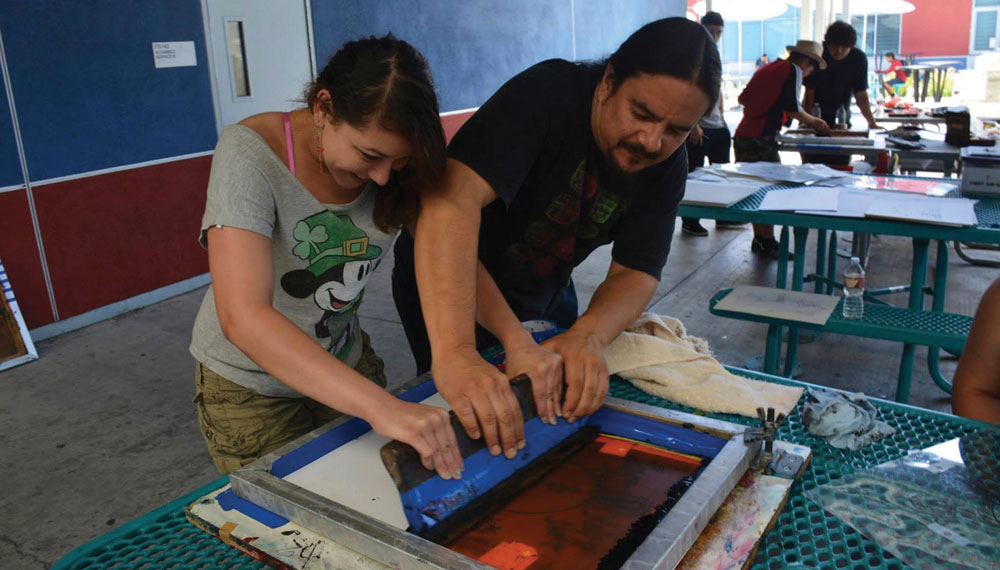
SCREEN-PRINTING WORKSHOP

Screen-printing workshop


Recent college graduates are invited to join other 22- to 26-year-olds for a hands-on screen-printing workshop. You also will get a close look at Self-Help Graphics and Art, an organization in East Los Angeles dedicated to empowering Latino and Chicano artists. 7 p.m. $15; $25 for two tickets. The Jewish Federation of Greater Los Angeles, 6505 Wilshire Blvd., Los Angeles. yala.org.

Events in Los Angeles from August 25-31: Nina Shallman, Rekood Music Fest and more Read More »

Reform leaders call on Netanyahu to denounce Western Wall body searches of female rabbinical students

Leaders of the Reform movement in the United States called on Israeli Prime Minister Benjamin Netanyahu to “issue a swift and clear denunciation” of the demeaning body searches of four female rabbinic students at the Western Wall.

The students from the Hebrew Union College-Jewish Institute of Religion, including two Americans, on Wednesday were asked to lift their shirts and skirts for security before being allowed to enter the Western Wall plaza, where an egalitarian prayer service was being held. The four said they were questioned and pulled aside into a private room.

“These bold young leaders were treated in the most degrading way imaginable,” said the Reform letter to Netanyahu dated Aug. 24. “They were pulled out of line among hundreds of men and women and were subject to a completely unnecessary search. The actions of the Western Wall Heritage Fund go beyond the disagreement we have about the implementation of a compromise at the Kotel. This was an unacceptable and shameful attempt to hurt and humiliate our leaders, and we are deeply outraged.”

The letter was signed by Rabbi Rick Jacobs, president of the Union for Reform Judaism; Rabbi Aaron Panken, president of the Hebrew Union College-Jewish Institute of Religion; and Rabbi Steven Fox, chief executive of the Central Conference of American Rabbis.

Western Wall security did not say what they were looking for, according to the Israel Religious Action Center of the Reform movement, or IRAC. Western Wall officials in the past have detained women and searched for Torah scrolls and other religious items they consider inappropriate for women to bring to the wall.

In January, Israel’s High Court of Justice ruled that women are not to be subjected to intense body searches when entering the Western Wall.

“Our goal with our young leadership is to cultivate a love and a commitment to Israel,” the letter also said. “We will continue to struggle for justice and work to create an Israel we can be proud of. The actions of the personnel at the Kotel yesterday morning only continue to make our work extremely difficult.

“Please issue a swift and clear denunciation of the events that took place yesterday,” it concluded.

Reform leaders call on Netanyahu to denounce Western Wall body searches of female rabbinical students Read More »

Letters to the Editor: Stephen Miller, Charlottesville and Hitler Youth

Two Views on Immigration

I am very grateful for Rob Eshman’s column on Stephen Miller (“Stephen Miller and Julia Hahn Have a Past,” Aug. 11). Shame on him.

When my grandfather came to this country as a 12-year-old boy, he did not speak one word of English, nor did his parents or siblings. They came here almost penniless to escape the pogroms in Russia. What his family did have were cousins who greeted them with open arms.

My grandfather grew up to become a successful lawyer in Chicago. His son, my uncle, became a colonel in the U.S. Army Air Forces during WWII and was one of Eisenhower’s key staff members. I often wonder how many young lives my uncle helped save.

To know Miller’s background and the opportunities that he has been given in this country because his forebears made many sacrifices to get here, and then to stand up at a press conference and publicly spew shameful alt-right buzzwords is a disgrace.

Marlene Grossman via email

Eshman’s column in support of continued high levels of legal immigration — due largely to so-called “family reunification” — misses many important reasons why U.S. immigration policies should be changed. Here are two such reasons.

Giving preferential admittance to extended family members of people already legally in the U.S. is discriminatory. Current immigration policy greatly favors people who have relatives who have recently immigrated to the U.S.; for many years now this would mean people coming from Latin America and various East-Asian countries. The policy strongly discriminates against people living in Africa, Europe, Pacifica and much of Asia. This is patently unfair. Even more important, in my opinion, is the sheer number of immigrants legally admitted. With business-as-usual population growth, by 2050 or so, California will be as densely populated as China. For many years, California’s rapid population growth essentially has been due entirely to immigration and the U.S.-born offspring of immigrants.

Ben Zuckerman, Los Angeles


What Charlottesville Says About Us

I get that Rob Eshman does not like President Trump and has been attacking him since Day One (“Donald Trump, Betrayer in Chief,” Aug. 18). But that should not negate his ability to maintain some semblance of balance and fairness. Eshman states that Trump “and his supporters” accused former President Barack Obama of refusing to say “radical Islamic terrorism,” offhandedly conceding that Obama’s failure opened himself up to “entirely valid criticism.”

It was far more than Trump supporters who were unhappy with Obama’s failure to ever name radical Islamic terrorism. Obama went out of his way to never call Islamic terrorism by its name; instead we heard things like “violent extremism,” “workplace violence” and “man-caused disaster.” Trump took 48 hours before identifying the evil perpetrators in Charlottesville, Va., as the Ku Klux Klan, neo-Nazis and white supremacists. Some of us waited eight years
for Obama to identify radical Islamic terrorism — only to remain disappointed the entire time.

Michael H. Pinchak, Tarzana

Charlottesville sent a message. President Trump may vocalize strong support for Israel, but his passive actions indicate he is willing to indirectly endorse hostility toward Jews if it will buy him accolades from his base of supporters. Those American Jews who continue to support the Trump presidency, including the most visible one, Sheldon Adelson, need to recognize the old axiom: Actions speak louder than words. It is time for them to reconsider their actions.

Michael Ernstoff via email

This story hit close to home. My father and his family were forced to leave Germany to escape anti-Semitism. I never thought in my life that this could ever happen in the U.S. I hope the Jewish community in Los Angeles gathers in a public space to show our solidarity against this hate. I will be there, and I know you will, too, Rob. Please keep writing.

Ralph Hattenbach via email

I don’t quarrel in general with what Eshman wrote, but there are also rhinoceri on the political left, in particular antifa, much of the media and some of the Black Lives Matter people. They use violence to prevent conservatives from speaking at colleges (UC Berkeley being the most egregious example), attack college faculty who dare to deviate from their orthodoxy (e.g. Yale), wail about “safe spaces” and “micro-aggressions,” and lie or distort facts about events (e.g. CNN). What ails this country will continue — and likely get worse — as long as the rhinoceri’s snorts drown out saner voices.

Stephen J. Meyers via email


Can Former Hitler Youth Be Remorseful?

I don’t understand how you can put a picture of a woman who belonged to the Hitler Youth and acted as a Nazi on your cover. You can never use “remorse” for what the Nazis did to so many millions of people (“A Soul-Crushing Debt,” Aug. 11) and expect to be redeemed and understood. I have remorse for not saving more money. I have remorse for not getting a higher education. How can Ursula Martens use the word remorse when she let a disabled child wander away and die? How can she use the word remorse when, during Kristallnacht, all she was upset about were the broken crystals and not the broken lives? When she saw the pictures in her father’s drawers of the horrors that he perpetrated, she kept quiet. Only when Germany was losing the war did she decide that Nazism was “perhaps” wrong. Then she tried to atone by having an affair with a married Jewish man. 

There are so many great people who risked their lives to save Jews and so many victims who went on to do good things for the Jewish community who you could put on your cover.

Miriam Fiber, Los Angeles


When to Pray, When to Remain Silent

I read Roger Price’s story (“A Solar Eclipse Deserves a Blessing,” Aug. 18), and although I appreciate his attempt to find an innovative way to introduce a new blessing to capture the moment, I believe there is a profound reason why no blessing was ever instituted for witnessing a solar eclipse.

There are times in life when the situation requires no blessing, no words … just simple silence.

Every so often we need to be humble and take in the majesty of God’s world.

Rabbi Binyomin Lisbon via email

Letters to the Editor: Stephen Miller, Charlottesville and Hitler Youth Read More »

La Crescenta Park’s Nazi ties reflected in new historical marker

The Los Angeles County Department of Parks and Recreation unveiled a historical marker at Crescenta Valley Community Regional Park in La Crescenta on Aug. 18 that includes an explanation of the park’s historical ties to Nazis.

The new marker takes note of the park’s past, acknowledging that “in the years before World War II” and “as Hitler and the Nazi Party rose to power in Germany, supporters of Hitler at times paraded in this park.”

[Peter Dreier: A tale of two cities – Charlottesville and La Crescenta]

The unveiling followed a controversy that arose last year from the installation, and subsequent removal, of a previous sign at the entrance that read, “Welcome to Hindenburg Park,” recognizing former German President Paul von Hindenburg, a World War I hero who appointed Hitler as chancellor in 1933. The installation of that sign angered Jewish community members who knew of Hindenburg’s history.

Mona Field, an Eagle Rock resident and former member of the L.A. Community College District board of trustees, who is Jewish, was among those who advocated for the removal of the Hindenburg Park sign, which was paid for by the Tricentennial Foundation, a nonprofit German-American heritage organization, with the county’s approval. The sign was removed last May, about one month after its installation.

Hans Eberhard, 85, the German-born chairman of the Tricentennial Foundation, was 17 when he immigrated to the United States in 1949. At that time, Crescenta Valley Community Regional Park was a private park owned by the German-American League. As Hindenburg Park, it was the setting for dances, picnics and other community events for Germans in the area.

“Probably in the late ’50s, I started to go to the Hindenburg Park,” he said. “When I first came [to Los Angeles], I didn’t know anybody here. People get to know you and find out you’re from Germany, that you’re German, [and say] ‘We have an affair, come on down.’ ”

By paying for the earlier sign, Eberhard said he was attempting to honor the park’s history. But part of that history — in the years before World War II, during Hitler’s rise to power — included rallies staged by the German American Bund, a pro-Nazi group.

Following the removal of Eberhard’s sign, the L.A. County Commission on Human Relations appointed an ad hoc task force to create a replacement historical marker. Eberhard and Field, who both attended the unveiling, were among the people on the task force.

Field was instrumental in developing the language for the new marker, which features text, photographs and captions. It is titled “German-American History at Crescenta Valley Community Regional Park.” The photographs include an image showing members of the Bund party, in 1936, posing before a flag with a giant swastika. The photo is courtesy of the special collections and archives of the Oviatt Library at Cal State Northridge, which maintains an archive titled “In Our Own Backyard: Resisting Nazi Propaganda in Southern California, 1933-1945.”

Eberhard, who is not Jewish, is concerned that the image of the swastika could foment anti-Semitism.

“The history [as depicted by the marker] is OK. What I don’t like is the picture with the big swastika. I think that attracts undesirable elements. That’s a little offensive, don’t you think?” he said, suggesting that there might be other ways to convey what happened in the past.

Field said she did her best in working with multiple interests in creating a marker that reflects a part of history that has implications today as the United States debates the ascension of neo-Nazis.

“My thing is not to confront people,” she said. “My thing is to fix a problem.”

Jason Moss, executive director of The Jewish Federation of the Greater San Gabriel and Pomona Valleys, also attended the new sign’s unveiling. He said he was pleased that after more than a year of debate, Field’s and Eberhard’s task force overcame differences and created something tangible.

“What I love about the marker is that it captures the true history of what took place at the park,” he said. “The ad hoc committee was able to come together and work through something that was very difficult, and in the end, I don’t think history was whitewashed.”

La Crescenta Park’s Nazi ties reflected in new historical marker Read More »

Moving & Shaking: Daniel Pearl fellows, L.A. Jewish Home luncheon and more

The 2017 Daniel Pearl fellows, Nicholas Cheng of Malaysia and Salman Yousafzai of Pakistan, discussed “Views on America” at the Steve Allen Theater in Los Feliz on Aug. 17.

Jewish Journal Publisher and Editor-in-Chief Rob Eshman moderated the discussion, which followed a cocktail reception, and drew about 80 attendees.

Also attending were Ruth and Judea Pearl, parents of slain Wall Street Journal reporter Daniel Pearl, who was kidnapped and murdered by Pakistani terrorists in 2002. In memory of their son, the Pearls established the Daniel Pearl Fellowship in 2003 in partnership with Alfred Friendly Press Partners.

The fellowship brings journalists from Muslim-majority countries to work in major U.S. newsrooms for five months, including a week at the Jewish Journal. There have been 24 fellows since the establishment of the program.

At the event, the panelists discussed, among other topics, anti-Semitism in their respective countries, misconceptions about Islam among Americans and the challenges facing journalism in their countries.

“Journalism is not a field anybody wants to go into in Malaysia,” Cheng said.

In closing remarks, Judea Pearl described journalists as “the elite force of the army of decency and the army of commitment.” A computer science professor at UCLA, Judea Pearl said he initially did not understand Daniel’s decision to go into journalism but eventually learned about the importance of the field.

“Journalism is transferring an existing particle [of information] from here to there,” and is necessary because a “lack of information is a major source of the trouble we have in our generation,” he said.


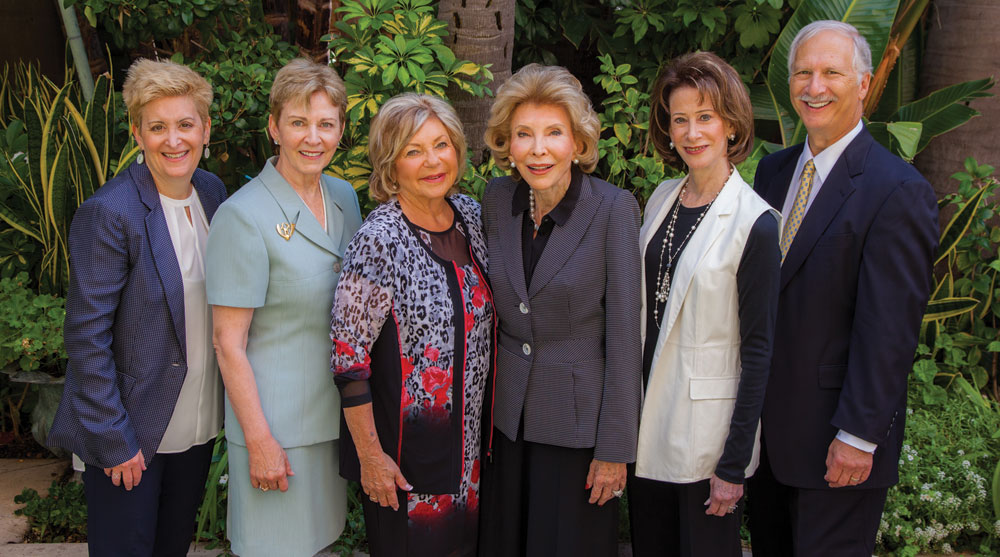
From left: Corey Slavin, Molly Forrest, Sandy Stackler, Marion Goldenfeld, Florence Gorlin and Ira Schreck attended the L.A. Jewish Home’s 87th Tree of Life luncheon. Photo by Jodye Alcon


Marion Goldenfeld was honored Aug. 10 at The Associates of the Los Angeles Jewish Home’s 87th Tree of Life Luncheon at the Four Seasons Hotel Los Angeles at Beverly Hills.

Goldenfeld, a longtime member of the women’s auxiliary, was the recipient of the 2017 Zelda White Woman of the Year Achievement Award for her “long-standing history with the women’s group and her impressive involvement in the community” said Debbi Fishel, manager of The Associates.

The luncheon was chaired by Florence Gorlin, as well as honorary luncheon chair Lynn Ziman.

Sandy Stackler, president of The Associates, welcomed the attendees, while entertainment chair Shirley Ashkenas introduced the guest performer, Maya Paredes, a piano student at the Colburn School of performing arts.

The Jewish Home serves senior members of the Los Angeles community by providing multilevel health care services through residential and community-based programs.

Molly Forrest, Jewish Home’s CEO, said in a statement, “Everyone recognizes the baby boomers will expand the number of seniors in our community. If the Jewish Home didn’t exist, leaders in the community would be creating it.” 

The luncheon, which also included a boutique, raised approximately $150,000. All proceeds will go to the Los Angeles Jewish Home.

— Julie Bien, Contributing Writer


More than 700 brothers of Alpha Epsilon Pi (AEPi), from 190 chapters in seven countries, attended the Jewish fraternity’s 104th international conference in Las Vegas on Aug. 2-5. Photo courtesy of AEPi


More than 700 brothers of Alpha Epsilon Pi (AEPi), from 190 chapters in seven countries, attended the Jewish fraternity’s 104th international conference in Las Vegas on Aug. 2-5.

Speakers included Russell Robinson, CEO of the Jewish National Fund, who appeared at the opening ceremony.

“I challenge you young leaders to talk about the greatness of the Jewish people, the land of Israel and the people of Israel,” Robinson said. “We can no longer have conversations about what our enemies want us to talk about.”

Representatives of 45 partner organizations — including the American Jewish Committee, the Anti-Defamation League and the Simon Wiesenthal Center — engaged with undergraduate students and alumni, and discussed issues of importance to the international Jewish community and Jewish life on college campuses.

“AEPi exists to provide its members with deep and transformative friendships within a context that strengthens Jewish identity, hones leadership skills, teaches philanthropy and inculcates an abiding commitment to the Jewish people and the State of Israel,” said Los Angeles County Deputy District Attorney Elan Carr, an active alumnus and a past international president of the fraternity. “Through this impact, AEPi brothers, both students and alumni, become force multipliers for Jewish leadership and for the future of our Jewish community.”

Other attendees included AEPi Executive Director Andrew Borans, conservative pollster Frank Luntz, Rep. Eliot Engel (D-N.Y.), Jewish Journal President David Suissa, Israeli American Council Chairman Adam Milstein, and Israeli-American philanthropists Shawn Evenhaim and Naty Saidoff.

“The strength and significance of our fraternity was seen every day,” Borans said. “I’ve never been more proud to be an AEPi brother.”

Sam Forman, an incoming UCLA junior who attended the conference, said, “I was able to make connections with undergraduate brothers from around the world, and I connected with potential employers and alumni at the career day job fair.”

— Mati Geula Cohen, Contributing Writer


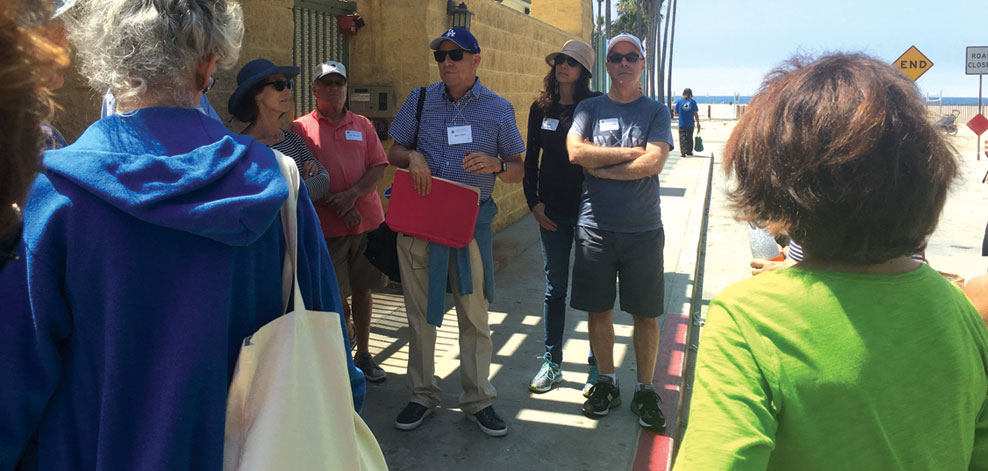
Stephen Sass, president of the Jewish Historical Society of Southern California, leads about 25 people on a walking tour of sites of Jewish significance at Venice Beach. Photo by Ryan Torok


About 50 people turned out Aug. 20 for “Bagels on the Boardwalk,” a walking tour of sites of Jewish significance in Venice Beach, including the Israel Levin Senior Center, Mishkon Tephilo and the Pacific Jewish Center (PJC).

Stephen Sass, president of the Jewish Historical Society of Southern California, and Jeremy Sunderland, a board member of the organization, each led groups on tours of the three locations. At the Israel Levin Senior Center, which operates in a building owned by The Jewish Federation of Greater Los Angeles and offers programs coordinated by Jewish Family Service of Los Angeles, the attendees enjoyed a breakfast of bagels, coffee and orange juice before watching the Academy Award-winning documentary “Number Our Days.”

The Whizin Center for Continuing Education of American Jewish University organized the sold-out event. As they moved from site to site, participants took in the bustling activity of the Venice boardwalk on a Sunday morning.

Speakers included Mishkon Tephilo Rabbi Gabriel Botnick, Mishkon Tephilo President Melissa Tarsky, PJC Executive Director Joanne Feldman and Milton Simon, a PJC congregant. PJC is an Orthodox shul that for 40 years also has been known as Shul on the Beach.

Sass, an attorney for HBO, said the future is bright for the Jewish community in Venice.

“It’s kind of an electric time to be here,” he said.


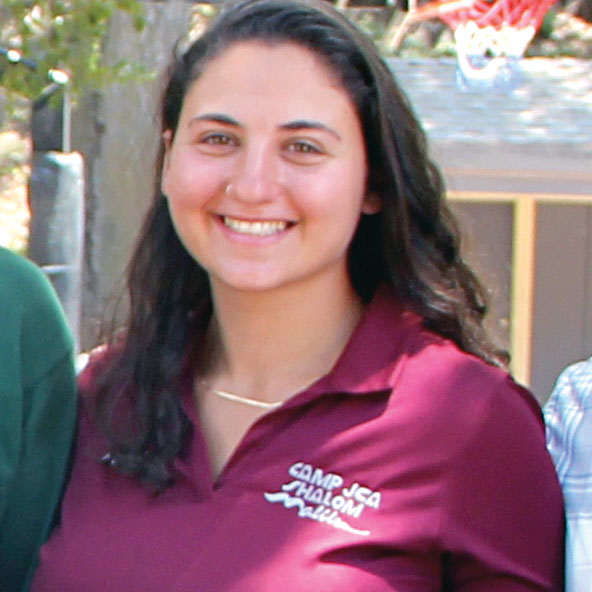
Ariel Wexler

Ariel Wexler was honored as the Summer 2017 Segil Farm and Garden Fellow at Shalom Institute during the second session of Camp JCA Shalom on July 9 in Malibu. The fellowship, funded by Shalom Institute board member Dr. Clive and Larraine Segil, provides a hands-on learning experience about sustainable organic farming infused with Jewish teachings.

Wexler spent the summer sharing her passion for and knowledge of urban farming, Judaism and the environment with hundreds of Camp JCA Shalom campers. She is a graduate of UC Santa Cruz, where she majored in environmental studies with a focus on sustainable agriculture and a minor in Jewish studies.

The Segils own The Little Farm in Encino, and each summer they donate $5,000 to ensure that a staffer is hired to further environmental education and sustainability through a Jewish lens. As a fellow, Wexler’s responsibilities include supervising the summer Shemesh Organic Farm program.

“We are grateful to the Segil family for their ongoing commitment to Shalom Institute’s Shemesh Organic Farm and the establishment of the Segil Farm Fellowship. Ariel was an excellent choice — we learned from each other and could see the impact she had on Camp JCA Shalom campers,” said Shalom Institute Executive Director Rabbi Bill Kaplan.

“The Segils’ generosity enables us to strengthen what we do, grow our farm and educational programs on the environment, which impact thousands of campers and adults who participate in Camp JCA Shalom and the Institute’s year-round programs.”

— Virginia Isaad, Contributing Writer


Moving & Shaking highlights events, honors and simchas. Got a tip? Email ryant@jewishjournal.com.

Moving & Shaking: Daniel Pearl fellows, L.A. Jewish Home luncheon and more Read More »