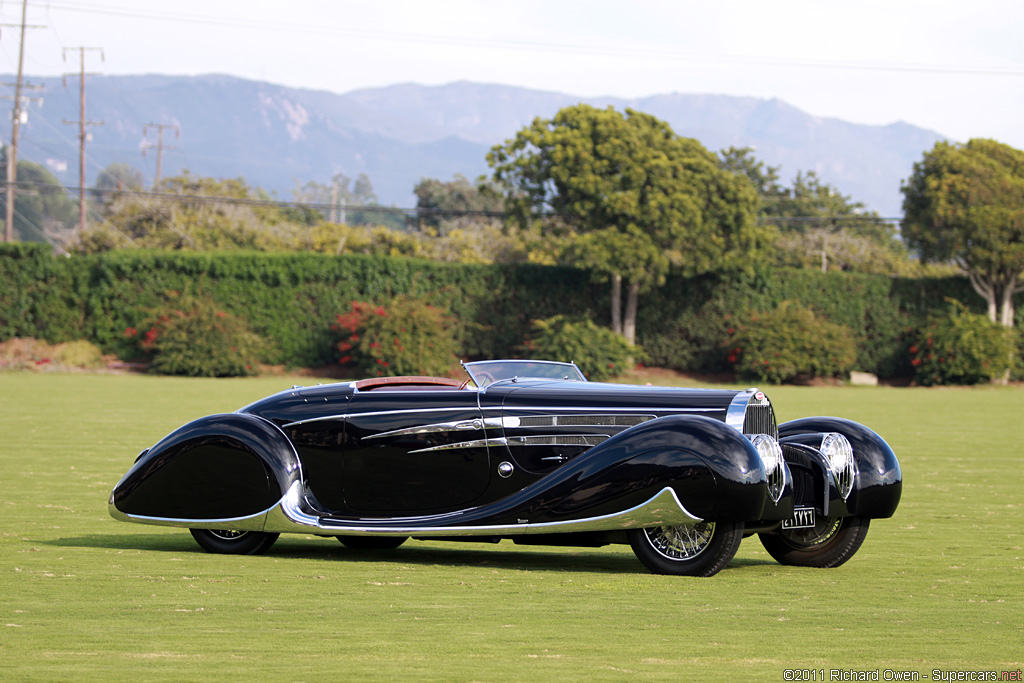
Alongside some of the most significant cars in history, the former Shah of Iran’s 57C Bugatti is now a confirmed showpiece at the new Petersen Museum in Los Angeles, California.
Originally gifted to the “Prince of Persia” Mohammed Reza Pahlavi, the soon-to-be Shah of Iran at the time, the Bugatti was delivered as a wedding gift from the French government. Several governments worldwide sent gifts to Pahlavi, but the Bugatti was the most extravagant.
The body was constructed by Vanvooren of Paris in Figoni et Falaschi style. The car features fully skirted fenders, and a windshield that can be lowered into the cowl with the hand crank mounted under the dashboard. In 1959, the Bugatti was sold out of the Shah’s Imperial Garage. The car produced an impressive 175 horsepower (130kW) from a 3245cc (198 cu in) engine.
The Shah’s Bugatti, however, did stay in the Royal Court of Iran until 1979. Afterwards, the Ayatollahs, who had nearly scraped the car, sold it for approximately 275 US dollars. Fortunately, the buyer had the Bugatti shipped to the USA and saved it in the process. At this point the car was heavily butchered to accommodate an American V8.
Over time, it was owned by several Bugatti collectors, and was completely restored in England in 1983.