
Trees’ rings provide us information about every season.
Could this mean that they are conscious of the facts
that they provide, their arboreal consciousness the reason
for rings we see once they’ve been chopped down by an ax?
It would be lovely to believe in consciousness of trees.
After all man is compared to trees of fields
in Deuteronomy, but this deduction is a squeeze
that hardly to sound scientific thinking yields.
The individual psalms may be regarded as growth rings,
lines from a tree of life that readers love to quoth,
each one of them a prooftext that poetically brings
proof that the past provides the future with new growth.
Providentially perhaps, a link that seems sensational
is present between Zionism that is evangelical
and the book of Psalms, for both are dispensational,
based on a process that resembles tree rings, holy helical.
John Searle (“Can Information Theory Explain Consciousness?” NYRB, 1/10/13, reviewing Consciousness: Confessions of a Romantic Reductionist, by Christof Koch, writes:
A favorite example in the literature is the rings in a tree stump. They contain information about the age of the tree. But what fact about them makes them information? The answer is that there is a correlation between the annual rings on the tree stump and the cycle of the seasons, and the different phases of the tree’s growth, and therefore we can use the rings to get information about the tree. The correlation is just a brute fact; it becomes information only when a conscious interpreter decides to treat the tree rings as information about the history of the tree. In short, you cannot explain consciousness by referring to observer-relative information, because the information in question requires consciousness. Information is only information relative to some consciousness that assigns the informational status.
In “Formed in the Crucible of Messianic Angst: The Eschatological Shape of the Hebrew Psalter’s Final Form” Scottish Bulletin of Evangelical Theology 31.2 (2013): 127-144, Ian J. Vaillancourt, Director of Distance Learning Heritage Theological Seminary, Ontario, Canada, writes an article republished by academia.com which appears to express a dispensationalist interpretation of the Book of Psalms that not only echoes evangelic Zionism but perhaps explains it. Here is a brief excerpt that I quote verbatim below:
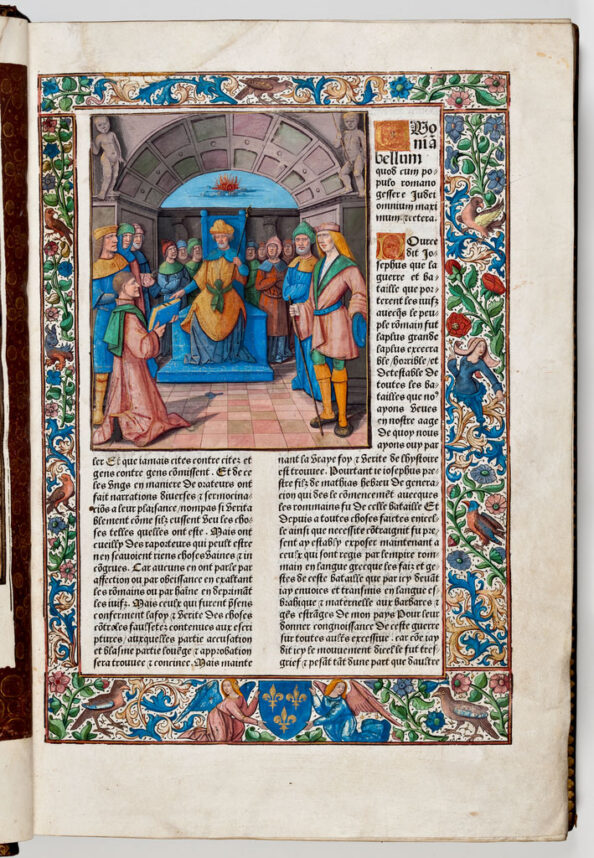
As we begin our study it is important to state what should be obvious, that the book of Psalms was not originally written as a single composition, In fact, the Psalter makes this claim for itself, with the superscription of Psalm 90 suggesting Mosaic authorship, and the content of Psalm 137 clearly pointing to a setting from the Babylonian exile, 850 years after Moses and the exodus. Thus, as the rest of the Hebrew Bible was undergoing its composition, compiling, and editing in stages, so was the book of Psalms. In light of this, [Bruce] Waltke observes that while each psalm does have an original compositional setting, its later use was adapted for a new setting, and its final redaction into the Hebrew Psalter as it now stands also bears editorial fingerprints, before its use in the New Testament offers a fourth interpretive horizon. For Waltke, the intention of the developing text of the Psalter ‘became deeper and clearer as the parameters of the canon were expanded. Just as redemption itself has a progressive history, so also older texts in the canon underwent a correlative progressive perception of meaning as they became part of a growing canonical literature.’ In short, God was the author of the book of Psalms through each stage of its development. If times changed as the psalms continued to be gathered, the Psalter reflected these changes through its various stages and toward its final form; the individual psalms would have been.
The doctrine of dispensationalism may perhaps also be applied to explain why letters of words in a Torah scroll need not be written in the original order of the text, unlike passages in tefillin or a mezuzah, which must be written in the original order. This law was discussed by Rabbi Meir Soloveichik in Episode 152 of his Jerusalem 365 podcasts, “The Torahs of Moses Montefiore and the Revolution of Jewish Philanthropy,” when he mentioned that among the Jewish communities to whom Moses Montefiore, supported by Christians whom he had inspired, sent Torah scrolls, were Jews who had gone to California during the Gold Rush.
Some rabbis have suggested that the waiving of the rule of writing the words of a Torah scroll כסדרן, kesidran, in the proper order, is a concession to practicality on the grounds that it would be statistically almost impossible to write a kosher Torah scroll if כסדרן were a halakhic requirement for a Torah scroll just as it is for tefillin and mezuzot. Interestingly, the key ritual on Passover, festival that celebrates the first liberation of the Jewish people, is called a סדר, seder, which is a ceremonial feast named for the order of the texts and food that are the basis of this ritual. The name of the ritual indicates that they must be performed in their prescribed order, כסדרן, kesidran, like the words of the tefillin and mezuzah which allude to the liberation of the Jews which they celebrate in this ritual.
Gershon Hepner is a poet who has written over 25,000 poems on subjects ranging from music to literature, politics to Torah. He grew up in England and moved to Los Angeles in 1976. Using his varied interests and experiences, he has authored dozens of papers in medical and academic journals, and authored “Legal Friction: Law, Narrative, and Identity Politics in Biblical Israel.” He can be reached at gershonhepner@gmail.com.