Trees’ rings provide us information about every season.
Could this mean that they are conscious of the facts
that they provide, their arboreal consciousness the reason
for rings we see once they’ve been chopped down by an ax?
It would be lovely to believe in consciousness of trees.
After all man is compared to trees of fields
in Deuteronomy, but this deduction is a squeeze
that hardly to sound scientific thinking yields.
The individual psalms may be regarded as growth rings,
lines from a tree of life that readers love to quoth,
each one of them a prooftext that poetically brings
proof that the past provides the future with new growth.
Providentially perhaps, a link that seems sensational
is present between Zionism that is evangelical
and the book of Psalms, for both are dispensational,
based on a process that resembles tree rings, holy helical.
John Searle (“Can Information Theory Explain Consciousness?” NYRB, 1/10/13, reviewing Consciousness: Confessions of a Romantic Reductionist, by Christof Koch, writes:
A favorite example in the literature is the rings in a tree stump. They contain information about the age of the tree. But what fact about them makes them information? The answer is that there is a correlation between the annual rings on the tree stump and the cycle of the seasons, and the different phases of the tree’s growth, and therefore we can use the rings to get information about the tree. The correlation is just a brute fact; it becomes information only when a conscious interpreter decides to treat the tree rings as information about the history of the tree. In short, you cannot explain consciousness by referring to observer-relative information, because the information in question requires consciousness. Information is only information relative to some consciousness that assigns the informational status.
In “Formed in the Crucible of Messianic Angst: The Eschatological Shape of the Hebrew Psalter’s Final Form” Scottish Bulletin of Evangelical Theology 31.2 (2013): 127-144, Ian J. Vaillancourt, Director of Distance Learning Heritage Theological Seminary, Ontario, Canada, writes an article republished by academia.com which appears to express a dispensationalist interpretation of the Book of Psalms that not only echoes evangelic Zionism but perhaps explains it. Here is a brief excerpt that I quote verbatim below:
As we begin our study it is important to state what should be obvious, that the book of Psalms was not originally written as a single composition, In fact, the Psalter makes this claim for itself, with the superscription of Psalm 90 suggesting Mosaic authorship, and the content of Psalm 137 clearly pointing to a setting from the Babylonian exile, 850 years after Moses and the exodus. Thus, as the rest of the Hebrew Bible was undergoing its composition, compiling, and editing in stages, so was the book of Psalms. In light of this, [Bruce] Waltke observes that while each psalm does have an original compositional setting, its later use was adapted for a new setting, and its final redaction into the Hebrew Psalter as it now stands also bears editorial fingerprints, before its use in the New Testament offers a fourth interpretive horizon. For Waltke, the intention of the developing text of the Psalter ‘became deeper and clearer as the parameters of the canon were expanded. Just as redemption itself has a progressive history, so also older texts in the canon underwent a correlative progressive perception of meaning as they became part of a growing canonical literature.’ In short, God was the author of the book of Psalms through each stage of its development. If times changed as the psalms continued to be gathered, the Psalter reflected these changes through its various stages and toward its final form; the individual psalms would have been.
The doctrine of dispensationalism may perhaps also be applied to explain why letters of words in a Torah scroll need not be written in the original order of the text, unlike passages in tefillin or a mezuzah, which must be written in the original order. This law was discussed by Rabbi Meir Soloveichik in Episode 152 of his Jerusalem 365 podcasts, “The Torahs of Moses Montefiore and the Revolution of Jewish Philanthropy,” when he mentioned that among the Jewish communities to whom Moses Montefiore, supported by Christians whom he had inspired, sent Torah scrolls, were Jews who had gone to California during the Gold Rush.
Some rabbis have suggested that the waiving of the rule of writing the words of a Torah scroll כסדרן, kesidran, in the proper order, is a concession to practicality on the grounds that it would be statistically almost impossible to write a kosher Torah scroll if כסדרן were a halakhic requirement for a Torah scroll just as it is for tefillin and mezuzot. Interestingly, the key ritual on Passover, festival that celebrates the first liberation of the Jewish people, is called a סדר, seder, which is a ceremonial feast named for the order of the texts and food that are the basis of this ritual. The name of the ritual indicates that they must be performed in their prescribed order, כסדרן, kesidran, like the words of the tefillin and mezuzah which allude to the liberation of the Jews which they celebrate in this ritual.
Gershon Hepner is a poet who has written over 25,000 poems on subjects ranging from music to literature, politics to Torah. He grew up in England and moved to Los Angeles in 1976. Using his varied interests and experiences, he has authored dozens of papers in medical and academic journals, and authored “Legal Friction: Law, Narrative, and Identity Politics in Biblical Israel.” He can be reached at gershonhepner@gmail.com.
Purim is named after the word “pur,” translated as lots or lottery. Haman thought it was great luck that the Jews were to be killed during the month of Adar, the month in which Moses died. Clearly a sign in Haman’s eyes that the Jews would be destroyed. But as the Talmud seems to indicate, good luck is in the eye of the beholder. The 7th of Adar is also Moses’ birthdate, a great sign of joy for the Jewish people. As Haman is sure his path is filled with success and riches, the question remains: how much of life is really in our control?
The Talmud relays another scene describing an angel taking one drop from the formation of a person and presenting that person to God. The angel asks about the person’s life trajectory. But decidedly missing is a question about this person’s true character. The passage determines that while much is planned in the Heavens, human beings direct their own journeys, either filled with a personal abundance of righteousness or misdeeds. Choosing between goodness and ruthlessness is entirely up to us.
Which means, we have a lot to choose. Even when it feels as if life is completely planned and we have little room to make a difference, building character has larger impact than we might realize. Viktor Frankl wrote, “Everything can be taken from a man but one thing: the last of human freedoms—to choose one’s attitude in any given set of circumstances, to choose one’s own way.”
So choose wisely. And may your path see much mazel: one filled with a richness of compassion and a lifetime of love.
Shabbat Shalom
Rabbi Nicole Guzik is a rabbi at Sinai Temple. She can be reached at her Facebook page at Rabbi Nicole Guzik or on Instagram @rabbiguzik. For more writings, visit Rabbi Guzik’s blog section from Sinai Temple’s website.
A story is told of the great 20th century theologian, Rabbi Abraham Joshua Heschel. One day, as he was teaching a group of rabbinical students, he asked them, “Did you witness a miracle today?”
The students pondered his question. None of them had witnessed the parting of the Sea of Reeds or Revelation of the Torah from Mt. Sinai.
Rabbi Heschel then asked, “Didn’t you see the sun rise this morning?”
For Rabbi Heschel, it wasn’t so much that the sun rose. It’s that humanity has the capacity to witness it (if we look).
I thought about this when snow fell in Los Angeles a couple of weeks ago. You see, the miracle isn’t that it snowed. (Sure, it’s rare.) The miracle is that so many people had wonderment in their hearts because of the snow.
It probably won’t snow in LA again for another 35 years. So where will you find your wonderment in noticing the beauty of nature? It only takes a moment in time to capture the miracles that abound each day!
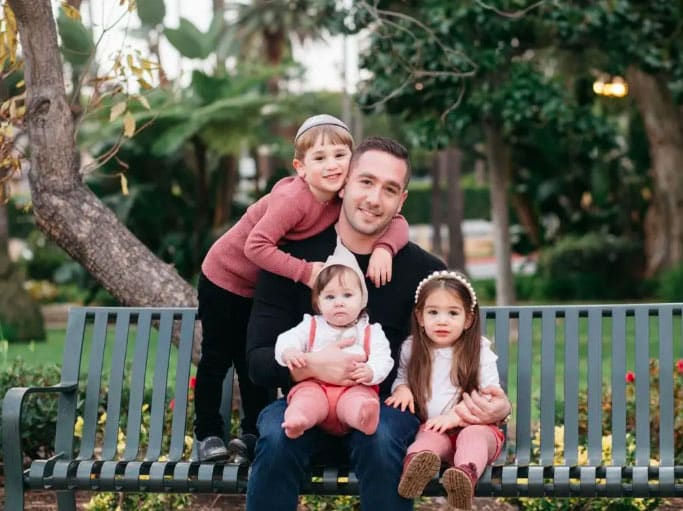
On Wednesday, March 8, the Los Angeles Jewish community was shocked to receive news that Chaim Elefant, a 33-year-old father of four and member of the Pico-Robertson community, had passed away. He left behind his wife, Miriam (Citronenbaum), and four children under the age of 7.
According to The Yeshiva World, Elefant was on a flight from Los Angeles to Fort Lauderdale, Florida when he suffered a heart attack. While crewmembers tried to resuscitate him, they were unsuccessful. The plane made an emergency landing in New Orleans and Elefant was rushed to the hospital, where he died.
At the time, Elefant was flying with two of his business partners at their company. He also went by Michael and was chief sales officer at Art Naturals, a beauty brand.
The Jewish community is now raising money for Miriam and her children via The Chesed Fun. The goal is $3 million; in one day, over $1 million in donations came in to pay for expenses like their mortgage, therapy and the children’s education. The fundraiser states, “Just the thought of writing such words about such a special person is unfathomable and beyond anyone’s wildest imagination.”
Rabbis like Rabbi Daniel Grama, Rabbi Boruch Gradon and Rabbi Shlomo Einhorn, dean of school at Yeshivat Yavneh – where the Elefant children go to school – signed the letter on the fundraiser.
“Chaim was always the type of person who would do anything for anybody.” – Rabbi Shlomo Einhorn
“Chaim was always the type of person who would do anything for anybody,” Einhorn said. “He had a heart of gold.”
The rabbi attended the levaya (funeral) on March 9 at Beth Jacob Congregation, calling it heart wrenching. The levaya, which was posted on YouTube, had 12,000 views in just six hours; some of the speakers broke down while talking about Elefant.
“He was such a zealot for others,” Einhorn said. “He would raise money and find charity for others. Now, his young children are going to need that support.”
Chaim is the son of Lisa and Yaakov Elefant of Brooklyn, New York.
And the Lord said to Moses: “Hew for yourself two stone tablets like the first ones. And I will inscribe upon the tablets the words that were on the first tablets, which you broke.
-Exodus 34:1
Like the first ones
This isn’t Moses’ first rodeo.
He’s been up the mountain.
His hands still chafed from
the hewing of the first stones.
Whose punishment is this
that he has to do it again?
The builders of the calf or
the one who threw the stones?
the words that were on the first tablets
What happened to the rubble?
The broken stone shards.
The pieces of the first set
of ten commandments.
The original artifact.
Did they gather them like
pieces of the Berlin Wall?
Did they skip them
across the Dead Sea?
How many of today’s feet
have unknowingly kicked
a piece across the desert?
the first tablets, which you broke
This is how parents speak.
Reminding children of their sin
driving it home as only words can
as the punishment is doled out.
It’s more for us than for them.
They know what they did.
Chaim Topol, who became known simply as “Topol,” and best known for playing Tevye in the iconic film “Fiddler on The Roof” died at the age of 87 in Tel Aviv.
Topol was born September 9, 1935 in Tel Aviv. His parents — Jacob, a laborer, and Rel (nee Goldman) a seamstress — were Hassidic Jews, and had moved to Palestine from Poland in the early 1930s. The oldest of three children (he had two younger sisters), Topol thought of becoming an artist, but a teacher directed him toward acting. He joined the Israeli army when he turned 18 and became part of the IDF’s Nahal entertainment troupe (he served during the 1956 Sinai campaign, 1967’s Six-Day War, and the Yom Kippur War in 1973). He met his wife, Galia Finkelstein, while in the troupe; they married on October 5th, 1956.
He never thought of becoming a professional actor, but in 1961 co-founded Haifa’s municipal theater, where he performed in plays by Shakespeare, Bertolt Brecht and Ionesco.
His film debut was in the 1961 movie “I Like Mike,” about an Israeli woman who wants her daughter to marry Mike, an American and the son of a rich oil tycoon, and experienced his first taste of stardom playing the title role in the 1964 Israeli film, “Sallah Shabati.” It was one of the most successful Israeli films and showcased Topol as a man in the new state of Israel trying to build a better life for himself and his family. The film won a Golden Globe for Best Foreign Language Film and Topol himself was recognized as Most Promising Newcomer. International fame followed with his role as Abou Ibn Kader in 1966’s “Cast a Giant Shadow,” an epic retelling of Israel’s War of Independence.
He first played Tevye in the 1966 Israeli production of “Fidder,” where he understudied for Shmuel Rodensky and played the role for 10 weeks while Rodensky was ill. A year later, he was cast as the original Tevye in “Fiddler’s” London West End production. He left the production to serve in the IDF during the Six-Day War, returning to London to play the part for 430 performances.
Based on the stories by Sholem Aleichem, Fiddler tells the story of Tevye the milkman in the Ukrainian shtetl of Anatevka. The original Broadway production, which starred Zero Mostel, was a massive hit, running until 1972 after over 3,000 performances. Many well-known actors had played the role, including Mostel, Theodore Bikel, Herschel Bernardi and Harry Goz. But Norman Jewison, who directed the 1971 film adaptation, decided to cast Topol as his Tevye, beating out Mostel, Danny Kaye, Bernardi, Rod Steiger, Danny Thomas, Walter Matthau, Richard Burton, and Frank Sinatra for the part. According to Alisa Solomon’s history of the play, “Wonder of Wonders,” Jewison decided against casting Mostel, the actor most closely identified as Tevye, because he felt Mostel’s performance was too caricatured and larger-than-life. The movie version was both a critical and commercial success, and nominated for eight Academy Awards, including a Best Actor nomination for Topol.
Topol became identified with the role as much as Mostel, playing the milkman for over 3,500 performances, including revivals on Broadway and the West End. His final performance as Tevye was on November 19, 2009 in Boston, Massachusetts. Other notable performances include Dr. Hans Zarkov in “Flash Gordon,” and the James Bond film “For Your Eyes Only.”
Topol’s death was mourned by both his fellow actors and Israeli politicians. Israeli President Isaac Herzog announced Topol’s death, noted the actor’s charity work, including Kfar Nahar Jordan, a fund for sick and disabled children. Prime Minister Benjamin Netanyahu, who awarded Topol The Israel Prize in 2015, tweeted “My wife and I and all the citizens of Israel, with deep pain are parting from our dear Chaim Topol — loved by the audience and one of the great artists of Israel.” Rena Strober, a cantoral student who played opposite Topol as Tevye’s daughter Tzeitel in a 2009 production, told the Journal: “It is a sad day. He was an icon but also just my papa.”
Topol is survived by his wife, Galia and their three children, Omer, Adi and Anat.
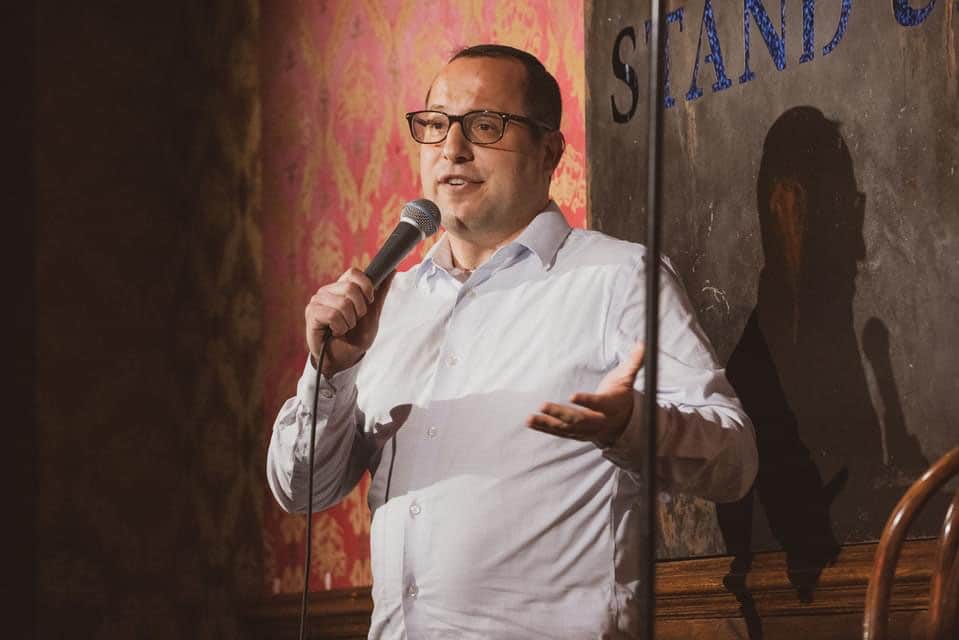
In Eli Lebowicz’s high school yearbook, there was a place where students could write the career they’d have in 10 years. He put “stand-up comedian.” He must have had some kind of prophecy, because sure enough, a decade later, he was living his dream.
Lebowicz, who is big in the Jewish world, grew up watching standup from Rodney Dangerfield and George Carlin. He also loved shows like “Seinfeld” and “Saturday Night Live.”
In the eighth grade, his school would put on “Friday Morning Live,” which was a kosher, kid-friendly version of “SNL,” and he’d act in the sketches. As a teenager, when he worked as a vendor at Wrigley Field, he would entertain customers by doing an impression of Will Ferrell’s Harry Caray from “SNL.”
“I’d say, ‘Hey, we’ve got ice cream, who wants to get crazy? Come on!’” Lebowicz said. “People would give me money without even buying anything because they were so entertained.”
It was at Wrigley Field that Lebowicz witnessed the impact that comedy could have firsthand. One of the ushers asked him to do his impression for a terminally ill customer.
“I did it for him, and he passed away a few weeks later,” he said. “Comedy is such a powerful thing. Who knew that getting kicked out of class for talking or being funny could become a viable career one day, and actually make a difference to people?”
After moving from his hometown of Chicago to New York to attend Yeshiva University, Lebowicz started performing at clubs all around New York City including Gotham, Carolines on Broadway, Stand Up New York and Comix. He opened up for other Jewish comedians like Modi, Elon Gold, Jessica Kirson, Myq Kaplan, Dan Naturman, Joel Chasnoff, and Gary Gulman, and performs at Jewish organizations, corporate gigs, Pesach programs, and bar and bat mitzvahs.
He is known for his very niche but funny jokes about living a Jewish life. Sometimes, they lean dark and sardonic, like this one he posted on Twitter: “News outlets: Antisemites are calling for a national Day of Hate against the Jewish People. Jews: Why is this day different than all other days?”
When Kanye West got in trouble for going on an antisemitic tirade, Lebowicz posted, “Great, now people are gonna say that Jews killed Yeezus.”
He also creates funny memes that are spread on Instagram (@elicomedyagram) and Facebook, like one where he put up a pair of sneakers that look like bread and said, “They had to hurry out of Egypt but didn’t have time for the sneakers to bake.”
To get into the Adar and Purim spirit, Lebowicz said, “When the Megillah ends, the King levies taxes on everyone. When it came to death or taxes, God could only save the Jews for one of them.”
Then, he offered up a Passover joke, since it’s right around the corner: “Everyone thinks we’re celebrating the fact that the Jews left Egypt, but really we’re just celebrating the fact that we left somewhere on time.”
“You can make someone’s day better when you make them laugh.
“There is a lot of Jewish humor that’s really untapped,” Lebowicz said. “There is material that’s very broad and Jewish, like bagel humor, but that doesn’t really get to the crux of it. My goal is to show that you can be clean and funny and not have fifth grade Rebbe humor. All the time, people ask me if they’re worried someone is going to steal my material. I say they have to have 16 years of yeshiva education first, so good luck.”
Lebowicz has had his fair share of interesting experiences doing standup. One time he performed at the opening of a sushi restaurant.
“I got paid in the form of a sushi gift card, which is definitely a Jewish payment method,” he said.
During the pandemic, when he had to stop performing live, he did over 100 shows on Zoom, and most of them went pretty well. But during one of them, while he was doing standup, somebody removed him from the Zoom room.
“They said they had technical difficulties,” he said. “That was a real low point. That will definitely make you reevaluate your life decisions.”
At the start of 2023, Lebowicz went full-time with comedy, and is planning on doing more live shows and podcasts, as well as contributing jokes to local papers like The Jewish Press in New York. Before, he worked in marketing, and was an account manager at B&H Photo Video, a Satmar Hasidic-owned company, for four years.
On Fridays, B&H employees would order Bravo Pizza, and one time, Eli received a funny email.
“It was addressed to me and 25 other Elis at the company, and was a blank email with the subject line, ‘Somebody ordered pizza delivery. Eli, was this you?’” he said. “I emailed every Eli back, ‘Describe working at a Jewish company in one email.’”
Lebowicz believes that when he performs comedy, he’s doing a good deed – after all, in one Gemara teaching, the sage Rav Yehoshua ben Levi is walking in the market and spots Eliyahu HaNavi, who says that a man who makes other people laugh will merit a high place in Olam Haba.
“When I perform, people come up to me and say, ‘I don’t normally laugh’ or ‘I haven’t laughed like that in a while,’” he said. “You can make someone’s day better when you make them laugh. So I’m definitely taking that piece of Gemara up there with me when it’s my time.”
To catch Eli Lebowicz live, check out his show “Remind Me After Shabbos” at Stand Up! New York on Thursday, March 16 at 8 p.m.
It is rare that the Jewish community should thank an antisemite, but the case of Saadah Masoud is an exception. Masoud’s actions, arguments and stunning admissions, detailed in his federal hate crimes sentencing hearing last week, prove once and for all that some “anti-Zionism” is really nothing more than antisemitism. Masoud and his friends are the exact reason why numerous states across the country are passing antisemitism bills, and his lawyers’ assertions in federal court are why Congress also needs to act.
On at least three separate occasions, Masoud and his accomplices violently assaulted innocent visibly Jewish men, one of whom they sent to the hospital. Masoud’s attorneys actually had the audacity to argue that he did not target these innocent American Jewish people because he is an antisemite, but rather because he was seeking to “promote social and political goals.” They admitted he should not have used violence, but claimed he did so because he feels so “deeply” about the “occupation of Palestine” and apparently just lost himself in the moment(s).
Incredibly, because there is currently no federal definition of antisemitism to which prosecutors can point when assessing the intent behind discriminatory action or hate crimes, that excuse might even have worked, just as it has in other similar instances. But this time, thank God, there was undeniable evidence. In their filing, heroic prosecutors showed the Court the defendant’s messages, in which he and his friends conspired in advance to commit the attacks on Jews. In one instance, Masoud actually warned them, “Remember, don’t chant out jews, it’s the Zionists,” in an apparent attempt to preserve the very argument his lawyers later tried to make. In private, however, he and his friends repeatedly dropped the “anti-Zionism” veil, and referred to their victims and their would-be victims as “Jews.” During one of the attacks, Masoud himself forgot to heed his own warning, asking Victim 3, “Are you a f—ing Jew?” before he punched him in the face.
And so Masoud will go to prison, as he should. But the question remains: What if he had been smart enough to hide his venomous hatred for Jews instead of putting it in writing? When a Chinese American is attacked because of someone’s hatred for China, it is readily understood as an act of racist or national origin-based discrimination. How could anyone argue that assaulting an innocent Jewish person because you don’t like the Jewish State is somehow “political” and not antisemitic?
The answer can be found in recent surveys that show that roughly half the U.S. population does not know what “antisemitism” means, while over 85% actually believe at least one anti-Jewish trope. Those numbers explain why authorities have had so much trouble enforcing existing laws without a definition. Bad actors, like Masoud, regularly take advantage of this massive knowledge gap: They commit heinous acts of discrimination and violence against Jewish people, then claim it was not antisemitism, but some more socially acceptable bias, and that charges of antisemitism are an attempt to somehow “silence critics of Israel.” So thank you, Masoud, for your service in exposing that particular lie, and to your lawyers for clarifying why we need a federal bill giving authorities a standard to use as evidence of intent for unlawful antisemitic conduct or hate crimes.
To be clear: Such a bill would not affect an antisemite’s ability to spread their hateful message, and would not ban or limit speech. It would only prevent antisemites from getting away with unlawful discriminatory actions. Unlawful discriminatory conduct can range from illegal hiring, firing or housing decisions, to hate crimes and discriminatory harassment. None of that is protected under the First Amendment. Nor would such a bill somehow “chill” protected speech. A unanimous Supreme Court ruling in Wisconsin vs. Mitchell (1993) held that when it comes to evaluating discriminatory actions “The First Amendment does not prohibit the evidentiary use of speech to prove motive or intent.” That is just how antidiscrimination laws always work.
Such a bill would not affect an antisemite’s ability to spread their hateful message, and would not ban or limit speech.
You don’t have to look far to understand why this bill is so desperately needed. Just this week, a judge in San Francisco dropped hate crime charges against a man who walked into a synagogue near his house and started firing blanks at a group of elderly Jewish people who had gathered for a Torah study session. The man has a documented history of posting antisemitic propaganda and antisemitic slurs, including photos of himself dressed as a Nazi soldier. The defense countered that he was a “history buff” with an interest in military uniforms, and that he wasn’t antisemitic because he himself was a non-affiliated Jew. (For the record, Jewish people can also be antisemitic.) Witnesses said that he uttered the words “Mossad” and “Haifa” during the attack. But because there is no legal standard definition to point to, the judge found “no substantial evidence of bias” against the Jewish community. This is why these bills are important.
In terms of which definition to use, there is really only one answer. The International Holocaust Remembrance Alliance (IHRA) definition of antisemitism is already used by several departments within our federal government, and has been embraced by Presidents of both parties, over 30 U.S. States, dozens of countries worldwide, and (perhaps most importantly) the vast majority of Jewish people and organizations across every spectrum, who believe that it best captures their shared lived experience of how antisemitism manifests. It is the onlynear universally accepted definition of antisemitism that there is or ever has been, and it has proven to be an essential tool for identifying contemporary manifestations of anti-Jewish bigotry or hate.
The IHRA definition explicitly states that criticism of Israel, like any other country, is not antisemitic. And yes, it alsoincludes some examples of anti-Zionism that can, sometimes, contextually, cross the line into antisemitism: For example: holding Jews collectively responsible for the actions of the Jewish state. The reason the specific Israel-related examples are provided in the IHRA definition (and are clearly so important) is explicitly not because all criticism of Israel is antisemitic, but precisely because there are those who claim that nothing can ever cross the line. Unfortunately, that is where you consistently find bad actors, like Masoud, who hide their vile antisemitism behind the thinnest of anti-Zionist veils.
Of course, there are some fringe groups even within the Jewish community who do not like the IHRA definition. But their concerns are (allegedly) all about the dangers of using IHRA as a speech code, and in that sense, they are correct: The IHRA definition should never be used as a speech code because regardless of how you feel about the definition’s examples and whether they cross the line into antisemitism, even antisemitic speech is protected under the First Amendment. But despite how anyone feels about the IHRA definition generally, or how it could theoretically be used in other contexts, thebill proposed here does not limit any speech at all. Like the state antisemitism bills that are already in place, thisbill would onlyuse the IHRA definition to assess antisemitic motives behind already unlawful conduct. It is demonstrably not about protecting Israel; it about protecting Jews. The problem is that Jews, even those who do not support Israel, are often targeted for discrimination because antisemites like Masoud hold them accountable (or pretend to hold them accountable) as an excuse to attack them for a perceived connection to the Jewish state. The IHRA definition makes it clear that doing so is not “social or political”—it is antisemitic.
Congress should act now, in a bipartisan manner, to make sure that Masoud and people like him can no longer pretend that hatred for Israel is an excuse to unlawfully discriminate against or violently attack a Jew. And unless anyone is planning to commit acts of discrimination or hate crimes against Jewish people, such a bill should face zero opposition.
Dr. Mark Goldfeder is Director of the National Jewish Advocacy Center.
Zack Plotzker, a young husband and father of three, was in desperate need of a kidney. The ex-Angeleno, who had recently moved to Las Vegas, was asking his friends in both California and Nevada if they could spread the word and help him find a donor.
Plotzker connected with Renewal, an organization that provides financial and moral support to kidney patients, to see if they could locate a donor. People in the Jewish community with blood types A and O swabbed to see if they would be a match for Plotzker.
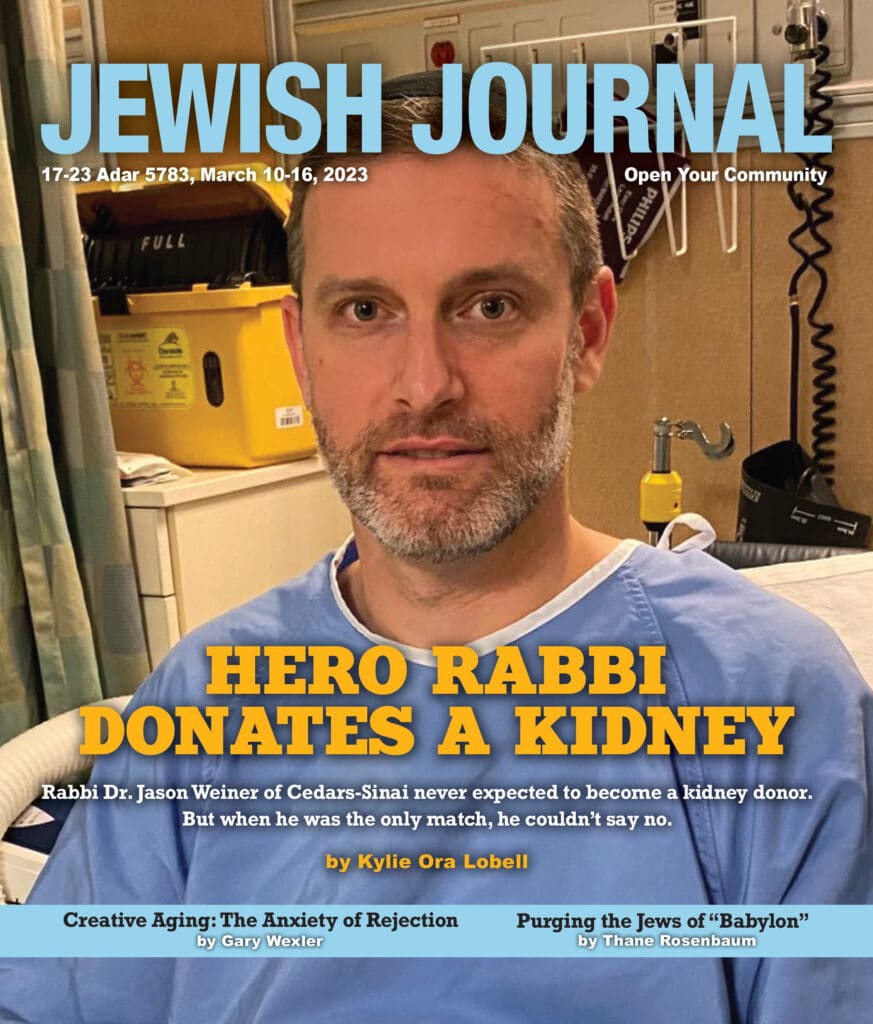
One of those who participated was Rabbi Dr. Jason Weiner, senior rabbi and director of the Spiritual Care Department at Cedars-Sinai Medical Center and rabbi of Knesset Israel Synagogue of Beverlywood. He knew Plotzker, and wanted to see if he could be of assistance.
“I said, ‘I guess I’ll swab, why not?’” said Weiner. “Maybe I was a match for him.”
Weiner ended up not being a match, but Plotzker eventually found a donor and received his kidney at Cedars-Sinai.
“I met the man who donated to Zack, and he said it changed his life in a significant way,” Weiner said. “Over the years, I had some friends, mostly rabbis, who donated kidneys, and I was always very impressed with them.”
Weiner didn’t know how he’d feel if he matched with someone. Would he be able to give his kidney as well?
Still, Weiner didn’t know how he’d feel if he matched with someone. Would he be able to give his kidney as well?
Six months ago, he suddenly had to answer that question. Renewal – which found that Orthodox Jews make up about 18% of the living altruistic kidney donors in the U.S. despite being only 0.2% of the population – called him up and told him he was a match for someone.
“They asked me if I remembered swabbing a year-and-a-half ago in Los Angeles,” Weiner said. “I was terrified and concerned. I thought, ‘Oh great. What did I get myself into?’”
Renewal told Weiner that he had matched with a 73-year-old woman who was a grandmother and elementary school teacher in Toronto. Her family and Renewal were searching all over the world for a match, but they couldn’t find anyone for her. They were afraid they were going to lose her.
Kidney transplant patients are categorized by risk. “She was at 100. One hundred percent of people wouldn’t match for her,” Weiner said.
Weiner saw that finding the match was miraculous. And while he was worried about the possibility of going through surgery, he got his blood work taken at Cedars to see if he really was such a good fit.
“The hospital in Toronto told me I probably wasn’t a match, because the woman had very rare antibodies and a rare HLA type,” he said.
Two weeks after Cedars sent the blood work in, Weiner received a call.
“They told me they were shocked, but I was a perfect match for this recipient,” he said.
Now, Weiner, a husband, a father of five and a rabbi and chaplain at the hospital as well as his own congregation, had a huge decision to make. He needed to carefully weigh his options and decide if this was for him.
Not only would he have to have his kidney removed, but he’d also have to fly to Toronto for an evaluation, and then again for the surgery, take several weeks off from work at both of his jobs and find caregivers for his children while he and his wife Lauren were away.
Weiner got a blessing from Lauren, who would be taking care of him and their children while he was in recovery. He then talked to family members, rabbis, friends of his who had donated a kidney and the leadership of the Cedars kidney donation department.
“They were very open about the risks, but they also talked about how transformative and safe it is, and how much I could really help someone and serve as a role model for others,” he said.
The recipient, Bonnie Lilien
The risks that concerned Weiner included a possible infection, negative reactions to the anesthesia, or increased risk of future failure of his other kidney and heart failure. From what the doctors at Cedars told him, though, the risks were extremely low.
The doctors also said that he wouldn’t be able to play contact sports anymore, because if he got hit really hard, his remaining kidney could become damaged. Weiner made sure that no one in his family had had kidney issues in the past. One of the benefits of the surgery, he discovered, was that if someone in his family ever needed a kidney, they would get put on the top of the list.
Weiner looked into the halacha on organ donation while deciding as well. He’s extensively studied Jewish medical ethics, has a doctorate in clinical bioethics and wrote three books on Jewish law and medicine: “Jewish Guide to Practical Medical Decision-Making” (Urim Press), “Guide to Observance of Jewish Law in a Hospital” (Kodesh Press) and “Care and Covenant: A Jewish Bioethic of Responsibility” (Georgetown University Press).
“The basic issue is that you’re not allowed to risk your life even to save someone else’s. But the lower the risk and the higher the benefit, the more it’s encouraged. We can’t require it of someone, but if they are willing to do it, it’s a huge mitzvah.” – Rabbi Jason Weiner
“The basic issue is that you’re not allowed to risk your life even to save someone else’s,” he said. “But the lower the risk and the higher the benefit, the more it’s encouraged. We can’t require it of someone, but if they are willing to do it, it’s a huge mitzvah.”
Taking everything into consideration, Weiner knew what he had to do.
“I had been praising people who did it for so long,” he said. “Could I live up to what I believed was right? There was a human being whose life I could save. No one else could. So I decided to say yes.”
Together with Lauren, Weiner figured out all the logistics. He got the time off work and the support of his family and friends, colleagues at Cedars and his congregants at Knesset Israel.
The first week of February, Weiner and his wife flew into Toronto, where it was 14 degrees below zero. They got set up in a hotel down the street from the hospital; Lauren would have to walk back and forth because the surgery was on Friday, and Weiner would be recovering during Shabbat.
On the walk over to the hospital with Lauren, right before his surgery, the rabbi started crying.
“I wasn’t afraid,” he said. “I tried to go into it with joy, and was praying to God that everything would go smoothly. I prayed for the recipient, and that this should be a merit for my family, my children and my community.”
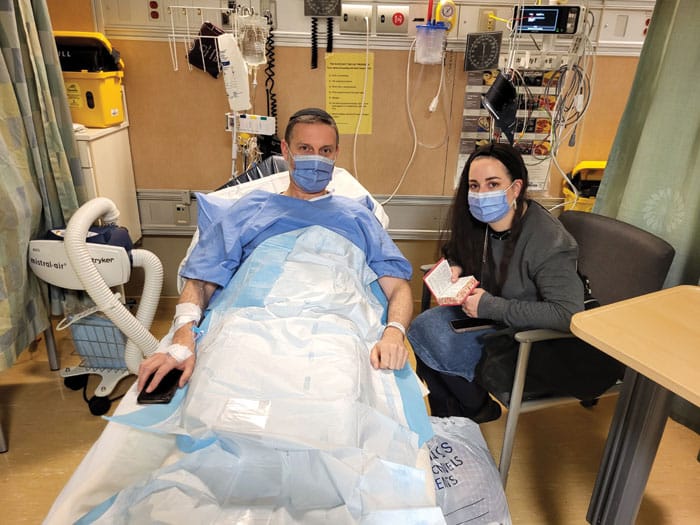
Prior to surgery, Weiner received a blessing from Rabbi Shlomo Miller, one of the leading rabbis in Toronto. He also posted a picture of himself from his hospital bed and wrote, “Today I am donating a kidney. I don’t want praise or accolades (or to be told I’ve lost my mind … I’m already somewhat aware of that). I would, however, appreciate your prayers. My Hebrew name is Yehudah Leib ben Sarah, and my recipients name is Bleema Tsiril bat Shayna Frimid.”
On Twitter alone, his post was viewed 171,400 times and received over 5,000 likes. It also blew up on Instagram, Facebook and LinkedIn, with people writing things like, “Godspeed. God bless you both” and “What a wonderful gesture to save someone’s life.”
Though he received so much engagement from the post, it was never his intention to tell everyone what he was doing.
“I didn’t really want to publicize it,” he said. “I felt like it was private and a chesed (kindness), and I was just trying to help someone. That’s the ideal, when it’s done privately and quietly.”
However, rabbis he knew encouraged him to talk about it publicly. “Since it really is saving a life, and requires people to want to do it, they said I could be a positive role model,” he said.
Weiner’s surgery went well. He was in the hospital at the same time as the recipient, whose name is Bonnie Lilien. Her surgery went well, too, and while they were recovering, they had a chance to meet.
“She gave Lauren a big hug and told me how her antibodies were changing and that every day that went by, there were less and less odds that she would find a match,” he said. “She also joked that she’s part rabbi now.”
Lilien, who is at home with her husband and healing from the surgery, said her new kidney is “working like a charm. I have Rabbi Weiner to thank for that, and he’s my hero.”
The grandmother had been relying on her faith for years, asking God to help her find a donor.
“I prayed so hard for this to happen,” she said. “I believe that God heard my prayers and those of the many friends and family who had me on their Mi Sheberach (prayer for the sick) list. My Cantor, Simon Spiro, prayed for me daily. In my synagogue Shabbat’s services, there is the opportunity to go up directly to the Torah and say your own Mi Sheberach. I was up there at every service.”
At times, she said, it was hard to stay positive.
“I needed to believe in miracles, and a miracle happened.” – Bonnie Lilien
“My advanced kidney disease meant having to confront my own mortality. Nonetheless, I kept a smile on my face, so as not to worry others. I needed to believe in miracles, and a miracle happened.”
Facilitating miracles is what Renewal is all about. They have arranged 900 kidney transplants for patients from age 2 to 86, and all the services they provide are free.
Facilitating miracles is what Renewal is all about. They have arranged 900 kidney transplants for patients from age 2 to 86, and all the services they provide are free. There are currently over 300 patients awaiting transplants, but the organization holds cheek swab events year round to find donors.
Their next event in LA is on Saturday, March 11, after Shabbat at 8:30 p.m. It will be at Young Israel of Century City, where Weiner used to be associate rabbi. He will be giving his first public talk about his experience as a donor.
Menachem Friedman, program director at Renewal, said he was surprised that Weiner went to the swab event in 2021.
“We are in awe that a person like Rabbi Weiner, who is so busy doing good things all day, made an effort to swab and see if he was a match,” he said. “He’s the one person who could have made excuses. He’s so busy. We’re honored to have been part of this process.”
A few weeks out from his surgery, Weiner is feeling much better. The first five days were tough; he was nauseous and in a lot of pain, and he could barely move. But now that he’s up and able to walk, his recovery is going much quicker.
When the rabbi hits the six-week mark, he can go back to running, his favorite hobby, again. Just last year, he participated in the LA Marathon, which he completed in four hours.
“I’ve been walking, and that’s really helpful, but I have to be a little less active,” he said.
Looking back on his experience, Weiner said he has no regrets.
“It’s a really amazing feeling, and it’s unlike any other chesed I’ve done for anyone,” he said. “It changes the way I see myself and I feel like I practice what I’ve been preaching. I’ve met so many people who are in need, and I hope I can make a difference. If I wouldn’t have known other people who did it, I would not have done it.”
Weiner is now in a WhatsApp group of people who have given their kidneys to a recipient as well. His friend sent out an article to the group about scientists trying to grow human organs in pigs, which would eliminate the need for donors.
“I thought people in the group would say, ‘Oh man, I wish they invented that sooner,’” Weiner said. “Instead, everyone said, ‘Wow, thank God we had the opportunity to do this before they invented that.’ It’s such a merit to be able to do that for someone.”
He continued, “I’m so thankful I was able to do it.”
Book excerpt from ‘Care and Covenant: A Jewish Bioethic of Responsibility’ by Jason Weiner
Developing a world built on the values discussed in this book is a task that cannot be achieved by any one individual or even one generation alone. As our sages remind us, “It is not for you to complete the task, but neither are you free to stand aside from it.” While there are limits to how much any individual can accomplish, we are charged with using our own personal gifts and place in the world to contribute as much as we can to our society.
The message of this book is simple but important. How we see the world and our role in it can have a huge impact on the decisions we make and our interactions with others.
The message of this book is simple but important. How we see the world and our role in it can have a huge impact on the decisions we make and our interactions with others. Approaching life with a desire to give and a sense of responsibility for serving others can transform all of our waking moments into dreams come true. Conversely, when one focuses narrowly on their own rights and taking from others, life can become a nightmare for everyone. A Jewish bioethic of responsibility can be actualized both individually and societally.
This change in perspective can have huge ramifications. For us, perhaps the greatest reward is the realization that we are here to give, and in doing so, we live a life of blessing.
Each chapter in this book provides concrete examples of how a compassionate, duty-based approach can be implemented in contemporary health care. Certainly, these same values can be applied to many more areas of life, helping to make the world a better and more just place for all. This goal can be achieved by asking the question “What is my obligation?” whenever challenges arise, rather than “What is owed to me?” This change in perspective can have huge ramifications. For us, perhaps the greatest reward is the realization that we are here to give, and in doing so, we live a life of blessing. This is why the influential psychiatrist and Holocaust survivor, Viktor Frankl, recommended that the Statue of Liberty on the East Coast be supplemented by a “Statue of Responsibility” on the West Coast.
A Jewish respondent to a qualitative study about COVID-19 vaccines made the claim that “the Torah does not require people to endanger themselves for other peoples’ benefit.” I hope this book has successfully made the case that such a statement is categorically false.
Rabbi Yekusiel Yehuda Halberstam, scion of the famous Sanz rabbinic dynasty, lost his wife and all eleven of his children in the gas chambers of Auschwitz. In July of 1944, Rabbi Halberstam was forced to march to the infamous Dachau death camp, during which he and the other frail inmates were made to walk twenty kilometers a day. Those who could not keep up were instantly shot by the SS guards. Indeed, one day Rabbi Halberstam was shot in the shoulder and lost a considerable amount of blood, but seeking medical attention was not an option. As he was losing his strength, he took on himself a vow to God: “If I merit to survive, I will garner all my energies to build a hospital in the Holy Land, where every human being will receive the same dedicated medical care irrespective of nationality or creed.” At that moment he noticed a tree with lush green leaves by the side of the road. He reached up, plucked a large leaf, and with his last bit of strength managed to place it on his wound.
The rabbi survived. He never had the opportunity to observe the traditional Jewish mourning rituals for his family because, despite all that he had lost, he felt that the duty to protect and care for those still alive took precedence; thus, he became a leader to the suffering Jews in the displaced persons camps, inspiring them not to give up. After the war he initially went to Brooklyn, New York, where he took it on himself to establish schools, care for orphans, perform weddings, and start a synagogue primarily for other Holocaust survivors in the Beth Moses Hospital.
The prayers in that synagogue were known for being very intense, with no talking whatsoever, and individuals frequently weeping aloud. One Shabbat morning in the summer of 1952, the Torah reader began to chant the weekly portion, which included the section known as the “chastisement” (tokhechah), detailing the curses that would befall the Jewish people. It is customary to chant that section very quietly and rapidly, but that morning the rabbi suddenly called out, “Hekher!” (louder!). The Torah reader couldn’t believe that the rabbi would want him to read that section loudly, so he continued to quickly whisper it in an undertone, but the rabbi demanded, banging on the table, “Ikh hob gezogt hekher!” (I said louder!). People began to tremble and cry, so the rabbi explained, “Let the Master of the Universe hear! We have nothing to be afraid of. We have already received all of the curses — and more. Let the Almighty hear, and let Him understand that the time has come to send the blessings!”
Once the prayers had concluded, the rabbi lovingly explained to his congregation that the blessings would come, as God had promised, but that these must result from their own initiatives to be a blessing to the world. He then explained to his congregants that in the coming week, they were to pack their bags one last time and move with him to the Land of Israel, where they could help support the fledging community of their fellow survivors in Netanya.
Soon after Rabbi Halberstam and his followers arrived in Netanya and began building a community, the rabbi noticed that this rapidly growing city had no community hospital. It was then that the rabbi took the initiative to uphold the vow he had made during that fateful march a decade earlier. In 1958 the cornerstone was laid for a modern general hospital to serve the entire city, thereby fulfilling the rabbi’s pledge to be a blessing. Today that hospital, Laniado, is an important regional medical center.
Rabbi Halberstam was clearly an extraordinary person, but his story — and the ethic of compassionate responsibility developed in this book — can remind us, in the words of Rabbi Jonathan Sacks, that “by making extraordinary demands, [Judaism] inspires ordinary people to live extraordinary lives.”





 Los Angeles poet Rick Lupert created the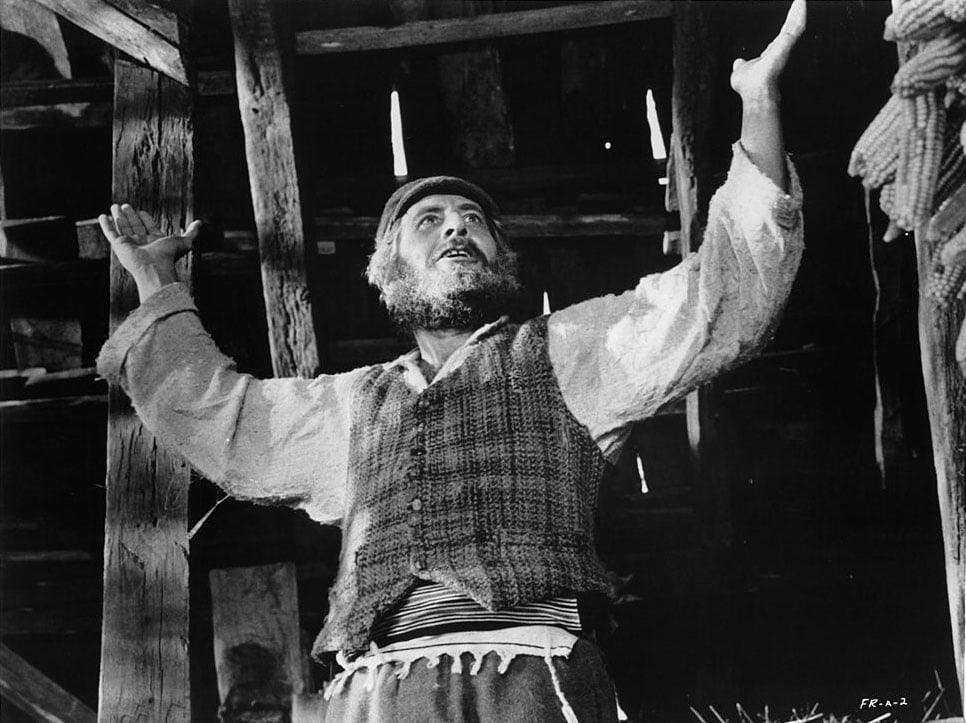


 Developing a world built on the values discussed in this book is a task that cannot be achieved by any one individual or even one generation alone. As our sages remind us, “It is not for you to complete the task, but neither are you free to stand aside from it.” While there are limits to how much any individual can accomplish, we are charged with using our own personal gifts and place in the world to contribute as much as we can to our society.