

The question we chose for a headline sounds hysterical, or theatrical, but it is painfully plausible. Israelis don’t want another war; they also don’t want the last one to have been for nothing. That tension — between exhaustion and resolve — is the seam Hezbollah (and Hamas) keep trying to pry open. Their method is consistent: wait out Israeli stamina, exploit international impatience, rebuild quietly, harass, fight, repeat. When democracies display fatigue, disciplined militias file it away as a plan.
War-weariness is human and universal. Democracies merely make it visible. After months of gruesome images from Gaza, the world’s appetite for confrontation collapsed faster than the logic of deterrence could be restored. Our enemies observed the arc: outrage, then calls for “restraint,” then a new proposal for “understandings,” then the cameras move on. They know they can rely on such a curve. When the public wants quiet and diplomats crave closure, the temptation is to pretend a problem has been managed when it has only been deferred.
Let’s focus on Lebanon. The war with Hezbollah that ended a year ago — one component of a larger war — was not a freak event. It was the bill for years of neglect. Following the 2006 war an agreement was reached, and almost immediately breached. Israel outsourced responsibility to “arrangements” in which it did not believe, tolerated the steady accumulation of rockets and precision kits, and prepared for a next round. Having paid dearly to relearn basic truths on Oct. 7, 2023, Israel gradually realized that it will have to strike in the north. The result was a resounding success: Hezbollah suffered heavy losses in manpower, equipment and prestige. It was tamed, so it seemed.
That is when a new understanding was reached, better than the one of 2006 — that was the promise. But Middle East promises tend to be broken, and it is no longer clear that the current understanding is truly better than the one of two decades ago. “The Lebanese military isn’t interested or ready to confront Hezbollah militarily,” Randa Slim, a fellow at the Johns Hopkins University-based Foreign Policy Institute, told The Wall Street Journal. “We are stuck in this gray area where the Lebanese government says it has taken the decision to disarm Hezbollah … But there is nothing, no concrete plans.” In other words, the lesson wasn’t internalized: If you prefer a contained confrontation to a regional war, help restore red lines before the next accumulation cycle matures. If you want Lebanese civilians to be safe, back a Lebanese state that actually enforces what it pledges. If you want “restraint,” make disarmament real and smuggling of weaponry hard. Do not reward a strategy of “lose the war, keep the guns, wait for the monitors to tire.” It will repeat, because it works.
Some will protest that talk of preemption — to be blunt, an Israeli attack on Hezbollah — risks escalation. That worry is understandable. But there is a difference between being trigger-happy and enforcing tripwires you set for a reason. Deterrence is maintenance: if you never service the system, it fails when you need it most. Early, limited actions — against specific capabilities, in response to specific violations — are not a march to war. They are how you keep a small fire from becoming a regional blaze. Precision and predictability reduce miscalculation; permissiveness invites it. On Israel’s northern front, the objective is not theatrical victory. It is practical stability: enforce the buffer, degrade rearmament and impose a price for violations high enough to make time an enemy of the enemies. Israel can live with a tamed enemy. It cannot live with a rearming one.
Practically, that means steady, credible pressure rather than rhetorical overreach. No need to vow to erase Hezbollah. Better to make rebuilding a losing proposition: shipments that do not arrive, workshops that do not reopen, commanders who do not sleep well and political patrons in Beirut and Tehran who pay heavy price for every breach. Couple this with a diplomatic effort to make the world understand the action as prevention rather than escalation.
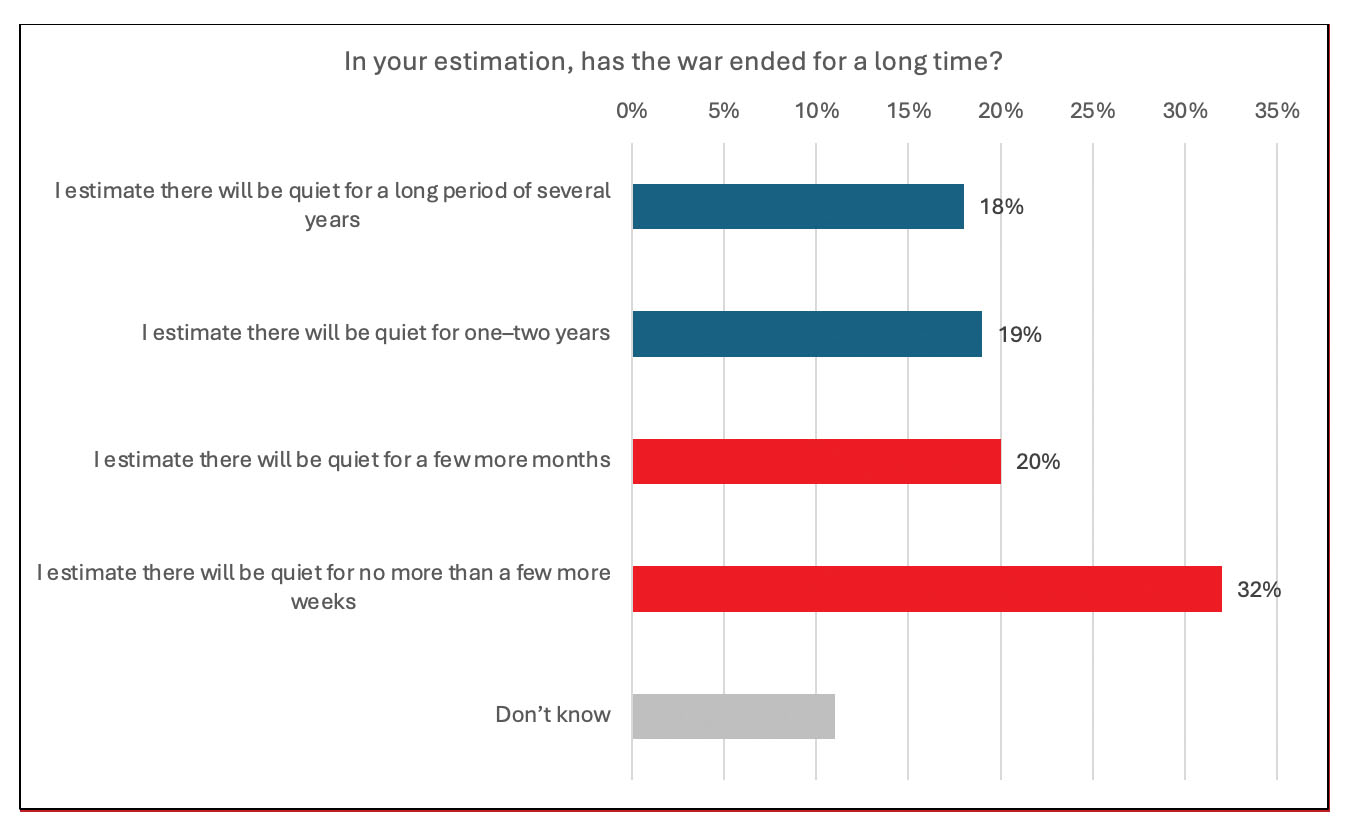
Israelis themselves are ambivalent, as they should be. Recent polls show many of them assume another war is coming within months. It could be a renewed war in Gaza, or a war with Iran or one in Lebanon. One has to wonder: is this a sign of unhealthy addiction to endless fighting? Are we unable to imagine life without conflict? This is one possible option, but there’s another option: we are much more realistic than others having learned a lesson of caution the hard way.
Are you ready for another war? We would be irresponsible not to. War fatigue is real; so are missiles. The task is to keep the first from empowering the second. If we do this well – firmly but proportionately, with eyes open and aims limited – the war that now feels inevitable in our surveys may remain where it belongs: in the cupboard of unrealized potentialities.
Something I wrote in Hebrew
Following Mamdani’s victory in NYC, here’s what I wrote:
Almost two years have passed since Jamaal Bowman, a congressman from New York was defeated in the Democratic primaries… Bowman was one of the few members of Congress who, even in the face of the Oct. 7 massacre, insisted on voting against resolutions backing Israel…. Bowman was unseated by a rival who received financial and political support from pro-Israel organizations. He was not ousted because he was the most prominent of Israel’s opponents in Congress … He was ousted to send a message: an anti-Israel vote is a dangerous vote … Zohran Mamdani proved otherwise. If there is a hard message for Israel in his election as mayor of New York, this is it. It turns out that even in the largest Jewish city in the world … an American can be elected with an unmistakably anti-Israel label pinned to his lapel.
A week’s numbers
Are you ready for another war? Israelis seem ready… (JPPI numbers)
A reader’s response
Albert Ezoun: “Do you expect many Jews to make aliyah because of antisemitism in America?” My response: Happily, the U.S. isn’t yet a dangerous place for Jews – and sadly, Israel isn’t yet a completely safe place for Jews. So, no, I don’t expect a dramatic surge in aliyah, maybe a slight growth.
Shmuel Rosner is senior political editor. For more analysis of Israeli and international politics, visit Rosner’s Domain at jewishjournal.com/rosnersdomain.

































