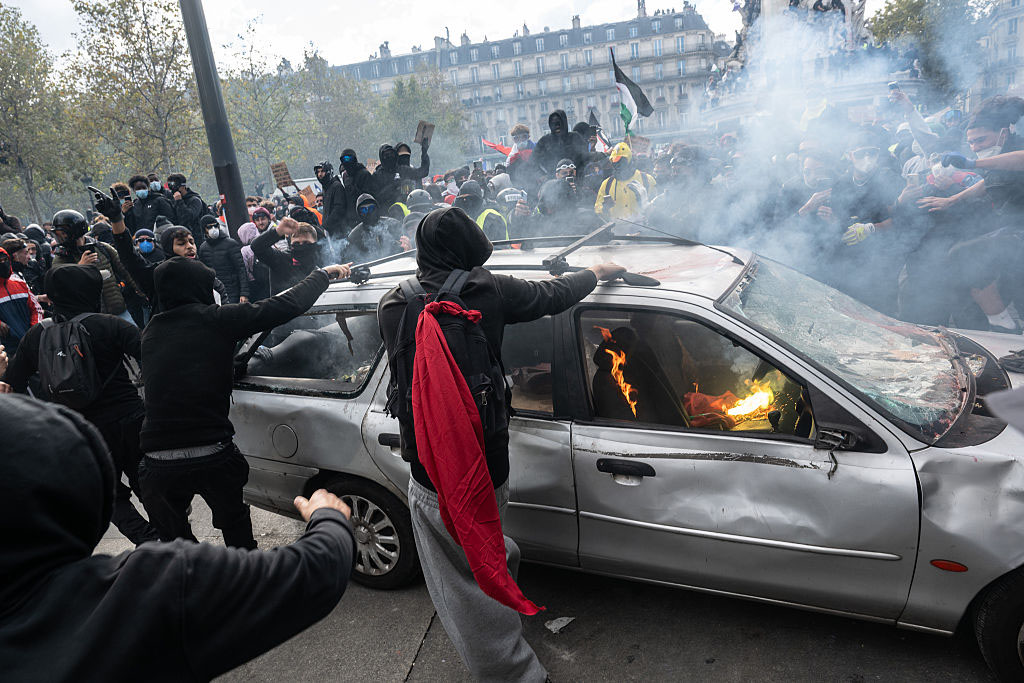
Last Saturday dozens of people were injured in Tel Aviv, as hundreds of Eritrean foreign workers, supporters and opponents of the Eritrean government, clashed with each other and with Israeli police.
There is a hidden, and yet close connection between the Eritrean riot, and three other things that Israel is talking about these days: the 30th anniversary of the Oslo Accords with the Palestinians, the rampant violence in Arab society and the looming political storm concerning the exemption of the ultra-Orthodox from military service.
Israel copes well with sudden crises, such as an outbreak of a pandemic, or war. But it’s not as good in using calmer times for dealing with long-term challenges.
The connection is Israel’s tendency to procrastinate. Rather than solving problems, it shelves them, to be dealt with maybe next year, or by the next government, or when the next crisis materializes. Israel copes well with sudden crises, such as an outbreak of a pandemic, or war. But it’s not as good in using calmer times for dealing with long-term challenges. This is true for annoyances, such as long-term planning of transportation, and it’s true in dangerous cases, such as dealing with violence in the Arab sector. This is true even for existential issues, such as the question of control over Judea and Samaria.
The Eritrean challenge is a case in point. Five years ago, Prime Minister Benjamin Netanyahu tried to deal with it, by reaching an agreement that would have sent many thousands of refugees away from Israel, while letting thousands of others stay and help them integrate. He announced the agreement with some pomp, then panicked, and retreated.
This is a case that explains why there’s such temptation for Israeli leaders to shelve problems. Dealing with problems requires a pragmatic approach. A remedy for a problem always has a price. In the Eritreans’ case: some will leave, and some will stay. But when things are calm, the purists look at such compromises with contempt. Those who want to keep all Eritreans in Israel (because they ought to be considered refugees) will not be satisfied with the idea of deporting some of them. Those who want to deport all of them (because they came in illegally), will not be satisfied with keeping some of them. A leader who chooses the pragmatic path, then, will pay a political price for his choice. And leaders don’t like to pay a price if they don’t have to. They prefer procrastination and inaction (if things go south, they can always blame the high court, or the previous government).
Netanyahu dropped the imperfect solution, but the challenge did not disappear. Now, it has suddenly erupted. Alas, a time of crisis is also bad for pragmatic solutions. Tensions are high, nerves are frayed, and politicians turn to rage. Now the PM must deal with all kinds of fanatics within his own coalition who are looking for the “trucks” that will “deport them all.” That is, for a quick and dramatic solution to a complex problem. Once again, the prime minister is facing a dilemma: keep his cool and pay a price — that is, accept a remedy that will not satisfy the fanatics — or become one of the fanatics himself.
Now let’s take that dilemma with larger cases that may also erupt at any time. Two previous governments that tried to deal with the Palestinian issue without postponement — by signing the Oslo Accords in the 1990s and disengaging from Gaza in 2005 — are remembered by the public as governments that made the wrong choice (see graph on the right). Regardless of whether the public is right or wrong in its judgment, the political fallout was clear: Oslo was followed by years of right-wing rule; disengagement was followed by more years of right-wing rule. Was that the price these governments paid for making bad decisions, or was it the price for making any decision at all?
It could be that the Israeli political system favors governments that avoid dealing with significant challenges. But there’s a big price to pay for constantly kicking the can down the road. The more time Eritreans live here, the more difficult it becomes to suggest that they must leave. The more time Yeshiva students are exempted from military service, the more difficult it becomes to suggest that they must carry their weight. The more criminal organizations become entrenched in Israel’s Arab society, the more difficult it is for the police to uproot them. The more settlers live in Judea and Samaria, the more difficult it becomes to come up with an idea for a viable remedy for the Israeli Palestinian conflict.
These challenges have been with us for a long time, and we decided on a policy of procrastination, instead of a policy of confrontation. So yes, there are certainly crises on Israel’s horizon that are difficult to foresee. Like a pandemic. But a significant part of our future crises is well known in advance. These originate from the many challenges that Israeli governments prefer to suppress.
Something I wrote in Hebrew
Amid reports that the government intends to dismiss Dani Dayan, director of Yad Vashem World Holocaust Remembrance Center in Jerusalem, and replace him with a political ally, I wrote the following:
One should not be naive about the appointment of Dayan: He was a political appointee. Worthy — but political. So those who now want his removal say “what’s the problem? He was an appointee of the previous government and now there will be a new appointee by us.” This is a far-fetched comparison, and the tenure of Dayan’s predecessors will testify to it. The chairman of Yad Vashem is a bit like the president of the country. The appointment is political, because politicians make the appointments, but once the appointee takes office, he is no longer political. Dayan’s predecessors served for about 20 years each. Governments came and went and did not replace the chairman of Yad Vashem. Because such an act has an unbearably heavy price: Politicization of the holy of holies of Israel’s state symbols.
A week’s numbers
Thirty years later, nearly 70% of the Israeli Jewish public believes that the decision to sign the Oslo Accords with the Palestinians was not a good one.

A reader’s response:
Ami Levi wrote: “Israel can call in Rudy Giuliani to deal with what you wrote about Arab crime. This is the one thing he knows how to do”. My response: Huh.
Shmuel Rosner is senior political editor. For more analysis of Israeli and international politics, visit Rosner’s Domain at jewishjournal.com/rosnersdomain.