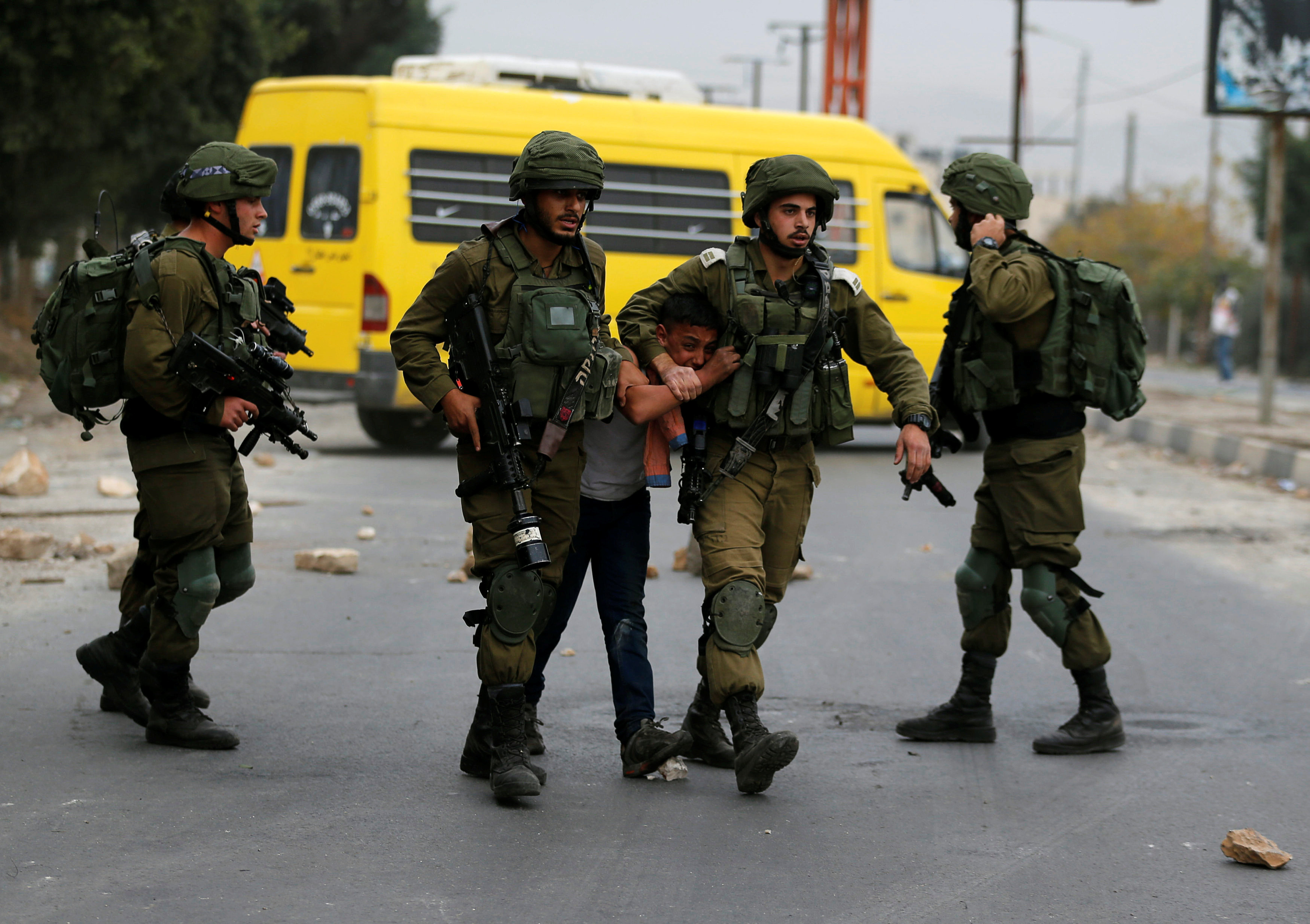
An Israeli officer is tasked with patrolling a West Bank village. A young Arab woman attacks him. She pushes him around, slaps him, scratches, kicks. The soldier does nothing. He understands that this is a trap. There are cameras around waiting for him to hit back, waiting for him to provide them with the footage that will cast him as a villain — an armed soldier hitting an unarmed young Palestinian female.
This is what happened on Dec. 15, in the West Bank village of Nabi Saleh. And as the footage made its way online, it stirred a debate in Israel. A debate about the woman: Was she a criminal, or maybe behaving as you’d expect from people under occupation? A debate about the young officer — was he being professional through his use of restraint, or maybe showing confusion by refraining from doing what you’d expect from a solder slapped in the face?
As often happens, this became a debate of “right” vs. “left.” But a sober discussion of this event should have nothing to do with the politics of Judea and Samaria. This ought to be a debate about cost and benefit, about military tactics in complex situations. This ought to be a debate about short-term gains and long-term pains.
Yes, there is short-term gain: The officer evaded the public relations trap that the young Palestinians prepared for him. They wanted to show the ugly face of a brutal occupying military, and what they got instead is the real face of a military going to great lengths to show restraint.
As the footage of the Arab woman slapping the Israeli officer made its way online, it stirred a debate in Israel.
Yes, there is a long-term pain: The Israel Defense Forces (IDF) needs to be an intimidating force — a force that Israel’s enemies fear. A footage of an IDF officer slapped in the face by a teenage girl does not serve such an image.
There also is the internal gain and pain to be considered. A message to Israel’s society from the IDF: We attempt to be as humane as possible. Another message to Israel’s society from the IDF: You are sending us to accomplish mission impossible. A yet a third message to Israel’s society from the IDF: Know that this is the cost of having to keep a hostile civilian population under our control. Maybe there is no other choice, maybe there is no better solution, but be aware of the price.
What would be the benefit and the cost of a reverse response by the officer? This is not hard to imagine, as such instances have occurred in the past. The young woman hits the officer, the officer hits back, cameras role. A PR embarrassment for Israel. An embarrassment that is part of an ongoing campaign to delegitimize Israel’s presence in Judea and Samaria, and to portray the IDF as a dark, cruel force.
Many Israelis, maybe a majority, would prefer such an outcome to the outcome we saw recently. They would prefer it because the young officers are their sons or cousins or neighbors, and because they feel in the Middle East that you do not let anyone slap you in the face without responding with force.
Let the cameras roll, let the world of hypocrites jabber. When you are a proud Israeli citizen, highly appreciative of the IDF and its soldiers, and isolated from the fallout of international condemnation, you’d instinctively take such a position. You don’t care about a Swedish or a Venezuelan or an American-on-campus condemnation — you care about your soldiers. You care about them not having to suffer through humiliation, about them not seeming weak.
There is a lot of sense in both positions, whether or not you support Israel’s control of the West Bank. If you support the occupation, you have fewer moral qualms about having to use force in the territories; if you oppose the occupation, you have to support an intimidating IDF as the only shield that can guarantee a safe withdrawal from the territory.
But if you support the occupation, you also understand the need for a long, patient game; if you oppose the occupation, you will upload restraint as the moral choice.
Now consider the officer’s situation. Consider him having to make all these calculations while someone is slapping him in the face.
Shmuel Rosner is senior political editor. For more analysis of Israeli and international politics, visit Rosner’s Domain at jewishjournal.com/rosnersdomain.