
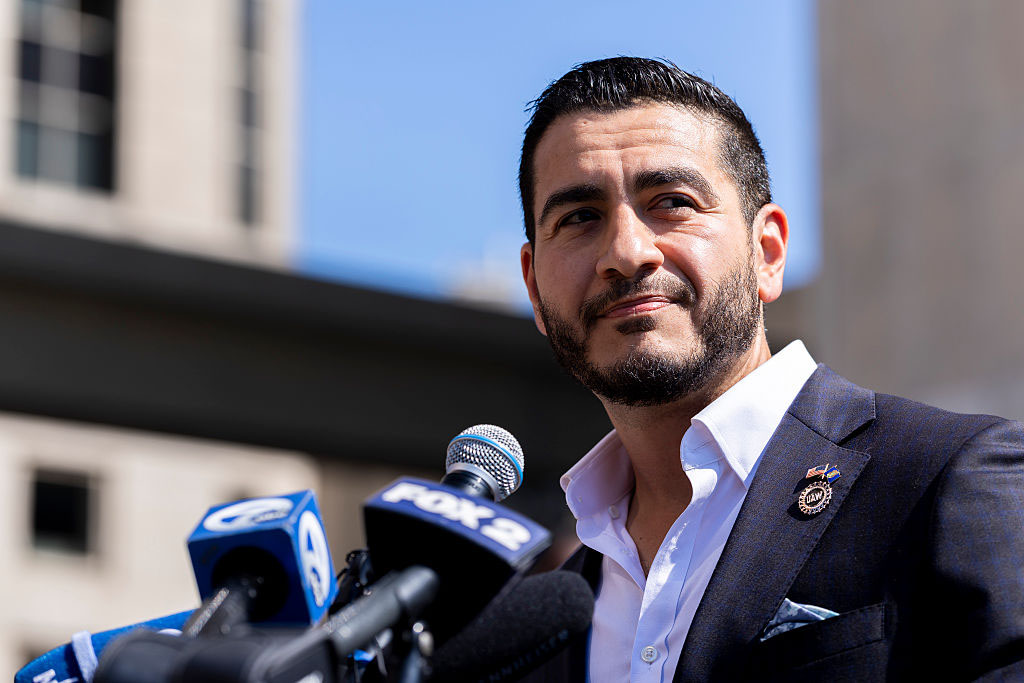
Before the invention of the steam engine, when ocean travel relied on sails and wind, sailors would talk about the choice between dangerous and disastrous alternatives as being caught “between the devil and the deep blue sea.” After the victory of Abdul El-Sayed in last week’s Senate primary, Jewish voters in Michigan are about to become very familiar with this type of predicament.
As we have highlighted in this space before, El-Sayed is an avowed anti-Zionist and anti-Semite. He refuses to say publicly whether he believes that Israel has a right to exist and draws a moral equivalency between what he calls the “evil” of Israel and Hamas. Most chillingly, after a gunman attacked a Jewish preschool and daycare center in a Detroit suburb earlier this year that was characterized by the FBI as a “Hezbollah-inspired act of terrorism”, El-Sayed suggested that the attempted mass homicide of Jewish toddlers and infants was an understandable response to Israeli military strikes in Lebanon. “Hurt people hurt people,” he said, glibly and grotesquely.
El-Sayed enjoys the company and the support of some of the most virulent Jew-haters on the political landscape today, campaigning frequently and proudly with social media demagogue Hasan Piker. El-Sayed has stated that he does not endorse Piker’s proclamation that “America deserved 9/11” or that Hamas “is a thousand times better” than Israel, but he has refused to distance himself or cut ties with the streamer.
Extrapolating from national exit polls, we can assume that between two-thirds and three-quarters of Michigan’s Jewish community voted for Kamala Harris in 2024. These are the voters caught between the aforementioned devil and ocean, who are now deciding whether Al-Sayed or Donald Trump is a less dreadful alternative for them. For a Jewish Democrat, there is no good option, only bad and worse. Depending on how they decide which of the two men is merely bad will carry immense political ramifications far beyond Michigan’s borders.
If Al-Sayed wins, then his noxious bigotry will be given an unavoidable national platform in the U.S. Senate for the next six years and the anti-Israel wing of the Democratic Party will be tremendously energized heading into the 2028 presidential primaries. If defections from Jewish and Black voters, who supported his primary opponent by sizable margins, cost him the election in November, then the GOP will almost certainly retain its majority in the Senate. For Democrats who watched Senate Republicans meekly fall into line to confirm Trump’s personal lawyer as the nation’s Attorney General last week, the prospect of Trump’s last two years in office abetted by an perpetually obsequious Congress is just as unacceptable.
Most Democrats will tell you that they believe that Trump is a dictator who represents a threat to their country. Most Jews will tell you that Al-Sayed is a bigot who represents a threat to their people. Is an anti-Semite in the Senate an acceptable tradeoff for a less pliant majority? That will be the question that decides this campaign in November.
Jewish Democrats, in Michigan and elsewhere, who are tempted to support Al-Sayed given the stakes outlined above may consider that their support could come with conditions. Some have already said that they will not back his candidacy unless he publicly separates from Piker and refuses to campaign with him. Many more should do the same. They should also demand that Al-Sayed endorse bipartisan legislation co-sponsored by Michigan’s other Senator, Elissa Slotkin, an avowed pro-Israel advocate. Slotkin and Republican Ted Cruz have introduced a bill that would protect synagogues and other houses of worship from violent and disruptive protests by establishing a 100-foot buffer zone during religious services.
Zohran Mamdani opposed a similar measure in New York City this spring. Let’s see if Al-Sayed is more motivated toward compromise – and to protecting religious freedom and safety – with his political future on the line. Those steps alone should not justify a vote for this man, but they are a minimal and necessary opening proffer from someone who will need to work diligently to gain the grudging trust of even the most committed Jewish Democrats.
Dan Schnur is the U.S. Politics Editor for the Jewish Journal. He teaches courses in politics, communications, and leadership at UC Berkeley, USC and Pepperdine. He hosts the monthly webinar “The Dan Schnur Political Report” for the Los Angeles World Affairs Council & Town Hall. Follow Dan’s work at www.danschnurpolitics.com