
It was raining in Tel Aviv this morning. Raining over my Sukkah. It was the first rain of the year — in Israel, as you may know, there is no rain during the very long summer (it only rains during the very short winter). The rain was a sign that this year will be just like every other year: Rain that ruins the Sukkah is a tradition, much like snow that ruins Purim in Jerusalem.
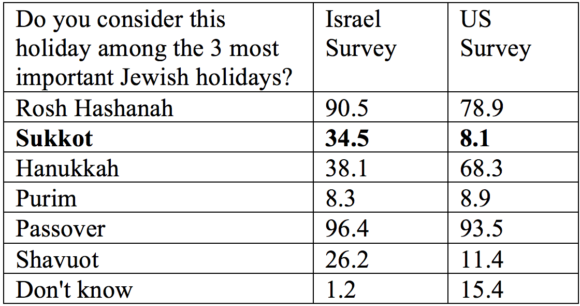
Sukkot is my favorite holiday of the year, making me an exception. For most other Jews, Sukkot is, well, not as important. A few years ago, I mentioned an academic paper that examined the relative significance of Jewish holidays and showed how Israeli Jews and American Jews differ in their priorities. But, as you can see in the table below, in Israel, considering Sukkot one of the “most important” holidays of the year is not that rare, while in the U.S. it is:
Conspicuously, the authors of this paper did not include Yom Kippur in their survey and thus prevented us from getting the full picture. But there are other surveys with which we can see the full picture. In 2012, PRRI asked Jews in the U.S. “What is the most important Jewish holiday to you personally?” It did not include Sukkot in the survey, but it did include Yom Kippur. The results were as follows:
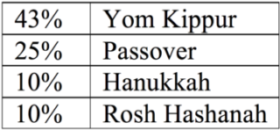
So, in this survey, Yom Kippur is more important than Passover and Hanukkah. In the previous survey, Passover and Hanukah are more important than Sukkot. Best case scenario: For most Jews, Sukkot is the fourth-ranking holiday, after Yom Kippur, Passover, Rosh Hashanah and Hanukah.
Of course, there is a big difference between declaring a holiday to be one of the “three most important” holidays, and the “most important Jewish holiday to you personally.” The first question is one of assessment, of understanding the priorities of the Jewish people and their traditions. The second question is one of personal preference. For a child, the personal favorite can be Purim — because it’s a fun holiday for kids — even though he understands that Purim is not the most important holiday on the Jewish calendar.
Personal preferences change with time: As a child, I also liked Purim, but today I much prefer other holidays. Assessments of the general importance of a holiday also change with time, maybe not for a specific Jew, but surely for a new generation of Jews. One of the most striking findings of the PRRI survey concerned the generational differences regarding Hanukah and Yom Kippur. The survey found that “younger Jews are more than three times as likely as older Jews to say that Hanukkah is the most important Jewish holiday to them personally (20% vs. 6% respectively). They are also less likely to cite Yom Kippur (37% vs. 53% respectively).”
What about Sukkot? The argument I’d make to promote the status of this holiday is simple: Sukkot is the holiday of appropriate balance. It is the holiday that offers the most enticing combination of general importance and opportunity for personal affinity. It is, no doubt, an important holiday in our tradition, but it is also a fun holiday, if you care to celebrate it. Maybe it’s not as important as Yom Kippur. Maybe it’s not as fun (for kids) as Purim. But it’s just important enough and fun enough to both feel its significance and remain relaxed. Even when it’s raining.