U.S.
Stephen Hayes and Michael Warren describe how the Trump administration decided to decertify the Iran deal:
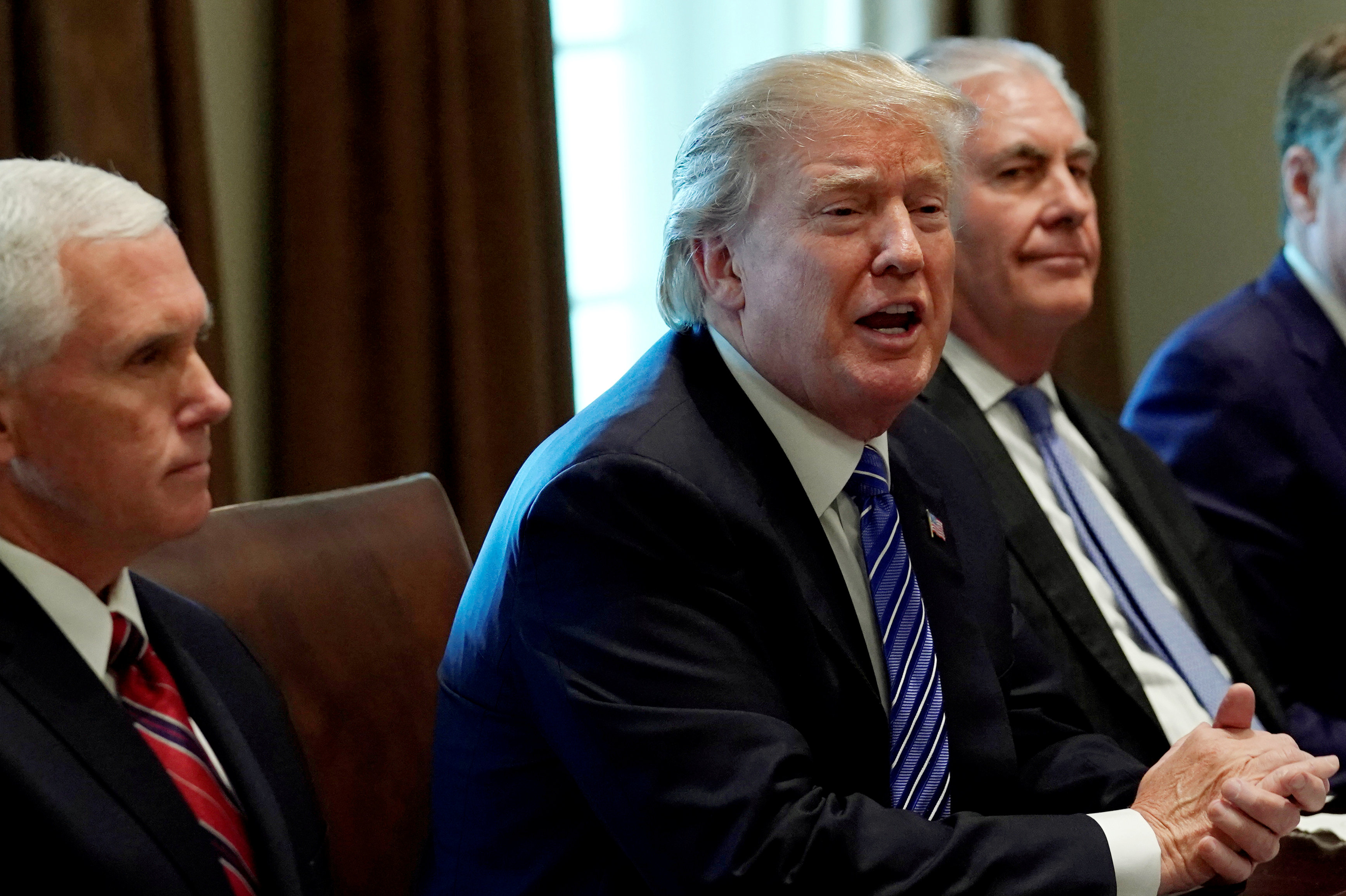
Having failed to receive the decertification option from his own team, Trump called Senator Tom Cotton and put him on speakerphone. The president asked Cotton to make the case for decertifying the Iran deal. Cotton took five minutes and walked Trump and his team through the case, emphasizing one point in particular: recertifying the deal would be declaring that it was in the national security interest of the United States, something Cotton understood that Trump didn’t believe. Bannon provided the political complement to Cotton’s policy argument: Mr. President, you campaigned on tearing up the deal and now you’re recertifying it—for the second time?
Dexter Filkins writes an interesting profile of Rex Tillerson for the New Yorker:
Tillerson confronts an unstable world and an unstable President, who undermines his best efforts to solve problems with diplomacy. Still, he carries on, conceding by his persistence that the best course is to accommodate Trump’s policies while apologizing for his most embarrassing outbursts. At Exxon, Tillerson was less a visionary than a manager of an institution built long before he took over. With Trump, he appears content to manage the decline of the State Department and of America’s influence abroad, in the hope of keeping his boss’s tendency toward entropy and conflict from producing catastrophic results.
Israel
Major General (res.) Noam Tibon explains why the White House’s waning interest in Syria is bad news for Israel:
Syria does not appear to really interest Washington, and Moscow has become the area’s ‘landlord.’ This is bad news for Israel, because Russia is currently assisting its real allies in the Middle East, who happen to be Israel’s most dangerous enemies: Iran, Hezbollah, and the Assad regime that depends on them for its survival.
Daoud Kuttab tries to figure out if President Abbas was serious about the one-state solution in his recent UN speech:
t is not clear if Abbas’ words reflect a strategic shift in Palestinian policy or a tactic to goad Israelis and the United States into backing the two-state solution. Regardless of the motivation, his reference to the concept has legitimized many who feared that talking about it will be seen as unpatriotic to the national idea of an independent Palestinian state alongside Israel.
Middle East
Katherine Bauer and Patrick Clawson explain the concept of decertification and the peril the Iran deal is currently facing:
Washington’s options are much broader than the extremes of recertifying the JCPOA as is or leaving the deal altogether. Taking stronger action against Iran’s destabilizing regional activities and expanding missile program while calling for full enforcement of the nuclear deal could give the president sufficient justification for either recertifying the deal later on or decertifying it while continuing to waive/suspend sanctions, irrespective of what Congress does. Those who wish to see the United States stick with the JCPOA would be ill-advised to refuse such middle courses out of hand. If critics insist that they will accept nothing less than Trump’s capitulation, they will put the JCPOA at grave risk.
Shadi Hamid, Peter Mandaville and William Mccants take a look at how the US has changed its position on political Islam:
While the momentum on Muslim Brotherhood proscription seems to have slowed to a crawl in the face of nearly universal criticism from experts, lawyers, and diplomats, the question of how Washington views the broader phenomenon of political Islam remains unsettled.
Jewish World
In honor of Sukkot, Tablet decided to post S.Y. Agnon’s classic story, The Etrog:
To witness how precious the mitzvah of Etrog is to the Jewish people one need only visit Meah Shearim between Elul and Sukkot. That neighborhood, which is like a withered plant all year long, becomes a verdant pleasure garden in that season, with stores full of etrogs, lulavs, and hadasim. Jews from all over Jerusalem crowd into those stores, inspecting the etrogs, lulavs, and hadasim, or sharing learned insights about them. Even the elderly, who never exit their own doorposts all year long, either due to weakness or fear of wasting moments from Torah study, come to purchase an etrog.
Batsheva Neuer explains why old-school synagogues (shtieblach) are making a comeback in NYC:
Demographically, the West Side is a hub for young Jewish professionals whose synagogue priorities are largely socializing and camaraderie—at the expense of commitment. The shtiebel fits that niche. Less structured than the large congregations, shtieblach offer a built-in community where everybody knows your name, but long-term expectations are low. The lack of structure also leaves space for millennials, many of whom feel overwhelmed in a larger space and bound to historical structures.