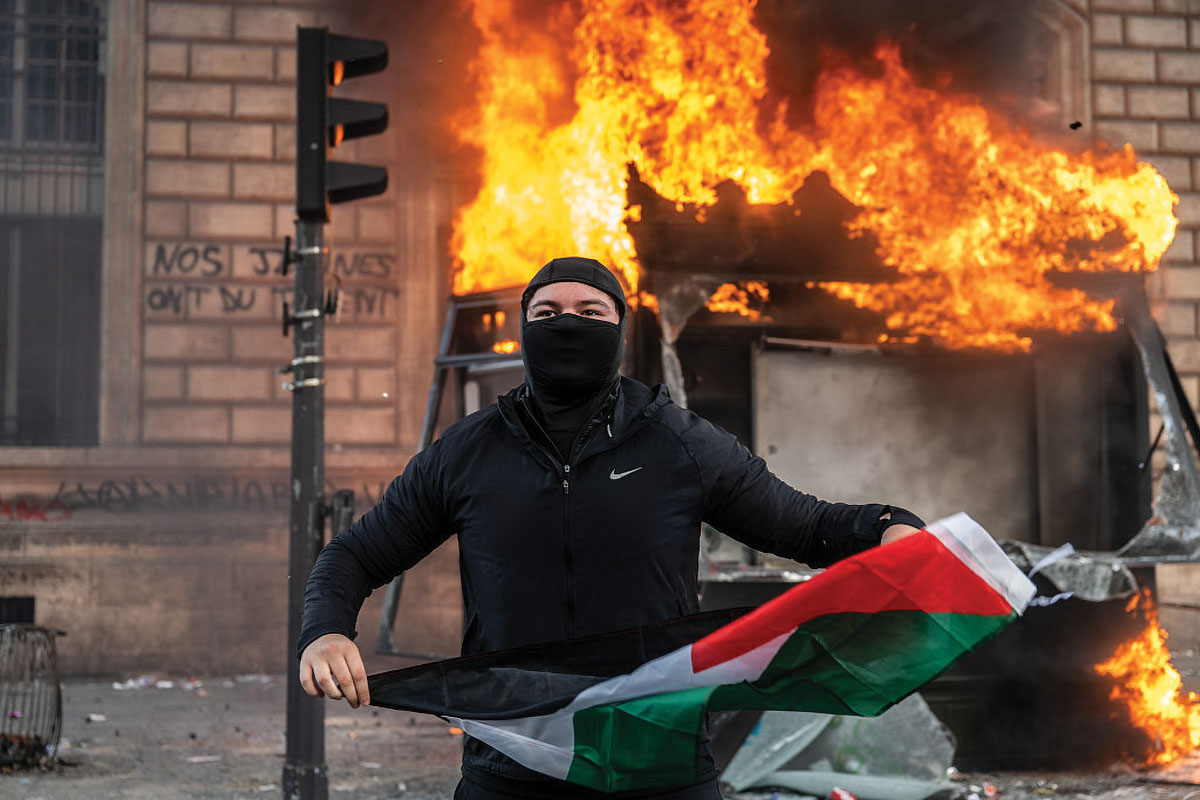
"They are like mice," said Yeheskel Abu-Zwilli, a 74-year-old Iraqi-born Israeli, surveying the wreckage of the photography shop he has run in Jerusalem’s Jaffa Street for 45 years. "Wherever there’s a hole, they sneak in."
This was one hour after a first Palestinian woman suicide bomber blew herself up Jan. 27, taking an 80-year-old Jewish passerby with her to the grave. Their bodies were so badly mutilated that at first the police were not sure which was the bomber and which the victim.
It was the 20th mass terror attack in Israel’s capital since the war of attrition that calls itself an intifada broke out 16 months ago and the second in Jaffa Street in five days. The escalation spurred the police and Ariel Sharon’s government to plug the holes. Security experts acknowledge that they cannot prevent every terror attack in a city shared by 450,000 Jews and 250,000 Arabs.
Shlomo Aharonishki, the national police commissioner, conceded: "A terrorist who leaves the territories is like a missile that has been fired. It is very hard to stop him, even if there have been a few successes."
Nonetheless, the police launched an emergency program designed to make it harder for the bombers and the gunmen, most of whom infiltrate from the West Bank, to reach their downtown targets.
For the short term, dozens of paramilitary border police were drafted into the Jewish commercial center of West Jerusalem, manning major junctions and patrolling the streets on foot and in jeeps. A mobile baggage scanner was stationed at the bottom of Prophets Street, the main corridor linking the old and new cities.
Steel barriers, of the kind used to close Orthodox neighborhoods on the Sabbath, were placed at the entrances of the narrow lanes feeding on to Jaffa Street. Police checked Arabs, in vehicles or walking.
Ethnic profiling, politically incorrect in the West, is de rigueur in Israel. Arabs with blue Jerusalem ID cards were allowed through; those with orange West Bank ones were questioned about what they were doing there.
Two days after the Jaffa Street bombing, a longer-term plan for insulating Jerusalem against attack was presented to the government by Uzi Landau, the internal security minister, and General Uzi Dayan, the head of the National Security Council (a joint body of the army, the secret services and the Foreign Ministry, based in the prime minister’s office). It tried to avoid the political pitfalls of delineating a permanent border between Israel and a Palestinian state or of re-dividing Jerusalem.
The idea is to create a buffer zone. Various barriers would draw a 34-mile arc between Jerusalem and the West Bank. At the southern end, the planners propose a wall, seven miles long, between the front-line suburbs of Gilo and Har Homa, targets for attack from the Bethlehem area. Other impediments would include ditches, fences, lookout posts and roadblocks, perhaps monitored by closed-circuit television cameras. Five additional companies of armed border police would be drafted into the capital.
Jerusalem’s Likud mayor, Ehud Olmert, gave the plan, which is estimated to cost 150 million shekels ($32.6 million), his blessing, so long as it embraces the whole of the city, outlying as well as downtown neighborhoods, Arab as well as Jewish quarters. Prime Minister Sharon agreed. The intention is not to separate East and West Jerusalem physically, as was the case between the 1948 and 1967 wars, but checkpoints and designated routes will try to control the flow of Arabs from one side of town to the other.
Olmert is resigned to the long haul. The mayor told reporters in Jaffa Street on Sunday: "There is no simple solution to this war. It won’t be ended in days, it won’t be ended in weeks, it won’t be ended in months." Till then, he is proposing tax breaks to ease the burden on those who live and work in his beleaguered city. The government is sympathetic, but has yet to show the color of its money.
Avraham Birnbaum, the chairman of the Israel Merchants’ Association, who heard the explosion in his office two blocks away, reported that downtown trade had fallen by 60 percent, in Jerusalem and other afflicted cities, since the start of the intifada in September of 2000. About 10 percent of downtown stores have closed in the capital in the past year alone. Gift shops, catering for non-existent tourists, have suffered an 80 percent drop in sales, restaurants and coffee shops 40 percent.
Benzi Ofir, a 48-year-old jewelry store owner, was serving his first and only customer when the suicide bomber blew in his window on Jaffa Street. Asked if he considered closing, he — and his photo shop neighbor Abu-Zwilli — replied with an emphatic "no." "I still believe," Ofir insisted.
Maybe, but bankruptcy has a bleak logic of its own.