(JTA) — The overarching narrative from Tuesday night’s pivotal midterm election slate was clear by Wednesday morning: the Republican Party’s hopes of a sweeping red wave have been dashed.
But how did the issues and candidates that Jewish Americans were watching most closely fare? Here are our initial insights from the first rounds of results.
We’ll plan to dig in in more depth in the coming days, so if there’s anything you want to know, feel free to let us know.
1. Most of the Republican candidates who drew attention for their ties to or even embrace of right-wing extremists fell short at the ballot box.
Doug Mastriano, who ran for governor in Pennsylvania and used Gab, the social media platform owned by an antisemite, to reach potential voters, lost decisively — to an observant Jew named Josh Shapiro. Kari Lake, running for governor in Arizona and Blake Masters, running for Senate, are trailing the Democratic incumbents they hoped to unseat. So were Republicans running for attorney general and secretary of state who unsettled Jewish Nevadans. Even Lauren Boebert, a Christian nationalist who is one of the most extreme members of Congress and who infuriated Jewish groups by comparing coronavirus restrictions to the Holocaust, could still be knocked out of her reliably red congressional seat in Colorado — by a self-described “moderate, pragmatic Jew,” Adam Frisch. Far-right incumbents prevailed in most cases, but for the most part the candidates seeking new positions who were most discomfiting to the majority of American Jews fell short on Election Day.
2. American voters are aligned with American Jews when it comes to abortion rights.
Exit polls showed that the Supreme Court’s reversal of Roe v. Wade had galvanized voters, and in five red states where reproductive rights were on the ballot, voters backed measures to make abortion more accessible. Measures upholding abortion rights passed in Michigan, Vermont and California, while voters in Kentucky — which otherwise trended conservative — defeated a measure that would have made the procedure illegal. That means voters sided with the predominant Jewish sentiment: American Jews favor abortion rights, more reliably so than any other religious group, according to public polling.
3. Florida’s Jewish voters are headed for the spotlight.
While Republicans didn’t post the red wave many expected across the country, Florida was one clear bright spot for far-right candidates on election night, where Anna Paulina Luna cleanly defeated Jewish Democrat Eric Lynn. The results in the state shows that Republicans are ensconced in power there — and that Gov. Ron DeSantis, who waltzed to reelection, would be a formidable contender for the GOP presidential nomination in 2024. The growing number of Orthodox Jews in the state, who tend to vote Republican, likely contributed to his margin of victory. Now, as all eyes turn to 2024, those Jews and how they vote will be a focus for political analysts.
4. Money matters until it doesn’t.
The American Israel Public Affairs Committee got involved this year for the first time directly in funding races, setting up a conventional political action committee and a Super PAC, which allows unlimited giving. It used the latter, the United Democracy Project, to raise tens of millions of dollars, and did well in primaries, winning almost every race it was involved in. But in the general election, UDP focused only on one race, trying to defeat Democrat Summer Lee in the Pittsburgh area — where she won handily. In New York, Lee Zeldin, a Jewish Republican who left Congress to run for governor, raised enough money from big givers like World Jewish Congress Chairman Roanld Lauder to give incumbent Democrat Kathy Hochul a scare — but not a big enough scare. Hochul won by a significant margin.
5. A breakout star of this cycle is a Jewish day school dad.
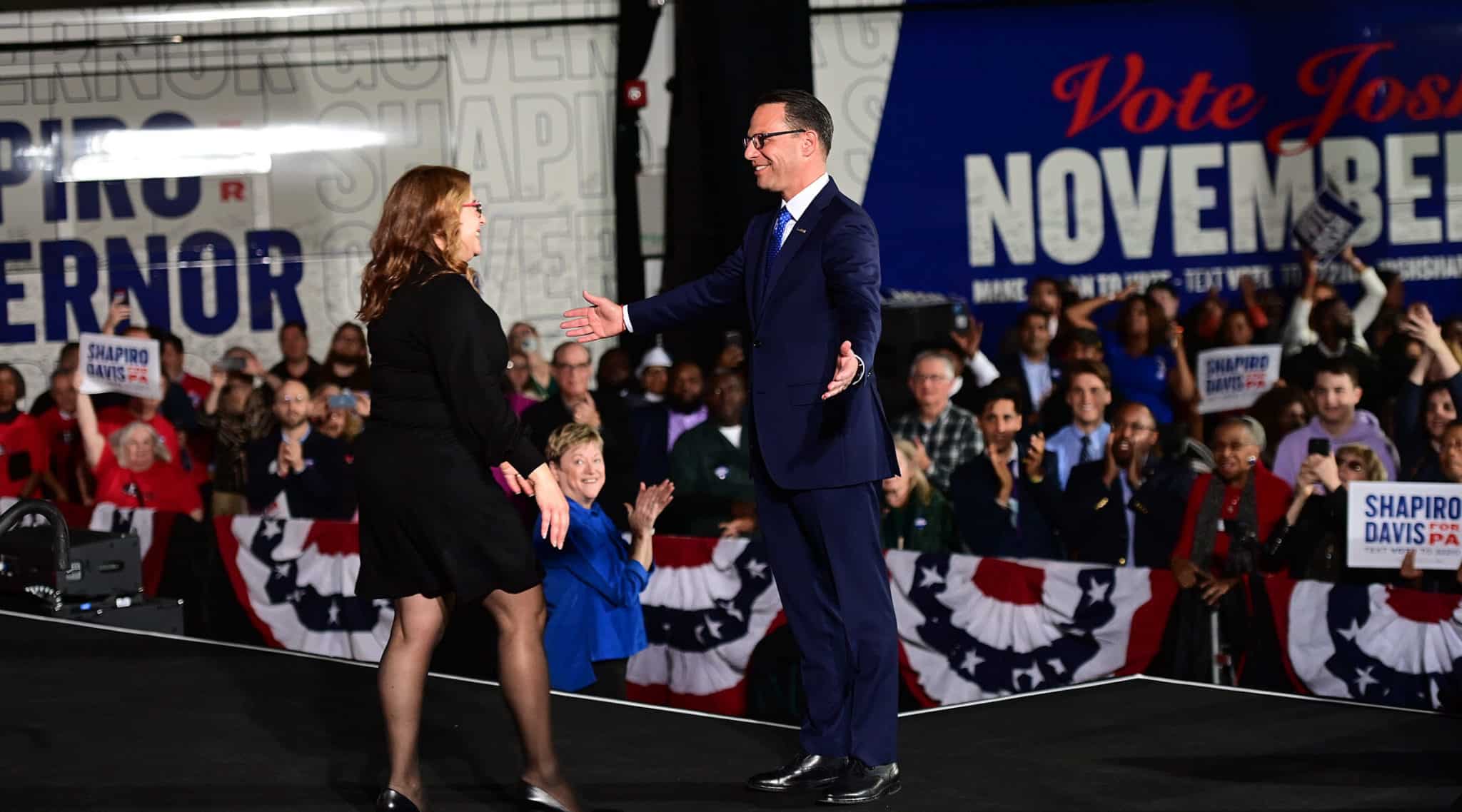
Pennsylvania is a deeply purple state, perhaps best exemplified by the very close Senate race between John Fetterman and Mehmet Oz — which the Democrat Fetterman eked out a win, flipping the seat from red to blue. Governor-elect Josh Shapiro is a self-described moderate Democrat and he has never lost: He represented Pennsylvania’s 153rd District in the state’s House of Representatives from 2005 to 2012; served on the board of commissioners for Montgomery County outside of Philadelphia from 2012 to 2017, helping wrest it from longtime Republican control; and before Tuesday night’s comfortable win, was elected the state’s attorney general in 2016 and again in 2020. It’s a formidable record, and Politico isn’t the only publication predicting that Shapiro could be the nation’s first Jewish president. Through it all, Shapiro wears his Jewishness on his sleeve, and as his opponent in the governor’s race flirted with multiple antisemitism controversies, Shapiro leaned into that identity instead of shying from it. Thanks to Shapiro’s own campaign ads and speeches, along with words from the Mastriano side, voters were well aware that Shapiro is a kosher-keeping, observant Jewish dad who sends his kids to a Jewish school. And it resonated in purple Pennsylvania.