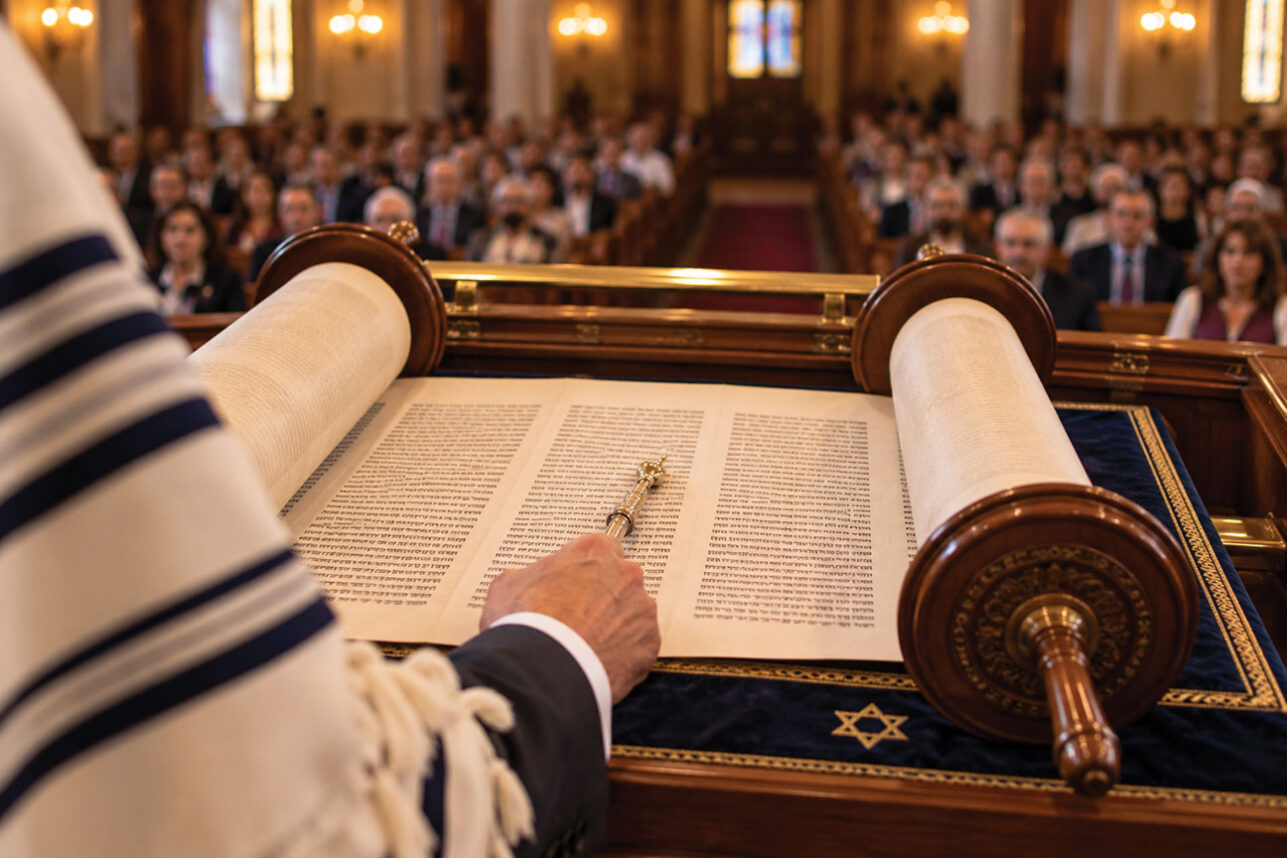
When Rabbi Eric Yoffie, president of the Union for Reform Judaism, delivers his Saturday-morning sermon at the group’s biennial conference, he sets the movement’s priorities for the coming two years.
His message this month in Toronto: Let’s eat like Jews.
He was not asking Reform Jews to observe kosher laws. Rather, acknowledging America’s increased interest in food choices in general, and pointing to Jewish values concerning stewardship of the earth, sustainable agriculture and treatment of workers, Yoffie urged Reform Jews to develop consciously Jewish and ethical food policies for themselves and their congregations.
“This is not about kashrut,” he said as he outlined the main points of the Reform movement’s new Green Table/Just Table Initiative. “We need to think about how the food we eat advances the values we hold as Reform Jews.”
That, he said, is how Reform Jews can eat food that is “proper and appropriate”—the literal meaning of the Hebrew word kosher.
Among Yoffie’s specifics: Eat 20 percent less red meat; it’s good for the environment and for your health, he said. Plant synagogue gardens. Join community-supported agriculture programs. Pay attention to how meat animals are raised and how food workers are treated. Develop a consciously Jewish dietary policy for your synagogue. Eat slower and together, suggesting that synagogues hold regular communal Shabbat meals.
“Above all,” Yoffie said, “let’s avoid the temptation to do nothing.”
For much of its history, the Reform approach to Jewish dietary practice was standoffish at best. In its founding Pittsburgh Platform of 1885, Reform Judaism declared Jewish rituals of dress and diet outmoded, including kashrut. But over the past generation or so, hostility toward these observances has lessened, particularly among younger Reform Jews.
A 2007 movement survey of 14,000 Reform activists and clergy revealed that 58 percent of those older than 40 brought shellfish into their homes, compared to 39 percent of the younger crowd. Forty-three percent of the older group ate pork at home, compared to 29 percent of those 39 and younger; and 16 percent of younger Reform Jews ate only kosher-certified meat, compared to 9 percent of their elders.
“The younger generation is more ritually comfortable across a wide range of practices, from kashrut to prayer,” said Rabbi Daniel Freelander, senior vice president of the Union for Reform Judaism.
Cautioning that the new focus was not about kashrut, Yoffie referred to last year’s scandals at the Agriprocessors kosher meatpacking plant.
“We do not accept the authority of the kashrut establishment, and its problems are for others to resolve,” he said.
Some Reform Jews who do not keep kosher think their institutions should.
An unpublished survey in 2000 of Reform synagogues in North America revealed that 10 percent have a kosher kitchen. Kosher-style policies are much more prevalent: 80 percent do not permit pork or shellfish in the building, and nearly half do not serve milk and meat on the same dishes.
Deborah Cohn, a member of Anshe Emeth Memorial Temple in Highland Park, N.J., says her congregation “is doing more and more to accommodate people who keep kosher.” Non-dairy creamer is served with meat meals, and catered events have a vegetarian option or are completely vegetarian.
“There are always people who object and say, ‘We’re Reform,’ ” she said. “Those are usually the older members.”
Some Reform Jews believe the growing embrace of Jewish ritual represents a betrayal of core Reform principles.
“Kashrut is a visceral issue for many Reform Jews—in the negative sense,” Yoffie said. “It has been seen by many Reform Jews historically as something we rejected—ritual without ethical content.”
Harold Eichenbaum, 70, of Temple Beit Torah in Colorado Springs is one of many older Reform Jews who feel under siege. He complains that not only are pork and shellfish not permitted in his synagogue, there is now a move to make the kitchen kosher.
Eichenbaum says he comes from a long line of activist Reform Jews, none of whom kept kosher.
“It’s part of being a Reform Jew,” he said. People “think you have to be kosher to be true Jewish people. I disagree.”
Largely for this reason, Yoffie said, he was careful not to promote kashrut in his talk. While a guide to Reform Jewish dietary practice that has appeared on the Union for Reform Judaism Web site for the past two years presents kashrut as one of the options Reform Jews might consider in developing a conscious dietary practice, it is noticeably absent from the Green Table/Just Table initiative.
“My central objective was putting food issues on our religious agenda, and in our movement, kashrut is not the vehicle to open that discussion,” Yoffie told JTA. “I intentionally put the focus on the ethical and communal dimension, which is central to who we are. If I’d talked about kashrut it would have had the opposite impact.”
Reaction to the initiative was generally positive.
“I think the recommendations are well founded,” said Michael Holberg, president of Congregation Sha’arai Shomayim in Mobile, Ala.
Holberg groaned when Yoffie first mentioned cutting back on red meat, but Holberg seemed more persuaded once Yoffie explained his position.
“I’m not in favor of advocating not eating meat, but a reduction not only has health benefits, it’s a wise Jewish decision,” Holberg said.
Sha’arai Shomayim planted a synagogue garden last year, one of a growing number of Reform congregations to do so.
Irene Rothschild, president of Congregation Emanu-El Israel in Greensburg, Pa., says she’s been encouraging her synagogue to adopt ecological practices, such as long-life light bulbs and recyclable dishware, but hadn’t made the same Jewish connection between environmentalism and food consumption.
“Food has not been a focus in our congregation, but after listening to him, I think I can push for it now,” she said.
In a conference workshop on Jewish dietary practice, Rabbi Mary Zamore of Temple B’nai Or in Morristown, N.J., said the Reform movement needs to reclaim and redefine kashrut rather than shy away from the term.
Kashrut, she said, is more than the laws outlined in halachah, or Jewish law, but can be understood “as a wholeness, a ‘shlemut,’ ” she said, using the Hebrew word.
“When we talk about kashrut, we are asking: What is our Jewish relationship to our food? The person who fasts on Yom Kippur or who eats matzah on Passover is functioning within the world of kashrut. Dayenu,” she said, using the Hebrew word for enough. “It’s a wonderful thing to celebrate. We can use our Reform approach to Judaism and mix the best of our tradition with trends in the modern food world.”