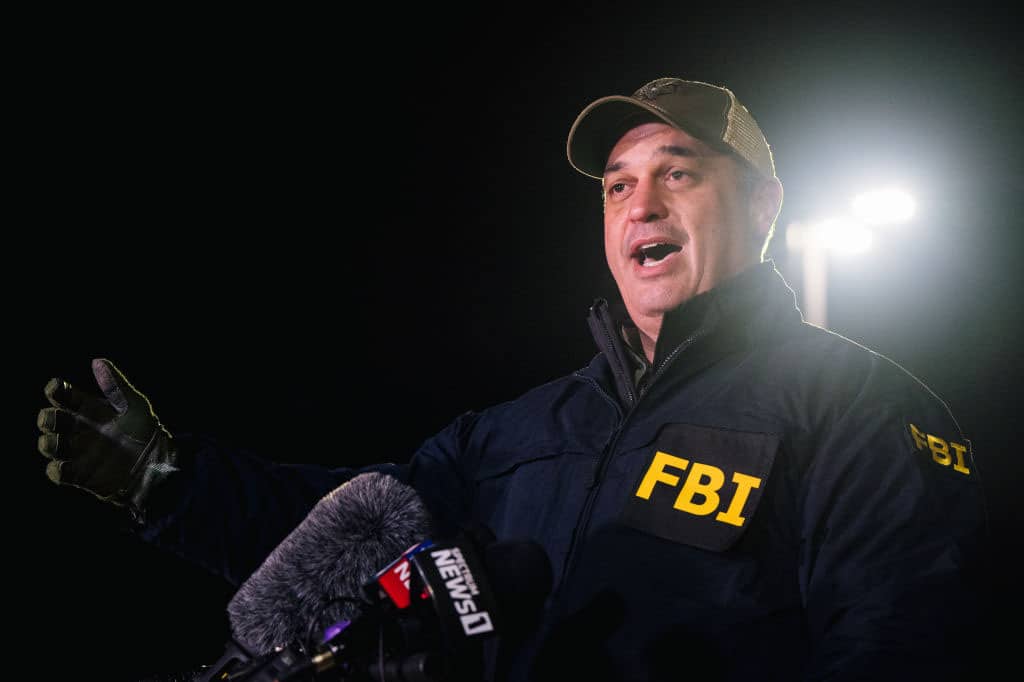
FBI Special Agent in Charge at the Dallas Field Office Matthew DeSarno called the January 15 hostage crisis at a synagogue in Colleyville, TV “a hate crime and act of terrorism” at a January 21 press conference.
The crisis, which took place at Congregation Beth Israel, involved a terrorist, identified as Malik Faisal Akram, holding four people hostage, including the synagogue’s rabbi, Charlie Cytron-Walker. All four hostages made it out unharmed, while Akram, 44, was shot dead by the FBI’s Hostage Rescue Team. DeSarno said that the FBI considers the hostage crisis “an act of terrorism targeting the Jewish community. It was committed by a terrorist holding an antisemitic worldview.” He also acknowledged that “the Jewish community in particular has suffered violence and faces very real threats from across the hate spectrum, from domestic violent extremists to foreign terrorist organizations. Because of that, the FBI considers the enduring threats to the community to be one of our highest priorities.”
DeSarno confirmed that Akram repeatedly called for the release of unnamed prisoner held in a nearby Fort Worth prison; various outlets have reported that this prisoner is Pakistani neuroscientist Dr. Aafia Siddiqui, who was sentenced to 86 years in prison for attempting to kill United States soldiers and FBI agents. The FBI agent described Akram as being “less communicative” and “more combative” toward the end of the crisis, prompting DeSarno to authorize the Hostage Rescue Team to enter the building take action. At that time, Cytron-Walker and the two remaining hostages (one had been released earlier as part of negotiations) escaped on their own accord. DeSarno called the escaped hostages “heroes.” The FBI’s investigation, which is now global, is ongoing and they’re looking into Akram’s associates and personal devices and how he came in possession of his firearm, DeSarno said. President Joe Biden said on January 16 that he had heard that Akram obtained his gun off the streets, but cautioned that he was still learning the facts.
Cytron-Walker also spoke at the press conference, saying that he was “overflowing with gratitude” that he and the rest of the hostages survived the crisis. He said that “things were getting bad … I was absolutely in fear of my life,” describing Akram as going “from extremely agitated with the negotiator to all of a sudden, very calm like he was earlier in the day just asking me for juice.” Giving Akram the juice was what provided Cytron-Walker the opportunity to throw a chair at him, allowing the hostages a chance to escape.
According to The Jewish Chronicle, Akram, a British citizen, initially gained entry to the synagogue asking for help; Cytron-Walker invited him in and made him some tea. Akram didn’t pull out his firearm until after the Amidah prayer. He can be heard on an audio recording of his final phone call telling his brother that “maybe the U.S. will “have compassion for f—ing Jews, but guess what? I’m opening the doors for every f—ing youngster in England to know, live your f—ing life, bro, you f—ing coward. We’re coming to f—ing America and f— with them. If they want to f— with us, we’ll give them f—ing war.”