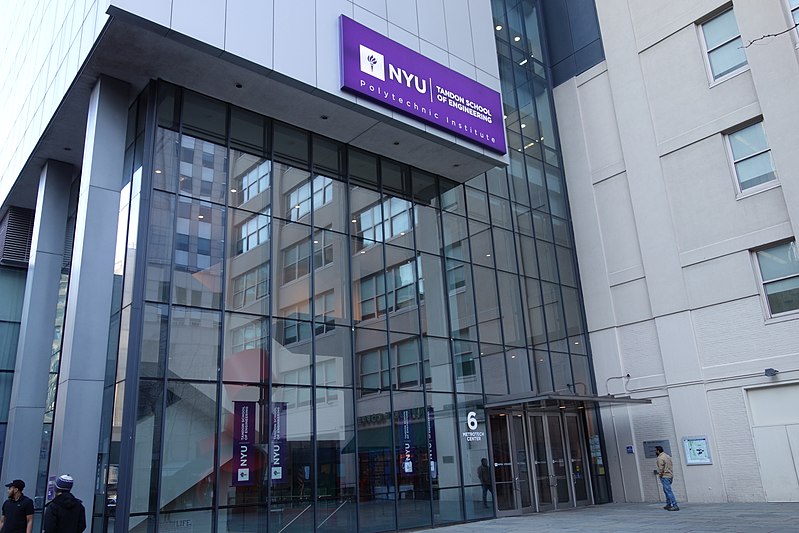
New York University (NYU) agreed to a settlement with the U.S. Department of Education on Sept. 15 over a complaint filed in 2019 alleging that the university improperly handled instances of anti-Semitism on campus.
Adela Cojab, who was an NYU student at the time, filed the complaint after NYU’s Students for Justice in Palestine (SJP) chapter received the university’s President’s Service Award in April 2019 despite a member from the group being charged in April 2018 for assaulting a pro-Israel student during a Yom HaAtzmaut rave. The Department of Education’s Office of Civil Rights (OCR) announced in November 2019 that it would investigate NYU over the matter.
According to a copy of the settlement obtained by the Journal, NYU is required to update its Non-Discrimination Anti-Harassment Policy to include a definition of anti-Semitism as defined under the Executive Order on Combating Anti-Semitism, which uses the International Holocaust Remembrance Alliance (IHRA) definition of anti-Semitism. NYU’s policy also will be required to explain how anti-Semitism manifests itself on campus and what actions the university will take against anti-Semitic incidents, “including anti-Semitism that involves student clubs.”
NYU was required to submit the revised policy to OCR by Sept. 15 and then provide proof to the OCR that the university has adopted the revised policy by Oct. 15.
Additionally, the settlement stated that NYU President Andrew Hamilton or a designee is required to issue a statement by Sept. 30 stating that anti-Semitism will not be tolerated on campus, explaining how anti-Semitism manifests itself on campus and encouraging students who experience anti-Semitism and other forms of discrimination to report it to the university. NYU spokesman John Beckman told the Journal that the statement and the revised policy have already been submitted to OCR.
The university also will host town halls during the 2020-21 and 2021-22 academic school years addressing anti-Semitism and other forms of discrimination on campus and provide training to students, staff and faculty on the matter during those academic years.
The settlement also requires NYU to meet with Cojab by Oct. 31 and that NYU engage in outreach to the Jewish community on campus.
Beckman said in a statement to the Journal, “We are pleased that the U.S. Department of Education has decided to end its review without finding any wrongdoing by NYU. NYU has long been understood as a place that is welcoming to and supportive of members of the Jewish community. For that reason, the university has gladly agreed to several steps that would bolster our longstanding commitment to opposing and responding to anti-Semitism.
“Anti-Semitism is vile, and its renewed spread in recent years defies both decency and understanding. It is at odds with the values of the NYU community, and we should all be joined in common cause against it. Anti-Semitism’s resurgence reminds us that there is a need for constant vigilance and effort in combating hate of all kinds.”
Cojab, who is now a northeast coordinator for the Maccabee Task Force, told the Journal in a phone interview that she was glad that NYU agreed to settle because it shows that “they know there are things they can improve on, they know there’s been instances of anti-Semitism and they do want to come to a resolution.”
However, she expressed concerns that the settlement doesn’t go far enough, arguing that the reporting deadlines listed in the settlement are unrealistic, pointing out that she’s supposed meet with the university by Oct. 31 and the university hasn’t reached out to her yet. Cojab also said she’s skeptical that the university will uphold the IHRA definition of anti-Semitism.
“Professor Amin Husain, who openly talks about his participation in the First Intifada, is still a teacher at NYU,” Cojab said. “He holds events, he holds talks, so how can you have all these anti-Semitism sensitivity trainings when you have a professor that explicitly flaunts his participation in violent riots against Jewish people?”
Cojab added: “I wouldn’t want this agreement to just be a way for them to get the OCR case out of the way instead of actually be introspective, look at their system and see what the system is promoting.”
NYU alumnus Judea Pearl, who is also a chancellor professor of computer science at UCLA, National Academy of Sciences member and Daniel Pearl Foundation president, said in a statement to the Journal that the settlement is “a milestone decision that will soon affect other campuses, such as USC and UCLA.” OCR had announced in January that it plans to investigate two complaints of anti-Semitism at UCLA.
“However, I am afraid the victory will be short-lived, because the word Zionism is not mentioned explicitly in the agreement,” Pearl continued. “This omission is a major mistake, inviting the Zionophobes to zigzag their way around the words and continue the harassments with impunity.”
Zionophobia is a term Pearl uses to describe “an irrational fear of Zionism and an obsessive commitment to delegitimize Israel,” he told Ha’Am, UCLA’s Jewish magazine in 2018.
Alyza Lewin, president of the Louis D. Brandeis Center for Human Rights Under Law, called the settlement “an extraordinary development, a victory for all Jews, and a defeat of anti-Semitism that will undoubtedly improve the climate on NYU’s campus. Other universities that are serious about combating anti-Semitism should follow suit and similarly incorporate the IHRA working definition into their university policies.”
Liora Rez, executive director of the Stop Antisemitism.org watchdog also said in a statement to the Journal, “It’s a shame it took a lawsuit for NYU to do the right thing and protect their Jewish students from discrimination and harassment. We believe this is just the start of many legal complaints we will be seeing by others thanks to the protection Jewish Americans now have under the President’s new Executive Order on antisemitism.”