
After Hurricane Harvey hit Texas, Yotam Polizer, co-CEO of the disaster relief organization IsraAID, called his friend Haider Elias in Houston to see if IsraAID could help him.
Instead, Elias countered with his own proposition: His home was spared by the flooding, so he and half a dozen members of his religious community — a Middle Eastern ethnic group called the Yazidis — offered to work alongside IsraAID packing possessions and removing debris from flooded Jewish homes.
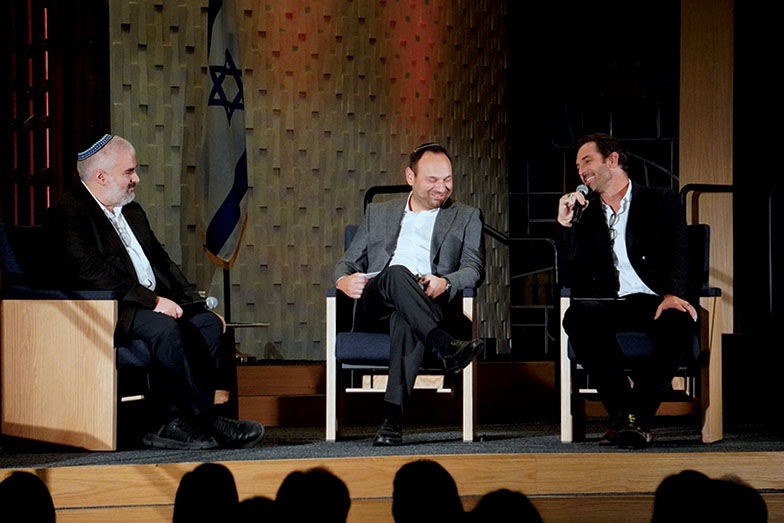
“There is really a shared destiny,” Polizer told an audience on Sept. 17 at University Synagogue in Brentwood, sitting next to Elias. “There is a unique partnership between the Yazidis and the Jews.”
Because of their historical proximity to genocide, American Jews are a prime target for Elias’ effort to lobby the United States government to come to the aid of this ancient religious sect as it struggles with an ongoing genocide at the hands of the Islamic State of Iraq and Syria (ISIS).
During two trips to Los Angeles last month, Elias addressed the local Jewish community in a series of synagogue visits, private dinners and High Holy Days appeals, hoping to mobilize them to lobby the United States on behalf of displaced and enslaved Yazidis. With Yazidis a population of well under 10,000 in the United States, Elias is increasingly relying on Jews to join the ranks of his supporters.
“As soon as we talk to a Jewish community member, they understand it right away,” Elias said in a phone interview after he returned to Texas. “They absorb it. They relate. They know exactly what is happening. It’s very hard for some other communities to understand.”
The Jewish community has loomed large on his recent travel schedule. In late July, Elias flew to Israel and visited Yad Vashem with fellow Yazidi activist and former sex slave Nadia Murad.
In September, he spoke on four panels in West Los Angeles with Polizer, whose group has offered aid and counseling to Yazidis in Iraq and Europe, and Rabbi Pam Frydman, an activist who heads the Beyond Genocide Campaign for the Board of Rabbis of Northern California. All four panels were co-sponsored by the Jewish Journal.
Returning to Los Angeles on Yom Kippur, Elias spoke at Temple of the Arts in Beverly Hills. In muted tones from the lectern, he described the events of Aug. 3, 2014.
In a single day, ISIS overran the Yazidi homeland in the Sinjar region of northern Iraq, murdering nearly 6,000, Elias said, including his 24-year-old brother, two of his cousins and nearly 50 close friends.
ISIS fighters loaded thousands more Yazidis onto trucks, with women and girls destined for sexual enslavement and young boys due to be brainwashed as child soldiers. About half a million Yazidis were driven from their homes, ending up in displaced persons’ camps where hundreds of thousands still live in tents.
Meanwhile, the Kurdish Regional Government has prevented Yazidis from returning home with any food, medicine and supplies that would enable them to rebuild their lives, Elias said.
Elias grew up in Til Azir, a small city of 28,000 Yazidis in the Sinjar region. Today, it’s a ghost town.
He followed news of the genocide from Houston, his home since 2010 after earning a visa for his work as a U.S. Army translator.
His home in Iraq was ransacked down to the windows and doorframes.
At the time, he was studying toward an undergraduate degree in the hope of becoming a doctor. But shortly afterward, he abandoned his medical ambitions to start Yazda, a lobbying and advocacy group based in Lincoln, Neb., where most American Yazidis live (yazda.org).
Elias engages audiences on a frenzied schedule. Between his two L.A. engagements last month he flew to New York and San Francisco, stopping each time for a brief layover in Houston.
To some extent, his efforts have succeeded. In the days after the genocide, demonstrations and lobbying in Washington, D.C., by Elias and others helped persuade President Barack Obama to launch strategic airstrikes that enabled Yazidis to escape an ISIS siege.
In March 2016, following lobbying efforts by Yazda and Frydman’s Beyond Genocide Campaign, the House of Representatives unanimously passed a resolution recognizing the Yazidi genocide.
Now, Frydman and Yazda are pushing for Congress to pass the Justice for Yazidis Act, which would extend psychosocial support and speed refugee resettlement for Yazidis and other persecuted minorities in Iraq.
Elias said his work takes its toll. Each time he speaks to an audience, it traumatizes him anew.
He drew a contrast with his previous occupation as a translator.
“Translators, they’re like instruments,” he said. “They transfer the words. Most of the time they’re too busy to feel the information. If you’ve gone through something, it’s different.”
“It affects you,” he added. “And if it doesn’t affect you in the moment, it has its negative impact soon after, in the future. It makes you different.”
With all of his speaking engagements, Elias has little time to see his wife and three children, ages 16, 14 and 6 years old, and little leisure time for himself. Once a film buff, he hasn’t finished a film since August 2014, he said. His mind always returns to the massive amount of work on his docket.
His work also impacts his children. “Their daddy is not around most of the time,” he said.
Elias said his children understand why he’s gone so often. When other kids ask what their father does, “they say nothing directly,” he said. “They say he’s helping people.”