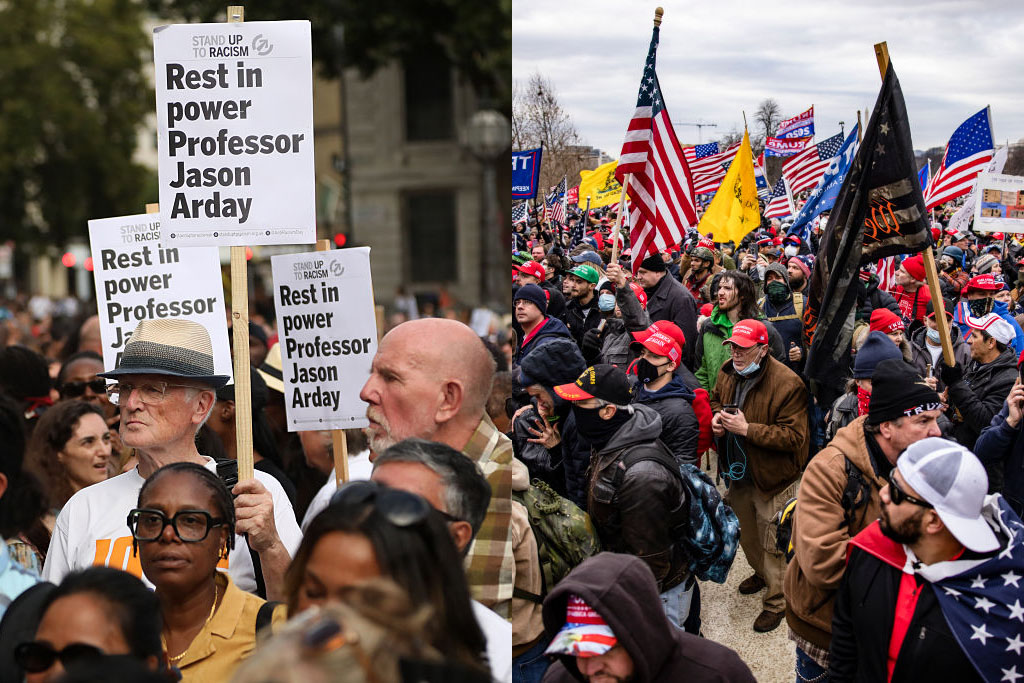
Jewish American groups closely aligned with Trump or with Republican traditional positions have joined the widespread criticism against the President for drawing a moral equivalence between the Neo-Nazis and white supremacists chanting anti-Semitic and Nazi slogans in Charlottesville with the counter protesters.
[This story originally appeared on jewishinsider.com]
In a rare statement issued on Wednesday, the Republican Jewish Coalition leadership implored Trump to dispel any notion of moral equivalency and forcefully reject Nazis and white supremacist groups. “The Nazis, the KKK, and white supremacists are dangerous anti-Semites. There are no good Nazis and no good members of the Klan,” RJC National Chairman Senator Norm Coleman and Executive Director Matt Brooks said in a statement. “ We join with our political and religious brethren in calling upon President Trump to provide greater moral clarity in rejecting racism, bigotry, and antisemitism.”
Trump has remained defiant in face of the backlash and is “without regret,” CNN reported on Wednesday.
The Rabbinical Council of America, the leading organization of Orthodox Jewish rabbis in North America, called the failure to unequivocally reject hatred and racism “a failing of moral leadership.”
“While as a rabbinic organization we prefer to address issues and not personalities, this situation rises above partisan politics and therefore we are taking the unusual approach to directly comment on the words of the President,” Rabbi Elazar Muskin, president of the RCA, said in a statement. Rabbi Mark Dratch, Executive Vice President, added, “The RCA joins with politicians of all parties, citizens of all political persuasions, and people of all faiths calling on President Trump to understand the critical consequences of his words.”
Appearing on i24News, Orthodox Union (OU) President Moshe Bane said he was “a bit confused” by Trump’s response to the weekend events in Charlottesville, Virginia. “It seems very inconsistent with his general sensitivities to bias crimes, hatred and terrorism,” Bane noted. “We are assuming – for our purposes – that he really didn’t mean the moral equivalency that he suggested because if he did, that would be totally unacceptable and abhorrent to us.”
“We are hoping that this is a communications issue, that he doesn’t appreciate the message that is being sent by saying there is blame on all sides,” Bane added. “ I can’t believe that any of [his Jewish advisors] would be supporting a moral equivalency message. I do not know what kind of communications they have on this kind of issue, I don’t know how receptive he is to input on his articulations of his views, but I am certain that they don’t have a perspective of moral equivalency in this situation.”
Agudath Israel of America issued a response to Trump’s comments late Wednesday evening. “While, as the president said, there were violent individuals in both camps, there is obviously no comparison between a group of people who gather to espouse a philosophy of hatred and exclusion and a group that gathered to oppose that odious message,” Rabbi Avi Shafran, a spokesperson for Agudath Israel of America, told Jewish Insider. “Had the president ended his addressing of the Charlottesville issue with his second set of remarks, it would have been a much clearer message than the one he left us with on Tuesday night. I don’t think he is either a racist or an anti-Semite, but it’s important to not give comfort, intentionally or inadvertently, to such lowly elements of society.”