fbpx

August 16, 2017

Moving & Shaking: Haim and Cheryl Saban donate $5 million to FIDF; Jewish Community Day at Dodger Stadium

Haim and Cheryl Saban of Beverly Hills have donated $5 million to Friends of the Israel Defense Forces (FIDF) to fund construction of a heritage center dedicated to the memory of fallen Israeli Druze soldiers.

“To me, the historic bond that Israel and the Jewish people have with the Israeli Druze community — and the mutual commitment we have to support and protect each other — is particularly inspiring. The Druze community deserves recognition for all its contributions to and sacrifices for Israel’s security,” Haim Saban said.

The 25,000-square-foot center, in the Arab town of Kisra-Sumei in northern Galilee, will have a 500-seat auditorium, a gymnasium, a heritage room, classrooms, offices and a dining hall, and it will display elements that tell the story of the Druze impact on the IDF and the State of Israel. It will be a facility for rest and recreation for active-duty and discharged soldiers, as well as a memorial for Druze soldiers who died in battle.

The Sabans attended a groundbreaking for the center on July 27, along with Israeli Minister of Defense Avigdor Lieberman; Sheikh Muwaffak Tarif, spiritual leader of the Israeli Druze community; and Shachiv Shanan, a former member of the Knesset and father of Advanced Staff Sgt. Maj. Kamil Shanan, one of two Israeli Druze soldiers who were shot and killed in a terrorist attack at the Temple Mount on July 14.

The Druze community in Israel has a population of about 130,000, most of whom serve in the IDF.

“This FIDF Druze Soldiers Heritage Center is a good and significant step toward making the Israeli public and Jewish community more aware of Druze contributions to defending the Jewish homeland, Israel,” said Haim Saban, chairman and CEO of Saban Capital Group, who was born in Alexandria, Egypt, and immigrated to Israel at the age of 12. “It is all of our responsibility to continue to highlight their important contributions to Israel’s safety and security, and do what we can to support them.”

— Ryan Torok, Staff Writer, and Clara Sandler, Contributing Writer
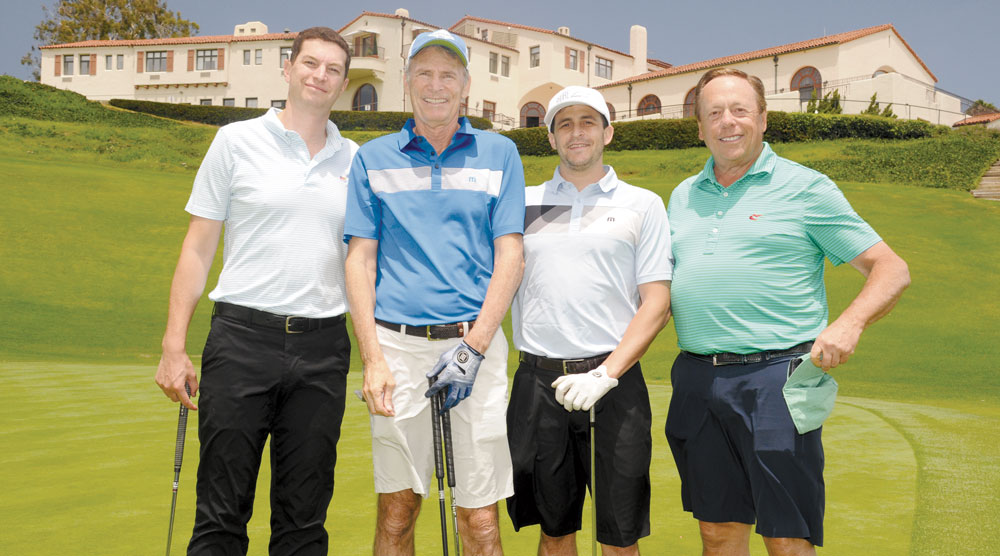
From left: Adam Koral, Richie Koral, Ryan Hayden and Anthony Lapenna were the champions of the 27th annual Jewish National Fund Golf Tournament on July 31 at the Riviera Country Club. Photo courtesy of Jewish National Fund


Nearly 130 players teed off in support of Israel during the 27th annual Jewish National Fund (JNF) Golf Tournament at Riviera Country Club on July 31.

The tournament began with practice at the driving range, followed by a barbecue lunch. Some participants played a round of golf, while others who were unable to play honed their skills with golf lessons.

The sold-out event included cocktails and an awards reception hosted by 2015 Miss America Kira Kazantsev, who played in the tournament and shot a 76. She also
was the longest-drive winner. Tournament champions were Ryan Hayden, Adam Koral, Richie Koral and Anthony Lapenna. Richie Koral also was the sponsor of the caddy bibs.

Over the past 25 years, the golf tournament has raised millions of dollars. Through its One Billion Dollar Roadmap for the Next Decade campaign, JNF is greening the desert with millions of trees, building thousands of parks across Israel, creating new communities and cities for generations of Israelis to call home, bolstering Israel’s water supply, helping develop innovative arid agriculture techniques, and educating people about the founding and importance of Israel and Zionism.

— Ayala Or-El, Contributing Writer
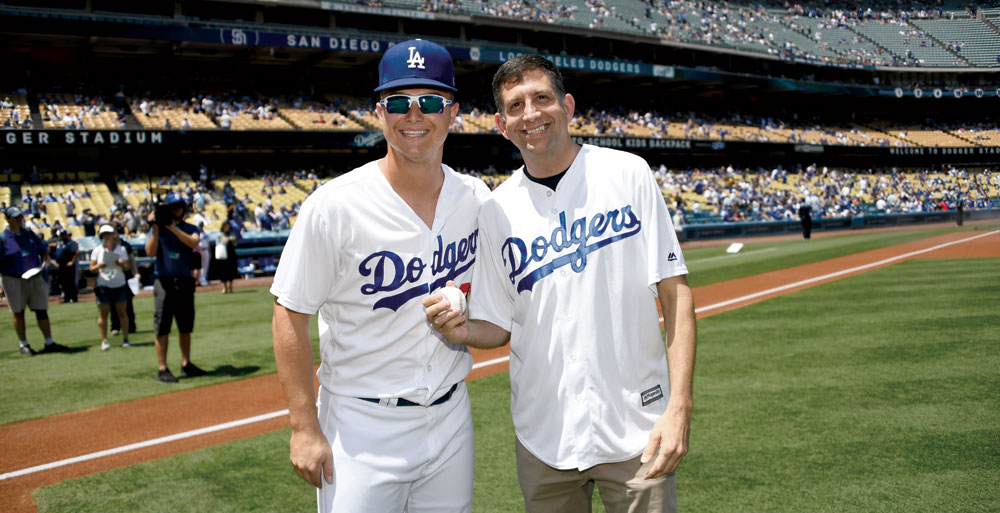
Dodgers outfielder Joc Pederson (left) and Consul General of Israel in Los Angeles Sam Grundwerg enjoy Jewish Community Day at Dodger Stadium on Aug. 13. Photo by Jon SooHoo


large contingent of Los Angeles Jews, many wearing special Hebrew-language Los Angeles Dodgers caps, cheered the Dodgers to a 6-4 victory over the San Diego Padres on Aug. 13 during the 18th annual Jewish Community Day at Dodger Stadium.

Before the Sunday afternoon matchup, Dodgers outfielder Joc Pederson, whose mother is Jewish, joined Consul General of Israel in Los Angeles Sam Grundwerg, who threw out the game’s ceremonial first pitch.

“Jewish Community Day is awesome,” said Pederson, who played for the Israeli national team in the qualifying rounds of the 2013 World Baseball Classic.

[For more photos from Jewish Community Day visit our Facebook page]

Additional pregame ceremonies featured Israeli-American singer and former “American Idol” contestant Elliott Yamin performing the national anthem and U.S. Army Ranger Capt. Dylan Alexander Mack receiving the Military Hero of the Game honor. Mack, who was the only Jewish cadet in his class at West Point, lives in Glassell Park and is an Iraq War veteran.

Members of Shomrei Torah Synagogue, Mishkon Tephilo and other synagogues and Jewish organizations turned out for the game, sporting the Hebrew Dodgers caps provided to attendees who purchased a special ticket package.

Glatt kosher hot dogs were available at two locations in the stadium, including on the Reserve level, where Beth Jacob Congregation Rabbi Kalman Topp stopped by shortly before the seventh-inning stretch to enjoy the dogs cooked by Jeff Rohatiner, owner of the Pico-Robertson-based Jeff’s Gourmet Sausage Factory.

“I grew up at Dodger Stadium,” Rohatiner said. “And now to make my own hot dogs and be able to serve them at the stadium to the community — to my Jewish community — is an amazing, wonderful thing.”

David Hanelin, 19, a YULA Boys High School graduate, was behind the counter, helping Rohatiner. Hanelin, whose family belongs to Young Israel of Century City, said he was happy that Jewish community members turned out to enjoy the ballgame.

“I think it’s good for the Jews to come out together and show their Jewish pride,” Hanelin said.

In a nod to the many Jewish community members in the crowd, including Ziegler School of Rabbinic Studies Dean Rabbi Bradley Artson, the stadium organist, Dieter Ruehle, played “Havah Nagilah” and “If I Were a Rich Man.”

To read more about Jewish Community Day at Dodger Stadium, visit JooTube.TV. 

Rachel Grose. Photo courtesy of Rachel Grose

The Los Angeles Jewish Free Loan Association (JFLA) named Rachel Grose as its new executive director on May 24. Grose, the organization’s longtime associate director, succeeds James A. Kohn, a past JFLA president and current board member who had been serving as interim executive director.

“My goal is to build on [our] distinguished tradition, collaborating with donors, board members, staff and other agencies, to increase our impact and strengthen our entire community,” Grose said.

Grose first joined JFLA in 2002 and began serving as associate director in 2013. She said she wants to uphold the values of JFLA and make a difference in the lives of families.

JFLA President Harold Tomin said Grose is poised for success in her new position.

“First, she is extremely bright and knowledgeable about not only the JFLA but Jewish philanthropy in general,” Tomin said. “She understands the absolute value of hard work and how it leads to success. She is growing into the position in an amazingly swift way.”

JFLA, founded in 1904, provides small, interest-free loans to individuals from all backgrounds and socioeconomic levels. JFLA has an active portfolio of $12 million, and last year it made nearly 1,000 loans. The organization extends services to about 3,000 families and has provided loans for a variety of circumstances, including household emergencies, small businesses and college educations.

— Avi Vogel, Contributing Writer
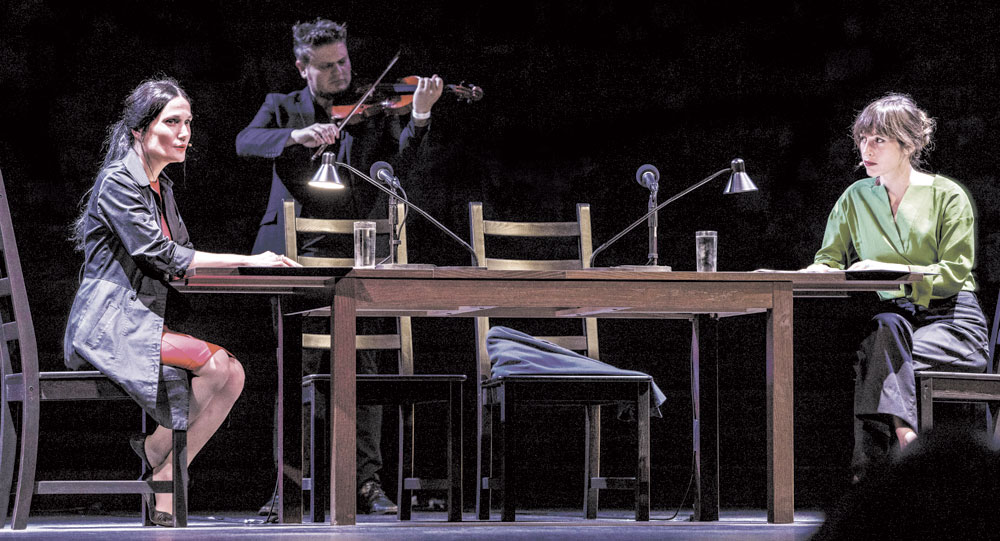
“Yitzhak Rabin: Chronicle of an Assassination,” which spotlights the former Israeli prime minister’s murder and the days preceding it, debuted at the Ford Theatre on July 23. Photo by Timothy Norris, courtesy of Ford Theatres


Israeli director Amos Gitai, whose feature films include “Kippur,” “Kadosh” and the recent “Rabin, the Last Day,” which chronicles Israeli Prime Minister Yitzhak Rabin’s murder and the days preceding it, arrived in Los Angeles for the local debut of “Yitzhak Rabin: Chronicle of an Assassination,” which was performed at the Ford Theatre on July 23.

The show, a theatrical version of “Rabin, the Last Day,” premiered at the 2016 Festival d’Avignon in France and also was performed at the Lincoln Center Festival in New York. The production features two actresses and three musicians, with a projection screen showing scenes from the final days of Rabin’s life, including images of the murder scene where three gunshots by Yigal Amir ended Rabin’s life shortly after a peace rally in support of the Oslo Accord. The assassination took place on Nov. 4, 1995, at the Kings of Israel Square in Tel Aviv, now known as Rabin Square.

Reading from the memoirs of Rabin’s widow, Leah Rabin, actresses Einat Weitzman and Sarah Adler explored the political violence and tension in Israeli society in the days and weeks prior to the event and the last moments of Rabin’s life as seen through his wife’s eyes.

Gitai, who sat in the last row during the L.A. premiere, created the project 20 years after the assassination that sent shockwaves around the world.

Musical performers in the 90-minute production included pianist Edna Stern, soprano Keren Motseri and violinist Alexey Kochetkov.

— Ayala Or-El, Contributing Writer
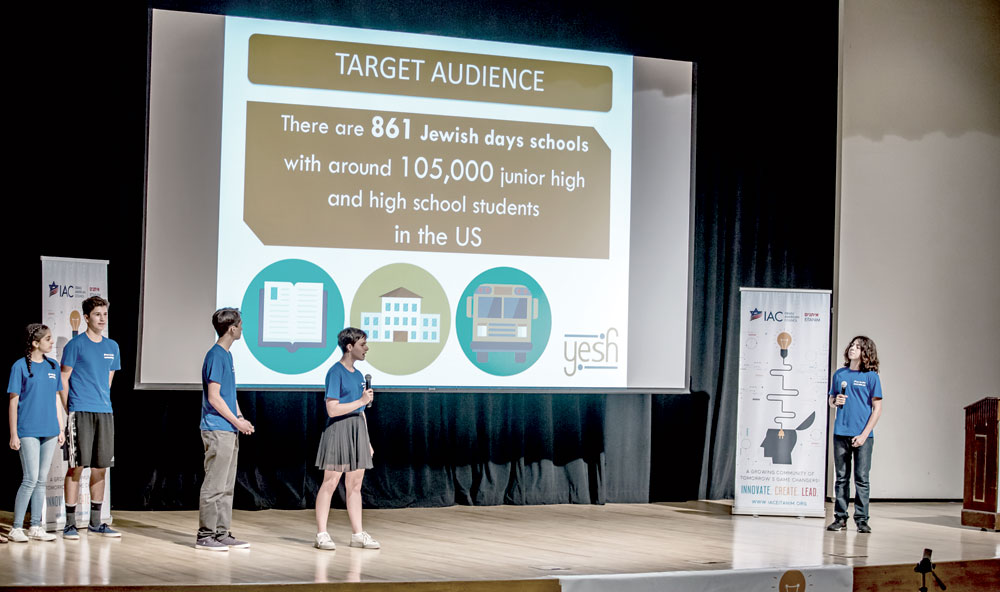
Middle and high school students present pitches on education technologies during the Israeli American Council Eitanim Summer Hackathon. Photo by Linda Kasian Photography


More than 250 people came to American Jewish University on Aug. 3 for the conclusion of the Israeli American Council (IAC) Eitanim Summer Hackathon, which kicked off on July 30.

During the second annual event, seven finalist groups presented to a panel of judges pitches on education technologies they had developed over the course of several days. The judges included Ilana Golan, CEO of Golan Ventures; Kfir Gavrieli, CEO of Tieks by Gavrieli; and Metuka Benjamin, president of Milken Community Schools.

Also in attendance were Israeli professionals from across the United States who mentored the students on their pitches. Among the mentors were Kobi Laredo, cloud technical account manager at Amazon Web Services; Justin Wolff, co-founder of Yoobi; Yair Vardi, managing partner at Splash Ventures; and numerous other industry professionals from across the country.

Addressing the crowd of students and guests, Orit Mizner, national director of programs for IAC, said the hackathon drew some of the most impressive young minds in the country.

“This week has been full of innovation and teamwork,” she said as the student section erupted with applause. “This is the group of leaders that will innovate and guide others nationwide.”

— Avi Vogel, Contributing Writer

Moving & Shaking highlights events, honors and simchas. Got a tip? Email ryant@jewishjournal.com.

Moving & Shaking: Haim and Cheryl Saban donate $5 million to FIDF; Jewish Community Day at Dodger Stadium Read More »

Gary Cohn, Steven Mnuchin: You good with this?

The question of the day, at least in my corner of the world, is this: How can Gary Cohn and Steven Mnuchin keep silent?

Cohn is chief economic advisor to President Donald Trump and the director the National Economic Council.   Mnuchin is Secretary of the Treasury.  Both men are Jewish.  And both men stood just to the right of Donald Trump as he equated neo-Nazis and white supremacists with the people who protested them, and declared that at a rally attended and promoted by hate groups from around the country, there were “very fine people”

It was, as the historian Steven Windmueller wrote,  “the first time in American history where a President has not uniformly and consistently condemned anti-Semitism.”

The statement was offensive enough that at least seven CEOs serving the administration as advisors resigned from their posts.  But Mnuchin and Cohn, who both come from the world of business and finance, remained silent  As of today, neither one has spoken out.

It is impossible to believe that both men are unaware of the deeply anti-semitic nature of the rally.  Its attendees posted threats against the local Charlottesville synagogue, Congregation Beth Israel, in the days leading up to the march.  On the day of the rally, congregants felt the threat acutely.  Here’s an account of that day from the temple’s president,  Alan Zimmerman:

For half an hour, three men dressed in fatigues and armed with semi-automatic rifles stood across the street from the temple. Had they tried to enter, I don’t know what I could have done to stop them, but I couldn’t take my eyes off them, either. Perhaps the presence of our armed guard deterred them. Perhaps their presence was just a coincidence, and I’m paranoid. I don’t know.

Several times, parades of Nazis passed our building, shouting, “There’s the synagogue!” followed by chants of “Seig Heil” and other anti-Semitic language. Some carried flags with swastikas and other Nazi symbols.

A guy in a white polo shirt walked by the synagogue a few times, arousing suspicion. Was he casing the building, or trying to build up courage to commit a crime? We didn’t know. Later, I noticed that the man accused in the automobile terror attack wore the same polo shirt as the man who kept walking by our synagogue; apparently it’s the uniform of a white supremacist group. Even now, that gives me a chill.

When services ended, my heart broke as I advised congregants that it would be safer to leave the temple through the back entrance rather than through the front, and to please go in groups.

Anti-semitism was not a bug of the rally, it was a feature.  The marchers chanted, “Jew will not replace us!”  Their flyers featured Nazi imagery and Stars of David.  These were the men and women that the President put on the same moral plane as those who confronted them.

Some media reported that Cohn and Mnuchin looked uncomfortable as Trump spoke.  If so, it is far more subtle than the visible snort and head shake his comments drew from Chief of Staff Gen. John Kelly.

So why the silence from Cohn and Mnuchin?  Here’s some guesses:

Could it be that neither man is that connected to his Jewish identity?  Unlikely. Cohn is an active member of his local Jewish Federation.  In 2009 he donated  money to Hillel International in order to build a Jewish student center at Kent State University.  It is called the Cohn Jewish Student Center.   The Mnuchin family  has a long history Jewish philanthropy as well.

Could it be that they know Trump is not an anti-Semite, so the idea that  he supports anti-Semitism is ridiculous? Maybe.  That’s what some of his other Jewish aides told the New York Times today.

“I know President Trump and his heart,” Michael Cohen, the president’s personal lawyer, wrote to the Times. “He is a good man and doesn’t have a racist bone in his body. All morning I am receiving horrific comments about being anti-black, racist, etc. for supporting Trump. It’s just wrong!”

This is the go-to response of Trump’s Jewish supporters, family and staff.  It is probably true, but it’s also besides the point.  You don’t have to be an anti-Semite to give cover to anti-Semites, which is what the President did yesterday.  His motivations may have had nothing to do with his feelings about Jews, but the effect is the same.  Neo-Nazis, repackaged as the “alt-right,” now can feel vindicated.

In fact, by standing silently by as  Trump betrayed American Jews , Cohn and Mnuchin are only encouraging Trump’s behavior.  He can use their presence to assure himself that he’s done nothing wrong.

Could it be they think the whole mess is a Leftist, media-fueled over-reaction to a few poorly chosen and ultimately meaningless words?  Maybe.  But neither man is known to be hyper-partisan.  Records show they have given to Democratic as well as Republican candidates.  They can read the denunciations of Trump’s words from a broad spectrum of Jewish organizations and community and religious leaders, as well as from numerous Republicans and foreign leaders.

“It is unbearable how Trump is now glossing over the violence of the right-wing hordes from Charlottesville,” Germany’s Justice Minister Heiko Maas said in a statement, according to Reuters. “No one should trivialize anti-Semitism and racism by neo-Nazis.”

No one’s making this up, and Cohn and Mnuchin are too smart to think otherwise.

Could it be they put their duties and their loyalty to the President far above whatever concerns they have about his statements and actions?  Again, maybe, in which case they have to swallow their gut reactions, shrug to their friends and family– hey, what can I do?– and just plow ahead.

Everybody makes choices about what principles are worth fighting for, Cohn and Mnuchin have made theirs. Thanks to President Trump, the neo-Nazis feel they have the wind at their backs, and white supremacists have planned more rallies across the country.   Cohn and Mnuchin have to own the fact that their boss has just received Twitter raves from Richard Spencer, David Duke, Matthew Heimbach and their well-armed minions.   Cohn and Mnuchin will have to explain whether they spoke up in private, because their public silence reads like cowardly acquiescence.

And Cohn and Mnuchin will need to face one of the supreme ironies of our time: when their boss endangered Jewish lives, they stayed silent, and the Germans spoke up.


ROB ESHMAN is publisher and editor-in-chief of TRIBE Media Corp./Jewish Journal. Email
him at robe@jewishjournal.com. You can follow him on Instagram and Twitter @foodaism
and @RobEshman.

Gary Cohn, Steven Mnuchin: You good with this? Read More »

Moonrise, Salt Lake City: December 26, 2015

It looks, for all the world, like the holy ghost
in an early Renaissance annunciation:
a light-struck, light-emitting dove in flight.
But there’s no Mary. No Gabriel. It’s night;
the moon’s taking an unexpected breather,
a bit too out of shape to slither past
this mountain I hadn’t seen was here,
its outlines newly visible as wings
(what’s showing of the moon itself’s the head).
Don’t worry, moon. We all lose our bearings;
why this urge to rise? Stay here instead.
I’ll spot you; we could both use an ally
and rumor has it disorientation
is the least resistant pathway to what’s holy.


Jacqueline Osherow is the author of seven collections of poetry, and has received grants from the John Simon Guggenheim Foundation, the NEA, the Ingram Merrill Foundation, and the Witter Bynner Prize from the American Academy and Institute of Arts and Letters. She is a distinguished professor of English at the University of Utah.

Moonrise, Salt Lake City: December 26, 2015 Read More »

ADL ‘troubled’ by Trump’s reluctance to denounce Alt-Right

ADL CEO Jonathan Greenblatt welcomed President Donald Trump’s public denunciation of white supremacists and neo-Nazis on Monday but cautioned that Trump’s statements “are no longer sufficient.”

[This story originally appeared on jewishinsider.com]

During a press call moments after the President singled out the KKK, neo-Nazis, white supremacists as “repugnant,” Greenblatt criticized Trump for sending a message to “white supremacists and extremists rallying around his rhetoric” and for “his unwillingness to consistently and forcefully denounce their behavior.”

“This was not a subtle dog whistle, but like a bullhorn and a signal for them to try and rise and take a seat at the center of the public conversation,” the head of the Anti-Defamation League empathized.

Pointing to several incidents in the past, Greenblatt suggested that Trump’s “many sides” comments on Saturday, demonstrated a pattern. “We have seen a pattern of the President equivocating in the face of intolerance, and an unwillingness to call out white supremacists, to name neo-Nazis, or to attack the alt-right,” Greenblatt told Jewish Insider. “Let’s just say it’s hard to understand what his intentions are. I can’t discern what’s in his head or in his heart. At the ADL, we can only deal with the impact. And the impact is, an uptick in anti-Semitic incidents. The impact is an increased tempo of white supremacist activity across the country. The impact is as we saw this weekend, unbridled violence from the worst elements of society. And so we find it very troubling that it has taken so long and it has been a serial issue.”

Greenblatt called for a bipartisan approach to address the issue. “I think we know that members of Congress care about this issue, these few men speak up again and again. I think it’s a good opportunity for them to work together to take action,” he said. “That could be, again directing federal agencies to do things, it could be directing the President to announce a new White House coordinator for fighting hate. As we’ve seen with previous administrations, it’s appropriate to elevate priorities with new dedicated personnel. Now again, if he can’t do it, then I think it’s possible that the Congress could appoint someone to this sort of role.”

The ADL chief also suggested that Congress work on federal-level legislation to protect students from religious harassment and discrimination on college campuses, particularly Jewish students who increasingly find themselves to be the targets of anti-Semitism. “We’ve seen an uptick in white supremacists recruiting on college campuses,” he explained. “We’ve recorded over 160 racist flyering incidents in more than 30 states in the last academic year. Our kids need protection, that’s an area where Democrats and Republicans could work together.”

ADL ‘troubled’ by Trump’s reluctance to denounce Alt-Right Read More »

Foxman: Now is Jared and Ivanka’s ‘Mordechai and Esther’ moment

“This is a dark moment for those of us who remember what hatred can do,” is how Abe Foxman, a Holocaust survivor and former National Director of the Anti-Defamation League, started off a phone interview with Jewish Insider moments after President Donald Trump’s combative press conference in New York on Tuesday.

[This story originally appeared on jewishinsider.com]

Doubling down on his controversial comments from Saturday, Trump drew a moral equivalence between the white supremacists chanting anti-Semitic and Nazi slogans in Charlottesville over the weekend with the counter protesters. “You had many people in that group other than neo-Nazis and white nationalists and the press has treated them absolutely unfairly,” the President said during the freewheeling press conference at Trump Tower in New York. “I think there’s blame on both sides. You look at both sides — I think there’s blame on both sides and I have no doubt about it.”

“As a Holocaust survivor, I never thought that I would witness the day that a president of the United States would rationalize away Nazism, its hatred, its violence, and find excuses for it,” said Foxman, who now serves as Director of Center for the Study of Anti-Semitism at the Museum of Jewish Heritage. “For him to have seen the torch parade and the epithets against his daughter, his grandchildren, his son-in-law, and stand up and say both sides are equal? Shame, shame, shame.”

Recognizing that Trump has a tendency of doubling down on irrational behavior when being pushed into a corner, Foxman said now might be the time for Ivanka Trump and Jared Kushner to take matters into their own hands and step into the roles of Mordechai and Esther. “Trump loves his daughter. She is the apple of his eye, and I saw him, he likes his son-in-law, but he certainly loves his grandchildren,” Foxman explained. “They need to sit down with him, and say to him, face-to-face, ‘Do you understand what message you’re sending to your grandchildren? That it’s okay for people to march down and yell get rid of the Jews, we don’t want the Jews. And you say this is nothing, this is like people who protest against something that they don’t like.’ I don’t see anybody else. I think this is the moment. People have said, ‘Well maybe Jared …’ Jared’s grandparents are Holocaust survivors. People say, ‘Well, maybe they were put there to be Esther or Mordecai.’ Well, maybe they have.”

Foxman: Now is Jared and Ivanka’s ‘Mordechai and Esther’ moment Read More »

How Charlottesville has defined the Trump presidency

The events in Charlottesville this past weekend serves as a metaphor for a broader battle over what is America and who are Americans. The alliance of alt-Right groups present in Virginia last Saturday seeks to return this nation to a European-oriented culture of white superiority, where class and race matter.  “Jews” served as the lightning rod for what would unfold on Saturday. The language, threats, and intensions of these Gestapo-type units who came to “demonstrate” were on display.  Their dress, their weapons, and their demeanor would convey their message of hate.

This represents the first time in American history where a President has not uniformly and consistently condemned anti-Semitism. Rather than trying to heal the nation or to create a constructive dialogue around regionalism, racism, and responsibility, our President through his inconsistent rhetoric and his willingness to excuse the actions of his alt Right allies has served to further splitter America, giving license to anti-Semitism. Moral equivalency has no place amidst this debate over hate.

Charlottesville saga also symbolizes the larger cultural divide that defines the nation, and more immediately the American South. Indeed, the future of Confederate monuments, scattered across Dixie is sparking an intensive debate on the place of the Civil War in American history, while at the same time reopening the realities of slavery and the vestiges of racism.

Emboldened by the events in Charlottesville and the tacit support of the White House, “Unite the Right” has announced nine rallies for this coming weekend across the nation and additional ones in the weeks ahead.  Now free from any constraints, at least from the White House, are we likely to see further assaults on minorities, including specific attacks on Jewish Americans?

Will the leadership of the Republican Party across this country follow the lead of Marco Rubio, John Kasich, and John McCain and push back against their President, repudiate his messaging while continuing to speak out in defense of the character and spirit of the American creed that has been acknowledged and celebrated for nearly 250 years?

The 20th Century Nazis now have their 21st Century American comrades.  Some have said “it can’t happen in America,” but this President may have set the seeds of hate that could allow such a war against the Jews to unfold.  Did Donald Trump just signal his consent that a war against the Jews and their allies fits within his definition of what it may to take to make America great again?

Steven Windmueller Ph. D. on behalf of the Wind Group, Consulting for the Jewish Future.  Dr. Windmueller’s collection of articles can be found on his website: www.thewindreport.com.

How Charlottesville has defined the Trump presidency Read More »

Meant to Be: Together 75 years with ‘The One’

My great-grandparents were married for 75 years. They died when I was well into my 30s. I knew them as Grandpa Meyer and Grandma Millie. He was 99; she died several years later, at 103. When I asked him the secret to their marriage, Grandpa Meyer confessed, “The secret is … we didn’t die.”

As I contemplate their almost eight-decade union, there was more to it than that.

When Grandma was 90, she began to decline from dementia. Grandpa put her in a convalescent facility and every day he would dress in a three-piece suit and shuffle down the hall, bringing her flowers and Nips, those caramel chocolates that were her favorite. Often, he found her in a haze, not knowing what was going on. But as soon as she heard his voice, she recognized it and would say his name. Her lucid moments lasted briefly, but they were just enough to keep him going back each day to hear her say “Meyer, is that you?”

I remember my great-grandparents very well. I had a long time to watch and observe their relationship, including their arguments. My great-grandmother wore the pants in the family, and she often scolded my great-grandfather for buying the wrong thing at the store or for not picking enough oranges in their backyard. Those memories are beginning to fade, but I do remember when I was 5 or 6 asking my father, “Dad, are they happy? Because they fight a lot.” He responded with, “That’s not fighting, that’s called talking loudly. They’re old and can’t hear.”

I also have a clear memory of being a small child and going with my great-grandfather to the supermarket. He loved to pick the fruit in the produce section and touched each melon as he flirted his way through the store. It was sort of adorable and hilarious at the same time. Every store clerk knew him by name. These trips often lasted hours. I remember thinking that he had not lost his own self just because he was attached to another person. He was still flirtatious and magnetic and loved people. And I know it was because his relationship with my great-grandmother had made him feel whole. She continued to foster his full spirit, so he never had to give up on those adorable habits of taking extra long to buy three apples at the grocery store.

What I remember most of all was asking my great-grandfather how he knew my great-grandmother was “the one.” He was a year and a half younger than Grandma Millie and had seen her for the first time when he was only 18. When he would retell the story of that moment, he described it, saying, “It was as if time stood still upon laying eyes on her.” Then he’d say, “I will never ever forget seeing this beautiful radiant girl, wearing absolutely no makeup, yet she had this permanent glow and these flushed red cheeks and ruby-red lips. I thought, this is a face I could wake up to every morning and be a happy man.” I must have heard him tell that story a million times.

My Grandpa Meyer worked as a bookkeeper until he retired at 85. He loved his root beer floats, his occasional schnapps, his carrot juice, his herring, his orange grove and, of course, his wife, children, grandchildren, great-grandchildren, even his great-great-grandchildren. When he turned 96, he was the sandek at the bris for my oldest son, his first great-great grandchild.

When I think about his long life and marriage, I think about his ability to prioritize his life with conviction. He made his wife his life. He savored every day to make her smile. Even toward the end of his life, when she started to lose her memory, he dedicated himself to find small moments to connect with her, even if it meant he would be disappointed in those muddled confusing conversations with her.

Five weeks before Grandpa Meyer died, when he was 99, he came to the wedding of my brother in a wheelchair. I barely recognized him because I had never seen him need help walking, not even with a cane. He whispered to me that he had waited all year for this wonderful party and would not miss it for the world.

My great-grandfather wasn’t waiting for a party; he was waiting to see my brother look into the eyes of his own beautiful wife so he could know that his Yakup — that’s what he called my brother Jacob — had found the one, just as he did.

CHAVA TOMBOSKY is an executive producer and a director at Deer-Vision Motion Pictures, a recording artist and an ongoing writer for The Huffington Post and for her
personal blog, “Thelma & Louise.” 

Meant to Be: Together 75 years with ‘The One’ Read More »

Solar eclipse a time to behold our world: Parashat Re’eh (Deuteronomy 11:26-16:17)

The parsha this week is titled Re’eh — “See.” In Deuteronomy 11:26, Moses declares to each individual person God’s command to, “See, this day I set before you blessing and curse.” Our commentators quickly move away from understanding the word re’eh as a visual glance, and move us toward the concept of beholding, perceiving or paying attention.

Of course, what one may “see” as a blessing another person may “see” as a curse. A person who does not like crowds may find attending a county fair to be a punishment, while someone else will consider it a great reward. When a person pays attention and truly sees something, then it is the viewer’s perception that determines if the occasion should be categorized as a blessing or a curse.

Our sages found this to be especially true when it comes to the solar eclipse. It’s hard to see in the dark, and when we hear a sound in the dark, we are quick to jump to negative conclusions, misperceive and become afraid. Perhaps this is why our ancestors were a bit at odds with a solar eclipse, a time when they witnessed darkness when there should be light.

Our Talmud teaches us to understand this rare sight as a curse and not an opportunity for blessing. In our tractate of Sukkot we learn, “When the sun is in eclipse it is a bad omen for the whole world. With what can this be compared? To a flesh-and-blood king who made a banquet for his servants and put a lamp in front of them. When he got angry with them, he said to the servant, ‘Take the lamp away from them, and let them sit in the dark’ ” (Sukkot 29a). Sitting in the dark is rarely a desired event, especially during a banquet.

Since the Jews live by a lunar calendar and other nations by a solar calendar, our rabbis further believed that when an eclipse occurred, these two are in conflict with each other. They even interpreted the color of the face of the sun negatively: If it was red, it meant blood will be spilled in war, and if it was shadowed and dark, then it was like the sackcloth of famine.

But I am troubled by the notion that an awesome occurrence like a total solar eclipse would receive no blessing. As a people, we are commanded to bless 100 times a day: taking note, appreciating, beholding, acknowledging, seeing the wonders of the world we live in and blessing them, giving thanks. We bless everything: from our ability to open our eyes, our mobility, everything we eat, even when we come into contact with a great teacher. And we are to bless the wonders of nature, from rainbows to lightning, earthquakes and even comets. But for an eclipse, our mouths should remain closed?

With modernity, we understand that solar eclipses are an aspect of nature at work, the same as lightning and earthquakes. It is about the moon, whose diameter is about 400 times smaller than the sun’s, being at just the right distance from Earth and in just the right rotational moment, so that it crosses paths between the Earth and sun, blocking the sun from our view. A moment of total eclipse has not been witnessed since 1979 in our country. It is a true wonder that we will pause and re’eh — behold — but from behind protective lenses. How is it possible not to offer blessing?

In our Torah portion this week, each of us is charged to re’eh — to behold blessing and curse, to seek out blessings and curses through our actions and the perception of these occurrences. In the days ahead, I am challenging myself to pause, to pay attention, to look upon the upcoming solar eclipse on Aug. 21 and find a way to approach the radical wonder of the moment with gratitude and blessing while holding the caution of my ancestors in mind. Out of respect for our tradition, I won’t be sharing the blessing usually recited over nature, but I will take guidance from the scientist Roger Price (see page 13), who provides a beautiful three-part structure:

As the eclipse nears: Blessed are You, Source of life that fashions the stars, the sun, the moon …

As we stand in the shadow of darkness not to fear but rather to be thankful: We are thankful to you, God, for the opportunity to witness this moment …

As light re-emerges: Blessed are You who sustains life, renews us fresh, returns light to our day each and every day so we can behold …

I pray that we may each choose to perceive this world as filled with blessings and see within it awe-inspiring moments to witness and give thanks.

Rabbi Sarah Hronsky is senior rabbi at Temple Beth Hillel in Valley Village. 

Solar eclipse a time to behold our world: Parashat Re’eh (Deuteronomy 11:26-16:17) Read More »

Art, history converge in Grunwald archive

On an early May morning in the mid-1930s, Gestapo officials barged into Fred Grunwald’s apartment building near Düsseldorf, demanding of the landlady, “Where is the Jew?”

Once inside the businessman’s home, the officers declared that because he was a leader of the local B’nai B’rith lodge, they would search his apartment and arrest him. They promptly tore apart the master bedroom, in the process seizing eight to 10 portfolios of Grunwald’s treasured collection of print artworks from an antique cabinet.

When Grunwald returned home after his arrest, he found that about 500 of his prints had been taken, including works by two of the most renowned German expressionists, Edvard Munch and Ernst Ludwig Kirschner. (The prints were never returned.)

Grunwald, who died in 1964, went on to amass an even more impressive collection after immigrating in 1939 to the United States, where he became a successful clothing manufacturer.

Pieces donated from his world-class collection in 1956 established what is now the Grunwald Center for the Graphic Arts at UCLA, currently housed at the Hammer Museum in Westwood. Now, information about the Grunwald family and a digital archive of their collection are available on a website created by the museum, “Loss and Restitution: The Story of the Grunwald Family Collection,” which went online last month.

“It’s important for research for art historians, curators, people interested in the history of early Los Angeles collections, the history of the Holocaust and Germany, and the emigres who came from that country,” said Cynthia Burlingham, director of UCLA’s Grunwald Center.

The archive, one of several digital initiatives to be funded with the help of a $500,000 grant from the Andrew W. Mellon Foundation, includes in-depth essays about Grunwald, official documents and some 1,500 images from his collection at UCLA. Many of the images are of 19th and 20th century French, German and American prints, as well as Japanese woodblock prints.

Erich Heckel’s “The Dead Woman” (1912), for instance, depicts a deceased, half-naked woman in bed, as two men mourn her in the foreground, all rendered in stark black and white. Woodcuts by another German artist, Gabriele Münter, mostly from around the turn of the 20th century, feature cityscapes and domestic scenes somewhat less raw than works by her fellow expressionists. There are pieces by Marc Chagall, Max Ernst and Pablo Picasso, whose “Winged Bull Watched by Four Children” (1934) centers on a swirling image of a winged bovine.

“Grunwald collected very intelligently,” Burlingham said. “He looked at very interesting artists who did excellent work; he bought good examples of their work that were in excellent condition. He also looked at the best artists — Picasso, for example — even though in some of his notes he bemoans the fact that he couldn’t collect certain Picassos because they were too expensive.”

The Grunwald family (from left): Ernest, Lotte, Fred and Trude.

Grunwald further became one of a group of émigré collectors who helped nurture the budding arts scene in Los Angeles decades ago.

The archive, in part, seeks to answer the question, “Who was Fred Grunwald?” said Philip Leers, the Hammer’s project manager for digital initiatives.

According to an essay by the collector’s son, Ernest Grunwald, who died in 2002, his father was born into a middle-class family in Dusseldorf. As a young man, he was drafted into the German army and, while fighting in World War I, shattered the bones in his left leg. During a two-year hospital convalescence, when his limb was amputated at the knee, Grunwald developed an avid interest in German graphic art, “which eloquently expressed the bitter anger of the artists after the First World War,” Ernest Grunwald wrote.

According to another account, Grunwald began collecting prints almost immediately after he was discharged from the hospital — initially, works by German artists such as painter, printmaker and sculptor Käthe Kollwitz, and the Jewish printmaker and painter Max Liebermann. The archive presents Kollwitz’s 1924 work “Germany’s Children Are Starving,” in which plaintive children appear to beg for food, holding up empty bowls.

In 1930, the senior Grunwald established his own shirt-collar business, which did well during the early Nazi period. But after his home was raided about five years later, he realized the Third Reich had become too dangerous for Jews. In August 1938, he hid jewelry inside moving boxes as the family anxiously awaited visas to immigrate to the United States.

Grunwald was arrested three months later, on the day after Kristallnacht, the anti-Jewish attack that signaled the start of the Holocaust. It was only through the intervention of a Gestapo officer who noticed Grunwald’s war injury that the businessman was released. After a former employee unsuccessfully attempted to blackmail him, Grunwald, his wife and two children boarded a boat for the United States.

His post-war collecting was “systematic and voracious,” according to an archive essay by scholar and archive lead researcher Leslie Cozzi. During the late 1950s, Grunwald filed restitution claims with the German government and eventually was awarded 125,000 German marks (about $75,000 today) for the theft of his pre-war art collection.

Grunwald spent his restitution money on acquiring even more works by both foreign and local artists.

“He’s part of a wider 20th-century circle of cultured individuals who really are responsible for many of the major cultural institutions in this city,” Burlingham said.

Visit the Grunwald digital archive at hammer.ucla.edu.

Art, history converge in Grunwald archive Read More »