fbpx

August 16, 2017

Both Bush presidents condemn anti-Semitism in Charlottesville statement

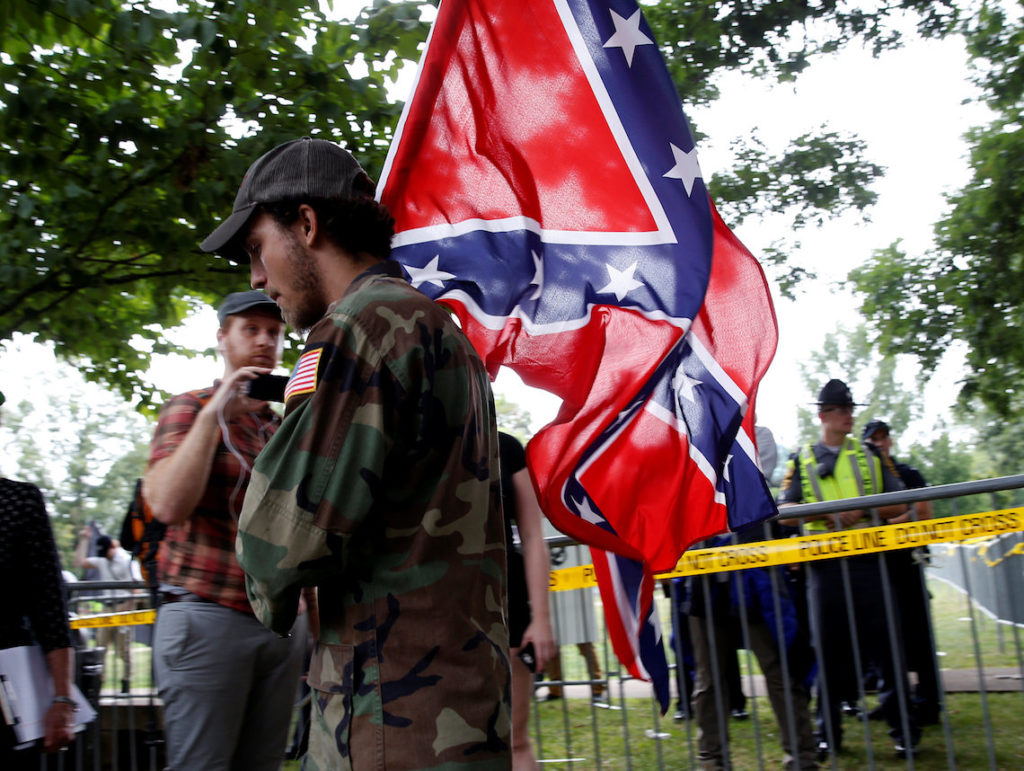
Former Presidents George H.W. Bush and George W. Bush issued a joint statement rejecting “racial bigotry, anti-Semitism, and hatred in all forms.”

“As we pray for Charlottesville, we are reminded by the fundamental truths recorded by that city’s most prominent citizen in the Declaration of Independence: we are all created equal and endowed by our Creator with unalienable rights,” the Bushes wrote Wednesday, referencing another former president, Thomas Jefferson.

Their statement, issued from their summer residence in Kennebunkport, Maine, comes in the wake of President Donald Trump’s stunning comments on the violence in the southern Virginia city over the weekend.

At a news conference Tuesday in New York, Trump doubled down on his claim that there was “blame on both sides,” equating combative left-wing counterprotesters with the bands of neo-Nazis and white supremacists who were demonstrating against the removal of a statue of Confederate Gen. Robert E. Lee.

Democrats and Republicans swiftly condemned Trump’s remarks. Sen. Lindsay Graham, R-S.C., was particularly blunt.

“Mr. President, I encourage you to bring us together as a nation after this horrific event in Charlottesville,” he wrote in a statement Wednesday. “Your words are dividing Americans, not healing them.”

The Bushes, both Republicans, have been critical of Trump in the past. In February, George W. Bush raised questions about Trump’s campaign contacts with Russian officials.

Jeb Bush, who lost to Trump in the 2016 Republican presidential primary and has since criticized the president’s social media use, urged him on Twitter and Facebook to “unite the country.”

“This is a time for moral clarity, not ambivalence,” the former Florida governor wrote.

Jewish Republicans were mixed in their reactions to Trump’s Charlottesville statements.

Rep. Lee Zeldin, R-N.Y., the only Jewish Republican in the House, posted a statement on Facebook that criticized counterprotesters whom he claimed were bused in with the intent of committing violence, but he did not equate them with the neo-Nazi protesters.

“These two sides are not equal. They are different,” Zeldin wrote. “I would add though that it is not right to suggest that President Trump is wrong for acknowledging the fact that criminals on both sides showed up for the purpose of being violent.”

Eric Cantor, a former Republican congressman from Virginia, told The New York Times that Trump’s effort to equate the protesters and counterprotesters was “unacceptable.”

“There’s no moral equivalence,” Cantor said.

The Republican Jewish Coalition did not mention Trump’s comments on Charlottesville in a statement posted on its Facebook page Tuesday afternoon following the news conference.

“We mourn the loss of life at Charlottesville this weekend, and will continue to pray for all those impacted,” the statement said. “Anti-Semitism and all forms of hate are anti-American, anti-Jewish, and antithetical to any sense of decency. We regret that we continue to be faced [with] these issues, but the RJC will never shy away from our role of standing up to racists, fascists, and Nazis.”

Both Bush presidents condemn anti-Semitism in Charlottesville statement Read More »
Odessa/Havana ensemble returns to Skirball with new vocalist

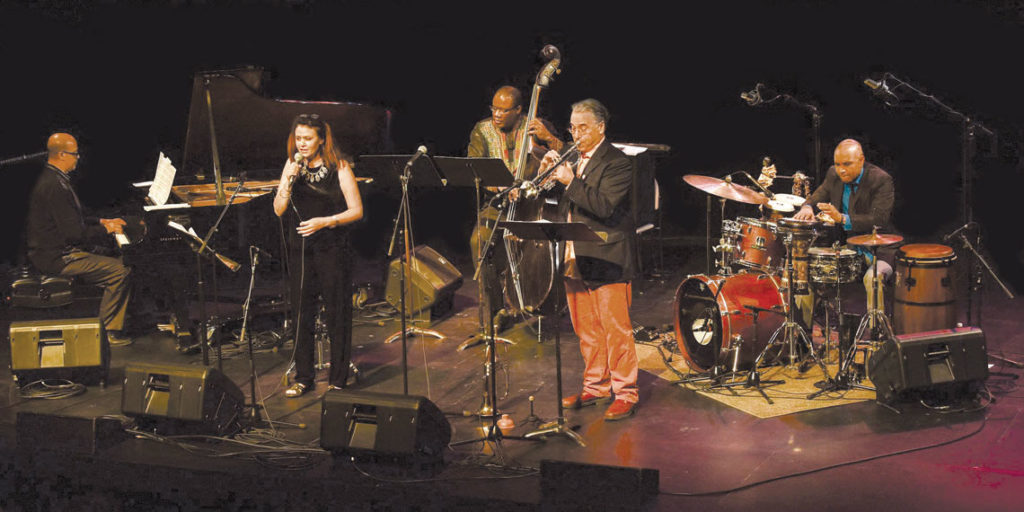
Remembered for its spellbinding performance at the Skirball Cultural Center 10 years ago, David Buchbinder’s Odessa/Havana ensemble will return with its blend of Jewish and Cuban music on Aug. 24 as part of the center’s Sunset Concert series. And it’s coming with a big change.

The group — formed in Toronto in 2006 by Buchbinder, an award-winning klezmer trumpeter and composer, and Cuban Hilario Duran, a Grammy-nominated jazz pianist — has added Maryem Hassan Tollar, an Egyptian-born singer, to broaden its repertoire.

“I decided to add a singer partly because our music is pretty intense and sometimes abstract,” Buchbinder said, “and it was really clear that having a singer would not only help us connect with audiences but also help us connect with ancient Ladino traditional songs.”

Ladino is the Judeo-Spanish language that Sephardic Jews took with them when they were exiled from Iberia more than 500 years ago.

“Ladino songs are the Jewish music of Andalusia,” Buchbinder said, “so they bring together the Jewish and the Cuban, since Andalusia is the root of both Jewish music and Cuban music. So to actually have a vocal repertoire to draw on, and to re-create it with our own imagination the way we do with everything, really brought a rich, new element into our sound.”

Adding a vocalist is a crucial change for Odessa/Havana, which a decade ago drew an enthusiastic response from a Skirball audience that urged the group to play encore after encore. The song  “Cadiz,” for example — offered in its entirety on the Skirball website — is an entrancing piece composed by Buchbinder with Tollar vocalizing without words, almost like a liturgical chant, so that her voice becomes a haunting musical element, weaving in and out with the piano, violin, trumpet, bass, sax and percussion.

Buchbinder described Tollar’s vocal style, even when she sings lyrics, as having a quality of “otherworldliness” that blends with the instruments.

“Cadiz” references the city of that name in southwestern Spain where a blend of ethnic and religious influences once created a mother lode of culture, Buchbinder said. “The Andalusia area, during the medieval period, was an amazing time in history,” he said. “There was innovation and advancement in everything that makes us human, from science and medicine to food [and] philosophy.”

According to Buchbinder, Cadiz and other Andalusian hubs spawned many musical strains that have common elements, including Roma, Arabic, Cuban, Ladino and North African. “Even klezmer came from there,” he said. “After the expulsion of Jews [from Spain and Portugal], some went to Eastern Europe, so that the Andalusian musical stream flowed into Yiddish culture as well.”

Those Andalusian melodic and rhythmic traditions are threaded deeply into Odessa/Havana’s music, all of which is composed by either Buchbinder or Duran.

“Hilario and I each write our own pieces,” Buchbinder said, “and once in a while we’ll get together and throw ideas back and forth. But usually we each go and do our own thing. That is still the core of the band, and that makes for something that I think is a really unique experience for an audience, because they recognize all the flavors, if you will. But the particular dish that we’ve created is unique because we’ve created an original sound that comes out of all these different traditions — Afro-Cuban and Jewish musical traditions. So people understand all the musical references, but they’ve never heard them expressed this way before.”

Buchbinder said the group has taken traditional Ladino songs and “reimagined” them, but they’ve also taken more contemporary Ladino poems and set them to music. “It’s very fruitful and enjoyable as a composer to take lyrics that don’t have a melody, lyrics that exist as poetry, and write songs,” he said. “And I’ve done some of that with Odessa/Havana.”

Of course, songs with lyrics would not have been possible without the addition of Tollar’s soulful singing.

In Odessa/Havana’s second album, “A Walk to the Sea” — which won a Juno Award, the Canadian Grammy — Buchbinder set a Ladino poem to music twice.

“I took this Ladino poem called “La Roza” (The Rose) and wrote two completely different musical versions with the idea that I would decide which one to use,” Buchbinder said. “But the band liked both of them so much, and the two versions were so different from each other, that we kept both of them in the album.”

Buchbinder said the group has already recorded its third album, which is still being prepared for release.

“Unfortunately, it won’t be finished when we do the Skirball concert, although we’ll give people an opportunity to purchase an advance copy, which we’ll send to them later,” he said. “In this third record we’ve taken the act of creating a new sound even further, and this is something that people will definitely hear at the concert in L.A., stuff that’s really pushing this kind of new sound.”

Odessa/Havana will perform at the Skirball Cultural Center at 8 p.m. Aug. 24. The concert is free, although RSVPs are no longer being accepted. Walk-up attendees are welcome, with seating on a first-come, first-served basis. Parking is $10, cash only. For more information, visit www.skirball.org.

Odessa/Havana ensemble returns to Skirball with new vocalist Read More »

Our president just asked us to be fair to white supremacists

There was a moment in his “neo-Nazi, neo-Shmazi” news conference where you might have found yourself thinking, maybe President Trump is right.

On the narrow question of who was responsible for the violence in Charlottesville, a prosecutor might note that punches were thrown by white supremacists and left-wing activists, neo-Nazis and members of the Antifa resistance.

“I think there’s blame on both sides,” is how Trump put it in his news conference Tuesday in New York.

It’s the right answer if this is the question: “Who threw punches in Charlottesville?” But it is the wrong answer to every other question raised by the awful events of the past three days. Such as, “What is expected of an American president when hundreds of people representing a stew of racist and anti-Semitic ideologies gather in a public park in an American city?” And, “What do we expect of the leader of our government when young men in 2017 wave Nazi flags and chant ‘Jews will not replace us’ while one of their number kills a counterprotester using his car as a weapon?”

And one more: “When given the choice between a mob that defends segregation, slavery and the ideology of genocide, and a crowd that stands opposed to these things, which side do you choose?”

Trump stunned his critics not because he was waiting (uncharacteristically, one might add) for all the “facts” to make a statement, as he said at the news conference, but because he ignored the essential fact: Neo-Nazis, Klansman and other far-right ghouls had called for a rally, under the banner of “Unite the Right,” in an attempt to resurrect ideas that the United States had declared — on the battlefield, in the courtroom and in the court of public opinion — morally bankrupt and grotesquely un-American.

And the president of those United States declared that while such people were bad, they were perhaps no worse than those who came to oppose them. In fact, he was careful to point out, “You had many people in that group other than neo-Nazis and white nationalists. OK? And the press has treated them absolutely unfairly.” But if there were “very fine people” who showed up in Charlottesville to “quietly” protest the removal of a Confederate statue, as Trump put it, they knew exactly what they were getting into. You can’t show up at an orgy and say you’re there just for the snacks. As the satirical newspaper The Onion put it in a headline that barely seemed satirical, “Trump Blasts Critics Who Judge Neo-Nazi Groups By Most Extreme Members.”

Trump may occasionally and reluctantly disavow them, but figures on the lunatic fringe appreciated the bone that they had been thrown.

“Really proud of him,” the white supremacist Richard Spencer said in a tweet. “He bucked the narrative of Alt-Right violence, and made a statement that is fair and down to earth.”

“Donald Trump: He Was Fair to White Supremacists” is quite the epitaph.

On Saturday morning, after the torchlight vigil, after the speech by David Duke and the anti-Semitic chants and the killing of a 32-year-old woman, no one outside of the “alt-right” was looking for fairness. They were seeking moral clarity — and they didn’t get it from the White House.

Some very fine people, including some Jews, are not convinced. They think Trump got it about right in noting that “many sides” are responsible for what happened in Charlottesville. They think it was important to point out that there were “vicious, hate-filled extremists,” as one Jewish leader put it, on both sides — that is, the neo-Nazi side and the protesters’ side, the Klan’s side and the anti-fascist side.

It is as if the lesson of Jewish history is moderation in the face of hatred, restraint when confronted by those who would kill us.

In his 2003 book “Nazis in Newark,” the historian Warren Grover recalled how a loose group calling themselves the Minutemen organized in order to crush the pro-Hitler activity proliferating in their backyard.

“Throughout the 1930s, the Minutemen consistently and effectively opposed Nazi activities in Newark and Northern New Jersey,” Grover wrote. “The fighting force included criminals and boxers who used fists, clubs, and baseball bats to counter the Nazi threat. Often just a rumor that the Minutemen had been sighted was enough to deter Newark’s Nazis from holding events.”

Plenty of Jews who remember the Minutemen consider them heroes — and even revere the memory of the gangster Abner “Longy” Zwillman, who aided them. Maybe we live in more rarefied times. Maybe today we’d call the anti-Nazi gangs “thugs” and “terrorists.” Maybe there’s a difference between standing up to neo-Nazis and actual Nazis. And maybe, to our credit, we understand that nonviolent resistance is the most principled and effective response to hatred and intolerance.

But if the Minutemen lacked a certain gentility, two things they didn’t lack: moral clarity and the courage of their convictions.

Trump was asked Tuesday whether white supremacists and their counterprotesters belong “on the same moral plane.”

“I’m not putting anybody on a moral plane,” our president said.

Our president just asked us to be fair to white supremacists Read More »

When a President Stands with Haters, Bigots, and Thugs

President Donald Trump giving a statement on the violence this past weekend in Charlottesville, Virginia at the White House, Aug. 14, 2017. Photo by Chris Kleponis-Pool/Getty Images.

It is now clear where President Trump stands – with haters, bigots, and violent thugs.

It’s sickening and disturbing to know that the man who occupies the Oval Office, a symbol of American exceptionalism, is an immoral, instinctively insensitive human being that represents the very worst of the human condition.

Trump and his campaign have brought the extremist and violent fringe into the mainstream of American life, and it is now up to all decent Americans of every race, ethnicity, religion, national background, and gender orientation, to stand up and say “Enough!”

“All that is necessary for evil to triumph is for good people to do nothing.” (Edmund Burke)

“One who condones evil is just as guilty as the one who perpetrates it.” (Dr. Martin Luther King)

“One who is able to protest against a wrong that is being done in his;/her family, city, nation or world and doesn’t do so is held accountable for that wrong being done.” (Babylonian Talmud, Shabbat 54b)

“We generations close to the Holocaust must be very clear that no interests of any kind can justify a shameful alliance with groups or individuals who fail to recognize responsibility for the crimes of the Holocaust.” (President Reuven Rivlin, State of Israel)

“Few are guilty, but all are responsible.” (Rabbi Abraham Joshua Heschel)

When a President Stands with Haters, Bigots, and Thugs Read More »

White supremacy is our country’s original sin

What happened in Charlottesville this past weekend is devastating, but not surprising. Over the past three years, white supremacists have been invited back to the streets, to the airwaves, into the White House.

White supremacy is our country’s original sin. The legacy of slavery, the genocide of Native Americans and the exploitation of immigrants remain unresolved and largely unacknowledged. But in my lifetime, over the past 40 years, while racism festered in the back rooms, behind bars in the prison industrial complex, in discriminatory hiring practices, in segregated schools and neighborhoods and among internet trolls, it was generally sanitized in public discourse.

And then a presidential candidate launched his campaign with an unconscionable attack on Mexican Americans, a verbal assault that should have marked the end of his public career. Instead, it was only the beginning. Attacks against Muslims, Blacks and immigrants followed, along with a refusal to disavow endorsements from known anti-Semites and white nationalists (“I don’t know anything about David Duke. I don’t know what you’re even talking about with white supremacy or white supremacist. I don’t know. I don’t know…”). Good people whispered their discomfort and went along for the ride. Cast votes ignoring what was clear as day, willfully ignored, justified and excused. Clergy were scolded when they entered the fray: let’s not get too political! Journalists faced full frontal attack for pointing out what was clear to anyone willing to pay attention. This was a dangerous and deliberate fueling of white supremacist ideology, which-once uncovered, promised to wreak havoc on our already deeply fractured nation.

So how can we be surprised when Nazis now march—armed and angry—through the streets of a college town chanting “Jews will not replace us”? The murder of Heather Heyer is tragic and horrific, but even that ought not surprise us. Charlottesville represents exactly what happens when hatred is met with anything short of explicit and unequivocal condemnation. Domestic terrorism is the logical outcome of an atmosphere of racialized tension that now receives daily ammunition from the highest offices.

.There’s a reason the white supremacists didn’t wear hoods to march in the streets this time; they didn’t feel they had anything to hide.

Thoughts and prayers for the victims—even expressions of outrage and disgust—are grossly insufficient. It takes generations to heal racial wounds and divisions. It takes a few casual dog-whistles to reignite them. It’s long past time for white Americans to stand up and acknowledge that a culture of racism is a culture of violence. It’s long past time forJews, Christians, Muslims, Sikhs, Hindus, Buddhists—people of all faiths and none—for immigrant and Native Americans, men, women and LGBT Americans to come together to manifest a political and social reality that reflects American ideals of freedom, dignity and justice for all.

We must come together today, not only to offer words of condemnation and consolation, but to do the hard work to heal our country before we slide further into the abyss.

White supremacy is our country’s original sin Read More »

Netanyahu’s son says neo-Nazis ‘dying out’ in US, leftist ‘thugs’ becoming dominant

The 26-year-old son of Prime Minister Benjamin Netanyahu suggested that far-left thugs in America may be as dangerous as neo-Nazis, spurring an Israeli left-wing lawmaker to imply that he was a fascist.

Yair Netanyahu was commenting on Facebook on events Saturday in which a white supremacist rammed his car into counterprotesters at a far-right rally, killing one and injuring some 20 others. President Donald Trump said Wednesday that both sides shared the blame for violence that occurred at the event in Charlottesville, Virginia.

“I’m a Jew, I’m an Israeli, the neo nazis scums in Virginia hate me and my country,” Yair Netanyahu wrote Wednesday in English, apparently after Trump’s reference at a news conference in New York to shared blame. “But they belong to the past. Their breed is dying out. However the thugs of Antifa and BLM who hate my country (and America too in my view) just as much are getting stronger and stronger and becoming super dominant in American universities and public life.”

BLM is the acronym for the Black Lives Matter movement. Antifa is a group that opposes neo-Nazism and has some members from far-left circles.

Mickey Rosenthal of the Zionist Union took aim at Yair Netanyahu on Twitter the same day, calling him “Netanyahu Jugend” – a reference to the Nazi youth movement that promoted the adoration of Adolf Hitler in Nazi Germany, the nrg news site reported. Rosenthal later deleted and apologized for the tweet after initially doubling down on his linking of the younger Netanyahu to the movement, whose name means “Hitler Youth.”

“Literally, what I wrote means ‘Netanyahu’s child,’” Rosenthal wrote to critics who felt offended by the phrase. “Unfortunately, the son is continuing to sow hatred like his father. I assume Ntanyahu and his supporters will try to twist what I said to their needs.”

But minutes later Rosenthal retracted and deleted his initial post.

“I reconsidered,” he said. “The criticism is founded. I accept it and apologize to anyone offended.”

Netanyahu’s son says neo-Nazis ‘dying out’ in US, leftist ‘thugs’ becoming dominant Read More »

The Mahmoud Abbas exchange, Part 3: On Israel and the Palestinian leadership struggle

Amir Tibon is an Israeli journalist who covers Washington, D.C. for Haaretz newspaper. Prior to Haaretz, Tibon was the diplomatic correspondent for Walla News, a leading Israeli news website. His writing on Israel, the peace process and the Middle East has appeared in Foreign Affairs, Politico Magazine, The New Yorker, The Atlantic, Tablet Magazine, The New Republic, The Huffington Post, The American Interest, and The Jerusalem Report.

Grant Rumley is a research fellow at the Foundation for Defense of Democracies, where he focuses on Palestinian politics. Rumley has published in leading media outlets, including Foreign Affairs and Foreign Policy, and contributed commentary to The New York Times, Reuters, and Newsweek. Prior to joining FDD, Rumley was a visiting fellow at Mitvim, The Israeli Institute for Regional Foreign Policies. While in Jerusalem, Grant also founded and edited The Jerusalem Review of Near East Affairs. Previously, Grant served as a consultant in Washington on issues related to counter-terrorism, the Middle East, and war-gaming strategies.

The following exchange will focus on Tibon and Rumley’s new book The Last Palestinian: The Rise and Reign of Mahmoud Abbas (Prometheus Books, 2017). You can find parts one and two here and here.

***

Dear Grant and Amir,

I’d like to dedicate our third round to the complicated hate triangle between Abbas, Hamas and Netanyahu. In your book, there is a description of Abbas’ reaction to the Shalit deal, which the previous Netanyahu-led government made with Hamas:

In one conversation with a senior American official, Abbas complained that “Hamas kidnapped one Israeli soldier and Netanyahu gave them a thousand prisoners for his release. My security forces have returned to Israel more than a hundred Israelis who wandered into our territories, and we got zero appreciation for it.” Indeed, Abbas’s security forces had a policy of escorting Israelis who entered Palestinian cities and towns by mistake into the safe arms of the Israeli military. “If I behaved like Hamas, I could have a hundred Shalit deals by now—there would be no more Palestinians in Israeli prisons. But I choose to do the humane thing and get nothing in return,” Abbas lamented.

My third-round question: looking ahead to the day after Abbas, what would you like, say, an Israeli decision maker reading your book to learn about Israel’s role in the fragile Hamas-Fatah relationship? What mistakes has Israel made, does Israel have a say on the matter and should Israel pursue any specific strategy when it comes to the inevitable succession struggle? 

Thank you once again for participating in this exchange.

Shmuel   

***

Dear Shmuel,

This anecdote represents a recurring frustration that Abbas has expressed over the years in the ears of Israeli and American officials who have worked with him – that Israel, in his eyes, responds “better” (from a Palestinian point of view) to violence than to negotiations. The Shalit affair is one example he has repeatedly used in this context. The 2005 Gaza disengagement is another, and we discuss it at length in the book. Abbas and people close to him felt that instead of giving the PA a larger role in the withdrawal from Gaza, and thus empowering Abbas in the eye of the Palestinian street, Ariel Sharon insisted to go at it alone and by doing that strengthened Hamas, which told the Palestinian public that Israel withdrew under fire, and that guns and suicide bombers were more efficient in extracting concessions from Israel than negotiations.

Abbas, of course, is also painfully aware of the price the Palestinians have paid for turning to violence. That’s why despite his talk about Israel’s “encouragement” of violence, he has never actually adopted Hamas’ strategy – only lamented about it. But one important conclusion that we hope policy-makers will take from our book, is the importance of creating incentives and benefits for a leader who opposes violence and is committed to negotiations. Abbas deserves a lot of criticism – which can easily be found in our book – but even his harshest critics should give him credit when it is due for opposing violence and supporting negotiations over the years. Unfortunately, that has not happened often enough during his long career as a diplomat and a political leader.

The succession struggle that will come after Abbas is an internal Palestinian affair, in our view. Israel could perhaps affect it by, as we have suggested above, empowering moderate leaders and showing more flexibility towards those who support negotiations and compromise than towards those who support violence and strive for conflict. But they should also beware not to look too eager to support any specific candidate or faction, since that could ultimately empower the ‘other side.’ Can the damages of the past be repaired, in a way that would convince a majority of Palestinians that Abbas’ approach is more beneficial than Hamas’? We hope so, but cannot say for sure.


The Mahmoud Abbas exchange, Part 3: On Israel and the Palestinian leadership struggle Read More »