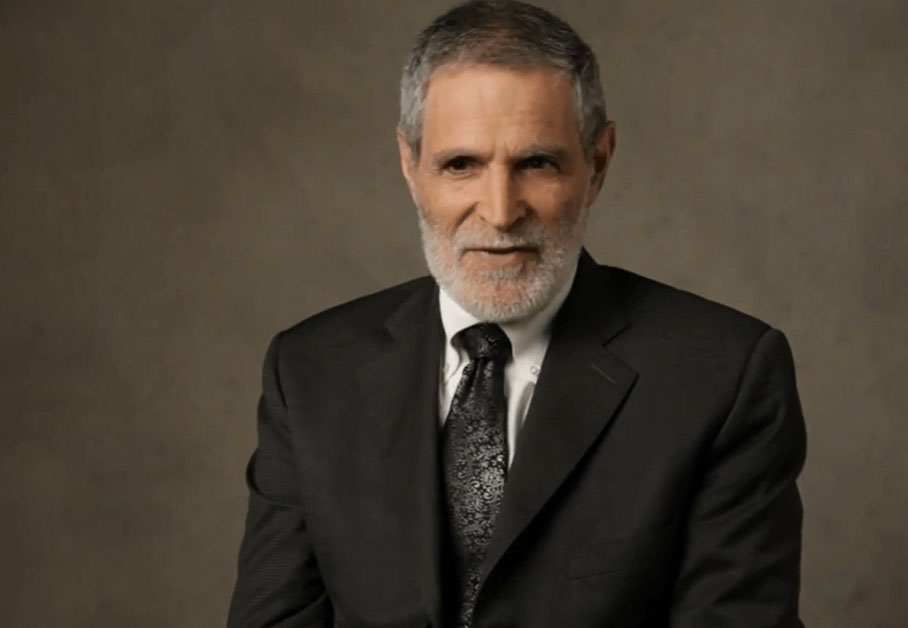
Benjamin Ginsberg is the David Bernstein Professor of Political Science and Chair of the Hopkins Center for Advanced Governmental Studies in Washington, DC. His research interests include American politics, Jewish history, higher education policy, and the societal impact of war and violence. He is the author, coauthor or editor of 24 books.
The following exchange will focus on his recent book, 'How the Jews Defeated Hitler: Exploding the Myth of Jewish Passivity in the Face of Nazism' (Rowman & Littlefield Publishers, 2013).
Dear Professor Ginsberg,
Your book begins with a question you were asked by one of your undergraduate students, who wanted to know (as almost every young person who learns about the holocaust does) why the Jews didn't resist the Nazis' efforts to exterminate them. Your book-length response to this question shows, stresses, and celebrates the impressive role which Jews played in fighting Nazi Germany- by serving in the US and Soviet armies, participating in the allies' Intelligence effort, and joining resistance groups throughout Europe.
I would like to start this exchange by asking about the 'myth' you were trying to address, the myth of 'Jewish passivity'- It seems that when people normally ask about 'the Jews not doing enough' what they have in mind is the European victims, the ones who supposedly “went like sheep to the slaughter”. You, on the other hand, chose to be more inclusive and to answer the question by largely focusing on American and Soviet Jews. It seems like these are different questions. Why did you make this choice? What was the misconception you wanted to challenge, what is its source and why is it so important to address?
I'm looking forward to reading your answer.
Best Regards,
Shmuel.
Dear Shmuel,
These are important questions and I am delighted to have the opportunity to reply. As you suggest, there is a general myth that the Jews were so weak and, indeed, so cowardly, that they allowed themselves to be slaughtered by the Nazis without offering more than token resistance. As I discovered in my class, many Jewish and Gentile students today continue to believe this idea. In my view, this myth is very pernicious. It suggests that the Jews were, in a sense, complicit in their own destruction, particularly so if one considers the roles of the various Judenrate in the governance of the German-established ghettos. This idea was, of course, forcefully asserted by Hannah Arendt in her well-known work, Eichman in Jerusalem, where she writes, “to a Jew, this role of Jewish leaders in the destruction of their own people is undoubtedly the darkest chapter of the whole dark story.”
The point of my book is that this notion of Jewish cowardice and even complicity in the Final Solution seems plausible only if one focuses on the ghettos and death camps where effective resistance was impossible. In other words, by focusing only upon those who were in no position to resist, historians have developed a thesis of non-resistance. If, on the other hand, we look more broadly at the actions of the Jewish people during the war years we find very effective resistance. Indeed, we discover that the Jews played an important role in the defeat of Nazi Germany.
As I point out in the book, Jewish engineers developed and built the weapons that made possible the seemingly miraculous Soviet victory over the Wehrmacht on the Russian front. Jewish espionage agents and cryptanalysts working for the U.S., the U.S.S.R. and the U.K. broke the most important German codes and developed unbreakable codes for the Allies. Jewish politicians and propagandists in the U.S. made it possible for Roosevelt to introduce “lend-lease” which saved Britain and the USSR. Jewish physicists, many of them refugees from Nazi Germany, built the atom bomb which was America's ace-in-the-hole and ended the war.
In these and other ways, the Jews were not lambs to the slaughter and were certainly not the architects of their own destruction. Without the Jews, it is not clear that the Allies would have defeated Hitler.
Benjamin Ginsberg.