fbpx

August 5, 2026

Training Leadership of the Head, the Hand and the Heart

Reform Jews have long been ambivalent about tefillin. Classical Reform tended to reject the use of phylacteries, affixing Biblical verses to one’s body, dismissing the ritual objects as unnecessary ornaments or condemning them as primitive amulets. More recently, some Reform Jews have made tefillin part of their religious apparatus. Whether or not the tefillin feature in your practice, one aspect of their construction deserves our attention. They comprise two boxes, one fixed onto the forehead, and the other wrapped usually on the left arm, so that it nestles close to the heart. Both boxes contain Biblical verses, but there is an important difference. While the box of the arm has all the verses in one compartment, the one affixed to the head is divided into four compartments. Our heads are full of different ideas, perspectives, opinions and convictions. When it comes to the work of our hands, we have to settle on a course of action, and act.

I have been thinking about tefillin in relation to the debate on approaches to Israel and Zionism in contemporary Reform. At any given time, my head is filled with challenging and apparently contradictory insights and conclusions. In parallel, there is something specific to be done, a life to be lived, commitments to be furthered. In my case, I grabbed on to life in Israel in the course of my twenties, and four decades later I am still lending a hand to the version of Israeli society in which I believe.

Just about everyone agrees that Zionism is in crisis. Those who think that it has become a watchword for supremacist nationalism certainly think so, but so do many who see themselves as Zionists. It is a cluster-crisis, relating to our conceptions of security, our measures of decency, our sense of solidarity, our vision of morality.

For decades, Hebrew Union College has placed a single compartment on the arms of its clergy students. If you want to be ordained by us, you will come to Israel. David Ellenson expressed this back in 2003, asserting that “all persons whom the College-Institute educates for roles of leadership in the contemporary Jewish community must have an extended first-hand acquaintance with the reality of Jewish national rebirth as evidenced in the State today.” We have worked hard to maintain this standard, and I hope we keep it in the future.

That is the box you strap on to the arm, and hopefully it gets close to the heart. When it comes to the range of thoughts going on within the head, however, I am in favor of multiple views, and multiple compartments. Experience teaches that some of our North American students are deeply stirred by the drama of Jewish sovereignty, while others are reinforced in their Diasporist orientation. Some identify profoundly with the struggle of Israelis to survive and thrive in the face of profound challenges, while others are most compelled by the plight of the Palestinian people. Some adopt mainstream Israeli political views, be they more conservative or more progressive, and a few swim against the stream. Quite a few of our students have all this contradictory stuff going on within them at the same time.

I don’t just tolerate this diversity. I celebrate it. It’s not only that resorting to loyalty oaths and purges usually weakens institutions, but also that, given the crisis we are in, we need all the creativity and all the multiple perspectives we can muster.

In the work of education and formation, it is tempting to ask: what does our ideal graduate look like? I have grown resistant to that question, and prefer: what would an ideal cohort of graduates, a generation of them, look like? In my ideal, such a group would include AIPAC-ers and J-Streeters, protesters and conscripts, radicals and moderates. If we Jews are to find a way forward in these critical times, we will need all of these opinions. But surely, you may object, some opinions are so objectionable that it is wrong to tolerate them? Some are, but based on my experience of our students, just about all of them fall well within the range of debate I want them to be holding, the debate that is raging within my own mental compartments every day.

Hebrew Union College is not immune to criticism. We should constantly review our courses and our learning outcomes, as should any serious institution of learning. Let’s not imagine, however, that the crisis we are all living through has a technical fix or a curricular solution.

We need leadership of the heart, the head and the hand. We need to educate a generation equal to a very difficult task: they have to navigate through controversy and anguish, and inspire the creation of new paradigms of possibility, new route maps of redemption. If our students are in two minds about the great moral and political questions faced by the Jewish people, this may well be because they are paying attention. According to our tradition, we should all be in at least four minds.

If the result of this embrace of diversity is paralysis or platitude, we may not be equal to the task ahead. If, however, it yields a range of heartfelt approaches, even when some of them make you enraged, we should be both grateful and uncomfortable. Let’s give our students the space they need to process the complexities of contemporary Jewish life. They are bound to think and do things some of us don’t like, not because they are doing it wrong. They are bound to do this, as they bind themselves to the task of Jewish leadership in times of crisis.


Marmur serves as the Professor of Jewish Theology at Hebrew Union College in Jerusalem.

Training Leadership of the Head, the Hand and the Heart Read More »

Rosner’s Domain | Are They Disarming Hamas or Netanyahu?

Anyone trying to understand the meaning of the agreement on the “complete disarmament of Hamas” — to quote President Donald Trump’s announcement — came back with more questions than answers. When will this disarmament happen? Which step precedes the next? What does “disarmament” mean, and where will the weapons be kept? What does the word “weapons” even encompass? The list goes on. Israel has reservations. It conveyed some of them to Tony Blair, who handles the international effort to resolve the Gaza crisis.

What Hamas wants isn’t hard to guess: to keep as many weapons as possible while simultaneously gaining control over the Strip, which will naturally expand as the IDF shrinks its footprint. If Hamas only needs to deposit its rockets in a place where they can be retrieved when needed, and in return gets an IDF withdrawal to a rear line, along with the opening of supply and reconstruction channels, that’s not a bad deal. True, a non-Hamas force is supposed to enter concurrently to manage the territory. It seems Hamas leaders aren’t worried about this. Such forces tend to bend to the will of the local bully or flee. In other words, Hamas will determine, or at least believes it will determine, when these forces enter, when they leave and what they will be able to execute.

What Israel wants is also not hard to guess. Exactly a year ago, the prime minister’s office issued a statement detailing five principles: the dismantling of Hamas’ military capabilities, the return of all hostages, the demilitarization of the Strip, Israeli security control over the Strip and the establishment of an alternative administration that is neither Hamas nor the Palestinian Authority.

How many of these principles are being met now? The hostages have returned. Dismantling weapons — President Trump says yes, but what constitutes a “weapon” still needs clarifying. An alternative administration is indeed supposed to be established. Israeli security control — it’s not entirely clear what this includes or where it applies. Demilitarization of the Strip — again, unclear what this entails.

It is possible that all we have here is a war over narrative. Hamas will say: “We are willing to disarm but Israel refuses to withdraw.” Israel will say: “First Hamas disarms, then we withdraw” (which will not happen). Who will decide what comes first? In Israel, there is a palpable fear of a scenario where Trump is the decider, because his decision might be uncomfortable.

Suppose he says: “Leave, and I will make sure there are no weapons” — will Israel agree or push back? Suppose he says: “You are dealing with trivial details” — will Israel watch Hamas deposit its weapons in warehouses for which it holds a spare key?

This war over narrative won’t just be between Israel and Hamas. It will also be an internal war over the narrative as Israel’s election is getting closer. Obviously, the opposition will have a vested interest in proving that the agreement does not fulfill what Netanyahu promised. They will say: Here is another “total victory” that never materialized.

What is less clear is what the coalition will do, and whether it will maintain a unified message. Will Bezalel Smotrich welcome the agreement and try to convince his skeptical supporters that this is the victory they prayed for? Will Likud ministers align themselves with it  on the eve of primaries? Will disgruntled Knesset members, trampling over each other for a spot on a crowded list, tell voters that yes, this is what Israel had hoped for? Israelis have thought for a while now that Hamas isn’t going anywhere. Between summer 2025 and summer 2026, the percentage of Israelis who think Hamas will be toppled was cut in half. The percentage of Israelis who believe Hamas will remain in Gaza — as is, or under some guise — rose from two out of four to three out of four: 72%.

The dilemma belongs primarily to Netanyahu. He has to figure out whether, and to what extent, he stands behind the agreement, and frames it as a success — or recognize that backing this agreement will make it even harder for him to win the elections. Right-wing voters will turn to more hardline parties that tell the grim truth about this dubious achievement, and centrist voters will turn to parties that at least don’t try to sell illusions. That leaves Netanyahu looking a bit pathetic, doing the bidding of a capricious president who decided to settle for less than a victory, not just in Iran, but in Gaza too.

The initial response from Jerusalem pointed to the second option as more likely. It is uncomfortable for Netanyahu to accept the agreement. Therefore, he is loading it with reservations, notes, requests, and clarifications.

You might say: If Trump really wants the agreement to materialize, maybe he should slow down a bit and wait until after the elections, when an Israeli leader without the fear of his voters is sitting in the chair.

He could counter: After the elections, Netanyahu won’t be able to implement such an agreement because of his coalition. And if it isn’t Netanyahu, then why wait? Why don’t we just help make such outcome more likely?

Something I wrote in Hebrew

Less than three months to election day, how many voters are still undecided?

We are talking about roughly 15% of all Israelis. Have you done the math? … we are still looking at a massive block of seats circulating in the undecided market. Maybe 10 seats, maybe between 10 and 15. That is a lot … The signal these voters are sending reminds us that almost everything else we hear is just noise. If Benjamin Netanyahu’s Likud party goes up or down by a seat or two in the polls, that is noise — because hovering in the background are 10 crucial seats waiting to land. If Israel’s newly merged center-left Democrats gain or lose a seat because of their recent primaries, that is also noise … We have quite a few noisy days ahead of us. Look for the signal.

A week’s numbers

Remember their visit? Just a week ago, and it feels like a year, if not more.

A reader’s response

Bob Roosth: “Our President CLEARLY has no consistent goal other than self-enrichment and self-glorification. No stated position can be taken as final (at least in foreign policy). The ballroom and arch are different.” My response: Maybe he does have a goal – what he seems to lack is a viable plan.


Shmuel Rosner is senior political editor. For more analysis of Israeli and international politics, visit Rosner’s Domain at jewishjournal.com/rosnersdomain.

Rosner’s Domain | Are They Disarming Hamas or Netanyahu? Read More »

How the Supreme Court Adapted Parshat Shoftim

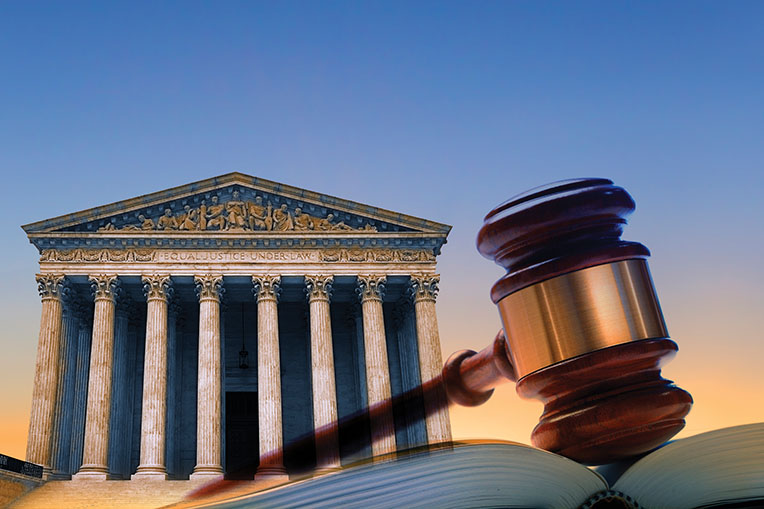
Imagine a constitutional convention in the ancient world, tasked with drafting laws for a new society. The convention must address the thorny problem of crime detection: In an age without fingerprint/DNA evidence or closed-circuit television cameras, how can the community determine “whodunnit”? Imagine the sarcasm that would greet someone who proposed, “I know, we’ll just have the killer turn himself in!” But that is exactly what the Torah prescribes, and it is so ingenious that the United States Supreme Court adapted a version of the model.

References to the “Cities of Refuge” are interspersed throughout the Torah, as the cities themselves were interspersed throughout the land. [Exodus 21:13; Numbers 35:11-14; Deuteronomy: 4:41-43; 19:1-10.] Someone who killed unintentionally would flee to one of these cities to avoid the vengeance of the go-el da-am, the blood avenger of the deceased. Unintentional killers would remain there until the death of the Kohen Gadol (high priest), after which they could return home. So it is easy to see these cities as a sentencing outcome: Just as intentional homicide (similar to what we today call “murder”) was punished by death, unintentional homicide (what we call “manslaughter”) was punished by indefinite confinement in one of these cities.

But the cities were not the outcome; if a killer fled to one but witnesses came forward and confirmed the killer used a deadly weapon, and the homicide was intentional, the murderer would not avoid the full punishment he deserved. Rather, the cities were a process.

Why would an unintentional killer follow this process and turn himself in? Because if he did not, and the blood avenger found him, he would be subject to the avenger’s immediate violence: he would have no opportunity to present his side of the story.

But if he went to one of the cities, he would be protected from immediate violence. Like all witnesses, he would be guaranteed an opportunity to present his account. In this sense, the cities’ function resembled that of the sotah procedure, which forestalled private vengeance and substituted legal process in its place. [Numbers 5:11.]

The process thus benefited both the suspect and the community. The suspect gained protection from impulsive retaliation and the community gained the knowledge of the killer’s identity. As the late Rabbi Emanuel Rackman, chancellor of Bar-Ilan University, explained, the Torah incentivized the killer’s self-identification, and enabled a proper legal inquiry.

Contemporary application

The U.S. Supreme Court embraced the wisdom behind the procedure in the 1980s. After Eric Weir fatally stabbed Ronnie Buchanan during a fight outside a Kentucky nightclub, he fled; he did not call for an ambulance, or police, but tried instead to escape detection. Weir was eventually arrested and tried for the crime. After the prosecution presented its evidence, Weir for the first time acknowledged it was he who stabbed Buchanan. He claimed both that “he acted in self-defense and that the stabbing was accidental.”

Though American criminal procedure does not involve “blood avengers,” the Supreme Court produced a modified application of the Torah’s incentive. Because Weir had not come forward to provide his innocent explanation but instead tried to conceal his involvement, the court held the jury could infer his belated account was false. Prosecutors may highlight where defendants choose to conceal rather than disclose their involvement, and juries may find them less trustworthy as a result. The undesirable consequence for Buchanan was not an angry avenger but a distrusting jury.

Those who commit a homicide are not forced to turn themselves in, and they may try to conceal their involvement. But they harm their “accidental” defense if they do not self-identify, and help it if they do.

The life imprisonment plea

There is another contemporary application of the “blood avenger” incentive. Just as the threat posed by the ancient blood avenger led unintentional killers to confess their involvement (to present their side of the story), the existence of the death penalty today leads intentional killers to confess their guilt (to avoid maximum punishment).

Though nearly all the relatives of Tree of Life Synagogue victims favored the death penalty for the murderer, one widow, Miri Rabinowitz, preferred the murderer plead guilty. Trial, she feared, would force her to “relive the horrific circumstances of Jerry’s murder through a trial and inevitable lengthy appeals.”

Many victims and prosecutors share this preference, as trials force survivors to relive trauma and force prosecutors to risk a jury acquittal (or reversal on appeal). A guilty plea, with a sentence of life imprisonment without parole (LWOP), avoids these problems. It can benefit both survivors and prosecutors when murderers plead guilty.

But this works only where death is an authorized punishment; it is the possibility of capital punishment that leads defendants to plead guilty for the lesser sentence of LWOP. No defendant ever pleads for the maximum sentence. Defendants have no incentive to plead guilty if they will receive the maximum term; they plead to receive a sentencing “discount.” So if there is no death penalty and the maximum sentence is LWOP, they will plead only for a sentence that offers parole, or at least the possibility of it. Ironically, it is the existence of capital punishment in theory that can render it unnecessary in practice.

Nonlegal applications

The Cities of Refuge concept has important lessons beyond the practice of criminal law. None of us will ever commit a homicide in ancient Israel. But all of us, at some point in our lives, will injure someone — emotionally if not physically. And all of us will be injured by someone — emotionally if not physically.

How will we respond? Instinct leads the injured to anger and impulsive retaliation. It leads the injurer (like Eric Weir) to conceal his role in the harm, or failing that, to avoid any contact with the injured, which breeds further distrust. Relationships can unravel.

The Torah offers a better model than avenging and avoiding. It offers a safe opportunity for parties to meet and peacefully explain their perspectives, which might have been misunderstood. They can offer apologies and, where necessary, make amends for harms caused. The commitment to peaceful discussion can often help parties save, and even strengthen, relationships that might otherwise be lost.

Ideally, the principles that promote justice in the courtroom can also promote peace in everyday life.


Mitchell Keiter, a certified appellate law specialist in Beverly Hills and former law professor, clerked at the California Supreme Court and has briefed over 30 cases before the U.S. and California Supreme Courts. 

How the Supreme Court Adapted Parshat Shoftim Read More »

Can One Be a Non-Observant Orthodox Jew?

When I tell people I’m a nonobservant Orthodox Jew, there is usually a small pause, followed by a look that says: Pick one. I understand it. The phrase sounds like a hedge, or like someone claiming a title he hasn’t earned. But I don’t think it’s a contradiction.

It helps to start with where this came from, because it didn’t come from childhood. Until a few years ago, I wasn’t curious about any of it. I was secular and, on some subjects, actively hostile to religion. What changed was Oct. 7, 2023, and then a semester when I was honored to be associated with Yeshiva University. I came away wanting to know more than I did, and I’ve been picking at that ever since.

I should be clear about the scale of it: I am not a learned man in the Jewish sense of that word. If you quoted a passage at me, there’s a good chance I wouldn’t recognize it. What I do is modest and improvised. I listen to podcasts — “Take One” is one I come back to. I keep books like Rabbi Joseph Telushkin’s “Jewish Wisdom” within reach. When something comes up in my life and I want to know whether the tradition has anything to say about it, I ask — sometimes a person, more often now AI, which is either a sign of the times or a small miracle depending on your mood. It’s not a formal program of study; it’s a habit of turning toward something.

So why call it Orthodox at all?

Partly, it’s an acknowledgment. I didn’t come to this on my own. It took an event and a place — and more than the place, the people in it. I came to admire the Modern Orthodox community I found at Yeshiva University: serious about the texts and serious about the world at the same time. The description is the most honest way I have of pointing at where this came from.

Partly, it’s because the word describes where I look, not what I do. It’s about what I take seriously — what I treat as having standing over how I understand my own life. When something happens to me, I’ve learned to ask a second question: not what I think about it, but what “they” would have said about it. What did the rabbis notice in a situation like this that I haven’t noticed yet?

As for the other half of the phrase: I am not observant. But I don’t experience that as failure, and I’m not walking around with a ledger of everything I’ve missed. Nor am I claiming the obligations don’t apply to me, as if I had examined them and placed myself above all that. They apply. I came to them late, with a life already built around other habits, and I have not rebuilt my week around them. That isn’t a principle I hold; it’s simply a fact about me.

What I get out of any of this is harder to describe. Sometimes it is direct. There is a command that a worker’s wages must not stay with you overnight, that you pay him the same day, before the sun sets. I used to let bills sit, not out of any bad intention but in the ordinary way a person puts things off, and I don’t anymore. Now I pay when the invoice arrives, especially when it comes from an individual rather than a company.

More often it is about how to carry myself, and Leviticus is full of it: not to spread gossip, not to hate your brother in your heart, not to take revenge or bear a grudge — the grudge being the harder of the two, because you can hold one for years while telling yourself you have let it go. Those sit in consecutive verses, leading directly to loving your neighbor as yourself. None of it is hard to understand. It is very hard to do, and I don’t always manage it. But going to look for what the rabbis said slows me down, and whatever is in front of me, I am not the first to face it. Having that in view makes me steadier than I would otherwise be — more centered, more at ease, less at the mercy of whatever happened to me that day.

That grounding in tradition takes on an even deeper weight when viewed alongside those who had everything stripped away. Look at the hostages in Gaza, who put all of this in true proportion. Eli Sharabi, who had never been religious a day in his life, began saying Shema Yisrael every morning in captivity, making Friday night Kiddush with water because there was no wine. Agam Berger kept kosher underground, refusing meat when she was hungry, and sewed a cover for a prayer book out of the leg of a ruined pair of trousers.

I was deeply moved by what they reached for in the dark, and by the strength it gave them. Some part of my own reading today is in their honor, and through it my bond with my people has become stronger than it ever was. Keeping less than others keep is not a complaint or a critique. We do Shabbat dinners at home, though not religiously, and when I see friends and family for whom Shabbat is a day genuinely set apart — work put down, the week shaped by the stopping — I look at that with respect, and some weeks I envy the discipline, and the community that comes with it.

The tradition has always been bigger than any one person’s grip on it. What draws me is simple: I think these texts are a good part of why we are still here as a people. I want to know them and, in my own way, embrace them. Orthodox is where I turn. Nonobservant is what I do. It’s where I’ve been standing these last couple of years, and I don’t assume I’m on my way somewhere else. I never thought this was something I needed, or that anything was missing. I didn’t expect any of it, and I wouldn’t give it back.


Mauricio Karchmer was a computer science lecturer at MIT until December of 2023, when he quit in protest over how the institute treated its Jewish community after the Oct. 7 terror attacks.

Can One Be a Non-Observant Orthodox Jew? Read More »

Lies, Damned Lies and the Right Side of History

When I was a member of that cultish Trotskyist organization, I learned to differentiate between two distinct, sharply opposed forms of truth. I thought of these, not quite consciously, as the truth-truth and the higher truth. My party embodied all that was righteous and true, which meant it was inconceivable for us to lie. If a political enemy caught us saying something flatly untrue, and the evidence was undeniable, we had two options. One was to acknowledge that we’d lied, but not only was this intellectually untenable — because we were righteous and true — but it might lead us to wonder how much else the party had lied, or at least been wrong, about. We might then discover that much of our worldview was based on untruths, and a tedious, nagging feeling would take hold: that if we wanted to figure out what was true, we would have to look for it outside our cozy circle — abandoning comradeship, certainty, a sense of meaning. Which would be existential suicide.

So we turned to the second option, a mental maneuver deploying the agility of an Olympic gymnast. Our cause was good; therefore, whatever we proclaimed to be true was good. Our truth was the higher truth, the version of truth that served the interests of the oppressed. Our enemy might be expressing the literal truth, or the truth-truth, but they were bad people working for evil. This sleight-of-hand allowed us to double down on our lies, while believing, with spine-tingling conviction, in our own irreproachable integrity.

Now 10 years out of that cult, I find that my comrades’ and my curiously elastic attitude toward truth is everywhere. One question alone matters: Does this truth strengthen my tribe, or is it bad for it? If bad, it must be suppressed, denied, explained away. The higher truth is the narrative that serves the cause, the quest of the righteous and true.

This not-quite-conscious mental ploy exists across the political spectrum, but I will limit myself here to the left. I do this for two reasons. One is that I’m a product of the left. However estranged I am from it these days, what you might call its ideals still run in my veins. My feelings of disappointment, injury and betrayal by my former tribe are personal, making its actions sting more. While the right also suppresses inconvenient facts, or more, tells whoppers — and must be held accountable for this — I’m not provoked by the same sense of hypocrisy. Both sides may lie, but only one does so in the name of righteousness.

The second reason is that it’s the left dominating our leading institutions: the media consumed by educated, right-thinking people, legacy NGOs, public schools and universities, medical and professional associations, Hollywood. Their glitterati dictate what attitude to take on every matter of public interest, and declare critics not only wrong, but dangerous to humanity. The tribe, including as it does figures like Arundhati Roy and Javier Bardem, is endlessly seductive. And it relies on the same epistemological device I turned to in my far-left Marxist party.

Hamas carried out Nazi-like atrocities on Oct. 7, and terrorizes its own people, but loyal leftists will, at most, only briefly and tetchily acknowledge this. They know it is the truth-truth, but far more importantly, it is devastating for their side. It’s the Zionists who dwell on it, and Zionism is the enemy of humanity. They possess the higher truth, the truth that serves the victimized and benighted, and according to which Hamas are freedom-fighters. That these heroes of the oppressed hurl gay Palestinians off rooftops (never mind what they do to Jews)arouses a dim suspicion that they themselves have taken a wrong turn somewhere. This knowledge gnaws at their brains like a flesh-eating worm. So they pile on lies against Israel — ever more crazy, lurid lies, hoping to kill that worm — in the name of truth and justice.

Hamas carried out Nazi-like atrocities on October 7, and terrorizes its own people, but loyal leftists will, at most, only briefly and tetchily acknowledge this. They know it is the truth-truth, but far more importantly, it is devastating for their side.

“Trans women are women” may not be the truth-truth, but decent people must subscribe to it anyway, as the higher truth. In Australia recently, an appeals court upheld a ruling in favor of a trans woman called Roxanne Tickle, who sued a social media app created for girls and women. No one with eyes actually thinks that “Tickle” is a woman, but only a right-wing transphobe would say so. So Australian girls and women lose a place to gather away from predatory men, and their peers around the world continue losing opportunities, privacy and safety in sports, prisons and other spaces.

The person who murdered one and injured dozens of others at a Berlin Pride parade last month was apparently an Islamist, but only an Islamophobe would comment on this truth-truth, or recognize it at all. “I had hoped that the attacker was not a foreigner, but a white Christian person,” one LGBTQ+ activist commented at a vigil the next day. The higher truth is that Muslims, as victims of imperialism and racism, are allies of gay, queer and trans people. Anyone who suggests otherwise — or anyone concerned about the uptick in terrorism, antisemitism and erosion of women’s rights and safety — is a bigot.

And now we have the liberal rallying around Anthony Fauci. He was closely linked to the Wuhan lab where leading scientists immediately suspected COVID originated, but anyone who so much as breathed the words “lab leak” was silenced as a conspiracy theorist. Fauci (with then-President Trump) oversaw our country’s dystopian pandemic response: the closures of elementary schools, businesses, churches, sporting events; the mandatory masking; the weddings broken up by police; the arrests for gathering, even outside. People committed suicide. Careers were destroyed. Old women died alone in nursing home rooms, their families forced to say goodbye over iPads. Meanwhile Fauci was writing, in his now-revealed diary, that he knew the virus wasn’t that lethal. These facts, these truth-truths, deserve to be recognized. But according to Fauci’s defenders, only obsessed, vindictive, rightwing crackpots invoke them.

Somewhere along the line, as a society we apparently stopped believing that such a thing as truth exists, or that it matters. All we have are narratives — competing stories to choose from based on taste and mood, like titles on a bookshelf. Some of these books contain an announcement on the cover: New York Times bestseller, Oprah Book Club, Booker Prize finalist. These tell us in advance the stories must be good.

Somewhere along the line, as a society we apparently stopped believing that such a thing as truth exists, or that it matters. All we have are narratives—competing stories to choose from based on taste and mood, like titles on a bookshelf.

We all want a good story. A good story removes us from our humdrum, maybe too-comfortable, boring lives. It stirs our imaginations, leading us to empathize with other people in their distant struggles. It gives us heroes and villains; delicious prose; joy, grief, romance, humor and heartbreak; and typically the comfort of seeing virtue triumph at the end. Harping on the supremacy of truth over narrative is something like telling people to put down a juicy novel and plow through an encyclopedia.

I find that I cannot eloquently explain why truth matters; I only know that it does. There is no such thing as “higher truth” — a version of truth that it is right to spin in the name of some greater good. Only one truth exists. No person may ever hope to know it in full, but to the extent it can be known, honorable people must strive for one thing: to live by it.


Kathleen Hayes is the author of ”Antisemitism and the Left: A Memoir.”

Lies, Damned Lies and the Right Side of History Read More »

Life Lessons in Old Age

Life is long and it is also short. A half century, 60 years, 70, 80, that’s many years. So many events, occasions, memories. Work, family, travel, so very much accomplished, so many things left undone. It’s a lifetime spent and then you look back and it seems like a dream, a distant experience — in Yiddish, der leben iz a cholem.

It was busy, full, rushed, and now it is quiet and reflective and hard to reconcile “then” and “now.” The lesson: Not that youth is wasted on the young, but rather that one should appreciate each stage as it unfolds. Hardship and joy are present at every step. There is no time when it will be all good, so focus on the good and carry on. There are always moments to savor and appreciate.

You see advertisements from pharmaceutical companies that promise great treatments, followed by 700 possible side effects. Well, a good laugh may not cure disease, but it does make life so much more pleasurable. With no side effects. I’ve noticed that people who enjoy a good joke and laugh heartily seem in good spirits and often in good health.

Even in the hardest times, humor has a role to play. In the gloomy days of the Soviet Union, Russians used sardonic humor as a coping mechanism: A frustrated man is standing in a long liquor line in the Soviet Union. Fed up with the agonizing wait, he throws his hands up, yells, “I have had enough, save my place, I am going to shoot Gorbachev!” and storms off. Two hours later, he returns and elbows his way back into his spot in line. His friends ask, “Did you get him?” He shakes his head and replies, “No, the line to shoot Gorbachev was even longer than the line here.” It’s at least partially true that humor is the best medicine.

Legacy. The chapter of the Torah titled “The Life of Sarah” begins with the statement that Sarah passed away. Why would the chapter title appear to be so misleading? The purpose is to draw our attention to the fact that life does not end with death. Even nonbelievers acknowledge that we leave behind a legacy. It can take the form of children and grandchildren, good deeds and kindness, reaching out to help others, professional accomplishments, donor bequests and many other possibilities. The Ethics of the Fathers states that a good name is paramount: “Rabbi Judah said there are three crowns: the crown of the Torah, the crown of the Priesthood and the crown of royalty, but the crown of a good name surpasses them all.” In other words, we all die, but we live on in many ways and we should live in awareness of that important truth and shape our behavior accordingly.

We all die, but we live on in many ways, and we should live in awareness of that important truth and shape our behavior accordingly.

One person is a world. Judaism introduced the notion that to kill a person is to kill a world because the potential offspring of endless generations would be eliminated. The 6 million Jews murdered in the Holocaust could have had children who would have contributed enormously until the end of time. Killing a person is also destroying a world in the sense that it denies the sanctity of life. It is nihilistic and sacrilegious.

There are many ways Judaism emphasizes the importance of the individual.  A prayer service requires a quorum of 10 men (a minyan). Nine is not enough. Each person is critically necessary. A story told by Sivan Rahav-Meir recounts a village that had 10 Jewish families, and 10 men came to the service every day no matter the obstacles. Another family settled in the town and suddenly it became difficult to have a minyan because some thought that someone else would attend. They felt less responsible: “Each person matters, each person must internalize that the whole world cannot function without his or her unique contribution. You are always the ‘10th person for the minyan,’ and you are always needed.”

Perspective. One of the hardest achievements is not living only in the moment. What someone said to you today, the disappointment you experienced yesterday, the unexpected setback now are rarely a true crisis. Even if there is a real challenge, it is usually manageable with concerted effort, assistance and time. Perspective in life is critical.

One of the hardest achievements is not living only in the moment. What someone said to you today, the disappointment you experienced yesterday, the unexpected setback now, are rarely a true crisis. Even if there is a real challenge, it is usually manageable with concerted effort, assistance and time. Perspective in life is critical.

Many people are outraged and bear a grudge and end up doing more damage to themselves than to the “offender.” In the case of truly egregious comments or actions, proper action needs to be taken, but first consider the real nature of the situation and whether it is as offensive as it first appears. Sometimes, a deep breath, a few minutes or even hours of reflection can avert tremendous stress and aggravation. Perspective asks: Is it worth it?

Making a living and making a life. Virtually everyone has to work to make a living. The ideal is to find work that you’re good at and that you like. If you’re good at it but don’t like it, you’ll be successful, but you won’t be happy; if you’re not good at it but you like it, you’ll be happy but you won’t be successful. Truly happy is that odd man or woman who succeeds in both senses.

In any event, making a living is not all there is to life. It seems that for many, it is all there is. But life is inside the workplace and outside. Just as it is important to be good at your work and enjoy it, it is just as important to make a living and to make a life. Family, friends, intellectual stimulation, volunteer or community work: these are vital relationships and activities that make the person. It is a complex and rounded view. Winston Churchill famously said: “We make a living by what we get, but we make a life by what we give.”

The king of the tiny state of Bhutan declared in the 1970s that Gross National Happiness is more important than the Gross Domestic Product. His purpose was to increase social well-being along with economic success. Gross National Happiness takes into account the whole person and the whole society, not calculating only material possession, the intangibles as well as the tangible. Perhaps that’s why Bhutan rates first on the World Happiness Index.

Those are some of my observations after a lifetime of experience.

What is most precious in your life? What would you add to the list? 


Dr. Paul Socken is Distinguished Professor Emeritus and founder of the Jewish Studies Program at the University of Waterloo.

Life Lessons in Old Age Read More »

The Forgotten Artist Who Fought Hitler with Faith

“They don’t want it to become a lost ark” is how a 2022 New York Post story began its lamenting how the Forest Hills Jewish Center, a Conservative synagogue downsizing to a smaller space, was hoping to find a new home for the room-within-the-sanctuary holding its Torah scrolls, a process still unfolding to this day.

The Baroque structure, made of gold leaf, bronze, and plaster ark, stands 32 feet tall and 19 feet wide and was designed in 1949 by Polish-born artist Arthur Szyk, who is buried in the congregation’s cemetery plot in West Babylon, Long Island.

“We have families — their children are named in front of that ark, bar mitzvahed in front of that ark. We’ve had weddings,” the shul’s executive director Deborah Gregor said in conveying how much the ark would be missed by the shul’s members. “It’s the backdrop to life.”

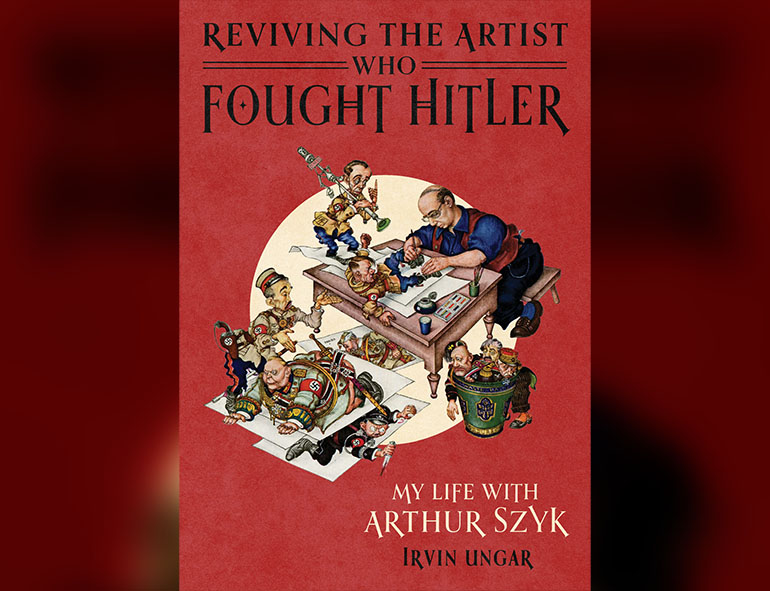
The commendable efforts to preserve masterfully complex work stem from a revival in recent decades to preserve Szyk’s creation, led by Irvin Ungar, whose memoir, “Reviving the Artist Who Fought Hitler: My Life with Arthur Szyk,” documents his dedication. It lovingly and intricately details how Szyk himself served as an aesthetic accompaniment in the backdrop of life during the first half of the 20th century, only to then be largely forgotten.

Ungar, a former pulpit rabbi in Forest Hills (though not at the Jewish Center), was two years old when Szyk died in 1951, and only discovered the artist’s work in a crowded bookstore in 1975, sparking a second career as a rare book seller. His interest in the man and his work unceasingly sparked, he recounts peppering his family with wonder: “Did you know that Arthur Szyk was the leading anti-Nazi artist in America during World War II?” “Did you know that when President Franklin Roosevelt gave his famous Four Freedoms speech in January 1941, 38 paintings by Arthur Szyk hung in the White House?” “Did you know that after the bombing of Pearl Harbor it was Arthur Szyk’s portrait of Japan’s Admiral Yamamoto that was on the front cover of Time magazine?”

Szyk  was born in Lodz in 1894. His father was blinded by acid when Russian authorities put down a Polish peasant protest in 1905, instilling in the young Arthur a knack for protesting injustice. In 1914, while on a trip to Palestine with other Polish artists and writers, he was conscripted into the Russian army and fought in WWI Battle of Lodz against the Germans. Afterwards, he composed and illuminated a letter to Paul von Hindenburg, commander of the German armies on the Eastern Front, requesting his father’s mill be spared from German pillaging due to his father’s blindness. Remarkably, von Hindenburg, who would later appoint Hitler as chancellor of Germany, sent a note back agreeing to the request.

Later, when the Poles were fighting the Russians from 1919-21, Szyk was appointed the artistic director for propaganda by the Poles. He then spent significant time in Paris, where he befriended Vladimir Jabotinsky, leader of the Revisionist Zionist movement, and earned the Ordre des Palmes académiques for his contributions to French artistic culture. He and his wife Julia were then sent to Morocco on behalf of France, where Szyk served as an ambassador of goodwill and painted the portrait of the Pasha. In 1931 he was awarded the Gold Cross of Merit by the Polish government and was the sole artist invited to illuminate the Charter of the League of Nations. Two years later, during a seven-month stay in the U.S., he received the George Washington Bicentennial Medal (which commemorated the first president’s birth), recognizing Szyk’s work on behalf of freedom across the globe. Proud of his Polish heritage and appreciative of American values, he created, in 1938, a series of 23 paintings titled “The Glorious Days of the Polish-American Fraternity,” including one of Tadeusz Kościuszko, who served in the Continental Army and helped supervise the fortification of West Point.

Over a few years in the late ’30s, in Lodz and London, Szyk composed and oversaw the printing of his masterpiece, an illuminated Haggadah which the Times of London hailed as “worthy to be placed among the most beautiful of books that the hand of man has produced.” (Ungar would later sell the original paintings for it to George Lucas for his Lucas Museum of Narrative Art)

During World War II, his reach was breathtaking and he sought to stem the tide of Hitler’s march of death and settled in America for good. By 1940, a Canadian paper, The Halifax Herald, reported that Hitler had put a bounty on the anti-fascist artist’s head. Szyk succeeded Dr. Seuss as the cartoonist for the popular PM newpaper, running his anti-Axis illustrations regularly. His art was exhibited at over 500 USO recreation centers. A survey conducted by Esquire reported his pieces were more popular among servicemen than pictures of pin-up girls. The New York Post ran over 90 of his political cartoons between 1942 and 43. Ben Hecht, the famed Hollywood screenwriter, was in awe of Szyk’s serving as a one-man art department for the Bergson Group, aiming to rescue whatever Jews they could during the Holocaust. Szyk designed their ads in The New York Times, brochure covers for their rallies, and even composed editorials advocating for the rescue of his coreligionists. “He appeared among us one day like a bonanza on the doorstep,” Hecht recalled of Szyk. “He worked for eight years without pause. Nobody paid him anything and nobody thought of thanking him. Nor was he an unknown artist using a cause to add luster to his name. It was already one of the most illustrious names in international art.”

The well-travelled Szyk, Ungar emphasizes, held a deep appreciation for America, and America appreciated him. Writing of his happiness in having an anti-Hitler image of his chosen for the cover of Collier’s magazine, Szyk humbly noted how “I have been in this country for only a year. I am a Polish exile from Lodz, which is now in German hands, and for years I have lived in Paris, which is also in German hands … For me I know it is not a war but a world revolution, and I am convinced as an individual, as an artist, as an exile and as a future American that the only hope for the future of the world lies in the Anglo-Saxon democracies. I am proud to see my work on the cover of Collier’s. It is a real privilege.” This son of Poland who had dodged death’s grasp while fighting for the ability of others to do the same would befriend Eleanor Roosevelt, have his work displayed in the White House and be designated by the Library of Congress as an “Artist for Freedom.” His illuminated “Declaration of Independence” was dedicated on July 4, 1950 in New Canaan, Connecticut, with the chairman of the proceedings praising the artist as “one of the world’s great free men who dedicated his life and art to the preservation of freedom.”

In an addendum, Ungar wonders aloud how it was that such a ubiquitous artist had largely faded from memory. He suggests several factors, from his hard-to-pronounce last name (said the same way as the razor company), to being investigated and blacklisted as a suspected subversive by the House Un-American Activities Committee (HUAC) between 1949 and 1951 due to his affiliation with anti-fascist and left-leaning causes. This severely distressed the artist, who died of a heart attack in 1951 (though Ungar dismisses the latter as a major factor, noting that Albert Einstein and Frank Lloyd Wright remained untarnished by McCarthy’s ugly hunt). He instead laments the art world dismissing Szyk’s realist style during its obsession with abstract expressionism in the ’40s and ’50s, his rich and varied body of popular works categorizing him as, perhaps to some, “merely an illustrator,” and the lack of dealers and family members who ensured that after his death the demand for his work would hold.

Ultimately, due to Ungar’s work collecting the forgotten creator’s productions, and his capstone sale of his lifetime personal collection of over 450 paintings and drawings bought by the Taube Foundation,  donated to the Taube Family Arthur Szyk Collection at the Magnes Collection of Jewish Art and Life at UC Berkeley, Szyk lives on, preserved for posterity. The artist would be humbly grateful, having written in the dedication of his “Haggadah” “I am but a Jew praying in art. If I have succeeded in any measure, if I have gained the power of reception among the elite of the world, then I owe it all to the teachings, traditions and eternal values of my people.”


Rabbi Dr. Stuart Halpern is Senior Adviser to the Provost of Yeshiva University and Deputy Director of Y.U.’s Straus Center for Torah and Western Thought. His books include the newly released “Jewish Roots of American Liberty,” “The Promise of Liberty: A Passover Haggada,” “Esther in America,” “Gleanings: Reflections on Ruth” and “Proclaim Liberty Throughout the Land: The Hebrew Bible in the United States.”

The Forgotten Artist Who Fought Hitler with Faith Read More »

How To Get Right the Woke-Right

The coalition breaks

For years, Israel assumed that erosion on the American left could be offset by a durable anchor on the right. That premise has now broken down in both parties. The decline on the left is no longer debatable. On the Democratic side, what was once contested is increasingly treated as settled fact: Israel is blamed first, and defended second, if at all. That shift is visible not only on the activist fringe but among figures long regarded as relatively pro-Israel, but that now throw Israel under the bus, saying it should no longer receive special U.S. military subsidies, or arguing that aid should function as leverage over Israel’s use of American-made weapons.

The right was supposed to be the safe zone, and recent polling suggests that assumption is weakening. Pew Research Center reported in July that only 51% of Republicans and Republican-leaning independents viewed the Israeli government favorably. Separately, Gallup found in February 2025 that the partisan gap in favorable views of Israel had reached a record 50 points — 83% among Republicans, versus 33% among Democrats — up from the previous 30-point record a year earlier. And in a University of Maryland poll fielded in 2025, only 22% of Republicans aged 18–34 said Israel’s military actions in Gaza were justified under the right to self-defense. These findings point to a significant generational fracture on the American right. Israel is becoming a wedge issue through which the American right is fighting over identity, authority, religion and national purpose.

The Republican identity crisis

Many scholars agree that the Republican Party is now divided into three broad streams, even if they do not always agree on the exact labels. The European Council on Foreign Relations describes the three foreign-policy “tribes” as restrainers, prioritizers and primacists, while other analysts describe the same basic fracture in different terms. For the purposes of this argument, it is more useful to embrace Yoram Hazony’s division of the party into “liberal Republicans;” a national wing who currently can be seen as mainstream Republicans led by President Trump; and the alt-right. “Liberal Republicans” are the heirs of the old internationalist and institutional party; the nationalist mainstream wing remains broadly conservative but pragmatic and coalition-minded; and the alt-right camp, much of it shaped by adjacent “woke right” or isolationist currents, is more hostile to elite institutions, more suspicious of foreign commitments and more open to defining Israel as part of the problem rather than part of the solution.

That third stream is no longer content to shout from the sidelines. Nick Fuentes, whose America First livestream now draws around a million views an episode, boasts that his followers have embedded themselves across the conservative ecosystem — in the administration, in youth organizations, in right-wing media — and speaks openly of leveraging his movement against the 2028 nomination. Whatever discount one applies to his bravado, the direction of travel is clear: what was an online subculture is becoming an entryist political force.

Israel as litmus test

This is why Israel has become so charged. The argument is not really about what Israel is doing, at least not in any narrow policy sense. Israel has become a litmus test for the Republican Party itself. To defend Israel is increasingly coded by one part of the right as submission to neoconservatives, donors, globalists, liberal empire or corrupted theology; to attack Israel is presented as proof of independence, authenticity, anti-elitism and civilizational clarity. What looks like a foreign-policy debate is actually an internal argument over who rules the right.

The Iran war accelerated this dynamic. In the populist right, the emotionally powerful narrative became that Israel dragged the United States into war, even though that claim was contested by reporting and by statements from administration figures indicating U.S. agency and prior awareness. That gap between narrative and reality is the key point. What matters politically is not merely what happened, but that a growing segment of the right now finds the accusation intuitive: of course Israel manipulated America, of course the war served someone else’s interests, of course the old alliance is a trap.

Since the spring, the conflict has moved from online argument into a high-profile statewide Republican contest. In Florida’s Aug. 18 gubernatorial primary, insurgent candidate James Fishback has attracted an energized cohort of younger and far-right supporters, though he remains well behind Trump-endorsed front-runner Byron Donalds in statewide polling. Fishback has said that “white genocide is real,” pledged not to enforce Florida’s antisemitism law, mocked the Western Wall as a “stupid wall” and praised Nick Fuentes as “very patriotic.” Fishback denies being antisemitic and says he condemns hatred of Jews. His campaign is not merely criticizing Israeli policy: it openly contests whether support for Israel and institutional enforcement against antisemitism should remain core expectations in Republican politics. Whatever the result, the Florida primary is an unusually visible statewide test of how much electoral space that challenge has on the American right.

The rupture reaches the very top. Tucker Carlson, once among Trump’s most prominent media backers, has repudiated the president as a “slave to Israel,” apologized to his audience for having “misled” them into voting for him, and declared that Trump has finally understood that Israel is the “biggest threat” to his administration. He now says he will not vote Republican in the midterms, while Fuentes urges his followers to stay home or vote Democrat. Israel has thus become something new in Republican politics: not merely a wedge inside the coalition, but a demobilization weapon aimed at its turnout.

Challenging the evangelical support

That theological dimension matters more than many in the Jewish world appreciate. One of the strongest pillars of American support for Israel was evangelical Christianity, but the generational trend line is unmistakably bad. Brookings reported that support for Israel among young evangelicals dropped dramatically between 2018 and 2021, and warned that the sustainability of strong religiously driven evangelical backing for Israel was in question. This July, Christianity Today reported that evangelical views of Israel have slipped to a new low. Brookings has argued that evangelical attitudes account for most of the Republican Party’s support for Israel, and that without evangelicals, Republican attitudes on Israel do not substantially deviate from the rest of America. In other words, the erosion of the evangelical foundation is not a side story, it is the essence.

And that evangelical support is not merely fading on its own. It is being actively demolished. In July, days after telling Nick Fuentes that he “hates Christian Zionists more than anybody” and that their beliefs are “anti-Christian,” Carlson devoted an entire episode to a disgraced ex-pastor under the title “Origins of Christian Zionism, How It Corrupted American Christianity and Why It’s Finally Collapsing.” The message to his millions of followers is explicit: Christian Zionism is not a conviction to be debated but a corruption to be purged.

Indeed, a growing current on the right is working to weaken the Protestant foundations of evangelical support for Israel by challenging biblical literalism and covenantal readings of scripture, while normalizing replacement theology or supersessionist claims that the Church has displaced Israel in God’s promises; academic research shows that evangelical support for Israel is closely tied to beliefs about prophecy, biblical authority and the continuing significance of the State of Israel. As younger evangelicals grow less attached to those commitments and influential right-wing voices increasingly mock or pathologize Christian Zionism, the fight over Israel becomes, in part, a fight over who gets to define orthodox Christian political theology on the American right.

What some call the “woke right” is not just anti-left populism. It often borrows the left’s moral grammar: purity tests, friend-enemy sorting, institutional capture, grievance identity and the search for hidden systems of oppression. The target is different, but the style is familiar. In that framework, Israel becomes irresistible because it sits at the intersection of war, religion, media, nationalism and Jewish visibility.

Safe spaces, schools and communal life

Two “wokes” begin to converge. Woke on the left undermines the Jewish lived experience by recoding Jewish particularism as suspect power. Woke on the right undermines the U.S.-Israel relationship by recoding support for Israel as betrayal of nation, faith and sovereignty. They speak in different vocabularies, but they are moving toward the same outcome: Israel as stigma, Jews as symbol, and Jewish communal life as something that must justify itself before increasingly hostile moral tribunals.

As a result, safe spaces, primarily universities and K-12 schools, become the first arenas in which Israel is transformed from a foreign-policy question into a moral sorting mechanism. The latest ADL audit makes the downward migration measurable: while antisemitic incidents on college campuses fell sharply last year, incidents in K-12 schools barely moved. The politicization of “safe spaces” is now moving downward into earlier civic formation, shaping how children first learn to think about Jews, Israel, and the legitimacy of Jewish communal life.

So what should be done?

First, the response has to begin with realism. There are two engageable audiences on the right, and they are not identical: evangelicals and mainstream nationalists. Sometimes they overlap, but they do not hear the same arguments from the same people. The mainstream Jewish community is not especially well positioned for this fight because it is more comfortable with liberal institutions, legacy media, establishment donors and bipartisan scripts than with the religious, populist and digital ecosystems where the new right increasingly lives. It is surely not in an ideal position to intervene in the domestic Christian theological battle.

Second, many of Israel’s natural Christian allies are not mobilized because they do not yet see the connection between isolationism, theological realignment, anti-elite nationalism and anti-Israel narratives. Too many allies still treat these as separate phenomena rather than parts of one emerging coalition. Making that connection visible should be a central task for advocacy organizations.

Third, engagement must be different for each audience, and left-wing tactics will fail in both arenas. With evangelicals, the case is theological, relational and civilizational. With mainstream nationalists, the case must be translated into the language of national interest, alliance credibility, anti-jihadist realism, minority self-defense and resistance to actual elite manipulation rather than conspiratorial fantasy.

The first counter-infrastructure is now being built. In July, allies of Sen. Ted Cruz (R-Texas) — who has described right-wing antisemitism as an “existential crisis” within the GOP — launched The Front Line, a 501(c)(4) political nonprofit that reportedly raised several million dollars. Its stated mission is to make antisemitism disqualifying in Republican politics by mapping primaries at every level, running electoral messaging, and building digital monitoring and response capacity. The organization’s first announced intervention is a $400,000 ad buy against James Fishback in Florida’s Aug. 18 gubernatorial primary.

That is a welcome start, but it relies initially on a familiar mechanism: paid political advertising. The harder task is to develop credible messengers within nationalist-right ecosystems, durable coalitions and arguments that address the strategic, theological and political claims driving anti-Israel sentiment there. The issue is not only Israel policy; it is also a struggle over the Republican Party’s moral and ideological boundaries.

The U.S.-Israel relationship is not doomed, but the old logic is no longer enough. Israel cannot rely only on historical goodwill, partisan habit, or privileged access to Washington; it must prove itself again as a strategic asset that advances hard American interests across administrations and across party lines. That requires deeper integration into the emerging regional order, stronger partnerships with pragmatic regional actors and a public case for Israel that speaks not only to old allies but to the new political coalitions now shaping America. Israel is already acting on this logic: in June, Washington and Jerusalem formally opened negotiations to replace the military-aid memorandum that expires in 2028, with Israel itself proposing a gradual wind-down of direct U.S. cash assistance in favor of joint research, development and defense-industrial partnership. Israel and Jewish community organizations do not need to move to the right; they need to get this right.


Eran Shayshon, founder of Astarta (atchalta.com), a think and create tank, working to strengthen resilience  and cohesion in Israel and the Jewish world. Astarta created and launched Parent-Dome, an AI platform that supports Jewish parents whose kids face antisemitism in schools; and will be launching soon Campus-Dome, a similar platform that support Jewish students on American universities.


How To Get Right the Woke-Right Read More »

Is Mamdani Helping Bibi?

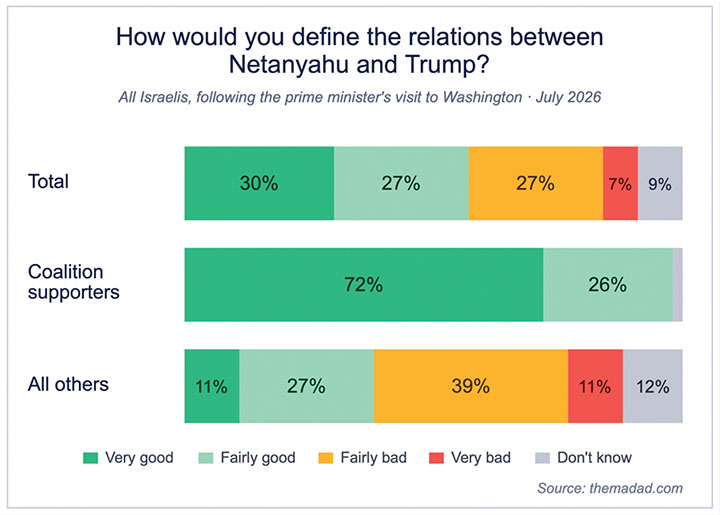
For more than a decade, Donald Trump has been an exceedingly valuable political asset for Benjamin Netanyahu. Trump’s level of popular support among Israelis had consistently remained at stratospheric levels, and both men recognized the mutual benefit of highlighting their symbiotic relationship for Israeli voters.

But that was a long time ago, before they convinced each other to go to war with Iran. Netanyahu is now fighting for his political life, as former IDF leader Gadi Eisenkot strengthens his hold on the centrist “anti-Bibi” vote in advance of the upcoming October elections. Trump has fallen even further in the eyes of Israeli voters, as recent polls show a dramatic drop in support for the American president in the Jewish state. Sizable majorities no longer believe that Trump is concerned about Israel’s security, and believe he only supports Israel when it serves his own interest. Given the international and domestic pressure that Trump is facing not to resume heightened military activity against Iran, those poll numbers are unlikely to change anytime soon.

For the first time in more than a decade, Netanyahu no longer has his reliable American life preserver to keep him afloat in these dangerous waters. But in the nick of time, it appears he may have found another political ally in our country to boost his fortunes when he most needs the assistance. This time, however, that surrogate is not helping Netanyahu on purpose.

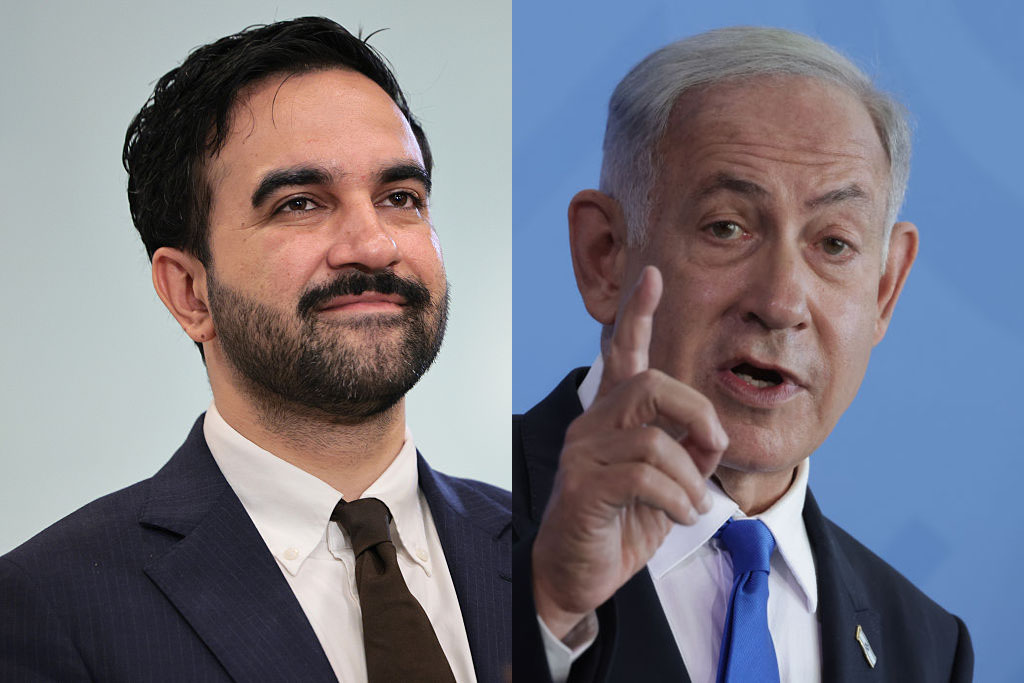
Zohran Mamdani, who ran for mayor of New York last year on a virulently anti-Zionist platform, has greatly escalated his attacks on the Israeli prime minister in recent weeks, renewing his call for Netanyahu’s arrest should the Israeli prime minister travel to the city for next month’s United Nations General Assembly meeting. (Mamdani awkwardly admitted that he lacked the authority to fulfill his campaign promise to apprehend Netanyahu himself, but then challenged the Trump administration to do so instead.)

The episode gave Mamdani the opportunity to revisit his ongoing invective against Israel, repeating his past denigration of the country’s response to the Oct. 7, 2023 Hamas terrorist attacks as “atrocities” and “genocide.”  In a heavily Democratic city where Netanyahu’s approval ratings are extremely low, Mamdani’s theatrics allowed him to shore up his support among anti-Israel progressives, who have been unhappy with his lack of progress on local budget, transit and safety issues.

But Mamdani may have helped Netanyahu even more. The Israeli leader quickly vowed to come to New York in September, promising to “speak the truth in front of this … hate-spewing elected official who’s pitting one group of New Yorkers against the others.”

Netanyahu accused Mamdani of turning his supporters “against New York Jews,” comparing the environment the mayor was creating to that of 1930s Germany. By explicitly linking Mamdani’s efforts to rising levels of antisemitism, Netanyahu was able to frame himself as a defender of Israel against growing international hostility. Israelis may be divided over settlements, military conscription and other aspects of Netanyahu’s leadership, but they understand at a much deeper, more fundamental level that their survival depends on their ability to stay unified against external danger.

Throughout his career, Netanyahu has repeatedly and masterfully presented himself as Israel’s defender against all manner of international threats. He won his first election in the aftermath of the wave of Palestinian suicide bombings in the mid-1990s. He returned to the prime minister’s office in 2009 in reaction to the second Lebanon war. Since then, he has regularly warned of the prospect of Iran’s potential nuclear capability and more recently of the ongoing terrorism menace from Hamas and other Iranian terrorist clients.

Mamdani’s slurs do not suggest that that Israel is experiencing military vulnerability but rather a more existential and omnipresent emotional challenge that the country and its people have faced for their entire existence. But the mayor provides an equally effective reminder about why Israel needs a strong and vigilant leader as its prime minister. If Netanyahu is able to win reelection in October, he may end up thanking the New York mayor for highlighting that need at an extremely helpful time.


Dan Schnur is the U.S. Politics Editor for the Jewish Journal. He teaches courses in politics, communications, and leadership at UC Berkeley, USC and Pepperdine. He hosts the monthly webinar “The Dan Schnur Political Report” for the Los Angeles World Affairs Council & Town Hall. Follow Dan’s work at www.danschnurpolitics.com

Is Mamdani Helping Bibi? Read More »

Israel’s Next Front: The Power of Attraction

Israel has spent much of the past three years demonstrating extraordinary military capability, degrading much of Hamas’ infrastructure, severely weakening Hezbollah, and projecting power deep into Iran.

Yet those battlefield gains have not translated into greater international influence. As Israel’s military reach expanded, its diplomatic room for maneuver narrowed. Academic and cultural boycotts spread. Scientific partnerships became more fragile. Public debate across Europe and North America grew more polarized. Israel demonstrated military superiority while steadily losing ground in the struggle for international legitimacy.

This erosion is no longer merely a matter of perception. Recent polling points to declining support for Israel in countries where public opinion had already turned negative, including the United States and Germany. For the first time in decades, Americans express no greater sympathy for Israelis than for Palestinians. The Anholt–Ipsos Nation Brands Index has placed Israel at or near the bottom of the countries it assesses for two consecutive years. At the same time, the International Criminal Court’s arrest warrants for Prime Minister Benjamin Netanyahu and former Defense Minister Yoav Gallant have reinforced the country’s growing diplomatic isolation.

This paradox captures one of the defining realities of the 21st century: military strength remains indispensable, but it is no longer sufficient.

For most of modern history, states measured power by armies, territory, industrial production and economic output. Those assets remain essential in an increasingly unstable world, as Russia’s war in Ukraine and Iran’s regional ambitions continue to demonstrate.

But strategic competition now extends well beyond the battlefield.

The concept of soft power has shaped international relations for more than 30 years. Yet in Israel, it is still too often reduced to public diplomacy – a question of messaging rather than national strategy. In reality, countries compete not only for territory but also for talent, investment, trust and enduring partnerships.

Universities, hospitals, cultural and sporting institutions, technology companies and philanthropic foundations increasingly shape a country’s international influence. Governments cannot simply command that influence. It grows when talented people choose to study, collaborate, invest and create within a country’s institutions.

Here, Israel possesses one of its greatest strategic assets. The country is widely known as the “Startup Nation,” but innovation is only part of a much larger story. Institutions such as the Technion and the Weizmann Institute rank among the world’s leading research centers. Hospitals such as Sheba and Ichilov are internationally recognized for medical innovation and humanitarian expertise. Israeli scientists, entrepreneurs, artists, filmmakers and athletes reach audiences far beyond the country’s borders.

Together, these institutions form an ecosystem that gives Israel a global reach far greater than its size would suggest. It is precisely this ecosystem that today’s boycotts, diplomatic isolation, and declining public support threaten.

Yet the picture is not entirely bleak. Columbia University recently announced the opening of its Tel Aviv Global Center to deepen collaboration in science, technology, entrepreneurship, and medicine, despite having become a symbol of anti-Israel campus protests. Nor is Columbia alone. MIT has expanded its Kalaniyot program, more than doubling the number of Israeli scholars on campus. Together, these developments suggest that even amid political polarization, Israeli institutions remain highly valued research partners.

Israel also possesses a less recognized advantage: its institutions are connected to one of history’s oldest and most globally dispersed communities. For centuries, Jewish communities built schools, universities, hospitals, charitable organizations, and philanthropic networks across the world. After the establishment of the State of Israel, many of these institutions became intertwined with Israeli ones, creating a far-reaching network of scientific, educational, cultural, medical and civic cooperation.

Few countries benefit from a worldwide network that predates the state and continues to reinforce it. Such networks rarely collapse overnight. They erode gradually as partnerships weaken, exchanges diminish and trust declines.

Unlike countries whose soft power rests primarily on culture, technology or higher education, Israel’s influence emerges from the interaction between a sovereign state and Jewish communities worldwide. This is not merely soft power. It is institutional and network power – the capacity to build relationships and generate forms of cooperation that others value and need.

This is why Israel must rethink its understanding of power.

For years, discussions about Israel’s international position have focused on public diplomacy. Every setback abroad prompts renewed calls for better messaging. Communication matters. But communication cannot substitute for strategy.

Countries admired for scientific excellence first build outstanding universities. Countries respected for innovation first cultivate entrepreneurs and researchers. Countries trusted during humanitarian crises first establish world-class hospitals.

Reputation follows performance. Institutions earn credibility long before governments communicate it.

That lesson has become especially important since Oct. 7, 2023. Israel’s understandable focus on immediate security has reinforced its traditional emphasis on military strength, and rightly so. But the past three years have also shown that military success alone cannot secure the country’s long-term international position. In some cases, military action may deepen the diplomatic isolation it is intended to prevent.

Scientific cooperation, educational exchange, technological leadership, cultural creativity, humanitarian engagement and strong ties with Jewish communities abroad are not luxuries reserved for peaceful times. They strengthen the economy, reinforce diplomacy, attract talent and create partnerships that become especially valuable during periods of crisis.

They are part of national security.

Israel therefore needs a broader understanding of grand strategy. The country built one of the world’s most sophisticated military establishments because successive governments understood that security required sustained investment, institutional capacity, and long-term planning.

The same strategic mindset must now guide investment in universities, research, culture, humanitarian institutions and the organizations connecting Israel with Jewish communities around the world. That means more than increasing budgets. It means protecting research partnerships from short-term political pressures, expanding scientific and cultural exchange, investing consistently in humanitarian cooperation and creating durable mechanisms through which Israeli and diaspora institutions can plan and act together.

These areas should not be treated as separate policy portfolios. They form a single strategic ecosystem. Strong universities generate discoveries. Discoveries attract investment. Investment fuels innovation and strengthens resilience. Culture broadens international familiarity. Philanthropy sustains education and research. Together, they create influence greater than the sum of their individual parts.

This perspective should also change how Israel views its relationship with world Jewry. Too often, that relationship is framed primarily in terms of political advocacy or philanthropy. In reality, Israel and Jewish communities together constitute a uniquely extensive network of knowledge, education, entrepreneurship, medicine and civic leadership. Preserving and strengthening those ties is not simply a communal responsibility. It is a strategic imperative.

The international system has already been transformed. Strategic competition now encompasses AI, biotechnology, cybersecurity and technological leadership alongside conventional military power. The countries that shape this new era will combine the ability to defend themselves with the ability to attract exceptional talent, investment and enduring partnerships.

Israel already possesses many of these advantages. The challenge is to protect them, strengthen them, and treat them as strategic assets rather than as byproducts of national success.

For 78 years, Israel has treated deterrence as a national imperative. The decades ahead will require it to pursue attraction with comparable determination. Military superiority will remain essential for survival. But lasting influence will depend on whether Israel remains an indispensable partner in science, innovation, education, culture, medicine and humanitarian engagement.

In the 21st century, the strongest countries will not simply be those that defeat their enemies. They will be those that others cannot afford to do without.


Professor Sharon Pardo is a Senior Fellow at the Jewish People Policy Institute (JPPI) and a professor of European studies and international relations in the Department of Politics and Government at Ben-Gurion University of the Negev.

Israel’s Next Front: The Power of Attraction Read More »