fbpx

June 3, 2026

Jewish Power and Other Myths

If Jews are all-powerful, why are they so powerless? Historically, Jews have been accused of controlling politics, the banks and the media. I haven’t read yet that they control the weather, but that wouldn’t be any more bizarre than the other charges.

If Jews control the media, why is the Jewish state portrayed in the mainstream media as the aggressor, when it is the victim? Why couldn’t the all-powerful Jews in America, Canada and Europe stop the intimidating street protests, campus protests and shootings at synagogues, Jewish schools and institutions?

When Jews lost their sovereignty to the Romans in the year 70 C.E., they sought refuge in other parts of the Middle East and Europe, where they were consistently uprooted whenever the reigning authorities turned on them. No stability, no safety, no power.

Wherever they settled, they added to the life and prosperity of their host country, but that did not make them immune to frenzied outbursts of violence, accused of every crime known to society. Pogroms and expulsion are not signs of power. They are proof of utter vulnerability and helplessness.

During the Middle Ages, in Europe, Jews had no rights, could not obtain citizenship, were banned from government posts and the military and excluded from the professions. Ghettos dated from the Middle Ages and lasted into the 20th century. Jews were expelled from England in 1290, from France in 1306, from Spain in 1492, from Portugal in 1497, not to mention the forced expulsion from Muslim countries in the Middle East and North Africa.

Yes, Jews do have power – the power to survive injustice, cruelty and inhumanity.

Another myth? Jews are rich. If all Jews are rich, why does every synagogue and so many Jewish institutions raise funds, especially before holidays, for Jewish families who cannot provide for themselves? Child poverty and senior poverty among Canadian Jews is higher than the national average. So many Jews have been successful and generous, funding hospitals, universities and arts institutions, that those who are fueled by hatred cannot recognize the good or acknowledge that most are not in that league.

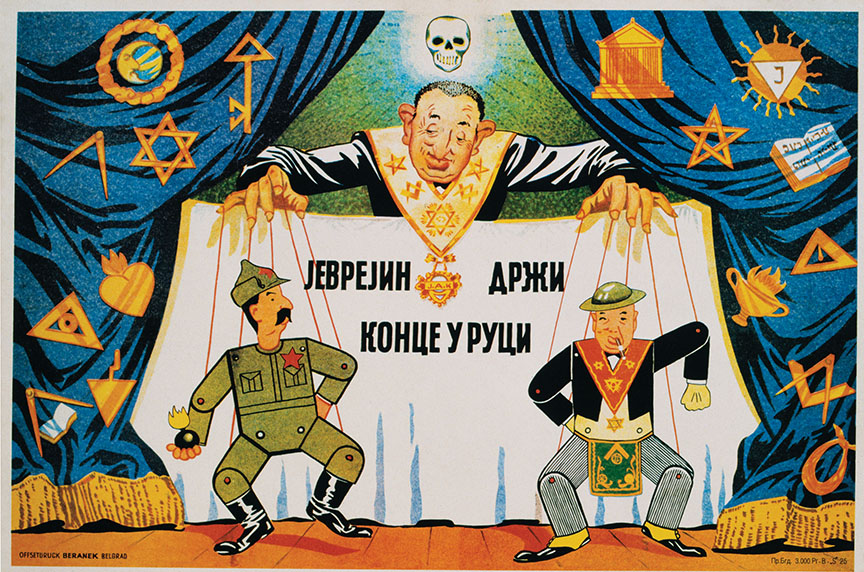
One of the most enduring and dangerous myths is “The Protocols of the Elders of Zion,” a completely fabricated text that has had a lasting effect. It was first published in a newspaper in the Russian Empire in 1903. The document claims that there is a worldwide Jewish conspiracy to rule the world.  In 1920, Lucien Wolf, a British journalist and diplomat, exposed the document as a fraud. He found that its source was a chapter of a German novel, “Biarritz” (1868), in which Jewish leaders meet secretly, with the Devil supporting them. There are 24 chapters or “protocols” claiming there were secret plans to control politics, the economy, financial markets and education. This is all fiction, not history. The leaders, the “learned elders of Zion,” never existed but the enduring lie lives on. Yes, the Devil was, indeed, involved. The Devil was the person who created this conspiracy theory that has inspired hatred and death for generations.

The current myth that dominates the academy, the press, social media and politics is the outrageous slander that the Jews don’t belong in Israel, that they displaced the original inhabitants and that Jews in Israel are an illegitimate presence. They are portrayed as colonial invaders. Anyone who reads history knows that Zionism is the national liberation movement of the Jewish people. It was a return to the land that gave birth to Judaism, the land of Abraham, Isaac and Jacob from which they were expelled after establishing kingdoms in Israel for hundreds of years. If the world did not want Jews to return to Zion, they should have treated them better. It was myths about the “wicked” Jews that made the Jews’ return an absolute necessity.

The irony of ironies is that antisemitism exists only in monotheistic countries, Christian and Muslim. Judaism is the parent of monotheism. Your children are your greatest joy, except when they turn on you, and then they’re your worst nightmare. Jews decided to exit the nightmare and fulfill a dream, a return to their ancestral homeland, free of hate-filled myths, a democracy among dictatorships, an open society of Jews from all over the Diaspora, including Arab lands. Jews in Israel are home.

The Diaspora myths – and I have enumerated only a few – are so preposterous and demonstrably untrue that only people who want to believe them, do. Jews cannot convince them of the facts, nor can they protect themselves in the Diaspora. Israel is not the problem – it is the solution to Diaspora vulnerability. Israel, the only Jewish state in the world, is portrayed as evil incarnate. It takes up one one-hundredth of 1% of the surface of the world, and one one-fifth of 1% of the landmass of the Arab world, yet it is the only country in the world whose existence is challenged.

As for the Diaspora, the general population needs to understand that the current wave of virulent, hysterical antisemitism is corrosive and dangerous for the entire society. Antisemitism is a fundamental challenge to Western democracy and the complex nature of our societies. Western countries are composed of many ethnic groups. If the existence of one group is questioned, all groups are endangered. The government’s responsibility is the safety and stability of everyone. Either government exercises authority and acts, rather than simply mouthing platitudes, or they participate in the dismantling of the fundamental values of our democracies. Justice cannot be selective.

This is what is at stake. The survival, not of the Jews, but of our free societies.


Dr. Paul Socken is Distinguished Professor Emeritus and founder of the Jewish Studies program at the University of Waterloo.

Jewish Power and Other Myths Read More »
The New Antisemitism Doesn’t Deny Jewish Suffering, It Weaponizes It

A few weeks after Oct. 7, 2023, I was invited to speak at a university in California. About 40 minutes into the conversation, a graduate student raised her hand.

She said: “I want to acknowledge that what happened on Oct. 7 was terrible. But I also think we need to be careful about how we use that tragedy, because it’s been weaponized to silence criticism of Israel.”

I paused before answering. Not because I didn’t know what to say, but because I wanted to understand what I was actually hearing.

She had just acknowledged that 1,200 people were massacred. And her immediate next move was to describe that massacre as something that could be “weaponized.” As if the horror of it were a political instrument rather than a human reality. As if the most important thing to say about Jewish death was: be careful how you use it.

I have spent more than 13 years working in Jewish communal life in America, trying to explain antisemitism to audiences who genuinely want to understand it. In that time, I have watched this particular form of bigotry change its vocabulary, its ideology and its political clothing while keeping something constant underneath: the desire to marginalize Jews while making them carry the weight of society’s discomfort.

What I watched in that California classroom is one of the newest and most dangerous forms that desire has taken.  Let’s call it the “Victim Inversion Engine.” It’s one of the many engines that fuel anti-Jewish bigotry, which I have been writing about. It works like this: the history of Jewish suffering is systematically denied, minimized or turned against the Jews themselves. Their victimhood is either erased or weaponized against them. And the moral weight their history should carry – the weight that should make the world especially sensitive and alert to threats against them – is systematically dismantled.

What makes this especially dangerous in 2026 is that it is happening at a moment when moral language itself has become a form of power.  Social and political movements are determining who is allowed to claim harm, whose suffering is recognized and whose pain is treated as morally relevant.

Increasingly, and dangerously so, Jews are being pushed outside that circle.

The new antisemitism does not always deny Jewish suffering outright. More often, it reframes that suffering as manipulative, suspicious or politically illegitimate. Jewish pain is treated not as a warning sign of danger, but as an obstacle to someone else’s narrative. The result is a culture in which Jews are expected to prove their humanity or something else, before they are permitted to grieve.

That is why the weaponization of Jewish suffering matters so much right now. Because once a society begins treating Jewish fear and/or pain as inherently dishonest, Jewish trauma as inherently political or Jewish victimhood as uniquely undeserving of empathy, it creates a moral exception around Jews. And, as history has repeatedly shown, societies become dangerous for Jews long before they become physically violent toward them. The danger begins when Jewish suffering stops counting as suffering.

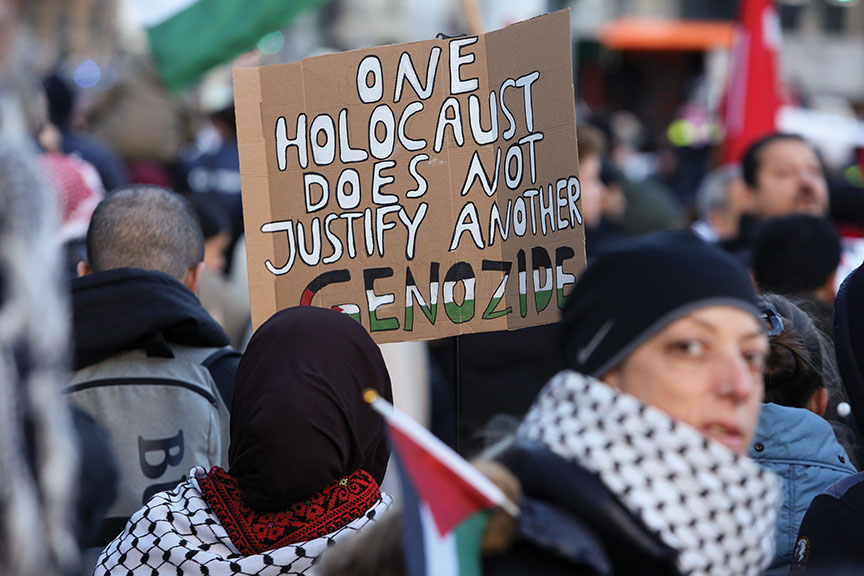
This is not Holocaust denial. It is something more sophisticated, sinister, yet more socially acceptable. It is like Holocaust weaponization – the rhetorical move that takes Jewish suffering and turns it into a liability rather than a human reality.

It sounds like this: “Jews use antisemitism accusations to silence critics.” Or: “Israel’s conduct in Gaza is just like what was done to Jews in Europe.” Or the softest and most common version: “I acknowledge what happened on Oct. 7 – but …” And one more thing, that is very dangerous as well: when someone start their criticism of Israel with the words: “As a Jew …” You already know what is coming….

That pivot is doing a great deal of work. In the hands of someone committed to honest inquiry, it introduces complexity. In the hands of someone running the victim inversion engine, it introduces doubt about whether Jewish suffering deserves to be treated as suffering at all.

Jewish students on campuses across America experienced this in real time in the weeks and months after Oct. 7. They were told their fear was not legitimate.  Some were told that naming what was happening to them was itself a form of manipulation. Some were told that their Jewishness, in the context of Israeli military action, disqualified them from claiming victim status.

Think about what that means. The grandchildren of Holocaust survivors – some of them the children of people who escaped persecution by the skin of their teeth – were being told that their experience of anti-Jewish hatred did not count as a legitimate experience of hatred. That the history behind their fear was not a history that entitled them to be concerned.

Every other form of antisemitism attacks Jews in ways that can, at least in principle, be countered with evidence and argument. The religious accusations can be examined. The economic myths can be fact-checked. The conspiracy theories can be exposed. But the victim inversion engine attacks the ground on which Jews stand to make their case after they have been harmed individually or collectively. It does not say your evidence is wrong. It says your evidence does not count.

Once a society accepts that logic – once it decides that Jewish claims of victimhood are inherently suspect, that the memory of Jewish suffering is a political tool rather than a human reality – it has removed the last moral guardrail between Jews and violence. This is not hypothetical. This is the pattern that preceded every major act of collective violence against Jews in modern history. The victim was recast as the aggressor first. The moral permission was established first. And then violence followed.

I told that graduate student: the people who were murdered on Oct. 7 do not belong to a political argument. They belong to their families. And the first moral obligation – before context, before analysis, before any political response – is to let them be human beings who were murdered.

She did not agree with me. That is fine. But several students in the room shifted in their seats, as if something had been named that had been floating unnamed for weeks.

That is the point of naming it. Hatred that has no name is harder to resist. Once you know what the victim inversion engine sounds like – once you can recognize it when it arrives wearing the language of social justice and political analysis – you can begin to push back against it.

The engines that fuel antisemitism have always run on confusion. The antidote is always clarity.


Oz Laniado is the Executive Director of StandWithUs for the Southwest and Mexico, an international nonpartisan education organization that supports Israel and combats antisemitism.  He is the author of The Engine of Blame: Thirteen Forces That Keep Antisemitism Alive, (https://engineofblame.com/)

The New Antisemitism Doesn’t Deny Jewish Suffering, It Weaponizes It Read More »

To Love Israel Is to Demand More of It

This week’s Torah portion begins with an instruction. While given specifically to Aaron as the High Priest, I think these words are meant for all of us and especially our leaders. We read:

“Speak to Aaron and say to him, ‘When you cause the light to go up, let the seven lamps give light at the front of the lampstand.’” (Numbers 8:1-2)

The Torah’s instruction to Aaron is precise. The word here is not the same as the one we use each Shabbat when we light our candles; it does not say l’hadlik. Aaron is not simply asked to kindle the lamps. Rather, the word is b’ha’alot’cha — when you cause the light to ascend, to go up. The purpose of the flame is not merely illumination. It is elevation. Our task as Jews — as a people, as a nation and as individuals — is to bring more light into the world and cause that light to rise, to inspire, to uplift.

This week I want to speak about something difficult. I do so not to add to the overwhelming noise around Israel, and not because I think the relentless criticism Israel faces is fair or accurate. On the contrary. But Israel is a real country with real challenges, just like any other country on the planet. Its leaders are imperfect, like all of us, and some of what has happened in recent weeks has pained me. As a Zionist — someone who loves Israel not only as it is, but even more the moral and spiritual promise of what it can still become — I do not believe silence is an option when that collective light is diminished.

So I want to name three incidents over the last few weeks that ask us to live up to our Zionist aspirations more fully.

First: settler violence in the West Bank. This is not new, but it has intensified. President Isaac Herzog, speaking at the Jerusalem Unity Prize ceremony last week, condemned “a wave of terrible violence carried out by an anarchist mob,” calling these acts ones that “defile and violate every basic moral, legal and Jewish norm.” He warned of a “terrible process of brutalization” creeping in from the margins — one that “threatens to enter the mainstream” of Israeli society.

That Herzog spoke these words publicly, at a ceremony celebrating Jewish unity, is the mark of a healthy democracy. I am grateful for his leadership and moral resolve. And I want to add my voice: lawlessness in the West Bank, by anyone, is a chillul Hashem, a desecration of God’s expectations for us. It diminishes the light.

Second: National Security Minister Itamar Ben-Gvir filmed himself taunting activists detained from the Global Sumud Flotilla and posted the footage to social media. Foreign Minister Gideon Sa’ar rebuked him sharply: “You knowingly caused harm to our state in this disgraceful display – and not for the first time.” U.S. Ambassador Huckabee said Ben-Gvir had “betrayed the dignity of his nation.”

I understand the strong feelings many of us have about publicity stunts like the flotilla, crewed in no small part by agitators and propagandists who seem more interested in harming Israel than helping Palestinians. But the rule of law, and the basic dignity owed to every person in custody, are not optional. Not even now. Not even for those who hate us. Ben-Gvir’s childish stunt handed our enemies exactly what they wanted. Prime Minister Netanyahu chose to include him in his government. He must hold him accountable. It diminishes the light.

Third: Social Equality Minister May Golan stood at the Knesset podium recently and told Reform rabbi and MK Gilad Kariv that he was “marrying dogs in your delusional synagogues.” Israel’s Ambassador to the U.S., Yechiel Leiter, himself an Orthodox Jew, called her remarks “disgusting and reprehensible, worthy of excoriation and rebuke … Theological, political and ideological differences are fine, even necessary for a healthy people. But there is a line that cannot be crossed.” I agree entirely. To speak this way about synagogues that millions of Diaspora Jews belong to, Jews who advocate tirelessly for our shared homeland, is a betrayal of the covenant between Israel and Diaspora Jewry. It diminishes the light.

I had the privilege of meeting with Ambassador Leiter in New York last week and raised these concerns directly. I also thanked him for speaking out so forcefully and unequivocally. That’s what real leadership looks like.

At the same time as we advocate publicly and proudly for Israel here in the United States, I left my meeting with the Ambassador feeling all the more strongly that true advocacy sometimes requires tochecha — loving critique, offered from within the family. I encourage you to make your voice heard. Reach out to the Israeli Ambassador’s office in Washington or the Consul General here in Los Angeles. Do so with love, as proud Zionists, as Jews who embrace values like egalitarianism, LGBTQ+ inclusion and Tikkun Olam. Speak not out of rejection, but out of love — because believing in Israel, and loving Israel, also means believing it can, and must, live up to the Jewish values we hold sacred.

B’ha’alot’cha teaches us that every action either elevates the flame or dims it. Our task — as Jews, as Zionists, as lovers of Israel — is always to bring more light. This is not a new calling. At Sinai, we were commanded:

“You shall be for Me a kingdom of priests and a holy nation.” (Exodus 19:6)

That is who we are called to be. And when we fall short — as individuals, as a people, whether everyday Jews or the Prime Minister himself — we must have the courage to face it honestly, call it what it is and do better. That is how we raise the light.


Rabbi Yoshi Zweiback is the Senior Rabbi of Stephen Wise Temple in Los Angeles.

To Love Israel Is to Demand More of It Read More »

Prayer in Times of Illness

As I sat with the parents of a very sick young patient who was in emergency surgery, I knew that the patient’s chances of survival were not good. “Can we say some prayers for her speedy recovery?” the patient’s father inquired. “Of course!” I responded, and we proceeded to recite Tehillim (Psalms) and a Mi She-Berach (healing prayer). No sooner had we finished praying than I received a call letting me know that the parents were about to receive the worst news possible. We grieved together. When I went to visit them during shiva the following week, the father of the patient intently made his way through the throngs of people gathering to offer their condolences, pointed right at me, and cried, “Rabbi, your prayers didn’t work!”

This incident forced me to grapple with the efficacy and goals of prayer. How should we approach prayer for an end-stage dying patient, for whom medical professionals predict no chance of recovery?

Some great rabbis, like Rav Shlomo Zalman Auerbach, have indeed expressed caution about prayer for the gravely ill, because if people feel that their prayers were not answered and the patients do not recover, this could lead to a weakening of their faith. Instead, he urged us to see ourselves as humble children before a wiser parent, and to pray simply that what happens be good for the patient and family, that suffering be spared, and that God mercifully do whatever is right.

Others, such as Rav Yaakov Yisrael Kanievsky, insist one should never lose hope in prayer, even for a critically ill patient. Prayer may ease suffering, extend life or even bring recovery. Even if not, it generates merit for the patient, may benefit their family, or help others and the broader community.

This approach maintains the crucial value of hope, and affirms that there are often ways of finding optimism and courage even in the bleakest of situations. According to this worldview, it was certainly appropriate for me to engage in prayer with the patient’s father. Although the father did not perceive that these prayers were answered, we are called upon to maintain faith that the prayers did have some impact, even if it is beyond us to know exactly how.

However, in my clinical experience, I have personally found great meaning in an entirely different perspective on this issue, which was offered by Rav Joseph B. Soloveitchik. In the Rav’s view, the goal of prayer is not to receive God’s answers to our requests, but rather to develop a supportive relationship between a person and God:

We have the assurance that God is indeed a shome’a tefillah, One who hears our prayers, but not necessarily that He is a mekabel tefillah, One who accepts our prayers and accedes to our specific requests. It is our persistent hope that our requests will be fulfilled, but it is not our primary motivation for prayer. In praying, we do not seek a response to a particular request as much as we desire a fellowship with God (“Reflections of the Rav” I, 78).

In this view, it is always essential to pray, even when there appears to be no chance of recovery or hope that our prayers will be answered. The emphasis of our faith is not on God’s answer, but that God hears our prayers, which forces us to expand what we mean by prayer being “effective.” Truly effective prayer is not that which results in our desired ends, but that which brings about a change in the one offering the prayer, specifically in creating a meaningful relationship and providing true comfort. After all, the experience of being in God’s caring presence throughout our time of need can be the best possible comfort.

Indeed, profound solace can be experienced as a result of prayer, since it can ultimately bring us closer to God; the comfort itself is the effectiveness of prayer. According to this view, the goal of contact with the Almighty is not only to get our needs fulfilled, but also to be ennobled, to deepen our relationship with God and to be brought to heights that we could not otherwise reach. Even if we do not receive what we prayed for, prayer that uplifts us and brings us to a closer relationship with God is certainly not uttered in vain. The value of prayer lies not in the response to our prayer from God, but rather in our response to intimately experiencing God’s presence.

The essence of prayer is thus the sense of accessibility, that we can turn to God and develop the crucial comforting experience of being in God’s presence. This does not deny the possibility of Divine acceptance of prayers, but it does view prayer primarily as a mode of worship that inculcates essential beliefs and emotions in the worshipper. This perception recognizes the crucial need for hope within the realistic limits of expectations, encouraging us to maintain faith as we refocus our expectations on something more attainable, and possibly even more crucial.

When offering support to patients and their families in a clinical setting, I’ve learned not only to pray for whatever people want, but also to facilitate the deepest spiritual healing possible for those individuals in order to enable them to deal with adversity. After all, even if we pray for an unlikely outcome and the patient miraculously recovers, that miracle will necessarily be impermanent; life is fraught with suffering and everyone eventually dies.

It was indeed highly appropriate to pray with the anxious father of the critical patient, but it may have been imperative to couch the focus of those prayers in a desire for God’s proximity and support during those trying times and the difficult days ahead, more than in specific pleas for a miraculous recovery.


Rabbi Dr. Jason Weiner, BCC, is the senior rabbi and executive director of the Spiritual Care Department at Cedars-Sinai in Los Angeles, rabbi of Knesset Israel Synagogue of Beverlywood and senior consultant to Ematai.

Prayer in Times of Illness Read More »

Jewish and Christian Zionists Must Stand Together

A 2018 survey conducted by Motti Inbari and Kirill Bumin found, astonishingly, that over 90% of evangelicals believe that God gave the land of Israel to the Jewish people. The pro-Israel organization Christians United for Israel (CUFI) claims an estimated 10 million members – more than the entire number of Jews in the United States. What explains the strong tendency among American Christians to love Israel?

To understand the roots of American Christian Zionism, it’s helpful to consider two key thinkers from early America: Increase Mather, a leading Puritan minister in 17th-century Massachusetts, and John Adams, the second president of the United States. Comparing selections from their writings highlights how Christian Zionism evolved from a theological doctrine in colonial America to a more politically oriented version in the early republic.

Long before the birth of the modern Zionist movement in the late 19th century, Puritans in New England envisioned a Jewish return to Zion. In his treatise “The Mystery of Israel’s Salvation” (1669), written in the aftermath of a failed Jewish messianic movement, Increase Mather insisted that the phrase “all Israel shall be saved” (Romans 11:26) – in his view, a precondition for the second coming of Christ – refers not only to a “spiritual” salvation of national conversion but also a “temporal” (this-worldly) salvation: “Some that have believed and asserted a general conversion of the Jews, yet have doubted whether they should ever again possess the Land of their fathers; But the Scripture is very clear and full for this, that I see not how it can justly be denyed or questioned.”

While this sentiment seems to align with Zionism by emphasizing Jewish possession of their ancestral homeland, it has two key limitations. Firstly, Mather did not wish for Jewish restoration as a manifestation of the national right to self-determination. Instead, he hoped to see a return of the Jews to the Holy Land to fulfill his eschatological ambition. Zionism, by contrast, denotes the establishment of a Jewish state – not a waystation toward a fully Christianized world order.

Secondly, the specific form of government Mather envisioned for the polity of the restored Zion looked backward to the Bible rather than forward to the modern idea of the nation-state. He lamented that the Jews had suffered “near 1,600 years since the house of Israel was left unto them desolate.” However, he also observed that the ancient Israelites only experienced “oppression from their own Rulers” when they demanded a human king and “cast off that Theocraty, or Government by Judges which was of divine appointment.” Mather envisioned the political system described in the Book of Judges – a nonmonarchical leader appointed by God – as the form of governance in the restored Israel.

To support this view, Mather cited an Old Testament prophecy: “I will restore thy Judges as at the first, and thy counsellors as at the beginning. Sion and her converts shall be redeemed with righteousness” (Isaiah 1:26-27). While his translation followed the King James Version, Mather made a subtle but highly significant tweak by capitalizing the term “Judges.” This editorial choice reinterpreted the vision as alluding not simply to a restoration of Israelite political power but rather the return of the theocratic judgeship. Such a model similarly conflicts with the principle of self-determination, which places agency in the hands of the people.

However, Christian Zionism evolved after the American Revolution. In this era emerged a vision of Jewish restoration inspired by the revolutionary ideals of independence and liberty. While still rooted in eschatology, these expressions in some ways anticipated modern political dimensions of Zionism as Jewish statehood.

Consider John Adams. Like his Puritan ancestors, Adams admired the Old Testament, which he hailed among the “greatest Wonders of Antiquity.” However, he also expressed a dim view of post-biblical rabbinic literature; in an 1813 letter to Thomas Jefferson, Adams dismissively remarked that examining the entire corpus “would require the life of Methuselah, and after all, his 969 years would be wasted to very little purpose.”

Despite his ambivalence toward rabbinic Judaism, Adams embraced the idea of Jewish restoration in his correspondence with the Jewish diplomat and notable proto-Zionist Mordecai Noah. In an 1819 letter to Noah, Adams expressed his hope for “restoring your nation to the dominion of [Judea]—For I really wish the Jews again in Judea an independent nation.” Adams believed that the Jews, “once restored to an independent government & no longer persecuted they would soon wear away some of the asperities & peculiarities of their character possibly in time become liberal Unitarian Christians.”

Adams’ letter retained the Puritans’ theological limitation noted earlier of idealizing Jewish restoration only to effectuate a national conversion. However, Adams’ political outlook differed significantly from Mather’s. Whereas Mather’s imagination led him to the Bible, Adams framed Jewish sovereignty through the new reality of a post-revolutionary world – hence the term “independent nation.”

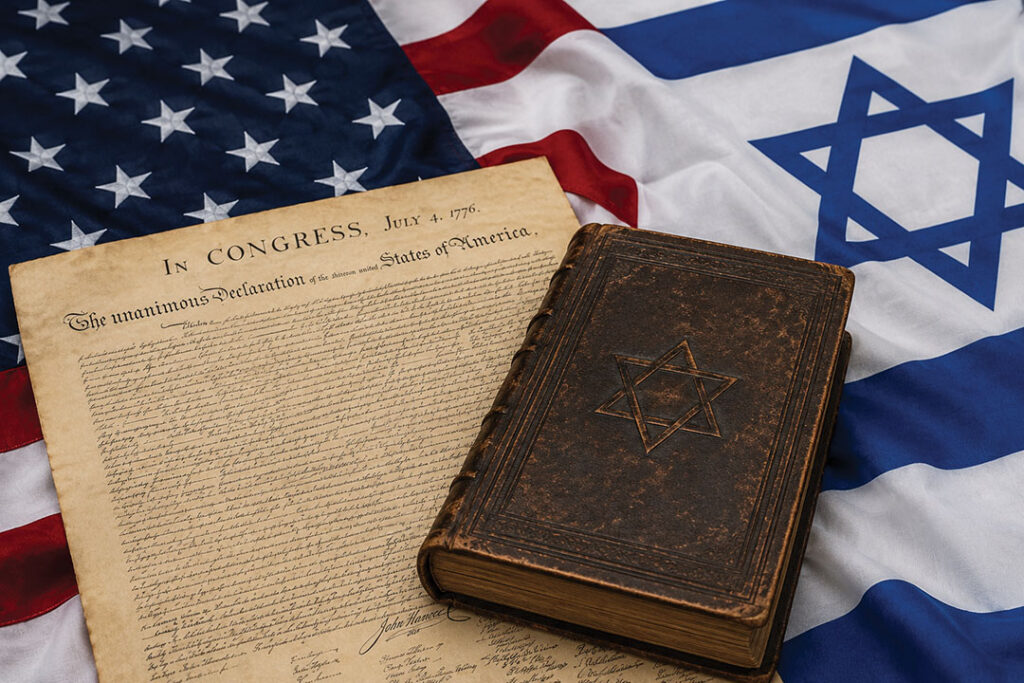
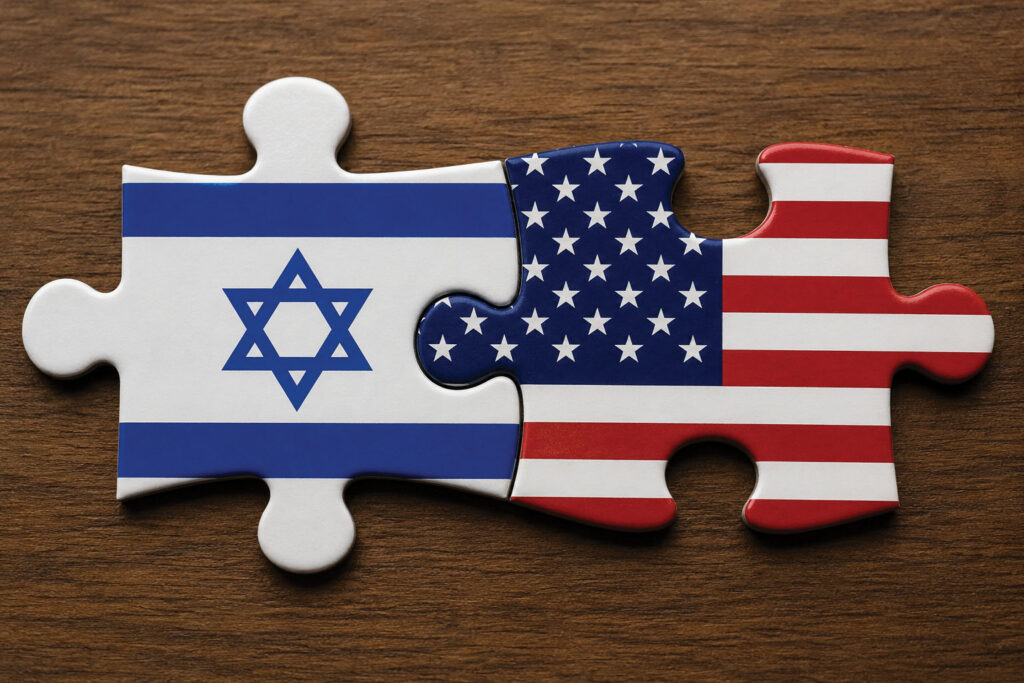
The advent of American independence, something that Mather could never have anticipated, might explain how theological and theocratic fantasies in the 17th century evolved into an embrace of Jewish statehood in the early 19th century. These ideas culminated with America’s embrace of Jewish self-determination in the 20th century. Indeed, a mere 11 minutes after Israel’s founding in 1948, U.S. President Harry Truman recognized the nascent Jewish state and cemented an alliance that endures today. Moreover, Israel’s Declaration of Independence in 1948 itself drew inspiration from the United States’ Declaration of Independence in 1776.

As America’s 250th birthday approaches, the history of Christian Zionism in early America highlights the importance of today’s ecumenical allyship. The ideals of 1776 and 1948 call for a united front against efforts to demonize and delegitimize Israel. Jewish and Christian Zionists must stand together, championing Israeli sovereignty on its own terms and ensuring that Judea’s “independent nation” endures for generations to come.


Yisroel Benporat serves as the Senior Associate for Faculty Engagement in New York at the Academic Engagement Network. He holds a Ph.D. in early American history from CUNY Graduate Center.

Jewish and Christian Zionists Must Stand Together Read More »

The Philanthropic Pivot to Jewish Joy Is Misguided

In recent months, a growing number of voices within Jewish philanthropy have argued that our community has spent too much time focused on threats and not enough time focused on flourishing. The proposed remedy is often framed as a greater investment in Jewish joy.

The argument is understandable. After years of rising antisemitism, political polarization, campus hostility and the trauma of Oct. 7, 2023, many donors are exhausted. They are weary of constantly funding defensive efforts. They are tired of crisis. They want to invest in positive Jewish identity, Jewish culture, Jewish experiences and Jewish flourishing.

Who could object to that?

The problem is not Jewish joy itself. The problem is the growing belief that Jewish joy can replace the difficult work of protecting the conditions that make Jewish flourishing possible in the first place.

A healthy Jewish community requires both. Increasingly, however, philanthropy is acting as though it must choose.

Across the Jewish world, there is a noticeable shift away from supporting efforts that tackle difficult and often controversial challenges: rebuilding democratic norms in Israel, countering Israeli extremism, confronting antisemitism, strengthening public policy protections for Jewish communities, advancing regional integration between Israel and its Arab neighbors and defending liberal democratic values against authoritarian movements that threaten minorities everywhere.

Many of these efforts are messy. They are politically complicated. They often produce outcomes that are difficult to measure. They generate criticism from one side or another.

A Shabbat dinner, a cultural festival or a Jewish arts initiative is far easier to celebrate.

But easier is not always wiser.

The irony is that the very reason many funders feel compelled to invest in Jewish joy is because the underlying conditions facing Jewish communities have deteriorated. Oct. 7 did not emerge from nowhere. The explosion of antisemitism on campuses did not emerge from nowhere. The growing normalization of anti-democratic movements throughout the world did not emerge from nowhere.

These developments were the result of political, educational, technological and ideological forces that evolved over decades. Addressing them requires sustained investment in institutions willing to engage difficult questions and tackle root causes.

Jewish joy can strengthen identity. It cannot stop an Iranian nuclear program. It cannot strengthen democratic institutions. It cannot counter extremist ideologies. It cannot reform social media systems that reward hatred. It cannot build strategic alliances between Israel and its regional partners.

The belief that we can withdraw from these arenas and simply focus inward represents a profound misunderstanding of the challenges before us.

The question is not whether antisemitism remains a serious threat. The question is whether now is the moment to deprioritize efforts to confront it. Given everything we have witnessed since Oct. 7, that conclusion strikes me as premature.

The shortcomings of the antisemitism field should prompt reflection, not retreat. Before redirecting substantial resources elsewhere, we should first understand what has worked, what has failed, and what changes are needed to meet a rapidly evolving threat environment.

If parts of the field have underperformed, the answer is not to pivot away from the challenge. It is to identify which approaches deserve more investment, which deserve less and where entirely new approaches are needed.

Before we conclude that philanthropy should shift its focus from combating antisemitism to promoting Jewish joy, we should first ask whether the field has genuinely had the opportunity to assess what went wrong. Many organizations are still responding to a post-Oct. 7 reality that remains poorly understood, while many funders have yet to undertake the difficult work of determining where consolidation, restructuring, or innovation may be required.

There is another reason the Jewish joy movement gives me pause.

If the goal is to strengthen Jewish identity and create deeper connections to Jewish life, then we cannot ignore one of the central pillars of modern Jewish identity: Israel.

Yet many of the same institutions now championing Jewish joy have still not reckoned with the shortcomings of contemporary Israel education.

For years, too many young Jews were presented with an Israel that felt disconnected from the reality they would eventually encounter. When they later confronted difficult questions about Israeli politics, “the occupation,” religious pluralism, democratic backsliding, corruption or internal social divisions, many felt unprepared. Some felt misled.

If philanthropy wants to invest more heavily in Jewish identity, belonging and joy, then honest Israel education must be part of that agenda.

The answer is not less Israel. The answer is better Israel.

Young Jews deserve an education that acknowledges complexity while remaining rooted in a deep understanding of Israel’s history, achievements, challenges and strategic importance. They deserve opportunities to wrestle with difficult questions rather than being shielded from them.

Just as importantly, they deserve educational spaces that move beyond ideological purity tests. Too often, communal institutions have narrowed the range of acceptable perspectives, creating environments where genuine inquiry is replaced by litmus tests. That approach does not build connection. It builds alienation.

A generation forced to choose between blind celebration and outright rejection will often choose neither. A generation invited into honest engagement is far more likely to develop a lasting sense of ownership and responsibility.

Jewish joy built upon avoidance is fragile. Jewish joy built upon truth is durable.

Ultimately, the debate is not between Jewish joy and Jewish security, Jewish joy and democracy or Jewish joy and Israel.

The real question is whether we are confusing outcomes with prerequisites.

There is nothing wrong with investing in Jewish joy. The mistake is treating it as a substitute for the harder work of defending the conditions that allow Jewish communities to thrive.

Strong communities, effective institutions, democratic resilience, physical security, honest education and meaningful engagement with Israel are what make Jewish flourishing possible. If we neglect those foundations, no amount of investment in joy will compensate for what has been lost.

And if we abandon the difficult work of protecting Jewish communities, defending democratic norms, strengthening Israel’s future, advancing regional integration and confronting the forces that threaten both, we may eventually discover that there is far less to celebrate than we imagined.


Coby Schoffman is a Los Angeles–based serial social entrepreneur and the founder of The Nation Foundation (TNF), which operates project zones across East Africa. Schoffman holds an MSc in Transnational Security from New York University and a BA in Counterterrorism and Conflict Resolution from Reichman University. The views expressed are his own and do not reflect those of any affiliated organization

The Philanthropic Pivot to Jewish Joy Is Misguided Read More »

More Than a Trip: A Lesson in Jewish Identity

When educational journeys do not go according to plan, unexpected opportunities sometimes emerge. That was certainly the case for our group of eighth grade students from Sinai Akiba Academy, whose anticipated trip to Israel was replaced by a journey through some of the most significant landmarks of Jewish and American history in Philadelphia and New York City.

While disappointment over not being in Israel was real, the experience quickly evolved into something deeper: an exploration of what it means to be a Jew in America.

Throughout the trip, students were challenged to consider questions at the heart of Jewish identity: Who are we as American Jews? What do we believe in? What traditions, values and connections will we choose to carry forward as we grow into adulthood?

The journey began at Mikveh Israel in Philadelphia, one of the oldest synagogues in America and still a thriving congregation today. Standing in a place where generations of Jews sought freedom, refuge and opportunity, students learned about the choices faced by Jewish immigrants who arrived on American shores. Some chose assimilation, hoping to blend seamlessly into American society. Many others found ways to embrace their new country while maintaining the traditions and values that had sustained the Jewish people for centuries.

The group continued to New York City, where a visit to Ellis Island brought those stories even closer to home. Looking out toward the Statue of Liberty, students reflected on the experiences of countless immigrants, including many of their own ancestors who arrived in America seeking opportunity and the freedom to practice their faith.

There they encountered the words of Jewish poet Emma Lazarus, whose inscription transformed the Statue of Liberty into a universal symbol of hope:

“Give me your tired, your poor, your huddled masses yearning to breathe free.”

For generations of Jewish immigrants, those words represented not simply an invitation to a new country but the promise of religious freedom and possibility.

The themes of identity and belonging continued throughout Shabbat in Manhattan. During a sermon at Park Avenue Synagogue, Rabbi Elliot Cosgrove spoke about standing up for what we care about and refusing to leave our identities at the door when we enter public life.

The message resonated deeply because it echoed the questions we had been asking students throughout the trip. For many, these questions were not distant history. Their grandparents — and for some, even their parents — had lived them firsthand, forced to leave behind homes, communities and everything familiar in pursuit of freedom and security. We asked our students to imagine themselves in that moment: If you had to flee your home, what would you take with you? What values, traditions and beliefs would you cling to? What part of your identity would you refuse to surrender? What do you care about deeply enough to carry across borders, across generations? And ultimately: What do you stand for?

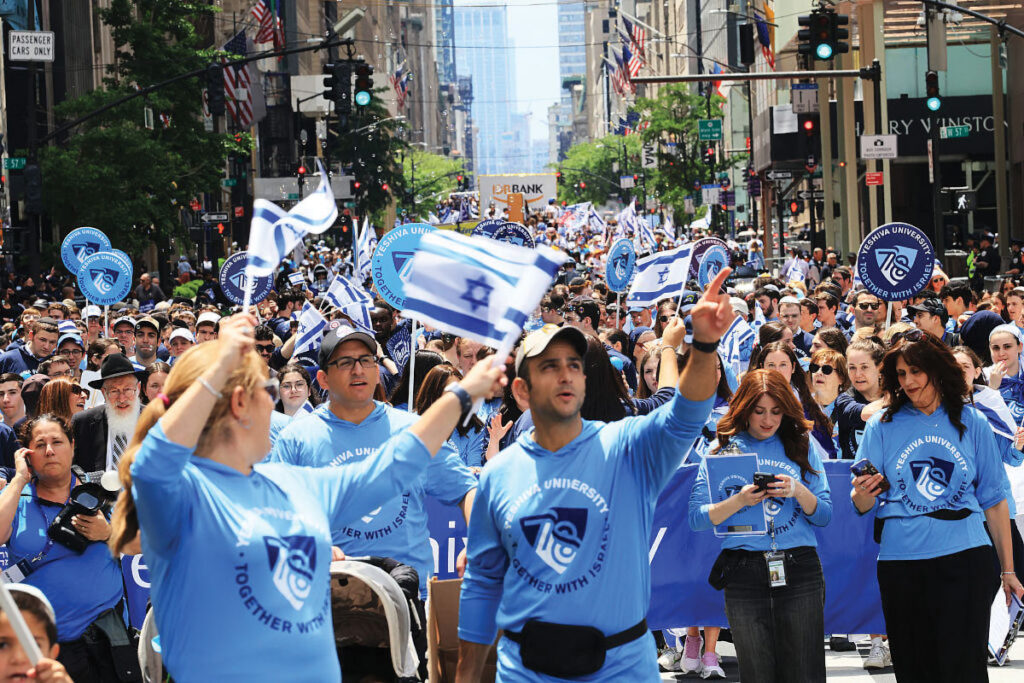
As students began hearing about New York City’s Israel Day Parade, more and more of them started asking whether we were going.

Initially, the answer was no.

The responsibility for student safety weighed heavily on us as trip leaders, and caution seemed the prudent choice. Yet over the course of Shabbat, we found ourselves returning again and again to the themes that had defined the journey: identity, courage, belonging and the willingness to stand publicly for what one believes.

The students wanted to attend because it mattered to them. They wanted to stand with their people. They wanted to be counted.

And here we were, in New York City, on the very day it was happening.

We decided to proceed cautiously.  Since we were already headed to Midtown Manhattan for a visit to the Empire State Building, we would simply see what it felt like to be there.

What we encountered was extraordinary.

As we walked through the city, we saw delegations arriving from every direction; synagogues, schools, youth groups and yeshivot from across the country. We also saw an extraordinary security presence. Streets were closed and barricaded. Officers were everywhere. It was clear that every precaution had been taken.

One challenge remained: the only way to get close to the heart of the event was to march, and participating groups had registered long before.

Then something unexpected happened.

Whether by luck or divine intervention, we found ourselves standing near a security checkpoint for marchers.  We caught the attention of a security official who asked a simple question: “How can I make your day better?”

We explained who we were and where we had come from. After carefully vetting us, he smiled and said, “Let’s do a mitzvah and get you in.”

And just like that, our students walked through the checkpoint singing “Am Yisrael Chai” at the top of their lungs.

For those of us accompanying them, it was a moment we will never forget.

We watched our students stand proudly as Jews. We watched them surrounded by tens of thousands of people connected by a shared history, a shared hope and a shared connection to Israel. Most importantly, we watched them realize that they were part of something much larger than themselves.

Although scheduling commitments prevented us from staying long enough to officially march in the parade, we stood together among thousands of Jews and supporters of Israel, making our voices heard and expressing our connection to the Jewish people and the Jewish homeland.

For many students, the experience was transformative.

“I’ve never felt anything like this before in my life,” one student said.

“I’ve never felt part of something so special,” said another.

Those comments captured the significance of the day better than any prepared lesson ever could.

Experiences like these cannot be fully taught in a classroom. They must be lived.

What began as an alternative to a trip to Israel became something profoundly meaningful in its own right: a journey into history, identity, community and belonging. For a group of young Jews standing on the threshold of high school, it offered a powerful reminder that Jewish identity is not simply inherited. It is discovered, embraced, and ultimately lived.

Long after the museums, landmarks and photographs fade from memory, we believe our students will remember how they felt that day: standing proudly as Jews, connected to their history, their people and one another.

And for those of us who witnessed it, that memory will endure for years to come.

Am Yisrael Chai!


Avi Taff is the Sinai Akiba Academy School rabbi and an associate rabbi at Sinai Temple in Los Angeles

More Than a Trip: A Lesson in Jewish Identity Read More »

Rosner’s Domain | Accepting an Unacceptable Dictate

Israel’s relationship with the United States is a serious matter, and it is rarely easy to manage. This is true today in Lebanon, just as it was in Gaza. “Israeli officers recount that their American counterparts claimed any ground maneuver would require ‘turning cities to dust,'” writes veteran military analyst Amos Harel in his new book “06:29,” about the Oct. 7, 2023 massacre. The Americans warned against Israel’s decision to send forces into Khan Younis and Rafah. Israeli officers, Harel notes, believed that “the track record of the Americans and their allies against ISIS – where the casualty ratio stood at five civilians for every combatant – disqualified the United States from lecturing Israel on morality.”

This encapsulates an important part of the U.S.-Israel dynamic. First, there is the American condescension – they believe they know better and feel entitled to dictate how others should act. Second, there is the misunderstanding by Israelis who assume the relationship is built on symmetry: if the U.S. is allowed to do something, so are we. It is cooperation running parallel to mutual grumbling. When Israeli officers argue that Washington’s own history of civilian casualties strips it of the moral high ground, they are entirely right in principle – but entirely wrong in practice. They can still lecture Israel because they are the superpower, and superpowers decide what they can and cannot do. Israel is left with three choices: surrender to the American position, attempt to persuade the Americans or defy the American stance. Every decision carries consequences and a cost. At every crossroads, Israel must decide what is right based on the immediate circumstances.

Amid the current ongoing fighting in Lebanon (Israelis are now calling it The Cease Fire War) there is a growing resentment in Israel toward the U.S. dictate that limits Israel’s options to respond militarily as it wishes to do. Israel is operating in Lebanon under constraints, and is also under constrains in Iran and Gaza. Every front remains open, and progress on them is subject to the whims or calculations of the American president. Many Israelis feel this unacceptable situation.

And perhaps it is.

And yet, this situation cannot be judged solely against the Israeli ideal – which is total freedom of action and unyielding American support. It must be weighed against reality, where freedom of action and strategic support are inextricably linked. This calculus is complicated – it is doubtful whether any citizen without access to classified information can compute it.

Consider an example from Harel’s book: “The Americans halted the supply of one-ton precision bombs to the Air Force, limiting transfers to quarter-ton bombs instead.” This refers to the earlier stages of the Gaza war. Let’s imagine a current scenario: Israel decides to launch a operation in Lebanon against American wishes. Israel needs one-ton bombs to operate effectively, but Washington warns: defy us and you won’t get them. If Israel lacks the capacity to manufacture these munitions, the dilemma is stark. Israel can either proceed without the right weapons, or it can stand down as requested. Defiance might boost national morale or signal a boundary to American overreach, but the cost could be an ineffective military campaign, and a further erosion of U.S. support.

Should Israel declare the situation “unacceptable” and march forward, or bite its lip and wait? The instinctive response for many Israelis is to act, because the idea of being constrained in defending your security is deeply unsettling. But the correct answer is that while there are times Israel must act regardless of the diplomatic fallout, other times it has no choice but to accept the constraints and vent. There is no sweeping, definitive rule that applies to every case. There are only specific, case-by-case options.

Can Israel’s dependency on the U.S. be reduced? Yes, but it is a lengthy, costly process. Israel is not alone in navigating these waters. Other nations weigh the costs and benefits of their relationship with Washington. The Saudis can maneuver because of their wealth and energy resources. The Europeans have leverage because, if they chose to unify, they could form a rival superpower. The Australians have flexibility because they face no immediate threat.

Israel’s situation is unique – it is not a vassal state. But it is also not a country that can easily revolt against American dictates. David Ben-Gurion understood this after the 1956 Sinai Campaign. Golda Meir realized it at the end of the Yom Kippur War. Yitzhak Rabin saw it when he faced Kissinger’s pressure, Menachem Begin during the peace talks with Egypt, Yitzhak Shamir during the First Gulf War and Ariel Sharon during the Second Intifada.

Netanyahu, of course, understands this too. Does he bear responsibility for the fact that Israel’s hands have been tied due to political choices he made over recent years? Absolutely. Would Israel’s hands be any freer had he chosen differently? That’s far from certain. Can he unbind these chains and release Israel from the iron grip of Donald Trump? Don’t answer “yes” until you fully comprehend the price. 

Something I wrote in Hebrew

Why would we find a correlation between Israelis who support civil marriage and Israelis who see climate change as real danger? There is a reason …

Of course, there is absolutely no connection between civil marriage and global warming. These are distinct issues that, on the surface, should have no bearing on one another. And indeed, when it comes to the other three threats [we asked about] – nuclear weapons, social networks and artificial intelligence – there is almost no consistent, clear link between the level of concern and other issues. But climate is a special case. That is because it has been put through the political ringer. Israelis (as well as Americans) do not evaluate the climate threat the way they do threats like nuclear weapons or networks; they look at the climate threat through the lens of political identity, where it is clearly aligned with an entire suite of other issues. Generally speaking, the situation is such that right-wing supporters are not worried about the climate, while center and left-wing supporters are (Center: 56% worried; Right: 21% worried).

A week’s numbers

Here’s what Israelis are telling themselves about you — Americans.


A reader’s response

Mike Posens writes: “I’ve never worried about the future of Israel as I do now.” My response: Join the club. It’s a great club, with many Israelis as current members.


Shmuel Rosner is senior political editor. For more analysis of Israeli and international politics, visit Rosner’s Domain at jewishjournal.com/rosnersdomain.

Rosner’s Domain | Accepting an Unacceptable Dictate Read More »

Zionism and the Bones of Ezekiel

Last week I attended an elegant Friday night dinner gathering in Jerusalem’s Old City, a short walk from the Kotel. Over the course of the evening, between appetizers and dessert, the host asked guests to stand one by one and introduce themselves. The guests ranged from dewy-skinned Israeli soldiers to white-haired American businessmen, and after they’d presented a potted account of themselves, the host wanted to know one thing. “And… are you a Zionist?” he asked. It became something of a joke, so that the moment the next guest rose to speak, a cry rose from the table: “Are you a Zionist? Are you a Zionist?”

The host pressed on, asking each guest to explain what they understand Zionism means. Most, squirming under all those pairs of eyes, responded with something along the lines of, “Zionism means the Jews have the right to self-determination in their ancestral homeland” or “It means Israel has the right to exist, just like any other nation.” This is how I’ve understood it since declaring myself a Zionist several years ago. I’d been steeped in the understanding that all nations have the right to self-determination. Once I saw that antizionists deny this principle to the Jews and only the Jews, it was obvious that antizionism is overwhelmingly driven by antisemitism, and Zionism is completely legitimate. I instinctively put a plus where the antisemites put a minus.

And all of this is true: Jews do have the right to self-determination, denying this right to the Jewish people alone is inherently antisemitic, and it’s right to object about being discriminated against. But I’m beginning to think this understanding doesn’t go deep enough. Part of the problem may lie in that bit about how Israel should be seen as “just like any other nation.” This plaintive Jewish wish runs far back in Jewish history. In the first Book of Samuel, the people, fed up with their existing leadership, demand that Samuel appoint a king to rule over them. Samuel tells them they’d come to regret it—that a king “will take a tenth of your flocks, and you yourselves will become his slaves”—but the people are obstinate.

“No!” they say. “We want a king over us. Then we will be like all the other nations, with a king to lead us and to go out before us and fight our battles.” And since the Jews ended up with King David, who is generally considered a flawed individual but great ruler, it might seem that the people were right to push for a king.

But there’s an inherent problem with the desire many Jews have to be like everybody else. Conforming is, in fact, what the non-Jewish world has often demanded of Jews, and it amounts to requiring them to effectively stop being Jewish. In the Greco-Roman world, Jewish men in the gymnasia felt huge pressure to reverse their circumcisions as a way of avoiding stigma. Napoleon granted the Jews civil rights but required them to drop outward displays of Jewishness. The Soviet Union forbade Jewish (and all forms of religious) worship. Today, Jews face relentless demands to disavow their state—to declare that although they have the misfortune of being Jews, they are not Zionists: a term deemed synonymous with “Nazi.”

As Gilda Radner said, It’s always something. The non-Jewish world will always find something rankling about the Jews, whether that’s monotheism, the original sin, or their stubborn refusal to die on command.

As Gilda Radner said, It’s always something. The non-Jewish world will always find something rankling about the Jews, whether that’s monotheism, the original sin, or their stubborn refusal to die on command. So maybe we should stop wanting to be like everybody else.

So we should stop wanting to be like everybody else. Embrace what makes Jews, and their state, different. Stop thinking of Zionism merely as an expression of national self-determination like any other. This is conceiving of it only in secular, political terms, when its beauty and strength stems from a different plane.

I write this in the shadow of Jerusalem’s old walls. From the balcony I can see the City of David, and if I wanted to, I could think about how that archeological site contains roughly a zillion refutations of the fashionable claim that Jews have no history in this land—that they swept in only recently to steal it from the Palestinians. But thinking this way only means that the ahistorical “anti-colonialists” have succeeded in colonizing my mind.

This is where King David walked. As a lifelong nonbeliever I’m supposed to be unmoved by this fact, or reflexively skeptical about how much truth there is in the biblical account. But thinking that way is also wearying and tedious. It robs me of a sense of majesty and mystery, the sparking of my imagination.

Jerusalem is not like any other place on Earth. The only way to experience it is to open yourself to its glorious strangeness, the dizzying juxtaposition between the transcendent and the mundane. The cats napping in the shade at Jaffa Gate. The reggae musician beating a drum at Zion Square. The bearded Jews in black hats and tallits hurrying through the stone alleyways of Old City. The souq, where a jovial merchant insists you marry him, and succeeds in getting you to hand over an insane number of shekels for a bag of paprika. The out-of-this-world wonder of the Kotel at dusk as Shabbat begins, a surge of humanity and song and prayer.

Jerusalem is not like any other place on the earth. The only way to experience it is to open yourself to its glorious strangeness, the dizzying juxtaposition between the transcendent and the mundane.

Newly stirring bones have been on my mind these past few days, ever since a visit to Jerusalem’s Friends of Zion Museum. It’s a wonderful, too-little-known place founded by Christians who advocate for Zionism with clarity and zeal. In one room, an artistically animated movie was played telling the story of the prophet Ezekiel—how he prophesied the destruction of the first temple in 586 B.C., but how he also prophesied that the Jewish people would eventually be restored to the land of Israel. This was Ezekiel’s vision after coming across a valley filled with dry bones. God commanded him to speak to them, promising that they would be restored to life. When Ezekiel did, flesh and skin formed over those bones, breath returned, and the dead lived once again.

As I watched that movie depicting this story, I knew how many people, including many dear to me, would smirk at the whole thing. I was raised to be allergic to anything resembling Bible-thumping. But this attitude increasingly feels like closedness, a deliberate stunting of the imagination and spirit. I choose to feel otherwise, and think I’m richer for it. I believe others would be, too.

My notebook contains a curious scrawled page, the source of which I didn’t note but I’m pretty sure I copied from a podcast with Yossi Klein Halevi. “The secular story of Israel is running out of juice,” it says. “And there’s something of the strangeness of the Jewish story that we need to reclaim.” That’s it exactly. Nothing about the Jewish story—with its then-revolutionary insistence that there is one God, its history of relentless suffering, its triumphant return to the land it was expelled from millennia ago—is normal, and we shouldn’t try claiming it is. The beauty lies in its incredibleness, those bones returning to life.


Kathleen Hayes is the author of ”Antisemitism and the Left: A Memoir.”

Zionism and the Bones of Ezekiel Read More »

Democracy, Divinity and the Inherent Challenge of the Image of God

Consider the Code of Hammurabi, from that 18th-century B.C.E. King of Babylonia.

What was the life of a servant’s child worth, from its perspective? A mere two shekels.

“If he strike the maid-servant of a man, and she lose her child, he shall pay two shekels in money,” the law coldly ruled.

“Did people actually behave this way?” Tomer Persico wonders. “They probably behaved much worse.”

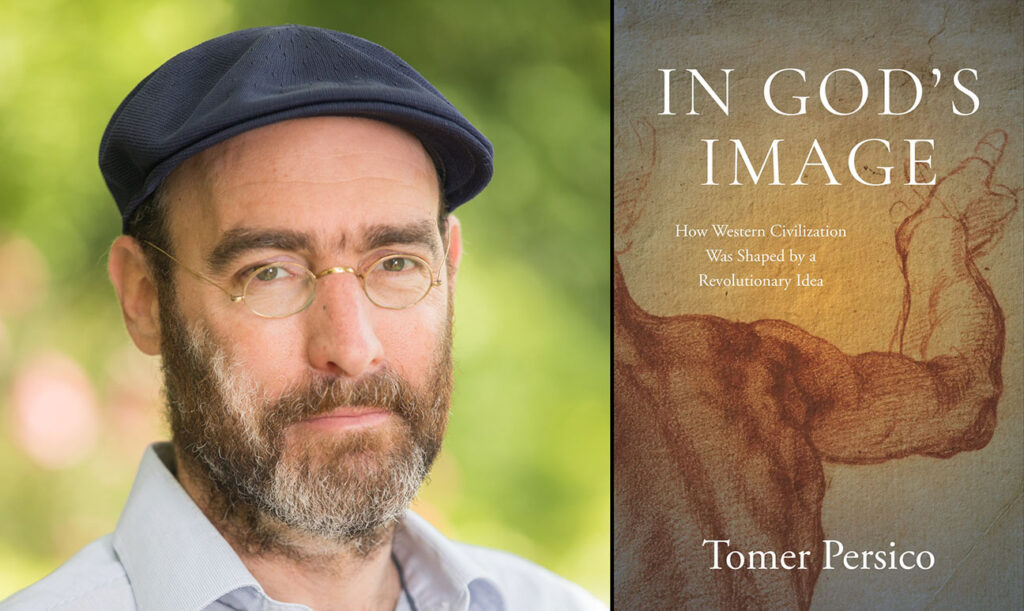
Persico, a Research Fellow at the Shalom Hartman Institute and Senior Research Scholar at the UC Berkeley Center for Middle Eastern Studies, argues for the radical innovation of the Hebraic teaching that humans were, in fact, of infinite worth –  copied, as they were, from God’s own form.

His “In God’s Image: How Western Civilization Was Shaped by a Revolutionary Idea” is a tour de force — with a twist. Tracing the history of the concept, he suggests the Deity perhaps planted the seeds for His own modern demise.

But first, let’s go back to the Beginning.

Genesis 1:26-27 reads: “And God said, ‘Let us make man in our image, after our likeness. They shall rule the fish of the sea, the birds of the sky, the cattle, the whole earth and all the creeping things that creep on earth.’ And God created man in His image, in the image of God He created him; male and female He created them.”

“There can be no overstating the revolutionary importance of the principle that human beings share God’s image,” Persico argues. The elaboration of his thesis is worth quoting at length:

“The difference between these Mesopotamian myths and Genesis is clear: in the former, specific characters are created or born in the image of a god — heroes or deities. In contrast, the Hebrew Bible tells us that all of humanity was created in the image of God. This is a critical difference. When a single individual, like Enkidu [from the Gilgamesh epic], is considered special because he was created in God’s image, we have a neat myth. That person’s life has exceptional meaning and his story attains iconic status. Tales are told about him, festivals celebrated in his honor. But if all of humanity is special in the same way, then history itself is a myth that we are all writing together. Everyone’s life carries exceptional meaning. The whole of humanity — including all human lives, struggles, challenges and achievements — become meaningful, as does the life of every single individual. Everyone matters. Humanity celebrates its own existence. If the image of God distinguishes and empowers all its bearers, then unlike the Babylonian myths that empowered gods and heroes, the Hebrew Bible empowered each and every member of humankind.”

Persico draws a direct line from the divine image to democracy. In pagan belief, only the king or legendary heroes have special status. In, for example, a letter addressed to the king of Assyria, the writer praises him as follows: “The father of the king my lord was the image of Bel, and the king my lord is likewise in the image of Bel.” In other words, it is only the men of the Assyrian royal family are said to bear the image of the god Bel.

  The ancient Israelite text “nullifie[d] the assumed legitimacy for rule based on the extraordinary status of the one created in god’s image. Indeed it is directly connected to the rise of democracy in the West: if everyone was created in the image of God, then everyone deserves a share of power.” It used to be that the self was thought of as porous “permanently exposed to a range of forces that might not only influence them from the outside but also penetrate them and cause them to act in certain ways … demons, angels, and dead souls — the universe was full of entities, some good and some bad, capable of entering us and changing us from within.” Now a person was no longer “an appendage of a patriarch or a paterfamilias,” no longer pushed and pulled by powers beyond their control.

As the professor of religion Elaine Pagels noted in The Atlantic in an article titled “The Moral Foundation of America,” “by suggesting that ultimate value resides in the individual, regardless of their sociopolitical status, the Bible defied some of the world’s most enduring conventions of rank and worth.”

Thus, Thomas Jefferson would assert, in rebelling against a tyrannical monarch, “We hold these truths to be self-evident, that all men are created equal, that they are endowed by their Creator with certain unalienable Rights.”

How did we get there?

It started with “I.” If humans are like God in the Bible, they can create. And recreate. And change their minds, make mistakes, get angry and be disappointed. “Individuals,” in other words, as Persico writes, “are exclusively responsible for their own deeds, and from it the notion that autonomy is a necessary condition for self-worth and self-determination would develop.”

Paul pushed this thinking forward. He “dove into the depths of his Judaism, and when he resurfaced, he radically transformed Judaism’s conception of a person’s relationship with God. He replaced the Jewish concept of the ‘covenant,’ whereby a collective committed to a heteronomous framework of political, moral, social and ritual laws and commandments, with a new covenant: a personal, not collective, one … It was this inner metamorphosis that would connect individual Christians to Christ and thereby redeem them.”

So, later, Augustine would request: “I beseech you, my God, show me myself.” The Church Father was, Persico notes, “asking God not to reveal himself (God) but himself (Augustine), so that he could know himself.”

One could, it was now believed, reach heaven through the heart. Without an intimate familiarity with oneself, there could be no true relationship with God. Whereas earlier in the ancient world, the family was the most basic building block of both society and faith, once the individual entered a personal association with God, the family began to lose its force. Every individual was now his or her own subject.

Of course, one could, on the other hand, decide you’ve looked within yourself and are not subject to God.

Citing the modern French thinker Alain Badiou, Persico offers that “Paul originated the notion of the individual universal subject, of the person as above all a single person, of the human being as an entity unchained by any particular ties or associations, unbound by sex or tribe.” No longer would people’s relationship with God be sustained indirectly or by invoking the memory of distant ancestors, as the Hebrew Bible and Jewish prayers claim. Truth would now depend “neither on law, as for the Jews, nor reason, as for the Greeks. It requires neither the authority of rabbinical-Pharisaic interpretations of law, nor the authority of the philosophers’ reason or logic. Paul’s truth shone from within.”

Liberal democracy would, over the centuries, eventually follow, “evolved in part due to the inability of absolutist monarchy to accommodate private spheres of autonomy and self-worth.” The Magna Carta represented “the pinnacle of a lively debate that had raged throughout the Middle Ages, a debate in which rights were understood to be derivative of a certain status — unto each class, its own privileges. This was the prevailing conception of rights in the Middle Ages.”

Martin Luther would later declare: “I am bound by the Scriptures I have quoted and my conscience is captive to the Word of God. I cannot and I will not retract anything, since it is neither safe nor right to go against my conscience. May God help me.” After Europe fragmented over religious debates and produced a multitude of Protestant denominations, “the idea that just as Christians were entitled to religious liberty, so were all human beings, took hold.”

On the positive side, the abolitionist struggle anchored itself on the principle of the image of God, and its correlated assumption of basic human rights. Being a copy of the divine would be reframed as “dignity.”

But by “sanctifying the inner life of the individual (its reason, freedom of choice, autonomy, conscience — in short, its image of God)” mankind eventually did what it does, taking things to the extreme. Sanctity morphed into militant secularism. In an ironic twist, the concept of being in God’s own image brought us to the modern moment of hyperindividualism, moral relativism, civic dissolution.

Persico quotes the scholar of Christianity Steve Bruce, who wrote “Innovations pressed to rejuvenate the Church undermined it. … The religion created by the Reformation was extremely vulnerable to fragmentation because it removed the institution of the church as a source of authority between God and man. . . . It inadvertently fragmented the dominant religious culture and created the competition which, in tolerant and egalitarian societies, would lead to relativism and perennialism.”

This all happened, per Persico, “grounded in a conception of the human subject as a bright nucleus of will or reason, unencumbered by ethnicity, religion, familial ties or gender.” What started in Eden has ended up with epidemics of loneliness and depression, online influencers and opioids.

“Finding a way to counter and ameliorate this crisis of identity will be the next major challenge of the liberal order,” the author warns. Perhaps, while the seeds of the current crisis were planted at Creation, the original aspiration of God for us human remains.

Persico concludes, “The idea of the image of God obliges us even today to support freedom and democracy. It requires us to protect our autonomy and that of our neighbours, to respect the dignity and intrinsic value of all human beings, to fight for human and civil rights, and to struggle for the establishment of a just, egalitarian society. The image of God compels us to see the divine in another, their unique, irreplaceable value, which stems from their subjective exceptionality.”

That is to say, the divine image within us remains an eternal challenge – beckoning each and every individual to live a life reflective of his or her highest capabilities.


Rabbi Dr. Stuart Halpern is Senior Adviser to the Provost of Yeshiva University and Deputy Director of Y.U.’s Straus Center for Torah and Western Thought. His books include the newly released “Jewish Roots of American Liberty,” “The Promise of Liberty: A Passover Haggada,” “Esther in America,” “Gleanings: Reflections on Ruth” and “Proclaim Liberty Throughout the Land: The Hebrew Bible in the United States.”

Democracy, Divinity and the Inherent Challenge of the Image of God Read More »