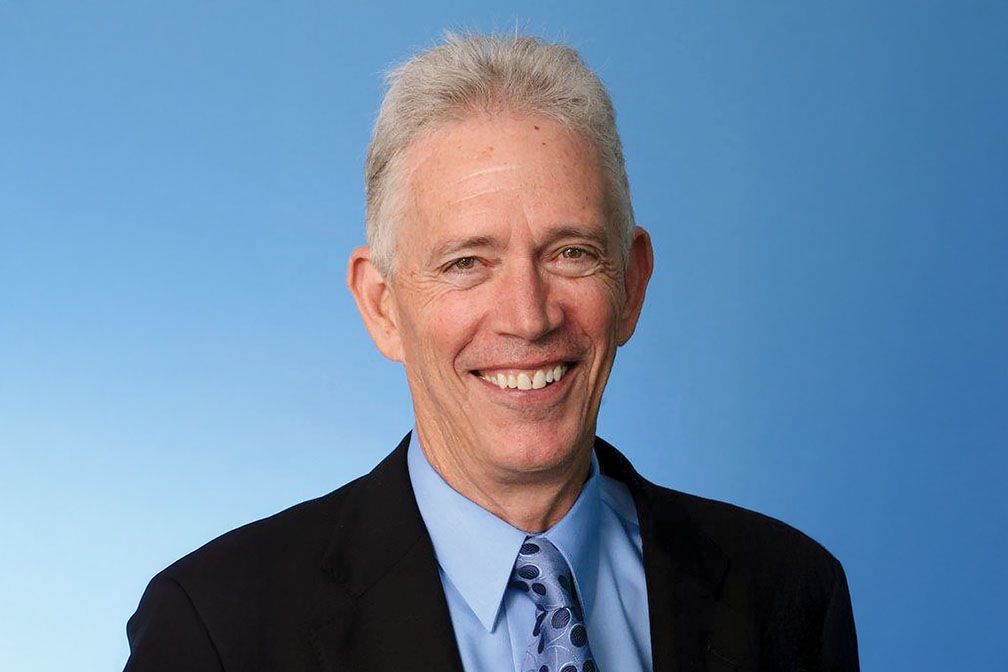
State Senator Scott Wiener (D-San Francisco) announced today that he would be stepping down as Co-Chair of the California Legislative Jewish Caucus on Feb. 15.
Wiener’s decision comes amid criticism from Jewish groups about statements he made about Israel. In his statement, Wiener linked the timing of his decision to both his congressional campaign and the “significant controversy” of his words.
“Last fall, I suggested stepping down but was asked to stay to provide continuity of leadership during a difficult time for the Jewish community. Now, my campaign is accelerating, and my recent statements on Israel and Gaza have led to significant controversy in the Jewish community. The time to transition has arrived.”
Weiner is currently serving his third term in the California State Senate. He was reelected in 2024 to a four-year term ending in 2028. He has co-chaired the CLJC for five years. No replacement for Wiener has been announced. He is running for the U.S. House seat currently held by U.S. Rep Nancy Pelosi, who said she will retire at the end of the term after serving since 1987.
In his statement, Wiener did not retract remarks from a Jan. 11 video he shared on X condemning Israel as “committing genocide” in Gaza. “Since I stated my view that the Netanyahu government committed a genocide in Gaza, I have had many in-depth conversations with members of the Jewish community with a range of perspectives,” Wiener said today. “While many in the community strongly disagree with my view, I am grateful for their willingness to engage with me and hear my perspective, showing once again the deep respect for difference in our community.”
“While many in the community strongly disagree with my view, I am grateful for their willingness to engage with me and hear my perspective, showing once again the deep respect for difference in our community.” – Scott Wiener
In the video posted on Jan. 11, Weiner said, “For those of you who saw the debate clip from last week, I want to clarify that I do believe Israel has committed genocide in Gaza, and I want to explain why I hesitated at the debate. For the past two years, I have harshly opposed Israel’s escalations in Gaza, and I’ve used phrases like total destruction and catastrophic levels of death and moral stain. But I haven’t used the word genocide, and I want to explain why. As a Jew, I am deeply aware that the word genocide was created in the wake of the Holocaust, which was the industrial extermination of 6 million Jews. For many Jews, associating the word genocide with the Jewish state of Israel is deeply painful, and frankly traumatic. But despite that pain and that trauma, we all have eyes, and we see the absolute devastation and catastrophic death toll in Gaza inflicted by the Israeli government … And we all have ears, and we hear the genocidal statements by certain senior members of the Israeli government. And to me, the Israeli government has tried to destroy Gaza and to push Palestinians out, and that qualifies as genocide.”
Wiener’s video on X has been viewed more than 2.5 million times.
On Jan. 14, Sephardic and Mizrahi Jewish organizations released a joint statement criticizing Wiener’s remarks and urging his removal as caucus co-chair. The statement was signed by 30 Years After in Los Angeles; Congregation Anshey Sfard in San Francisco; the Iranian American Jewish Federation in Los Angeles; JIMENA: Jews Indigenous to the Middle East and North Africa in San Francisco; Karaite Jews of America in San Francisco; and Magain David Sephardim Congregation in San Francisco.
“As co-chair of the California Legislative Jewish Caucus, Senator Wiener’s statement does not represent the views, values and interests of California’s Jewish communities,” the groups said in the joint statement, adding that Wiener’s condemnation of Israel came “at a time when Jewish Californians face unprecedented antisemitic violence and hate.”
Following Wiener’s announcement of stepping down as co-chair of the CLJC today, community leaders shared their reactions with The Journal.
“Wiener’s resignation in disgrace should be followed by the Caucus and every Caucus member immediately revoking their endorsements of Wiener,” LA civic and Jewish community leader Sam Yebri told The Journal. “Every elected official should also make clear where they stand. By falsely, cavalierly, and performatively accusing Israel of genocide and ethnic cleansing, Wiener endangered the lives of Jews. Hopefully, in June, voters will show us that being anti-Israel is bad policy and bad politics and end Wiener’s career in public life.”
American Jewish Community Los Angeles Interim Director Ron Galperin called Wiener’s characterization about Israel “irresponsible and inaccurate.”
“[Senator Wiener’s characterization of Israel] does not encourage peace; it sows division in times that require unity,” Galperin told the Journal. “His new position is out of step with the Jewish community, and we agree with him that his leadership of the Legislative Jewish Caucus is no longer appropriate. Words matter, and it is vital that our elected leaders use thoughtful and accurate language, as inflammatory language such as his can have dangerous consequences.”
And I went like locusts – devouring the crops
like grasshoppers with bad reputations.
I remember the sound when the crickets
escaped the lizard habitat. It’s not that
the food was gone – it was the noise.
You can’t watch your television programs
under those circumstances.
And I went like darkness –
have you been to one of those
black out restaurants where they
guide you through the meal
in the pitchest of black?
It was like that without the help.
And I went like your first born –
not away to camp, not away to college
not driving on his own for the first time
But for good. Gone. With only your
memories to lift you up if you ever
get past the sadness.
This is what it took for us to go.
This and the seven things I
mentioned last week. I hear
they’re digging up proof
that it actually happened.
This changes everything.
Rick Lupert, a poet, songleader and graphic designer, is the author of 29 books including “God Wrestler: A Poem for Every Torah Portion.” Visit him at www.JewishPoetry.net
God told the trees they should produce
all fruit according to their kind,
with leaves and bark producing juice
that brings fruit flavor to the mind.
Rejecting Him, the trees refused
to taste like fruit that they produced,
and though First Adam was accused
of disobedience, Eve seduced
her husband only when he tasted
the fruit that from a knowing tree
had grown, not fruity as commanded.
Yet trees got off from God scot free,
while Eve and Adam were remanded
in custody, and then expelled
for disobedience, imitating
trees which also had rebelled.
The Primal Sin was not the Mating
of Eve and Adam but their choice
of freedom which God never gave
our parents, “Use the passive voice”,
behaving as obedient slaves,
until He gave to their descendants
the Sabbath, representing freedom,
the destiny of their descendants
while fruitfully they’d freely breed ‘em,
the Sabbath thus the paradigm
that leads to what is for us written
on the Bell which does not chime,
constructed for free men in Britain,
proclaiming the same freedom for
Americans as for the Jews,
based on the Sabbath, made before
King George the Third a war would lose.
This echoes how Egyptian midwives
saved Israel’s fate when they disobeyed
Pharoh’s order to end all lives
of Jews like Moses. Unafraid
to fight perhaps their own regime —
Egyptians, possibly, and citizens.
The word ha’ivriot’s a meme
denoting “of Hebrew ivritizens,”
a rhyming word that I’ve here coined
for Jewish citizens, as if Jews
all speak in Hebrew, which we’re enjoined
to do to God, praying not to lose.
Though Moses grew up in the palace
of Pharaoh, he supported Jews,
opposing antisemites’ malice
which midwives also would refuse
to show to boys they never drowned
like tea Bostonians would drown,
opposing George, whose head was crowned,
sans Pharaoh’s Exodus renown,
before the exodus of Britain,
whose army’s most calamitous collapse
occurred when beaten, its royal bulldogs bitten,
as were the Germans and the Japs
by USA and Brits, delighted
to win a later war, united.
In “The “Egyptian” Midwives: Who were the midwives who risked their lives to save male Hebrew babies—Israelites or Egyptians? A text discovered at the Cairo Genizah sheds new light on this exegetical conundrum,” thetorah.com, Moshe Lavee and Shana Strauch-Schick discuss Exod. 1:15, which states that the king of Egypt, concerned about the large population of Hebrews in his borders, tells their midwives, named Shifra and Puah, to kill any male child they deliver:
שמות א:טו וַיֹּאמֶר מֶלֶךְ מִצְרַיִם לַמְיַלְּדֹת הָעִבְרִיֹּת אֲשֶׁר שֵׁם הָאַחַת שִׁפְרָה וְשֵׁם הַשֵּׁנִית פּוּעָה. א:טז וַיֹּאמֶר בְּיַלֶּדְכֶן אֶתהָעִבְרִיּוֹת וּרְאִיתֶן עַל הָאׇבְנָיִם אִם־בֵּן הוּא וַהֲמִתֶּן אֹתוֹ וְאִם בַּת הִוא וָחָיָה.
Exod. 1:15 The king of Egypt spoke to the Hebrew midwives, one of whom was named Shiphrah and the other Puah, 1:16 saying, “When you deliver the Hebrew women, look at the birthstool: if it is a boy, kill him; if it is a girl, let her live.” (NJPS)
The midwives, fearing God, ignore Pharaoh’s orders. When Pharaoh confronts them, they make up an excuse, claiming that Hebrew women are “vigorous” (lit. “animals,” חָיוֹת) and give birth before the midwives even show up:
א:יט וַתֹּאמַרְןָ הַמְיַלְּדֹת אֶל פַּרְעֹה כִּי לֹא כַנָּשִׁים הַמִּצְרִיֹּת הָעִבְרִיֹּת כִּי חָיוֹת הֵנָּה בְּטֶרֶם תָּבוֹא אֲלֵהֶן הַמְיַלֶּדֶת וְיָלָדוּ. 1:19 The midwives said to Pharaoh, “Because the Hebrew women are not like the Egyptian women: they are vigorous. Before the midwife can come to them, they have given birth.”
Moshe Lavee and Shana Strauch-Schick point out that:
Although some medieval and pre-modern peshat readers of the text favor narrative context over the grammatically correct translation of the MT, the classical rabbinic / midrashic interpreters from late antiquity generally follow the grammatical meaning of the text (=Hebrew midwives) reflected in the (later) preserved vocalized text; some go on to embellish and fill in the text with the tradition that these two midwives are Yocheved and Miriam. And yet, the alternative translation, that the midwives were ethnic Egyptians, seems to have taken hold in some obscure midrashic texts, including in a genizah fragment from a previously lost midrash.
This observation inspired my coinage of the word “ivritizens” in this poem’s second verse.
Gershon Hepner is a poet who has written over 25,000 poems on subjects ranging from music to literature, politics to Torah. He grew up in England and moved to Los Angeles in 1976. Using his varied interests and experiences, he has authored dozens of papers in medical and academic journals, and authored “Legal Friction: Law, Narrative, and Identity Politics in Biblical Israel.” He can be reached at gershonhepner@gmail.com.
Rabbi Guzik is on sabbatical. Please enjoy A Bisl Torah from Rabbi Avi Taff.
What does it mean to live in total and complete darkness? This week’s Torah portion gives us a vivid image. A heavy darkness descends upon Egypt, so thick that people could not see one another, and for three days, no one could move. This was the ninth plague, but it feels like more than a one-time event. It reads like the consequence of a blindness that had been growing for years. From the moment the Israelites were enslaved, Pharaoh and his people refused to see them as human beings. Now that moral blindness became real, immobilizing, and inescapable.
There is a story of a rabbi who once asked his students, “How do we know when the night has ended and the day has begun?” One said it was when you can tell your field from your neighbor’s. Another said when you can recognize your own house. A third said when you can identify your animal in the distance, and a fourth said when you can see the colors of a flower.
The rabbi said they were all mistaken. “All you do is divide,” he said. “When you look into the face of the person who is beside you, and you can see that person is your brother or your sister, then finally the night has ended and the day has begun.” True redemption begins not when we divide, but when we learn to truly see one another.
I was thinking about where we are in our Torah cycle – as Moses goes head to head with Pharaoh. At no point, did Pharaoh ask Moses, “What kind of a Hebrew (Jew) are you?”
It didn’t matter to Pharaoh.
It didn’t matter to Hitler.
It didn’t matter to those who murdered Daniel Pearl.
And it doesn’t matter in this moment in time to those who oppose Judaism today.
And so it got me thinking. How should I define myself Jewishly? Here is what I discovered?
I am a Jew, and I shouldn’t need a further “distinction.”
After a quarter century shaping generations of rabbis as dean of the Ziegler School of Rabbinic Studies, Rabbi Bradley Shavit Artson is stepping into a new role at American Jewish University (AJU) — one that reflects both his enduring influence and his forward-looking vision for Jewish life.
AJU has announced that Rabbi Artson will be named the Mordecai Kaplan Distinguished Scholar, effective July 1, a position that places him at the heart of the university’s intellectual, spiritual and public-facing life. Reporting directly to AJU President Jay Sanderson, Artson will serve as a senior partner to the university’s leadership, a guiding Jewish voice across AJU’s diverse programs and a representative of the institution on the national and international level.
“I love to teach, I love to speak, I love to counsel, and that’s what this job will be — all the time,” Artson said during a recent interview at his home in Pico-Robertson. “So, it’s really an invitation to get on the balcony and articulate a broad vision of the ways that Judaism can serve looking forward into the future, and the ways that it can still augment its relevance for a new generation. That feels like an amazing next chapter.”
For Artson, the new role builds naturally on 25 years devoted to teaching, scholarship and Jewish leadership at AJU’s Ziegler School.
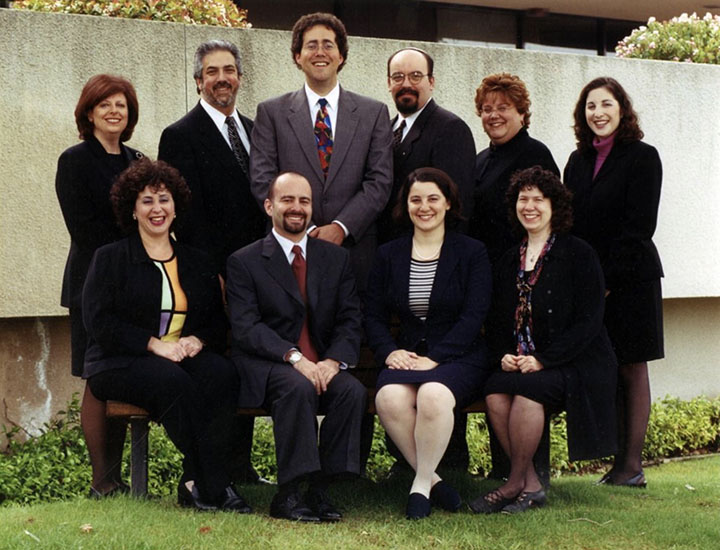
Rabbi Artson (top row, third from left) appears with the 2001 graduating class of the Ziegler School. Courtesy of American Jewish University.
His stepping away from the Ziegler School, a leading seminary for the Conservative movement, to begin this new position as Distinguished Scholar marks a new beginning — not just for Artson and AJU but for the entire Jewish community.
“As we begin a reimagination of American Jewish University and everything we do as both a university and a living laboratory of Judaism, Rabbi Artson is taking a pen and underlining the word ‘Jewish’ in American Jewish University,” Sanderson said. “Brad Artson in this new role, as Mordecai Kaplan Distinguished Scholar, is going to be sitting at every table at AJU, thinking about how we can add more depth of Jewish knowledge, of Jewish learning, in everything we do, no matter who the audience is, no matter what the program is.
“Brad Artson in this new role, as Mordecai Kaplan Distinguished Scholar, is going to be sitting at every table at AJU, thinking about how we can add more depth of Jewish knowledge, of Jewish learning, in everything we do, no matter who the audience is, no matter what the program is.” – Jay Sanderson
“He’s going to be the Jewish conscience of this university as it reimagines itself, which honors his 25-year legacy as the dean of the Ziegler School but also signals that our future is going to be deeply entrenched in what it means to be a Jew for the next generation of Jewish life,” said Sanderson.
As AJU’s leadership works toward this reimagining of the university, it also remains focused on honoring and saluting Artson. On May 19, AJU is feting the outgoing Ziegler dean during a gala slated to take place at Stephen Wise Temple. The event, AJU leadership says, will “recognize both his remarkable accomplishments and this exciting new chapter in his leadership and teaching.”
A Transformational Tenure at Ziegler
Artson has served as dean of the Ziegler School since 2000, making him one of the longest-serving rabbinical school deans in North America. Before joining Ziegler, he served as a pulpit rabbi for 10 years at a Conservative congregation in Mission Viejo, where he helped grow the synagogue’s membership from 200 to 600 families. This was followed by a stint as executive vice president of the Southern California Board of Rabbis. But when Ziegler’s founding dean, Daniel Gordis, made aliyah, then-University of Judaism President Bob Wexler invited Artson to breakfast and made Artson an exciting offer the young rabbi couldn’t refuse.
“I thought, and I think, that if someone offers a rabbi the chance to be the dean of a rabbinical school, there’s only one correct answer to that,” Artson said.
During Artson’s tenure, Ziegler ordained nearly 300 rabbis who serve communities across North America, Europe, Israel and Africa, including Uganda. Today, some of the most dynamic and influential congregations in the country, from Los Angeles to Houston to Washington D.C., have Ziegler alumni.
“I am a rabbi to a great extent because Brad took a chance on me,” said Rabbi Aaron Alexander, co-senior rabbi at Adas Israel Congregation in Washington D.C. Before taking on the pulpit role in D.C., Alexander, a graduate of the Ziegler School, served as an associate dean at Ziegler, working closely alongside Artson. He said Artson possessed rare gifts and has been both the public face and the “blood running through the Ziegler School. It was pumped from his very unique heart.”
Rabbi Sharon Brous, another close colleague and friend of Artson’s, called Artson a “generational talent.”
“A whole generation of rabbis have been transformed by his teaching, thinking, his theology, by his modeling of the rabbinate,” Brous, senior clergy member of IKAR, said in an interview.
“A whole generation of rabbis have been transformed by his teaching, thinking, his theology, by his modeling of the rabbinate.”– Rabbi Sharon Brous
Under Artson’s leadership, the Ziegler School has expanded its reach, reimagined its curriculum, strengthened its Israel program and become a pioneer in inclusion — welcoming LGBTQ students, dramatically increasing the number of women in the rabbinate and embracing a broader and more innovative vision of Jewish leadership.
Artson has also been candid about how the rabbinate’s demographics have changed during his tenure. Citing a recent, widely-reported study that found 51% of students enrolled in non-Haredi rabbinical programs identify as LGBTQ, he noted that while Ziegler’s numbers are somewhat lower, the impact has been profound.
“We’re not quite at that level,” Artson said, “but it’s a significant number of LGBTQ rabbinical students who have enriched the community and made us better — so I’m very proud of that.”
Norman Levine, a Los Angeles-based attorney who served as chair of the Ziegler School Advisory Committee for four years, said Artson’s effect on the university has been immeasurable. In a phone interview, he called Artson a “great force for good in rabbinic education and the Conservative movement. Because of his leadership, Ziegler has become a model for rabbinic education and produced rabbis serving across the country who’ve really had an impact.”
“I’m looking forward to the contributions he’ll make in this new role with the university,” Levine said.
Artson’s influence is felt just as strongly among rabbinic colleagues. Rabbi Ed Feinstein, emeritus rabbi of Valley Beth Shalom and a longtime adjunct member of the Ziegler faculty, described Artson as both a thinker and a mentor.
“He’s a visionary and a philosopher and a scholar — a visionary as a community leader and a mentor to so many of us,” Feinstein said. “Students, colleagues — we all look up to him. He’s a true believer in the message of Conservative Judaism and the future of the American Jewish community. He’s devoted enormous energy to protecting and sustaining that community, and I’ve learned a tremendous amount from him.”
Feinstein further described Artson as “thoughtful and imaginative” and an “optimistic Jewish leader.” He credited him with building Ziegler into the respected institution it is today.
“The whole vision of the school was Artson,” Feinstein told the Journal. “The vision of a school that takes seriously not only scholarship and preparation but the deep individual spiritual growth of each student.”
Ziegler also emerged as a global force during Artson’s tenure. Artson helped launch the Abraham Joshua Heschel Seminary in Germany, the first Conservative rabbinical school in Europe since the Holocaust. “To stand in Berlin and ordain rabbis felt historic,” Artson reflected. “It felt like a way to fight Hitler.”
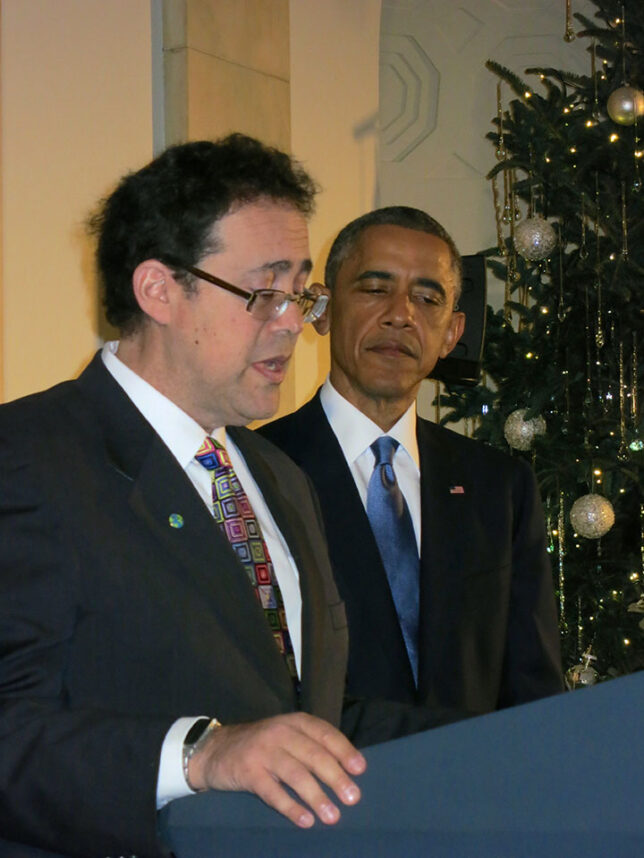
Joined by then-President Obama at a White House Chanukah party. “I was so excited that they serve a kosher banquet, and I was too excited to eat,” Artson recalled. Courtesy of American Jewish University
Another defining chapter was Ziegler’s relationship with the Abayudaya Jewish community in Uganda, including the ordination of Rabbi Gershom Sizomu. Artson traveled to Uganda for Sizomu’s installation — an experience he describes as one of the most powerful of his rabbinate. A tiny wooden throne — a memento from that 2008 trip to Uganda — still sits in Artson’s living room today.
Sizomu called Artson “a great teacher with a voice of reason heard in every statement coming out of him, and I admire his clarity in teaching Torah and in explaining the realities of life.”
Beyond institutional leadership, Artson has maintained a deep, visible presence in Jewish life. For more than two decades, he has led High Holy Day services at Sinai Temple, forging relationships that span generations. “I now see people who were once babies bringing their own children,” he said. “It feels like a family reunion every year.”
Rabbi David Wolpe, emeritus rabbi of Sinai Temple, has seen how successful Artson can be in inspiring not just students — but Jews in the pews. The two have known each other since they were enrolled at the Jewish Theological Seminary (JTS), the Conservative seminary in New York. Even then, Wolpe could see Artson’s obvious talents.
“He was always outstanding,” Wolpe said. “There was never any question he was going to be a leading rabbi as far back as when we were students. He has a unique combination of empathy and intellect, which, you know, those two don’t always go together.”
Like many of Artson’s colleagues, Wolpe said that the Ziegler School and Artson have been inextricably linked. “He has been the principal magnet for people coming to the rabbinical school at AJU for many, many, many years,” Wolpe said.
A Scholar Rooted in Judaism’s Moral Vision
Artson’s own journey to the rabbinate began as an undergraduate at Harvard College, where a growing fascination with theology and Jewish thought — sparked by encounters with theologian Franz Rosenzweig and lived religious experience — led him from a promising path in politics to rabbinical school at the JTS.
That intellectual foundation has shaped a prolific scholarly career. Artson earned his doctorate from Hebrew Union College while serving as dean of the Ziegler School and has authored 12 books on theology, spirituality and Jewish ethics, many of which are widely taught and discussed. His forthcoming book, “The Water Wants You to Float,” explores the idea that people already possess what they need to live expansive, meaningful lives.
“In an age of loneliness and anxiety,” Artson said, “Judaism has the solution. We have community. We show up for people in every moment of their lives.”
A New Chapter for AJU
As Mordecai Kaplan Distinguished Scholar, Artson will remain an intellectual force within the denomination as he continues teaching across AJU’s schools and campuses, from rabbinical and educational programs to business and leadership initiatives. He will also continue serving on AJU’s senior staff, helping shape the university’s long-term vision.
The title itself carries particular resonance. Mordecai Kaplan, the founder of Reconstructionist Judaism, championed an evolving, people-centered Judaism — an approach that has animated Artson’s work.
Virginia Maas, a past AJU board chair and current member of the Ziegler School advisory committee, has known Artson for decades. Their collaboration dates back to when AJU conceived of the Intro to Judaism Program, which reconnects Jews with deep Jewish learning and introduces non-Jews to the possibilities of leading a Jewish life. She told The Journal she has always found Artson to be an open, empathetic ear, both steeped in the specifics of the Conservative movement but also not overly ecumenical.
“He’s a great scholar,” Maas said. “He’s thoughtful, bright and respected around the community, the U.S. and internationally as well. People gravitate to him because of his warmth, and I’m confident he’ll be an excellent ambassador in this new role for AJU.”
Rabbi Artson is joined by his wife, Elana Artson, and their twin children, Shira and Jacob. Shira and Artson’s son-in-law, Asher, have one child—Rabbi Artson’s grandson. Courtesy of American Jewish University
Artson, 66, and his wife, Elana Shavit Artson, have twin children, Jacob and Shira. Shira and her husband, Asher, recently welcomed a baby boy—the Artsons’ first grandchild.
As his family enters a new generation, Artson is also embracing a new chapter in his professional life. He sees the appointment at AJU not as a capstone, but as a new beginning. “Not many rabbis at my stage get invited into a moment of great expansion,” he said. “But that’s what I’ve been invited into—and I’m thrilled to be a partner in shaping what comes next.”
In naming him Mordecai Kaplan Distinguished Scholar, AJU affirms Artson’s lifelong commitment to Jewish thought, peoplehood and possibility — positioning him to help articulate what Jewish life can become in the years ahead.
“I’m very proud of the alumni of the Ziegler School,” Artson said. “I think they’ve made a real difference in Jewish life. I see their creativity and their energy in all kinds of ways, and I forged really close relations with them. And so that feels really beautiful and now feels like the right time to take on the next challenge and let someone else take over.”
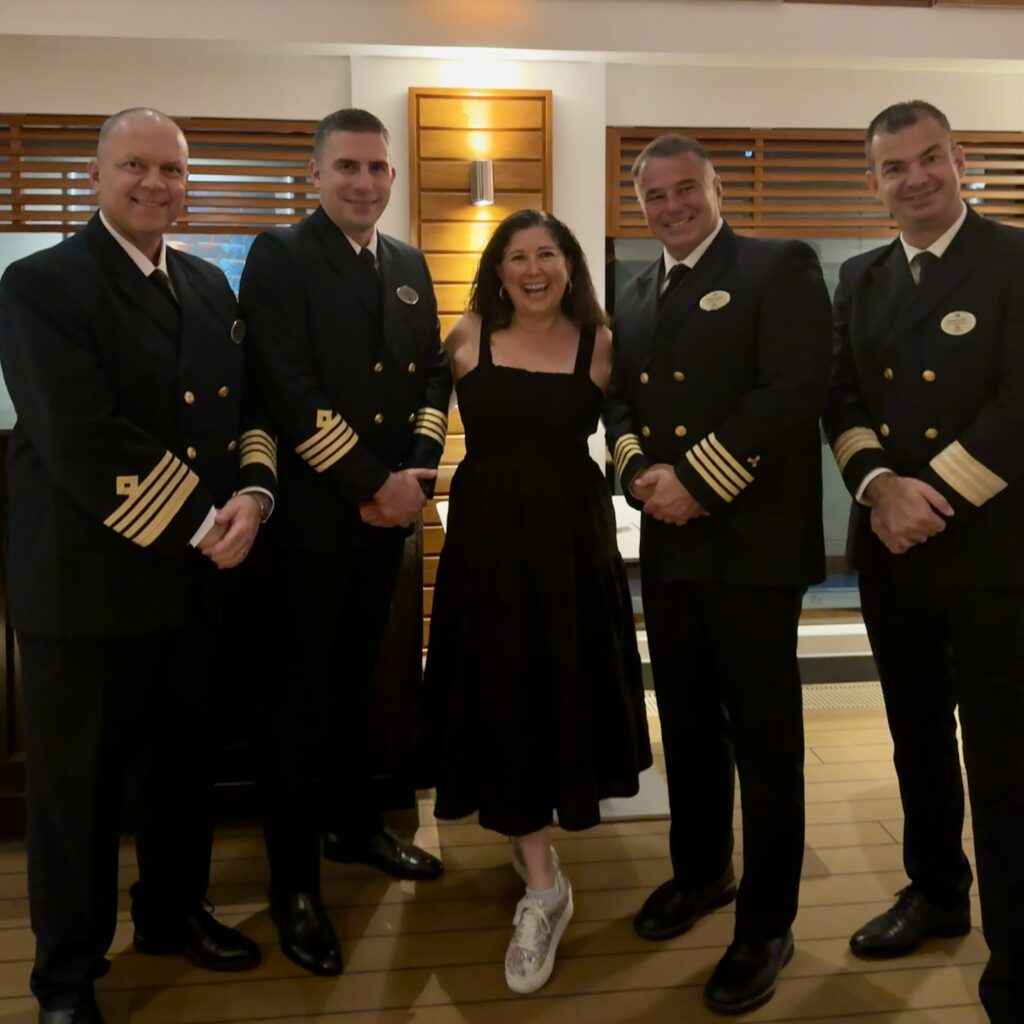
One of the most striking aspects of sailing on the Norwegian Escape is the leadership culture onboard. Captain Matko Candrlić and General Manager Kivanc Ucar set the tone—and it shows. This is a ship where the senior team is not tucked away behind closed doors. I met Kivanc on the gangway during embarkation and saw him again ashore in the morning as guests walked into port, personally welcoming people on and off the ship. And here’s what really stood out: every time I met a senior staff member, they handed me their business card—with a direct phone number. If there was a question, a concern, or something that could make the experience better, they wanted to know immediately.
Across the vessel, senior staff are consistently present and genuinely engaged. Housekeeping Supervisor Andro Bautista came to greet me at my cabin. I met Executive Sous Chef Gerum Genavia during a lively dinner at Teppanyaki. And in the Garden Café, Maitre D’ Lilibeth Espinosa ensured the dining experience felt warm, attentive, and effortless. These aren’t one-off moments; this is the culture. After working for three different cruise lines, sailing dozens of ships, and attending several inaugurals, I’ve never seen a leadership team this visible, approachable, and proactive. A supported crew creates a supported guest—happy crew, happy passengers—and the Escape embodies that beautifully.
The NCL app also stands out for its ease and clarity. I made dinner reservations directly in the app, menus and specialty dining pricing were clearly displayed, and everything simply worked the way cruise technology should. It’s surprisingly rare for an at-sea app to feel this intuitive and reliable.
The Garden Café offers thoughtful variety and smart design—yes, including silverware already set on tables, so you’re not juggling plates and utensils. I especially enjoyed the Taste of India and Asian selections, and the evening crêpes were a delightful treat.
Entertainment, particularly The Choir of Man, an all-male musical performance filled with big vocals, audience participation (including inviting guests onstage for a beer), and an unforgettable tap sequence, was exceptional. Teppanyaki delivered both flavor and fun, with chefs who sing while they cook, turning dinner into an experience. Paired with a comfortable balcony cabin, a caring housekeeping team, and consistently warm service, the Escape didn’t just provide a voyage—it created a collection of shared, meaningful moments.
What ultimately set the Norwegian Escape apart for me was how cohesive the experience felt. The food and beverage offerings were consistently delicious and thoughtfully presented, the service was genuinely warm, and the entertainment brought real joy to the journey. It’s rare to find a ship where hospitality, leadership, and creativity are all so strong—and so aligned. This voyage didn’t simply check boxes; it exceeded expectations and delivered a truly memorable experience at sea.
Ten years ago, Hilary Sheinbaum participated in Dry January for the first time. She had no idea it would change her life!
“I made a very spontaneous, silly bet with one of my guy friends on New Year’s Eve,” Sheinbaum, who was working as a red carpet entertainment journalist at the time – and also wrote articles on beer, wine and spirits, told the Journal.
The first one to take a sip of alcohol in January lost. Her friend lasted around three weeks, Sheinbaum made it through the entire month.
“That was New Year’s Eve 2016, and here we are 10 years later, 10 dry Januarys later,” she said. “I won a very expensive dinner at a Michelin star restaurant, but honestly the impact that it has had on my life for the past 10 years is worth so much more.”
Sheinbaum is the founder of GoingDry.co, where she throws non-alcoholic (N.A.) events in Los Angeles, New York and other US cities, and helps restaurants, bars and hotels with their non-alcoholic menus. She is the author of “Going Dry: A Workbook: A Practical Guide to Drinking Less and Living More” and “The Dry Challenge: How to Lose the Booze for Dry January, Sober October, and Any Other Alcohol-Free Month.”
Sober curiosity is a thing. And the interest in it keeps growing.
Sheinbaum believes that since the pandemic, people have been more focused on their health, wellness, immunity and longevity.
“Certainly alcohol obviously contributes to a lot of health risks, so people are looking to scale back,” she said. “They might not be looking to cut it out from their lives altogether, but people are definitely drinking less than they were before.”
Better sleep, weight loss, and financial savings are some of the benefits of going dry. Even your skin will look better, since alcohol dehydrates you.
Besides, she said, some events – social and/or fitness-related – are better for bonding without booze.
A sense of community is an important factor in both Jewish and sober cultures.
“Knowing how you connect with other Jewish individuals is so unique and such a … lovely, magical thing,” she said. “You understand [each other]; you’ve grown up with the same holidays and spiritual background, [though] obviously there is a wide range.”
In the sober and sober-curious community, you automatically “get” each other too. While there are different reasons for going sober – and a wide range of people trying it out – the goal of not drinking is the same. There’s a similar string that ties everyone together.
“There is dry January, there is sober October; you can really go dry at any point in the year or for more than a month if you like,” she said. “It’s not about putting pressure on yourself to be [perfect], it’s really about seeing how reducing alcohol in your life can make it better on a day-to-day basis.”
If you want to try to go dry, Sheinbaum has recommendations:
“Number one, be easy on yourself,” she said. “It’s not easy to give up alcohol.”
Number two is to recruit a friend; there’s strength in numbers.
“It’s really great to have somebody who’s also experiencing the same feelings as you are, whether that is frustration or feeling left out maybe,” Sheinbaum said. “But it’s also great to have somebody who you can make plans with that doesn’t involve booze.”
Her third suggestion is to become the social director of your friend group.
“If your friends are accustomed to meeting at a bar every Friday, maybe suggest that you do a different activity, like go bowling or take a cooking class,” she said. Be the person who is going to plan that because having the ability to gather with people without booze is really important.”
What’s most important to remember is that you are in control of how you honor your “dry spells.”
“If you have an event, like a wedding or a birthday or a Jewish holiday and it calls for a glass of wine or a sip, I think that’s okay,” she said. “Call it a damp January or a damp month.”
Sheinbaum thinks it is important to have alcohol alternatives. Her favorite non-alcoholic margarita recipe is below.
“If you are somebody who wants to enjoy a glass of wine but you don’t want a buzz, you can still drink that and celebrate and have the same experiences.”
Recipe adopted from Free Spirits (photo credit is also Free Spirits).
I love this nonalcoholic marg recipe because it tastes like the classic everyone knows and loves– just without a buzz. This might be a stretch for some, but if you– like me– are looking to include a citrus beverage, you can use this recipe to serve NA margaritas and entertain guests.
Ingredients
2 oz Free Spirits The Spirit of Tequila
1 oz fresh lime juice
.5 oz agave syrup
2 slices of lime
kosher salt
Method
Rub a rocks glass with lime. Dip in salt.
Add ice to the glass.
Fill the shaker with ice, add The Spirit of Tequila, agave syrup and lime juice.
Shake vigorously for approximately 15 seconds.
Strain into the rocks glass filled with ice and garnish with a slice of lime.
Debra Eckerling is a writer for the Jewish Journal and the host of “Taste Buds with Deb.” Subscribe on YouTube or your favorite podcast platform.Email Debra: tastebuds@jewishjournal.com.
We have lost a great visionary and a remarkable leader in the field of philanthropy.
Marvin Schotland—who passed away Jan. 7 at the age of 78—led the Jewish Community Foundation of Los Angeles for 33 years, between 1989 and 2022, transforming it from a small, little-known $90 million entity into a $1.5 billion powerhouse of charity. It became the largest source of Jewish communal philanthropy in Los Angeles, consistently ranked among the top 10 foundations locally by size, and one of the largest Jewish community foundations in America.
Most significantly, Marvin helped distribute upwards of $2 billion in grants to the community locally, nationally, and in Israel
From a modest upbringing in Youngstown, Ohio, raised by parents who had survived the Holocaust, Marvin rose to the pinnacle of Jewish philanthropy, ultimately improving the lives of innumerable people. What I witnessed during our 23 years working together was a man completely devoted to strengthening our Jewish community, the community at large, and the State of Israel. Tzedakah was an integral part of his DNA. I also learned what makes a great Jewish leader.
He was an innovative thinker, a powerful presence, and an empathetic soul wrapped in a deep devotion for our people and Israel. Articulate and passionate,he combined the wisdom of Solomon and the leadership skills of Moses with compassion and modesty. He was single-minded in his purpose; it was never about him but rather about how to help our 1,400 clients give tzedakah more effectively.
Marvin was always calm and clearheaded, concentrating on what was best for the community. He made the difficult decisions with precision and focus. He inspired his staff through his dedication, clever sense of humor, and no-nonsense approach to solving problems and helping people in need.
Running a large foundation that in 2025 distributed more than 14,000 grants totaling approximately $200 million and managed $135 million in incoming contributions is a complicated enterprise. It requires immense administrative talents; deep knowledge of finance, investments, and legal matters; and tremendous diplomatic skills to work with diverse personalities. Marvin excelled at it all.
Whomever he met with—real estate moguls or rabbis, entertainment professionals or educators, lawyers or leaders of nonprofits—he always sought common ground and unity. And when he spoke, people listened. He had a keen sense of authority that permeated any room he was in.
Marvin always treated people with dignity, fairness, and kindness. He had perfected the skill of listening to impassioned arguments, acknowledging everyone’s point of view so they felt heard, and then sharing his well-reasoned decision that was always respected.
He was an innovator in everything, even our advertising. In the early 2000s, TV legends Leonard Nimoy of “Star Trek” and David Schwimmer of “Friends” became spokespeople in Foundation radio ads. Coincidentally, Nimoy had a charitable fund at The Foundation, so he knew firsthand about all the benefits. No Jewish community foundation was using radio back then, certainly not with stars like Nimoy and Schwimmer. Marvin stretched the boundaries in every aspect of our work to further The Foundation’s goals.
He held the weight of many community institutions and programs on his shoulders – Jewish day schools, special needs programs, social service organizations, elderly initiatives, summer camps, synagogues, Jewish cultural entities, Israel advocacy groups and more. There was hardly a Jewish nonprofit in town that he wasn’t concerned about or didn’t help to strengthen in some fashion. Of course, countless causes in Israel benefited from his vision and support as well.
At his shiva in Oakland—where he moved upon retiring three years ago—I learned that he and his wife, Sandy, had been volunteering at their grandkids’ day school, with Marvin helping the school build an endowment program. He could not let go of his life’s passion—strengthening the Jewish community—even in retirement. As a colleague stated, “You can take Marvin out of The Foundation, but you can never take The Foundation out of Marvin.” So true.
He believed deeply in the concept of l’dor va’dor, handing down and enriching our traditions from one generation to another. So just over three years ago, when a new leader, Rabbi Aaron Lerner, was chosen to fill his shoes, Marvin spent several months sharing his vast institutional knowledge and philanthropic wisdom with him. Today, Lerner, an equally smart, articulate, and highly dedicated professional, is carrying forth Marvin’s legacy with his unique vision, energy, and passion to embolden our community’s philanthropy.
There must be a place in heaven for selfless leaders who achieve great things for humanity, live a life of chesed, and dedicate their lives to repairing our world. May Marvin’s soul rest peacefully in that very special place in shamayim reserved for the holiest of humanitarians.
He is survived by his wife, Sandy, son Daniel and daughter-in-law Marieka, sister Tess and brother-in-law Bruce, and four grandchildren. His daughter, Aviva, of blessed memory, predeceased him in 2021.
Lew Groner is Vice President of Community Relations at the Jewish Community Foundation of Los Angeles.









 Sheinbaum is the founder of GoingDry.co, where she throws non-alcoholic (N.A.) events in Los Angeles, New York and other US cities, and helps restaurants, bars and hotels with their non-alcoholic menus. She is the author of “Going Dry: A Workbook: A Practical Guide to Drinking Less and Living More” and “The Dry Challenge: How to Lose the Booze for Dry January, Sober October, and Any Other Alcohol-Free Month.”
 “There is dry January, there is sober October; you can really go dry at any point in the year or for more than a month if you like,” she said. “It’s not about putting pressure on yourself to be [perfect], it’s really about seeing how reducing alcohol in your life can make it better on a day-to-day basis.”