fbpx

January 15, 2026

Anti-Semitism Is Not Just Wrong. It’s Stupid.

I really wanted to attend the Israeli-American Council’s (IAC) conference this year, as I often do, but family obligations kept me in Los Angeles.

As luck would have it, I got a little taste of the IAC on the Santa Monica Pier.

Let me explain. One of the many things I’ve enjoyed about the IAC is what my friend Adam Milstein has called the spirit of “Israeliness” they have brought to American Jewry.

I tasted that spirit when my friend and I bumped into a young Israeli couple while watching a heavenly sunset from the Santa Monica Pier.

They were on a mission in the diaspora to help injured soldiers. The young man, a Moroccan Israeli with a ready smile, had caught four bullets defending Kibbutz Beeri on Oct. 7. After recuperating, he went straight to fight in Gaza. His girlfriend was also in the IDF and told her own stories.

Their tone was matter of fact. No drama. Just two Israelis doing what they must do to defend their country. And they both seemed quite happy to be alive.

At one point, the woman asked why there was so much antisemitism in America. It’s the way she asked that caught my attention. She wasn’t naïve; she was perplexed, as if she couldn’t understand why anyone would want to hate Jews or Israel. The war in Gaza? She made sure to tell us how her commanders would “drive us crazy” about limiting civilian casualties.

We wanted to answer her question, so my friend and I dutifully started sharing the litany of explanations for antisemitism, which by now I can recite like an AI Bot.

Then I stopped. Maybe I was just tired of repeating the same old stuff and figured that this young Israeli couple needed to hear something different.

“You’re right to be surprised that people hate Jews,” I told her. “You should be surprised. Never stop being surprised. Hating Jews is stupid.”

When I got home that night, I couldn’t get the word “stupid” out of my mind.

We rarely think of using “stupid” to describe antisemitism. It’s too lowbrow, and it doesn’t have the drama of “evil,” “hateful,” “racist” and “unacceptable.” These words carry the gravitas of morality.

Stupid carries the gravitas of a schoolyard rumble.

“A stupid person,” according to a dictionary definition, “goes through life making decisions that seem to lack all common sense.”

That’s it: no common sense. Those Israelis we met were full of common sense, and common sense suggests that only a stupid person would decide to hate Jews. After all, it should be stupid to hate people who have done so much for America and the world, and a country like Israel that has brought countless innovations to help humanity.

But words like “stupid” don’t enter our vocabulary because we’re too busy trying to understand our haters. Why do they hate us? Are they antisemites or antizionists, and how are those different? Are they from the left or right, and which is more dangerous? The questions are endless.

Whether it’s from skinheads or kaffiyeh-wearing fanatics or leftist Israel-haters, all Jew-hatred has one thing in common: it’s stupid.

Yes, it’s also dangerous and we must defend ourselves. But one way we can take the initiative is to humiliate the haters, something we rarely do.

“Stupid” conveys instantly the ridicule and contempt Jew-haters merit. It tells them they don’t even deserve an argument.

It’s well-known that the hate that starts with Jews never ends with Jews. History has shown that Jew-hatred is typically followed by decline and instability in the societies that have harbored the hatred.

Hating Jews, in other words, is suicidal, which makes it even more stupid.

I’m not suggesting we should stop analyzing why people hate us. Jews will never stop trying to understand. It’s who we are.

But while we’re at it, let’s also try to understand why we’ve had so little impact on Jew-haters. They brazenly brand us as genocidal murderers, while we accuse them of being Jew-haters, as if that will hurt their feelings.

Rather than letting them brand us with lies, isn’t it time we brand them with a truth that stings?

“Anti-Semites are Pro-Stupid” is my entry for the next Jewish activist T-shirt. I have a feeling that Israeli couple we met during the heavenly sunset would totally get it.

Anti-Semitism Is Not Just Wrong. It’s Stupid. Read More »

A Moment in Time: “The First Three Questions in the Torah”

Dear all,

This week I returned to the opening chapters of Genesis and reflected on the first three questions ever asked in the Torah:

  1. “Where are you?” — God to Adam, hiding in the garden after eating from the Tree of Knowledge.
  2. “Where is your brother?” — God to Cain, after Abel has been murdered.
  3. “Am I my brother’s keeper?” — Cain’s chilling reply.

These are not questions about geography. They are questions about moral presence. About responsibility. About what it means to be human.

In this moment in time, we must ask ourselves those same questions.

Where are we when ICE agents terrorize civilians and families live in fear?

Where are we when our neighbors are endangered and our fellow human beings are treated as expendable?

Are we truly looking after one another when the Jewish community in Jackson, Mississippi is threatened, or when antisemitic graffiti appears on the walls of a synagogue in Pasadena?

Across the world in Iran, ordinary people continue to raise their voices in the face of deep hardship and repression, and many have paid a terrible price for seeking dignity, safety, and the freedom to be

It is tempting—perhaps even comforting—to ask, Where is God when terrible things happen?

But Torah insists on a more difficult question first:

Where is humanity?

And even more uncomfortably—where are we?

Because the first failure in Genesis is not disobedience.

It is hiding.

And the second is not murder alone, but the refusal to accept responsibility for another’s life.

The Torah’s opening questions echo across time, demanding an answer not from God, but from us.

What will our answers be?

With love and Shalom,

Rabbi Zachary R. Shapiro

A Moment in Time: “The First Three Questions in the Torah” Read More »

Disobedient Midwives of the Hebrews

God told the trees they should produce
all fruit according to their kind,
with leaves and bark producing juice
that brings fruit flavor to the mind.

Rejecting Him, the trees refused
to taste like fruit that they produced,
and though First Adam was accused
of disobedience, Eve seduced
her husband only when he tasted
the fruit that from a knowing tree
had grown, not fruity as commanded.

Yet trees got off from God scot free,
while Eve and Adam were remanded
in custody, and then expelled
for disobedience, imitating
trees which also had rebelled.

The Primal Sin was not the Mating
of Eve and Adam but their choice
of freedom which God never gave
our parents, “Use the passive voice”,
behaving as obedient slaves,
until He gave to their descendants
the Sabbath, representing freedom,
the destiny of their descendants
while fruitfully they’d freely breed ‘em,
the Sabbath thus the paradigm
that leads to what is for us written
on the Bell which does not chime,
constructed for free men in Britain,
proclaiming the same freedom for
Americans as for the Jews,
based on the Sabbath, made before
King George the Third a war would lose.

This echoes how Egyptian midwives
saved Israel’s fate when they disobeyed
Pharoh’s order to end all lives
of Jews like Moses. Unafraid
to fight perhaps their own regime —
Egyptians, possibly, and citizens.

The word ha’ivriot’s a meme
denoting “of Hebrew ivritizens,”
a rhyming word that I’ve here coined
for Jewish citizens, as if Jews
all speak in Hebrew, which we’re enjoined
to do to God, praying not to lose.

Though Moses grew up in the palace
of Pharaoh, he supported Jews,
opposing antisemites’ malice
which midwives also would refuse
to show to boys they never drowned
like tea Bostonians would drown,
opposing George, whose head was crowned,
sans Pharaoh’s  Exodus renown,
before the exodus of Britain,
whose army’s most calamitous collapse
occurred when beaten, its royal bulldogs bitten,
as were the Germans and the Japs
by USA and Brits, delighted
to win a later war, united.

In “The “Egyptian” Midwives: Who were the midwives who risked their lives to save male Hebrew babies—Israelites or Egyptians? A text discovered at the Cairo Genizah sheds new light on this exegetical conundrum,” thetorah.com, Moshe Lavee and Shana Strauch-Schick discuss Exod. 1:15, which states that the king of Egypt, concerned about the large population of Hebrews in his borders, tells their midwives, named Shifra and Puah, to kill any male child they deliver:

שמות א:טו וַיֹּאמֶר מֶלֶךְ מִצְרַיִם לַמְיַלְּדֹת הָעִבְרִיֹּת אֲשֶׁר שֵׁם הָאַחַת שִׁפְרָה וְשֵׁם הַשֵּׁנִית פּוּעָה. א:טז וַיֹּאמֶר בְּיַלֶּדְכֶן אֶתהָעִבְרִיּוֹת וּרְאִיתֶן עַל הָאׇבְנָיִם אִם־בֵּן הוּא וַהֲמִתֶּן אֹתוֹ וְאִם בַּת הִוא וָחָיָה.
Exod. 1:15 The king of Egypt spoke to the Hebrew midwives, one of whom was named Shiphrah and the other Puah, 1:16 saying, “When you deliver the Hebrew women, look at the birthstool: if it is a boy, kill him; if it is a girl, let her live.” (NJPS)

The midwives, fearing God, ignore Pharaoh’s orders. When Pharaoh confronts them, they make up an excuse, claiming that Hebrew women are “vigorous” (lit. “animals,” חָיוֹת) and give birth before the midwives even show up:

א:יט וַתֹּאמַרְןָ הַמְיַלְּדֹת אֶל פַּרְעֹה כִּי לֹא כַנָּשִׁים הַמִּצְרִיֹּת הָעִבְרִיֹּת כִּי חָיוֹת הֵנָּה בְּטֶרֶם תָּבוֹא אֲלֵהֶן הַמְיַלֶּדֶת וְיָלָדוּ. 1:19 The midwives said to Pharaoh, “Because the Hebrew women are not like the Egyptian women: they are vigorous. Before the midwife can come to them, they have given birth.”

Moshe Lavee and Shana Strauch-Schick point out that:

Although some medieval and pre-modern peshat readers of the text favor narrative context over the grammatically correct translation of the MT, the classical rabbinic / midrashic interpreters from late antiquity generally follow the grammatical meaning of the text (=Hebrew midwives) reflected in the (later) preserved vocalized text; some go on to embellish and fill in the text with the tradition that these two midwives are Yocheved and Miriam. And yet, the alternative translation, that the midwives were ethnic Egyptians, seems to have taken hold in some obscure midrashic texts, including in a genizah fragment from a previously lost midrash.

This observation inspired my coinage of the word “ivritizens” in this poem’s  second verse.


Gershon Hepner is a poet who has written over 25,000 poems on subjects ranging from music to literature, politics to Torah. He grew up in England and moved to Los Angeles in 1976. Using his varied interests and experiences, he has authored dozens of papers in medical and academic journals, and authored “Legal Friction: Law, Narrative, and Identity Politics in Biblical Israel.” He can be reached at gershonhepner@gmail.com.

Disobedient Midwives of the Hebrews Read More »

Showing Up in All Sorts of Places – A poem for Parsha Va’era

Va’era — and I appeared (Exodus 6:2-9:35)

And I appeared like blood in the river –
The kind of thing you’d want to
call a plumber about, or maybe
the Army Corps of Engineers.
No one liked my party trick.

And I appeared like frogs –
who seem magical enough when
you see them, but unexpected
and in such large numbers
the population hid their flies from me.

And I appeared like lice –
which almost prevented my kid
being admitted to summer camp
but they had a system and
it just took a credit card
and I was on my way.

And I appeared like wild beasts –
and I don’t really know what
the problem was as from
all the videos I’ve seen, wild beasts
just want to be our friends.
I just want to be your friend.

And I appeared like pestilence –
I didn’t want to, but I wanted
to be convincing. I had all the cards
so I knew it wouldn’t work

And I appeared like boils –
On everyone…The wait times at Kaiser
were out of control. Skin cream prices
shot up like rockets. The entire
homeopathic movement was invented.
I didn’t do it for the money.
I did it because it needed doing.


Rick Lupert, a poet, songleader and graphic designer, is the author of 29 books including “God Wrestler: A Poem for Every Torah Portion.” Visit him at www.JewishPoetry.net

Showing Up in All Sorts of Places – A poem for Parsha Va’era Read More »

The Braid’s ‘Do The Right Thing’ IS the Right Thing for Right Now

The Braid Jewish theater company  is meeting this moment in time with its first salon show of their 2026 season. A curated collection of true stories of Jewish ethics under pressure, “Do The Right Thing” premieres Jan. 20 in Santa Monica. “In these times, with much confusion about what is right and what is wrong, with the lines never being more blurred, or more treacherous, I wanted to use The Braid’s platform to explore a Jewish take on what it means to do the right thing,” producer Ronda Spinak, The Braid’s founder and artistic director, told The Journal. 

Even more importantly: What happens when doing the right thing comes at a cost? “There are moral choices we all have to make,” said Spinak, who curated and adapted the stories for the show. “And having a moment to reflect when it’s someone else’s story can be validating and inspirational.”  

Anchored in Jewish ethics and identity, topics in “Do The Right Thing” include aviation whistleblowing and Vietnam War-era wartime journalism, along with deeply personal stories of family and aging. “Staying true to our values with self, family, community and the world at large can help us thrive,” Spinak said. “Experiencing more art can also take us out of our everyday lives, our fears, our worries and not only give us a respite from everything, but make us think and feel in new ways.“

“Do The Right Thing” brings together stories from Honey Kessler Amado, Elana Arian, Susan Baskin, Vanessa Bloom, Shelley Fisher Fishkin, Lauren John, Jennifer Roth Krieger, Walter Lipsman, Robert Masello, Alan Duncan Ross, Libby Schwartz and Edward Wolfman.

Jennifer Roth Krieger, who served as LA Deputy Mayor as well as Chief Financial and Administrative Officer to the LA City Attorney, has a story about her efforts over the last year to deliver six letters, nearly 90 years after they came into her grandfather’s possession. The letters were authored in Sambor, Poland, in the year 1938 and were addressed to loved ones who had emigrated to the United States. “As I have unraveled the mystery of these letters, I have learned so much about the immigrant experience at the time and about my own family, many of whom were lost in the Shoah,” she told The Journal. “Sharing the story is a way to honor the memory of my grandfather and all those who were impacted by this story and have long since passed away.” She added, “In Jewish tradition, they say a person dies twice: the first when the heart stops beating and the second when the name of the dead is uttered for the last time. I’m grateful to keep my grandfather’s name alive.”

Screenwriter and producer Alan Duncan Ross penned the aforementioned aviation whistleblower story. 

“I was on a flight that was still at the gate when I thought I saw a spark come from the engine,” Ross told The Journal. “I alerted the flight attendant who assured me I was mistaken; passengers turned against me as I insisted that my concerns be addressed.”

Frustrated, the flight attendant brought the captain out to reprimand him. “He said I was causing a delay, upsetting passengers, assuring me there was no danger related to the engine; that’s when a flame coming from the engine caught his eye,” Ross said. “He aborted the flight, and angry passengers who vilified me became my new best friends.”

Ross hopes the story will inspire people to stand up and be heard, especially when pressured to do  the opposite. “Just because a majority of people oppose you, does not mean they are right,” he said. “It isn’t easy to maintain a position when people have doubts or don’t believe you … and worse, being vilified for bucking the status quo.  None of those reasons should deter you from doing the right thing – standing your ground especially when truth is on your side.”

A powerful mix of acclaimed and new Jewish voices also featured in the show:

• Celebrated author Shelley Fisher Fishkin recounts how as a rookie journalist during the Vietnam War, she made the hard decision to sit on a piece of explosive news in order to save lives.

• Susan Baskin, LA Times essayist and writer of the Academy Award-winning film “Violet,” explores how these times of virulent antisemitism may call on her people to be “bad Jews,” acting in ways that are uncommon for most American Jews.

• Tales by acclaimed writer Robert Masello, noted attorney and Times of Israel writer Honey Kessler Amado and more.

The stories are brought to life by veteran Braid actors Jasmine Curry (“I Loved Jew, I Loved Jew Not”), Jeanette Horn (“The New Colossus,” “The Art of Forgiveness”), Ethan Remez-Cott (“Bat Boy: The Musical,” “As You Like It”), Rick Zieff (“Yiddle with a Fiddle,” “Stories from the Violins of Hope”) and Braid newcomer Ilana Zackon (“Riverdale”). “Do The Right Thing” is directed by The Braid’s producing director Susan Morgenstern.

“This show offers an insight into how we all struggle as we weigh, ‘What is the right thing to do in any given situation,” Horn, an Abby Freeman Artist-in-Residence at The Braid, told The Journal. “When I was growing up my parents constantly said, ‘Remember, try to do the right thing,’ and that right thing meant being kind, thoughtful, respecting others and standing up for fairness and justice particularly for people who don’t have a voice.”

A lifelong actor, Zieff said he has often gravitated to Jewish-themed plays. The first show he did for The Braid was called “The Art of Forgiveness.” 

“The reason I did that show and the many since …  is simple: The Braid curates material that makes us think, that makes us remember, that makes us laugh and that hopefully makes us try to improve ourselves,” Zieff, also an Abby Freeman Artist-in-Residence, told The Journal. “Even being on the performance side of the equation, Braid shows have motivated me to deal with things from my past, connect with people with a hand of forgiveness that I might not otherwise have done and even work through some of life’s difficulties … talk about chicken soup for the soul!”

“Do The Right Thing” runs January Jan. 20-February Feb. 22 in person in Los Angeles and the Bay Area, as well as live on Zoom (February Feb. 12 and 15). For tickets and more information, go to the-braid.org/right 

The Braid’s ‘Do The Right Thing’ IS the Right Thing for Right Now Read More »

Sam Silverman: BagelUp, BagelFest and New York Bagels

Sam Silverman is a proud bagel-tarian. The founder and CEO of BagelUp, a trade organization dedicated to advancing bagel culture worldwide, and the creator of New York BagelFest, bagels have always been his favorite food.

“From the earliest memories that I have, bagels were always a part of our life, a part of our household,” Silverman, who grew up in Worcester, Massachusetts, told the Journal. “When I moved to New York 10 years ago, and I had my first New York bagel, [I] realized that I’d been eating bagel-shaped bread my entire life.”

This ignited his passion to explore New York through the lens of finding the best bagels. When he discovered New York didn’t have a bagel festival, Silverman started BagelFest. This was seven years ago. And led to the launch of BagelUp.

“BagelUp is all about celebrating bagels, the culture and the people behind them,” said Silverman, nicknamed “the New York bagel ambassador” by Utopia Bagels. “This food evokes such amazing nostalgia and comfort and feelings of joy and excitement, it’s [easy] to find other people who feel [the same] way.”

And it’s not just New York.

“Bagels are having a moment around the country, around the world, and our bagel up community brings everyone together in a centralized place,” he said. “It’s really amazing to see this food spread from what was classically known as a New York-centric and maybe a Montreal-centric food to places like Australia and Europe and it’s been fascinating to watch.”

Silverman attributes its popularity into three main factors.

“Number one, the bagel has become a vehicle for a sandwich; this was not historically true,” he said. “Bagels used to be eaten on their own, maybe with some cream cheese, but really as a snack or as a roll.”

Over the past 50 years, sandwiches, which have a much higher profit margin, have helped bagel shops become more profitable. Bagel shops are no longer simply a bakery that only sells bread.

The second factor relates to the pandemic.

“Not only did this cause an exodus of New Yorkers and North Easterners who went to other parts of the country and settled in other parts of the world – and brought their standards for bagels and their love for bagels with them, but many people who were stuck at home, started to bake,” he said. “Some of those people started baking bagels.”

And some of those people turned their bagel love into a business.

“Since the pandemic, we’ve seen this real explosion of artisan bagel makers and bagel shops pop up,” Silverman said. “The third and final factor is the internet, so that has unlocked the knowledge about how to make a great bagel in a way that simply has never been accessible before.”

Silverman explained that for years, the secret of how to make a good bagel was guarded by the members of the Bagel Bakers Union, who ran the New York bagel scene in New York City in the early parts of the 20th century.

“From the 1910s to the 1950s, you literally had to be the son of a bagel maker to get admitted into the union and to learn the secrets of the trade,” he said. “Today, anybody with an internet connection can access that secret information, and it’s become totally democratized, so we’re seeing entrepreneurs and creators and bakers all over take advantage of that.”

Silverman’s go-to is an everything bagel with scallion schmear, not toasted.

“That’s my litmus test that I get at every new bagel shop I visit, which at this point is in the hundreds, if not the thousands,” he said. “And the beautiful thing is the schmear is where the creativity of the local artisans really sings.”

The bagel is their canvas, the schmear and toppings are the paint.

For those creating schmears at home, Silverman shared a secret.

“The majority of bagel shops in New York use Philadelphia cream cheese as their base,” he said. The issue with that cream cheese is its brick format.

“To make it into a more spreadable, smearing vehicle, to add a tablespoon of seltzer water,” he said. “The carbonation from the seltzer helps to soften and whip up that cream cheese, and you can then mix in your own scallions, your veggies, your cut up lox, your blueberries, whatever cream cheese flavor that you want, to create.”

Then, put on gloves and mix it with your hands.

“It’s going to be 10 times better than the pre-mixed stuff you get at the grocery store,” he said.

When asked what makes a good bagel, Silverman, a self-proclaimed “hobbyist bagel baker” said it has to be boiled before it’s baked.

“That’s how you get the textural contrast, the crunchy outside and the soft chewy inside,” he said.

And, contrary to what a lot of people ask, Silverman said it’s not the water that makes teh difference.

“It is making your dough with a high gluten flour, letting it ferment at least overnight, if not longer – putting it in a cold environment and letting that yeast eat the sugars and the barley malt or whatever sweetener in the flour – and then the next day or a couple days later, boiling, then seeding and baking it,” he said. “Those are really the key steps in the bagel making process that cannot be skipped; otherwise, it’s just a roll with a hole.”

National Bagel Day is January 15. Happy Bagel Day to all who celebrate!

Learn more at BagelUp.com and BagelFest.com. Follow @bagelambassador on TikTok and Instagram, and connect with Sam on LinkedIn.

For the full conversation, listen to the podcast:

New York Bagels

Recipe courtesy of renowned New York City bread baker and instructor Reva Castillenti. Get the complete instructions at BagelFest.com.

Makes 6 bagels

Ingredients

2 cups (453 grams) bread flour

1 cup (~250 grams) water (≤80°F)

1 tablespoon (13 grams) barley malt syrup

¾ teaspoon (2 grams) instant yeast

1 ½ teaspoons (10 grams) kosher salt

Instructions

  1. Measure flour into a medium or large bowl. In a separate bowl, mix the water, yeast and barley malt syrup until dissolved. Then, add to the flour; mix until a shaggy dough forms.
  2. Rest the dough for 8-10 minutes, add the salt and knead for 1 minute. Rest the dough for another 8-10 minutes, knead for 1 minute. Repeat the process until the dough is smooth and can pass the “window pane test:” Gently stretch a small piece of dough until it’s thin enough to see light through it without tearing.
  3. Divide the dough into six equal pieces and shape each into a bagel using either the rope-and-loop method or the poke-and-stretch method.
  4. Place the shaped bagels on a cornmeal-dusted or parchment-lined tray, cover and refrigerate for 12-48 hours to cold ferment.
  5. Preheat the oven to 475°F. Bring a large pot of water to a boil. Then, boil each bagel for 30 seconds to 1 minute, flipping halfway.
  6. Remove the bagels from the water and immediately apply any desired toppings, while the crust is still wet.
  7. Bake the bagels for 15-20min, flipping halfway through, until crust is a deep golden brown.
  8. Cool the bagels on a wire rack before slicing and eating.

Debra Eckerling is a writer for the Jewish Journal and the host of “Taste Buds with Deb.Subscribe on YouTube or your favorite podcast platform. Email Debra: tastebuds@jewishjournal.com.

Sam Silverman: BagelUp, BagelFest and New York Bagels Read More »

Jacob, Joseph and the Genesis of American Character: An MLK Day Reflection

The biblical patriarch Jacob, also known as Israel, is whom the Jewish State is named for. But he and his 12 sons, Joseph in particular, have also served as founding influences on the United States.

For those in need of a quick refresher, in the Book of Genesis, Isaac, Abraham’s son, marries Rebecca. They have twin boys – Jacob and Esau. As a young man, hungry after a hunt in the fields, Esau sells his birthright, which signals covenantal chosenness, to Jacob. Jacob, eluding the clutches of an angry and regretful Esau, proceeds to have 12 sons. His favorite is Joseph, who, after Jacob gifted him a special coat as a token of his love, is sold into slavery in Egypt by his brothers. After many years, Joseph is reunited with his father, his favorite brother Benjamin, and the rest of the family. At the end of the story, a dying Jacob blesses his reunited sons. Joseph forgives his brothers and tells them that what happened to him was all part of God’s plan.

The adventures of Jacob and his children have served as a throughline in the genesis of America – from abolition to revolution, the Civil War to civil rights.

Samuel Sewall’s “The Selling of Joseph” (1700) is one of the earliest American tracts decrying slavery. Sewall, who served as the chief justice of the Massachusetts Superior Court of Judicature, the then-province’s highest court, wrote:

“Joseph was rightfully no more a Slave to his Brethren, than they were to him: and they had no more Authority to Sell him, than they had to Slay him.  And if they had nothing to do to Sell him; the Ishmaelites bargaining with them, and paying down 20 pieces of Silver, could not make a Title. Neither could Potiphar have any better Interest in him than the Ishmaelites had. Gen. 37. 20, 27, 28.  For he that shall in this case plead Alteration of Property, seems to have forfeited a great part of his own claim to Humanity.  There is no proportion between 20 Pieces of Silver, and LIBERTY.”

Sewall saw in Joseph’s sale a testament to the need to treat all humans deserving of freedom, not as property.

In 1775, John Adams compared Loyalists’ affinity for the British to Jacobs’ sinning sons. But he added a generous-hearted line: “However, what the sons of Israel [Jacob’s other name] intended for ruin to Joseph proved the salvation of his family; and I hope and believe that the whigs will have the magnanimity, like him, to suppress their resentment and the felicity of saving their ungrateful brothers.” 

In 1776, John Jay, co-author of The Federalist Papers and later a founder of the American Bible Society, urged his fellow New Yorkers, at their state’s constitutional convention, not to give up on their birthright of freedom. He harkened to Esau’s overly hasty relinquishing of his birthright to his younger twin brother Jacob in exchange for a pot of soup in Genesis 25:

“If then, God hath given us freedom, are we not responsible to him for that, as well as other talents? If it be our birthright, let us not sell it for a mess of pottage, nor suffer it to be torn from us by the hand of violence! If the means of defense are in our power and we do not make use of them, what excuse shall we make to our children and our Creator? These are questions of the deepest concern to us all. These are questions which materially affect our happiness, not only in this world but in the world to come.”

In 1789, at America’s first inauguration, George Washington placed his hand on a Bible, loaned for the occasion by New York’s St. John’s Lodge No. 1. It was open to Genesis 49, Jacob’s blessings to his 12 sons, an expression of his hopes for their future. 

Richard Snowden’s “American Revolution; Written in the Style of Ancient History” (1793) also made a subtle allusion to the brothers’ tale. In discussing Benjamin Franklin’s return from Europe, he purposely echoed the style of Joseph’s brother Benjamin, who was brought down to Egypt by his brothers, after Joseph, in his guise as the viceroy of Egypt, requested his presence. Snowden renders Franklin’s return as:

“And it came to pass, when the ship had arrived, and it was known to the people of the provinces that Benjamin their brother was returned from the island of Britain, that there was great rejoicing throughout the whole land.”

In 1811, after America had successfully begun to flourish and he had completed his two terms as the country’s third president, Thomas Jefferson decried monarchs, which he did not miss, as Esaus: “A people having no king to sell them for a mess of pottage for himself, no shackles to restrain the power of self-defence, find resources within themselves equal to every trial.” The Founder was proud that America would be like Jacob.

Tragically, the Bible was also used in support of slavery. On June 13, 1861, the South Carolina-born Presbyterian minister Benjamin Morgan Palmer delivered a sermon, “National Responsibility Before God.” In it, he tried to enlist scriptural reinforcements taken from the birth story of Isaac and Rebecca’s twins in order to justify secession:

“We have vainly read the history of our Fathers, if we failed to see that from the beginning two nations were in the American womb [a reference to Gen. 25:23 in which Rebecca is informed she will have twins]; and through the whole period of gestation the supplanter has had his hand upon his brother’s heel. The separation of North and South was as surely decreed of God, and has as certainly been accomplished by the outworking of great moral causes, as was the separation of the colonies from their English mother.”

Ironically, and thankfully, the story of Jacob and Joseph would later be reclaimed in support of those seeking equal rights for all Americans.

Outside of Room 306 at what used to be the Lorraine Motel in Memphis, there is a plaque noting that the room is where Martin Luther King Jr. spent the last night of his life, on April 3, 1968. The commemoration of the indelible figure who delivered the “I Have a Dream” speech is inscribed not with a quote from that legendary address, with the words of Joseph’s brothers as they prepared selling him: “Behold, here cometh the Dreamer. Let us slay him, and we shall see what will become of his dreams.” The memorial is meant as a call to action, challenging each of us to realize the era in which people “will not be judged by the color of their skin but by the content of their character.” 

The inscription, an abridgment of Genesis 37:19-20, is just the latest, but surely not the last, testament to the indelible impression Jacob, Joseph and the 12 tribes of Israel have had on the character of America itself.

Rabbi Dr. Stuart Halpern is Senior Adviser to the Provost of Yeshiva University and Deputy Director of Y.U.’s Straus Center for Torah and Western Thought. His books include the newly released “Jewish Roots of American Liberty,” “The Promise of Liberty: A Passover Haggada,” “Esther in America,” “Gleanings: Reflections on Ruth” and “Proclaim Liberty Throughout the Land: The Hebrew Bible in the United States.”

Jacob, Joseph and the Genesis of American Character: An MLK Day Reflection Read More »

Put Your Jewish Identity Where It Belongs

I thought burning Jewish buildings down in America was a thing of the past, until it wasn’t. Temple Beth Israel, the oldest synagogue in Mississippi, didn’t just employ the only full-time rabbi in the state. It was where my best friend from summer camp attended, where I had seen him become a bar mitzvah, where he had read from a Torah that, last week, burned to ash. The Jewish community of Jackson, the remnants of a community that has thrived since before the Civil War, now mourns instead. 

Antisemitism, however, goes much further back than the three generations my family has lived in my hometown of New Orleans, further back than during the lifetimes of the first Jews who settled into Savannah, Georgia in the 1700s. It was alive during my childhood, too, while I attended Isidore Newman, a New Orleans institution that had been founded as a trade school for Jewish orphans in 1903, by one of the city’s leading philanthropists of the day. It may have lost that identity long ago, but Newman, as it is known, never stopped attracting casual antisemitism, ignorant hatred that popped out of the mouths of the opposing sports teams, or their fans, or others, even within its walls. I saw with my own eyes, and heard with my own ears, many reasons why one might choose to wear their Judaism close to the vest. 

Today, even in New York City one might be justified in doing the same. But there is always a seemingly good reason to compartmentalize your Judaism, to limit your Jewish identity to two holidays a year. How’s that working out for you? Amid every wild subway rant, every pro-Hamas protest, every shooting at a Jewish museum or outdoor gathering and its aftermath, are you starting to feel a strange sensation? That’s your Jewish identity trying to come out. Do you feel its power pushing through whatever barriers you put in place to keep it in check?

Why do we feel we have to separate our identity as Jews from every other identity we take on? What is holding you back from incorporating your Jewishness into your professional life, your parenting, your personal relationships?

In a world where the line between antisemitism and antizionism is blurring, to put it mildly, what is the point of trying to hide your Jewish identity? Those who would burn our synagogues to the ground do not see a distinction. In fact, they take the opposite position: that you are a Jew, and nothing else. I’m reluctant to quote Albert Einstein, given how often he gets credit for things he didn’t say. Being one of the most prominent Jews that’s ever walked the earth will do that to you. But he hit the nail on the head long before Lord Jonathan Sacks said something similar: “It is not the Jew who is ashamed of his Judaism who is respected, but the Jew who is proud of it.”

There is a little television show that was recently up for a number of Golden Globes. It explored similar questions. That is, when you try to hide from your pain, your sadness, your loss, your identity, how long will it be until you either die or let that identity come rushing out? This series, “Severance,” shows us the perils of running away and hiding out. We shrivel up. We become shadows of our former selves. We lurk in the darkness, at the mercy of whatever forces decide to attack. 

What will you do? You can choose to learn from fiction, or you can choose to learn from real life. I don’t see an alternative to American Jews stepping up, owning who we are, and grabbing the power inherent in taking pride in our identity — unless we want to run away and never stop running. Israelis learned this lesson nearly 80 years ago. It’s time we do as well. 

Sure, we can reel off facts about our identities as billionaires, Nobel Prize winners, actors and comics and bankers and engineers, and farmers who have made the desert bloom. But at the heart of things, it is our Jewish identity, our age-old striving toward a perfection we will never achieve, that has proven to be the most effective engine of civilization there is. Why would we hide that away? Why would we keep it from infecting the rest of everything we are in the very best way? It is that creativity, that dynamism, that power that will save us from the perilous moment we find ourselves in. We are a beautiful people that has brought an almost immeasurable amount of goodness to the world. That’s an identity we should lean into.


Scott Harris is the founder of Magnetic Real Estate and the author of new nationally bestselling book The Pursuit of Home: A Real Estate Guide to Achieving the American Dream (from Matt Holt Books). 


Put Your Jewish Identity Where It Belongs Read More »

Print Issue: Moment of Truth | January 16, 2026

CLICK HERE FOR FULLSCREEN VERSION

Print Issue: Moment of Truth | January 16, 2026 Read More »

Danny A. Abeckaser Brings Oct. 7 to the Screen in ‘12 Hours in October’

There have already been several documentaries and one television series about the events of Oct. 7, 2023. Now, there is also a feature film, “12 Hours in October,” directed by Danny A. Abeckaser.

The film portrays the horrors of that day through the perspectives of several fictional characters as they face the terror and chaos of the first 12 hours of the attack. Naturally, the question arises: Why is there a need for a feature film about these events? There are already hundreds of hours of footage available — filmed by the terrorists themselves, captured by security cameras, and documented through interviews with survivors and with families who lost loved ones. Much of this material is accessible online.

In an interview with The Journal, Abeckaser who goes by his nickname, Danny A., explained that the film was not intended for an Israeli audience, but rather for American viewers and the broader international community. “There was never a feature film about the events,” he said. “I decided to make a feature film in English — a reenactment with actors — because it’s never been done before in that way. I feel like I’m the only one who did it. When you watch a documentary, you mostly see the aftermath. You don’t see the fear in people’s eyes or what they went through in real time.”

Although the characters in the film are fictional, the events depicted are based on real occurrences. Abeckaser said he deliberately avoided portraying real individuals out of concern for the victims’ families. “I didn’t want families to watch the film and be hurt by seeing what their loved ones went through,” he explained. “We took stories we had heard and read about, changed the names, and altered certain details.”

The cast includes several familiar faces from the popular Israeli series “Fauda,” among them Doron Ben-David and Yaakov Zada-Daniel, as well as singer, dancer and social media influencer Montana Tucker.

“Montana Tucker is a strong activist for Israel,” Abeckaser said. “She has a large following and a powerful voice. I asked her if she would be interested in acting, and she immediately said yes — especially because the film is about Oct. 7. I was thinking about who could help bring audiences to the film. That’s why she was cast, and the same applies to the ‘Fauda’ actors. They are recognizable, and they understand this world.”

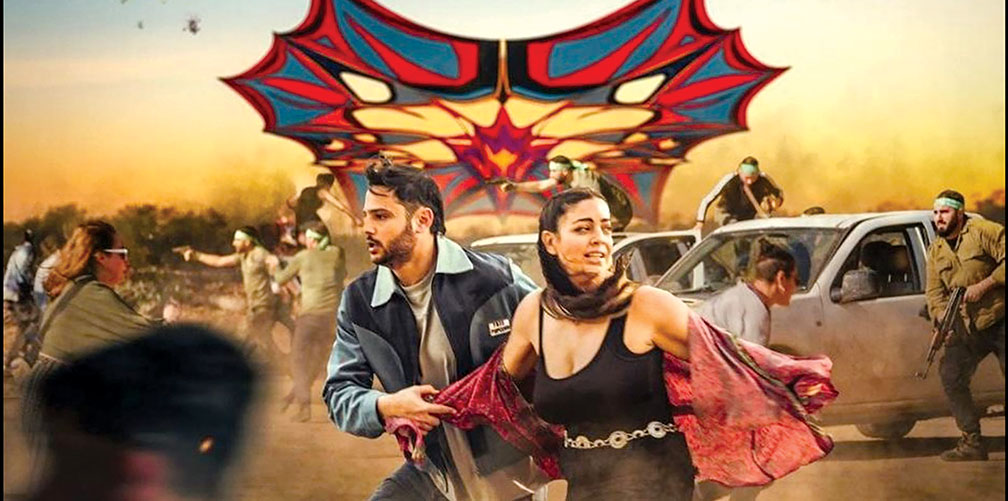
The 80-minute film tells the stories of festivalgoers at the Nova music festival and families trapped in their homes near the Gaza border.  The film opens with a chilling phone call: a little girl reaches out to her mother, terrified, as she tells her that Hamas has just killed her father and brother. The mother tries to comfort her while hiding in their home, setting the tone for the fear and chaos that unfolds throughout the day.

At 6:29 a.m., the massacre at the Nova music festival begins. Among the festivalgoers are a young couple dancing in celebration of their recent engagement, a married couple sharing the news of an unexpected pregnancy, and another couple going about their morning in a nearby kibbutz. Suddenly, alarm bells ring as a massive barrage of rockets is launched from the Gaza border. As people scramble for shelter, a group of Hamas terrorists breaches the festival, targeting anyone attempting to flee and gunning down those who remain.

The terror extends beyond the festival. Another group of terrorists moves into the nearby kibbutz, going from home to home, dragging residents into the streets before executing them. Meanwhile, the film also follows one of the Hamas leaders as he trains his son, teaching him to embrace violence and seize the spoils of war, illustrating how the cycle of terror is passed down.

In one particularly harrowing sequence, the film depicts a young Israeli woman who is attacked and raped by a terrorist before being stabbed. Mortally wounded, she manages to reach the terrorist’s pistol and shoots him. The rape itself is not shown visually, but the sounds and context are disturbing enough to convey the horror of the act.

“Some people say it’s not graphic enough,” Abeckaser said. “Everyone has their own opinion. Listen, I didn’t go into politics or anything like that. I wanted to show what happened on that day and what they did. That was the goal — to start a conversation. So someone in middle America might watch it and say, ‘I didn’t realize what happened exactly. I thought it was a war between the people of Israel and the people of Palestine.’ Some people refuse to understand what really happened. I wanted to educate the world about it.”

Abeckaser was born in Israel and has lived in Brooklyn since he was nine years old. He was a club promoter and later a nightclub owner before becoming an actor, appearing in films such as “Alpha Dog,” “You Don’t Mess With the Zohan,” “Holy Rollers,” “The Wolf of Wall Street” and “The Irishman.”

The Israeli American director married his Israeli wife, May Almakaies, in May 2022 at Soho House in Israel. Many local and international celebrities attended the wedding, including Leonardo DiCaprio and singer Omer Adam. The couple reside in Los Angeles with their children. 

Recently, Abeckaser released his crime drama “The Perfect Gamble,” in which he stars alongside David Arquette and Danielle Pick Tarantino.

Over the past 10 years Abeckaser has released seven films. “The truth is, I didn’t want to make this one,” he admitted. “My films are usually very different, although 90% are based on real stories like this one. It’s not easy to watch. However, I was approached a few times about it and felt it was important for the world to see and understand what happened that day.”

The film is available to buy or rent on Apple TV, Amazon, Dish and pay-per-view platforms.

Danny A. Abeckaser Brings Oct. 7 to the Screen in ‘12 Hours in October’ Read More »