The Intense Psychology of Israeli Protection Dogs and Their Trainers
With the rise in violence against Jewish communities around the world, an Israel-based company is seeing an increased demand for their security products — protection dogs. Israel Protection K9 co-founder, Eli Bobroff took The Journal on a walk and demonstrated what exactly that means.
I met up with Bobroff and his Belgian Malinois Raja in Pan Pacific Park just before 7:00 a.m. Even at that early hour, there were plenty of distractions that would rattle even the best behaved family dogs: joggers, off-leash dogs playing fetch, and the screeching, drilling and hammering noises coming from the Holocaust Museum Los Angeles’ ongoing renovation.
Bobroff has a masterful grasp of dog psychology. To watch him work with Raja is akin to watching the last two minutes of an episode of “The Dog Whisperer” when the dog is perfectly trained and the owner has all the answers. Raja is a four-legged domestic force field. One conversation with Bobroff was enough to outline an entire documentary series about elite protection canines.
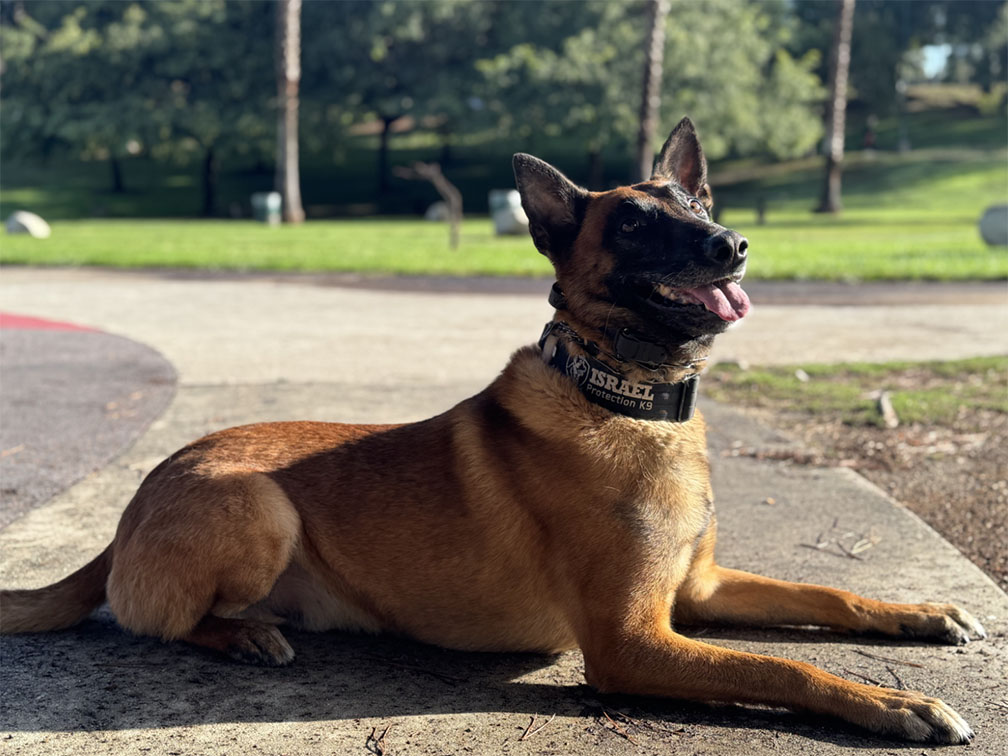
Raja is 7 years-old and weighs 75 pounds, with a thick light brown coat, and pointy black-outlined ears. Raja walks towards me in the parking lot, confident posture even with a hockey mask-like muzzle over his snout. Bobroff warns me in a calm voice to not make any big gestures toward him — it’s a simple way to convey to Raja that I am to be trusted. Raja keeps firm eye contact with me.
“Some dogs are very eager to please, and Raja is very in touch with me,” Bobroff said. “Handling him is much easier because he’s already trying to do the commands before I even give them.” We walked around the sidewalk of the park, Raja at complete attention.
Other dogs passed by, some barking at one another, and some playing in the wet grass.
“His restraint with other dogs is off the charts,” Bobroff said. Bobroff raised his hand and told Raja a short command in Hebrew. He walks with us like a furry soldier. His owner eschews the guard dog characterization — Raja is a protection dog, not a guard dog. This dog, and few others like him, are exceptionally trained at their four acre facility outside of Jerusalem. Israel Protection K9 is a white-glove service but with a catch — they only do business with qualified, vetted clients. And that’s with a client base that is already limited; dogs like Raja can cost over $100,000 each. The check clearing is far from enough.
Petting Raja felt like petting any other family dog, but much more muscular. Raja’s chest and ribcage felt engineered. Every part of him seemed to serve a clear purpose.
Beyond what kind of person buys these protection dogs, what kind of person trains them? Bobroff’s earliest dog memories were around age five or six, growing up in Los Angeles with a golden retriever on his neighborhood block. His mother’s allergies kept them from owning one themselves. Still, Bobroff always identified as an animal lover.
Bobroff got married at age 19, and he and his wife moved to Israel, where he would work in healthcare. He admits that he has an appetite for intensity; he’s into black diamond snowboarding and skydiving. When he learned about Israel Defense Forces veterans training protection dogs with off-the-charts intellect and strength, he knew he wanted one. But Bobroff couldn’t afford it, so he and his wife bought a white German shepherd, which he trained himself. He learned how to train these dogs under the tutelage of Arik Deri, who Bobroff describes as “one of one — the best dog trainer in Israel. Their work grew into a partnership and they then formed the Israel Protection K9 company. Bobroff and his family returned to Los Angeles, and since then, the company’s inventory has grown to over 50 dogs. And their standards are as high as can be.
The training of the dogs from Israel Protection K9 begins before they’re even born.
“We choose the male and the female specifically to create a certain outcome to balance it, with very specific bloodlines,” he said. At most, they’re enlisting only one or two puppies from any given litter to go through the training program. Like Navy SEAL training, there’s a significant failure rate, only a few get the protection dog distinction.
“You can’t control nature and you don’t know throughout a year and a half how it’ll go with this intensive training process,” he said. The puppies who make it through the program show early signs of capability. Their rapid development from puppy to bona fide trainee goes quickly from “zero training to level 100.”
He explained that the company is in a sense, “engineering the dog,” and the earlier you do this with a dog, the better. A misconception about the protection dog industry is that the dogs are unhinged killers who live by no rules.
View this post on Instagram
“You hear ‘protection dog’ and you picture [Hercules the Beast] from the film, ‘The Sandlot,’” he said. On screen, Hercules was a furious English mastiff that intimidated the entire town.
Not Raja.
At close range, Raja’s obedience and responsiveness show just how much of a well-calibrated tool he is.
“Look, he’s a weapon first, but he’s also a regular dog,” Bobroff said. When given the exact command — words and inflection that Bobroff doesn’t play around with — Raja can bite a target’s flesh down to their bone in 20 seconds. Not just reach, but crush the bone. Without the muzzle, Raja’s jaw muscles feel different, as if furry dog jowls could have toned biceps.
As the morning wears on, Pan Pacific Park starts to get slightly busier: parents pushing strollers, more dogs off leash doing their random friendly wrestling matches. Raja has no interest. He has a Kobe Bryant-like focus. Using a yellow rubber ball attached to a rope, Bobroff has Raja demonstrate just how high and far he can jump from a sitting posture—about four and a half feet high, and a broad distance of at least 9 feet.
“I could give him a command and he’ll clear this whole area and anyone he finds [to be a particular threat], he’ll take them out,” Bobroff said. No one else can activate Raja. Not a stranger, not even someone shouting the right commands in perfect Hebrew. Raja will just stare at you.
“You can’t steal this car and drive it,” Bobroff said. When asked if Bobroff says a particular word that sounds like an attack command, Raja is trained to the point that only with the correct nuances, will Raja treat it like a actualcommand.
“He might pick up that before I give a certain command, I may lift my lips a certain way or something like that, a cue that I’m giving subconsciously,” he said.
Raja is far beyond impressive. But who really needs a dog like this when there are plenty of conventional means of self-defense and protection?
“People come for many random reasons, stalkers, threats, and they also want them to be a family dog, and of course, there’s the dogs’ connection to Israel,” he said. Price becomes a secondary question for those focused on safety. Bobroff compares the six-figure price of a protection dog to that price of state-of-the art electronic civilian home security systems.
“The alarm doesn’t even do anything, there’s still a probably six, seven minute [law enforcement] response time,” he said. Dogs like Raja are ready to protect their protectees in an instant.
Prospective owners are put through a thorough background check, with many red flags — including if someone appears too enthusiastic about the dog’s killing power —that result in automatic disqualification.
Even when a client-dog match proceeds, as with any weapon, responsibility remains paramount. With unprecedented violence targeting the Jewish community, many are considering outside-the-box solutions to protection. Some of those come to Israel Protection K9 to see if dogs like Raja are an appropriate fit.
By the end of our walk, Bobroff said that his family has been fortunate to not have to engage Raja’s capabilities to the fullest extent.
But the very next morning, Bobroff called me to share the story of a close call the night before. He and his family were walking on a sidewalk in midtown Los Angeles when a hostile transient began following them at a close distance. The family, along with Raja, crossed the street, and the belligerent did too. Bobroff told his wife to walk ahead with the children. Raja was as ready as always. When the agitator moved closer, Bobroff warned him, “if you come any closer, my dog will attack you.”
The transient took one look at the dog, decided it wasn’t worth it and left them alone.
View this post on Instagram
Israel Protection K9 clients hope their dogs are a deterrent their clients never need to deploy. Like any family dog, the majority of Raja’s time is spent being a cuddly big brother to his two young human siblings.
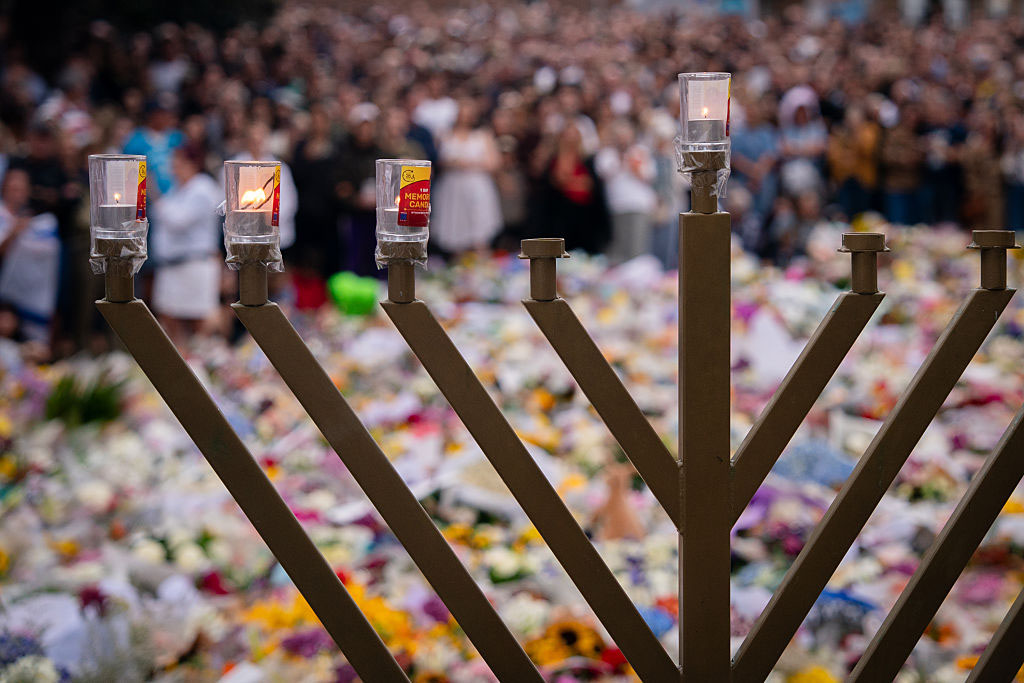
“Our dogs are more stable than the average dog,” Bobroff said. “Raja cuddles with my kids every single morning.” It’s a welcome daily respite for both Bobroff and Raja, especially since the threats don’t seem to be waning. Bobroff spoke with The Journal two days after the Dec. 14 Hanukkah attack that left 15 dead in Bondi Beach near Sydney, Australia. In those 48 hours, Israel Protection K9 received an uptick in calls from potential new clients.
“Since Oct. 7 and now again after the Bondi attack, Jews around the world are reassessing what real security means for their families and communities,” Bobroff said. “Beyond targeted threats, people are also factoring in everyday concerns like home invasions and break-ins. When people realize a properly-trained protection dog provides roughly a decade of dependable protection, and that a full-time human guard can easily cost over $100,000 per year, it reframes the conversation. For many families, it becomes a practical and rational security decision.”
The Intense Psychology of Israeli Protection Dogs and Their Trainers Read More »




 A primetime and children’s Emmy award-winner, Stanford, who produced content for the Jim Henson Company for more than 30 years, served as an EP on celebrated kid’s programs such as “Fraggle Rock: Back to the Rock,” “The Dark Crystal: Age of Resistance” and “Harriet the Spy.