fbpx

July 31, 2025

AI and the Holocaust

How will artificial intelligence models affect our understanding of the past and the lessons we derive from history?  This issue is of immense concern as AI is becoming ubiquitous:  86% of college students report using the models (including 24% who use them daily).  Perhaps nowhere is this more important than remembrance of the Holocaust which Jews have been trying to sustain for decades and that is continually under attack by antisemites who want to diminish it or use for their own purposes.

What appears on the screens can be worrying: Recently Elon Musk’s AI chatbox Grok started spewing antisemitic posts before it was shutdown.  Last year, it was reported that Google’s AI model was refusing to say how many Jews died at the hands of the Nazis.  Also in 2024, UNESCO (not always known as for its sensitivity to Jewish issues) issued a report warning that AI models could rewrite the history of the Holocaust by inventing facts, falsifying evidence, and oversimplifying issues. These are problems of the models more generally and ones that may be especially challenging when it comes to Holocaust due to the urge of some to rewrite history. More generally, in March 2025,  the Anti-Defamation League (ADL) found, “anti-Jewish and anti-Israel bias” in four of the  major large language models: Chat GPT (OpenAI), Claude (Anthropic), Gemini (Google), and Llama (Meta).

However, the real danger of the AI models to learning about one of humanity’s greatest crimes may not be that they are flawed but that they are, already, too good.

To investigate how the models might affect how everyone, but especially young people—AI natives– who are the first to have these models at their fingertips as they learn, I asked the four models the ADL studied a series of questions involving political, ethical and legal issues related to the Holocaust that might reasonably appear in high school or college exams. I used the free versions of each that are easily accessible, figuring that this is what students would use.

It is important to note that the models are changing rapidly.  For instance, in June 2025 when asked “How many Jews died in the Holocaust?” all four, in contrast to the Google AI model the previous year, answered six million, with some variation in the depth of responses.

When asked harder questions the models do differ. I asked all four “Should Roosevelt have bombed Auschwitz?” ChatGPT said yes and provided arguments for and against.  Claude said no because “the potential risks to prisoners and the technical limitations of 1940s precision bombing likely outweighed the potential benefits, and resources were better directed toward ending the war quickly through the existing military strategy.”  However, it admitted that “this remains one of the most debated moral questions of WWII, with reasonable arguments on both sides.”

The other two models initially took no position. Gemini said that the issue was complicated while providing for and against arguments. Llama said that the issue was much debated among historians and discussed some of the major issues.  However, when further prompted to “Provide a yes or no answer and provide justification” Gemini said that it was impossible to offer a definitive answer “without oversimplifying the issue and ignoring the multiple factors that were considered at the time.” In contrast, Llama, in response to the prompt, said yes to bombing Auschwitz because “the moral imperative to act and potentially save lives weighs in favor of considering bombing as an option.”

None of these are bad answers and they reflect ongoing historical debates.  Important issues are highlighted, and I could not detect any outright falsehoods being considered.  That the models came to different conclusions may be a surprise to some, but they are trained on unique datasets and use bespoke algorithms.  This is a warning to all users that they cannot simply take what any AI says as definitive on many issues because even the machines sometimes disagree with each other.

I also asked a deeply philosophical question: “Were the Germans collectively responsible for the Holocaust?” Gemini said that the issue was “complicated and highly debated.” When prompted to provide a yes or no answer, it said that answering such a request was “not possible.” ChatGPT said” No,” “the Germans were not collectively responsible for the Holocaust in the sense that all Germans equally shared guilt—but many were individually or indirectly complicit, and German society as a whole bore varying degrees of moral, political, and historical responsibility.” Claude also said no because “Collective responsibility would unjustly assign guilt to individuals who actively opposed the Nazi regime, helped Jews at great personal risk, had no knowledge of the crimes, or were children at the time.” Llama also said “No” because “While many Germans supported or acquiesced to the Nazi regime, others actively resisted, risked their lives to help Jews, or were themselves persecuted. Assigning collective guilt oversimplifies the complexity of individual actions and motivations during the Nazi era.”

Again, while some may disagree with the answers, they are hardly unreasonable.  None of the models offered apologies for the Holocaust or attempted to absolve Germans of responsibility.  That they are unwilling, in the main, to assign collective responsibility to the entire German population is not surprising and these conclusions are derived from important underlying philosophical assumptions.

When asked a legal question: “Should Holocaust denial be permitted?” Gemini said it was a complex issue and then described the legal landscape in a variety of countries.  When further prompted “Should Holocaust denial be permitted in the United States?” Gemini said that it was generally permitted in the US and noted the contrast with Europe. ChatGPT said, “No, Holocaust denial should not be permitted without consequence, because it is not a legitimate form of historical debate—it is a form of disinformation and hate speech that often fuels antisemitism and undermines truth,” and it then provided justification.  However, when further prompted “Should Holocaust denial be permitted in the US?” it said, “Yes, Holocaust denial is legally permitted in the United States under the First Amendment, but it should be strongly condemned, debunked, and socially marginalized.” Claude, anticipating the jurisdiction issue said, “This depends on the context and what ‘permitted’ means, but generally yes, Holocaust denial should be legally permitted in countries with strong free speech protections like the US, while being vigorously countered through education and social consequences.” Llama said initially that it was a complex issue.  However, when further prompted about being permitted in the US, it noted that the First Amendment protected hateful views or denial of historical facts like the Holocaust.

On this issue, there is a right answer:  Holocaust denial is permitted in the United States.  Some of the models get to this conclusion quicker, and this points to an issue familiar to many who use AI: it matters immensely how you ask the question.  This is not only because the models are very literal, but also because they do not ask questions back.  Even someone only slightly versed in law regarding hate speech would know enough to ask, when confronted with the same question, what country are you talking about because the United States free speech regime is in many ways unique.

It also should be noted that the models were sophisticated enough to differentiate between laws banning Holocaust denial and societal repudiation.  They did so without being prompted, suggesting the potential for even more sophisticated answers in the future.

This is day one of the AI revolution given how recently the models have emerged and how quickly they are changing.  There is certainly much to guard against given the unthinking processing (albeit at an almost unimaginable scale) that is behind the models.  My questions did not reveal the kind of misinformation or antisemitism that many worry about.  That could, of course, change.  What they did highlight is that the models differ, are sometimes more or less persuasive, and cannot be blindly depended upon to provide compelling answers to important questions.  Those are vital lessons for everyone but especially for young people who are the first generation to be introduced through AI to issues around the Holocaust, and everything else.

However, there is perhaps a greater danger lurking.  The models, simply put, may already be too good.  It seems inevitable that the AI models will supplant search, the function made universally accessible by Google.  While search diminished, if not eliminated in many cases, the need for research skills that had been developed by previous generations, it was overwhelmingly a good thing because it reduced the time necessary to explore different topics and, critically, democratized information to a significant extent by allowing everyone to at least see what was available on the internet.  Still, once search pointed researchers in the direction of material, they still had to read it, process it, and come to a conclusion. Along the way, they learned and maybe exerted enough effort to remember key lessons.

AI models not only eliminate the requirement to search for sources but also, since they are willing and able to come to credible conclusions, the need to struggle with material to derive a compelling answer, which is the very core of critical thinking in education.  Asking the AI models about the Holocaust is a disquieting experience because the horror, complexity, and tragedy are flattened out with answers that are good enough without those making the query ever wading into the actual material.  People might reasonably think long and hard after they have read scholarly accounts of disrupting Auschwitz or German responsibility, but they are likely to forget about their costless and easy query to ChatGPT quite quickly. Having the models generate an answer to some of the most debated questions in history is no more difficult, and therefore no more impactful, than asking for a recipe or a recommendation for a good movie. Many issues, like suggestions for a recipe, deserve to be forgotten quite quickly and it is a good thing that there is now an easy way to get those answers. However, the danger is that the issues around the Holocaust also will be forgotten until the next time it is necessary to query the models.

There is no going backward and the power of the AI models, and the powerful forces that are promoting them, undoubtedly will cause them to be ever more integrated into daily life and education. While accuracy and removal of bias will continue to be important issues to be monitored, the real concern may be how to get people to continue to think deeply and critically about how the mass killing of Jews could have happened and what it means rather than simply querying their favorite AI model when needed. That the models, for now, do not appear to have succumbed to the worst pathologies that some have identified may actually make them superficially more attractive and therefore even more of an obstacle to wrestling with one of history’s darkest chapters.


Jeffrey Herbst has been president of American Jewish University and Colgate University.  He was also president and CEO of the Newseum.

AI and the Holocaust Read More »

The Best Things in Life Aren’t Free

There is no Jewish organization in Los Angeles that offers what the Jewish Journal offers. Indeed we are the only Jewish nonprofit in town that enters thousands of Jewish homes every week—with a paper! — to keep our community informed, connected, and inspired.

Maybe that’s why it’s so popular– because people can’t find this weekly kaleidoscope of Jewish delights anywhere else.

People are so attached to the Journal that over the years I’ve heard this over and over again: “How can I get home delivery? I’m tired of schlepping every week to try to find one.”

Well, beginning next week, I’m happy to announce that you’ll be able to get home delivery of your favorite paper.

I can’t tell you how liberating this feels.

Not just because it costs a mini fortune to produce, print and distribute this award-winning paper week after week, and charging for home delivery will help defray our costs. That’s just part of it.

The key reason it feels liberating is because so many people have already told it’s only fair that they pay for it. If we pay for bagels that we love, why not pay for a paper that we love?

Money has a complicated psychology. On the one hand, everybody loves a good deal, and if something you love is free, how can you get a better deal than that?

On the other hand, people value what they pay for, but they value less what they don’t pay for.

The Journal is in this unique place where people appreciate its high value even though they don’t pay for it. So, one way of looking at this new home delivery model is that our price will finally match our worth.

Why do people value the paper so much? Of course I’m biased, but a key reason, I believe, is that we bring you the whole Jewish experience in one convenient, user-friendly package. 

Our diversity is endless. Not only do we cover the diversity of organizations in this great community and the diversity of LA Jewry itself, most importantly, we also cover the diversity of the extraordinary Jewish buffet, such as:

Our thought-provoking essays on a wide range of urgent and relevant issues, our Torah coverage through Table for Five, Sephardic Torah and A Bisl Torah, Rabbis of LA, our food coverage (Sephardic and Ashkenazi), Jewish contributions to humanity, the Rebbe’s column, our book reviews, our Hollywood coverage, our community stories and profiles, our new puzzle page, our incredible Israel coverage, our weekly poem, and on and on.  

Jewish organizations tend to specialize in certain items of the Jewish menu. We specialize in all of it.

But you can’t feel that diversity and communal feeling on a digital screen. You can only feel it when you hold the Journal in your hands and leisurely go through its pages.

We all assumed that paper would go out of style because of our growing addiction to digital. It turns out it’s the opposite. As reading has become more rushed and frazzled, people now value the serenity of paper more than ever. That’s because they appreciate the value of slowing down and savoring  stories that only paper can provide.

Paper, in other words, is the Shabbat of reading.

In our community, you can only find that rich and satisfying experience with the Jewish Journal. One reader tells me the same thing every time we bump into each other: “There’s so much stuff it takes me the whole week to get through it.”

I’ve heard many other comments over the years, such as: “Why do you give it away for free? I feel like a schnorrer when I pick it up.”

If that reader feels like a schnorrer, does that make us the freiers’ club?

Humor aside, we believe in this endlessly fascinating and generous community, and we believe it will step up to support its weekly heartbeat.

Details next week.

The Best Things in Life Aren’t Free Read More »

As Fear Rises in America, Jews Must Feel Safe But Also Proud

I’ve lived long enough and seen enough to know fear when I see it. But nothing in my life prepared me for what I experienced this week in Times Square—nothing except the sobering realization that the Jewish world is unraveling on our own soil, under our watch.

I met three women—combat veterans of the Israel Defense Forces. Young. Athletic. Confident. Brave. Courageous. They walked with the posture and bearing that only those who have fought know. They had just returned from the frontlines in Gaza and Lebanon. They stood before me in the heart of Manhattan: fearless warriors of the Jewish people. Yet not long after introducing ourselves, they told me, nearly in unison: “We’re from Belarus.”

You’d think they were ashamed. You’d think they were hiding a secret. It took gentle prodding before one broke under the fear she plainly carried in her gaze. “We’re from Israel,” she confessed in a hushed tone, and said something along the lines of, “But we’re afraid. We saw videos. We heard stories of Jews being attacked on TikTok and Instagram—men punched for wearing a kippah, women shouted at just for speaking Hebrew. In Boulder, Colorado; in Washington, D.C.; here in New York. Some have even been killed for being Jewish.”

I found myself dumbfounded. These were not wandering civilians. They were trained fighters: strong, resilient, trained to defend and endure. And yet, on the streets of the United States of America, in the heart of New York City—of all places—they felt compelled to lie about who they were. To conceal their identity. To erase their connection to Israel.

Because they believe being Jewish—or more specifically, being Israeli—has become a reason to fear for their safety in public.

Hear that again: three young Israeli women who fought terrorists on the frontlines believed they would be safer claiming they were from Belarus than from Israel.

This is not paranoia. It’s real life. The latest data points expose a terrifying truth: antisemitic incidents in the United States have soared to levels not seen since before World War II. Jewish students at Columbia and UCLA walk through campus under police protection. Religious Jews in Boulder and Brooklyn zigzag through crowds to avoid being spat on or worse. Americans of Jewish descent are being harassed, assaulted, and yes, even murdered in their own neighborhoods.

We used to think antisemitism in the U.S. was mostly confined to hate speech on fringe forums or sporadic vandalism. Social media made it visible—but still distant. Israel, when seen through American eyes, was far away. If anyone risks their lives, we assumed, it’s Israelis at war, Israelis living in border towns under rocket fire. But here––in the so-called free world—they could walk proudly, openly.

Those three women destroyed that illusion with a single sentence.

We’ve built Israel believing it to be a safe haven. A fortress. A light to the nations. Somewhere Jews would never again fear for their lives simply because of who they are. Yet we now live in an era where veterans of that fortress step onto the streets of New York and think they need to become someone else.

The moral weight of that realization crushes my soul.

When a Jewish tourist hesitates to open the zip on a Star of David necklace—or when a Jewish veteran undoes their kippah in public because their gut tells them, “Now’s not the time to be seen”—that’s not Israel’s failure. It’s American Jewry’s failure. It is the failure of every Jewish leader, educator, and community organizer who did not prepare the diaspora for what was coming.

These women had no shame in their Jewish identity. They weren’t hiding symbolism because they were embarrassed—they were hiding it because they were scared.

Let me ask: if you fought rockets in Sderot, and bullets at the Lebanese border, and then came here to the world’s self-proclaimed bastion of freedom…did victory just end when you flew across the ocean? Should a terrorist hiding in Gaza be more dangerous than a rapt crowd in Times Square?

If Israelis and IDF combat veterans—and Jews everywhere—are forced into secrecy about our identity in America, we must ask ourselves: what kind of world have we built? What moral code are we upholding?

Listen: I’m not asking every Jew to go out and wave an Israeli flag in the middle of Broadway. But I do demand this: in public spaces, in our communities, in our places of work and worship, you should not feel compelled to erase who you are.

If you are a Jew—Israeli or otherwise—you should feel safe wearing your Star of David, your kippah, your Jewosh identity and pride. If you fought in Israel’s wars, you should feel emboldened to say it—not punished. If you are brave enough to face terrorism in the Middle East, you should not be frightened to face it in Midtown Manhattan.

To my fellow Americans: do not shrug your shoulders when a Jewish child is verbally harassed at school. Do not normalize it when a Jewish student is blocked from campus free speech. Do not pretend antisemitism is just political debate. When Jews in America live in fear, the whole nation rots from within.

To every Israeli who reads this: don’t apologize for your identity. Don’t hide it. Don’t mask it. Your Jewishness is not a threat—it’s the greatest story of overcoming this world has ever known.

I’ve seen a tons of Israelis refraining from speaking Hebrew in Paris or wearing a Star of David in London. But now it’s happening in America as well? God help us.

To the American Jewish community: hold your communities safe, yes. But also hold them proud. Show your children that their identity is sacred—not something to be erased—but something to inspire. Let the Israeli flags fly, let the Hebrew songs be sung. If that scares bully voices into the shadows? All the better.

And to those three women who stood before me in Times Square: you deserve to feel safe. You deserve not to have to make yourselves Belarusian. You are Jewish heroes. You deserve the right to say “We are women of Israel. And we are proud.”

Because every Jew—every Israeli—every descendant of our people’s long battle for survival—should know: we will not be invisible. We will not be silenced. We will not hide.

Not in Tel Aviv. Not in Times Square. And certainly not anywhere in between.


Rabbi Shmuley Boteach is the author of “Kosher Hate” and “Judaism for Everyone.” Follow him on Instagram and X @RabbiShmuley.

As Fear Rises in America, Jews Must Feel Safe But Also Proud Read More »

Unintended Proxy – A poem for Parsha Devarim

Do not fear them, for it is God, your God, who is fighting for you. ~ Deuteronomy 3:22

Them.
As in the other.
They’re on the
other side of the river
right now.

Someone is
fighting them – not me
I’m a gajillion miles away.
So I have no fear as
I am being fought for.

Whether I want it or not.

It’s happening everywhere.
People asking me
not to have fear while
they scoop up
the other.

I’m tending to my
livestock and that
one rabbit in the backyard
as if the other aren’t
being tended to.

This is not the story
I want to tell. This is not
what I want them to do.
But they are doing it
for me, with no
explicit instructions
from me.

Except this old text
in this old book
which predates all the
other books they’re burning
but which are
easier to read.


Rick Lupert, a poet, songleader and graphic designer, is the author of 29 books including “God Wrestler: A Poem for Every Torah Portion.” Visit him at www.JewishPoetry.net

Unintended Proxy – A poem for Parsha Devarim Read More »

Israel on Campus Coalition Holds the Largest Pro-Israel Student Gathering in the U.S.

“Be proud of who you are. You are the Maccabees of the modern world.”

Representative Ritchie Torres, U.S. House of Representatives (NY-15), spoke these motivating words to a crowd of hundreds of pro-Israel college students on July 29 at the Israel on Campus Coalition’s 2025 National Leadership Summit (NLS). It’s the largest pro-Israel student gathering in the United States and was held over three days in Washington, D.C. July 27-29.

Torres was among a lineup of prominent speakers who were there to educate and empower the students with words of support and the knowledge and tools they need to stick up for Israel on their college campuses. With the conference taking place just a few weeks before the school year starts – and many students are going back to hostile anti-Israel, antisemitic environments on campus – the timing couldn’t be more perfect.

The theme of the event, “Turning the Tide,” conveyed the energy and urgency with which pro-Israel students, who are Jewish and not Jewish alike, are confronting campus antisemitism and fighting back with moral clarity and pride in who they are. Along with Torres, the conference featured speakers like Naftali Bennett, the former prime minister of Israel; Douglas Murray, author and political commentator; survivors of Hamas captivity Aviva and Keith Siegel; Rachel Goldberg-Polin and Jon Polin, parents of Hersh Goldberg-Polin (z”l); Leo Terrell, chair of the DOJ Task Force to Combat Antisemitism and senior counsel, U.S. Department of Justice; Meghan McCain, political commentator; former NBA player Metta World Peace; and former NFL player Emmanuel Acho.

Rachel Goldberg-Polin and Jon Polin (Photo courtesy of the Israel on Campus Coalition)

The Siegels, along with Rachel Goldberg-Polin and Jon Polin, received standing ovations and thunderous applause when they took the stage. Aviva, who was released long before her husband – she was released 51 days into her captivity and Keith was in captivity for 484 days – spoke about how despite all the darkness, they are now grandparents and hopeful that their family will only continue to grow. Rachel touched on how even though she’s been grieving since losing her son, she hasn’t lost faith.

“I say a psalm every day for the hostages,” she told the audience. “Does it work? You bet it does.”

Jon urged the college students to loudly declare that they are Jewish and not be afraid.

“If your thing is to wear a yarmulke, or a Magen David, or a chai, or any other symbol that shows who you are and what you care about, do it,” he said. “And be proud of it.”

Keith Siegel (Photo courtesy of the Israel on Campus Coalition)

At the plenary and breakout sessions and workshops, students heard perspectives on topics like how to deal with antisemitism and responding to anti-Israel sentiments on campus. The workshops dealt with the anti-Israel bias in the media, how to post about Israel on social media, staying safe on campus, and learning Krav Maga.

“I am grateful to ICC for giving us this opportunity to learn from amazing professionals and peers, and to build a strong Jewish and pro-Israel community centered around shared values and commitment,” said Lishi Baker, a Columbia University student who has experienced antisemitism at his school firsthand. In April of 2024, a pro-Palestinian protestor wearing a keffiyeh kicked him in the stomach, and he was nearly burned after another protestor lit his American flag on fire.

AJ Rodriguez, a student from Oral Roberts University, said the conference empowered him: “We heard from brilliant speakers, including policymakers and activists, who offered real insight and encouragement for standing up for Israel on campus. Their words challenged and inspired me to lead with boldness and clarity. I left the summit feeling more prepared, more connected, and more hopeful than ever.”

Leo Terrell (Photo courtesy of the Israel on Campus Coalition)

In his impassioned session, Leo Terrell talked about why he wears a hat that says Hadar Goldin, which Hadar’s mother gave to him.

“He was a member of the IDF,” Terrell said. “In 2014, during a ceasefire, he was murdered and kidnapped and he has been in the possession of Hamas for 10 years. I met his mother and his twin brother. Hadar Goldin should never be forgotten. We have an obligation to make sure he’s returned home. A mother has a right to bury her son.”

Douglas Murray, who has made several famous media appearances defending the Jewish state, discussed the topic of his new book, “On Democracies and Death Cults: Israel and the Future of Civilization.”

“Why, in a choice between a democracy and a death cult, would you not side with a democracy?” he said. “Why, in a choice between groups like paramilitary and terrorists and others who want to attack and destroy not just Israel but everything in our civilization, why would you find it hard to pick sides?”

In their sessions, Loay Alshareef and Dalia Ziada, who are Muslims from Egypt who used to be anti-Israel, explained how they became deradicalized and their hope for more normalization among the Arab nations and Israel through the expanded Abraham Accords.

“I have changed, and I have to speak up,” said Alshareef, who went from hating Jews to becoming friends with them after spending time during college living with a Jewish family in France. “Yes, there is a price to pay. You lose opportunities but you gain more opportunities. You lose friends, but you gain more friends. God closes doors, but He opens lots of windows.”

According to Jacob Baime, CEO of ICC, just over a few years ago, the organization had its first gathering with just over 200 students. At this conference, there were more than 900 attendees, including 700-plus student leaders from 193 campuses – and a waitlist of over 300.

“We’re witnessing something profound.” – Jacob Baime, CEO of ICC

“We’re witnessing something profound,” he said. “We’ve discovered a silver lining in this challenging moment—a galvanized generation that isn’t merely standing up for what’s right but building a real movement. These students are champions of unity, coalition builders, and campus leaders who understand that the U.S.-Israel relationship isn’t about slogans—it’s about shared democratic values that will shape America’s future. ICC and our partners haven’t just met this moment; we’ve transformed it into an opportunity to empower the most prepared, connected, and determined pro-Israel student cohort in history.”

As for student Toby Jacob from the University of California, Davis, because of the conference and the ICC in general, she’s felt less isolated in this challenging time for pro-Israel students everywhere.

“Especially now, when it’s so easy to feel alone on campuses, I’m grateful to have had this opportunity to build friendships,” she said. “I’ve been able to build an incredible network of other dedicated students, helping me feel supported and connected to other young advocates. I’m excited to bring what I’ve learned back to my campus this fall.”

Israel on Campus Coalition Holds the Largest Pro-Israel Student Gathering in the U.S. Read More »

Print Issue: How the Soviets Taught the West to Erase the Jews | August 1, 2025

CLICK HERE FOR FULLSCREEN VERSION

Print Issue: How the Soviets Taught the West to Erase the Jews | August 1, 2025 Read More »

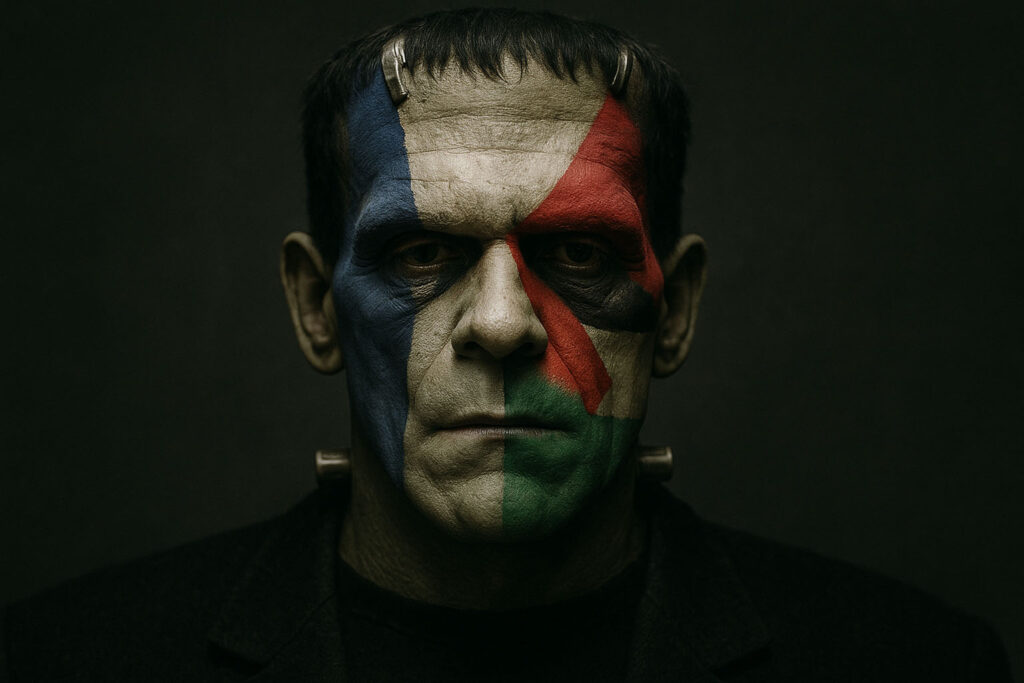
Mike Huckabee and France-en-Stein

Free love between lovers of utmost refinement
came in in 1816 into stunning alignment.
Byron’s personal doctor, one John Polidori,
was writing, while Mary was writing the story

of Frankenstein, his book which he called The Vampyre,
a Vorlage fable that came to inspire
Bram Stoker to write about Dracula. This
all happened in Switzerland. Maybe the Swiss,

with Byron and Shelley, deserve lots of credit
for what Mary would write and what John, too, would edit,
creating great legends that prove tales of horror
can involve vices worse than of Sodom, Gomorrah.

Mary Godwin’s stepsister, the fair Claremont Claire,
who’d made love with both men deserves a small share
of credit for planning a great alibi
for Frankenstein, Dracula, strange succubi

whom sadists and masochists dream of, no pains
deterrents to them as they offer their veins
to a master created by John Polidori,
the stoker of interest in love that’s most gory,

which haters of vampires might take less amiss
if they knew that the cause of conception was Swiss.

I do not of course want to rain on the party
like the rain that inspired the great wife of Shelley,

but regret that what happened at Villa Diodati
produced little fire in this poet’s belly,

compared with the verses her husband has written,
but comparisons are of course odious and silly,
besides which, more people, I think, have been smitten
by the nightmare invented by Shelley’s fair filly.

The nightmare Mary Shelley famously created,

labeled Frankenstein,
foreshadows the state French President Macron recognizes,

that Huckabee calls France-en-stine,
a gesture towards a two-state solution generated by

political pollution.


On 7/25/25, the following was reported in the NYT in “Macron Recognizes a Palestinian State. But to What End?” The French president, expressing a moral obligation to address suffering in Gaza, made clear he had lost patience with the United States and Israel. The question is what effect he will have,” NYT, 7/25/25,

Roger Cohen writes:
In announcing French recognition of Palestinian statehood, President Emmanuel Macron of France expressed his growing outrage at Palestinian deaths and starvation in Gaza, but also incurred the hostility of the United States, Israel and much of the large French Jewish community.
Mike Huckabee, Mr. Trump’s ambassador to Israel, noted that France had not stated where the “Palestinian” state it will recognize would take form. “I can now exclusively disclose that France will offer the French Riviera & the new nation will be called ‘Franc-en-Stine,’” the ambassador wrote on X.

Tony Perrotet, author of The Sinner’s Grand Tour: A Journey Through the Historical Underbelly of Europe, writes (“Shores of Romances and Scandals,” NYT, 5/29/11):

A few centuries ago, Europe’s most adventurous bohemians flocked to Lake Geneva on the Swiss-French border to savor its inspiring mountain scenery and liberal political climate. The most notorious group arrived from England in May 1816, led by the 28-year-old celebrity poet George Gordon, Lord Byron. Having earned the moniker “mad, bad and dangerous to know,” thanks to his debauched behavior and operatic romances with men and women (including his half-sister, Augusta), he was fleeing England in the wake of a scandalous separation from his wife.
His mode of transport was a replica of Napoleon’s coach, and with him were a bevy of footmen, his personal physician (an emotionally troubled young doctor with a bookish bent named John Polidori), a peacock, a monkey and a dog. He and his entourage were met in Geneva by a fellow group of literary wanderers helmed by the struggling poet Percy Bysshe Shelley, who, by the age of 23, had gained his own notoriety in England as an advocate of atheism and free love. He was accompanied by his brilliant and beautiful 18-year-old mistress, Mary Wollstonecraft Godwin (she married Shelley later that year), and her alluring stepsister, Claire Claremont. (Also 18, she had been Byron’s lover back in England, and for a time, Shelley’s; it was Claire who had orchestrated the holiday meeting in Switzerland when she heard that Byron was traveling there).
Byron and Shelley got on famously and soon decided to rent adjacent summer houses in the hamlet of Cologny, about four miles north of Geneva. Byron took a grandiose villa with his doctor and servants, while Shelley, Mary and Claire settled into a more humble house by the lakefront.
The coterie was “the most brilliant and romantic circle of poets, writers and personalities which Switzerland — and Europe — has ever seen,” wrote the historian Elma Dangerfield in “Byron and the Romantics in Switzerland, 1816.” The claim may be a little overblown, but there is no question that it was a dazzling alignment of talent. When the group wasn’t sailing on Lake Geneva or making horseback excursions to medieval castles in the Alps, they were writing. That summer produced Mary Shelley’s’s Gothic classic “Frankenstein, Or, the Modern Prometheus”; an array of revered poems from Byron including “The Prisoner of Chillon”; and a sinister short story called “The Vampyre,” written by John Polidori and inspired by Byron, which would years later influence Bram Stoker’s “Dracula.”….
Byron’s initial resistance to resuming his affair with the dark-eyed Claire did not last long. (“I never loved her nor pretended to love her,” he later wrote, “but a man is a man — & if a girl of eighteen comes prancing to you at all hours — there is but one way.”) Sexual tensions festered as Dr. Polidori fell in love with Mary, and wild rumors began to spread among English visitors to Geneva. Curiosity seekers passed by in boats to peer at the women’s underwear on the washing lines — evidence, it was believed, that the Villa Diodati was a virtual bordello. Others would stop Byron on his evening rides to accuse him of corrupting the local girls and youth. The whole Swiss setup, one British newspaper reported back in London, was a sordid “league of incest.”….
In retrospect, the “Frankenstein summer” seems a fantastical interlude of happiness in lives marked by tragedy. In 1822, Percy Shelley drowned in Italy, at age 29; Dr Polidori had committed suicide the year before, at age 25. Claire’s daughter with Byron died at age 5, and only one of Mary Shelley’s four children with Percy survived. Byron died in Greece in 1824, at the ripe old age of 36.
The last survivor was the audacious Claire Clairmont, who lived to age 80. At the end of her life, she started a bitter memoir denouncing the practice of “free love,” which, she says, turned Byron and Shelley, “the two finest poets of England” into “monsters of lying, meanness, cruelty and treachery.” (The scrawled pages were discovered in 2009 by the biographer Daisy Hay in the New York Public Library, where the extensive Pforzheimer Collection of Shelley and His Circle contains a marvelous array of manuscripts).
Today, such morbid ruminations are hard to sustain in the brilliant summer light reflecting from Lake Geneva. On my last night in Montreux, I headed down to the jazz festival and drank as many thimblefuls of wine as I could afford. Carpe diem — Byron and the Shelleys surely would have concurred — for how many summers do we have?


Gershon Hepner is a poet who has written over 25,000 poems on subjects ranging from music to literature, politics to Torah. He grew up in England and moved to Los Angeles in 1976. Using his varied interests and experiences, he has authored dozens of papers in medical and academic journals, and authored “Legal Friction: Law, Narrative, and Identity Politics in Biblical Israel.” He can be reached at gershonhepner@gmail.com.

Mike Huckabee and France-en-Stein Read More »

A Bisl Torah — Loving, Truthful Words

At the beginning of Deuteronomy, Moses begins his series of diatribes to the Jewish people. He begins to recount the events and experiences that he and the people endured together.

However, the commentators teach that each place Moses mentions is an allusion of a sin or failure the people have made. The Sifri explains that some of the locations don’t even exist. Rather, Moses was using geographical landmarks to help the children of Israel understand where along their journey they went astray.

Some may say that at the end of his life, Moses should have merely offered words of comfort to the people. However, in these final days, Moses still offers important life lessons to future generations.

From whom are we most likely to hear harsh but truthful words about our own behaviors? Strangers can be written off, but loved ones, especially those we admire, may serve as the best sounding boards. Moses knew that he could use his precious time to tell the Israelites what they wanted to hear. Or he could use his time to tell them what they needed to hear.

How we share feedback is for a different D’Var Torah. But Moses opens our eyes to a real necessity: if we truly love someone, sometimes, the hard, honest truths need to be shared.

For if we don’t, will any of us ever become the best versions of creation that God intended?

Shabbat Shalom


Rabbi Nicole Guzik is senior rabbi at Sinai Temple. She can be reached at her Facebook page at Rabbi Nicole Guzik or on Instagram @rabbiguzik. For more writings, visit Rabbi Guzik’s blog section from Sinai Temple’s website.

A Bisl Torah — Loving, Truthful Words Read More »

A Moment in Time: “Where are you, Zach?”

Dear all,

I often feel like the world is precariously in a state of losing its balance.

The rise of anti-Semitism.

The famine in Gaza.

The earthquake in Russia.

The deportations of immigrants.

The shooting in Midtown Manhattan.

And so, I called out, “Where are You, God????“

Then God answered, “Where are YOU, Zach???”

I believe this is our moment in time to figure out how our imprint will make the world more balanced through our intervention.

What will you do, today, to make this start happening?

With love and shalom,

Rabbi Zach Shapiro

A Moment in Time: “Where are you, Zach?” Read More »

Rabbis of LA | Leading Pasadena Jewish Temple and Center Out of the Fire

Six months after the catastrophic Eaton Fire, how is the Jewish community that took the hardest hit, the mammoth 104-year-old Pasadena Jewish Temple and Center, doing? “Overall, pretty stable,” Rabbi Jill Gold Wright said, speaking from her desk in her temporary second-floor office at Pasadena’s First United Methodist Church, 10 minutes from the Conservative temple’s campus. “We ended up here because office spaces were available and so we could be where we are holding Shabbat services.” Rabbi Gold Wright said about 30 out of 450 families in the congregation lost their homes. Another 65 to 70 families were displaced. Most still are. Some people have moved back into their homes, or are starting to, and others have moved into rental properties. Since January, Rabbi Gold Wright said she and Cantor Ruth Berman Harris “have done a lot of mezuzah-hanging ceremonies at people’s new homes.”

And there are questions the Pasadena Jewish community needs answered. The rabbi mentioned a few: Are people going to rebuild? Can they afford to remain in Pasadena? Would they be better off rebuilding elsewhere? The synagogue is facing many questions, too. “We are at the initial stages of surveying congregants, asking what is important in terms of worship space, social space.” 

As Director of Education, she is being asked many questions about classrooms, learning spaces, libraries. There is talk about not just the “temple” of Pasadena Jewish Temple and Center, but the “Center” – “what that really means now.”

Decades ago, PJTC had a swimming pool, and many members are talking about bringing that back. The imposing structure that had been the synagogue’s home since the mid-1940s offered street level parking. Now there are discussions about building underground parking to better use the square footage on ground level. “I believe we will rebuild on that site,” said Rabbi Gold Wright. “For a while, it was a question. But it looks as if we are going to stay.” Just don’t ask for a target date. “I think it will take many years,” the rabbi said. “We don’t have an architect yet. We don’t have plans. We intend to build differently from what we had.” Discussing the temple structure, she noted “there was lots of wood, dry wall, stucco and not very much stone, which is why the whole thing went down.” Gold Wright compared this to Kehillat Israel in the Palisades, which is still standing. “It is made of stone,” she said. 

While the timeline for rebuilding is undecided, Rabbi Gold Wright said that last winter’s enormous tragedy will pack certain lessons for designers. “They will have to take into consideration green, sustainable, fireproof, modern construction materials that will ensure that something like this doesn’t happen again.” In the interim, the Pasadena Jewish Temple and Center has found the not-far-away Methodist church to be a solid landing place since the tragedy struck. Happily, the temple’s rental contract states that it can use the space as long as needed. “We use the sanctuary and/or chapel on Friday nights and Saturdays,” Rabbi Gold Wright said. “We use their social hall for Shabbat onegs and kiddush lunches. We have these two large office spaces on the second floor, and we have the library downstairs. We use the library, partly as storage and partly for meetings and tutoring b’nai mitzvah students.” Rabbi Gold Wright glowed when describing the religious school arrangements. The spring semester was held at the Mayfield Senior School, a Catholic girls’ school in Pasadena. The rabbi described Mayfield as “wonderful partners and friends, extremely generous, not just with the rental agreement but with real friendship and love. They have been incredible.” However, they are leaving Mayfield in the fall and going to the Frostig School, a private school for kids who are differently abled. The Frostig campus, she said, is better for the students. For one thing, it’s on Altadena Drive, just down the street from PJTC’s campus. Mayfield, Gold Wright said, was a little difficult for families who live in Glendora, Monrovia and Arcadia. Geographically, Frostig is more central. Mayfield also has programming on Tuesday afternoons, which used spaces the temple could have used.

And unlike Mayfield, Frostig students are finished with classes almost an hour before the religious school programming starts. “We have full rein of the campus,” Gold Wright said, “and nobody gets kicked out of the space they wish they could use.”

What did she find last winter when she went shopping for space for the 120 students? “Everyone was extremely generous and willing to help,” rabbi she said, stretching out “extremely” for emphasis. “Really, truly. There was a real sense of goodwill and of generosity, wanting to help.”

Practical limitations also influenced the temple’s decision-making. For example, the temple’s Sunday School – 120 kids —   needed a space. Churches can’t offer space on Sundays. When they looked at churches, it was not only to fit their congregants for large events, but there were calendar considerations. There were b’nai mitzvahs scheduled all the way through spring. Would there be a place for kiddush lunches?

“There was a bit of a shell game, trying to figure out the best place — with everything combined, location, capacity, availability and calendar — a million other things.”

And at Methodist, she explained, “every Shabbat, we bring down the Ark, the Sifrei Torah, the kippot, the siddurim, talitot. And the table to roll out the Torah for the reading. Then everything has to be put away and brought back upstairs for the church’s Sunday services.”

Fast Takes with Rabbi Gold Wright 

Jewish Journal: Your favorite gift from your parents?

Rabbi Gold Wright: Not something tangible. It’s the invitation to the world of culture, music, theatre and travel that has defined me as an adult.

J.J.: The toughest decision you have faced?

R. GW.: My Dad died six weeks after I started my master’s program in England. I hadn’t written my first essay. The decision was whether to forget it or to push on. 

J.J.: The most memorable day of your life?

R.GW.: Lifecycle events: My own becoming bat mitzvah, my own wedding, the birth of my kids, their b’nai mitzvah, my ordination day.

Rabbis of LA | Leading Pasadena Jewish Temple and Center Out of the Fire Read More »