fbpx

July 30, 2025

Ten Secrets to Academic Success | Give Yourself the College Orientation You Deserve

If you’re starting college soon, congratulations! I hope it’s eye-opening, mind-expanding, brain-sharpening, soul-stretching, character-building and FUN. But beware. Unless you take charge, your campus debut will disappoint.

Today’s college orientation programs prove just how modern universities lost their way.  The University of South Florida Official Admissions Blog suggests “a few questions you might bring” – the word “bring” evokes consumer goods not thought-provoking queries good for brains or souls: “What support services are available if I struggle academically? How do I get involved in student organizations or leadership roles? What should I know about campus safety? What are some common first-year challenges and how do students overcome them?”

Sallie, the “first educational solutions company,” offers “college orientation tips you can’t live without,” including: “research courses” – makes sense – “Pack a comfortable pair of shoes … Bring a refillable water bottle … and “Eat a healthy breakfast,” while advising parents to “attend the orientation in person,” even “if your son or daughter” squirms.

Finally, over the last decade, many orientations degenerated into Woke U Boot Camps. In 2022, Speech First’s “Freshman Disorientation Report” noted that “only around 30%” of 51 leading universities “mention free speech or viewpoint diversity (30% and 33%, respectively) in their orientation programs, while 91%” push Diversity Equity and Inclusion. Most antiracism and sexism-awareness workshops students endured were heavy-handed. One University of North Carolina student reported in 2015, “Instead of showing that all people are equally deserving of human dignity,” the exercises caricatured a series of “villains” who were “either white, male, heterosexual, middle class or some combination of the four.”

Over the last decade, many orientations degenerated into Woke U Boot Camps. A 2022 report noted that “only around 30%” of 51 leading universities “mention free speech or viewpoint diversity while 91%” push Diversity Equity and Inclusion. 

In 2003, Shippensburg University students encountered a code proclaiming that Shippensburg’s “commitment to racial tolerance, cultural diversity and social justice will require every member of this community to ensure that the principles of these ideals be mirrored in their attitudes and behaviors.”

Unless you’re proactive, you risk being propagandized into becoming what my book on the Academic Intifada called “rampaging snowflakes.” Clearly, students should learn about resources offering academic and psychological support, avoid toxic behaviors, and get practical advice. Moreover, orientation should introduce you to fellow students, tour you around campus, and help you navigate the bureaucracy, to facilitate picking courses, clubs and comrades – the three “c”s central to successful campus living.

But never forget “the why” – which most universities neglect. College orientations should help students learn about their university, each other, and, most important, themselves. Universities should offer guided discussions with professors and older students about their educational mission to help first-years clarify their goals. Only by knowing where you’re going — or where you hope to get — can you figure out what path to take.

At a time when so many students demonize those who dare disagree with them, my ideal orientation would start with John Stuart Mill’s 1859 classic “On Liberty,” celebrating the free marketplace of ideas. When I read Mill my first year (admittedly in a seminar on the history of free speech), I recognized Freedom of Speech as the keystone freedom for successful democracies — and to being a good person while living a good life.

“Truth emerges from the clash of adverse ideas,” Mill exulted. That insight repudiates campus cancel culture and the modern educator’s tendency to wrap students in cotton to insulate them from uncomfortable, “triggering” ideas, attitudes, thoughts, realities. Demonstrating how much intolerance suffocates thought, Mill wrote: “To refuse a hearing to an opinion, because they are sure that it is false, is to assume that their certainty is the same thing as absolute certainty. All silencing of discussion is an assumption of infallibility. …” Shutting down others robs humanity of the possibility of learning what might be a corrective to today’s conventional wisdom.

Anyone who truly gets Mill – and Free Speech – won’t dismiss or disdain others because of any differences – of race, gender or creed. Mill urges us to learn from one another, respect one another, and create the kind of liberal democratic community resilient enough to cultivate consensus while tolerating dissent.

This essential approach can launch fresh, fertile, enriching college careers while helping save the university from itself. The Academic Intifada, and the antisemitic anti-Zionism rife on too many – but, beware, don’t exaggerate or overreact, not all – campuses – reflect this broader academic breakdown. I am not arrogant enough to claim that anyone who truly understands John Stuart Mill would never criticize Israel or never support the Palestinian cause. But no true Millian liberal would hesitate to criticize Palestinian terrorism, dictatorship, homophobia, sexism, mass-murder or Jew-hatred. And, certainly, no one who gets Mill would applaud the way professors, administrators, and students targeted, harassed and sometimes attacked Jews, Israelis and Zionists on campus.

Admittedly, no one expects students, in their first week, to revolutionize the university culture.  It took years to get derailed by excessive credentialism and job hunger – on the part of students, parents, and administrators alike — mushy psychobabbling, all-or-nothing woke identity politics, the hiring excess administrators, and an institutional gargantuanism more committed to preserving university reputations and budgets than cultivating young minds and souls.

But you can learn from these last few decades’ misfires, and from the strange, self-sabotaging mix of laziness and harshness blinding so many of your fellow students and recent graduates.

Seize the day. Take responsibility for your education and enlightenment. Start reading challenging books while finding fellow students who want to argue with you about them – after actually reading them! Learn from the entrepreneur Malcolm Forbes that “Education’s purpose is to replace an empty mind with an open one,” and from the journalist Sydney J. Harris that “The whole purpose of education is to turn mirrors into windows.”

As you thrive, outgrow the heavy-handedness of your previous educational experiences.  Embrace university as an opportunity to unlearn the worst educational habits instilled by our factory-like and now often highly-politicized elementary schools and high schools. And rediscover your inner child, who, as the philosopher Martha Nussbaum rhapsodizes, has a “love of play” and “questioning spirit” that needs “to be strengthened, not crushed.” 


Gil Troy, a senior fellow in Zionist Thought at the Jewish People Policy Institute, is an American presidential historian. His latest books, “To Resist the Academic Intifada: Letters to My Students on Defending the Zionist Dream” and “The Essential Guide to October 7th and its Aftermath” were just published. 

Ten Secrets to Academic Success | Give Yourself the College Orientation You Deserve Read More »

Rosner’s Domain | Gaza Hunger: A Guide

Every conversation about Gaza — about hunger in Gaza — needs structure. Before talking, one must decide what the conversation is about. So, let’s begin where every analytical effort must begin: with the facts. Is there famine in Gaza? 

This is a surprisingly hard question to answer. Not because no one is trying to answer it, but because no one you fully trust is giving you the answer. You’d be right to be skeptical of international organizations. You have reason to be wary of foreign media reports. And I can’t blame you if you’re also not always inclined to believe Israel’s government denials or the IDF Spokesperson’s updates. Can you imagine a front-page story in The New York Times reading: “The claims were false—there is no famine in Gaza”? Can you picture a UN official announcing, microphones in hand: “We checked—no hunger in Gaza, nothing to worry about”?

Neither can I.

On the flip side, can you imagine the Israeli government issuing a press release admitting that it’s found severe food insecurity in Gaza? Or the IDF stating: “Due to the blockade we imposed, children in Gaza are now without food and water in the heatwave”? Not likely.

There’s a credibility vacuum. Information flows from interested parties — each with their own agenda or bias. The absence of trust in any of these sources makes it nearly impossible to grasp reality as it is. If you want to know whether there’s hunger in Tel Aviv, you can look around and find out. But hunger in Gaza? There’s no source you can rely on without second-guessing yourself. Not Hamas. Not the NGOs. Not Western journalists. Not even the IDF whose obligation to win the war overrides the obligation to always speak the truth.

There’s a credibility vacuum. Information flows from interested parties – each with their own agenda or bias. The absence of trust in any of these sources makes it nearly impossible to grasp reality as it is. 

So, what can one do? You can be concerned. You can wonder. But you cannot know. Not with confidence.

Which brings us to a second question: Are you bothered by the possibility that there is hunger in Gaza?

This one is also tricky. It’s hard to be bothered by something you don’t know is happening, but not impossible. You can say: “I don’t know if there is hunger, but the possibility troubles me.” And if someone asks: “Why does it trouble you?”, you’ll need an answer.

Let’s start with those who are not troubled:

1. “I’m not troubled, because I assume there is no hunger.”

2. “I’m not troubled, because if there is hunger, it’s Hamas’ fault.”

3. “I’m not troubled, because I think it’s okay if there is hunger. It’s the price of war.”

Now, those who are troubled can also be sorted into types:

4. “I’m troubled by the reports of hunger because they make it harder for Israel to wage and win the war.”

5. “I’m troubled by the very possibility of hunger because I think it’s morally wrong for such a situation to exist.”

These five positions are not mutually compatible. You can’t simultaneously say: “I’m not troubled because I assume there is no hunger,” and “I’m troubled because reports of hunger are making Israel look bad.” If the reports trouble you, then you’re not fully at peace with the assumption that they’re false.

Here’s another example: You can’t claim both “Israel’s not to blame; Hamas is at fault,” and also say “Hunger in Gaza is morally unacceptable.” If it’s unacceptable and someone else is to blame, then the moral burden is theirs, not yours. So again, not compatible.

Try combining any two options of the five views and you’ll find contradictions. Which is why you have to choose. Choose one. Only then can you draw a conclusion and propose a policy.

For instance:

If you’re in Camp 1 (there’s no hunger): Do nothing. Maybe challenge the reports if you feel like it. But there’s no moral or strategic imperative to act.

Camp 2 (Hamas is to blame): Also do nothing – except possibly draw attention to Hamas’ failures. Again, no need for action on Israel’s part.

Camp 3 (hunger is okay as a wartime tactic): Tighten the siege. Block aid. Let it be known: “This continues until Hamas surrenders” (or until the hostages are released, or until some other condition is met).

Camp 4 (reports of hunger harm Israel’s war effort): Focus on stopping the reports, not the hunger itself. This could mean trying to silence them (at a cost: international backlash), or burying them under a flood of humanitarian aid (also costly: reduced pressure on Hamas). Either way, if you believe the damage from the reporting is great, you must be willing to pay a price to stop it. If you’re not willing to do it, maybe you’re not as troubled as you think (in such case, you belong at camp one or two).

Camp 5 (it’s morally wrong to let Gaza starve): Send food. Not to help Israel win the war, not to improve Israel’s PR, but simply because allowing hunger violates your moral code. And yes, that has a cost too. Nations sometimes pay a price to act morally.

Why go through this exercise?

Because conceptual confusion is dangerous. It makes it difficult to think clearly, to plan realistically, to act responsibly. There’s a huge difference between a need to refute false reports -example: the fabricated “Jenin massacre” of the early 2000s – and a need to alter policy because the images of starving babies (real or not) might derail a war, or might reflect reality.

So pick a position. Accept its implications. War is complicated.

Something I wrote in Hebrew

Do Israelis feel most people are trustworthy?

…there is a dramatic gap between Israeli Jews and Arabs. In fact, Israel’s Jews rank near the top worldwide when it comes to trust in other people. Fifty-seven percent of Israeli Jews say they trust most people. In contrast, only 20% of Israeli Arabs say that most people can be trusted… I’m not sure I have a convincing explanation for this very large gap between Jews and Arabs. It’s not a gap driven by education or income… what could explain this gap? Naturally, the suspicion that comes with being a minority group plays a role. Naturally, the social tension inherent in the current status of Arabs in Israel is a factor. And here’s another possibility: the international rankings show that many Arab countries are located at the bottom of the global trust table. Jordan – 16%. Palestine – 16%. Iran – 15%. Iraq – 11%. Lebanon – 10%. Libya – 9%. Egypt – 7%. In other words, Israeli Arabs more closely resemble other Arabs in the Middle East when it comes to levels of interpersonal trust, and resemble their Jewish compatriots in Israel far less.

A week’s numbers

See the above text. Numbers by JPPI.


A reader’s response

Gil asks: “Shmuel, any idea what Trump meant when he said about Gaza ‘I know what I’d do, but I don’t think it’s appropriate that I say it’?” My response: No, but I know what I’d do when Trump says such thing – I’d wait to hear more about it at some point.


Shmuel Rosner is senior political editor. For more analysis of Israeli and international politics, visit Rosner’s Domain at jewishjournal.com/rosnersdomain.

Rosner’s Domain | Gaza Hunger: A Guide Read More »

Progressive Rabbis to Hold Tisha b’Av Service Denouncing ICE Raids

Coinciding with Tisha B’Av, the saddest day on the Jewish calendar, Clergy and Laity United for Economic Justice (CLUE) organizers, along with many local rabbis, will express opposition to President Trump’s immigration policies by staging an in-person event at the Metropolitan Detention Center in downtown Los Angeles on Aug. 3. 

Dubbed “Our Collective Cry to Rebuild Sanctuary,” the action will feature two hours of Jewish rituals and programming, including a Shacharit (morning) service; the reading of Kinnot, liturgical poems of lamentations that are recited on Tisha b’Av; and a shofar blowing. The event’s cosponsors include IKAR, Pico Union Project, Jewish Partnership for Los Angeles and Challah and Soul.

“As Tisha b’Av approaches, a substantial part of the Jewish community feels this real intense moral objection to what’s happening,” Matthew Hom, the Los Angeles and Santa Monica organizer at CLUE, told The Journal in a recent phone interview. “We’re coming together in solidarity to protect immigrants and everyone in our community.”

The planned action follows the signing of a letter by 550 rabbis and cantors across the country, including 77 in California and 28 in Los Angeles, that denounced U.S. Immigration and Customs Enforcement (ICE) raids in Southern California, as well as the decision of U.S. President Trump to deploy the National Guard in support of ICE agents as they faced heavy protests.

Local signatories to the letter include Rabbis Susan Goldberg and Aryeh Cohen as well as Michelle Missaghieh of Temple Israel of Hollywood and Ron Stern of Stephen Wise Temple.

“It is central to our Jewish values to love our neighbors as ourselves,” Goldberg, founder of progressive spiritual community Nefesh, said in a statement accompanying the letter. “What is happening to our neighbors is cruel and simply reprehensible. It is important that we raise our voices as a Jewish community to stand together with those at the center of this hateful scapegoating and to call out for a world we know is possible.”

“The assault on, and kidnapping of citizens by ICE and other federal agents, coupled with the invasion of our city by the National Guard and the Marines is appalling,” Cohen, professor of rabbinic literature at the American Jewish University, said in a separate statement.

Several retired rabbis from major Los Angeles synagogues—including Rabbis Lisa Edwards of Beth Chayim Chadashim; Laura Geller of Temple Emanuel of Beverly Hills; Chaim Seidler-Feller, former executive director at Hillel at UCLA; Mel Gottlieb, former president of Academy of Jewish Religion, CA and Karen Fox, formerly of Wilshire Boulevard Temple, among them—also signed on.

The letter states, in part, “We, the undersigned Jewish clergy in the United States…condemn the indiscriminate and violent U.S. Immigration and Customs Enforcement (ICE) raids…and the incursion of soldiers under the command of President Donald Trump into Los Angeles.”

It adds, “Our Jewish tradition and values demand that we show up unwaveringly with immigrants, and that we fiercely protect the right to free speech and protest.” 

The letter was organized by T’ruah: The Rabbinic Call for Human Rights, a national rabbinic human rights organization, and CLUE, a movement of social justice-focused faith leaders in Southern California.

Read the full letter here.

Progressive Rabbis to Hold Tisha b’Av Service Denouncing ICE Raids Read More »

Mourning Something We’ve Never Seen

Each summer, for three weeks, many Jews around the world engage in an ancient and communal act of mourning — culminating in a full fast on the 9th of Av, or Tisha b’Av. This day marks the destruction of both the First and Second Temples in Jerusalem, in 586 B.C.E. and 70 C.E., respectively. But for most contemporary Jews, especially those who didn’t grow up observant, the events feel so remote, the rituals so foreign, that the grief might seem abstract — if not confusing.

So why do some of us still feel it?

Raised in a Modern Orthodox home, I know the weight of the day well. Even during the years I was too sick to fast, I felt a heaviness settle in. The haunting chanting of Eicha (Lamentations), the low stools, the dimmed lights — it was deeply emotional. Yet, when I met my husband, who was raised in a Conservative-leaning environment, he confessed that he had never heard of Tisha b’Av until adulthood. The first time he witnessed people crying in synagogue on that day, he was bewildered. “How can they mourn something they’ve never seen?” he asked.

That question stuck with me. Why does it still move so many of us — even if we’ve never seen Jerusalem or studied the Temple service? And what are we actually mourning?

Trauma Travels

Over the past decade, trauma research has uncovered what Jewish tradition has intuited for generations: pain travels through generations. The idea of intergenerational trauma — that trauma can be biologically, psychologically, and culturally inherited — is now well-supported. A 2015 study published in Biological Psychiatry by Rachel Yehuda, a leading trauma researcher, found that Holocaust survivors’ descendants exhibited epigenetic changes related to stress hormone regulation.

This echoes broader findings in other historically traumatized communities. Descendants of enslaved African Americans, Native Americans, Rwandan genocide survivors and Cambodian refugees have also shown signs of inherited trauma—sometimes in the form of anxiety, depression, or even cellular inflammation.

Tisha b’Av is often explained as a religious obligation, but it also functions as an annual encounter with communal grief. We may not remember the Temples, but we remember loss. And that memory is not just emotional — it’s structural.

Systems That Shape Us

In social work, we often cite ecological systems theory, a framework developed by psychologist Urie Bronfenbrenner in the 1970s. It posits that individuals are shaped by overlapping environments: personal, social, cultural, and historical. Our emotional responses aren’t just “ours.” They’re echoes of the systems we inhabit.

In this light, Tisha b’Av isn’t just about two buildings. It’s about exile, fragmentation, and yearning that’s been woven into the Jewish psyche for thousands of years.

Vicarious Grief, Real Emotion

Another framework that helps explain this phenomenon is vicarious trauma — a condition often experienced by mental health professionals, caregivers or anyone who bears witness to others’ suffering. It’s a kind of “secondhand grief” that still leaves a mark.

Even those of us who didn’t live through the destruction of Jerusalem — or the Inquisition, pogroms or Shoah —  may still internalize the collective trauma these events represent. Rituals like fasting or reading Eicha may function as communal containers for that grief.

Memory, Not Just Religion

Historian Yosef Hayim Yerushalmi, in his foundational work “Zakhor: Jewish History and Jewish Memory,” distinguishes between history as an academic discipline and memory as a sacred communal act. What Jews preserve through Tisha b’Av is less about linear facts and more about emotional continuity.

It’s not just religious Jews who carry this memory. In a 2020 Pew Research Center study, 72% of American Jews — across denominations — said that “remembering the Holocaust” was essential to their Jewish identity. Far fewer emphasized religious law or synagogue attendance. The takeaway? Memory is a key cultural connector — even for secular Jews.

And Tisha b’Av is a day of memory.

A Personal Anchor

When I walked the streets of Jerusalem in 2004, I felt something shift. I wasn’t mourning a Temple; I was connecting with a long line of family history. My great-grandfather was born in the Old City in 1898. His family fled in 1912, fearing Ottoman conscription. His father — a rabbi — continued traveling between New York and Jerusalem until his death in 1951. He is buried in Sheikh Badr Cemetery in Givat Ram, now tucked between the Israeli Supreme Court and Sacher Park.

In that city, I felt the footsteps of people I never met—but somehow knew. I remembered the late Elie Wiesel’s words: “For a Jew, to be in Jerusalem is to be at home.” That day, I felt it.

Meaning Without Uniformity

The day may not resonate with everyone in the same way. And that’s okay. Rabbi Jonathan Sacks, of blessed memory, once wrote: “Jerusalem is the city where Jews of every background — secular or religious, Ashkenazi or Sephardi — find their past and future. It is not just a place, but a symbol of hope and return.”

Rabbi Abraham Isaac Kook, a mystic and early Zionist rabbi, believed Jerusalem’s holiness was not tied to the behavior or observance level of its inhabitants. “Even those far from Torah are drawn to her,” he wrote, “for Jerusalem calls to every Jewish soul.”

That idea — that there’s something deeper than law or ritual that draws us — feels true in my bones. Maybe we don’t cry on Tisha b’Av because we’re mourning a building. Maybe we cry because we recognize the feeling of rupture, of loss that has no clear source. And maybe, in remembering it together, we begin to heal.

Preparing for the Next Generation

As I await the birth of my first child, I think about what grief and hope he’ll inherit. What stories I’ll tell him. What feelings will live in his bones before he has words for them.

Tisha b’Av will likely feel different to him than it does to me. And yet, the threads will still be there — woven into lullabies, family stories and unspoken longing.

We may not have seen the Temples fall.

But we’ve all seen things fall apart.

To mourn something we’ve never seen isn’t irrational.

It’s profoundly human.

It’s how we honor memory.

It’s how we stay connected.

It’s how we begin again.


Ariel Rose Goldstein, LSW, LMSW, is a licensed trauma therapist and writer who integrates Jewish values with mental health and disability advocacy. She lives in New Jersey with her husband and is expecting their first child in early fall.

Mourning Something We’ve Never Seen Read More »

Guarding Against an ‘i’-Shaped Society and the Social Risks of Unchecked AI Advancement

The rapid advance of artificial intelligence is transforming nearly every aspect of modern society, from the way we work to how we communicate, produce goods, and organize our lives. Yet, in the midst of this technological revolution, we must pause to consider the shape of the society we are creating—lest we find ourselves in an “i”-shaped world, where a thin and exclusive tier at the top controls nearly all wealth, while a broad base struggles to participate meaningfully in the economy or to achieve fundamental aspirations such as homeownership.

When we speak of an “i”-shaped society, we conjure the image of a tall, narrow column: a very thin dot at the top, representing those who possess extraordinary economic power, and a vast, undifferentiated lower base whose members have little opportunity for upward mobility. Unlike a healthy hourglass or diamond shape, where opportunity and prosperity are distributed more broadly, the “i” shape is synonymous with severe inequality and the risk of a permanent underclass.

This is not mere speculation. The risks are real—and they are already emerging. As AI-driven automation and data concentration increase, so too does the power of those who own the algorithms, the infrastructure, and the data necessary to train and deploy artificial intelligence. Left unchecked, these dynamics threaten to push us toward a society where a handful of people and companies accumulate unprecedented wealth, while the majority experience stagnation or even decline in their material well-being.

AI’s potential to deliver immense value is undeniable, but the way this value is distributed is far from guaranteed. The current trajectory favors those with access to capital, technical know-how, and control over the digital infrastructure. AI systems are expensive to develop and deploy; they require massive datasets and computational resources, both of which are out of reach for most individuals and even many enterprises. As a result, a small cadre of technology companies and their stakeholders have become the primary beneficiaries. This concentration of wealth is not just a matter of the rich getting richer. AI enables new forms of productivity and efficiency, but these gains increasingly accrue to those who are already at the top of the economic pyramid. As AI takes over tasks once performed by humans, especially those that are routine or repetitive—large segments of the population may find their jobs disappearing, wages stagnating, and economic agency slipping away.

Historically, wage growth and upward mobility for middle- and working-class individuals have depended on the ability of workers to negotiate for a fair share of productivity gains. In an AI-driven economy, this relationship is at risk of breaking down. If machines perform the bulk of productive labor, and if ownership of those machines is concentrated in private hands, then the link between work and reward is severed. This disconnect erodes the foundation of a healthy society, where individuals expect that hard work and skill will be rewarded, and where there is a tangible path to betterment. If most people are relegated to precarious, low-paying service jobs or find themselves entirely excluded from the productive economy, the result is the emergence of a permanent underclass which represents an outcome fundamentally at odds with the principles of fairness and shared prosperity let alone our Jewish values.

One of the starkest consequences of an “i”-shaped society is the decoupling of salary from the most basic markers of stability and inclusion, such as homeownership. For much of the twentieth century, steady employment and rising wages made it possible for many to buy homes, build wealth, and participate in the broader project of societal growth. Yet, as income growth for average workers has stagnated—while costs for housing, education, and healthcare soar—the dream of homeownership has become increasingly out of reach. AI, if not thoughtfully integrated, could accelerate these trends by further suppressing wages and increasing the premium on highly specialized skills. When the relationship between salary and affordability is severed, society divides into those who own and those who perpetually rent, those who participate in wealth creation and those who do not. Homeownership is not only a means of building equity, but also a signal of social stability and an anchor for civic participation. The risk is that entire generations will be shut out of this fundamental rite of passage further fueling resentment, social fragmentation, and a sense of futility.

Perhaps even more insidious than the concentration of wealth is the narrowing of opportunities to meaningfully participate in production. In an AI-dominated economy, value creation becomes the province of a technical elite: those who design the algorithms, interpret the data, and control the infrastructure. In simplest terms, if society fails to create avenues for broad participation in the new economy—through education, access to technology, and support for entrepreneurship—the overwhelming majority will be left out. They may consume the products of AI, but they will not participate in their creation, nor will they share in the benefits.

Work is not merely a means of survival; it is a source of purpose, dignity, and connection. The creation of a permanent underclass, deprived of meaningful work or advancement, risks fueling alienation, political instability, and the rise of destructive ideologies. 

As members of civil society, the choices we make today about technology, policy, and social structure will indeed shape the contours of our society for generations. If we allow AI to reinforce existing inequalities, we risk waking up in a world where opportunity is a memory and democracy is a facade. Beyond the economic consequences, exclusion from productive activity has deep psychological and social costs. Work is not merely a means of survival; it is a source of purpose, dignity, and connection. The creation of a permanent underclass, deprived of meaningful work or advancement, risks fueling alienation, political instability, and the rise of destructive ideologies. In the very near future when the effects of AI on the labor market can no longer be relegated to future discussion, we will come to the inevitable crossroads of which team we will align with and as they say, there is no “i” in team.


Lisa Ansell is the Associate Director of the USC Casden Institute and Lecturer of Hebrew Language at Hebrew Union College-Jewish Institute of Religion Los Angeles.

Guarding Against an ‘i’-Shaped Society and the Social Risks of Unchecked AI Advancement Read More »

Israel as Political Wellspring for the West: A Tisha b’Av Reflection

Since the destruction of the Second Temple in Jerusalem in 70 C.E., the mourning for which is commemorated this Saturday night and Sunday on Tisha b’Av, the argument has been made that Jewish history was over. Christianity premised itself on having superseded its older brother in God’s eyes and on the world stage. 

Much to the consternation of antagonists of Israel, however, the Jewish story remained a wellspring of inspiration for the West, even as the historical script awaited the rebirth of Jewish national sovereignty in 1948. Over a millennium and a half after the destruction of Jerusalem at the hands of the Romans, European political thought, spurred by a revitalized passion for reading the Bible, turned to the story of ancient Israel to shape its self-perception. This was true of Britain from the late 16th century until the mid-17th century in particular, despite England having expelled its Jews by the decree of Edward I in 1290. They would not return until doing so informally during the middle of the 1650s, during the reign of Oliver Cromwell. The absence of Jewish citizens didn’t prevent the British from seeing in ancient Israel a prism for their own polity. 

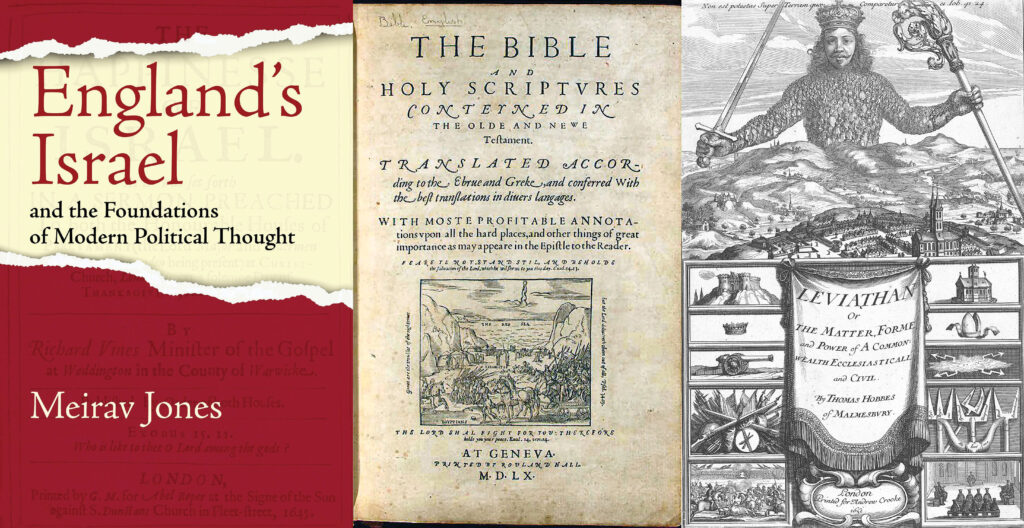
As Meirav Jones’s “England’s Israel and the Foundations of Modern Political Thought” chronicles, the affinity for viewing the British enterprise through a Hebraic lens arose through a combination of factors. King Henry VIII, seeking to break from the Pope following the pontiff’s refusal to grant him a divorce from Catherine of Aragon, sought Jewish textual support. Guided by scholarly Italian Jews, Henry established spiritual independence from Rome by way of scriptural and Talmudic argumentation. This newfound affinity for Jewish texts led to his establishment of the Regius Professorships in Hebrew at Cambridge in 1540 and Oxford in 1546, cementing England as a center for Hebraic study. 

The availability of the English Bible was another contributing factor. Printed in 1539, it was among the first vernacular Bibles printed in the world. The Geneva Bible arrived in 1560, and saw 150 editions printed over the next 80 years. The Good Book had become both affordable and pocket-sized. And the rapidly growing Protestant movement sparked widespread interest in direct access to the text. 

Christian Hebraists led a revitalized interest in the language that had been reserved for Jewish prayer and Bible reading. Sometimes these scholars, studying classic Jewish works in their original language, even called each other “rabbi” as they swapped sources of Jewish wisdom. One such “rabbi,” the polymath John Selden (1584-1654), possessed an expertise in Jewish law and was twice elected to Parliament. John Milton, the author of “Paradise Lost,” the beloved retelling of the Bible’s story of Adam and Eve, called Selden as “the chief of learned men reputed in this land.” 

Additionally, the chaotic nature of British politics, including the judicial execution of King Charles I on Jan. 30, 1649, amidst general European millenarianism, enhanced the societal feeling history was undergoing what Jones describes as “biblically prophesied chronology, toward an ultimate end.” With people believing they were living through long-predicted end-times, they naturally turned to ancient texts for understanding and inspiration. 

So it was that on Nov. 7, 1640, a pair of sermons were offered to Parliament during a public fast. In one, the nation’s elected officials were compared to Ezra, the post-Babylonian-exile spiritual leader of Israel during Second Temple times who ensured that the Israelites returned to God’s covenantal law. “Were you all as innocent as Ezra was?” questioned preacher Stephen Marshall. “What if you yourselves were guilty … You that are the flower of your Tribes … what a terror round about you there will be, when God comes to find you, and to reckon with you.”

In the second address, Cornelius Burges described how “in those dates, and in that time, saith the Lord, the children of Israel shall come, they and the children of Judah together, going and weeping, they shall goe [sic] and seek the Lord their God.” He expressed the wish “that I may yet more effectually bring home this to all our hearts … to parallel the slow pace of our deliverance out of mystical Babylon with that of Judah, and some of the remnant of Israel.”

During the English Civil War, the prominent theologian John Goodwin authored a 1642 tract urging armed resistance against the king. In it, he expressed the wish that the wrath of God wielded against Pharaoh in Moses’ time during the plague of the Slaying of the Firstborn be brought to bear once more. Though now, like then, it would be bloody, it would be justified. “There was a grievous cry throughout the whole land of Egypt upon it: But this cup was given to the Egyptians to drink,” since they deserved it. Goodwin hoped “the Israell [sic] of God amongst us” would emerge similarly victorious. 

Petrus Cunaeus’ “Republic of the Hebrews,” translated from Latin into English in 1653, offered its readers in search of a stable and flourishing exemplar of governance, “a commonwealth, the most holy and the most exemplary in the whole World. The rise and advance whereof it well becomes you perfectly to understand, because it had not any mortal man for its Author and Founder, but the immortal God.”

The public debates over the crucial question as to whether a king could be deposed by his human subjects drew from Deuteronomy and Samuel for justification. 

Thomas Hobbes’ “Leviathan” (1651), which took its name from a mythical sea creature mentioned in the Hebrew Bible, offered an articulation of social contract theory steeped in Judaic imagery. Citing Isaiah no fewer than 12 times, it offers a redemptive vision of God’s rule on earth described by the ancient prophet as a model for human rule. It is in the 33rd chapter of Isaiah’s book, Hobbes wrote, “In which words we have the place from when Salvation is to proceed, Jerusalem, a quiet habitation; the eternity of it, a tabernacle [i.e. Temple] that shall not be taken down.” Hobbes also lyrically describes the eternal value of Shabbat as a model political institution, cultivating humility and social cohesion. The Jews, he tells his readers, have “every seventh day, a Sabbath, in which the law was read and expounded; and in the solemnity whereof they were put in mind, that their King was God; and that having created the world in six dates, he rested the seventh day.”

As Jones concludes, “by 1640 when King Charles I convened the parliament that would ultimately see to his execution, the scope of this Hebrew revival had exceeded anything orchestrated or planned: the language, Israel’s story, its dramas and the wisdom and mission of a Godly people had permeated the English political imagination to such an extent that tapping into the beliefs and motivations of this people involved employing Hebraic terms. From the pulpit and the printing press, English politics was the politics of Israel, its wars, the wars of Israel, its leaders, the leaders of Israel. Israel was the people to whom God spoke, and in the mid-seventeenth century God spoke to England.”

This Hebraic political philosophy, of course, informed and inspired the Puritans and Pilgrims who traveled to the New World during this period, and later, the Founders who forged the United States. 

 “The holy city of Jerusalem did not die,” reflected the late political philosopher Russell Kirk, “though Nineveh and Babylon and Memphis and Susa and Antioch, and other mighty imperial capitals of the ancient world, were destroyed utterly. The buildings of Jerusalem might be razed, the city’s walls thrown down, its population put to the sword … [but] the Jew would find his way back to the sanctuary of Zion, lamenting beside the Wailing Wall that was said to be a fragment of the ancient Temple, renewing community on those blood-soaked sacred hills.”

This Tisha b’Av, then, as we sadly commemorate the loss of the Temple in Jerusalem, we also take solace in knowing the story of Israel continues. It serves now, as it has for centuries, as a source of inspiration for all those seeking redemptive covenantal community.


Rabbi Dr. Stuart Halpern is Senior Adviser to the Provost of Yeshiva University and Deputy Director of Y.U.’s Straus Center for Torah and Western Thought. His books include “The Promise of Liberty: A Passover Haggada,” which examines the Exodus story’s impact on the United States, “Esther in America,” “Gleanings: Reflections on Ruth” and “Proclaim Liberty Throughout the Land: The Hebrew Bible in the United States.”

Israel as Political Wellspring for the West: A Tisha b’Av Reflection Read More »

Fighting Antisemitism Before It’s Too Late

The cold-blooded murders of Sarah Milgrim and Yaron Lischinsky in Washington, D.C. followed by the terrorist attack in Boulder, Colorado, and the torching of the home of the Governor of Pennsylvania are among the most recent and high-profile attacks on Jews – and that is just in this country.  

It is not just in the United States that these attacks are occurring.  Overseas in Australia, a restaurant owned by an Israeli Jew was ransacked and a historic synagogue was torched.  At a rock concert in England, a band led the crowd in chants glorifying the intifada and cursing the IDF.

These are not isolated events.  They are the tip of the iceberg, as there are countless other incidents, not all recorded, which are part of the dramatic increase in assaults on Jews.   

Enough is enough.  

It is time to get serious about addressing Jew-hatred.  No more parsing whether it’s “anti-Zionism” or “just criticism of Israel.”  No more equivocation as to whether there is a difference between attacks on Jews, Israel or Zionism.  Jew-hatred in any form must not be tolerated.

Eradicating this toxic obsessive hatred will not be easy.  It will require accountability, honesty, courage and action.  

Distorted narratives and ideological bias promulgated by the media, professors, pundits and politicians who spread harmful rhetoric about Jews, Israel and their supporters create an environment which makes Jews and Israelis legitimate targets.  When statements of sympathy or expressions of solidarity come from the very individuals who contribute to the climate that fosters hostility towards Jews, they are especially hollow and meaningless and offensive.  

When statements of sympathy or expressions of solidarity come from the very individuals who contribute to the climate that fosters hostility toward Jews, they are especially hollow and meaningless and offensive. 

No more excuses and no more sugar-coating.

Honesty demands that we recognize that much of the antisemitic rhetoric and actions emanate from radical fundamentalist Islamists intent on spreading hatred of Jews.  We need to reject the feeling that any time an antisemitic incident is condemned or the word antisemitism is mentioned we feel obligated to include the word Islamophobia.  There is no comparison between the number of assaults on the two communities.  Claiming that criticism of Islamic extremists is Islamophobia has the desired effect of shutting down legitimate criticism of their Nazi-like propaganda and avoids dealing with a problem that is real.

To quell the surge and ubiquitous hostility to Jews, Judaism and Israel I offer the following comprehensive plan of action.

The Media

Mainstream media outlets play a significant role in stoking hostility toward Jews and Israel. 

The disproportionate coverage of Gaza compared to other international stories, and how Israel is portrayed are major factors in stirring hostility toward Jews and Israel.  

False claims by Hamas, a terrorist organization that is known to manipulate facts, are accepted without verification.  Hamas’ uncorroborated and unsubstantiated accusations are reported, often followed by lame corrections days later, which do not mitigate the harm done by the initial report, or the damaging headlines.  The meek line, “Israel denies the claim.”  

Portraying Israel as solely responsible for suffering in Gaza, while omitting Hamas’ role in creating the situation, in its use of human shields, the scale of its brutality, and that its stated intention is nothing less than the genocidal goal of eradicating the Jewish state provides a distorted and incomplete picture of the conflict.  

People need to be informed and made aware that reporters in Gaza as well as “eyewitnesses” are not objective or free to report anything that portrays Hamas negatively or that conflicts with the message Hamas wants to project.  They use terror to exert control not just over Gaza, but how it is reported.  If a school or hospital is targeted by the Israeli Defense Forces, the public needs to know what was going on there that led Israel to act.  Hospitals that harbor terrorist operatives should be identified as such, and the public should be informed that in these instances, the assumption of neutrality is lost.  Tell the whole story.  

Telling the whole story entails including the deliberate targeting of Israeli civilians, and the suffering not just in Gaza, but of Israel’s people as well, tens of thousands of whom have been displaced and are dealing with the aftermath of the horror not just of what happened on Oct. 7, but the constant barrage of rockets.  Objective and balanced reporting doesn’t mean accepting information provided by a terrorist organization which is known to give false information and use lies to promote its message.  

The disproportionate focus on Israel and Gaza, while ignoring atrocities in Sudan, Syria and Yemen and human rights violations around the world contribute to the perception that Israel’s war against Hamas is the only international conflict deserving attention.

News outlets must take responsibility for their role in promoting and encouraging antisemitism and hostility towards Israel.  We need to demand that they objectively report the truth.

Social Media Platforms

Online platforms have become incubators and purveyors of hate.  Outlets such as X, TikTok, Facebook and Instagram allow Holocaust denial, blood libels, glorification of terrorism and virulent anti-Israel propaganda, often under the guise of “pro-Palestinian advocacy” to spread unchecked.

Content moderation must be enforced consistently. That means following their own guidelines, which would entail banning antisemitic accounts, removing terrorist propaganda, and promoting educational content on Jewish history and identity.  We now know the deadly impact and results of unbridled rhetoric and calls to “Globalize the Intifada” or “From the River to the Sea,” which leads people to act violently against Jews.  

Platforms should actively partner with Jewish watchdog groups to identify and respond to threats.  

Social media platforms must take responsibility for their role in promoting and encouraging antisemitism and enforce their own rules.  

Colleges and Universities

American universities have become breeding grounds for antisemitism. Jewish students are doxed, threatened, harassed and ostracized, often with the passive tolerance of administrators and the active support of faculty.  Groups assembling and blocking Jewish students from traversing certain areas, surrounding them while shouting antisemitic slurs and anti-Israel chants to intimidate Jewish students, must not be allowed.   

Universities must unequivocally condemn and act forcefully to curb antisemitism, not bury it under objections to “all forms of hate.”  Nonstudents, often financed and supported by forces hostile to Jews, come on campus and promote acts against Jews.  Rules against those who participate in unauthorized encampments and violent takeovers of buildings should be enforced and outsiders should not be allowed to lead the charge against Jewish students.  

Antisemitic threats and harassment should not be tolerated under the guise of free speech.  Faculty who discriminate or intimidate Jewish students, who promote or excuse violence against Jews, who teach false narratives or manipulate their curricula and subject matter in a biased and false way to negatively reflect on Israel, Jews and the history of Jews and Israel should not be given free rein, but should face consequences for their academic malpractice. 

Discriminatory acts and slanderous comments about Jews, Israel and Israelis would not be tolerated were they made about any other minority group.  The same standard should be applied to all.  Organized mobs chanting “Globalize the Intifada” and “From the River to the Sea” are not harmless expressions of free speech.  To help provide guidance colleges should adopt the IHRA definition of antisemitism and provide real protection to Jewish students, just as they do for other minority groups.  

Colleges must take responsibility for their role in promoting, tolerating and encouraging antisemitism and are obligated to protect Jewish students from anti-Jewish actions.

Elected Officials

When public officials accuse Israel of genocide and parrot Hamas’ talking points while ignoring the fact that Hamas broke the ceasefire and effectively declared war when it murdered 1,200 people and abducted over 250, they are giving succor to and encouraging the terrorists.  By contributing to this atmosphere of animosity they are enabling the rise in antisemitic rhetoric and attacks on Jews.   

Overlooking the billions of dollars given by the international community intended to better the lives of Gazans but that were stolen by Hamas to make their leaders millionaires and build their network of tunnels, as well as the sadistic nature of Hamas and its ongoing launching of rockets from Gaza into civilian areas in Israel, only emboldens and provides cover and encouragement to those who legitimize antisemitism.

Politicians who sympathize with Hamas must take responsibility for their role in promoting and encouraging antisemitism and must stop parroting Hamas propaganda.

The United Nations 

No global institution has done more to normalize and spread and promote antisemitism and to delegitimize Israel than the United Nations.  While real genocides rage in Sudan, Myanmar and Syria, and atrocities are committed by nations against minorities around the world, the U.N. repeatedly singles out the world’s only Jewish state for condemnation. There is incontrovertible proof that U.N. agencies like UNRWA have harbored terrorists and taught antisemitic content in schools, and that its employees participated in Hamas’ Oct. 7 massacre.

The U.N. Human Rights Council has passed more resolutions against Israel than against all other countries combined. Its obsession with demonizing Israel while ignoring Hamas’ crimes not only distorts reality, but fuels hatred toward the Jewish state. When international bodies obsess about Israel alone as guilty of violating human rights, they send a message to the world that Israel and Jews are the only people deserving of such approbation, thereby signaling that Jew-hatred is justified.

Appointing officials who have a track record of antisemitic statements to monitor and report on Israel’s treatment of Palestinians and alleged human rights infractions must not be allowed.  It is like having Dracula guard the blood bank.   

The United Nations must take responsibility for its role in promoting and encouraging antisemitism and change the way it focuses on Israel.

Local Public Schools and School Boards

In some districts, antisemitic and anti-Israel content has infiltrated curricula — especially in ethnic studies and DEI programs.  Jews are portrayed as privileged, as oppressors or colonizers despite millennia of persecution, and despite being an indigenous people with ancient roots in the land of Israel.  This is propaganda being used as indoctrination in the guise of education.  

School boards must rigorously review educational materials, prohibit antisemitic content and ensure Holocaust education includes discussion of modern-day Jew-hatred. Jewish parents must be included in conversations about inclusion and diversity.

Schools and administrators must take responsibility for their role in promoting and encouraging antisemitism and must keep antisemitism out of classrooms.

Rabbis

In times of crisis, Jewish spiritual leaders have a responsibility to educate, not to spread misinformation or virtue signal moral superiority by condemning Israel.  

Criticism has its place.  But when rabbis recite false claims of genocide or apartheid, they mislead their communities, lend credibility and fuel efforts to delegitimize Israel.  Their anti-Israel rhetoric causes lasting damage.  We need rabbis to help their communities understand Israel’s security dilemmas, the morality of its actions, and the security challenges and hatred it faces — not express hostility and sow doubts about its legitimacy.

As I have said to my colleagues – criticism of Israel dare not be louder than expressions of love.  

The current climate demands solidarity and clarity, not virtue signaling.  When Israel is criticized on the pulpit, rabbis should realize that it will not change the policy of the government of Israel, but it will affect how the people hearing that message feel about Israel.  And it will lead to discomfort which can often lead to alienation from the Jewish state, and not just from Israel, but ultimately cause listeners to sour on Judaism and the Jewish people.   

Jewish clergy must take responsibility for their role in promoting and encouraging antisemitism by their public critiques. Instead they should strive to foster positive feelings about Israel among Jews and others.  

How Should Jews Respond?

Jewish organizations and leaders must prioritize defending the Jewish people.  They should stand up for Jews and support actions taken to defend Jews that are not unconstitutional.  They should have a zero-tolerance policy towards antisemitism and anti-Zionism regardless of its source.

Individual Jews should lean into being Jewish.  Show up at synagogue and community events. Support Jewish organizations. Talk to your neighbors. Challenge antisemitism when you see it — whether it comes from the right-wing conspiracy theorist or the progressive activist group that won’t acknowledge Israel’s right to exist. If we don’t speak up for ourselves, no one else will.  Be open though to building coalitions with those who stand with us and accept the love and support of those allies who are willing to partner with us.  

Antisemitism is not just a Jewish problem.  The kind of widespread and intense hatred of Jews we are currently experiencing has historically signaled a deeper societal sickness, one that can ultimately destroy the society itself.  

Finally, the strongest response and antidote to efforts to intimidate Jews is to deny those who wish to eliminate Jews a victory.  The answer is Jewish pride, which entails being proud of who we are, of what Jews have given the world, and proudly living as Jews.  

In Conclusion

Fighting the “world’s oldest hatred” requires more than words.  It demands that each sector of society that fuels harmful impressions about Israel and Jews examine how they have contributed to the toxic environment that has led to hateful words and violent acts against Jews.  All segments of society need to take a good hard look at their statements and actions and commit to real change.  

All of us must all take responsibility for our role in promoting and encouraging antisemitism.


Rabbi Stuart Weinblatt is Chairman, Zionist Rabbinic Coalition 

Fighting Antisemitism Before It’s Too Late Read More »

The Curse with No Answer

The football soared high in the air and landed comfortably in my arms. It was a clear path to a touchdown. For sixth graders, football at recess was our escape before we returned to class. Then seemingly out of nowhere, Dennis, a fellow student who was taller and stronger than me, lunged and tackled me to the ground. “Get off me!” I yelled as he kept my shoulders pinned to the ground. “Shut up you dirty Jew,” he shouted back.

The public elementary school I attended in San Jose, California had about 2,000 students. Six were Jewish and the rest a patchwork of various forms of Christianity. All my friends knew I was Jewish and as far as I knew, nobody cared. The neighbors all knew my family was Jewish, especially since my parents, both Holocaust survivors, still carried European accents. So when Dennis’ anger overtook him, he went straight to where he thought it would hurt most. Reminding me and everyone standing around that I was not one of them. I was a Jew.

For some reason this childhood incident has stuck with me all these years. But it wasn’t the words, it was where he learned that ugly phrase. It was decades before social media. The most controversial television show was “Leave It to Beaver.” The press had real journalists not partisan commentators. Yet, he learned it somewhere and knew how and when to weaponize it.

I thought it could have come from only two places: either overhearing his parents in the privacy of their home, or at Catechism. Catechism was the Christian version of Hebrew School. Twice a week after school I would ride my bike to the one shul where in a back office I had to attend Hebrew School and learn Torah. My non-Jewish friends did the same by attending Catechism at their church. I just assumed they learned about Jesus while we learned about Moses.

 Hundreds of books, articles and lectures have tried to explain antisemitism. 

We Jews want answers. Why does it exist? What have we done or not done that it simply won’t go away?

The more I think about it, the more I am coming to accept that perhaps there just isn’t an answer. Why does every question require a sensible explanation? The Talmud is a compendium of disagreements. We should be accustomed to asking questions that have no answers. Maybe the curse of antisemitism is the same.

This by no means suggests that antisemitism is something we just live with. It must be fought and called out whenever and wherever we find it. And we do.

Most infuriating are “progressive Jews” who proclaim, “I am Jewish!” as they march holding a Palestinian flag. They believe that being born Jewish proves they can’t be anti-Jewish. But a closer look will undoubtedly reveal that many if not most don’t practice Judaism in their daily lives. Apparently being a proud Jew only comes in handy when used to justify attacking Israel and those who support it.

People hate because they choose to hate and as tempting as it is to uncover the root cause of this hatred, it might just be an exercise in futility. In the meantime, our efforts should focus on eradicating the real-life consequences of this scourge, and leave the academic hand-wringing for when antisemitism is truly wiped out and relegated to the pages of history. 


Harvey Farr is a local community reporter for the Jewish Journal.

The Curse with No Answer Read More »

Epstein and Tisha b’Av

In recent weeks, legislators across a broad political spectrum have been raising questions about Jeffrey Epstein’s child sex trafficking empire, asking who were his clients? The media, likewise, has been awash with stories of conspiracies and cover-ups following the Justice Department’s statement that Epstein did not keep a client list. 

While many media stories have focused on Trump’s interactions with Epstein prior to their falling out in 2004, there is a much more important story that should not be overlooked, especially for those in the Jewish community.

As a Jewish woman who has devoted her life to writing about child sexual abuse in the academic literature and for the popular press, I was deeply troubled by the horror Epstein visited upon innocent under-aged girls, which included rape, sodomy and forced performance of perverse sexual acts. Yet, when reading the headline stories of Epstein’s suicide, I found myself troubled by his ending of his life. He was a Jew and I couldn’t push that out of my mind, no matter how hard I tried. 

Nor could I dismiss the eerie coincidence that he took his life about 12 hours before the onset of Tisha b’Av, the saddest day on the Jewish calendar when we commemorate the destruction of the Holy Temple by following the rituals of mourning and committing to a 24-hour fast. Perhaps most eerie is that one of the reasons for the destruction of the Holy Temple, particularly the First Temple, was that the Jewish community had descended into sexual depravity, along with murder and idolatry. Epstein, taking his life hours before the start of Tisha b’Av makes it especially hard to escape the fact that his existence on earth was ironically defined by the same sexual depravity that had brought about the desecration of the Holy Temple. Epstein, whose life of sin was now squarely before the world for everyone to see. 

I had a brief encounter with Jeffrey Epstein myself. It was sometime in the ‘90s when I was at my parents’ home in Brooklyn. My father was a prominent rabbi whose synagogue, The Jewish Center of Brighton Beach (where Nicolas Cage would later be filmed in “Lord of War”), was a stone’s throw from where Jeffrey Epstein grew up in the Seagate section of Brooklyn. My father would often be called upon to privately counsel those facing the difficulties of public life. As a member of the clergy he kept these matters strictly confidential. 

One day I recall how the phone rang at the Brooklyn home. I took the call. It was Jeffrey Epstein on the line asking to speak to “the rabbi” about a “highly personal matter.” Epstein was noticeably upset. I could see my father was visibly shaken after the call and I knew something was wrong. My father never uttered a word because confidentiality was sacrosanct to him as a member of the clergy.

Years later when I read the headline news reports of Jeffrey Epstein having strangled himself with his bedsheets at the Manhattan jail where he was awaiting trial on child-sex trafficking charges, I realized that this detestable child-sex trafficker who had reached out to my father for rabbinic guidance so many years prior might have actually taken his life to spare the Jewish community from a “shanda” – profound community shame.

Having taken his life hours before the start of Tisha b’Av makes it hard to escape the fact that Epstein’s suicide might have arguably – and in the most twisted way – been a “sacrificial” act – a way of effacing his memory so that he would not bring down the Jewish people. For Epstein, he may have left the world because his shame as a Jew had become too burdensome to bear. If so, his strangling of himself may have been his last attempt to smite the enemy from within. And that would have been his last message as a Jew who had fallen into an abyss of shame.


Amy Neustein, Ph.D. (Sociology) is the author/editor of 16 academic books. Her two books on child-sex abuse are “From Madness to Mutiny: Why Mothers are Running from the Family Courts –and What Can Be Done about It” and “Tempest in the Temple: Jewish Communities and Child-Sex Scandals.” She resides in Fort Lee, NJ.

Epstein and Tisha b’Av Read More »

Superman and the Jews

Minor spoilers ahead.

In the most recent Superman movie, there’s a key moment when Clark Kent (aka the titular hero) finds out something that shakes his sense of sense to the core. He has taken on embodying hope as his life’s mission, driven by a somewhat garbled video from his parents, recorded shortly before their planet was destroyed. Without getting into the intricacies of the plot, the rest of the transmission is later shown in full, revealing that he was actually sent here to dominate humanity. This not only upends Superman‘s public image, but shatters his personal identity. What happens when your place in the world is turned upside down? How would you respond? What would help you rebuild? 

After seeing the movie a few weeks ago, I’ve found these questions to be resonant. Over these past few years, cascading events have left me wondering about the world and my place in it, in our city, our country and in Israel. Writ large, these are not the expectations I grew up with at the “end of history” in a heavily Jewish suburb of Chicago. Many of those expectations, which framed a narrative of how the world works, seem to be called into question more and more each day: what’s the future of the Jews in America? What’s the future of the Jewish state? What does the future of our city, our country, our world look like? This is not the same thing as discovering disturbing long-hidden wishes my parents actually had for me, but as someone whose Jewish identity and American identity are core to his sense of self, it raises some real challenges. 

The theologian Neil Gillman wrote extensively about the role that myth plays in our lives. Myth is not merely a set of fictional stories, but rather narratives through which we craft meaning in the world. When we are confronted with a crisis, we have a choice: we can hold onto the narrative we’ve been telling ourselves about how the world works, or we can take on the difficult and sometimes painful task of taking many of the same facts and crafting them to tell a different story. Gillman places this task in the context of midrash, the rabbinic reinterpretation and sometimes extensive reconfiguration of certain verses and narratives from our tradition. He describes this as the plasticity of myth, taking the facts that we have in front of us and working to reshape the stories that we’ve told ourselves to create new meaning. 

Superman provides a model for this, not only because the character is successful in doing so by the end of the film. Superman is a modern myth, one that has evolved over time. A quick survey of different comic book runs or movie posters shows how the same hero, the same myth, can evolve over a few short decades. Much has been written about what a Jewish hero Superman is, from the fact that his creators were Jews to his Moses-like origin story, but perhaps what makes him most Jewish is the fact that he has a core narrative that still shifts and evolves to meet the needs of the moment. 

As Jews, we too have evolved over time, a paradigmatic example of how the plasticity of myth can make it possible for a people to last for centuries against all odds. From wandering through the ancient Near East to a temple-based, ritually-focused tribe, to a text-based civilization, to a diasporic people across countries and continents, our self-understanding has evolved, but we still remain. Through the 20th and into the 21st century, we’ve grappled with yet another new set of circumstances, for good and for ill, but we know perhaps better than any other people how through the plasticity of myth we can move forward, that reshaping our narrative is possible, as both a group and as individuals. 

I don’t know what that narrative will be, for us or for myself. But I trust that we’ll get there, that we’ll find a way to hold onto what is essential, then take it and mold it to fit the moment in which we find ourselves. Finding a way to take our core narratives and reshape them to craft meaning and purpose, otherwise known as fundamentally reshaping our sense of reality? Sure sounds like a superpower to me.


Rabbi Matt Shapiro is Temple Beth Am’s Director of Youth Learning and Engagement. 

Superman and the Jews Read More »