fbpx

May 28, 2025

A Conversation with Syrian Leader: Journey Beyond the Ruins

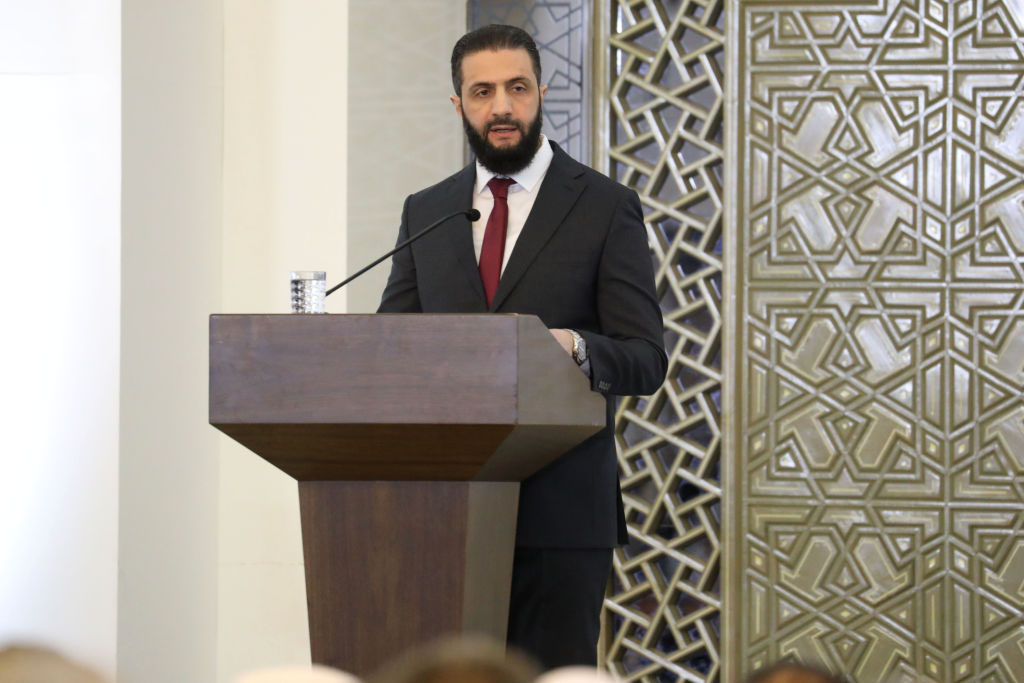
In the heart of Damascus — a city that has withstood siege, sorrow, darkness, and time itself — I met with Syria’s newly elected president, Ahmed al-Sharaa. Our conversation unfolded in the grandeur of Assad’s former palace, now renamed the People’s Palace — a striking contrast to the modest buildings around it. Damascus is the oldest living city, where history whispers from every wall. It was a fitting setting for a dialogue not about power, but about rebuilding, reconciliation, and the burden of leading a nation long broken.

“We are not starting from zero,” he told me. “We are starting from the depths.”

President Sharaa, who assumed office following the fall of Bashar al-Assad, carries himself with quiet conviction. He is soft-spoken, but every word lands with deliberation. There is no triumph in his voice — only urgency.

“We have inherited more than ruins,” he said. “We’ve inherited trauma, mistrust, and fatigue. But we have also inherited hope. Fragile, yes — but real.”

For decades, Syria was ruled by a regime that confused loyalty with silence, coexistence with hate, and stability with suppression. The Assad dynasty — first Hafez and then Bashar — ruled with an iron grip, using fear and executions to cement control, while the country’s institutions withered and dissent turned deadly.

Sharaa is clear-eyed about the legacy he inherits.

“It would be dishonest to speak of a clean slate,” he said. “The past is present — in the eyes of every person, on every street, in every family. But our duty now is not to repeat it. Not even as a softer version. We must create something entirely new.”

Sharaa’s early moves have been cautious, yet deeply symbolic. He has ordered the release of political prisoners, initiated dialogue with opposition groups once exiled or silenced, and pledged to reform Syria’s notorious security apparatus. His vision is of a vibrant, multicultural, and pluralistic society. He supports the right of return for all Syrians — Jews, Druze, Christians, and others whose assets were seized under the Assad regime.

He has proposed the creation of a Ministry dedicated to addressing the fate of the missing and the dead. To uncover the truth behind Syria’s mass graves, he recognizes the need for partnership with the United States — to provide forensic technology and equipment, from establishing DNA databases to securing cooperation from those responsible for past atrocities.

“If I am the only one speaking,” he said, “then Syria has learned nothing. We are inviting all voices to the table — secular, religious, tribal, academic, rural, and urban. The state must listen now more than it commands.”

But will people trust again? Will they believe the promises of a government that rises from the ashes of dictatorship?

“I don’t ask for trust,” he replied. “I ask for patience — and for scrutiny. Hold me accountable. Hold this process accountable. That is how trust will come.”

When I asked the president what Syrians most need right now, he answered without hesitation:

“Dignity through work. Peace through purpose.”

In towns emptied by war and villages still scarred by conflict, the cry is not for politics but for normalcy — the chance to rebuild homes, raise children, and earn a living in peace.

Sharaa knows this. He is pushing for emergency economic programs focused on job creation in agriculture, manufacturing, construction, and public services.

“It’s not about ideology anymore,” he told me. “It’s about giving people a reason to stay, a reason to live — and a reason to believe.”

He emphasized partnerships with regional investors, microenterprise grants for returnees, and vocational training for youth who have known nothing but war.

“A stable Syria will not be built through speeches or slogans — it will be built through action: in the marketplace, in classrooms, on farms, and in workshops. We will rebuild supply chains. Syria will return as a hub for trade and commerce.”

There’s a deeper insight behind this economic vision: after a generation of loss, Syrians are tired of conflict. They crave peace — not just the absence of war, but the presence of opportunity.

“Every young man with a job is one less soul at risk of radicalization,” Sharaa said. “Every child in school is a vote for the future.”

In one of the more delicate parts of our conversation, Sharaa addressed Syria’s future relationship with Israel — a subject that has haunted the region since 1948 and intensified with each airstrike, covert operation, and accusation of proxy warfare.

“I want to be clear,” he said. “The era of endless tit-for-tat bombings must end. No nation prospers when its skies are filled with fear. The reality is, we have common enemies — and we can play a major role in regional security.”

He expressed a desire to return to the spirit of the 1974 Disengagement Agreement (Dofa Accord) — not merely as a ceasefire line, but as the foundation for mutual restraint and protection of civilians, especially the Druze communities in southern Syria and the Golan Heights.

“Syria’s Druze are not pawns,” he said. “They are citizens — deeply rooted, historically loyal, and deserving of every protection under the law. Their safety is non-negotiable.”

While he stopped short of proposing immediate normalization, Sharaa signaled openness to future talks grounded in international law and sovereignty.

“Peace must be earned through mutual respect, not fear. We will engage where there is honesty and a clear path to coexistence — and walk away from anything less.”

Perhaps most notably, he voiced a bold diplomatic overture: his desire to sit down directly with former U.S. President Donald Trump.

“However the media portrays him,” Sharaa said, “I see him as a man of peace. We’ve both been shot at by the same enemy. Trump understands leverage, strength, and outcomes. Syria needs an honest broker who can reset the conversation. If there is a possibility of alignment that helps bring stability to the region — and security to the U.S. and its allies — I am ready to have that conversation. He is the only man capable of fixing this region, bringing us together, one brick at a time.”

It was a striking statement — not just for its candor, but for what it implied: the new Syria is not afraid to make unconventional moves in pursuit of peace and recognition.

Sharaa does not sugarcoat Syria’s challenges: more than a million dead in mass graves, 12 million displaced, an economy on life support, sanctions still in place, and rival militias entrenched in the north.

“This is not a fairy tale,” he said. “It is a recovery. And recoveries are painful.”

He acknowledges that foreign powers — China, Russia, Iran, Turkey, the UAE, Qatar, and the U.S. — will continue to influence Syria’s path. But he insists that Syrian sovereignty begins with Syrian consensus.

“We will not be a pawn. Nor will we be a fortress. We will be a state that governs with legitimacy, not just control. We want the U.S. to partner with us — in governance, in anti-corruption, in building institutions based on honesty and integrity.”

Many Syrians see Sharaa not as a revolutionary but as a restorer — someone capable of stitching together a nation fatigued by war and fractured by identity. It is perhaps his very ordinariness — his refusal to play the strongman, despite his extremist former life — that makes him a man of the hour.

“I did not seek this position to rule,” he told me near the end of our talk. “I accepted it because Syria must turn the page. And I would rather help write that history — with others — than watch it be torn apart again. We have no option but to succeed. We must make Syria great again.”

I believe his extremist and violent past has taught him how to navigate the future. You can change. You can grow. He has learned from experience, and twenty-twenty vision gives him the clarity to shape what comes next. His history with extremism has made him capable of defending Syria from within — against ISIS and those seeking to topple the fragile progress underway. He has grown from revolution to governance, and I believe he has the ability to lead and impact the real future of this country.

As I left the Presidential Palace, I glanced back at the man now tasked with resurrecting one of the world’s oldest civilizations — where the first alphabet was created. There were no portraits of him on the wall, no slogans, no flags. Just a man trying to unite a map of Syria into a country of equals. He stands tall, firm in his resolve, with the odds set against him — but determined.

He wants to build a future for his people, for the region, and for Syria to come out of the dark and take its rightful seat at the table of the world.

Only time will tell.

A Conversation with Syrian Leader: Journey Beyond the Ruins Read More »

Feds Open Investigation Into Antisemitism Complaints at Cal Poly Humboldt

The U.S. Department of Education’s Office for Civil Rights (OCR) opened a formal investigation into allegations of antisemitic harassment at California State Polytechnic University, Humboldt (Cal Poly Humboldt) on May 20. The probe follows a Title VI complaint filed in March by the Louis D. Brandeis Center for Human Rights Under Law and Jewish on Campus.

The complaint alleges that Jewish students were physically assaulted, verbally harassed, excluded from campus spaces, and subjected to targeted intimidation while administrators failed to respond.

“We were really pleased that they moved relatively quickly — it’s been about two months since we filed,” Denise Katz-Prober, director of legal initiatives at the Brandeis Center, told The Journal. “We’re pleased to hear that OCR appears to recognize that there is a legitimate and serious problem here worth looking into. We’re hopeful that they’re going to hold the university accountable for failing to protect your students from harassment, discrimination that we documented in the complaint.”

The Brandeis Center filed the complaint on March 6 after what Katz-Prober described as months of inaction by university officials, even after students reported multiple incidents of harassment in October and November 2024. Among the alleged examples cited are fake blood thrown on Jewish students, the theft of an etrog from a Sukkah and vandalism of a campus building. It also claims  that students staffing a Jewish club table at a campus fair were harassed while administrators looked on, then allegedly instructed the Jewish students to “leave the event rather than address the harassment.”

“What we’ve explained in the complaint is that there is no political controversy or disagreement at issue here,” Katz-Prober said. “What’s at issue in our complaint as we documented is unlawful conduct and behavior that the university was obligated to address in order to make sure that Jewish students are safe and welcome on their campus. They didn’t do so, and that’s why we filed the complaint.” At least one student ultimately left campus and completed coursework remotely before graduation due to fear for their safety, she said.

“What’s at issue in our complaint as we documented is unlawful conduct and behavior that the university was obligated to address in order to make sure that Jewish students are safe and welcome on their campus.” – Denise Katz-Prober

The Brandeis Center’s chairman, Kenneth Marcus, is a former head of OCR at the Department of Education during the Bush Administration. In 2004, Marcus authored an official letter signaling that “OCR will exercise its jurisdiction to enforce the Title VI prohibition against national origin discrimination, regardless of whether the groups targeted for discrimination also exhibit religious characteristics. Thus, for example, OCR aggressively investigates alleged race or ethnic harassment against Arab Muslim, Sikh and Jewish students.” The letter was written two days after the third anniversary of the 9/11 attacks, and specifically references an uptick in religion-based incidents.

Katz-Prober said that the reason Marcus’ letter was so monumental “is because prior to 2004, when this guidance was issued, groups like Jews, Arab Muslims and Sikhs who are part of religious communities and are faith-based groups but also have a shared ancestry and ethnicity, when they faced harassment and discrimination, OCR would not prosecute those cases. They would not investigate those cases because their understanding was they didn’t have jurisdiction over religious discrimination because Title VI of the Civil Rights Act only covers discrimination based on race, color, or national origin — it doesn’t include religion. And so after 9/11 in particular, when Sikhs and Muslims — especially in K-12 schools — were facing horrible harassment.

Katz-Prober said the letter is now known as “The Marcus Doctrine”, which she says establishes that OCR does have jurisdiction to investigate cases involving harassing, the discrimination against groups like Muslims, Sikhs and Jews that have both a religious (they’re part of religious communities) and a shared ancestry and ethnicity. That interpretation, the Brandeis Center believes, means these incidents are covered under the national origin provision of Title VI.

According to Katz-Prober, the complaint at Cal Poly Humboldt, located about 100 miles south of the California-Oregon border, is about situations where Jewish students are “actually mistreated and targeted by behaviors that are unlawful — not speech, but behaviors.”

“When Jewish students are tabling at an event and someone confronts them and disrupts them and actually makes them feel unsafe such that they can’t even conduct their activities, or when someone throws a red substance at Jewish students because they supposedly disagree with their position on what’s happening in Israel, that is not a legitimate political discussion,” Katz-Prober said. “That’s an assault.”

The complaint recommends the International Holocaust Remembrance Alliance (IHRA) definition of antisemitism as a tool for understanding where that line is between speech and behaviors. It states “students report being shunned, harassed, marginalized and excluded as ‘Zionists.’ As OCR recognizes, Jews share more than a common faith; they are a people with a shared history and heritage deeply rooted in the land of Israel. … For most Jews, therefore, the ancestral connection to Israel (i.e., Zionism) represents an integral component of their Jewish identity.”

The Brandeis Center is calling on Cal Poly Humboldt to adopt the IHRA definition, which includes illustrative examples to distinguish between protected political speech and antisemitic conduct. “This is where the IHRA definition is so useful because it does explain where is the line between legitimate criticism of Israel and either discourse or speech that crosses the line into antisemitism,” Katz-Prober said. “And it explains that where someone is demonizing Israel is subjecting it to a double standard or delegitimizing Israel by denying its right to exist.”

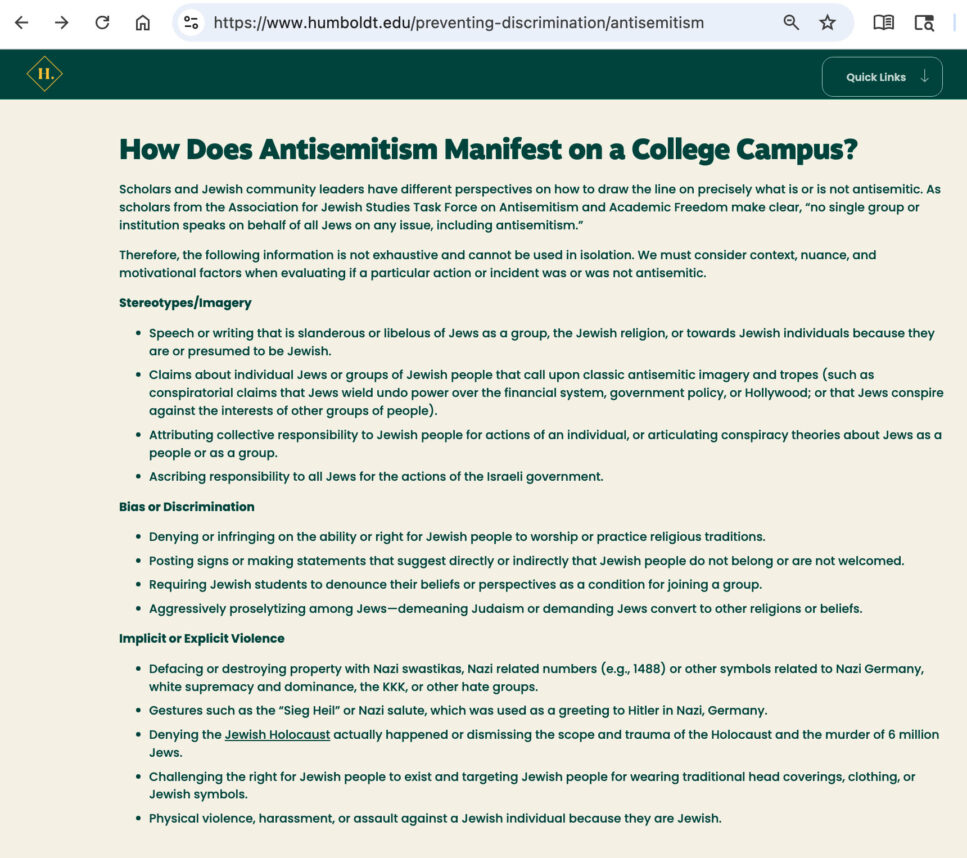
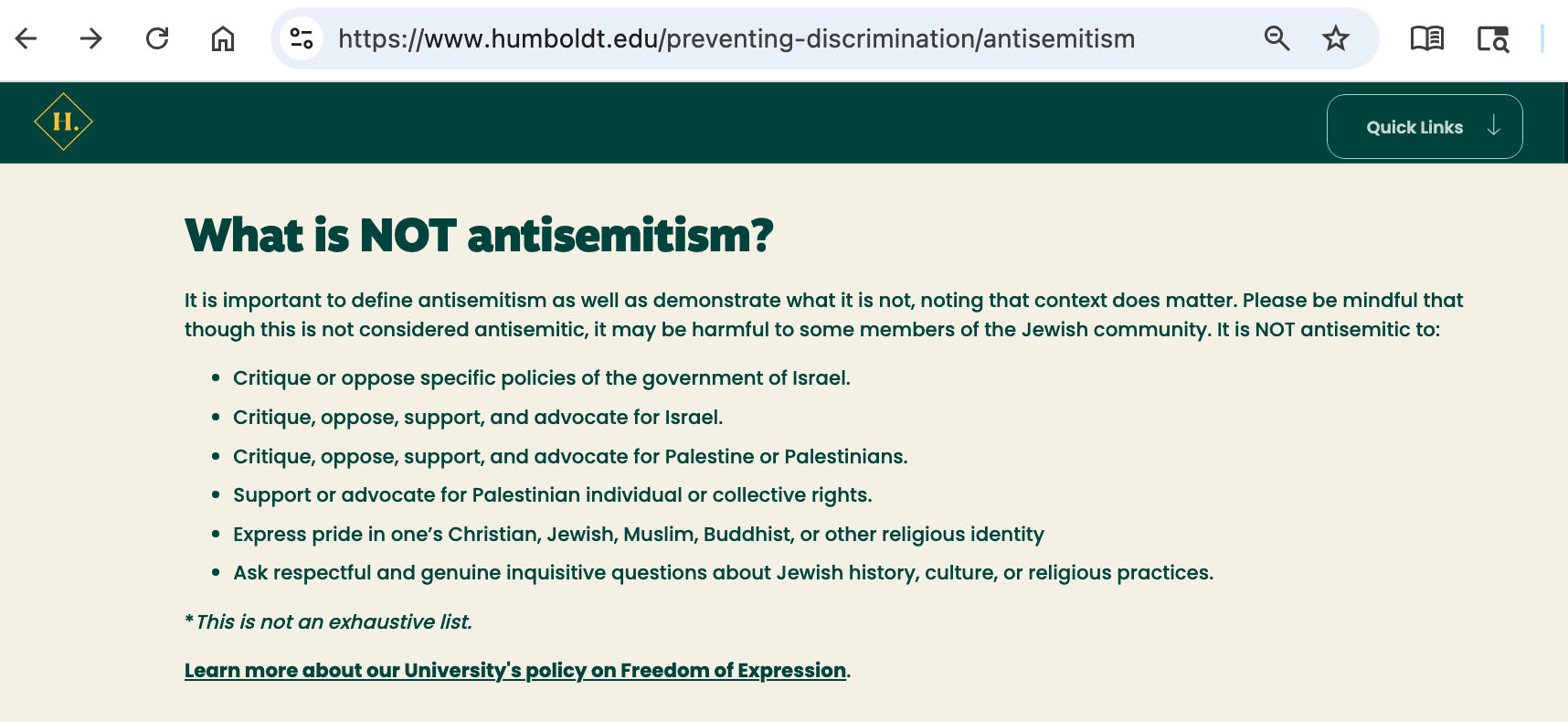
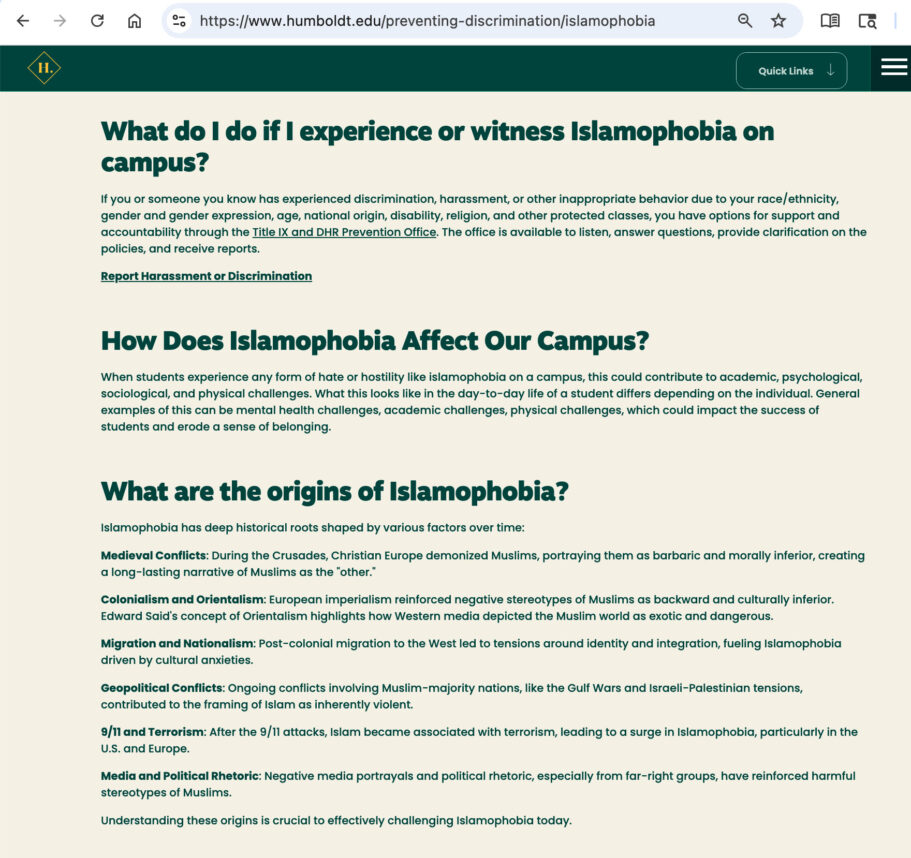
On their website, Cal Poly Humboldt lays out their policy on “helping to prevent discrimination” on campus. The policy states that “challenging ideas and debating different viewpoints are essential to intellectual development. Disagreements are natural, but they should never lead to dehumanization or hostility.” The university also lists specific learning resources about antisemitism and islamophobia on its website. As of May 28, a “coming soon” placeholder is currently on the website for homophobia and transphobia,

In the section titled “What is NOT antisemitism,” the university says, “it is important to define antisemitism as well as demonstrate what it is not, noting that context does matter. Please be mindful that though this is not considered antisemitic, it may be harmful to some members of the Jewish community. It is NOT antisemitic to:

  • Critique or oppose specific policies of the government of Israel.
  • Critique, oppose, support, and advocate for Israel.
  • Critique, oppose, support, and advocate for Palestine or Palestinians.
  • Support or advocate for Palestinian individual or collective rights.
  • Express pride in one’s Christian, Jewish, Muslim, Buddhist, or other religious identity
  • Ask respectful and genuine inquisitive questions about Jewish history, culture, or religious practices.”

Katz-Prober said that “university cannot — should not in this day and age — cannot tell any student to hide their identity and hide who they are in order to avoid mistreatment and targeting. And that goes for Jewish students and it goes for all students.”

Currently, the Cal Poly Humboldt complaint is one of 21 active investigations added to the list during the Trump administration, which has called for the dismantling of the Department of Education. There are currently 155 active civil rights investigations underway by the department, with some still being investigated after being on the list for over five years.

Screenshots of the Cal Poly Humboldt’s website on preventing discrimination are below.

Feds Open Investigation Into Antisemitism Complaints at Cal Poly Humboldt Read More »

The American Jewish Community’s Blue City Trap

In the days following Oct. 7, New York Times columnist Bret Stephens coined the term “the October 8th Jew” to describe those who woke up the next morning with a renewed understanding of Jewish vulnerability. For many, Oct. 7 was a breaking point—an unmistakable signal that the ideological allies they had trusted in academia, activism, and government did not stand with them when Jews were massacred. But what Stephens captured was not just an emotional turning point—it was a call for a political and communal reckoning. And yet that reckoning has been largely postponed or avoided by many major Jewish institutions, especially in the blue cities where they are based.

There has been, of course, talk of a “Jewish realignment,” and some shifts have occurred. Individual donors have pulled back from institutions like Harvard or PEN America. Some communal leaders issued stronger statements on antisemitism from the left. But institutionally? The pivot has been muted, especially among legacy  organizations. Why?

The Politics of Proximity

The ten largest Jewish communities in America are embedded within metro areas that overwhelmingly voted for Kamala Harris in the 2024 election. With a few exceptions (notably Miami and Atlanta, which still went for Harris), these metropolitan regions are deeply blue. Cities like New York, Los Angeles, Washington, Boston and San Francisco not only lean Democratic—they define the progressive political mainstream.

Largest Jewish Communities and 2024 Presidential Vote by Metro Area

Rank Metropolitan Area Estimated Jewish Population 2024 Presidential Election Result
1 New York–Newark–Jersey City, NY–NJ–PA 2,109,300 Harris 55.9%, Trump 43.3%
2 Los Angeles–Long Beach–Anaheim, CA 622,480 Harris 63.5%, Trump 34.3%
3 Miami–Fort Lauderdale–Pompano Beach, FL 535,500 Trump 51.2%, Harris 47.8%
4 Philadelphia–Camden–Wilmington, PA–NJ–DE–MD 419,850 Trump 50.1%, Harris 48.9%
5 Washington–Arlington–Alexandria, DC–VA–MD–WV 297,290 Harris 65.3%, Trump 32.5%
6 Chicago–Naperville–Elgin, IL–IN–WI 294,280 Harris 53.2%, Trump 45.1%
7 Boston–Cambridge–Newton, MA–NH 257,460 Harris 60.8%, Trump 37.5%
8 San Francisco–Oakland–Berkeley, CA 244,000 Harris 71.2%, Trump 26.1%
9 Atlanta–Sandy Springs–Alpharetta, GA 119,800 Trump 50.4%, Harris 48.5%
10 Baltimore–Columbia–Towson, MD 117,800 Harris 62.1%, Trump 35.4%

This geographic-political context is essential to understanding why many legacy Jewish institutions have not meaningfully pivoted away engaging progressives and progressive causes, and built new coalitions more manifestly aligned with their interests, even after the Oct. 7 attacks and the surge of antisemitism that followed.

Mainstream Jewish organizations—such as federations, JCRCs (Jewish Community Relations Councils), and large synagogues—are physically and culturally situated within progressive political ecosystems. Their staff, board members, donors, and partner institutions (e.g., universities, interfaith coalitions, city governments) are mostly Democrats. For many, their children attend public or private schools where progressive DEI frameworks are dominant. Their rabbis speak from pulpits located in precincts where a Republican vote is not just rare but also can be seen as morally suspect.

As a result, criticizing progressive norms—whether it’s identity-based ideology or acceptance of antisemitism in racial justice movements—can alienate their base and undermine their perceived legitimacy. Even raising concerns about how progressive frameworks might fuel antisemitism is often framed as “punching left” or “undermining coalition unity.”

High Stakes in the Status Quo

Mainstream Jewish organizations are recipients of government support, including DHS Nonprofit Security Grant Program funds, which have grown to over $300 million nationally; state social services contracts, especially in New York, Maryland, California, and Illinois; and urban partnerships tied to homelessness services, senior care, food distribution, and workforce development. Criticizing the political leadership of cities or governors who sign these checks—or the ideological frameworks embedded in city agencies—can threaten not just public standing, but real revenue.

Turning against the progressive coalition would mean breaking relationships with city councils, school boards, and interfaith partners; losing credibility with younger, progressive Jews; and risking their funding base and social capital. Moreover, many of their own members have not pivoted politically. While concerned about antisemitism, they still support even the most progressive Democrats because of abortion rights, gun control, climate policy, or fear of Trumpism. This creates a tension: Jewish organizations that wish to sound the alarm about antisemitism from the left must do so without alienating their liberal constituents.

Jewish organizations that wish to sound the alarm about antisemitism from the left must do so without alienating their liberal constituents.

Jewish organizations thus remain in political alliances, arguably out of necessity, that no longer serve all their interests—but exiting those coalitions comes at a very high price. Their ideological partners often tolerate or excuse anti-Zionism and even antisemitism. Their financial, cultural and political survival depends on not making too much noise about it. So despite the trauma of Oct. 7, most of the organizational behavior has remained the same. Statements get sharpened. Backchannel complaints are made. But the political alignment holds.

Escaping the Trap

Legacy organizations have good reasons to defend the status quo. Their funding streams, institutional partnerships, and reputational capital are all bound up in the political structures of blue cities and states. Legacy organizations are bound by legacy commitments. But that reality means that many of these institutions will remain constrained in their ability to respond to new and growing threats. If we want to face the challenges of this moment—whether in education, campus culture, or public safety—we need to build new institutions (or old institutions need to develop new vehicles) not bound by these same commitments. These new initiatives must be funded, staffed and scaled to serve as durable alternatives. Over time, they must become as strong or stronger than the legacy groups they sit alongside, not because they are louder or more radical, but because they are freer to speak the truth and act on it.


David Bernstein is the Founder and CEO of the North American Values Institute (NAVI).

The American Jewish Community’s Blue City Trap Read More »

Three Out of 800 Graduating Students Refused to Shake Hands With a Jewish Professor

The reality of the past 20 months at California State University, Northridge (CSUN) made me suddenly anxious when I chose to wear a blue and white Jewish star sash over my faculty robes for commencement this year. I was excited to celebrate my students’ successes as I have for the past 27 years of my academic career. However, as I stepped out into the screaming throng on the quad, I felt my heart quicken, just as it did months ago when a keffiyeh-wearing colleague accosted me. I feared insults or worse being thrown down, and the LAPD snipers on the rooftop nearby did little to ease my distress.

The CSUN campus continues to be a place where Jewish students, staff and faculty have not felt welcome since Oct. 8, 2023. So it was not surprising when three out of 800 graduating psychology students refused my handshake at this commencement ceremony in front of nearly 10,000 family members, university administrators and faculty.

These snubs did not occur on the ceremonial grand stage and were not broadcast on the screens on the quad; rather, the refused handshakes occurred unseen, off to the side of the stage the students crossed, after shaking hands with the university administrators who have remained unresponsive to the rampant antisemitism on campus.

Up until Oct. 8, 2023 my freedom to be openly Jewish had never been threatened. Since then, countless Jewish students, staff and faculty members across the globe have learned that universities are not safe places for Jews.

Over the past 20 months, hostage posters on my office door have been repeatedly vandalized.  Other individuals scrawled hateful antisemitic comments on my nameplate and other parts of my door. A colleague in my own department filed an unsupported complaint alleging I had weaponized the word “antisemite” against them. Months later, this faculty member berated me in connection with this frivolous complaint in a meeting while many of my colleagues watched silently. This bullying was later deemed “protected speech” by a university Equity and Compliance officer.


So, at commencement, when graduates from the Psychology Department began to cross the stage, I stood up with my colleagues to meet the new graduates as their names were called. As in prior years, I shook hands and shouted, “Congratulations” to our incredibly diverse students who were wearing all types of attire and symbols on their robes and mortarboards.

After dozens of uneventful handshakes, a student walked toward our line of hand-shaking faculty members and clearly caught sight of my sash. He shook his head in disagreement, he pulled his hand away and walked on. I felt anxious again and looked behind me to confirm that this was intentional. His handshakes with my colleagues behind me confirmed the snub. Two other psychology students made similar refusals that night as well.

Oddly enough, the snubs were only briefly distressing. At one point, the distress was replaced by shared joy as a woman with an Israeli flag sewn onto her sash yelled, “Thank you!” in Hebrew when shaking my hand. Four other students commented positively when noticing my Jewish symbols. The six-pointed star is a Jewish symbol, not necessarily an Israeli symbol; it is millennia-old and not Israeli but Jewish in origin. The willful misrepresentation and conflation of the star with Israel—and the war being waged against Hamas—clearly presented a reason for some students’ dismissal of my handshake. Israel hatred and Jew-hatred are conflated these days on campus as elsewhere.

The willful misrepresentation and conflation of the star with Israel … clearly presented a reason for some students’ dismissal of my handshake.

While my anxiety about wearing the Jewish stars never dissipated, I was happy to share moments of joy with so many graduating students at commencement. I was also glad that I could bring comfort to the unseen and constantly threatened Jewish students.

This commencement night was the same night that Yuval Raphael, a Jewish Israeli woman and survivor of the Oct. 7 Hamas massacre, took second place in this year’s Jewish-hostile Eurovision Song Contest. Graduation 2025 was a lot like Yuval’s song, “New Day Will Rise” and indeed, a lot like Israel’s national anthem “Hatikvah,” or “The Hope.” My own hope for the new days that rise is that others in academia will push to create college campus climates that feel safe for Jewish students, staff and faculty.


Gary S. Katz is Associate Professor of Psychology at California State University, Northridge; a proud member of Matadors Against Antisemitism (MAA); and the incoming International First Vice President of the Federation of Jewish Men’s Clubs.


Three Out of 800 Graduating Students Refused to Shake Hands With a Jewish Professor Read More »

Rosner’s Domain | Golan’s Hobby, Israel’s Morality

A national leader must know how to use words. Know when to speak and when to hold back. Know how to phrase things, and how not to. Know the difference between a rally speech and a diplomatic conversation. Know, in advance, how his words will be understood — and how they might be used.

Yair Golan, the head of the leftist Democrats Party wants to be a national leader. Polls suggest that he might actually have a shot. But the way he uses words sometimes raises the suspicion that he’s not quite ready for the job. What exactly did Golan, a general and a former IDF deputy chief of staff, intend to gain when he raised a storm by declaring that “a sane country doesn’t wage war on civilians, doesn’t kill babies as a hobby and doesn’t set goals like population expulsion”? Although he did walk it back, what would he have lost if he had phrased the point he presumably meant to make a bit more cautiously? 

Yes, directness has power. So does, occasionally, bluntness. But these powers must be learned – learned to wield, and learned to restrain. Israel, for all its many faults, doesn’t “kill babies as a hobby.” Israel – and this holds true whether one supports or opposes its current war effort – doesn’t just “wage war on civilians.” 

So why did Golan use such language? I assume – in fact, I’m convinced – that he wants to save Israel from what he sees as a possible descent down a moral slope. It is one thing to be engaged in aggressive war when the objective is clear, and the rationale for a renewed fight is solid. It’s another when the war is waged for vaguer purposes (possibly, as Golan suspects, for domestic political purposes). 

There are four possible ways to respond to Golan’s decision to raise the alarm:

• Share his concern – disregarding the way he expressed it.

• Share his concern, but reject his exagerated rhetoric. 

• Dismiss the concern as unfounded.

• Think there’s no need at all to preserve moral standards.

You can probably place most Israelis into one of these categories.

Future Golan voters share Golan’s concern. That doesn’t mean they were thrilled about his wording. But they understand what he’s worried about, and for that reason, more of them than the media’s flurry of condemnations would suggest will forgive his bluntness. Golan was blunt and controversial before when, on Holocaust Memorial Day 2016, he warned of “horrifying processes,” similar to those that “occurred in Europe” in the ’30s, that inflict Israel. His remarks drew wide condemnation, but his current supporters believe that he was vindicated, that his warning was apt. 

In the second group, you’ll find not a few people who bear responsibility for soldiers’ lives. Those lashed out at Golan – not because they’re unconcerned about Israel’s moral standing, and not because they believe there’s no reason to be worried, but because they’re more worried about the impact of Golan’s remarks. On Israel’s international image. On its ability to fight. On the risks officers could face when they travel abroad. On efforts to stave off sanctions. These critics think there are things that must be dealt with quietly.

Then there’s the third group – the untroubled. The ones who believe everything’s fine: The IDF operates within the bounds of international law, its soldiers follow ethical codes, its commanders steer clear of shady operations. True, some politicians say irresponsible things that give Israel an undeserved bad reputation – but these politicians are just making noise, they don’t control operations. 

The fourth group is the untroubled. They simply don’t care about Israel’s way of conducting war. How big is this group? That’s a good question, and here’s a hint: Most Israelis say an effort should be made to avoid harming civilians. They want to win, but also want to try – try – to avoid a harming of uninvolved civilians. At the same time, nearly half of Jewish Israelis say they don’t care. Not in those words, of course. What they actually say is “win – no matter how.”

Let’s assume you’re not in that fourth camp – the one where morality doesn’t matter. Are these numbers a cause for concern?

They can be interpreted in several ways. One might assume those who picked “win – no matter how” simply meant to underscore their desire for victory. Perhaps they too would rather avoid needless harm to noncombatants – but didn’t want to choose an answer that could be read as signaling weaker resolve.

But there’s a harsher interpretation. The question clearly stated that victory would be sought either way. So the respondents could pick a win without attempted caution or a win plus attempted caution. If they didn’t pick caution, maybe it’s really because they just don’t care.

Something I wrote in Hebrew

The controversial appointment of a new Internal Security Chief made me write this:

There are at least four reasons to oppose the appointment of David Zini as head of the Shin Bet. And there is at least one reason to support it. Both camps – critics and supporters – would do well to acknowledge the full picture. A flat, one-dimensional view doesn’t help foster a useful public debate, or even a productive argument … Editorial suggestion: distance yourself from the one-dimensional extremes. Editorial prediction: our suggestion will have little to no effect on where you end up.

A week’s numbers

For now, there’s one potential candidate that beats Netanyahu in a head to head race. Note that in Israel’s parliamentry system, a head to head race means something – but does not guarantee victory. Not even close (Ch.12 News poll).


A reader’s response

Ravi G. asks: “How is Israel’s economy doing in such a long war? Answer: Not as bad as you’d think, not as good as you’d want. A headline from earlier this week: “Due to the renewal of fighting: an excess of more than NIS15 billion in the defense budget.”


Shmuel Rosner is senior political editor. For more analysis of Israeli and international politics, visit Rosner’s Domain at jewishjournal.com/rosnersdomain.

Rosner’s Domain | Golan’s Hobby, Israel’s Morality Read More »

AJC’s Moment

We have cried. We have mourned. We have cursed the antisemitic hatred that caused the senseless slaughter of two vital and committed young people whose only crime was enjoying a spring evening by sharing it with other supporters of the state of Israel.

So what do we do now? We will say “Never again.” Again. We will talk about how this massacre was different from Poway and Pittsburgh, while knowing that it was more of the same senseless bile we have faced and will always face. We have vowed to do better and to work harder to protect each other. But we really don’t know how.

A successful movement of any type requires leaders. But while we possess an ample supply of religious mentors and community organizers, there is no individual, group or governance structure who can possibly claim to represent more than 15 million of us in 100 countries across the planet. We are a notoriously individualistic culture, which is a trait that has served us well through centuries of dialectical reasoning, debate and intellectual disagreement. But that means that we have not possessed a traditional leadership structure in modern times – we have no equivalent to a Pope, a Grand Mufti or a Dalai Lama. While the state of Israel is our religious and cultural homeland, we have not had a central gathering place since the destruction of the Second Temple.

All of which leaves us without the conventional infrastructure that can provide leadership to a large mass of people seeking direction. That is a feature of Judaism rather than a bug, but it makes organizing a global movement that much more difficult. We tend to flourish at the local level, through our involvement with synagogues, JCCs and Jewish Federations that provide fellowship, reassurance and support. But if we decided that a more far-reaching campaign was necessary, it’s not clear who would direct it.

The Anti-Defamation League, of course, has done heroic work for over a century. But they are most effective as first responders: their greatest strength is their ability to be on the scene immediately in the wake of an emergency and to lead the fight against the most dangerous and menacing attacks we face. The Conference of Presidents of Major American Jewish Organizations, under the adroit leadership of William Daroff, does an equally admirable job of coordinating between 50 individual groups that all represent this nation’s Jews in different ways. But what’s also needed is a more proactive entity, one that can work to prevent such atrocities and tragedies from occurring.

In addition to EMTs and specialists, in other words, we need an internist. One of the most difficult realizations of the post-Oct. 7 era has been watching as many of the other underrepresented communities that we had believed were our strongest allies become some of the loudest and harshest anti-Israel critics. American Jews had let these relationships wither over the years and we are now paying the price.

Here in Southern California, the Jewish Federation LA has developed an aggressive and effective set of outreach programs designed to reestablish these critical alliances. But this task cannot be accomplished one zip code at a time: a far broader coordinated effort is necessary.

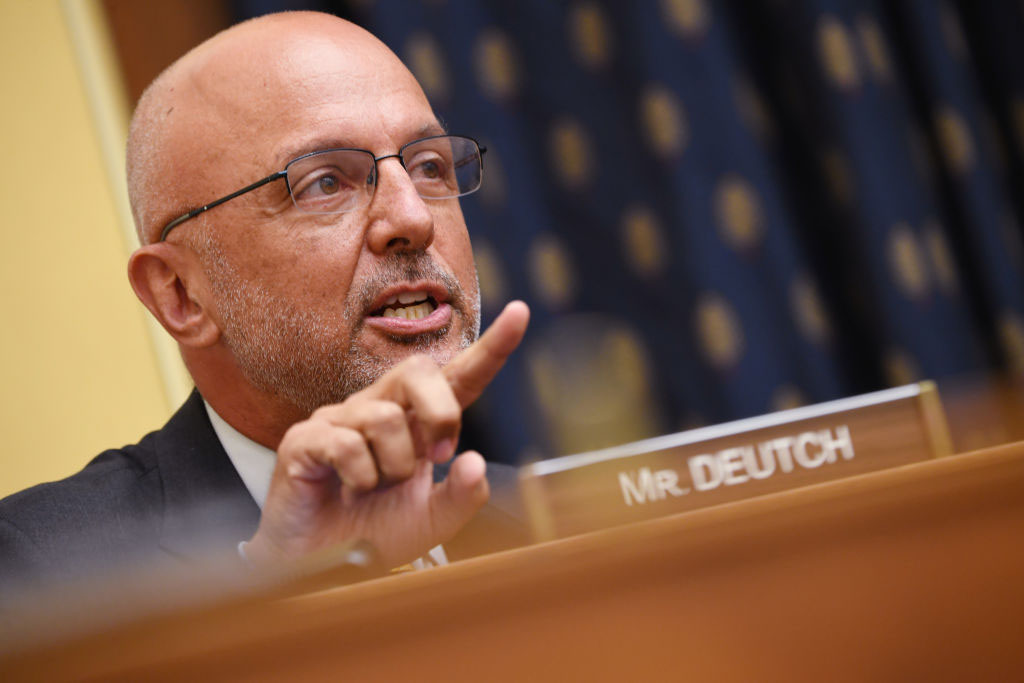
 Ironically, the organization that hosted the event that led to Sarah Milgrim and Yaron Lischinsky’s heartbreaking deaths may also be the best-positioned to take on this challenge. The American Jewish Committee devoted much of its time during the latter half of the 20th century to U.S.-based work, fighting for civil rights and strengthening Jewish-Christian relations before shifting its focus in the 1990s to international endeavors. But under the leadership of former U.S. Representative Ted Deutch (D-Fla.), who was named the group’s CEO in 2022, it’s become clear that the AJC has commendably reprioritized its work in this country.

Deutch has forcefully engaged in the fight against antisemitism on college campuses and brought a renewed energy to what appears to be a revitalized organization. If he decides to take on this challenge, it could be the AJC’s most vital contribution — and its greatest success.


Dan Schnur is the U.S. Politics Editor for the Jewish Journal. He teaches courses in politics, communications, and leadership at UC Berkeley, USC and Pepperdine. He hosts the monthly webinar “The Dan Schnur Political Report” for the Los Angeles World Affairs Council & Town Hall. Follow Dan’s work at www.danschnurpolitics.com.

AJC’s Moment Read More »

The Consequences of Unaffordable Education in Medicine and Teaching in America

Higher education in fields like medicine and teaching is becoming increasingly out of reach for many due to rising costs and the burden of student loans which can take decades to pay down. Moreover, when people can no longer afford to pursue degrees in these critical areas, the consequences ripple far beyond the student, impacting entire communities and the functioning of society. In essence, a shortage of qualified professionals in healthcare and education threatens to erode the pillars upon which the well-being and future of the nation rest.

The inability to afford degrees in education will lead to fewer people choosing teaching as a career. Schools, particularly in rural and underserved areas, will face increasing difficulties in filling vacancies. Over time, this could result in larger class sizes, diminished student-teacher interaction, and reduced overall quality of education. The long-term effects will likely include lower educational achievement and a less skilled workforce. Similarly, unaffordable medical education will deter aspiring doctors from entering the healthcare field, exacerbating existing shortages. Rural and marginalized communities will be the hardest hit, as fewer physicians will be available to provide essential care. Specialized fields such as primary care and psychiatry, which are already critically understaffed, could face further depletion, leading to longer wait times and poorer health outcomes.

When access to education in these professions is reserved for those who can afford it, socio-economic disparities will deepen. The shortage of teachers and doctors in underserved communities will disproportionately affect low-income households, perpetuating cycles of poverty and limiting opportunities for upward mobility. Further, the decline in educators and medical professionals will place a significant strain on public institutions. Schools may struggle to maintain the quality of education, while hospitals and clinics may experience operational inefficiencies due to understaffing. This can reduce trust in public services and undermine social cohesion.

The regretful erosion of the World War Two era of a collective sense of working towards a common good and shared vision of what America should look like is what is largely responsible for the perpetuation of debt-funded education. Therefore, solutions to the urgent teacher and medical shortages that are fueled by the extreme unaffordability in higher education must be championed by all who value the belief in life, liberty and the pursuit of happiness in its purest form. In practice, what this could look like is expanding access to scholarships and grants for education and medical degrees can help alleviate financial barriers. Specifically, targeted funding for students from low-income backgrounds or those committing to work in underserved areas could address the imbalance. Policymakers, who in theory should represent the interests of their constituents over corporate donors, must focus on reducing the costs of higher education through tuition caps, subsidized programs, and lower interest rates on student loans. These measures can make degrees in education and medicine more accessible, ensuring a steady influx of professionals into these fields.

Moreover, programs like Public Service Loan Forgiveness (PSLF) should be expanded and streamlined to encourage students to enter teaching and medical professions and actually deliver on the promise of student loan cancellation after the ten years of public service has been reached rather than deny borrowers their lawful cancellation due to bureaucratic and profit-driven motives to keep borrowers trapped in repayment far longer than legally required. Such initiatives can help mitigate the financial burden of loans while incentivizing work in high-need areas.

The inability to afford degrees in education and medicine is not just a personal financial failing. Rather, it is a crisis that if left unmitigated, can and will exacerbate the shortage of teachers and doctors and will consequently compromise the quality of life for millions, undermine the economy, and widen existing inequalities. By implementing targeted solutions to reduce financial barriers, society can ensure that these indispensable professions remain accessible, especially as the world of Artificial Intelligence further encroaches on job stability and access to quality healthcare for millions across the nation. 


Lisa Ansell Schneider is the Associate Director of the USC Casden Institute and Lecturer of Hebrew Language at Hebrew Union College-Jewish Institute of Religion Los Angeles.

The Consequences of Unaffordable Education in Medicine and Teaching in America Read More »

Counting What (and Who) Matters in Jewish LA

I’ve stood outside Elat Market more times than I can count — grabbing cucumbers, beef for stew or just soaking in the pre-Shabbat buzz. But this time was different. It was late at night, and I was slowly driving down the alley behind the market as a volunteer for the 2025 Los Angeles Homeless Count.

In addition to counting the omer as we do now, leading up to Shavuot, once a year, thousands of volunteers spread out across LA to count how many of our neighbors are living outside: on sidewalks, in cars, in tents, and alleys. This wasn’t my first time joining, but it was my first time counting in Pico-Robertson, the heart of LA’s religious Jewish community. I kept wondering: Would anyone be sleeping outside here? Would any of them be Jewish?

Data from 2021 shows that about 19% of Jewish Angelenos are struggling to make ends meet. New preliminary data from the Jewish Federations of North America shows that in 2025, 29% of American Jews are struggling to make ends meet. 

These families are not outliers. They are single parents in Pico-Robertson choosing between a Hebrew school payment and a mortgage. They are older adults in Encino skipping doctor visits because of copays. They are students at UCLA, quietly picking up free produce from the food pantry between classes. Yet in too many Jewish spaces, economic vulnerability remains unspoken — a taboo hidden behind summer camp fundraisers and reduced synagogue membership options. But that’s starting to change.

Two years ago, I began leading an initiative called Together Ending Need (TEN), a partnership between the Harry and Jeanette Weinberg Foundation and the Jewish Funders Network. TEN brings together funders, agencies and Jewish leaders to ensure that every Jew has access to food, housing, healthcare and the full experience of Jewish life, regardless of income.

We recently released a new study, “On the Edge,” conducted by Tulane University and Rosov Consulting. It affirms what many who are struggling know: Jews experiencing economic insecurity often feel unrooted — or even invisible — in Jewish communal life. One Jewish Family Services social worker put it plainly:

“Shame — it’s shame … I can’t tell you how many people say, ‘I dropped out of the Jewish community because we’re so embarrassed.’ It’s hands down shame that prevents them from being connected to the community.”

As an Iranian Jew, this isn’t hard to recall. Many of our families fled with very little. We received free school lunches and public benefits that helped us pursue the American dream. But we know this dream was never within reach for everyone. In our greater Jewish community, many still benefit from Jewish Family Services of Los Angeles – a longtime safety net now offering over 30 essential programs, or Tomchei Shabbos and the many other Jewish groups showing up every day for vulnerable Jews here at home. 

Something unique the On The Edge study showed was that Jews are often situationally vulnerable. Illness, caretaking responsibilities, and job loss were the three leading characteristics of Jewish people experiencing economic vulnerability. These challenges are heightened with the federal government’s layoffs, budget cuts and the impending cuts to Medicaid and SNAP. And with the rise in antisemitism, more Jews are seeking support specifically from Jewish agencies.

During the homeless count that night, we identified 20 people sleeping outside in Pico-Robertson. I don’t know how many were Jewish. But I do know this: a few months ago, I saw a tallit draped across the windshield of a car being used as a home. A sacred garment, repurposed as a protective shield for someone. That image still sits with me.

So, what can we do? First, sign up and join me in the homeless count next January. This year, the organizers and the Jewish Federation of LA said we needed at least 10 more volunteers. And in the meantime, pay attention when the 2025 Homeless Count data is released. 

Second, find ways to tell the story of Jews that reflects our economic diversity. You don’t need to go very far back in most families’ history to find a poor Jew. It shouldn’t be so hard to believe there are still Jews in our community who need support. It’s our responsibility to bring light to the story. Numbers and data matter. Stories we tell matter more.

In Jewish tradition, we’re taught that every person is created b’tzelem Elohim, in the image of God. That includes those sleeping behind the market. May we count each of them not just once a year, but always, as part of our sacred community and support the programs that make our city one that is more just and fitting of its angelic name.


Rachel Sumekh is an Iranian Jewish activist. She is the director of Together Ending Need, a community of philanthropies committed to supporting economically vulnerable Jews meet their basic needs and live a thriving Jewish life. She is the Founder and CEO Emeritus of Swipe Out Hunger. 

Counting What (and Who) Matters in Jewish LA Read More »

Anti-Zionism from the Standpoint of Its Victims

Last week, social media was ablaze with news that Israel had struck the European Hospital in Gaza. A single interpretation of this event prevailed: Israel, in an act of genocidal sadism, had targeted the hospital for no reason other than to terrorize innocent civilians as they sought medical care.

The IDF told a different story, saying that the target of the strike was none other than Mohammed Sinwar, the brother of the late Yahya Sinwar and the current head of Hamas, but people were skeptical of this claim. As one BBC reporter stated, “The IDF has failed to provide any evidence whatsoever that Sinwar was at the hospital.”

The reason the IDF “failed” to provide this evidence, however, was that they were still verifying it. Unlike Hamas, which makes wild pronouncements about fatalities after every Israeli strike and then quietly corrects the record months later, the IDF tries to confirm information before publishing it. It would take an entire week before the IDF was able to announce that Sinwar had indeed been killed in the strike. Furthermore, new documentation showed that the strike had not hit the hospital building itself, but rather the area outside the building in the hospital compound. 

But by then, the damage was done. Israel had been maligned as a villainous hospital-bomber and what should have been the headline — that Hamas’ top military commander was hiding out in a bunker under a hospital — went largely unreported. 

According to international law, protected zones lose their protected status when used for military purposes. If Hamas uses a hospital for a bunker, or an ambulance for a military transport, or a humanitarian zone to hide hostages — all of which it has done — it can no longer expect such areas to be immune from attack. 

This abuse of protected zones is a key element of Hamas’ strategy, and it is an incredibly effective way to provoke outrage against Israel. We have seen these war crimes for 18 months now, but sometimes I’m still capable of being shocked — and Sinwar’s hospital hideout shocked me.

Consider what you know about Gaza right now. Regardless of what one feels about Israel’s continued war, it’s a fact that the people of Gaza are facing incredible hardships and live in a constant state of fear and uncertainty. Amidst this humanitarian crisis, their leader — the one supposedly championing their cause — nestles under one of their last functioning hospitals, transforming it into a target for a strike. 

I was also shocked in 2024 when I learned that Mohammed Deif, then Hamas’ number two man, was killed in a strike in what had been designated as a humanitarian zone. Then, as now, the story was reported as if Israel was mercilessly raining down fire on innocent civilians for the sport of it. In reality, it wasn’t Israel that had violated the humanitarian zone, but Deif, who clearly saw the civilians around him as cheap and expendable. 

Palestinian-American intellectual Edward Said famously argued that Zionism must be evaluated from the standpoint of its victims, not its beneficiaries. We need not be afraid of such a proposition. Zionism can withstand critique and it can also withstand an honest examination of its shortcomings and missteps, even the crimes that have been committed in its name.

But at the very least, Zionism has beneficiaries. Whatever else Zionism has wrought in the world, it has created a thriving and productive society where people of every race and religion enjoy the benefits of freedom and citizenship. It has welcomed and settled refugees from all over the world. It has created technologies and products that have benefited all of humanity. And it has protected its people from the constant onslaughts, invasions and massacres of its neighbors — with the security failure of Oct. 7 being a notable exception. 

Does anti-Zionism also have beneficiaries? Only a few billionaires in Qatar and a handful of anti-Israel TikTok influencers can claim this title. 

But what happens when we evaluate anti-Zionism from the standpoint of its victims? Here we embark on a tour of human misery almost without end. It begins in 1948, when the Palestinians, aided by the Arab League, rejected coexistence in favor of a “war of extermination” against Israel, leading to the Palestinian refugee crisis. 

It continues with decades of failed wars, shortsighted strategies and rejected offers of statehood. 

As Jews, we are accustomed to thinking of ourselves as the victims of anti-Zionism. We think primarily of the massacres, the kidnappings, the wars and the terrorist attacks. But the people who have suffered the most from anti-Zionism are the Palestinians themselves. 

Look to Gaza — a wasteland of rubble that could have been a thriving society by the sea had its leaders’ venomous hatred of Israel not led them to hollow out its cities with tunnels, build bunkers under hospitals and schools, hide top military brass in humanitarian zones and sacrifice their own people on the altar of their holy war against Israel’s existence.  

Sinwar’s subterranean hospital bunker should make one thing very clear. One can be an anti-Zionist or one can care about the well-being and the future of Palestinians in the Gaza strip, but not both.


Matthew Schultz is a Jewish Journal columnist and rabbinical student at Hebrew College. He is the author of the essay collection “What Came Before” (Tupelo, 2020) and lives in Boston and Jerusalem.  

Anti-Zionism from the Standpoint of Its Victims Read More »

A Shavuot Story: How Ruth’s Loyalty Inspired American Liberty

On the holiday of Shavuot, the biblical book of Ruth is read in synagogue. Explanations for this practice include the springtime setting of both the tale and the holiday, as well as the heroine’s acceptance of Judaism, which thematically connects to the festival’s commemoration of the acceptance of God’s law at Sinai by the Israelites in the days of Moses. While the scriptural story records Ruth as the ancestor of King David, American history credits her as a figure who helped advance civil rights and liberty.

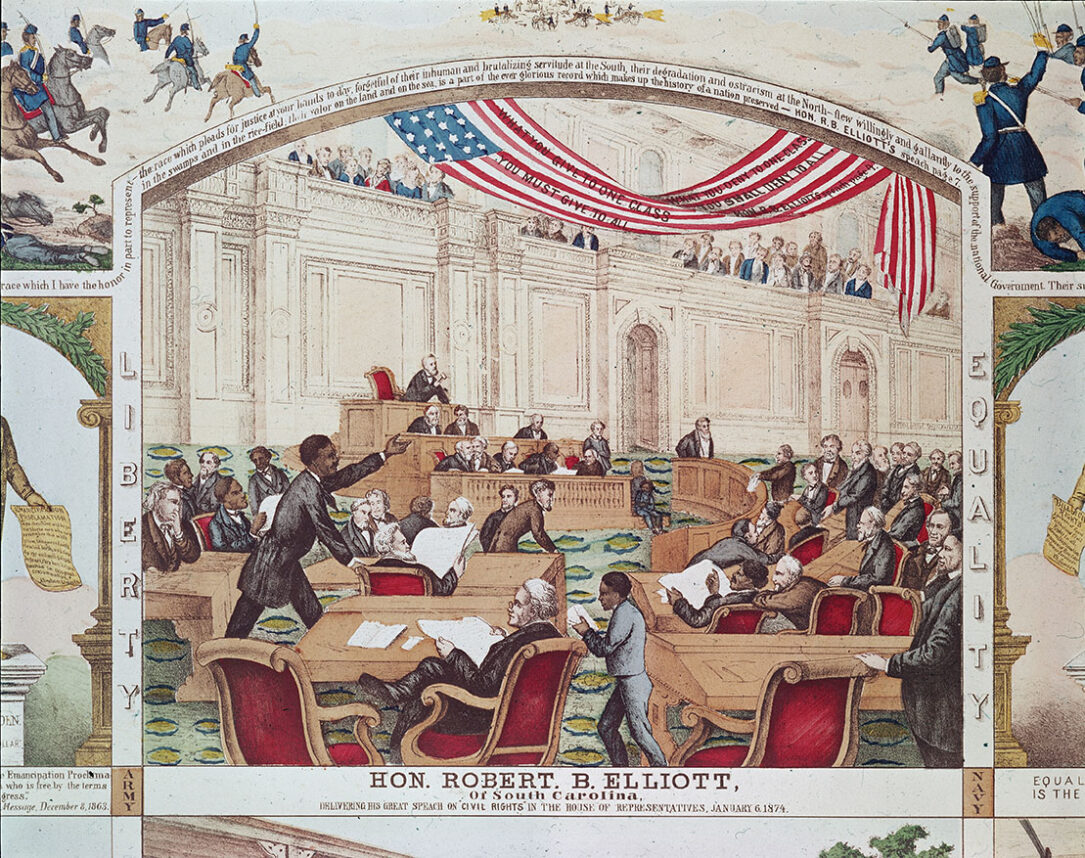
In a Jan. 6, 1874 speech, Representative Robert Brown Elliott invoked the heroine in arguing before Congress on behalf of equal treatment for all Americans.

Elliott was a fascinating figure. Born in 1842 in Liverpool, England, he was educated at the prestigious Eton College, served in the British Royal Navy, and then immigrated to America, where he settled in South Carolina in 1867. There he campaigned against the Ku Klux Klan, was elected to the state legislature and later commanded the South Carolina National Guard, the first Black man to do so. Elliott also served in the U.S. House of Representatives from 1870 to 1874. It was there that he gave a speech urging the passage of what would become the Civil Rights Act of 1875.

Powerfully, he began by arguing that while the cause was undoubtedly personally relevant, that was not why he was advocating for the legislation: “While I am sincerely grateful for this high mark of courtesy that has been accorded to me by this House,” he said, “it is a matter of regret to me that it is necessary at this day that I should rise in the presence of an American Congress to advocate a bill which simply asserts equal rights and equal public privileges for all classes of American citizens. I regret, sir, that the dark hue of my skin may lend a color to the imputation that I am controlled by motives personal to myself in my advocacy of this great measure of national justice. Sir, the motive that impels me is restricted by no such narrow boundary but is as broad as your Constitution. I advocate it, sir, because it is right.”

Citing Alexander Hamilton’s argument that “natural liberty is a gift of the beneficent Creator to the whole human race,” Elliott reminded the House that “it is scarcely 12 years since [the South] shocked the civilized world by announcing the birth of a government which rested on human slavery as its cornerstone.” He expressed relief that the “progress of events has swept away that pseudo-government which rested on greed, pride, and tyranny.”

The bill on the floor, Elliott believed, “does not seek to confer new rights, nor to place rights conferred by state citizenship under the protection of the United States, but simply to prevent and forbid inequality and discrimination on account of race, color, or previous condition of servitude.” If it was to pass, the congressman passionately proclaimed, “it will form the capstone of that temple of liberty, begun on this continent under discouraging circumstances, carried on in spite of the sneers of monarchists and the cavils of pretended friends of freedom, until at last it stands in all its beautiful symmetry and proportions, a building the grandest which the world has ever seen, realizing the most sanguine expectations and the highest hopes of those who, in the name of equal, impartial, and universal liberty, laid the foundation stones.”

It was then that he turned to the ancient Jewish figure of Ruth. 

“The Holy Scriptures,” Elliott concluded, “tell us of a humble handmaiden who long, faithfully, and patiently gleaned in the rich fields of her wealthy kinsman; and we are told further that at last, in spite of her humble antecedents, she found complete favor in his sight.” 

Illustration depicting American politician US Representative from South Carolina Robert Brown Elliott (1842 – 1884) delivering a Civil Rights speech in the House of Representatives, Washington DC, January 6, 1874. (Photo by Kean Collection/Getty Images)

To this British-born, black American Congressman, Ruth’s having earned full acceptance into the nation of Israel foreshadowed the expansion of equality in the American national narrative. Should the law be enacted, should all citizens receive the equal rights they deserve, “we may, with hearts overflowing with gratitude, and thankful that our prayer has been granted, repeat the prayer of Ruth: ‘Entreat me not to leave thee, or to return from following after thee; for whither thou goest, I will go; and where thou lodgest, I will lodge; thy people shall be my people, and thy god my God; where thou diest, will I die, and there will I be buried; the Lord do so to me, and more also, if aught but death part thee and me.” 

Quoting Ruth’s pledge of loyalty to her mother-in-law Naomi as the two headed to the Promised Land, Elliott saw a prefiguring of the march of American liberty. 

Even after Elliott’s well-received speech, and the Civil Rights Act’s passage, the path towards full equality for all Americans would remain long and winding. But Ruth would remain as an inspiration for advocates of social equality and freedom in our country.

Helen Keller, born in Tuscumbia, Alabama six years after Elliott’s speech, also reflected on the biblical figure’s foundational impact on her advocacy for equality. After losing her sight and hearing after an illness at 19 months old, Keller, under the tutelage of her teacher Anne Sullivan, learned to read and write. Her graduation at Harvard made her the first deafblind person to earn an undergraduate degree in U.S. history. She campaigned on behalf of disability rights, women’s suffrage and labor rights, and co-founded the American Civil Liberties Union (ACLU). In her 1903 autobiography, “The Story of My Life,” Keller wrote movingly of her love of the Bible.

“[H]ow shall I speak of the glories I have since discovered in the Bible?” she wrote. “For years I have read it with an ever-broadening sense of joy and inspiration; and I love it as I love no other book.” She expressed an affinity for Esther, the ancient Persian Jewish queen, wondering, “[c]ould there be anything more dramatic than the scene in which Esther stands before her wicked lord? She knows her life is in his hands; there is no one to protect her from his wrath. Yet, conquering her woman’s fear, she approaches him, animated by the noblest patriotism, having but one thought: ‘If I perish, I perish; but if I live, my people shall live.’” 

But Keller’s favorite figure was Ruth. “Ruth is so loyal and gentle-hearted,” she enthused. “We cannot help loving her, as she stands with the reapers amid the waving corn. Her beautiful, unselfish spirit shines out like a bright star in the night of a dark and cruel age. Love like Ruth’s, love which can rise above conflicting creeds and deep-seated racial prejudices, is hard to find in all the world.”

Decades later, as the United States faced the greatest threat to liberty that the world has ever known, the Nazi menace, Ruth reappeared once more. 

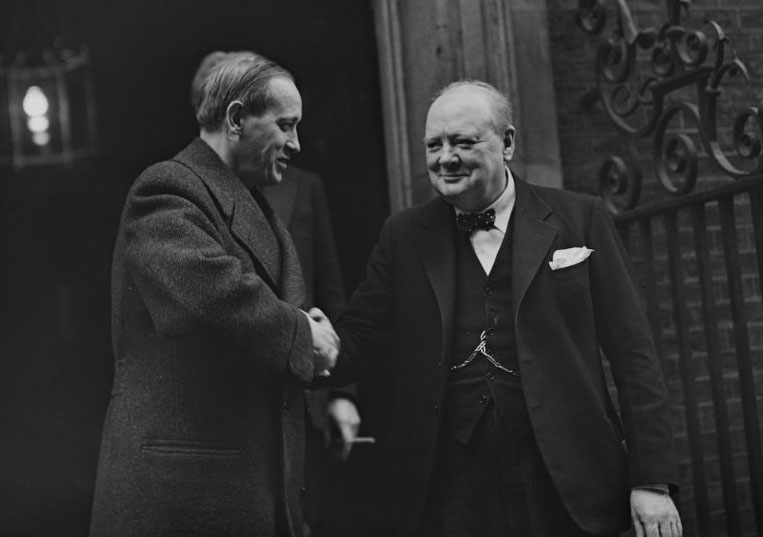
Decades later, as the United States faced the greatest threat to liberty that the world has ever known, the Nazi menace, Ruth reappeared once more. Harry Hopkins, a trusted deputy of President Franklin Delano Roosevelt, attended a dinner in England in January 1941, to show support for Prime Minister Winston Churchill. The setting was dire. As Hopkins’ granddaughter, historian June Hopkins, has recounted, “Hitler’s armies now held most of Western Europe, and seemed to be rolling through the Soviet Union; Congress was squabbling over intervention versus isolation; Britain and the Commonwealth seemed to be losing everywhere.” 

Though America would not enter WWII for a few more months, Hopkins was there to express American support for the Allies. As his granddaughter would later write, “though [Harry Hopkins] had no official title, some called him (not always with approval) the ‘Assistant President.’ He certainly wielded extraordinary influence in the White House. But Hopkins was not a shadowy figure hovering in the background, nor was he merely an intermediary. He served, rather, as a kind of third leg of a tripod. Churchill and Roosevelt had previously viewed each other with a wary eye; Hopkins provided stability for the often-tenuous balance between two powerful leaders with very different world outlooks.”

American public administrator, and presidential advisor Harry Hopkins shakes hands with British politician Winston Churchill, the UK Prime Minister, outside 10 Downing Street in Westminster, London, England, January 1941. (Photo by Central Press/Hulton Archive/Getty Images)

During the dinner, Hopkins turned to the Prime Minister and said: “I suppose you wish to know what I am going to say to President Roosevelt on my return. Well, I’m going to quote you one verse from that Book of Books. . . . ‘Whither thou goest, I will go; and where thou lodgest, I will lodge: thy people shall be my people, and thy God my God.’” And, added Hopkins, “even to the end.”

Throughout the American story, Ruth has reverberated, reminding us, then and now — as we read her eponymous book once more on the holiday of Shavuot — of the power of one individual’s faith and loyalty to inspire the fight for freedom and liberty.


Rabbi Dr. Stuart Halpern is Senior Adviser to the Provost of Yeshiva University and Deputy Director of Y.U.’s Straus Center for Torah and Western Thought. His books include “The Promise of Liberty: A Passover Haggada,” which examines the Exodus story’s impact on the United States, “Esther in America,” “Gleanings: Reflections on Ruth” and “Proclaim Liberty Throughout the Land: The Hebrew Bible in the United States.”

A Shavuot Story: How Ruth’s Loyalty Inspired American Liberty Read More »