fbpx

April 17, 2025

Rabbis of LA | Rabbi Leah Fein Proves You Can Go Home Again

After nine months on the job at Wilshire Boulevard Temple, Rabbi Leah Fein still can’t believe she’s back in Los Angeles.  “I feel lucky Wilshire was looking when I was looking,” she said. But how could Wilshire resist hiring a member of its own family – even if she had been on the East Coast nearly 20 years?

Those family ties helped bring her back.  Starting with her grandmother’s 1947 Confirmation class, Rabbi Fein is the fourth generation at the city’s oldest synagogue. Her family knew Jodi Berman, now at Stephen Wise Temple, when she was the associate executive director at Wilshire. The rabbi explained that Berman “has been close with my family for many years, and from being a gabbai with my mom at Torah in the Round, Rabbi Sherre Hirsch’s service. We have stayed in touch over the years.” It was Berman who let her know about Wilshire Boulevard Temple’s opening. 

Her return to Los Angeles last July has “far exceeded my expectations.” Although she’s been back less than a year, she feels like it has been a homecoming in multiple ways. “I am literally home with family and friends,” she told The Journal. “But I am also at home here at Wilshire Boulevard Temple. My son Asher (almost two) is fifth generation. His classroom is downstairs in this building” on Wilshire Boulevard Temple’s sprawling Westside Irmas Campus on Olympic Boulevard. “This is the greatest gift,” she said.

Although her parents were very involved at Wilshire when she was growing up, there were no schools at Wilshire Boulevard Temple, so she went to school at Sinai Temple. She had a wonderful experience there, one that set her on her career course. “While I was a student at Sinai, Rabbi Sherre Hirsch became the first female rabbi at Sinai.” Fein pointed out that Hirsch inaugurated a minyan there, Torah in the Round. “My Mom, being a feminist Jewish mother, said ‘There’s a female rabbi at Sinai, and we are going to her services.’”

Between Sinai’s day school and Rabbi Hirsch, Fein’s family became thoroughly involved in the Hirsch minyan. “My Mom became a gabbai, assisting in Rabbi Hirsch’s minyan — that was really amazing.” Rabbi Hirsch also influenced Fein’s choice to study at the Conservative movement’s Jewish Theological Seminary (JTS). Hirsch was an alumna, which Fein said was the most persuasive factor for her choosing JTS. “I really loved learning with her for my bat mitzvah,” Fein said. “I went to Brandeis undergrad. Some of my professors there had gone to JTS. A lot of rabbis I was connected with were JTS grads – Sinai, Brandeis and Camp Ramah.”

Fein was ordained at JTS in 2015. After rabbinical school, Fein and her husband Alex moved to Syracuse for four years while he was in med school. She led Syracuse Hillel. When they returned to Manhattan, she worked at the Columbia/Barnard Hillel. They had a long-term plan. “We decided he would do all of his medical training in New York,” she said. “When he was done, we would move back here to be with my family.”

That family is an engaging blend of all major streams of Judaism. “My husband grew up Modern Orthodox” in the Orthodox stronghold of Monsey, N.Y. “My parents, my family – all Reform. I went to Conservative schools. So we are a little bit all over the place — it’s reflected in me professionally and with my family.”

At the Irmas Campus, Fein was engaging and enthusiastic in describing her duties. “A big part of my job is engagement and relationship-building,” she said. “I meet with congregants on this side of town since I am based here on the Westside. All generations. My goal now is just to get to know people, the community. I am new here. Part of (Senior) Rabbi Joel Nickerson’s vision — one of the reasons I was excited to work here — is that he talks about Wilshire Boulevard Temple being a large community. Our work as clergy is to make it feel small and to make sure our congregants feel known.”

One of the great lessons she learned at Hillel is “you can’t wait for people to come to you, and you can’t expect people to come to you,” so Rabbi Fein tries to be everywhere. “I am with our Religious School, I am with the ECC, with our Day School, I am involved with our Young Professionals programming. I am on the bimah for most Shabbatot and holidays. I do lifecycle events, too. … I love that every day looks different, and I get to do all of these things.”  

One of the great lessons she learned at Hillel is “you can’t wait for people to come to you, and you can’t expect people to come to you,” so Rabbi Fein tries to be everywhere. 

As rabbi, “you need to reach out, offer something personal. So when I reach out to congregants, I am just trying to get to know people, not trying to sell anybody on anything. 

Her formula is direct. “I just ask questions,” the rabbi explained. “I am curious about people, hearing their stories. My favorite books are memoirs and biographies – about show business, religious, political – all of them.”

She just tries to get to know people and connect them to one another in an intentional way. After that, “I can help them plug into what is going to be meaningful and interesting for them within Jewish life here.


Fast Takes with Rabbi Fein

Jewish Journal: What is a favorite Wilshire Boulevard Temple memory from your childhood?

Rabbi Fein: Sitting in the sanctuary at the Glazer Campus with my family for High Holy Day services. I love visual art, and I remember being struck by the murals, the dome, the size of the sanctuary, reading and understanding the Hebrew on the walls.

J.J. What is your career goal?

Rabbi Fein: To help individuals and families connect to Judaism, Jewish life and living in ways that are right and meaningful for them, to experience joyful Judaism in community.

J.J.:  Is there one moment every week you are eager to repeat?

Rabbi Fein: My favorite moment is on Friday mornings when the ECC comes to the chapel for Shabbat. Here comes my son Asher, almost 2. When we open the Ark and start bringing around the Torah, seeing the joy on the kids’ faces, and especially on my son’s face as he kisses the Torah — that is the best part of my week.

Rabbis of LA | Rabbi Leah Fein Proves You Can Go Home Again Read More »

LAJFF Screening, Federation Seder, Birthright Summit, Photo Exhibit

On March 27, the Los Angeles premiere of the new documentary “For the Living” was held at the Museum of Tolerance, in partnership with the L.A. Jewish Film Festival, Museum of Tolerance, Holocaust Museum LA and the Goldrich Family Foundation. 

 The film screened to an audience of 300 guests, followed by a Q&A with the film’s co-directors, Marc Bennett and Tim Roper, executive producer Melinda Goldrich, writer Rabbi Brett Kopin and Holocaust scholar Michael Berenbaum, moderated by Hilary Helstein, director of L.A. Jewish Film Festival. The evening opened with remarks by Museum of Tolerance Deputy Director Mark Katrikh and Holocaust Museum LA CEO Beth Kean.


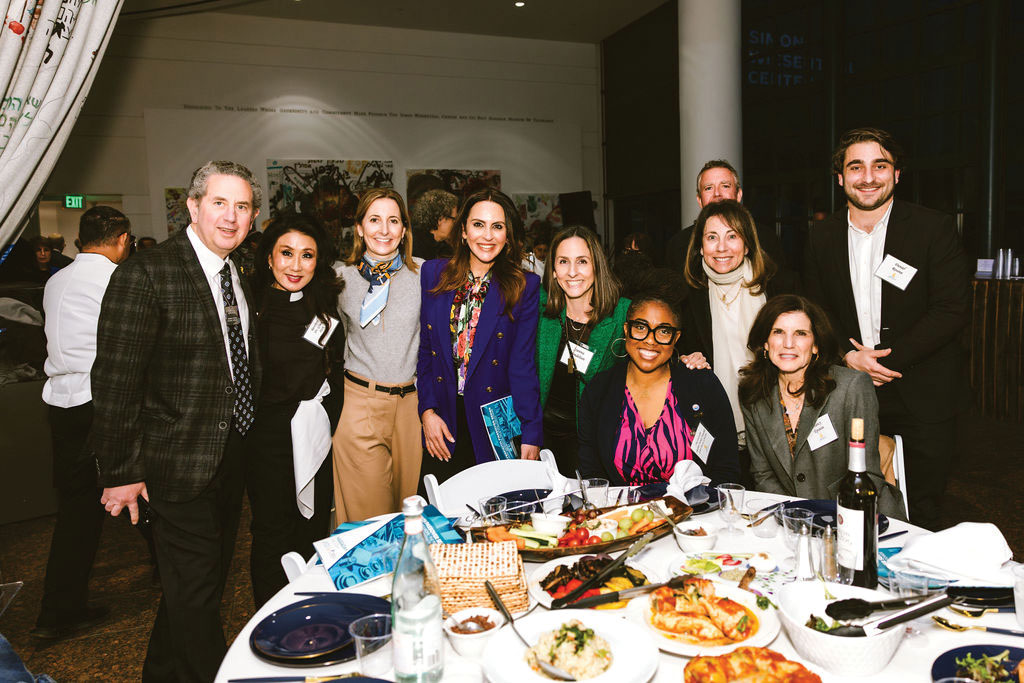
From left: Rick Hirschhaut, Rev. Dr. Grace Park, Beth Kean, Beverly Hills Mayor Sharona Nazarian, Joanna Mendelson, LAUSD School Board Member Sherlett Hendy Newbill, Debi Graboff, Nancy Epstein and Daniel Rosove. Back row: Rev. John Shaver. Courtesy of Jewish Federation Los Angeles

On April 3, Jewish Federation Los Angeles, in partnership with the Museum of Tolerance, held its annual Interfaith Passover Seder — “From Hardship to Hope: The Power of Collective Strength” — bringing together religious leaders, elected officials and first responders to honor and celebrate the Los Angeles community. 

The program eloquently connected the universal themes of Passover — perseverance, liberation, and renewal — to the city’s resilient response to the wildfires. Civic partners, interfaith leaders, survivors, social service providers and many other members of Los Angeles’ diverse communities joined to learn about Passover traditions, hear stirring choir performances, create an interactive origami community project, and connect with both new and old friends, as they collectively work toward building a more compassionate and connected city.

From left: Jewish Federation Los Angeles’ Carol Koransky; First AME Church Rev. Judi Wortham-Sauls; Shawn White, and Federation Board Chair Orna Wolens. Courtesy of Jewish Federation Los Angeles

Los Angeles attendees of the latest Birthright Excel Summit included (from left) Madison Stein, Charlotte Fletcher, Yaniv Sadka, Zoe Pessin, Solomon Olshin, Josh Khalili, Ethan Finestone and Sydney Bloch. Photo by Ohad Kab, Birthright Israel Excel

Birthright Excel’s recent Excelerate25 Summit was held last month in New York, with more than 400 Excel fellows from North America and around the world turning out for the weekend-long event.

The theme of the summit was “Building Bridges. Building Business. Building the Jewish Future.” 

Throughout the weekend, participants engaged in global networking opportunities and attended peer-to-peer workshops on topics ranging from impact investing to climate tech, artificial intelligence and the evolution of venture capital. 

Speakers included Tom Nides, vice chairman of strategy and client relations at Blackstone and a former U.S. ambassador to Israel. Nides discussed the intersection of diplomacy and business. 

“At a time when the global Jewish community is navigating unprecedented challenges, Birthright Israel Excel continues to stand out as a beacon of unity, innovation, and leadership,” Birthright Israel CEO Gidi Mark said. “This Summit showed the power of our Fellows — rising business leaders from across the world — who are not only shaping the future of global industries but also stepping up to strengthen Jewish life post-Oct. 7.” 

Excel — a lifelong, global business fellowship focused on professional development, networking, personal growth, Israel engagement, and Jewish identity — is a program of Birthright Israel. The program selects extraordinary college students for a summer business or tech internship in Tel Aviv at leading companies. Upon their return, Excel fellows join a global community that provides resources for personal and professional development.


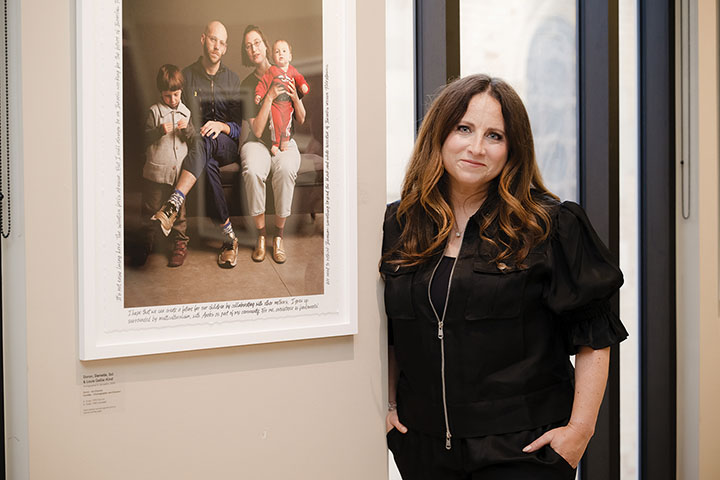
Photographer Shlomit Levy Bard.
Courtesy of Karina Pires Photography

“(RE)Defining Zionism: Portraits and Perspectives from a Post-Oct. 7 Israel,” a new photography exhibit featuring works by Shlomit Levy Bard, recently opened at Hillel at UCLA, with hundreds of guests turning out to view the images.

Bard has traveled around Israel — Haifa, Jerusalem, Tel Aviv, Beersheva, and the Gaza border — photographing and interviewing ordinary citizens and well-known figures. Her exhibit grapples with what Zionism means in the wake of Oct. 7 by depicting unfiltered, emotive photographs and personal stories from over 60 Israelis. 

The goal, she said, is challenging the one-dimensional narratives currently dominating Western debates, particularly on U.S. college campuses.

“Campus conversations on Zionism often force people into ideological boxes — either you stand for Palestinian rights, or you stand for Israel,” Bard, who emigrated to Los Angeles from Israel at a young age, said. “But in Israel, the lines aren’t so clear-cut. This exhibit challenges those binaries, offering firsthand perspectives that refuse to be reduced to a slogan.”

Bard’s work displays at UCLA Hillel through June 18. To learn more, visit uclahillel.org

LAJFF Screening, Federation Seder, Birthright Summit, Photo Exhibit Read More »

Black Jewish Woman Denied Service at Staples Calls Incident ‘A Serious Ambush’

Elisheva Rishon, the woman who was denied service at a Staples store in Los Angeles’ Mid-Wilshire area, said in an interview with The Journal that she believes the Staples employees ambushed her.

Rishon, a Black Jewish Orthodox woman, had posted videos from her encounter at the Staples store on April 7 to her Instagram account “@therealeli7designs” in a story titled “staples incident”; the videos show a Staples employee named Ryatt claiming that he could not process her order for her postcards stating “Black Jewish Zionist Squad” and “Jewish Joy” because he found the use of “Zionist” in the cards to be racist. After Rishon argued with Ryatt, Ryatt’s manager Cynthia eventually stepped in and after a back-and-forth tells Rishon “we’re done” and a customer angrily told Rishon that he didn’t “want to hear you yell” to “leave them alone and shut the f— up.” “There are a lot of people here that need service,” the customer added. “Fix your wig and get the hell out of here.”

Speaking to The Journal over Zoom on April 11 alongside her attorney, Lawfare Project Senior Counsel Gerard Filitti, Rishon explained that she gives out the “Jewish Joy” cards to remind people “to center Jewish joy instead of the hate that we face because unfortunately most people, especially in America, have made the foundation of their Jewish identity antisemitism … so I always hand these out to people and I tell them to put it in their cars, in their rooms, on their refrigerators so they remember every day what it means to be Jewish.” As for the “Black Jewish Zionist Squad” cards, Rishon started the squad as “an innovative program” to “uplift Black Jewish Zionists in America in multifaceted ways. I create safe spaces for Black Jewish Zionists to find themselves and to be empowered with their identity, to be able to go to out to other communities, to create coalitions, to create meaningful dialogues, and because Black Jewish Americans are the bridge between the Black community and the Jewish community.” The squad also provides career resources, consultations and content creation. “Nothing about this is offensive or racist at all whatsoever,” Rishon said. “But this person decided that both of them were so offensive that he had to delete the entire order.”

In her Instagram story, Rishon said that Ryatt had called her to come into the store and pick up her order. Rishon elaborated to The Journal that on the evening of April 7, she was in her pajamas and called to check the status of her order and that Ryatt had “very enthusiastically” told her the order was ready to be picked up and that he couldn’t wait to see her soon. “I honestly didn’t feel like going to the store because I was tired, it’s Monday night, and I was also coming off a cold by the way, so I wasn’t feeling the best of my health,” Rishon said. “But he sounded so enthusiastic that I didn’t want to disappoint him, I thought he was this young, new employee. So I actually came because of the enthusiasm in his voice.”

When Rishon arrived at the store, she wanted to match Ryatt’s energy on the phone and was ready to start filming her getting the cards. Ryatt put Rishon’s name into the computer, and he appeared “confused”; initially, Rishon thought he was confused to see her Jewish name associated with someone who is Black. “It looked like he was going to go get a box, the way that he was behind the cashier, so I still didn’t realize what was about to happen, and then he said, ‘Actually I didn’t print out your order because it’s racist,’” Rishon said. “I was shocked to hear what he was saying and I was already opening my phone because I was going to film it.”

Ryatt then said he found the term “Zionist” to be racist; Rishon then asked him what his definition of Zionism, he put the question on her, she gave her definition that it’s “being able to return to your homeland after over 2,000 years.” Rishon said that the way that Ryatt tilted his head made it clear that he didn’t like the answer and that he viewed Zionism as “extermination” and that’s how he thinks the masses view it.

As she continued her back-and-forth with Ryatt, she “began to realize the severity of the situation.” “He had historical inaccuracies, he said things like, ‘I’m not antisemitic because I’m a semite,’” Rishon said. “The term ‘antisemitism’ only applies to Jews because it was created by someone who actually was an antisemite, but he wanted to refer to his Jew-hatred, or to Jew-hatred in general, in a more scholarly way … so I see this guy also doesn’t know this.”

Rishon proceeded to turn the focus of the conversation to her “Jewish Joy” cards, but “he also said it was Zionist.”

When Cynthia came to the situation, she initially claimed to not know what was going on, so Rishon said she explained what had happened to her and that Ryatt didn’t even print out the “Jewish Joy” cards that “had nothing at all about Zionism or Israel in it, and he denied it, you see him in the video denying it … and I kept insisting to her to go check the project … and then you see them looking at it, and I filmed her, and I’m like, ‘Ma’am do you see the cards… what do you see on the cards? It only says ‘Jewish Joy’… so he was lying about what the ‘Jewish Joy’ card said.

“And that’s when I realized something very significant happened: he was more so triggered by the ‘Jewish Joy’ cards than the BJZ Squad because he felt the need to lie about what it said,” she added. “So this is what really triggered him: the concept of Jews being happy.”

“So this is what really triggered him: the concept of Jews being happy.” – Elisheva Rishon

Rishon claimed that Cynthia then told her that when she was closing Ryatt’s register, he had told her that he was “uncomfortable with this order long before you came to this store, and I was like, ‘whoa, whoa, whoa, whoa, so you had this conversation hours ago? You told me when you came out you didn’t know anything at all about what was going on.’ And I began to realize, yes this was a serious ambush. He lied to get me to the store to pick up an imaginary order, and the manager said she knew nothing about it and then admitted she knew everything about it long before it happened. This was a very hostile type of situation.”

Additionally, Rishon said that Cynthia kept saying “that’s it, that’s it” and “didn’t even want to have the dialogue anymore.”

She further claimed that when new customers came into the store — she says there were about three behind her in line — Ryatt told them that Rishon “just came here to argue she’s so performative … he made it look like I was some sort of crazy customer.” Rishon also said that the customer who cussed at her also called her a “dirty a— woman.”

Additionally, when that customer cussed her out, Rishon contended that on the video you can hear the employees saying to him “thank you for doing that” and that by “misleading the customers” to what had happened, the employees were encouraging harassment toward her..

“It was a horrible experience overall,” she said. “Many forms of discrimination were hit all at once.”

There is video purportedly of Ryatt giving his version of the incident from his Instagram account, which has since been deleted. In the since-deleted video, he contended that “my job has a policy against any type of racist messaging, which Zionism holds lots of racist ideologies towards Arab people and Islamophobic ideologies towards anyone who practices Islam.” Ryatt claimed that he didn’t see the “Jewish Joy” card  and that “she wanted to focus on the fact that I didn’t print out the second cards that I didn’t really care to look at because I was just hit in the face with Zionistic messages and wanted to call me an antisemite.” He further claimed that he later offered to print the “Jewish Joy” cards for free but Rishon didn’t take him up on it. “She wanted to just keep arguing, keep filming and calling me an antisemite … it’s just so performative,” added Ryatt, who also said that his grandfather was Jewish and that he thinks that Judaism should be celebrated and that Judaism is not Zionism.

Rishon told The Journal that while Ryatt and Cynthia did at one point suggest printing the “Jewish Joy” cards for free, the manager did not want to have a discussion as to why the whole order was canceled in the first place and should have simply apologized and just printed the order for her. Rishon added that it seemed like they were trying to “halfway wiggle out of it” and only made the suggestion when customers began showing up behind her in line. Rishon said that she doesn’t like addressing the matter because she was still asking what was wrong with the order when the customer who cussed her out came up. “Why didn’t they print it?” Rishon asked.

Ryatt also claimed that there were seven people behind Rishon in line “rolling their eyes” at the situation. Rishon told The Journal that her videos that can be seen in her Instagram story speak for themselves and she didn’t feel the need to address Ryatt’s video. In her story, she contended that that he was lying in his video when he claimed she was being aggressive toward him.

Also in Rishon’s Instagram story is a slide stating that “the employee in his [Instagram] stories told his followers to reach out to him because he had personal information on me” and that he told the Internet to “do your thing.” “The situation was immediately brought to the attention of law enforcement on Thursday,” Rishon wrote in her story, adding that she “went into Shabbat & [the] chag with a larger amount of anxiety.” Filitti told The Journal that the “Internet do your thing” video amounted to “an apparent doxxing threat. So even the police is taking this behavior very seriously.”

Rishon also claimed that no one from Staples has reached out to her yet about the incident; on April 9, a spokesperson from Staples told The Journal: “Staples is aware of the recent interaction between a customer and associates at one of our stores in Los Angeles, California. Staples is currently investigating the circumstances involving this interaction. Staples remains committed to serving all customers, and we continue to work hard to ensure respectful and professional interactions in all situations.” Staples did not respond to The Journal’s request for comment following up on the matter.

On April 11, The Lawfare Project announced in a press release that it will be representing Rishon, stating that “the same employee that called her to pick up her order told her that he had refused to print the order and harassed her, targeting her identity as a Black Jewish woman and engaging in antisemitism, anti-Black racism, and colorism. The person purporting to be the store manager did nothing to prevent Elisheva’s civil rights from being violated, choosing instead to support the employee who was targeting Elisheva.”

Filitti told The Journal that a lawsuit is “one of the strong options that we are considering. … Seeing that Staples has not even bothered to reach out to Elisheva with regard to this incident, it looks increasingly likely that legal action may need to be taken. They’re not taking this incident seriously.” Filitti also claimed that Staples’ employees may have seemingly encouraged “a customer to menace Elisheva without providing her safety. What would have happened if that finger waved in her face turned into a fist or a shove or something else? … again, a failure on Staples’ part with regard to the conduct of their employees.”

He added: “No person, no customer should be forced to negotiate their identity in order to be served. That’s not what the law says. When you’re forcing a customer to say, ‘Well I’m Jewish but not Zionist or you can ignore part of my identity,’ that’s not acceptable … This was, pure and simple, illegal discrimination by Staples of a Black Orthodox Jewish female customer. And given that Staples has not responded with more than a perfunctory statement that says absolutely nothing, given that the video is very clear about what happened, and these employees have not been terminated, given that they’ve not even bothered reaching out, then I think the next step is to seriously consider the appropriate legal action. We’re seeing a broader societal pattern where the antisemitism that we’re seeing in schools is translating to antisemitism on the streets and in the workplace … this is a systemic problem.”

Rishon said she’s “extremely grateful for the support that I’ve gotten from multiple communities … Antisemitism has gotten so bad at this point in time in this country and of course around the world … you have to set a precedent that this is not where we’re headed. We can’t allow our country to go down this direction. I’m still processing everything right now, and I’m doing the best that I can to try to create meaningful dialogues around this incident because there has to be some sort of positive, progressive outcome from this whole thing.”.

Black Jewish Woman Denied Service at Staples Calls Incident ‘A Serious Ambush’ Read More »

A Laundry List of Bitterness – A poem for Maror

…with bitter herbs they shall eat it. ~ Exodus 12:8

This bitterness, usually horseradish
is for the memory of building cities.
in a place where the locals refuse to
acknowledge we were ever there.

This bitterness, which could have been
a type of dandelion is for the names
erased from Egyptian cornerstones.

This bitterness, matching in volume the
size of in olive, is for our ancestors’ feet
that walked out of Egypt, but died in the
desert before reaching the promised land.

This bitterness, eaten over a few minutes
before dousing it with sweet mortar
is for the people who erase slaves’ names
from Federal websites. Harriet Tubman
may not appear next to the electronic
documentation of the Underground Railroad
but she’ll always hold space in this poem.

This bitterness, it shouldn’t be cooked
or mixed with anything, just raw bitterness
is for our cousins who take space in that
promised land, surrounded by neighbors
who re-write history every day.

This quaint bitterness on our plates
every seder, by law, by tradition is for
an explosion of unwelcome news –
our melting planet, our missiles, our
invaded borders, our suddenly
Greenland and Canada are problems.

This bitterness
of which there is no shortage –
Are you tasting it on your tongue
long enough?


Rick Lupert, a poet, songleader and graphic designer, is the author of 28 books including “God Wrestler: A Poem for Every Torah Portion.” Visit him at www.JewishPoetry.net

A Laundry List of Bitterness – A poem for Maror Read More »

A Bisl Torah — So Much Matzah

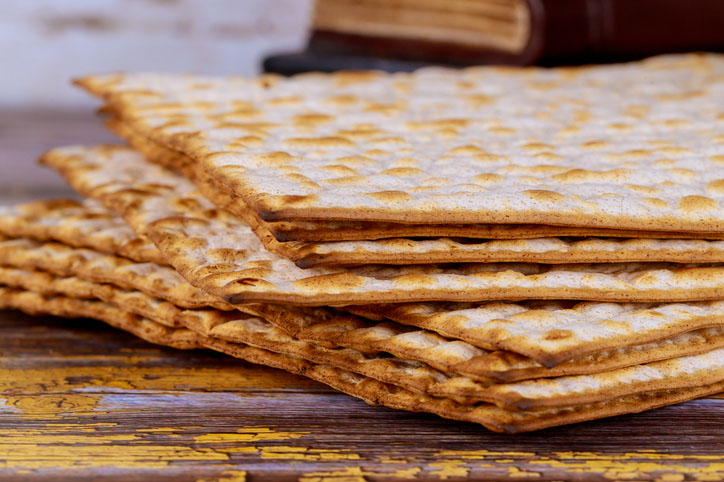
While we know there are four questions during the Passover Seder, there seems to be a fifth over the course of the week: how many ways can matzah be eaten?

The standards: matzah brei, matzah pizza, and matzah with butter. But now we’ve seen gourmet: matzah grilled cheese, matzah lasagna, and matzah granola. As I’m often chided over Passover, is this really representative of the Hebrew slave’s plight in history?

Professor Nahum Sarna reminds us that matzah was not a new invention to the Hebrew slaves. He writes, “The implication, justified by biblical texts, is that matzah is already known and, hence, a product independent of Exodus events.” Through the necessity of leaving quickly, matzah became the go-to cuisine as the slaves fled Egypt. But Sarna also suggests matzah was a meal swiftly prepared for unexpected guests. The meaning of matzah conveys everything from slavery to hospitality to prioritization. Ultimately, matzah symbolizes the story of the Jewish people.

The Jewish people have learned how to adapt, change, and grow throughout history. We are forced to flee from place to place, creating new homes and opportunities wherever we go. Through our collective plight, we continue to open our doors to those in need.

Just like matzah, our survival retains simple ingredients to ensure our success. Faith, tradition, and community push us forward. Whether we choose to eat matzah with jam or matzah brittle, we continue to recall our servitude, the Exodus from Egypt, our desire to bring people into our homes, and the commandment to retell our expanded story year after year.

May it be a week of a lot of matzah, a lot of meaning, and a lot of mitzvot. Let your matzah be tasty and most importantly, with each bite, make room for yourself within the story you are telling.


Rabbi Nicole Guzik is senior rabbi at Sinai Temple. She can be reached at her Facebook page at Rabbi Nicole Guzik or on Instagram @rabbiguzik. For more writings, visit Rabbi Guzik’s blog section from Sinai Temple’s website.

A Bisl Torah — So Much Matzah Read More »

Counting to the Next Festival on Sinai Mountain

Each of the Haggadah’s four sons reveals
himself by his expressions,
all four questions are like seals
confirmed by their confessions.

The wise one reveals that he is wise
with services that he
performs on Passover, the highs
he gets from liberty.

The wicked one reveals he’s not
a good man, using reason
to justify opposing what
Jews do, supporting treason.

The simple one reveals that he’s
less simple than we think,
since he is as inclined to please
as all the wine we drink.

The son who asks no questions shows
an open mind he closes
to learning, since he thinks he knows
far more than he supposes.

Three sons are what they say, the fourth
what he does As we
stretch to all four sons our kind hand forth,
we hope all will agree,

that during fifty days we’re counting,
focused on the next
great festival on Sinai mountain,
where we received the text

providing answers to questions asked
by only three sons, while
one does not ask, from answers masked,
but hopefully will smile

when saying “cheese,” cheered by cheesecake,
once Omer days are counted
by Shavuot; for Sinai’s sake
we smile, Sinai remounted.


Gershon Hepner is a poet who has written over 25,000 poems on subjects ranging from music to literature, politics to Torah. He grew up in England and moved to Los Angeles in 1976. Using his varied interests and experiences, he has authored dozens of papers in medical and academic journals, and authored “Legal Friction: Law, Narrative, and Identity Politics in Biblical Israel.” He can be reached at gershonhepner@gmail.com.

Counting to the Next Festival on Sinai Mountain Read More »

A Moment in Time: “Passover to Shavuot: Counting or Harnessing the Days?”

Dear all,

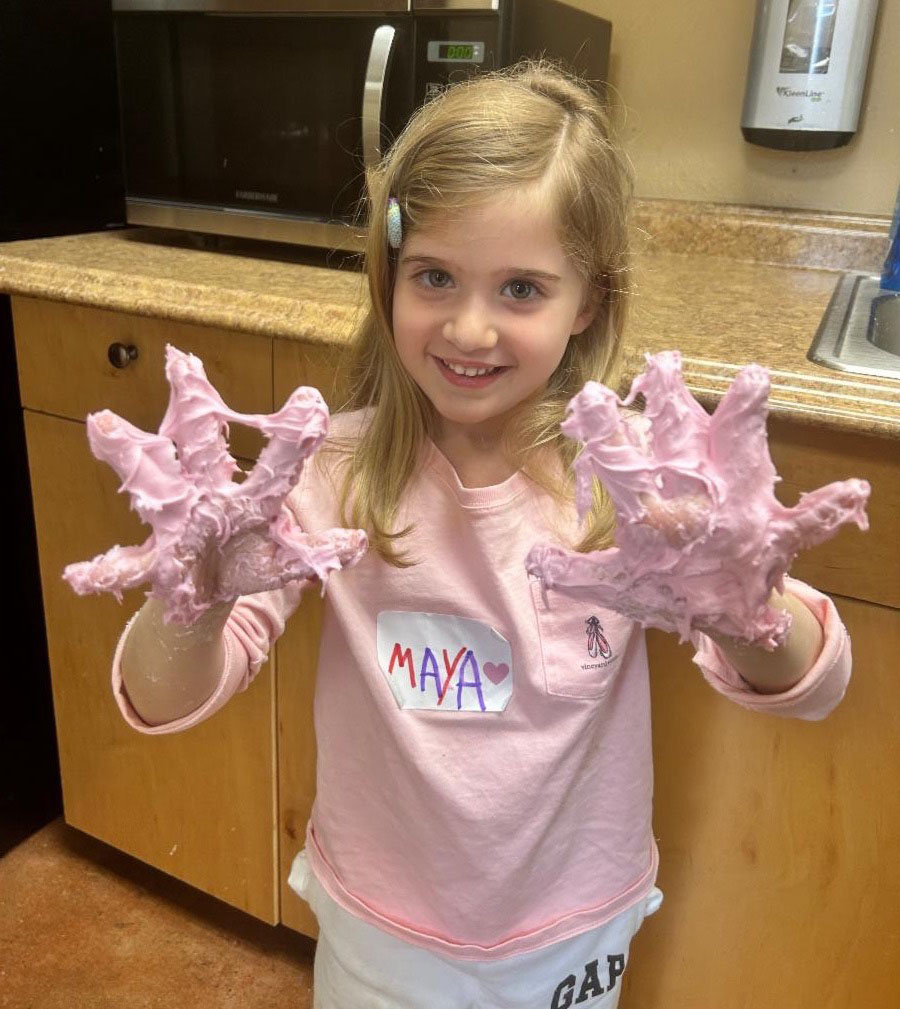
When I first saw Maya’s hands, I began to worry, “Yikes, PLEASE don’t schmutz up anything!”

But I then realized … Someday I will look back at this tender moment in time wistfully, yearning for the wonderment that comes with parenting a young child.

Ten sticky fingers. Ten incredible reasons to harness time.

This season between the Festivals of Passover and Shavuot, Jews traditionally count off each day with a measurement of barley. We call this “counting the omer.”

Are we counting the days in anticipation of something at the end?

Or are we harnessing amazing possibilities that accompany each day?

I would hope that we measure each day by the opportunity to harness goodness. We have the ability to recognize the beauty that surrounds us. We shouldn’t always be so focused on arriving there – but rather on our journey. We don’t want to miss out on all the sticky little fingers that create blessings in our lives.

With love and shalom,

Rabbi Zach Shapiro

A Moment in Time: “Passover to Shavuot: Counting or Harnessing the Days?” Read More »

Exploring Antarctica’s Penguins with Quark Expeditions

Thank you to Quark Expeditions for making my dream of not only stepping on my seventh continent but also hula-hooping there come true. I sailed south of the Antarctic circle on Quark Ultramarine with Fabrice Genevois, the Penguinologist Who Brings Antarctica to Life!
For over three decades, Fabrice Genevois has been sharing his deep passion for penguins, seabirds, and the polar regions with travelers from around the world. As a French expedition guide, marine biology presenter, and ornithology expert, Fabrice has spent 31 years with Quark Expeditions, making him one of the most experienced and engaging voices in Antarctic exploration. His knowledge, combined with his ability to captivate audiences, makes him an unforgettable part of any voyage to the White Continent.

WATCH MY INTERVIEW with FABRICE:

A Life Dedicated to Penguins

Fabrice has been studying penguins since 1987, earning his PhD in ornithology with a focus on these fascinating creatures. His love for penguins extends beyond research—he is also an accomplished author, having written multiple books, including a coffee table photo book, a bird identification guide, and even a children’s book series based on a true story from Antarctica about Toby the Polar Pig. His book Penguins 101 is particularly useful for travelers, offering a Q&A-style introduction to these charismatic birds, helping visitors prepare for their expedition and understand what they’re seeing in the field.

Bringing Penguins to Life Onboard and Onshore

Aboard the Quark Expeditions’ Ultramarine, Fabrice introduced passengers to the three species of penguins they would encounter—Chinstrap, Gentoo, and Adélie. Of these, the Adélie is the most iconic, as it is found only in Antarctica. Not every expedition gets to see their colonies, as it depends on conditions, making every sighting a privilege.
His lectures onboard are both informative and entertaining, offering insights into penguin behavior and why people find them so mesmerizing. “Penguins are a reflection of ourselves,” he explains. “They are bipedal, social, they argue, they cheat, and they make us smile.” Whether watching them nest, care for their chicks, or take their first swim, every stage of their life is captivating.
Fabrice also dispels common misconceptions about penguins, explaining their evolutionary journey. They are birds, despite having lost the ability to fly—something that actually benefits them, as it allows them to be stronger swimmers. He describes how their feathers have adapted to reduce drag underwater, and early explorers thought they were reptiles. “Penguins are living dinosaurs, just like all birds,” he says.

The Ultimate Antarctic Experience with Quark Expeditions

What sets Quark Expeditions apart, according to Fabrice, is the way they connect the learning experience onboard with what passengers see onshore. After hearing about penguin behavior in a lecture, guests can walk up to a colony and immediately recognize what’s happening. This deepens the experience, making it far more than just sightseeing—it’s about truly understanding and appreciating the ecosystem.
When asked what travelers can do to help protect penguins, Fabrice highlights the threats faced by species outside of Antarctica, particularly in South Africa, where oil spills and human encroachment have put African penguins at risk. While Antarctic penguins are relatively safe due to their remote habitat, supporting conservation efforts and being mindful of our environmental impact is crucial.

A True Polar Explorer

Fabrice doesn’t just specialize in Antarctica—he also guides expeditions in the Arctic, including Greenland and Svalbard, where he introduces travelers to another world of seabirds, including puffins. His knowledge spans both polar regions, making him a true ambassador for these fragile environments. When asked about his own bucket list, Fabrice is ready to return to the sub-Antarctic islands of New Zealand to see the crested penguins and the Rockhopper at the National Parks.

An Unforgettable Encounter

Being onboard with Fabrice was a true privilege. His passion and depth of knowledge made every landing more meaningful, and his approachable nature meant guests could always ask him questions and learn more. One of the best aspects of a Quark Expeditions journey is that you can chat with all the guides and lecturers, making the experience incredibly personal.
And, of course, I’ll never forget the moment Fabrice helped me film myself hula-hooping at the southernmost post office in the world—Damoy Point! It was a full-circle moment in more ways than one, as I reflected on this incredible journey to my seventh continent.
Antarctica is extraordinary, but it’s people like Fabrice Genevois who make it truly unforgettable.

What is it like to travel to Antarctica? 60+ videos to show you my expedition with penguins, seals, whales, SUP and my polar plunge!

FABRICE GENEVOIS: Penguinologist, French Expedition Guide, Marine Biology Presenter, Ornithology Presenter: 30 years with Quark Expeditions since 1993 Fabrice is a French biologist with a special interest in wildlife of the Polar Regions. As an expert in ornithology, he firmly believes that birds are an inexhaustible source of wonder as well as a great excuse to travel. His experience in the Polar Regions began in 1989, when he spent 18 months working as a field researcher of seabirds and marine mammals on the remote, subantarctic Kerguelen Islands. His work on the breeding behavior of the blue petrel led to the publication of several scientific papers on pair formation and mate choice in the context of sexual selection. In the early 90s, he began working as a field guide and lecturer on Quark Expeditions icebreakers, leading trips for bird lovers to the Antarctic Peninsula, the Weddell and the Ross seas in Antarctica, as well as the famous Northeast and Northwest passages in the high Arctic. Fabrice is the author of “The Wildlife of the Polar Regions”, and co-author of the “Field guide to the Birds and Mammals of the Antarctic and Southern Ocean”. More recently, he published two illustrated books on Seabird Biology and Ecology. His last book deals with the Ecology of Sea Ice and the consequences of sea ice decline in the context of climate change. When he is not traveling in the Polar Regions, Fabrice enjoys riding his horses in the countryside of central France and conducts field research on birds with the Museum of Natural History in Paris.

My Jet Set TV segment about our expedition:


Exploring Antarctica’s Penguins with Quark Expeditions Read More »

Print Issue: From the River to the Campus | April 18, 2025

CLICK HERE FOR FULLSCREEN VERSION

Print Issue: From the River to the Campus | April 18, 2025 Read More »

Sephardic Torah from the Holy Land | A Mimouna Prayer for Peace

In April 1948, on the last Passover before Israel declared her independence just a few weeks later, Rabbi Uziel extended an olive branch to the Muslim world:

“I reach out to our Arab neighbors in peace, for our sole desire is to live together with you in this Holy Land that is sacred to all nations. Passover teaches us to love all those around us, including our declared enemies, as it is written: ‘You shall not abhor an Egyptian, for you were a stranger in his land’ (Deuteronomy 23:8)

Let us put our differences behind us and instead engage together in fruitful labor for the sake of peace for all inhabitants of this land. Let us work together, using all of our diversity in religion, beliefs, customs and languages, so that we can build and assure absolute freedom and equality for all inhabitants in this land. Let us together recognize that God is the ultimate ruler over the earth, for we are all guests in God’s world.”

I wonder what the atmosphere was like at Mimouna in 1948, weeks before the outbreak of Israel’s War of Independence? I ask, because beyond the colorful kaftans, tasty mofletas and lavish sweet tables, the deeper message of Mimouna is peaceful relations between Jewish and Muslim neighbors.

In a conversation with Rabbi Eliyahu Marciano, Israel’s foremost expert on Mimouna, he recalled that “In Morocco, at the conclusion of Passover, our Muslim neighbors would come to Jewish homes with leaves of fresh sheba vine and nana (mint), flour, milk, honey and fresh fish. They helped us launch Mimouna, would wish us a blessed celebration, and asked us to bless them.”

My father’s descriptions of Mimouna in Marrakesh were exactly the same.

Rabbi Marciano has written three books on Mimouna, one titled “Mimouna: The Holiday of Reconciliation and Reunification.”

“These timeless themes have particular relevance today”, he told me. “We had cordial relations with our Muslim neighbors in Morocco, and Mimouna serves as a powerful reminder of that, still today, for Israelis of all backgrounds.”

I imagine that this peaceful vibe from Morocco was missing in the Mimouna of the war torn Israel of 1948, and sadly, 77 years and many wars later, it’s still missing in the war torn Israel of 2025.

But as a proud Moroccan Jew who has celebrated Mimouna my entire life – with guests from all faiths in my home – and now celebrates Mimouna living in Israel, I will continue to pray for the return of that peaceful vibe from Morocco.

While I taste the butter-filled date and honey-drizzled mofleta, I will pray that this beautiful Land of Israel, and all of its inhabitants from all faiths, be blessed with the sweetness of peace.

Tirbah u’Tissad…and Shalom.


Rabbi Daniel Bouskila is the international director of the Sephardic Educational Center.

Sephardic Torah from the Holy Land | A Mimouna Prayer for Peace Read More »