fbpx

April 10, 2025

Pre-Passover Seder Serves Up Black-Jewish Culinary Fusion

Attempting to fuse Jewish and Black culinary traditions, a menu at a recent community seder included za’atar-seasoned salmon, parsnip-and-potato kugel, brussels sprouts and carrots dressed in tahini and, for dessert, a challah bread pudding.

It was the inaugural “Soulful Seder,” organized by Challah and Soul co-founders Shonda Walkowitz and Judi Leib.

Conceived in 2021 as a one-off luncheon for Black and Jewish mothers, Challah and Soul one year later became a full-fledged nonprofit organization with a mission of reigniting the Black and Jewish alliance by highlighting shared experiences of oppression, resilience and social justice advocacy. The organization uses food and storytelling as a bridge-building tool.

Held on April 8 at the Skirball Cultural Center, the “Soulful Seder” was full of both. The event celebrated the historic Black-Jewish relationship and the diversity of the Jewish world by featuring leaders from the Jews of Color community while offering a creative, pareve and tasty selection of Passover-themed bites.

The evening brought together more than 150 attendees.

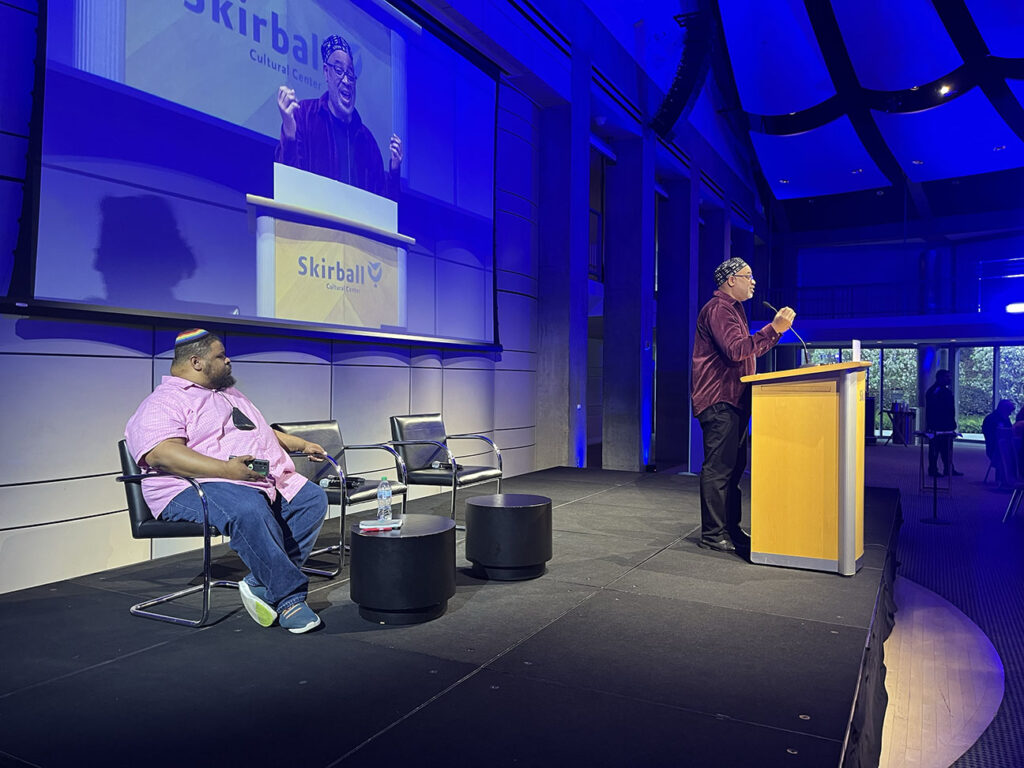
Speaking guests emphasized how the Exodus story resonates with both Jewish and Black communities. They included Michael Twitty, a Black American Jewish chef, as well as Adrian Miller, a non-Jewish and Black culinary historian who calls himself the “Soul Food Scholar”—Miller’s catchphrase: “Dropping Knowledge Like Hot Biscuits.” At the Skirball, Miller’s topic was “The Theology of Soul Food.”

During a panel discussion, Twitty and Miller spoke about their upbringing and the connections between culture and food. Miller discussed the ways he was influenced by his mother’s cooking. At church potlucks, he said, members of the congregation were always seeking out whatever dish his mother had cooked.

At one point during their panel, Twitty noted how unusual it was for two people of their backgrounds to be having such a conversation with one another.

“How many times have you seen a Black Jewish man and a Black Christian man having this dialogue?” Twitty, author of the award-winning memoir, “Koshersoul: The Faith and Food Journey of an African American Jew,” said from Skirball’s Ahmanson Ballroom stage. “You can thank Challah and Soul for that.”

Additional guests included Los Angeles City Councilmember Bob Blumenfield, who presented Walkowitz and Lieb with a certificate from the city. Offering brief remarks, the elected official from the San Fernando Valley, who is married to an African American woman from St. Thomas, said events like “Soulful Seder” reminded him of his own family seders.

Throughout the evening, clergy from the local community—including Calabasas-based Rabbi Paul Kipnes of Congregation Or Ami—recited the various blessings of the seder.

Additionally, Black Christian singer Bobby Newt performed the feel-good gospel tune,
“You are Enough.”

Midway through the program, writer, actor and educator Joshua Silverstein, an African American Jew, led the crowd in the reading of the Haggadah, which was made available as a digital download via a QR code displayed above the stage. The Haggadah was filled with images and anecdotes highlighting instances of Black-Jewish solidarity, including Martin Luther King Jr. and social justice icon, Rabbi Abraham Joshua Heschel, marching together during the civil rights movement.

Silverstein punctuated his presentation of the Haggadah with interactive prompts and writing exercises. One asked everyone to reflect about an ancestor who had done something that had made a resounding impact on their lives. Then, Silverstein asked participants to share about that ancestor with the person seated next to them.

Miller, the culinary historian, spoke with this reporter about how his late mother had always been his cheerleader.

Over the course of the night, the guests feasted on both bread and matzah; because it was held several days before the start of Passover, the evening wasn’t breadfree.

Each of the tables was decorated with a seder plate as well as an orange. According to several educational resources, it was Susanna Heschel, feminist scholar and daughter of Rabbi Heschel, who introduced the concept of including an orange on the seder plate as a nod to gay and lesbian Jews. Historically, LGBTQ+ Jews were not accepted in the mainstream Jewish community, and the inclusion of the orange was a way of correcting that omission.

On Tuesday night, the “Soulful Seder” showed just how far the community has come in embracing the marginalized.

Pre-Passover Seder Serves Up Black-Jewish Culinary Fusion Read More »

The Love Seder

The love in me is as simple as matzah 
as essential, and as plain.
when my heart burns
and I return to you
having gone through the fire
that ignites superfluity, and anything that doesn’t survive
each test of the furnace, was not meant to live
in this rushed, hasty, quick running out of time
flattened, natural, core bounty. 
nothing is left to give except… what’s true and holy, and what I know is mine.


The love in me is as as crazy as charoset.
as I enter the orchard
lost in a world of apples and wine.
hinting at spices I can’t quite touch, and nuts,
it’s the sweetness of our foundation
of what hardship could be endured
what could be enduringly built between the binding
and the bound.


The love in me is as ruthless as salt
in water.
the kind that God steams from my eyes. 
that bounces in oceans
waters that split—into walls on either side
it’s the birth of duality, of a me and a you.
and those three miraculous words pour forth,
that can make anyone quiver
and salt water drips from your hair line
as we press hearts and sweat, 
“I love you.”


The love in me is as fierce as maror, horseradish.
It will burn you, remind you of pain, but not quite— 
like a burning bush that does not consume, 
my passion will kill you, but you will not die.
because 
The love in me is as fresh as karpas, green vegetable.
I scream, “Renew us, God, and we will be renewed!”
In a circle like beitzah, the roasted egg.
it’s the cycle of life, this love. what makes the worlds
and the generations and artistry go on
it’s the lovesickness that comes again
knows you again, and enters you
holds your mind in my hands


For we are all held by the moon
this seder plate, as we meditate
on the parts of the many, 
for love is as dynamic as freedom tastes
and the center of what liberates is The One.
What all else lives within
held and cradled
is my love. 


For my love is the most ancient. 
like a shank bone.
reminding me of the start,
that initial spark,
that every offering I make
brings me closer to my heart.

The Love Seder Read More »

Make Up & Mikvahs ft. Allison Chait aka Shabbos Brushups

This week Libby and Marla are bringing you a guest that might look familiar to you but before they get into that, they share some life updates! Libby reminisces on the anniversary of Jack’s proposal while Marla delivers a surprising twist in her dating life. The two then discuss Passover, sharing stories and strong opinions on Passover foods. 

They then welcome make up artist, Allison Chait aka Shabbos Brush Ups. The three then explore the beauty industry with a unique twist—Shabbos makeup. Allison discusses how religious guidelines intertwine with beauty routines, and how that shapes a Jewish woman’s identity? She also talks about the transformative power of spiritual rituals like the mikvah, and how she’s helped women feel more comfortable in participating. 

Allison then shares about the positive experience she had at a makeup show where she received much more love than hate. The group ends with a fun game and of course asking Allison to describe a Schmuckboys.


You can follow Allison @shabbosbrushups on Instagram. 

Make Up & Mikvahs ft. Allison Chait aka Shabbos Brushups Read More »

Marinela Malcheva/Getty Images

Oil Spill – A poem for Parsha Tzav

Moses took some of the anointing oil and some of the blood that was on the Altar and mixed them together. He dashed the mixture on Aaron, on his garments, on his sons, and on his sons’ garments… ~ Leviticus 8:30

I’ve never been to rabbinic school and only just learned
a few minutes ago that the terms rabbinic school and
rabbinical school are interchangeable.

I once asked a rabbi to give me s’micha and
he responded I don’t have any with me and anyway
you don’t want the responsibility.

So I don’t know for sure what’s involved
but I suspect things have changed since
this was all set up in the desert

and no longer does it involve the sprinkling
of blood and anointing oil on one’s person.
As I said I don’t know what’s involved so

it’s possible that these things still happen
and they just don’t put it on the brochure.
I’ll be the first one to tell you (unless someone

has already told you) a priest (the ancient Jewish kind)
is not the same thing as a rabbi, so that may be
how they get out of it.

We spent a lot of time in the desert setting
all this up and it went pretty well until we
got where we were going, where it continued

to go pretty well until the main building
got torn down, we had to flee the country,
invent the Yiddish language, and figure out

how to observe the festival holidays without sacrificing
the very best of our flock so the Holy One would be
satisfied and the priests would have something for dinner.

All this is to say if you accidentally spill some oil
on yourself in the kitchen, you may have inadvertently
anointed yourself. Take the responsibility seriously.

We’re not in the desert anymore and the rabbi may be
on sabbatical. You may have to lead the service and
all our ears will be yearning to hear what you have to say.


Rick Lupert, a poet, songleader and graphic designer, is the author of 28 books including “God Wrestler: A Poem for Every Torah Portion.” Visit him at www.JewishPoetry.net

Oil Spill – A poem for Parsha Tzav Read More »

Rabbis of LA | Rabbi Avrohom Czapnik and JLE: A ‘Temporary Thing’ That’s Lasted More Than 40 Years

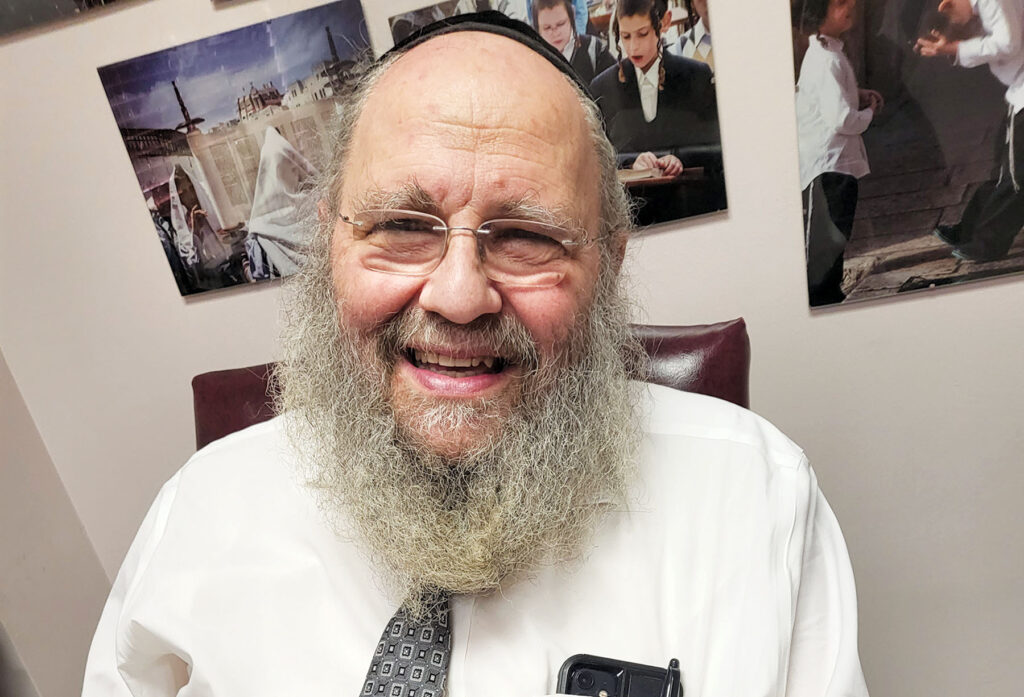
Many Jews view Oct. 7, 2023 as the time when everything changed: there’s before Oct. 7 and after. But at the 40-year-old Jewish Learning Exchange (JLE), Rabbi Avrohom Czapnik, the JLE’s longtime executive director, has not altered his agenda — at all. “Our message has been consistent throughout,” the modest, quiet-spoken Manhattan native told The Journal “If you are Jewish, find out what it’s all about — and come, let’s learn more together. There has been more interest in learning since Oct. 7, but we haven’t changed the message.”

“If you are Jewish, find out what it’s all about – and come, let’s learn more together. There has been more interest in learning since Oct. 7, but we haven’t changed the message.”

In his nearly half-century as an educator, Czapnik is known for personally understating his role. And at JLE, his work includes in-person and Zoom learning, taught by its five instructors, plus a synagogue at its La Brea Boulevard headquarters. There are Sunday morning classes on how to learn Torah texts, and through the week prayerbook Hebrew, which is a follow-up to a crash course on learning Hebrew and also a Parsha class, the Torah portion of the week. 

For Rabbi Czapnik, his weekday mornings have been spent the same way the last 45 years. “I am a pre-1A rebbe at Toras Emes, which means I teach 5-year-old boys how to read Hebrew and about Judaism.”

As a yeshiva student in South Fallsburg, N.Y., this is precisely what the youngest of four children of Holocaust survivors dreamed of doing. “I always have loved being with kids,” the father of eight said.

Becoming a rabbi, however, never was among his intentions. It was the last thing he thought he would do. “I thought about teaching kids, young children. But I didn’t know beyond that. I just kept on studying. I thought I would teach kids.” He never envisioned being a pulpit rabbi. But after he married his wife Rivky, he started teaching little children at a yeshiva in Stamford, Connecticut. Then in 1980, the yeshiva at Toras Emes brought his family to Los Angeles. Five years later, when the late Rabbi Yitzchok Kirzner founded the Jewish Learning Exchange, he asked Czapnik to join his faculty. A year and a half later, Rabbi Kirzner left for the East Coast and tapped Czapnik as the new director.

At the time, Czapnik wasn’t sure if he was ready to take over. At the dinner honoring Rabbi Kirzner, “I said I felt a little like a kid who takes his father’s shoes and comes clunking around. That is exactly what I felt like. Rabbi Kirzner was a very special person, a very deep Torah scholar. I felt inadequate in his shoes. Very inadequate in his shoes. But with the Almighty’s help, you just develop your own style. And with the Almighty’s help, hopefully, people are gaining from it.” But at the start, he thought it might be “a temporary thing.”

Today, there are several aspects to his job. “Classroom, counseling, the practical side of trying to work out my schedule for Pesach, having speakers come to cover different classes. So there are technical things. When there’s a leak, we have to call someone to fix it.” And then there’s the planning of the classes themselves, making flyers, proofing them.  “There are a lot of responsibilities.” he notes modestly.

He points with pride to the fact that Jewish Learning Exchange class sizes are small enough to make sure everyone can interact with the instructor. “For a Sunday parsha class, I could have maybe five, 10 people present and maybe another five, 10 people on Zoom. Depends also on what’s going on.” Among the popular classes are a crash course in reading Hebrew and a Simply Parsha. Each class has its own group of people who love to come to it. It’s especially heartwarming when “people come to me and say ‘you taught me Hebrew 20 years ago.’”

As for the student body, “we are talking about a broad range of people,” he said. There are those who are not Jewish, people who are exploring Judaism, people who are in a conversion program, people who are religious already and want to grow. An important part of the job is just being there for people and “help them — spiritually or even practically.” But he’s consistently impressed by the “inner strength people have to make the change. Not everyone can do it,” he admits, “moving from secular to religious or more religious. It’s very inspiring to see people take dramatic steps.” 

The least appealing part of the job, he says, is fundraising. “I can be clear on that,” he said, an example of the rabbi’s understated sense of humor. “For a while, we didn’t have a building, and we were going here and there. But the Almighty helped and … 

“When people ask what is going to be, I say the JLE is very nonprofit. I am not a prophet. I don’t know what is going to be. We survive on people’s graciousness, and on donations.” He adds, “we keep on trying to do the best that we can … and pray for divine help.”


Fast Takes with Rabbi Czapnik

Jewish Journal: What is your favorite childhood memory?

Rabbi Czapnik: Having loving parents, and — despite what they went through with the Holocaust — to be warm and loving to me.

JJ: Was learning Holocaust history part of your growing-up experience?

RC:  It was part of the history in the sense there was no book, no course. It was life because my parents lived it. My mother didn’t want to talk about it, but especially on Pesach night, my father would tell us about his coming out of Egypt.

JJ: What is your favorite moment of the week?

RC:  Coming home Friday night to my wife and our guests.

Rabbis of LA | Rabbi Avrohom Czapnik and JLE: A ‘Temporary Thing’ That’s Lasted More Than 40 Years Read More »

Yesh Tikva Celebrates 10 Years of Supporting Jewish Women Facing Infertility

Ten years ago, after struggling with infertility, Gila Block co-founded Yesh Tikva, an organization that provides support to Jewish women and couples facing infertility.

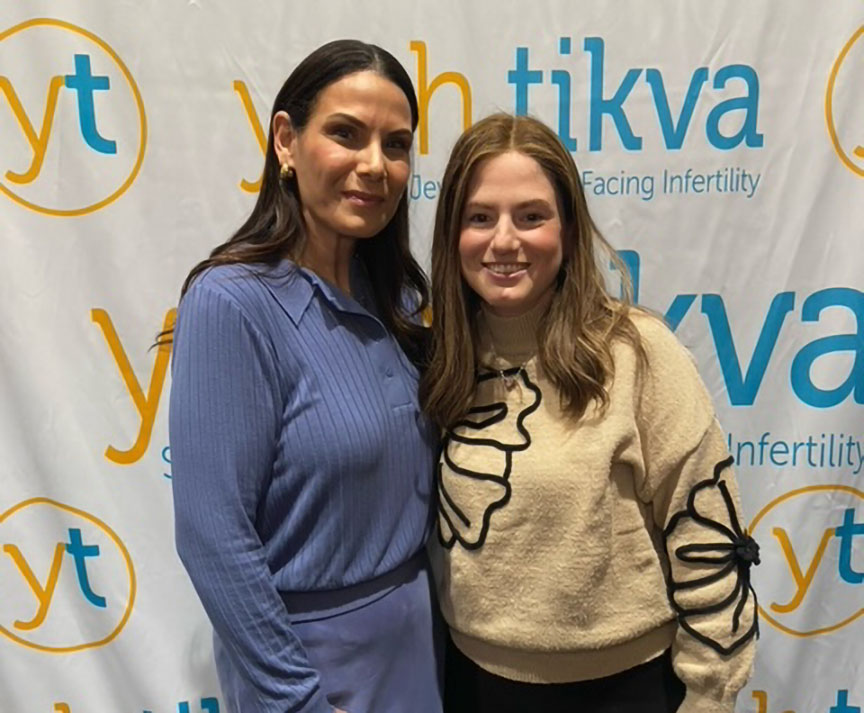
In honor of Yesh Tikva’s (“There is Hope,” in Hebrew), 10th annual Infertility Awareness Shabbat, Block hosted a special event at Shalhevet High School with Sivan Kobi, known to her 850K followers as Sivan’s Kitchen.

Block and her husband were diagnosed with unexplained infertility at a young age and went through multiple treatments, including IUI and IVF, before finally conceiving. Today, they are the proud and grateful parents of three children, ages 9, 7 and 5. But even though that journey into motherhood is behind her, Block remains the driving force behind Yesh Tikva.

The non-profit offers free professional psychosocial services, resources and tools to those struggling with infertility while also raising awareness and sensitivity within the Jewish community.

“It started as a support group with three women around my dining room table,” Block told the Journal at the event, which was attended by dozens of women who filled every seat at the basketball court at Shalhevet.

“I got connected to a few women who either worked in the fertility space or had themselves gone through this journey, and that’s how I found my partner Elie Salomon.”

Since launching the non-profit, it has helped hundreds of women from the U.S. and around the world. They meet on Zoom, share their struggles, support each other and receive important information to help them on their journey. They also celebrate whenever one of them is able to conceive. There are different support groups for women going through IVF, those going through donor conception and for parents post-donor conception. If you are struggling with any type of infertility, resources are available to you.

“This past year, we helped over 300 people, men and women. We offer an emotional support group as well as a peer mentorship program. It allows us to pair those in the beginning phase of their journey with those who have already been through it, to be their buddy so they can listen and support them,” said Block.

April is recognized as National Infertility Awareness Month, with National Infertility Awareness Week (NIAW) typically taking place in the last full week of April. During Infertility Awareness Shabbat, synagogues, rabbis and communities across denominations participate by discussing infertility in sermons, offering prayers for those struggling to conceive and promoting conversations that break the stigma around infertility. The goal is to create a supportive and understanding environment for individuals and couples experiencing this challenge.

“When I was diagnosed, it was something that happened to others; no one spoke about it,” said Block. “But the statistics tell us that it’s one in six, and we all know at least one in six. Go to the synagogue and count six women and one of them deals with it. The more we talk about it, the more we’ll have people understand.”

Block said she wants to shift the way people approach each other when talking about children, as the conversation can be sensitive for many. Instead of asking people whom you meet for the first time, “How many children do you have?” she suggested asking: “What can you tell me about your family?” or, “What can you tell me about yourself?” Assuming that someone has children can be painful for someone who desperately wants to have them but is dealing with infertility issues.

During the event, a woman shared her personal journey through infertility and how she was able to conceive four children successfully through IVF. Dr. Sahar Wertheimer, Dr. Sasha Hakman and Dr. Shahin Ghadir of HRC Fertility Clinic also attended the event. This is one of many clinics Yesh Tikvapartners with to offer educational resources.

“The fertility space isn’t regulated by insurance and therefore, you need to be an informed consumer and an empowered one,” said Block. “You can be a partner in your journey rather than just a passenger, letting the doctor take the lead.”

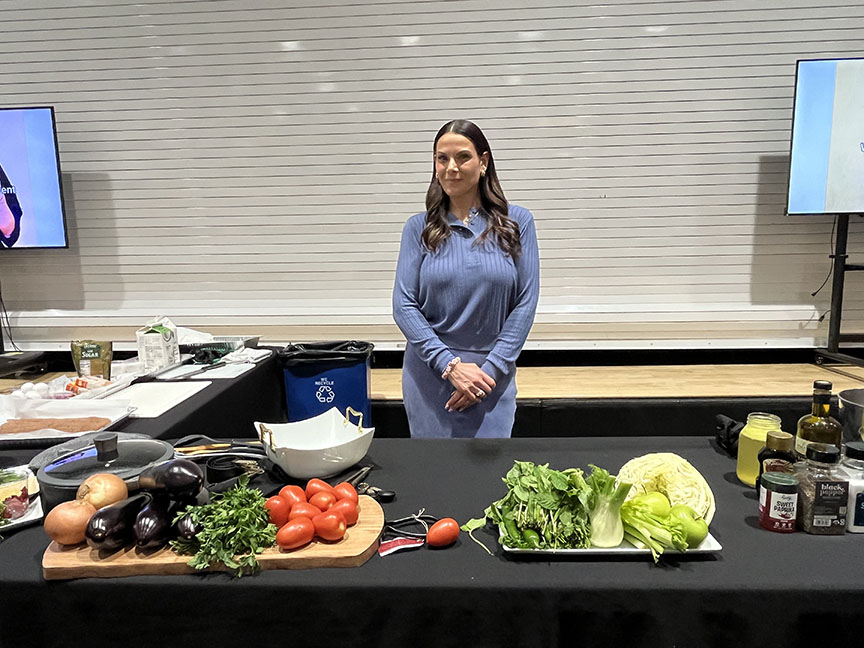
Participants enjoyed a special cooking presentation by Kobi, who shared a few Passover recipes that they were able to enjoy at the beginning of the event: viral green salad, Moussaka and Crembo Cake.

Kobi shared her personal story of stardom while demonstrating the three dishes in one hour. She immigrated to the U.S. with her family when she was 10 years old. Her father opened Sherman’s Bakery in Sherman Oaks and quickly added two more locations, which became a huge success.  Her husband’s family also came from a family of restaurateurs. It was a perfect match.

She married him when she turned 19 and became a mom at 20. Three more children followed. Kobi loves to host and her guests loved her cooking, but she didn’t take it much further than that, although at one point, she did have a cake design business while also working as a fitness coach.

It all changed in 2020, shortly after the Covid pandemic hit.

“It was sometime in May, my 30-year-old daughter came to me one Friday, the kitchen was full of food, pots on the stove, cakes and challah in the oven. She said: ‘Ima, why don’t you share everything you make with the world? No one is going anywhere, everyone is either at home cooking or watching someone else cook.’”

Kobi was skeptical but decided to go along with it. Back then, she had an Instagram page, Sivan’s Cakes, with only 200 followers. “She asked what name I wanted to call my new page and I said, let’s go with Sivan’s Kitchen.”

At first, she said she didn’t think this would go anywhere, but soon enough, she discovered that for many, cooking doesn’t come as easily and they need tutorials. One woman even asked her, “How do you make a schnitzel?” She was happy to help.

“It took me two and a half years to reach 10,000 followers,” she said. “And then, it took off.”

After October 7, Kobi opened her home to families and friends of hostages and those who lost their loved ones in the Hamas attack. One mother, Ayala Fuder, who lost her daughter, Maya, at the Nova festival, prepared a special carrot cake with Kobi in her kitchen and named it after her beloved daughter. She also brought 30 children from the Gaza envelope to her home, and together they made hamantaschen.

The talented chef and social media sensation said that through her cooking and beautiful table settings, she encourages people to welcome Shabbat and host meaningful Jewish holidays.

“It’s very important post-October 7, when we feel so neglected, unwelcome and unwanted. We need to bring Judaism into our world and hold on to it as much as we can,” she said.  “I pinch myself when I stand in front of people and they tell me, ‘You saved my Shabbat.’ I feel blessed that I’m bringing people closer to Judaism and Shabbat.”

To learn more about Yesh Tikva, visit: yeshtikva.org


Recipes by Sivan’s Kitchen

VIRAL GREEN SALAD

Ingredients:

  • 1/2 green cabbage shredded
  • 1 fennel bulb sliced thin
  • 4 celery ribs chopped (leaves included if available)
  • 3 green onions chopped
  • 1 green apple sliced thinly and into strips
  • optional for a kick 2 Serrano chilies with seeds or deseeded
  • 1/2 bunch chopped fresh mint
  • 1/2 bunch chopped fresh cilantro
  • 1/3 cup olive oil
  • 1/3 cup fresh lemon juice
  • 1 tbsp. salt or to taste

Directions:

  1. Chop
  2. Slice
  3. Toss
  4. Enjoy!

Moussaka

Ingredients:

For meat filling:

  • •1 pound ground beef
  • •1 large onion
  • •about 6 garlic cloves
  • •1 bunch fresh parsley
  • •1/4 cup oil
  • • 1 tbsp. salt
  • • 1 tsp. black pepper
  • •1 tsp. sweet paprika

For tomato sauce:

  • •1/4 cup oil
  • •1/4 cup date molasses (silan)
  • •1/4 cup tomato paste
  • •1 tsp. salt
  • • 1 tsp. black pepper
  • •1.5 cups chicken stock

You’ll need 3 medium sized eggplants not too fat, and 2 tomatoes.

Directions:

  1. Prepare Meat Filling:
  • Combine ground beef, chopped onion, chopped garlic, fresh parsley, seasonings, and oil in a bowl. Mix well and set aside.
  1. Assemble Layers:
  • Diagonally slice eggplants to one inch thick slices.
    Drizzle oil in a baking dish or pot.
  • Spoon meat filling between two eggplant slices and assemble in circular motion for a round pot or rows for a casserole dish.
  • Slice tomatoes and scatter slices between eggplant and meat layers.
  1. Make Tomato Sauce:
  • Whisk together the ingredients for the tomato sauce.
  1. Layer and Bake:
  • Spoon tomato sauce over the layers.
  • Optionally, cover with parchment paper and foil.
  • Bake covered in a preheated oven at 375°F
    for one hour.
  1. Broil:
  • Uncover and broil for an additional 10 minutes.
  1. Garnish and Serve:
  • Garnish with fresh chopped parsley.
  • Enjoy hot!

Yesh Tikva Celebrates 10 Years of Supporting Jewish Women Facing Infertility Read More »

A Bisl Torah~Check Your Pockets

We are in the final preparations for the holiday of Passover: The pantries cleaned, the refrigerator scoured, and the oven thoroughly inspected.

The Shulchan Arukh, a widely accepted code of Jewish law, advises that when checking for chametz (leavened products), one should also check their purses and their pockets. If by chance we store chametz in these areas, we can’t forget to look there.

There is a spiritually elevated connection in checking one’s pockets. Rabbi Simcha Bunem was said to carry two notes in his pockets. In one pocket, the note read: “I am only dust and ashes.” In the other pocket, the note read: “For my sake, the world was created”.

These are two different messages that balanced his soul: We should remember that we have a unique purpose and live out each day with the highest of goals, linking our potential to the creation of the world. And we are also compared to a grain of sand, a small speck of dust in this vast universe and within the generations of time.

On Passover, check your pockets for both chametz and a spiritual awakening. In this season of freedom, rid yourself of arrogance and haughtiness, and remember how essential you are as one of God’s blessings.

In doing so, may you find pockets filled with wisdom, clarity, humility, and grace.

Early Shabbat Shalom and Chag Sameach


Rabbi Nicole Guzik is senior rabbi at Sinai Temple. She can be reached at her Facebook page at Rabbi Nicole Guzik or on Instagram @rabbiguzik. For more writings, visit Rabbi Guzik’s blog section from Sinai Temple’s website.

A Bisl Torah~Check Your Pockets Read More »

J Los Angeles, formerly Westside JCC, names new CEO

J Los Angeles (JLA), formerly Westside Jewish Community Center, has named nonprofit and global media leader David Siegel as its new CEO, with JLA leadership saying Siegel was the right person to lead the organization’s next chapter.

“David is an inspired choice to lead JLA at this critical moment,” JLA Board President Tony Regenstreif said in a statement. “His passion and expertise are reflected in his track record of transforming organizations. We’ve built something extraordinary at the J, and with David at the helm, we will propel it into the future.”

Before starting at JLA, Siegel worked in the entertainment industry and philanthropy. He is the immediate past CEO at Exceptional Minds, a professional training academy and animation studio for young adults on the autism spectrum. Siegel also has deep roots in Jewish philanthropy, having worked on a campaign with his son—Siegel and his wife are the parents of three boys—that raised $1.5 million to combat a Jewish genetic disease.

“I am deeply honored and energized to lead JLA and to do this work in collaboration with our dedicated team, board, and the broader community,” Siegel said. “Together, we will build on the strong foundation already in place to shape a dynamic, welcoming, and forward-thinking hub for Jewish life.”

For seven decades, JLA has played a central role in Jewish life in Los Angeles, fostering enduring connections through several empowering initiatives, including an early childhood center, an infant care program, JCamp, the JLA Maccabi Games, a Diller Teen fellows program and the Lenny Krayzelburg SwimRight Academy.

J Los Angeles, formerly Westside JCC, names new CEO Read More »

Mercaz Slate Info Session, J Los Angeles Names CEO, Israel Film Festival Event

On April 2, Temple Beth Am held an informational and voting outreach event ahead of the World Zionist Congress elections. The event focused on Mercaz USA, the slate for the Conservative and Masorti movement.

Speaking at the event, Yizhar Hess, vice chair of the World Zionist Organization (WZO), emphasized the importance of gathering support for the Mercaz slate, which advocates for a pluralistic and democratic State of Israel; calls for equal treatment for all Jews in Israel; is committed to combating antisemitism and educating youth; and has emphasized the importance of rebuilding Israel in the aftermath of Oct. 7 as well as aiding those who have been held hostage.

Local Conservative leaders who are candidates on the Mercaz slate include Rabbi Bradley Artson, Irene Berman, Noa Kligfeld, Rabbi Gavriella Kornsgold, Cantor Michelle Bider Stone, Rabbi Cantor Hillary Chorny, Rabbi Gail Lebovitz, Nico Losorelli, Rabbi Joseph Menashe, Michelle Lippman, Rabbis Nicole Guzik and Erez Sherman, Rabbi Cheryl Peretz and Rabbi Nolan Lebovitz.

Voting for U.S. election in the World Zionist Congress election opened March 10 and continues through May 4.

To learn more about the elections—which are being administered by the American Zionist Movement—and gain a better understanding of all the slates participating in the election, visit zionistelection.org.


J Los Angeles CEO David Siegel.
Photo courtesy of J Los Angeles.

J Los Angeles (JLA), formerly Westside Jewish Community Center, has named nonprofit and global media leader David Siegel as its new CEO, with JLA leadership saying Siegel was the right person to lead the organization’s next chapter.

“David is an inspired choice to lead JLA at this critical moment,” JLA Board President Tony Regenstreif said in a statement. “His passion and expertise are reflected in his track record of transforming organizations. We’ve built something extraordinary at the J, and with David at the helm, we will propel it into the future.”

Before starting at JLA, Siegel worked in the entertainment industry and philanthropy. He is the immediate past CEO at Exceptional Minds, a professional training academy and animation studio for young adults on the autism spectrum. Siegel also has deep roots in Jewish philanthropy, having worked on a campaign with his son—Siegel and his wife are the parents of three boys—that raised $1.5 million to combat a Jewish genetic disease.

“I am deeply honored and energized to lead JLA and to do this work in collaboration with our dedicated team, board, and the broader community,” Siegel said. “Together, we will build on the strong foundation already in place to shape a dynamic, welcoming, and forward-thinking hub for Jewish life.” 

For seven decades, JLA has played a central role in Jewish life in Los Angeles, fostering enduring connections through several empowering initiatives, including an early childhood center, an infant cate program, JCamp, the JLA Maccabi Games, a Diller Teen fellows program and the Lenny Krayzelburg SwimRight Academy.


Israel Film Festival CEO Meir Fenigstein.
Photo by Ayala Or-El

Meir Fenigstein, CEO of the Israel Film Festival, hosted sponsors for a special screening of the first episode of the Israeli documentary series “Kaveret – I Gave Her My Life” — named after one of the band’s biggest hits — at the Landmark Theatre on Sunset. The outstanding three-part series, created by Yoav Kutner, tells the story of Kaveret, Israel’s most influential band. It follows the members from their time serving in the Nahal entertainment troupe in the late 1960s, through the formation of Kaveret in 1973, and their final reunion in 2013 in front of tens of thousands of fans.

Before launching the Israeli Film Festival in the 1980s, Fenigstein was a member of Kaveret,serving as the band’s drummer. 

Following the screening, the evening’s host, actor Mike Burstyn, conducted an interview with Fenigstein, who reminisced about the festival’s early years and shared memories from his time with the band.

The 37th Israel Film Festival will open in November.

– Ayala Or-El, Contributing Writer

Mercaz Slate Info Session, J Los Angeles Names CEO, Israel Film Festival Event Read More »

Not Breaking Bones for Freedom’s Sake

Seeing as adventures all ordeals
enables even people who’d been harmed
to interpret as triumphal deals
disasters,  by which they are charmed,

unbroken as must by the bones of all
Passover sacrifices, which recall
its goal, Jews’ freedom. It’s a wall
which must forever stand, and never fall.

The ban on breaking any bones
of the Passover sacrifice
warns us that violence for freedom
is a vice.

Exod. 12:46 states:

בְּבַ֤יִת אֶחָד֙ יֵאָכֵ֔ל לֹא־תוֹצִ֧יא מִן־הַבַּ֛יִת מִן־הַבָּשָׂ֖ר ח֑וּצָה וְעֶ֖צֶם לֹ֥א תִשְׁבְּרוּ־בֽוֹ׃
It shall be eaten in one house: you shall not take any of the flesh outside the house; nor shall you break a bone of it.

Meir Soloveichik pointed out that the Passover sacrifice is the only one in which it is forbidden to break a bone.  Soloveichik suggests that the rationale of this prohibition is that Passover is a festival of herut, freedom, and the prohibition implies that it is forbidden to break bones in order to achieve freedom. This prohibition was ignored in the French and Russian revolutions, but not the British and American ones, when the principle “under God” prevailed.


Exod. 12:51 supports this poem’s concluding couplet:


וַיְהִ֕י בְּעֶ֖צֶם הַיּ֣וֹם הַזֶּ֑ה הוֹצִ֨יא יְהֹוָ֜ה אֶת־בְּנֵ֧י יִשְׂרָאֵ֛ל מֵאֶ֥רֶץ מִצְרַ֖יִם עַל־צִבְאֹתָֽם׃ {פ}
And it was b’etsem hayom, on the very same, day,  YHWH freed the Israelites from the land of Egypt, troop by troop.
The words b’etsem hayom, can be translated not just as “on the very same day,” but as “on this day of the bone.”


Gershon Hepner is a poet who has written over 25,000 poems on subjects ranging from music to literature, politics to Torah. He grew up in England and moved to Los Angeles in 1976. Using his varied interests and experiences, he has authored dozens of papers in medical and academic journals, and authored “Legal Friction: Law, Narrative, and Identity Politics in Biblical Israel.” He can be reached at gershonhepner@gmail.com.

Not Breaking Bones for Freedom’s Sake Read More »