fbpx

October 23, 2024

“The Mind Can’t Grasp It”: Why a Film on Oct. 7 Hero Oz Davidian Left Me So Shaken

October 7 will never go away.

That was my first thought as I left the Saban Theater Monday night after watching a harrowing documentary on Oct. 7 superhero Oz Davidian.

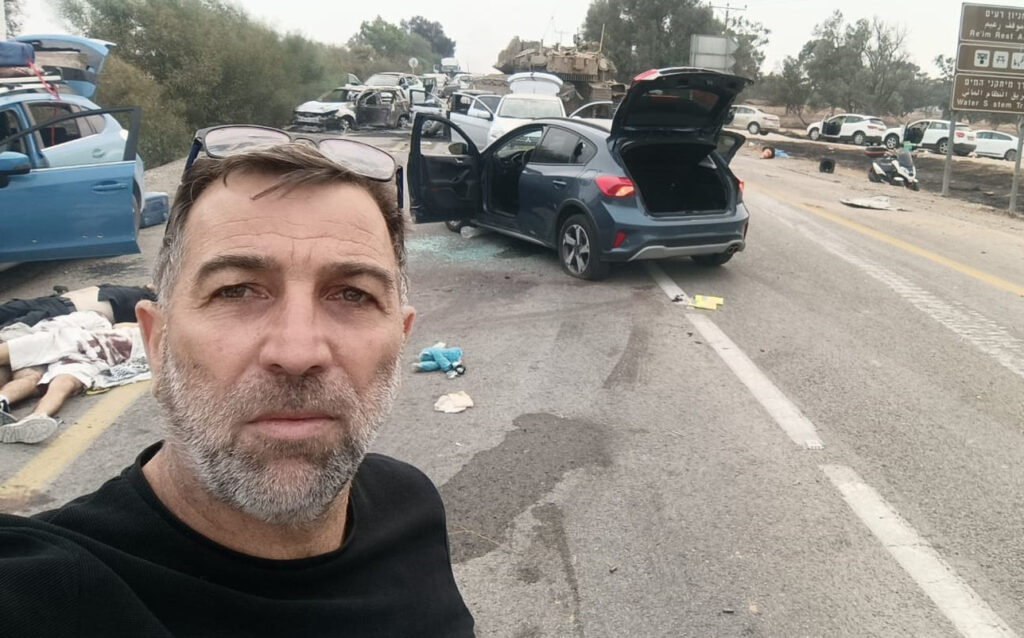
You may remember Davidian as the Israeli father who drove his pickup truck 15 times into the Nova Festival inferno on Oct. 7, 2023. By some combination of radical courage and miracle, he managed to rescue 120 terrified young revelers as crazed Hamas terrorists were hunting them down.

I’ve seen everything I could since that darkest of days—films, art exhibits, essays, poems, plays, heroic stories, the outpouring of volunteers, you name it. We’ve reported on hundreds of these stories.

And yet, there’s something about this film, “Oz’s List,” that got to me like nothing else. It grabbed my heart from the first minute and never let go. What is it about this particular story that so shook me up?

I’m not sure, but one thing may be the staggering contrasts. Above all, you see the contrast between a man desperate to save human lives and men desperate to kill them– a courageous life-saver next to cowardly life-killers.

Then you see the contrast between actual footage of the carnage in the fields (which was gathered from Hamas cameras and dash cams), and the way those same fields look today, peaceful and serene. You see a beautiful tree and learn that is where a group of kids perished. The film is full of such jarring contrasts, like a lazy country road that looks quiet now, but where Davidian drove in a frenzy to avoid the flying bullets of terror.

There’s also the contrast between Israeli security and terrorism. At one point, Davidian sees an Israeli patrol car nestled on the side of the road. Feeling hopeful, he approaches the vehicle only to discover a Hamas terrorist overlooking a dead Israeli policeman, forcing him to flee for his life. Here is a symbol of Israeli security next to the reality of a calamity.

Perhaps the most heart-wrenching contrast lies in our imagination. As we see the terrified faces of Israeli festivalgoers being rescued in Davidian’s pickup, it’s impossible not to imagine those same faces a few hours earlier, radiant with the joy of dancing in the morning desert.

We live in a time of hype. To compete for people’s attention, stories are routinely exaggerated and made more dramatic. There is none of that hype in this film. The dry facts alone are shattering enough.

There is a scene where Davidian visits the mother of someone he could not save. It’s a tender scene, made even more tender when Davidian starts to tear up, and it is the grieving mother who consoles him.

Davidian tears up a lot. On stage after the screening, his answers often slowed down as he choked up. He’s easily overwhelmed by his memory. How could he not be? The ordeal is bigger than him, bigger than us.

“The mind can’t grasp it,” he says in the film.

Indeed, that line may capture why it is so hard for so many of us to shake Oct. 7: Our minds can’t grasp it.

No matter how hard we try, our minds can’t grasp the horror of 380 beautiful souls murdered at a music festival. Our minds can’t grasp the full extent of a massacre where so many more souls perished– families, children, grandparents, murdered in cold blood, with hundreds taken hostage.

A year later, despite the continuing devastation of wars that seem never-ending, our minds still can’t grasp the level of pain, the level of grief that has emanated from that one singular day.

Maybe that is why Oct. 7 will never go away– because while our minds can’t grasp the horror of that day, the horror can’t stop grasping us.

“The Mind Can’t Grasp It”: Why a Film on Oct. 7 Hero Oz Davidian Left Me So Shaken Read More »

Columbus the Colonizer, a Real Jew

This is a piece of satire.

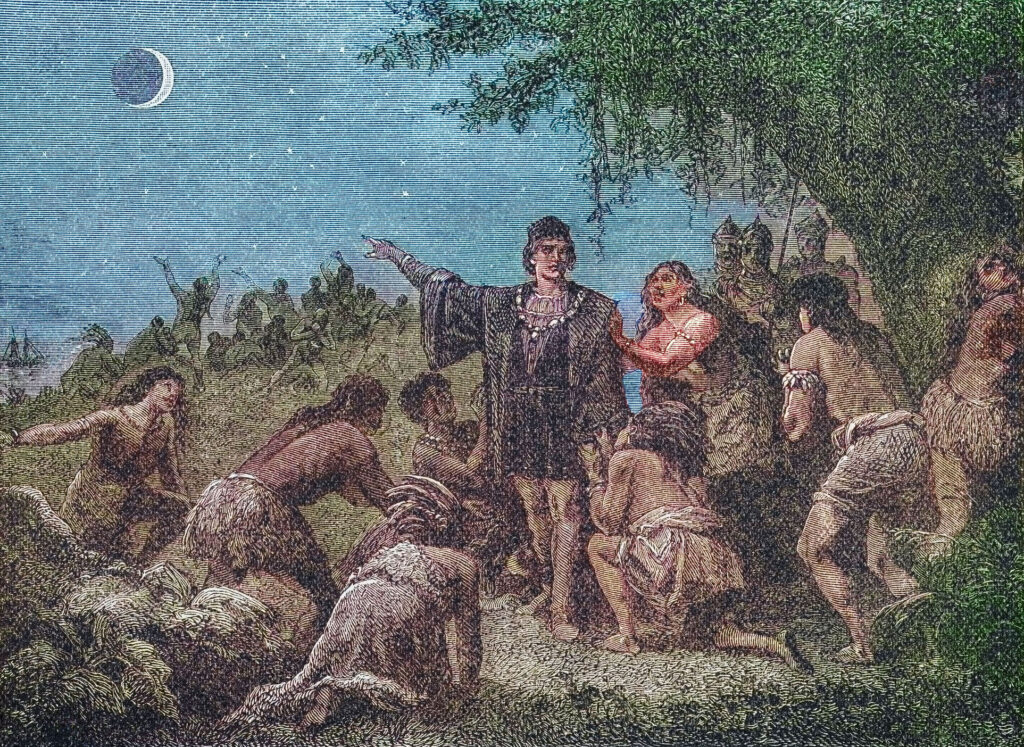
In a new DNA study on Christopher Columbus and his 500-year-old remains, Spanish researchers, and a plethora of news outlets, announced that the colonizing explorer was actually a Sephardic Jew from western Europe. Since 2003, scientists have tested samples of remains buried at Seville Cathedral in Spain. Christopher Columbus, whose given name was discovered to be Christ Killer Columberg, was raised in a kind of Western European shtetl. Think “Fiddler on the Roof” meets “Curb Your Enthusiasm.” Think a Hasidic rabbi playing with a dreidel meets his own curly peyos getting smothered by a Jewish mother’s cream cheese. Think intelligently.

As part of their profession, forensic scientists investigate the murders of our society’s most vulnerable; they can absolve an innocent man from an unjust life sentence. And then you have the forensic scientists who humbly ask, “Hmm, what homicidal squatter from history should we look into next?” They want to make sure the money they paid for their degrees are going toward justice, and they knew right away that their subsequent act of heroism would be a 22-year-dig into Christopher Columbus, the dude who’s now bringing shame to America, and never discovered anything. Or, maybe the afikomen 3-year-olds have no trouble finding? I don’t know. What I do know is that these are the people who truly make a difference. Haven’t we all asked how we would raise our children in a world where we were lacking the lineage of a disgraced navigator that got very, very lost?

When Christ Killer was growing up, he was a tough young boychick. The attacks and murders leading up to the Spanish Inquisition basically rolled off his family’s shoulders. “Eh,” they said, “we live in Italy, where we have specific dress codes for Jews and our own cool expulsions of them.” His father, Domenico Colombo and mother, Susanna Fontanarossa, who were known in the community by the joint name “you better run,” had raised their Christ Killer to be a diligent student, and only allowed him to explore and adventure after finishing his Hebrew homework, which was super popular in Italy all the way until the country joined forces with Hitler but only after Jews were slaves in Rome.

Of course, Domenico and Susanna wanted their son to be a Jewish doctor, or a Jewish banker, or a Jewish demon, but there was no convincing the colonizer we now know as Christopher Columbus, or what New Yorkers like to call, “Hot Chris,” of the challenges that lay ahead. So Hot Chris could think of nothing else to do than kiss the Star of David he’d tattooed on himself when he was a teenager in a place no one could see it, since being Jewish at the time was actually quite dangerous. Yes, it was tattooed on the interior of his tuchus, the one given to him by Abraham, Isaac and Jacob. But only his family knew. As soon as they were all done with Havdalah, Columbus the Jew went to ask for some money from the heretic-killing Christian royalty. Maybe Ferdinand and Isabella were Jews, too. Maybe Ghengis Khan, Henry VIII and his daughter “Bloody Mary,” the Roman Empire, the Umayyad Dynasty, and all of England were Jews. People are also looking into Puff Daddy’s maternal great grandmother.

In the sweet Semitic spring of 1492, Columberg signed, along with King Ferdinand II and Queen Isabella I, the “Capitulations of Santa Fe,” granting Columbus, their “big Jew on campus,” the titles of admiral of the Ocean Sea, viceroy, and governor-general and the honorific don, along with a tenth of all money he would collect from a successful voyage. It was a standard 15th-century contract, one any Jew at the time would be privy to. You know, a time when Jews were promised safety but instead thrown overboard by Spanish captains, a time they faced massacre deaths of tens to hundreds of thousands (debated by historians depending on how okay they feel about Jewy stuff). In a time where Spanish Jews were forced to convert by means of violencethat’s when the King and Queen of Spain enthusiastically sponsored their proud Jewish tatala on his journey west, in pursuit of his Hebrew dreams. They said, “we’re trusting one Jew and one Jew only in the whole of Spain, and it’s you, Christ Killer.” We know they said this because the forensic scientists took two decades to not actually confirm it scientifically.

They said, “we’re trusting one Jew and one Jew only in the whole of Spain, and it’s you, Christ Killer.”

It doesn’t really matter that the evidence of these scientists is not at all conclusive, that “compatible” with his being of Jewish origin isn’t actual evidence. It doesn’t matter that Columbus would not have practiced, been able to practice, or even know he was Jewish. What matters is that after centuries of putting him on a pedestal as America’s white Christian genius celeb savior, he gets labeled a “Jew” the second he’s  federally considered a colonizer. The mad scientists got together, and said, just like Doctor Frankenstein, “let’s make this one … Jewish. You know, for inclusivity.” For once, Jews are not being left out of the diversity conversation—specifically in a time when Jews are denied being a distinct ethnicity you can trace back to their ancestral homeland, when Jewish people all around the world are being referred to as colonizers as well as attacked and murdered for wanting to live in their scientifically proven indigenous place of origin. It’s very exciting news for the Jewish community that our beloved, Christ Killer Columberg, who used the powerful stage name Christopher Columbus to get him to the top, will in his demise be remembered as a Jew.


Alexandra Ozeri is a Los Angeles-based writer who has written for Reductress, The Belladonna, The Foreigner, Flexx, Robot Butt, and the Jewish Journal. 

Columbus the Colonizer, a Real Jew Read More »

Sephardic Torah from the Holy Land | It was Simchat Torah, Not October 7th

It was fifty-one years ago when our enemies attacked us in October, 1973, and one year ago when they struck us in October, 2023. Fifty-one years ago, the date when the Syrian and Egyptian armies attacked Israel was October 6, and one year ago, Hamas’ atrocities against Israel were carried out on October 7.

But neither of these calendrical dates – October 6 or October 7 – hold any meaning for our enemies. Fifty-one years ago, they chose to attack us on Yom Kippur, and one year ago, they chose to attack us on Simchat Torah. They coordinated their attacks on these dates, precisely because they understood the significance of these dates for the Jewish people.

By attacking us on Yom Kippur and Simchat Torah, they sought to destroy Israel and desecrate our most sacred day (Yom Kippur) and murder Jews and darken our most joyous day (Simchat Torah). Their attacks were directed against the core values of Judaism embedded in these Jewish holidays.

Yom Kippur is a day when we affirm life. We pray to be “inscribed and sealed in the Book of Life.” We seek reconciliation with God and our fellow human beings. On Yom Kippur, we look to solve disputes and ask for forgiveness. On Yom Kippur, God sits on a “Throne of Mercy.”

What a beautiful set of ideas and values: life, reconciliation, conflict resolution, forgiveness and mercy. It is these very values that our enemies came to attack and destroy on Yom Kippur. They looked to transform our day of life into their day of “death to the Jews.” They sought to defile our day of life, reconciliation and mercy, and to replace it with the “values” of death, war and mercilessness. It was an assault on the ideas and values of Yom Kippur. It was as much a “war on Yom Kippur” as it was the Yom Kippur War.

Simchat Torah is a day of joy and dancing. Dancing with what? A book. Our sacred book. On Simchat Torah, we dance with a scroll and we rejoice in its sacred words. We take pride in our beloved book of values, morals and ethics. It’s a day when we all dance together, children and adults. Children wave flags, we shower them with sweets, and we sing songs that affirm our commitment to the sacred words of our Torah.

Is there another people who dance with a book in their arms? How tragically ironic that the Muslim world named us “The People of the Book,” and on the day when we dance and celebrate our book, they attacked us with a pogrom the likes of which we haven’t experienced since the Holocaust.

On our day of dancing, on our day of joy – Simchat Torah – they sought to destroy all of this by bringing upon us darkness, rape, violence, hatred and murder.

The brutal attacks on Simchat Torah were not about territory. Hamas perpetrated a genocidal attack on our values.

To make all of this even more potent, both Yom Kippur of 1973 and Simchat Torah of 2023 fell on Shabbat. That, too, is not by chance, but by design. Our enemies know that Shabbat is our ultimate day of family, God and community, a spiritual day of rest. They know that Shabbat is the jewel in the crown of Judaism, our weekly reminder that we aren’t slaves.

Fifty-one years ago, and one year ago, these forces of darkness and evil sought to destroy our greatest gift to mankind – a weekly day of rest, a day that Rabbi Jonathan Sacks called “A utopian revolution,” a day that towers above tyranny, oppression and hatred.

These wars are not about land. They are about conflicting value systems. Life, respect, spirituality, intellect and progress vs. death, hatred, jihad, the closing of the mind and primitive behavior.

“To be a Jew is to be hated, and to defy that hate” taught Rabbi Sacks. He also taught us how to defy that hatred: “To be a Jew is to be an agent of hope.”

Let us never lose hope. “Hatikvah” – “The Hope” – is our national anthem. It’s in our DNA.

Beyond the heroic battlefield, our enlightened victory over the darkness of our enemies comes through our values, our intellect, our ideas. These are our ultimate weapons. Every Jewish ritual we observe – Yom Kippur, Simchat Torah and Shabbat – is our ultimate form of protest against darkness, brutality, racism, violence and hatred. Every time we study and teach that book we dance with, we bring light into the world.

Let’s dance again – with the Torah, with our values, with our ideas.

Chag Sameach and Shabbat Shalom


Rabbi Daniel Bouskila is the international director of the Sephardic Educational Center.

Sephardic Torah from the Holy Land | It was Simchat Torah, Not October 7th Read More »

Bridging Cultures: Pressman Academy Students Document Transformative Journey to Selma

Whe Kenny Stoff’s son, a student at Pressman Academy, went on a class trip to Alabama, he decided to join him. Kenny also brought along a team of videographers to document the experience.

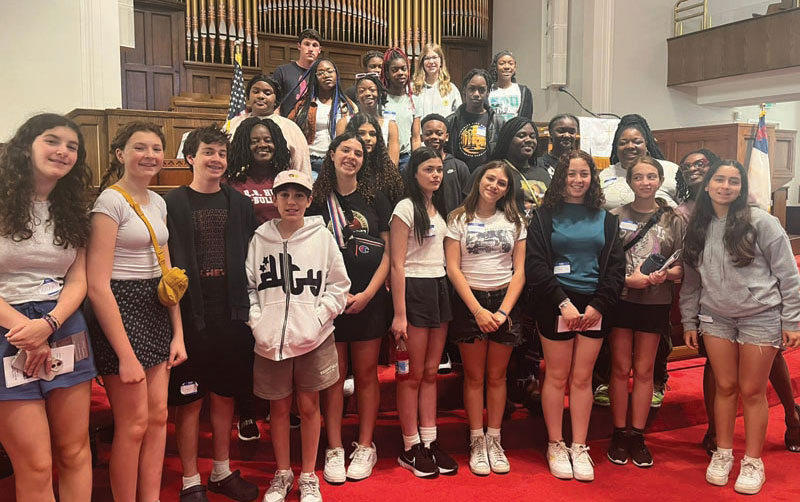
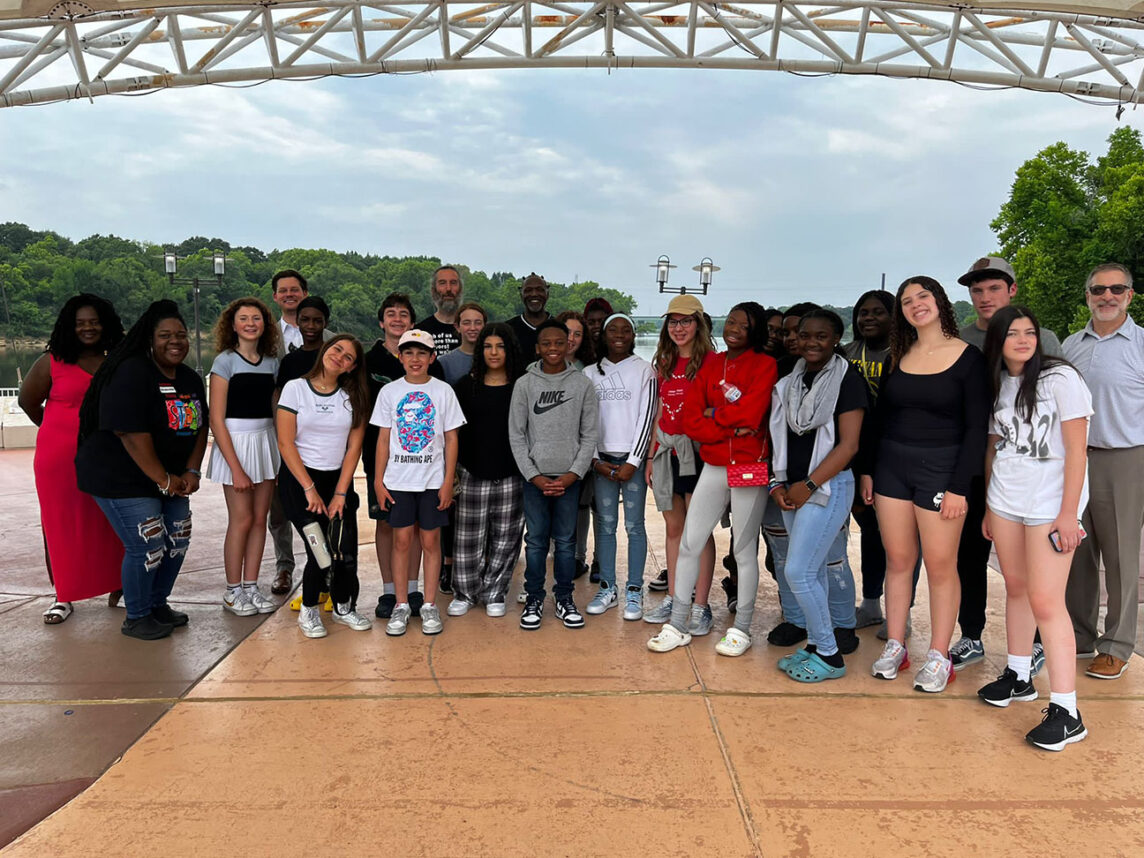
This was no ordinary field trip; the eighth-grade students were traveling to Selma, Alabama, to meet with their counterparts at RB Hudson School, with whom they had been connecting via Zoom for a year.

The collaboration between the schools, initiated by the private Jewish day school, aimed to foster understanding and tolerance among students from diverse backgrounds. Until May 2023, R.B. Hudson students had never met Jews, and Pressman students had not had the opportunity to interact with Black peers. Rabbi Chaim Tureff of Pressman Academy believed this initiative was a way to combat racism and antisemitism while promoting tolerance.

“It really opened our students’ minds,” said Tureff. “Generally, we tend to communicate and spend time with people similar to ourselves. This experience allowed them to connect with individuals from different parts of the country, as well as diverse religious, ethnic, racial, and socioeconomic backgrounds. It broadened their worldview.”

Thirteen students from Pressman Academy participated in the project, meeting with 10 Hudson students over a dozen Zoom sessions before their in-person visit. Kenny, a videographer known for his work on music films featuring Foo Fighters, Karol G and Coachella, captured dozens of hours of footage, resulting in a compelling 45-minute documentary titled, “Shared Fellowship: Reinventing a New Tomorrow.” The film will be screened at the Museum of Tolerance on Sunday, November 3 at 6 p.m.

“The documentary offers a powerful glimpse into our shared humanity and the connections that unite us,” states the film’s flyer. “By bringing together African American students from Selma and Jewish American students from Los Angeles, the film explores the Civil Rights Movement in the U.S. and the bond between these two communities. It examines the history of racism and its lasting impact today.”

Miya Peterseil, one of the students who participated in the trip, shared how it positively impacted her life. “I was able to experience a completely different culture and connect with people I never would have met otherwise,” she said.

“I was able to experience a completely different culture and connect with people I never would have met otherwise.”
– Miya Peterseil

However, the cost of the trip and a lack of funding made it challenging for the Alabama students to visit LA. Tureff noted that they plan to continue the program, meeting on Zoom once a month. Then, the eighth graders will travel to Alabama as part of their annual trip to spend time in Selma.

“My goal is for the film to be part of a broader effort to help schools find ways to educate their students,” Tureff said. “They can partner with different institutions and use the film as a launching point.”

But can relationships between students from vastly different backgrounds, ethnicities and religions truly be sustained? Peterseil admitted it was difficult to stay in touch after the initial meeting.

“However, since the documentary was released, we’ve discussed our thoughts on it, and are considering a reunion in the future,” she said.

Another student, Adira Lee, expressed that participating in the program was a life-changing experience, “especially after growing up in my small Jewish bubble. It opened so many new doors and ideas for me, prompting me to think about things I had never considered before.”

She added, “One realization that still resonates with me is that, although both Black and Jewish communities have faced oppression, we often appear simply as white people to the outside world. Our Jewish identity isn’t always visible, while theirs is.”

Kenny, who had two sons at Pressman – and sends his daughter there now as well – premiered the film for the first time at R.B. Hudson School for the eighth graders. “Three of the students featured in the film, who are now in high school, also attended the screening,” he said. “I watched their faces and could see how emotionally impacted they were. It had a meaningful effect on them. These are 14-year-olds with attention spans of a minute or less, yet they stayed engaged and didn’t fall asleep. That was amazing to see.”

The filmmaker used to create documentaries before venturing into live music videos. He said that the purpose of the film was to demonstrate to the kids that despite coming from vastly different backgrounds, they have much in common. 

“The discussion after the screening was great. They realized that their preconceived notions about the Jewish and African American communities were incorrect. They quickly formed friendships and bonds. And really, the goal of this film is to start a conversation; it’s a screen board of a larger conversation on Black and Jewish relations, civil rights, racism and antisemitism.”

A second screening was held at Montgomery in collaboration with the Jewish Federation. “People were moved in a meaningful way,” Kenny said. “They cried and they laughed and they wanted to talk about it afterwards. As a filmmaker, that’s what you want: reaction and engagement.”

Pressman Academy and the Museum of Tolerance will host a free screening on November 3. A panel discussion will follow the screening. Participants are encouraged to RSVP on the Museum of Tolerance website.

Bridging Cultures: Pressman Academy Students Document Transformative Journey to Selma Read More »

Reuniting Generations: How DNA Testing Helps Holocaust Survivors Find Lost Family

Genealogists Jennifer Mendelsohn and Dr. Adina Newman have helped Holocaust survivors find long-lost family members. Since launching the Holocaust Reunion Project in 2022, they’ve received hundreds of requests from Holocaust survivors and their children and grandchildren worldwide.

DNA testing has evolved over the years, enabling the discovery of family members scattered across the globe. Genealogical research, particularly commercial DNA testing, can unlock mysteries and forge crucial connections, often linking survivors to living relatives they didn’t know existed. DNA matches also help survivors reconstruct their shattered family trees and reclaim their lost history, reopening lines of communication severed by the Holocaust.

Since the project began, over 1,200 Holocaust survivors or their descendants have received free DNA tests thanks to Mendelsohn and Newman. They are not only genealogists but also detectives, gathering information, conducting online research and piecing together family trees for those searching for their identities. 

After years of working in the Jewish genetic genealogy space, co-founders Mendelsohn and Newman recognized the revolutionary potential of DNA testing for the Holocaust survivor community, leading to the creation of the Holocaust Reunion Project. “We started as a pilot project at the Center for Jewish History,” said Mendelsohn. “They provided us with some seed funding. The project ended earlier this year, and we continued on our own as an independent organization.”

One case involved two sisters in Poland, Halina Michałowska and Krystyna Leszczynska, who were unaware of each other’s existence and reunited after 80 years apart. Born during World War II, neither remembered their parents. The DNA tests also revealed that they are Jewish—something that may explain why their parents chose to give them up. 

“Their grandchildren told them, ‘You were abandoned in 1941 in Poland and orphaned. Let’s find out what’s going on.’ So they both took a DNA test and discovered they were sisters,” said Mendelsohn.

After seeing the sisters’ story in the news, the genealogists decided to help them uncover the identities of their parents. “We found out they have living relatives—one is a second cousin in Germany and they have cousins in Australia, Boston and Israel. Literally everywhere,” said Mendelsohn. 

The sisters expressed relief in knowing they weren’t abandoned by their parents but that their parents had tried to save them from death. Leszczynska was raised by nuns in an orphanage, while Michałowska was found wrapped in a blanket on church steps as a toddler. 

Another case was the search for Jackie Young’s father. Young appeared on the BBC show “DNA Family Secrets,” voicing concerns that his father might have been a Nazi. He knew nothing of his past or that he was adopted until he was preparing to marry his fiancée, Lita. Affiliated with the London Jewish community, he needed proof of his Jewish identity before the marriage could proceed at a local synagogue. It was only then that he learned about his birth in Vienna and how he miraculously survived as an orphaned infant for two years and eight months at the Theresienstadt ghetto in Czechoslovakia.

He was able to find the name of his biological mother, Elsa Spiegel. However, there was no record of his father. That field on his birth certificate was left empty.

Once Mendelsohn and Newman heard the story, they were eager to help Young find the truth about his birth father. 

“Jennifer and I are admins at a popular Jewish DNA group on Facebook,” said Newman. “Someone in the group mentioned that their parents are neighbors with Jackie. So we contacted him and said we would be happy to help.”

“It took for some fun detective work,” said Mendelsohn. “Using his DNA matches, we were able to zero in on a family we thought were Jackie’s grandparents. We needed a son of theirs and discovered there were three daughters and two sons—one son was in France around the time Jackie was conceived, so we knew it couldn’t be him.”

Through Google Maps, they found that the second son lived a seven-minute walk from where Jackie’s mother lived. This man was his dad.  Unfortunately, both parents were on the same transport to the execution camp. Elsa Spiegel called her baby Yona Jakob Spiegel. He was born at the Rothschild-Spital (Jewish hospital) on December 18, 1941 and handed over to an orphanage before Spiegel was deported. 

The two also discovered that Young’s father had been married a few years earlier and had a son, but was no longer living at the same address as his wife. “We assumed they were separated or divorced,” said Mendelsohn.

Mendelsohn and Newman created a family tree based on matches in DNA databases and historical documents. This tree dates back to the early 1800s, tracing Young’s lineage to a family in Lackenbach, which was then part of the Austro-Hungarian Empire and is now in Austria.

Newman explained that, indirectly, they have helped many people find family connections while working on their client’s DNA and genealogy tree. “It’s hard to know exactly how many people we’ve assisted,” she said. “We’re connecting people from all over the world, using matching trees to reconstruct family histories, which allows many others to discover their roots.”

“We’re connecting people from all over the world.” – Adina Newman

Another case involved a woman smuggled from the Bialystok ghetto as a toddler. Mendelsohn said, “Her parents were trapped inside and hoped she would survive. They arranged for her to be taken out through the fence on someone’s back. Unfortunately, they didn’t make it out. She had just a scrap of paper with two names on it—her parents’ possible surnames—nothing more. For 70 years, she searched for her identity. After taking a DNA test, we helped her find her parents’ marriage record from 1936 in Bialystok.”

The work often comes as a shock to clients, especially those who discover they have Jewish roots for the first time. Newman said, “For many, it’s a huge surprise to learn about their family connections. We also have those who believe they are 100% Jewish and find out they are only 50% and want to know who their non-Jewish father is.”

Newman added that the emotional impact of their work is bittersweet. “Sometimes we connect relatives and sometimes there’s no one left to find. We can help trace a family tree, but we can’t always reunite them with living relatives. Yet, that process can be empowering. Many in our community believe the Holocaust created an uncrossable chasm in our history, but that’s not true.”

Finding where you came from and who your parents and grandparents were is very meaningful for those whose roots are unknown or feel they are alone in the world.

“We often talk about how these people lost not only their living relatives but also the chance to learn their history,” said Mendelsohn. “Because how do any of us know our history? Thanks to grandma, who would tell us stories while baking bread in the kitchen, sharing where she came from and the names of her sisters. These people feel there’s no way to reconstruct that history, but there is a way; they just don’t know how.”

“One of our clients moved us deeply,” added Mendelsohn. “Her father was the only survivor of their family. We gave her her grandparents’ marriage certificate from 1921 in Poland, and you would think we had handed her the Ark of the Covenant.”

To learn more about the Holocaust Reunion Project, please visit: holocaustreunions.org

Reuniting Generations: How DNA Testing Helps Holocaust Survivors Find Lost Family Read More »

Pumpkin Everything for Halloween

Halloween is just around the corner. However, these pumpkin treats are perfect throughout fall or any time of year. 

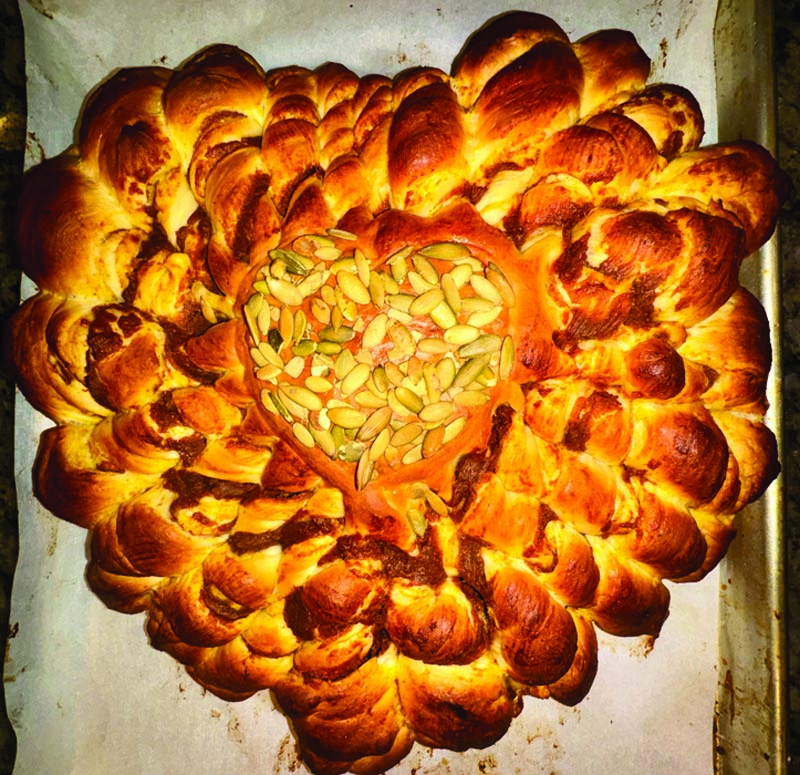
Mandie Davis’ pumpkin challah, inspired by Mandylicious’ challah recipe, is a blend of cozy fall flavors with a hint of sweetness that “feels like a warm hug,” Davis, founder and CEO of Worthy of Love, told The Journal. She added, ”I love how the pumpkin twist gives it that babka-like richness, perfect for sharing and savoring with family and friends.” 

Pumpkin Challah

Dough
4 1/2 cups of flour
1 1/2 cups of water
1 1/2 Tbsp of yeast
1/3 cup oil
1/2 cup sugar
2 tsp salt 

Combine all dough ingredients in a large bowl and knead by hand for 5 to 10 minutes until smooth and elastic. 

 Place the dough in a greased bowl, cover, and let it rise in a warm place until doubled in size (about 1 to 1 1/2 hours). 

Pumpkin Filling
1 can pumpkin puree
1/2 package of vanilla pudding mix
1 Tbsp ground cinnamon
1 Tbsp pumpkin pie spice
3 Tbsp brown sugar 

In a medium bowl, mix together the pumpkin puree, vanilla pudding mix, cinnamon, pumpkin pie spice and brown sugar until well blended. 

Shaping and Baking 

After the dough has risen, divide it in half and roll each half into a large rectangle. 

Spread the pumpkin filling evenly over each rectangle. 

Roll each rectangle lengthwise into a log. Slice each log down the middle lengthwise and twist the two halves together. 

Place the twisted loaves on a baking sheet lined with parchment paper. Let them rest for about 15 minutes. 

Preheat the oven to 350°F (175°C). Bake for 40-50 minutes, or until the inside temperature reaches at least 190°F. 


Judy Elbaum’s Pumpkin Streusel Squares are the perfect sweet treat!

“They’re easy to make, dairy-free and delicious.” Elbaum, founder of Leave it to Bubbe, told the Journal.

Parve Pumpkin Streusel Squares

1 can (15.5ounce) solid pack pumpkin
12 ounces evaporated soy milk (directions below)
3 eggs
1 ½ cups sugar
1 Tbsp pumpkin pie spice
½ tsp salt
1 package (18.25 ounce) yellow cake mix
½ cup margarine, melted
1 ½ cups pecans, chopped

Preheat the oven to 350°F.  Grease a 13-by-9-inch baking pan. 

In a large mixing bowl combine pumpkin, evaporated soy milk, eggs, sugar, pumpkin pie spice and salt.  Whisk together all ingredients well.  

Pour pumpkin mixture into your prepared baking pan.  

Combine cake mix, margarine and pecans in a large bowl. Use a fork or your hands to form coarse crumbs. Sprinkle the crumbs over the filling.

Bake for 50 to 55 minutes or until the top is golden brown. Remove from the oven, and place on a cooling rack to cool.  

Makes about 20 bars.  

*To make evaporated soy milk, place 6 cups of soy milk into a saucepan. Bring to a simmer and cook until the 6 cups are reduced to 2 cups. You will need 1 and ½ cups for the recipe and will have ½ cup left over for another use.  


Chef Lior Lev Sercarz’ herb and spice pumpkin seed recipe brings together a variety of flavors, which you combine together yourself or get the chef’s Shabazi blend.

“The Shabazi is one of my favorite blends because it combines so many great flavors that I enjoy, such as chilies, cilantro and garlic,” Lev Sercarz, owner of La Bôite and author of “A Middle Eastern Pantry,” told the Journal.

“The Shabazi is one of my favorite blends because it combines so many great flavors that I enjoy, such as chilies, cilantro and garlic.” – Chef Lior Lev Sercarz

While you can certainly enjoy these pumpkin seeds as a snack, they also add a great finishing crunch to the top of a salad or a burst of flavor to seasonal vegetables.

“Although this recipe can be enjoyed throughout the year, most people don’t really think about roasting pumpkin seeds until the fall when they are so prevalent,” Lev Sercarz said. “This method can be used with other seeds as well.”

Herb & Spice Pumpkin Seeds  

Servings/Yield: 1 cup 

1 cup (150g) raw, unseasoned pumpkin seeds,
1 tsp Shabazi spice blend OR a custom blend of cilantro, chili, garlic and lemon
¼ tsp fine sea salt
1 tsp vegetable oil

Preheat the oven to 300°F.

In a small mixing bowl, mix all ingredients to combine well.

Pour out onto a baking tray (parchment optional) in a single layer and bake for 10 minutes or until just golden brown, turning and stirring halfway.

Remove the tray of finished seeds from the oven and cool completely.

Store in an airtight container or jar.

Pumpkin Everything for Halloween Read More »

CCFP Hosting Author Ben M. Freeman and Attorney David Byrnes in Conversation

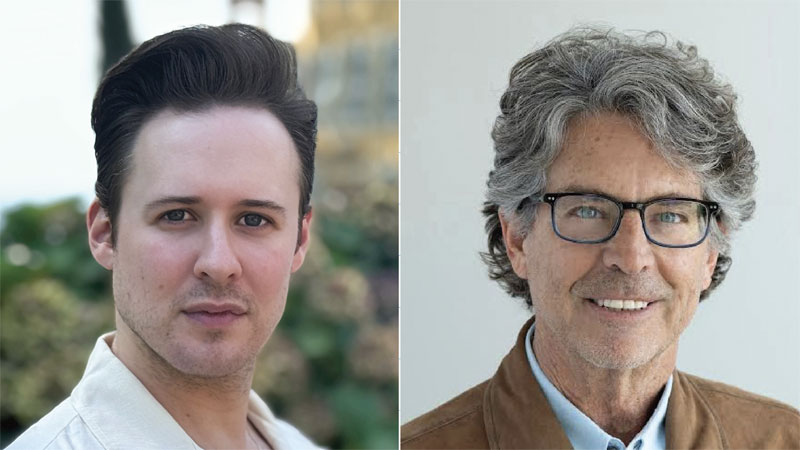
On Monday, Nov. 4, Creative Community for Peace will be hosting its fall vanguard gathering featuring a conversation with author and educator Ben M. Freeman and top entertainment attorney David Byrnes. CCFP’s Executive Director Ari Ingel will be moderating the event called, “Israel, Antisemitism, and the Entertainment Industry,” which is set to take place at a private residence in Cheviot Hills.

Freeman is the founder of the modern Jewish pride movement, as well as author of “Jewish Pride: Rebuilding a People” (2021) and “Reclaiming Our Story: The Pursuit of Jewish Pride” (2022). He’s currently working on a third book, “The Jews: An Indigenous People,” to be released in February of next year, and he’s an outspoken advocate on X and Instagram. 

As an entertainment attorney, Byrnes, a partner at Ziffren Brittenham LLP, has represented prominent people like Kelly Clarkson and Beyoncé, and the estates of Kurt Cobain, Tom Petty and the Ramones. 

“Vanguard events bring experts on antisemitism and entertainment together,” said Ingel. “Having both Ben and David speak helps bridge and coalesce the conversation on the Jewish experience within entertainment.”

The CCFP executive director praised Freeman as a “fantastic writer and a thoughtful public intellectual” who is “helping to reshape the conversation and public perception about antisemitism and the Jewish connection to Israel.” He said that Byrnes, “works with some of the biggest music talent in the industry, many of whom have performed in Israel, despite being targeted by BDS activists online.”

Since it was founded in 2011, CCFP has worked to support artists who wish to perform in Israel and fight boycotts of the Jewish state from groups like BDS. Following Oct. 7, it put out videos of celebrities – both Jewish and not Jewish – standing up for the Jewish community and Israel, and it’s held several events and sponsored community-wide solidarity gatherings.

Since it was founded in 2011, CCFP has worked to support artists who wish to perform in Israel and fight boycotts of the Jewish state from groups like BDS.

Recently, they were one of the sponsors of the Jewish Federation Los Angeles’ Oct. 7 memorial featuring Mayor Karen Bass, Mayim Bialik, Scooter Braun and Moran Atias, among many others. They also encouraged people to attend the Nova exhibit, and they will be holding a screening of “October H8te,” a documentary that Debra Messing produced about the explosion of antisemitism over the past year. 

For the Nov. 4 event, CCFP is requesting an $18 donation per person, which includes the conversation, networking opportunities for entertainment professionals and food and drinks. 

“We hope [attendees] learn about some of the ongoing challenges facing Israel and the Jewish people, and connect with a broader community committed to peace,” Ingel said. “We also encourage their participation in conversation and hope they leave with a sense of connection with one another and a renewed resilience to stand against antisemitism and anti-Israeli attitudes.”

It’s important to hold the upcoming event, and others for the community, because the next generation of entertainment industry leaders need to be educated on issues surrounding Israel and antisemitism, according to Ingel. 

“That’s why we launched the Vanguard initiative – to educate, curate connection and build awareness around the most pressing issues facing the Jewish community, particularly within the entertainment industry,” he said. “Through increased awareness, we hope to continue to build momentum within the entertainment community to stand for peace and against antisemitism.”

To register for the CCFP event, visit: creativecommunityforpeace.com/vanguard-israel-antisemitism-the-entertainment-industry.http://creativecommunityforpeace.com/vanguard-israel-antisemitism-the-entertainment-industry

CCFP Hosting Author Ben M. Freeman and Attorney David Byrnes in Conversation Read More »

Rabbis of L.A. | Rabbi Joel Rembaum on Honoring the Matriarchs

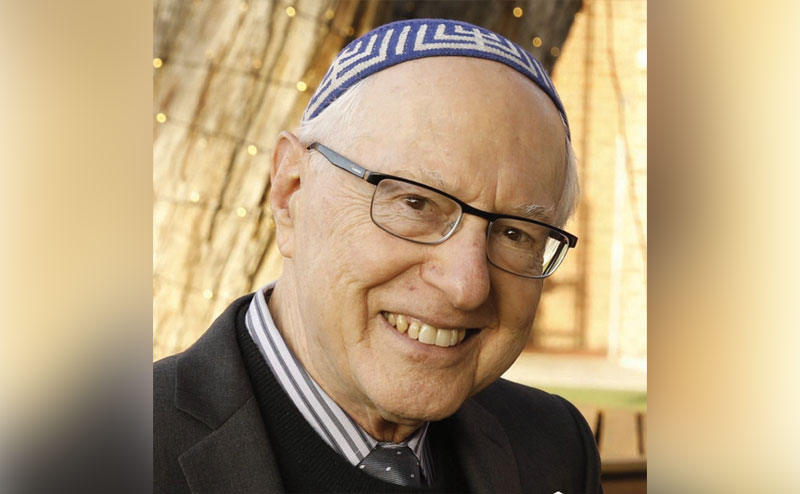
The Matriarchs of Jewish history — Sarah, Rebecca, Rachel and Leah — have officially gained equality with the Patriarchs in Conservative Judaism, thanks to Rabbi Joel Rembaum, the emeritus rabbi at Temple Beth Am. “There is nothing in the Jewish tradition that should differentiate between patriarchs and matriarchs,” the rabbi said, of his 34-year-long project.  And now he believes that a historic injustice has been corrected. “If you read the Torah closely,” Rabbi Rembaum explained, “you will see that were it not for the efforts of those four women, it’s likely there would not have been a people with whom God could make a covenant.”

“If you read the Torah closely, you will see that were it not for the efforts of those four women, it’s likely there would not have been a people with whom God could make a covenant.”

Since 1998, the four Matriarchs have been included, as an option, in the first paragraph of the daily Amidah prayer said by Conservative Jews. Last December, their inclusion became official when a leadership vote made their inclusion mandatory. 

The goal of including the Matriarchs started with Beth Am’s Library Minyan, a group the rabbi and his wife, Fredi, found in 1971. Other charter members included Rabbis Michael Berenbaum and Elliot Dorff, and Susan Laemmele. In the 1980s, Conservatives began ordaining women; in 1990, the Library Minyan started discussions about including the Matriarchs in the daily prayers. 

Inclusion of the matriarchs in daily prayer was seen as part of the Conservative movement’s shift toward a more egalitarian approach. Younger women in the Library Minyan started advocating for recognizing the matriarchs in daily prayer. Going through the legal process, they brought the idea to Rabbi Rembaum. As discussions progressed, the rabbi realized this was bigger than Temple Beth Am.

His next step was to ask his colleagues on the Rabbinical Assembly’s Committee on Jewish Law and Standards if women could be “included in the first blessing of the Amidah?”

The 25-member committee voted to accept the Rembaum paper, with 80% voting in favor. Four members abstained. Rembaum described their pullback as “my head says yes but my heart says no. A lot of lay people throughout the country said ‘yes, but it is not what I am used to.’ It is a matter of heart vs. head.” In 1998 — the next printing of the Conservative movement’s prayer books — the Matriarchs’ names appeared for the first time … as an alternative.

Rabbi Rembaum’s cause hit a speed bump in 2007, when a “learned colleague” — whom Rabbi Rembaum firmly declined to identify — was asked if the Matriarchs could be included in the Amidah. “This person brilliantly challenged many details in the paper,” said Rembaum. “He asked the questions that should have been asked 17 years earlier” when the proposed changes were submitted to the Conservative Law Committee. 

Rabbi Rembaum noted this person “was citing sources that seemed to indicate you can make no changes in the first and last three verses of the Amidah.”

However, the committee did not budge. The changes Rabbi Rembaum submitted in 1990 – making mention of the Matriarchs optional – remained the law until last December.

Including the Matriarchs in the Amidah’s first paragraph finally became the law of the Conservative community last December when Rabbi Rembaum made a submission to the Law Committee.

Although he officially had retired as Beth Am’s senior rabbi in 2010, over the next dozen years, he accepted numerous temporary positions at synagogues and universities. And there seemed to be no changes in the offing. “While a national survey never has been done,” said the rabbi, “based on experience, the majority of synagogues included the matriarchs – Sarah, Rebecca, Rachel and Leah.” They are listed in that order, he explained because “that is how they are mentioned in rabbinic writings, in the Talmud and Midrash.”

Rabbi Rembaum’s smile grew wider as he talked about how the idea caught fire. “In Israel in the ’90s,” he said, “the Conservative movement was addressing the same thing. And they came up with the same conclusion. They published their version independently in 1998, which is almost identical.” Before 2007, Rembaum’s colleague’s critique had not been lodged and there was “no large brouhaha.”

As fresh proof that change requires time, Rembaum noted that it took 17 years for his “learned colleague’s” objections to surface.

Rembaum, who is 80 years old, has spent his life at Beth Am, from childhood to the present. He praised his “learned colleague,” who resides in Israel. His objections formed “a good, challenging paper,” Rembaum said.

After reading the critique, “I began to formulate a piecemeal response in 2019. After I stopped working in synagogues at the end of 2022, I completed everything I needed to do. It was intense. I answered all the major issues.”

Was Rabbi Rembaum surprised that until 1990 there had not been an outburst endorsing the Matriarchs? “I knew some synagogues were playing around with it on their own,” he said. “I understood these things take time to process.

“The ordination of women was a big deal. Then you have to let that issue move from page 1 to page ten.”

Did that soften opposition to women playing wider roles? “Over time,” he said. 

“Same thing happened in the Reform movement. In the beginning, women were given assistant rabbi positions. Over time, they became senior rabbis, which required adjustment. The laity had to become adjusted to the concept.”

At Beth Am, he said “when the issue came up of introducing the Matriarchs, I had a meeting at my house. I invited the old guard people from the daily minyan, about 12 of them. Some were old enough to be my father. We talked. And they said ‘it sounds fine.’” When the final version, including the Matriarchs, was approved last December by the Law Committee, Rabbi Rembaum said, “the basic structure was what I had suggested in 1990.”

There is a measure of elasticity. “Different shuls have been using varying orders of the names,” the rabbi said. “I say that when we print the next edition of siddurim (prayer books), the authorized version will be printed first. The Siddur Committee will be responsible for defining how they want to deal with alternate versions.”

Regardless of details, Rabbi Rembaum asserted that “my point is, the concept of the Matriarchs is now being woven into the text. Patriarchs and Matriarchs have equal standing.” That line is the final word – except for the pride the rabbi expressed about the Library Minyan’s primary role in sparking the massive change.  

“My point is,” said Rabbi Rembaum, “that words identifying the Matriarchs no longer have brackets or options. It makes a statement about the egalitarian status of women.”

Rabbis of L.A. | Rabbi Joel Rembaum on Honoring the Matriarchs Read More »

Temple of the Arts’ High Holy Days, Tour de Summer Camps’ Teen Rider

Temple of the Arts’ recent Yom Kippur services, held at the Saban Theatre in Beverly Hills, featured several special guests.

Among those who joined the synagogue’s Rabbi David Baron on the bimah on Oct. 11 and 12 were Oz Davidian, a farmer from southern Israel who, on Oct. 7, 2023, rescued 120 young people that were under attack by Hamas at the Nova music festival. On that tragic morning, Davidian was behind the wheel of an ordinary pickup truck, and he drove into the onslaught of terrorist gunfire 15 times risking his life to transport festival attendees to safety. 

On Yom Kippur, addressing those gathered in the Saban’s pews, Davidian spoke about his efforts that day, downplaying the idea that he was a hero. All the young people he saved that day, he said, speaking in Hebrew, have become like family. As he spoke, Baron provided a translation of his remarks in English.

Philanthropists Haim and Cheryl Saban join Oz Davidian (center) at Temple of the Arts. Photo by Steve Moyer

During the break between Yom Kippur morning services and afternoon services, a short clip of a documentary, “Oz’s List,” showing footage from Davidian’s rescue activities, was screened for the congregation. 

Additional guest participants at the congregation’s services included Yossi Levy, an Israeli who discussed his experiences being displaced from his home in northern Israel as a result of ongoing Hezbollah attacks at Israel’s northern border; American Jewish Committee Regional Director Richard Hirschhaut, who emphasized the collaboration of the American-Jewish community in the aftermath of Oct. 7 and urged the crowd to visit the Nova exhibit in Culver City if they had not already done so; Bishop Juan Carlos Mendez, founder and president of Churches in Action, a self-identified Christian Zionist and an outspoken advocate against antisemitism; Judea Pearl, father of slain Wall Street Journal reporter, Daniel Pearl; and philanthropist/author Daphna Ziman.

“My Yom Kippur High Holy Day Guests this year exemplified faith in action by their heroic and humane acts of kindness in the face of Hamas atrocities, while at the same time reigning in antisemitic expressions,” Baron said. “My guests have incredible stories of courage and perseverance which demonstrate the strength of the human spirit, and can serve as examples to enlighten and encourage all of us.”

Temple of the Arts explores Judaism through music, film, art and drama.


16-year-old Tour de Summer Camps participant Max Wallenstein, who completed the event’s 100-mile route — by far the toughest. Courtesy of Lauren Wallenstein

Jewish Federation Los Angeles recently held its 12th annual Tour de Summer Camps, a cycling and hiking event in Simi Valley that raises funds for Jewish summer camp scholarships.

Among the participants of the Sept. 29 gathering was 16-year-old high school junior Max Wallenstein. He completed the event’s 100-mile bike ride, one of only 40 adults who made the attempt and the only teen to attempt and finish the route. 

The event — which had a $1 million fundraising goal—featured four bike ride routes: 18, 36, 62 and 100 miles. 

Lauren Wallenstein said her son, Max, fundraised ahead of time — raising $604 — and was “pretty invested because he attended Camp Hess Kramer [a Jewish summer camp in Malibu] for years and felt strongly that kids who couldn’t afford Jewish summer camp should still be able to go.”

Max completed the bike ride with his dad, Andy. At one point, the father and son took a brief, unintentional detour that added eight miles to the ride. It also meant they were far behind the others for most of it. At some point, the ride’s organizers sent two chaperones to help them find their way back because the signs were being taken down and they were concerned they wouldn’t be able to find their way back to the starting point. And at another point, an organizer said they wouldn’t be able to finish so they wanted to send a van to pick up them and their bikes. But Andy said, ‘Absolutely not.’ 

“They finished dead last” Lauren Wallenstein said, “and it was well worth it!”

Held every year, Jewish Federation Los Angeles’ Tour de Summer Camps welcomes cyclists of all skill levels. Since its inception, the event has raised more than $11 million, making it possible for thousands of Jewish kids to enjoy transformative summer camp experiences, according to the L.A. Federation website.

Temple of the Arts’ High Holy Days, Tour de Summer Camps’ Teen Rider Read More »

Table for Five: Bereshit

One verse, five voices. Edited by Nina Litvak and Salvador Litvak, the Accidental Talmudist

God said, “Let there be light”; and there was light.

– Gen. 1:3


Nili Isenberg
Pressman Academy Judaics Faculty

In his commentary on our verse, Rabbi Samson Raphael Hirsch (1808 – 1888) connected the Hebrew word “Or” (light), spelled with an aleph, to the similar-sounding words “Er” (awake) and “Or” (skin), both spelled with an ayin. He explained that the connection is about being receptive to external impressions: Light is the awakening element, and skin is the organ of feeling. 

What would it be like to be underground, denied external impressions, without light, or kind human touch, in darkness for days on end? This is the nightmare condition of the hostages that remain alive somewhere in the miles upon miles of tunnels underground in Gaza. Surely they have lost their sense of direction and their sense of time, hidden in claustrophobic surroundings, lacking air and basic necessities. Perhaps they have also lost their sense of hope, like poor Job who cried out, “I hoped for good and was met with evil; for light, and was met with darkness” (Job 30:26). 

When IDF troops recently used heavy machinery to enter one such tunnel, they found the bodies of six murdered hostages behind a locked blast door. Among those killed was Ori Danino z”l, whose name means light. Last year I baked Ori’s favorite apple cake with a recipe from the “Tastes Like Home” website. While Ori met a tragic end, we must not lose hope that others will come home alive. 

May we begin this year with good news: Let there be light at the end of the tunnel.


Rabbi Gavriel Sanders
Content Creator — Jewish Year Abroad

Until recently, the quantum nature of light — both as a vibrating, diffracted wave and a particle (photon) — remained a hidden mystery. In ancient times, Plato’s emission theory posited that we see because our eyes emit light beams. The Greeks believed that light, including fire, was a divine gift (they weren’t far off.) In quantum theory, particles are seen as excitations or vibrations of underlying fields; for example, photons are excitations of the electromagnetic field. This suggests that what we perceive as particles are actually manifestations of these vibrating fields, produced by variable frequencies. 

In Genesis 1:3, speech — vibration manifesting consciousness through articulation — creates light, which is both a particle and a wave. Light, with its spectrum of frequencies, and sound can create form. The Chladni plate experiments serve as an illustration of this concept. 

When we examine Genesis 1:4, we find that the Creator saw the light and deemed it good. The phrase et ha’or is packed with meaning. Mystically intriguing as it is, how can we access this depth? The brilliant 14th-century commentator Ba’al Ha’Turim notes two profound derivatives from the gematria of these two words, which total 613 — something that certainly raises an eyebrow. The first derivative is ba’Torah — “in the Torah” — and the second is the four letters of TaRYaG = the number of mitzvot in the Torah. The world of light we can access unfolds through learning Torah and applying its teachings through the mitzvot. For further insight, consider Rashi’s commentary on Proverbs 6:23.


Dr. Sheila Tuller Keiter
Judaic Studies Faculty, Shalhevet High School

God’s first act of creation is to bring forth light, forever inspiring us to bring light into this world in imitatio dei. One could simplify the Jewish mission in precisely these terms: Our duty is to spread God’s light to all of humanity. 

But there is much to be learned from the beginning of this verse too. The words “And God said” are ubiquitous throughout the Torah, yet this verse provides the very first instance of God’s speech. Hashem uses words to create. Spoken words, like light, are ephemeral, impossible to grasp, but no less real. Sound and light emerge into this world simultaneously, allowing us to apprehend creation. 

Yet despite our tendencies to valorize light, both sight and sound are ultimately morally neutral. Words can heal as well as hurt. Light can illuminate or it can mislead. Just as the lanternfish in the ocean depths uses its light to lure unsuspecting prey, learned men have used knowledge to claim the light of scholarship for abhorrent ideologies. So many shiny things compete for our attention while drawing us away from true clarity. 

How, then, are we to discern true light from the false, good from evil? We merely need return to the beginning of our verse: “And God said.” True light shines forth from the Creator of light, and His words provide the lit path to goodness. God’s word is illuminated in the Torah, and the “Torah is light” (Prov 6:23). Let it shine.


Sara Blau
Prolific Author

If G-d were to desire the world to cease to exist, what would He have to do to destroy it? Burn it? Smash it into smithereens? Actually, all G-d would have to do would be to stop uttering it into existence. 

In the beginning, G-d said, “Let there be light”; and there was light. According to the teachings of Kabbalah, the same speech — or revelation of energy — that G d used to create light in the world must be perpetually repeated by G-d in order for light to remain in existence. In other words, G d is constantly recreating. Just like a frisbee can only remain airborne as long as there’s lift, creation only exists as long as G d is “speaking” it into creation. “Let there be light” was not a one-time proclamation, but rather the first of a never-ending series of proclamations. This does not only apply to the creation of light, but to the creations of everything in existence. 

As the Psalmist said “Forever, O G-d, Your word stands firm in the heavens.” (Psalms 119:89) This means the words G-d used to create the heavens are repeated forever to keep the heavens in existence. For were G-d to stop his perpetual repetition for even one moment, the entire world would go kaput. 

Think about it. If you exist today, G-d is speaking you into existence. What might your purpose be?


Rabbi Brett Kopin
The Six11 Project, Base LA

Our daughter was born on a Friday morning in late August this year. As my wife made the final pushes and our daughter emerged, I was overwhelmed by the sense that this moment was the closest metaphor we can experience for God creating the Universe. In the opening lines of the Torah, it merely says that God spoke, and light came into being. Anyone who has birthed any creation into the world, whether a community project, a piece of writing, or a business, understands that most often, the first step to creation is its articulation, communicating the vision or intention out loud. God says “let there be light” in a world shrouded in chaos and darkness. Light comes first and serves as the guidepost to bring order and life into being. We might wonder what the actual experiences of laboring that light into being were like. The Spanish commentator Rabbeinu Bahya writes that God created everything in the world at once, and over the days of creation, the light from Day One illuminated each of the creations as they were set in their proper places. Rabbeinu Bahya would also know that the Spanish phrase for giving birth is “dar a luz,” which literally means “to give light.” We named our daughter Dahlia Meira, connoting the illumination that she, and every new life, brings into the world. May we all continue to birth new creations into being, adding to the holy work that began with those famous first words.


Table for Five: Bereshit Read More »