fbpx

September 26, 2024

Wikipedia Editors Title Article “Israeli Apartheid”

Wikipedia editors have renamed an article from “Israel and apartheid” to “Israeli apartheid” following a short discussion over the summer that received little pushback.

A longtime editor who runs a blog called “The Wikipedia Flood” wrote in a Sept. 19 post that in 2023, the article had been titled “Israel and apartheid” and the opening paragraph had stated: “Israel is accused by international, Israeli and Palestinian human rights groups of committing the crime of apartheid under the 2002 Rome Statute of the International Criminal Court, both in the occupied Palestinian territories and, by some, in Israel proper. Israel and its supporters deny the charges.” Under the “Israeli apartheid” title, the opening paragraph now states: “Israeli apartheid is a system of institutionalized segregation and discrimination in the Israeli-occupied Palestinian territories and to a lesser extent in Israel proper. This system is characterized by near-total physical separation between the Palestinian and the Israeli settler population of the West Bank, as well as the judicial separation that governs both communities, which discriminates against the Palestinians in a wide range of ways. Israel also discriminates against Palestinian refugees in the diaspora and against its own Palestinian citizens.”

As I’ve previously written, a discussion regarding changing the title of a Wikipedia article is known as a “Requested move” (RM) in wiki-parlance. Wikipedia policy states that an article’s title is usually from the most common name used in reliable sources (WP:COMMONNAME) . The RM discussion started on July 20, a day after the International Court of Justice (ICJ) issued a nonbinding ruling determining that Israeli settlements in the West Bank and East Jerusalem violate international law.  Editors in favor of changing the title contended that the ICJ ruling — and how it’s being reported — as well as more scholarly literature using the term “Israeli apartheid” warranted a change.

“The ICJ ruling yesterday by the world’s highest court that this occupation constitutes apartheid was the cherry on the top,” the editor, who posts under the name “Makeandtoss,” who started the RM discussion, wrote. “This move is long overdue, it is time to call a spade a spade.” Makeandtoss pointed to reporting in Amnesty International, Human Rights Watch, The Guardian and Financial Times as evidence.

Another editor, “Iskandar323,” contended that the ICJ ruling “confirms the presence of systematic discrimination and racial segregation — affirming the findings of the numerous human rights bodies.” The editor also argued that Google Scholar searches to show that the term “Israeli apartheid” is “very much rooted in scholarly usage.”

Wikipedia is based on consensus, a combination of numbers and argument quality in regards to site policy; usually a supermajority is required for there to be consensus for a change, if the argument strength is equal. Sometimes a closer (an uninvolved Wikipedian in good standing) is needed to render a verdict on the discussion. Because there was barely any pushback to the proposed change, the discussion was closed two weeks later in favor of the “Israeli apartheid” title.

“There was little substantive discussion at all,” The Wikipedia Flood blog claimed. “Not a single editor objected … While the lack of interest in this title change is startling, as is the lack of pushback into the article’s gradual transformation into blatant Hamas propaganda, that’s not really surprising. The pro-Hamas editors are well-organized offsite and, above all, far more numerous than the editors who might oppose them. They can branch out all around Wikipedia and bring their friends with them.”

While the lack of interest in this title change is startling, as is the lack of pushback into the article’s gradual transformation into blatant Hamas propaganda, that’s not really surprising. The pro-Hamas editors are well-organized offsite and, above all, far more numerous than the editors who might oppose them. They can branch out all around Wikipedia and bring their friends with them.” – The Wikipedia Flood (blog)

George Mason University Professor Eugene Kontorovich told me, “It is completely false that the ICJ’s recent advisory opinion accused Israel of apartheid. The opinion of the Court simply said no such thing, though a few individual judges did — but their position was NOT accepted by the Court. In any case, an ICJ Advisory opinion is not a ruling in a case, does not involving hearing and reviewing evidence, and has absolutely no legal or precedential weight. As for claims of racial segregation in Israel, such problems are ubiquitous in Western countries; the U.N. has condemned the United States for ‘systematic racism’ in law enforcement — and the issue of police shootings of black men is well known — but that does not [make] American an apartheid state. Yet Wikipedia does not speak of Palestinian Apartheid, despite the [Palestinian Authority] government having an explicit program of extrajudicial killing of Jews (pay for slay); forbids Jews living anywhere in its territory; and erases Jews from history and culture. Moreover, the leaders of Western democracies – from left to right -have uniformly rejected the Apartheid charges.”

Asaf Romirowsky, who heads Scholars for Peace Middle East and the Association of Study in the Middle East and North Africa, called the Wikipedia article’s title and opening paragraph a “work of fiction … The entire Palestinian narrative is based on OPT [Occupied Palestinian Territories] and there’s nothing factual about any of the claims made by the ICJ, and it doesn’t look realistically at the state of Israel and the Arab population,” he said. “There’s no apartheid in Israel. This is all part of the fallacy that has been sold and validated by these international groups — Human Rights Watch, the ICJ — because this is exactly where they want to wage these allegations against Israel. They’re not rooted in reality.”

An editor told me that “it looks like only pro-Hamas editors knew about it to weigh in … Hard to get the cat back in the bag. Not that [the] ‘Israel and apartheid’ [title] is much better. ‘Allegations of apartheid in Israel’ might be more NPOV but longer. The longer the article title stays at this, the harder it is to change it back because it has the consensus of lengthy time without objection, and a drive-by re-RM will probably go down in flames.” The editor noted that “the longer it stays at this title, the less likely another name will be the more common name,” as sources like AJ+ and Human Rights Watch use the term; even sources that dispute that Israel is committing apartheid against the Palestinians are pushing back against allegations of “Israeli apartheid.”

“Of course, a consensus of editors could find that POVTITLE overrides that,” the editor continued, referencing Wikipedia policy stating that a title needs to comply with the site’s Neutral Point of View (NPOV) policy. “But [it] would need a critical mass of pro-Israel editors to know about the RM, and have it be closed with a consensus to move again — much harder now that any [no consensus] is status quo.” The editor claimed that “a lot of turf has been given up by banning or topic-banning pro-Israel editors with thin justifications … and scaring others.”

Another editor told me that the RM discussion was basically “an echo chamber” and that something similar occurred when in August, the “Palestinian territories” Wikipedia article was renamed to “Occupied Palestinian Territories” following the ICJ ruling. The editor argued that “if there isn’t diverse debate, none of these [discussions] should go through.”

Wikipedia Editors Title Article “Israeli Apartheid” Read More »

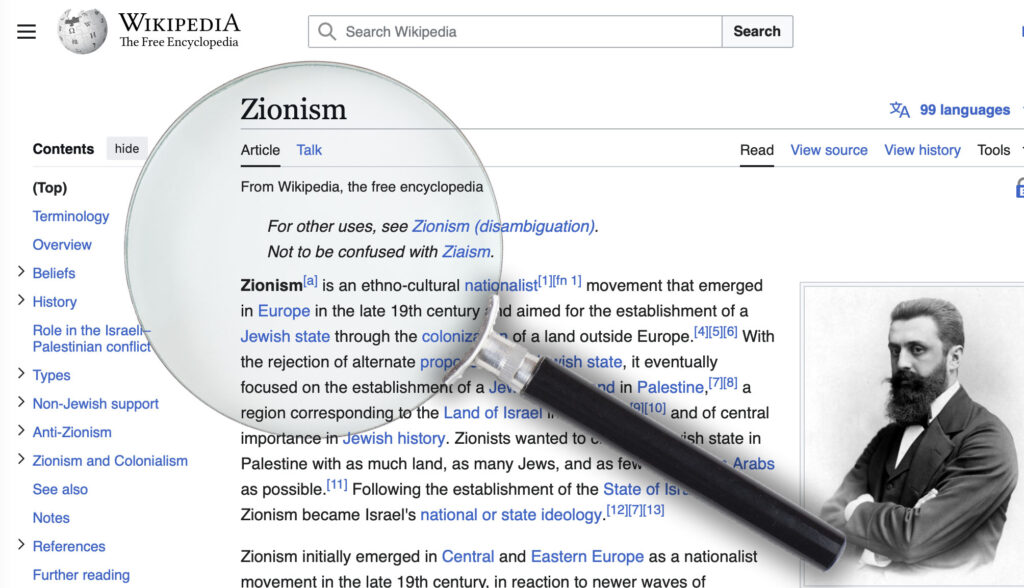
Wikipedia Describes Zionism As “Colonization”

Wikipedia’s main article on Zionism describes it as a movement based on “colonization,” garnering controversy both on and off Wikipedia.

The Wikipedia Flood blog noted that the Zionism Wikipedia article became slanted following “a spasm of edits by pro-Hamas editors subsequent to Oct. 7, when the article was reasonably stable and was not heavily edited. At the time of the ‘Al Aqsa Flood’ slaughter in the Gaza Envelope, it provided a balanced and neutral depiction of Zionism, noting criticism by anti-Zionists but not giving undue emphasis to it.”

The opening sentence of the Wikipedia article states: “Zionism is an ethno-cultural nationalist movement that emerged in Europe in the late 19th century and aimed for the establishment of a Jewish state through the colonization of a land outside of Europe.” In 2023, the opening sentence defined Zionism as “a nationalist movement that emerged in the 19th century to espouse support for the establishment of a homeland for the Jewish people in Palestine, a region roughly corresponding to the Land of Israel in Jewish tradition. Following the establishment of Israel, Zionism became an ideology that supports ‘the development and protection of the State of Israel.’”

Middle East historian Asaf Romirowsky, who heads Scholars for Peace in the Middle East and the Association for Study in the Middle East and North Africa, told me that the sentence implies that “Jews are Europeans and they’ve colonized the land” and that “scholars who recognize the connection between the land and the Jewish people and the evolution that Zionism is Jewish nationalism based on ancestral ties to the land itself from Biblical times all the way to modern times, that would be the honest way to look at it.” Those who promulgate the narrative that Zionism is settler-colonialism try to “weaken the claim that the people and Israel are connected” and that Israel stole the land from the Palestinians is “ahistorical.” Tel Aviv University Vice Rector Eyal Zisser told me that “it’s not a matter of colonization, it’s a matter of feeling if any nation has its own right for self-determination and a state, Jews should also have this right and they should fulfill it in their historical homeland.” Zisser also said regarding the Wikipedia article’s use of the term “ethno-cultural nationalist” that “it’s the national movement of the Jews” and that “Polish nationalism or Italian nationalism” would not be discussed “in the same manner.”

“It’s not a matter of colonization, it’s a matter of feeling if any nation has its own right for self-determination and a state, Jews should also have this right and they should fulfill it in their historical homeland.”- Eyal Zisser

A Wikipedia editor told me that while it’s true that “Zionism ended up with colonization…as written now [the article] implies colonialism. It should probably mention the Ottoman [Empire] and British for context.” An editor who grew disillusioned with Wikipedia after making thousands of edits believes the “colonization” term should be removed altogether “because it’s being used anachronistically. When the early Zionists were talking about ‘colonization,’ a new city anywhere could be called a ‘colony.’ Now they’re trying to shoehorn that into the modern interpretation of colonialism where a power sends its people to gain control over a territory that at least to begin with remains loyal to that power.”

Shortly after the “colonization” sentence, the Wikipedia article says that “Zionists wanted to create a Jewish state in Palestine with as much land, as many Jews, and as few Palestinian Arabs as possible.” Romirowsky called this sentence “false.” “There are [an] abundance of diplomatic correspondents of looking to find ways for coexistence and the fact of the matter is that all those Arabs who stayed in the land and became the Arab Israelis … they became naturalized citizens because of that earlier desire for coexistence between the population of the land,” he said, adding that there were Jews who “bought the areas of the land fair and square from lease owners and land owners who were not even on the land itself. The politicization of the land itself only became politicized post-1948, and the reason for that was, this is all part of the Arab propaganda of the day, and theologically speaking I would argue that … there is a Sharia law perception that any land that was once Muslim is Muslim in perpetuity.” Romirowsky also pointed to the fact that “the Jewish community was willing to accept whatever proposal was offered to them, even the desolate land itself, just the idea of having a homeland.”

The Wikipedia Flood blog noted that the citations behind the “as few Palestinian Arabs as possible” line includes “anti-Israel extremists such as Columbia University professor Rashid Khalidi.” In addition to Khalidi, anti-Israel historians Avi Shlaim, Ilan Pappe and Nur Masalha are among the academics also cited.

“Shlaim, Pappe are all New Historians, they’re basically anti-Zionist Jews. Masalha and Khalidi are, of course, Palestinian … why not read Ken Stein’s book about what the Jewish community did in the 1930s, how about reading Anita Shapira’s book on Israel and Israel’s formation,” Romirowsky said. “There is a plethora of Zionist historiography looking at these facts, and they have selectively chosen basically all Arab Palestinian ones.” Shapira is cited elsewhere in the Wikipedia article.

Israeli historian Benny Morris’s 2004 book, “The Birth of the Palestinian Refugee Problem Revisited,” is also among the citations for the “as few Palestinians Arabs as possible” line, based on a passage that stated in part that “the displacement of Arabs from Palestine or from the areas of Palestine that would become the Jewish State was inherent in Zionist ideology.” Romirowsky claimed that Wikipedia editors are “selectively choosing quotes” from Morris here. Interestingly, an editor raised concerns on the talk page that the line in question is “a bit too vague to be considered a broadly-supported mainstream view” and that the citation from Morris’ book is “taken out of context,” pointing to how Morris wrote in the following paragraph of the book that “there was no pre-war Zionist plan to expel ‘the Arabs’ from Palestine or the areas of the emergent Jewish State; and the Yishuv did not enter the war with a plan or policy of expulsion.”  The editor’s concerns were roundly rejected, as others argued that the sourcing still supported the line in question.

An editor told me that the line “as few Palestinian Arabs as possible” line is not precise. “‘As much land as possible’ is obviously false. They only cared about the land of Israel, and while some certainly wanted as few Arabs (or non-Jews more precisely) others didn’t, so putting all this in the encyclopedia’s neutral voice is an obvious NPOV [Neutral Point of View policy] violation.” Another editor told me that the line is “POV” and poorly written, explaining that the “lead is supposed to be concise, a summary of the article, including all minority POVs. It’s ridiculous that there’s an article about Zionism that scarcely says what Zionist historians actually say.”

The end of the lead of the Wikipedia article concludes with the sentence: “Proponents of Zionism do not necessarily reject the characterization of Zionism as settler-colonial or exceptionalist.” Romirowsky said that this too was “incorrect,” calling the Zionism is settler-colonial narrative “propaganda. That is the Arab Palestinian viewpoint in order to argue and amplify that there is no connection between the people and the land itself.” Zisser said that “the United States is also a settler-state, and the Americans have no problem with that … maybe this is what they mean, I don’t understand it… maybe technically it’s right, [but] what you understand from such a sentence is wrong.”

An editor told me that the sentence “is awkward, clumsy, and it’s arguing in the lead,” reiterating that the “lead is supposed to be a simple summary.” Another editor told me, “How is this lead material unless you’re trying to push a POV? Most proponents of Zionism reject the characterization obviously. The ‘do not necessarily’ is so weasel-worded it’s ridiculous. Some don’t, most do.”

As I have previously written, Wikipedia operates by a process known as consensus, which is a combination of the number of editors who weigh in on a discussion and the strength of their arguments as it pertains to site policy. There have been rounds and rounds of debates dating back to the beginning of the summer on whether or not the notion that Zionism is based on “colonization” is the mainstream academic view.

“It is not the mainstream academic view,” Romirowsky argued, though he acknowledged that “it is the one that has become dominant as a result of how the conflict has been sold as a white colonial settler movement.”

At the heart of the arguments on the talk page is the aspect of Wikipedia’s  NPOV policy known as WP:BESTSOURCES, which states: “When writing about a topic, basing content on the best respected and most authoritative reliable sources helps to prevent bias, undue weight, and other NPOV  disagreements. Try the library for reputable books and journal articles, and look online for the most reliable resources.” Those in favor of the “colonization” descriptor contended that academic books specifically about Zionism, rather than about the Israeli-Palestinian conflict or Judaism more generally, are the best sources to decide this debate, especially when such books have “Zionism” in their titles. Those books describe Zionism as “colonialism” or “colonization,” editors in favor of the use of “colonization” argued. Those opposed to the use of “colonization” in a neutral voice (wikivoice) in the article argued that there are enough academics who dispute that Zionism is colonialism and that “colonization” should be put in its proper context. And so the two sides have gone back-and-forth on what the corpus of academic literature says on the matters and what exactly constitutes as the BESTSOURCES. Talk page discussions on the matter remain ongoing for a possible rewrite.

“I disagree that sources explicitly about Zionism are necessarily best sources … that seems to be likely to skew the results,” an editor told me. Another editor similarly told me that “that many more critical works on Zionism use Zionism in the title” and that the Wikipedia article needs to reflect that “most sources describe Zionism first and foremost as the Jewish movement for self-determination and a national homeland but not necessarily or always ethnocentric, or demanding anything in particular about the Arabs. To paint all of Zionism with said brush in my opinion is POV.” A new ongoing list of books on the matter on the talk page that was started on Sept. 17 seems to include a handful of books that don’t explicitly mention Zionism in the title.

Some editors on the Zionism talk page contended that the early Zionist founders saw their efforts as a colonial venture; one of the citations to the “colonization” sentence in the lead of the Wikipedia article is to Ze’ev Jabotinsky’s 1923 “The Iron Wall” essay stating that “colonization can have only one aim, and Palestine Arabs cannot accept this aim. It lies in the very nature of things, and in this particular regard nature cannot be changed … Zionist colonization must either stop, or else proceed regardless of the native population.” But Romirowsky told me that the early Zionist thinkers “all saw themselves as reclaiming and reinvigorating the ancestral promise of a Jewish homeland, not as colonizers.” Romirowsky explained that Zionist founding fathers specifically used a Hebrew phrase “that talks about resettling those lands” and “the opposition has taken that verbiage to connote that Jews are colonizers and they are stealing land that was not theirs. That’s the game that plays out here where they weaponize the meaning of what words actually mean.” Zisser agreed that the Zionist founders were talking about the resettlement of the Jews. “At that time, colony had a different meaning, and if you translate some of the statements made in the 20s or 30s or in the 19th century, when they speak about cultivating the land, and use it to show something that has a different meaning nowadays, it’s not serious,” he said.

Another aspect of the Wikipedia Zionism article that has garnered controversy is the “Ethnic unity and common ancestry of Jews” subsection discussing how “early Zionists were the primary Jewish supporters of the idea that Jews are a race.” The opening sentence of the second paragraph in the subsection states that “it was particularly important in early nation building in Israel, because Jews in Israel are ethnically diverse and the origins of Ashkenazi Jews were not known.” Romirowsky called this line “idiotic,” noting that the term “Ashkenazi” is traced to “areas of modern-day Germany. We know exactly where they came from.”

One of the citations to the Ashkenazi Jews line is to a 2012 book by Columbia University and Barnard College anthropologist Nadia Abu El-Haj; the citation highlights a passage from the book that says: “There is a ‘problem’ regarding the origins of the Ashkenazim, which needs resolution: Ashkenazi Jews, who seem European — phenotypically, that is — are the normative center of world Jewry. No less, they are the political and cultural elite of the newly founded Jewish state. Given their central symbolic and political capital in the Jewish state and given simultaneously the scientific and social persistence of racial logics as ways of categorizing and understanding human groups, it was essential to find other evidence that Israel’s European Jews were not in truth Europeans. The normative Jew had to have his/her origins in ancient Palestine or else the fundamental tenet of Zionism, the entire edifice of Jewish history and nationalist ideology, would come tumbling down. In short, the Ashkenazi Jew is the Jew — the Jew in relation to whose values and cultural practices the oriental Jew in Israel must assimilate. Simultaneously, however, the Ashkenazi Jew is the most dubious Jew, the Jew whose historical and genealogical roots in ancient Palestine are most difficult to see and perhaps thus to believe—in practice, although clearly not by definition.”

Romirowsky noted that Abu El-Haj had previously written a book in 2001 in which she attempted to “say that there is no connection whatsoever archaeologically between the land and the people of Israel.” Zisser said that the El-Haj citation in the Wikipedia article is “polemic not scientific.”

An editor told me that “an anthropologist should not be considered an authoritative source on such a matter but in Wikipedia ‘academic press’ and ‘some kind of professor’ means ‘we can use’ and the complete politicization combined with admins getting rid of dissenting views means this sort of s— can and does find its way into high visibility articles.”

There appears to other issues with the “Ethnic unity” subsection. The beginning of the subsection states that “early Zionists were the primary Jewish supporters of the idea that Jews are a race, as it ‘offered scientific ‘proof’ of the ethno-nationalist myth of common descent.’[67] Zionist nationalism drew from a German ethnic-nationalist theory that people of common descent should seek separation and pursue the formation of their own state… According to Raphael Falk, as early as the 1870s, contrary to largely cultural perspectives among integrated and assimilated Jewish communities in the Age of Enlightenment and Age of Romanticism, ‘the Zionists-to-be stressed that Jews were not merely members of a cultural or a religious entity, but were an integral biological entity.’”

“The whole narrative here is to dilute as much as possible the connection between the land and the people of Israel, to argue ultimately that Judaism is purely a religion,” Romirowsky said, “and has no nationalistic aspirations which are rooted in the Zionist narrative, which is Jewish nationalism…That ignores thousands of years of Jewish history of connecting to the land and the people and everything else.” Zisser agreed that the entire subsection reads like it’s trying to downplay the Jewish connection to Israel and is thus “not serious.”

In the end, Wikipedia talk page discussions are a “kabuki dance,” the longtime editor behind The Wikipedia Flood blog told me. “The sources and other substantive issues are actually weapons, sort of like sabers and rifles, deployed by one warrior or set of warriors against the other,” The Wikipedia Flood editor told me, adding that ultimately the numbers are what prevails as consensus on Wikipedia. “Anyone who says otherwise is either ignorant or lying.” One Wikipedia Flood blog post noted that a recent discussion on the Zionism talk page consisted of at least 4700 words in the course of a single day. “That is typical of discussions when the Wikipedia Flood of pro-Hamas editors are involved,” the blog post stated. “They just go on and on and won’t let up … Wikipedia talk pages under the control of anti-Israel editors use such methods to wear down their opponents, using the sheer numbers that they can bring to bear.” The blog post further noted that under the “extended confirmed” protection rule, someone has to have been an editor for at least 30 days and made more than 500 edits to even participate in talk page discussions on matters related to the Israeli-Palestinian conflict rule, thus keeping the anti-Israel editors in control.

Which then begs the question posed by the news aggregator Visegrad 24 on X, “Why did they feel the need to drastically rewrite the Wikipedia page for ‘Zionism’ in the past few months?” An editor told me that “there was a run on the article in the past 6-9 months” after “a bunch of editors were banned, and others were exhausted and stopped fighting as hard.” Consequently, the anti-Israel editors “realized that a lot of the opposition was weakened so they swooped in.” Another editor acknowledged that this explanation is “quite possible,” noting that at least a couple editors were banned “and other people just stopped editing or editing less, or got topic banned… I’ve seen other editors say they are just holding their powder and are gun-shy, editing in other topic areas…The area has been considered a war and toxic, and a failure of ArbCom, for years.” ArbCom is a reference to the Arbitration Committee, Wikipedia’s 15-member body that acts as a Supreme Court of sorts on the site.

It may be easy to simply dismiss Wikipedia as being an unreliable site that nobody takes seriously, but consider that, as I have previously written, studies show that students begin their research process by looking at Wikipedia. Imagine the kind of effect Wikipedia’s Zionism article would have on a student working on a research paper about the Israeli-Palestinian conflict.

Wikipedia Describes Zionism As “Colonization” Read More »

They Want to Kill Us

I want to bring you into the everyday world of Israel’s existential war. Existential war: fighting to survive, to not be wiped out.

Excuse my chutzpah, but I want much more than that.  I want the right to enjoy a normal, peaceful existence – I do not want neighbors whose goal is to annihilate us.

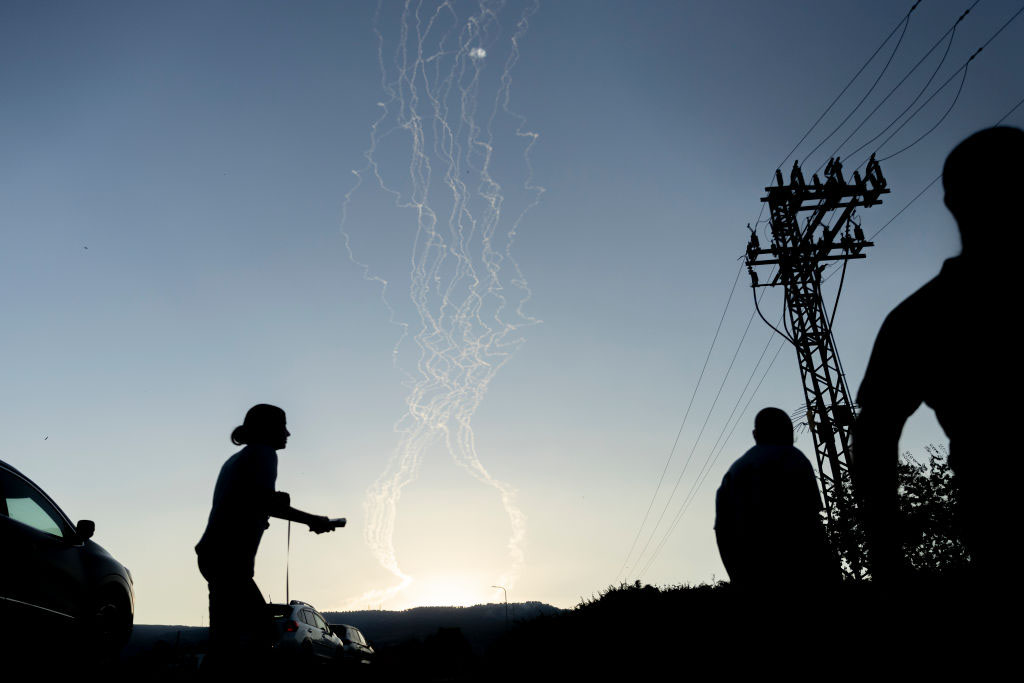
How close would you go to areas that weren’t evacuated but are theoretically within rocket range? You must ask yourself: Will there be air-raid sirens while I’m driving? While I’m there? An appointment at Ceders-Sinai:Should I go? I’ll wear clothes that won’t get too messed up if I have to jump out of the car and lie on the ground with my hands over my head.

These are our daily dilemmas. Fears. Stresses.  Who accepts this in a recognized, sovereign country?

Excuse my chutzpah, but I am tired of hearing we have the right to defend ourselves against terrorist rockets, missiles, drones and anti-tank missiles. I am tired of being forced to play defense until we are beaten down enough to win a short-lived international clearance to fight back. Not to win. Just to push them back until the next time.

Israel left Lebanon in 2000 and Gaza in 2005. We did not start this war.

So I have to ask: Why are we still subjected to bombardments— whether sporadic (Lebanon) or routine (Gaza) almost from the day we left? Not just since October 7.

It’s very simple.

They want to kill us. They are terrorists who want to kill Jews.

Fear of an invasion like the one in the south on October 7 led to the evacuation of more than 60,000 residents along the northern border. Even when that threat subsided, residents didn’t return. The north has been subjected to deadly and destructive attacks, especially from anti-tank missiles that have a range of nine miles – too close to shoot down or to take cover. These “internal refugees” have been living in crowded hotel rooms and guest houses while all attempts at diplomatic solutions have failed.

That’s not a bad thing. Negotiations, withdrawals, UN agreements never gave us anything, but it gave these terrorist organizations time to regroup, restock and grow in numbers.  They do not honor agreements. They do not want neighborly relations. They do not want us.

Why is it so hard to understand that?

The Israeli army is finally taking aggressive action that will hopefully enable residents to return:

To their homes, if those structures are still standing and livable;

To their farms, if their livestock and crops haven’t been burned to the ground;

To their schools, if they are not afraid to ride a school bus;

To their places of work, if they still have a job, if they haven’t filed for bankruptcy.

Sound extreme? Picture Beverly Hills, approximate population 32,000 according to the 2020 U.S. Census Bureau. Empty. Homes, shops and schools deserted. Visions of Coronavirus lockdown but with the addition of deadly rocket fire. Some buildings have crumbled onto the expansive sidewalks, insides blown through plate-glass windows onto Wilshire Blvd.  Or the Fairfax district (12,500) with the Farmers Market clock tower now rubble among the stalls. The Grove a ghost town.

Israeli children who ride school buses in border areas are drilled in hiding under the seats or bending down away from the windows while covering their heads. They have 15 seconds.  Would you send your kids on a school bus under these conditions?

Remember hiding under desks in the 1950s and early ‘60s? Now Israeli children who ride school buses in border areas are drilled in hiding under the seats or bending down away from the windows while covering their heads. They have 15 seconds.  If they are in a “30-second” designated area, the adults riding with them can try to get them off the bus, away from vehicles, and make sure they lie on the ground and cover their heads. Thirty seconds.  Would you send your kids on a school bus under these conditions?

We don’t want the “right to defend ourselves.” We demand the right to live without having to defend ourselves daily.

Excuse my chutzpah for wanting the new year to be one of enduring security and a normal existence. A new year that will see the return of the hostages, the return of our citizens to their homes, the return of our reservists to their families.

Shana Tova.


Galia Miller Sprung moved to Israel from Southern California in 1970 to become a pioneer farmer and today she is a writer and editor. 

They Want to Kill Us Read More »

That Song In My Head – a poem for Parsha Nitzavim-Vayelech

And now, write for yourselves this song, and teach it to the Children of Israel. ~ Deuteronomy 31:19

I’d like to be told to write a song
like Moses was told. This is the kind of
assignment I’ve been waiting for.

Free reign to be an artist and
use my sensibility to pluck the
right notes out of the air.

Does it have to rhyme or will
the mouths I put it in be okay
with a little free verse?

I hope it’s not the last thing I do
like it was the last thing that
Moses did. He got to sing it, at least.

I always think the last thing I wrote
is the best thing I wrote, but
I keep breathing and another week

goes by and I write something else.
This was Moses’ last best thing
before he sent us off to

where we’ve been going.
It’s not like sending your kid
off to college. They can visit.

And if you did your job right
they probably will. Our kid is
about to get his driver’s license

so soon he’ll transport himself
to his own holy land. It’s not like that.
We never saw Moses again.

We couldn’t if we wanted to.
I want to. I want to tell him
his song is still in my mouth –

that we’re a little lost without him.


Rick Lupert, a poet, songleader and graphic designer, is the author of 28 books including “God Wrestler: A Poem for Every Torah Portion.” Find him online at www.JewishPoetry.net

That Song In My Head – a poem for Parsha Nitzavim-Vayelech Read More »

Israeli Band RGB’s Journey of Love, Resilience and Music: A New Album for Troubled Times

After serving in the IDF, many young Israelis embark on extended trips around the world before enrolling in university, starting a job and settling down. This is how Roy Bartal and Noi Agam met while traveling in Mexico. They became a couple and quickly discovered they shared a similar taste in music and a love for singing.

After returning from Mexico, Bartal proposed starting a band. While Agam was initially hesitant, Bartal’s enthusiasm won her over. “We love the same music, but when he first suggested it, I was a little scared,” Agam said. “But he persuaded me.”

Calling themselves RGB, they released an EP, “In Sight,” in 2020, but realized they needed something to fill out their sound.  I knew Alon Kenett from high school and immediately thought of him”

Kenett, who spent two years as the keyboard players for Israeli pop star Omer Adam, not only expanded RGB’s musical palette, but he brought his experiences as a professional musician. With Kenett on keyboardsand producing and Agam and Bartal as singers and songwriters, they invested all their time, effort and money into their band and this month, they released their second album, “A Place For Lovers.” The album’s themes of resilience and emotional exploration gain even deeper meaning in the wake of the violence and upheaval following Hamas’ attack on Israel on Oct. 7, 2023, and the subsequent war in Gaza.

Agam explained that “RGB has always been about offering comfort and hope. We all face hardships in life and love, but we believe things will eventually be okay. The three of us — Roy, Alon and I— are committed to making music that feels like a warm embrace, something that leaves listeners feeling better after they hear it.”

“The three of us — Roy, Alon and I — are committed to making music that feels like a warm embrace, something that leaves listeners feeling better after they hear it.” – Noi Agam

While “A Place for Lovers” has a breezy, lightly syncopated pop sound, Agam explained that it was inspired by a difficult year in her relationship with Bartal. “Life isn’t always what you thought it would be and our message is to hold on to light and love. We are all on a journey from night to day and in the end, we find the sun.”

Although the songs were written before Oct. 7, they resonate even more deeply now. “Since Oct. 7, I feel more and more how these songs relate to what’s happening today,” Bartal said in a Zoom interview with The Journal. “There are lyrics in the song ‘Parties’ that really strike a chord — it connects to the hostages and wanting to see them out in the sun.”

“A Place For Lovers,” includes the previously released singles “Parties,” “Write About You,” “iCare” and “Unhappy,” alongside their latest single, “Green.”

The songs form a continuous narrative, charting the emotional highs and lows of Bartal and Agam’s personal love story. The trio introduced the album earlier in the year with “Unhappy,” infectious track whose jaunty melody and danceable groove contrasts with its narrative of struggling to escape sadness. “iCare” is an edgy, percussive critique of the world’s numbness toward others’ suffering.

The upbeat “Write About You” celebrates life, passion and love, while “Parties” tells the story of feeling lonely amid others’ joy. The latest single, “Green,” is a moody, soulful ballad about battling inner toxicity and recognizing that depression can eventually lead to growth, much like the change of seasons.

On GTV (Green TV), which can be seen on YouTube,  RGB creates whimsical, dreamlike videos that reflect the playful side of their work. The describe it as  evoking “the feeling of falling asleep in front of a TV, where dreams blend with the images onscreen.” The trio has also made performance videos for their singles, including visuals further exploring the themes of their songs.

Even though all three members are Israeli, they write and sing their songs in English. “Most of our audience is actually abroad, not in Israel,” said Kenett. “I checked Spotify and we have 3,000 listeners in Mexico, along with some in Brazil, the U.S., Japan and other parts of the world. It’s great to see our music reaching so many people in different corners of the world.”

Even with the success they’ve found, RGB still has to work day jobs to make ends meet.  Agam works at the Israeli equivalent of DoorDash, and Bartal works at a startup, but both pour their energy into the band outside of work hours. “I get up at 7 a.m., work until 6 or 7 p.m., then spend the rest of the time on the band,” Bartal shared. “I hardly sleep —sometimes only three hours a night — but it’s fine, I enjoy what we are doing.” Kenett works on a different schedule. ’“My day job performing with Israeli artists happens to be at night,” he said. “In contrast to Noi and Roy schedule, who work during the day, but we make it work, this is our passion in life and this band is what drives me.”

On Tuesday, October 1, RGB will perform at Hotel Ziggy (8462 W. Sunset Blvd) and on Thursday, October 3 at Bar Lubitsch (7702 Santa Monica Blvd) as part of the “We Found New Music” showcase series.

Israeli Band RGB’s Journey of Love, Resilience and Music: A New Album for Troubled Times Read More »

A Bisl Torah – What Does God Look Like?

There is a piece of Jewish lore about a group of Jews praying in a synagogue. The setting is Eastern Europe during a time of great antisemitism. On Rosh Hashana, as the Jews take out the Torah and begin to read the holy text, a local official bangs on the door of the shul.

The official, angry and disgusted by the palpable joy felt within the synagogue, began to yell. “Hear me! You Jews think you’re so smart and clever. If you can’t answer the following question by Yom Kippur, I’m putting you all to death!” He continued, “You tell me your God isn’t one of idols or images. So explain to me, what does God look like?” The Jews began to speak in nervous tones. This was a question without an answer. But the man repeated himself, “What does God look like? And if you don’t have an answer by Kol Nidre, you won’t live to see another Erev Rosh Hashana.” He left with the door slamming behind him.

The Jews turned to the rabbi with horror and sorrow. What answer would suffice? They knew they couldn’t name a person or make a statue. This wasn’t the Jewish way nor would the official accept some made up lie. The rabbi decided to take a walk in the woods to contemplate the situation.

As the rabbi strolled, perplexed and frightened over the possibility of the official returning and his people killed, he stumbled over a rock. As the rabbi got up from his fall, his eye turned towards a creek, water once hidden from sight. He slowly walked over, looked into the creek and saw his face staring back at his. The rabbi smiled. He had his answer.

True to his word, the official of the city returned on Kol Nidre. He bellowed before the congregation, “What does God look like?” And the rabbi stood up and held a mirror in his hands. He walked over to the official and said, “Look into the mirror and you will see your answer. God looks like you, like me, like every human being for each one of us was made in the image of God. God isn’t one of us. We don’t have that power. But God is reflected in each of us and we should remember that, always.” The official was shocked by the eloquence of the rabbi’s answer that he turned to leave and took the mirror with him.

We are each made in the image of God. Our actions and words reflect the Holy One. This new year, may we model our Creator and behave with kindness, grace and an open heart. God wouldn’t want it any other way.

Shana Tovah


Rabbi Nicole Guzik is senior rabbi at Sinai Temple. She can be reached at her Facebook page at Rabbi Nicole Guzik or on Instagram @rabbiguzik. For more writings, visit Rabbi Guzik’s blog section from Sinai Temple’s website.

A Bisl Torah – What Does God Look Like? Read More »

The Shofar Calls on our Moral Conscience

Without consciousness
we’d all be sociopaths.
I claim this because all decisions made
without it
might be morally mistaken,
since any we might make while choosing
moral paths
could not be by what I call conscience,
or our consciousness,
be taken.

Paths taken while we act unguided by it are
as likely to be morally as incorrect
as ones that we from anyone
who has no conscience
might expect.
By creating what becomes our conscience,
unconsciousness
deserves respect
for its power to prevent us from
the moral path to deviate and
defect.

Matspun, the Hebrew word for conscience
signifies
unconsciousness,
its root
denoting “hidden,” like the meaning of
sounds of shofars Jews every Rosh Hashanah
toot.


In “Pope Francis Is Turning Certainty on Its Head,” NYT, 9/19/24, David French writes:

Pope Francis made two comments last week that touched off a tempest in Christendom.

First, during an interreligious meeting at Catholic Junior College in Singapore, he said that religions are “like different languages in order to arrive at God, but God is God for all. And if God is God for all, then we are all sons and daughters of God.” ….

The idea that we are sons and daughters of God is basic Christian doctrine. He is the creator, and we are his creation. But the pope’s statements go farther than simply recognizing God’s sovereignty. He indicated that other faiths can reach God as well. “But,” he continued, “‘my God is more important than your God!’ Is that true? There’s only one God, and each of us has a language, so to speak, in order to arrive at God.”

Then, in a news conference on his flight home, he addressed the American presidential election and criticized both Kamala Harris and Donald Trump. “Both are against life,” the pope said, Harris because of her stance on abortion and Trump because of his stance on immigration. Pope Francis would not choose between them. Instead, he said, “Which is the lesser evil? That lady or that gentleman? I don’t know. Each person must think and decide according to his or her own conscience.


Gershon Hepner is a poet who has written over 25,000 poems on subjects ranging from music to literature, politics to Torah. He grew up in England and moved to Los Angeles in 1976. Using his varied interests and experiences, he has authored dozens of papers in medical and academic journals, and authored “Legal Friction: Law, Narrative, and Identity Politics in Biblical Israel.” He can be reached at gershonhepner@gmail.com.

The Shofar Calls on our Moral Conscience Read More »

A Moment in Time: “The First Step Toward Peace Begins ….. Here.“

Dear all,

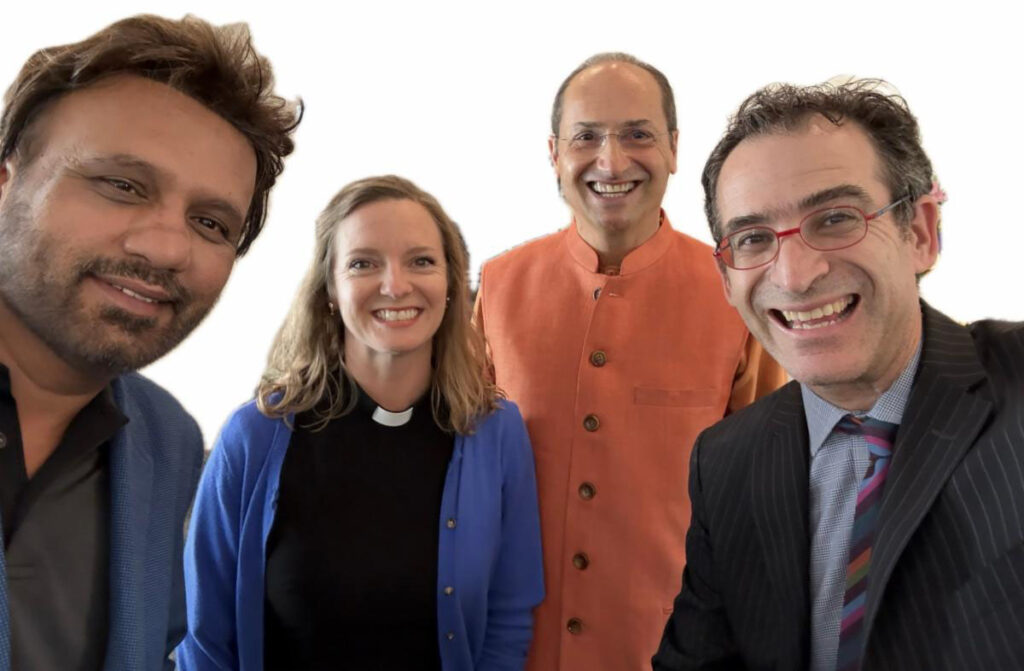
Last weekend I participated in a Culver City event sponsored by Unity of the Westside and the Heartfulness Institute. The organizers asked if I would share a prayer or thought about peace.

I asked many questions upfront, as (unfortunately) many “peace” events around the country morph into anti-Israel diatribes. As I researched the organizations and learned more about the event, I realized that was to be a day of building toward goodness.

And so …. A Muslim, a Christian, a Self-Realization Monk, and a Jew walked into a room….

And in that moment in time we dreamed about peace.

I left a better person than I was when I entered.

Peace only happens when we talk. With the vitriol we endure on social media, we have an opportunity and obligation to create space (sometime leaving our comfort zones) to enter real dialogue. It begins now. It begins here!

With love and shalom,

Rabbi Zach Shapiro

(Below is a video I created after the Tree of Life Synagogue shooting in 2018. At that time, the Culver City community created a grass roots candlelight vigil with hundreds of people of all faiths entering Temple Akiba in support. We were all so moved by the love they shared. I took an excerpt of my original words and shared them at the peace event this past weekend).

A Moment in Time: “The First Step Toward Peace Begins ….. Here.“ Read More »

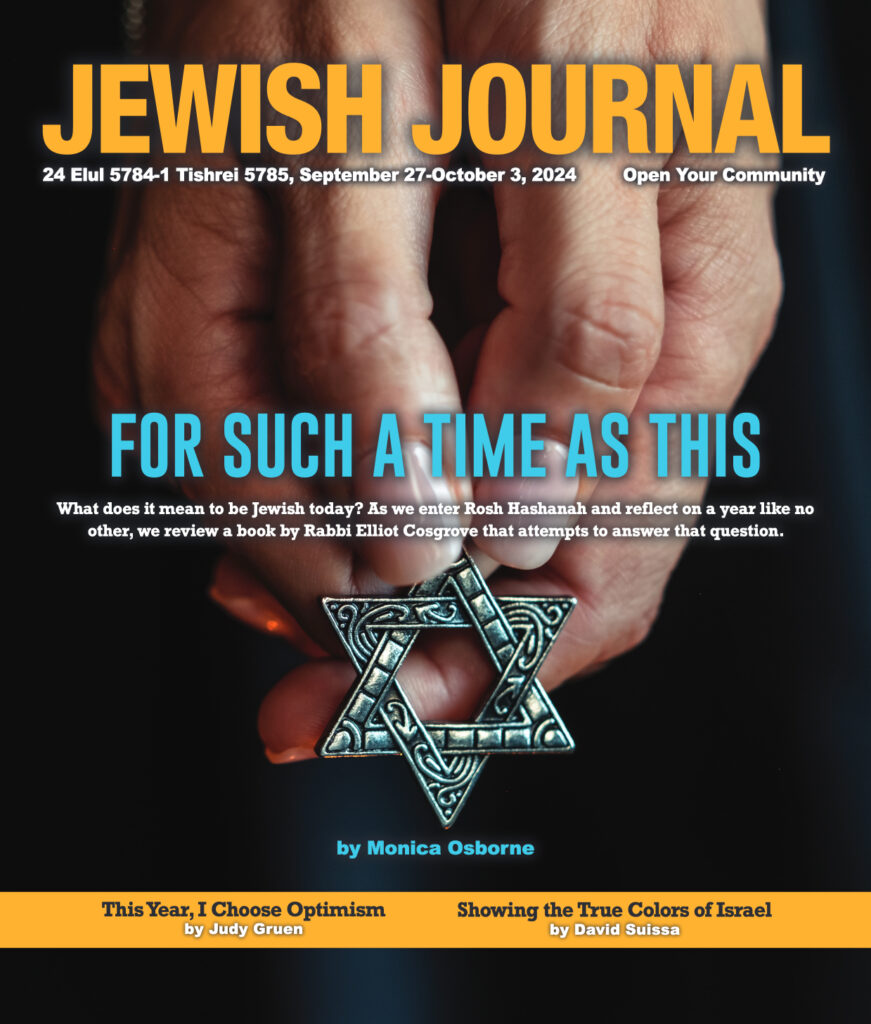
Print Issue: For Such a Time as This | Sep 27, 2024

CLICK HERE FOR FULLSCREEN VERSION

Print Issue: For Such a Time as This | Sep 27, 2024 Read More »

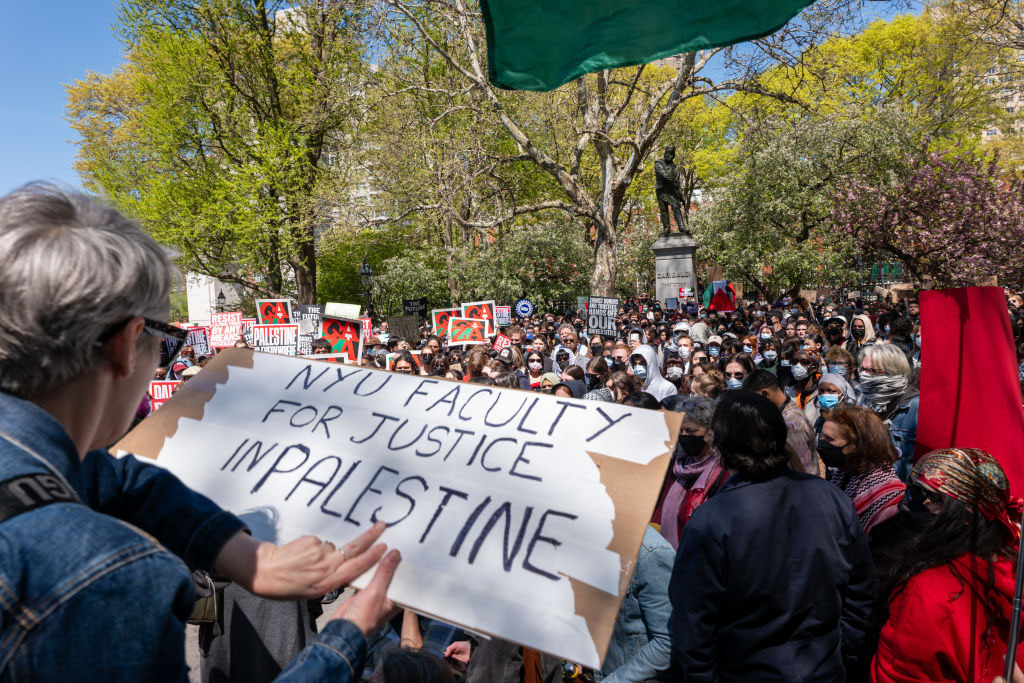
Report: Faculty for Justice in Palestine “Pivotal” in Rise of Campus Antisemitism

A new report released by the AMCHA Initiative on Sept. 26 concluded that Faculty for Justice in Palestine (FJP) “played a pivotal role in the unprecedented explosion of anti-Israel unrest and antisemitism that continues to grip many U.S. campuses.”

The report investigated “more than 100 schools most popular with Jewish students from Oct. 7, 2023 to June 30, 2024” and found that FJP was established on 55% of these campuses and that many of them “were directly involved with anti-Zionist student organizations and academic departments in organizing events and authoring statements.” “Nearly 70% of FJP chapters cosponsored events and/or co-authored statements with one or more student organizations, a collaboration that not only provided academic legitimacy to the student organizations and helped propel their anti-Zionist activism, but also assisted the FJP groups in spreading their own messaging among student activists,” the report stated. “In addition, more than one-quarter (26%) of FJP groups cosponsored events and/or co-authored statements with academic departments, which provided additional institutional approval and support for FJP’s activism.”

The report also found that schools with an FJP chapter likely had anti-Israel protest activity that lasted 2.5 times longer and 9.5 times more days those that didn’t have an FJP chapter. In schools with FJP chapters, encampments were likely to last 4.7 times more days; student governments at schools with FJP chapters were 4.9 times more likely to pass a resolution calling for their schools to divest from companies that conduct business with Israel.

Notably, the report found that “schools with an FJP group were 7.3 times more likely to have incidents involving physical violence targeting Jews than schools without an FJP group” and were also “3.4 times more likely to have incidents involving death threats or threats of physical harm targeting Jews.”

FJP chapters, the report explained, were established after the Palestinian Campaign for the Academic and Cultural Boycott of Israel (PACBI), a founding member of the Palestinian BDS National Committee, called for their formation and were thus “explicitly created to vigorously promote PACBI’s academic boycott of Israel (academic BDS) on their campuses and in their classrooms” and “provide direct support to anti-Zionist student groups, particularly Students for Justice in Palestine (SJP), facilitating their activism and embedding BDS goals into campus life.”

The report concluded by stating that AMCHA has “never seen faculty organize to this extent, within a national network that is supported by an international movement with the single political goal of bringing down a sovereign nation, and harming its inhabitants and those who support them on U.S. campuses, including their own students and colleagues. This is an extremely alarming development, which shows no sign of diminishing.” It urged college and university administrators to “establish robust safeguards and enforcement mechanisms to prevent faculty from using their academic positions and departmental affiliations to promote politically motivated advocacy and activism that directly targets their own students and colleagues for harm” and for lawmakers to “consider establishing legislation that would withhold government funding of schools that permit faculty to engage in such behavior.”

AMCHA hasnever seen faculty organize to this extent, within a national network that is supported by an international movement with the single political goal of bringing down a sovereign nation, and harming its inhabitants and those who support them on U.S. campuses, including their own students and colleagues. This is an extremely alarming development, which shows no sign of diminishing.”

AMCHA Initiative Director Tammi Rossman-Benjamin, who is also one of the lead researchers in the report, said in a statement. “These faculty-led groups are inciting anti-Zionist activism among students, propelling academic boycotts, and actively fostering an environment where Jewish students are physically attacked and threatened. The correlation between these faculty groups and violent antisemitic acts cannot be ignored. Without immediate intervention from university administrations and policymakers, the situation will only worsen, leaving Jewish students and faculty vulnerable to escalating violence.”

Report: Faculty for Justice in Palestine “Pivotal” in Rise of Campus Antisemitism Read More »