fbpx

September 12, 2024

UCLA Accepts Recommendation on Adopting Institutional Neutrality

On Sept. 12, UCLA announced that Interim Chancellor Darnell Hunt has accepted a recommendation from a working group that the university should not weigh in on political matters.

The working group, headed by UCLA School of Law Dean Michael Waterstone,  submitted a recommendation — accepted in full by Interim Chancellor Hunt — that moving forward, “UCLA’s chancellor, executive vice chancellor and provost, vice chancellors, vice provosts and deans should not make public statements on societal, public and political matters, unless those matters directly affect the university’s ability to support a research and educational environment where free expression thrives.” Such institutional statements, the recommendation explained, “can imply a false sense of unanimity about a given topic, stifle the free exchange of ideas, and risk making parts of our diverse community feel silenced or unheard. A focus on these kinds of statements can also divert university leaders’ attention away from their core responsibilities and pursuit of institutional goals.”

The working group’s report elaborated that “whether — and if so, how — a contentious issue relates to this essential mission of the university will itself be disputed at times; as with any general rule, this one would require university officials to exercise judgment in good faith, subject to critique by community members,” adding that in borderline cases, “the presumption should be for not issuing a statement.”

The “recommendation does not extend to department chairs and heads of academic programs, centers and institutes. There are often similar reasons for these leaders to be reluctant to issue statements so as not to exert pressure, however inadvertent, on how the discussion of important issues unfolds in their units, and so as not to risk any misimpression that they speak for others.”

UCLA Professor Kira Stein, who heads the Jewish Faculty Resilience Group (JFrg) at UCLA, told The Journal that while JFrg supports institutional neutrality, she wants to know what the university means by it. “When antisemitism and indoctrination within the institutions, are they going to hide behind neutrality and refuse to act? That’s my concern,” she said. “There’s confusion. The real question is whether they have the will to address these internal issues as they have to other forms of hate.” Stein said that universities like UCLA have actively spoken out “against prejudice and hate toward other groups but when Jews become targets, they demure. So this double-standard is what has offended and endangered the Jewish community… the selective application of neutrality becomes a shield to deflect responsibility from enforcing their own anti-hate and anti-discrimination policies internally.”

Jerald Mosley and Dominic Manser, co-founders of the nonpartisan group Bruin Alumni in Defense of Free Speech, called for UCLA to adopt a policy of institutional neutrality in a Sept. 10 op-ed in the Los Angeles Daily News. They contended that that the university taking sides on political matters “creates a campus orthodoxy, an officially sanctioned political position that marginalizes dissenting views … Fear of ostracism for taking unpopular positions, or for contradicting the university’s official opinion, raises professional risks for untenured academics that can trigger self-censorship. Prospective students or faculty members should not have to worry whether they will find a home on campus because their political views are officially disfavored.”

The JFrg at UCLA had posted on X on  Sept. 11 that it “strongly” supports UCLA adopting a policy of institutional neutrality. “It must be emphasized that, as a practical matter, this principle has not been in effect — the university has already weighed in on various social issues,” the JFrg wrote. “It saddens and disappoints us that, during a time that UCLA and other universities have already spoken out forcefully against various forms of hate and prejudice, they lack the strength and will to condemn antisemitism with the same clarity and urgency. This selective response deeply affects and endangers the Jewish community, which deserves the same protection accorded to others.”

The group added: “It’s also important to underscore that institutional neutrality relates to external matters — whether commenting on events in Ukraine, at the U.S. Capitol, or involving police departments across the country. It does not mean that the university remains aloof from commenting about internal matters. Consequently, institutional neutrality furnishes no excuse for inaction when it comes to addressing antisemitism or any form of bigotry within the university. To redress past failures, UCLA has a special obligation when it comes to enforcing existing anti-discrimination and anti-indoctrination policies and ensuring a safe, respectful environment on campus. Universities must be vigilant in rooting out antisemitism and bigotry within their own walls. We look forward to UCLA meeting its obligations in that regard.”

Among the academic institutions to recently adopt institutional neutrality include Barnard College, Stanford University and the University of Pennsylvania. The American Council of Trustees and Alumni (ACTA) has an ongoing list of universities and colleges that have adopted a policy or statement on institutional neutrality.

UCLA Accepts Recommendation on Adopting Institutional Neutrality Read More »
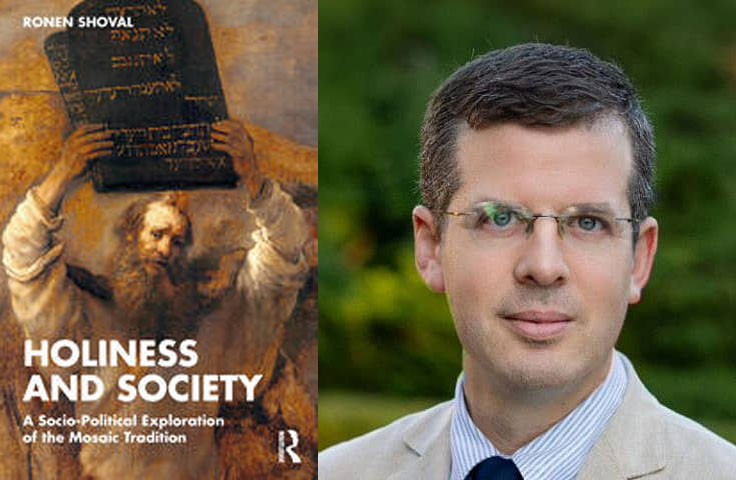
Ronen Shoval’s “Holiness and Society” Examines Collective Holiness and Jewish Political Thought

Over the gallery doors in Congress hang 23 portraits, known as the lawgivers. The 11 profiles of these lawgivers in the eastern half of the chamber face left, and the other 11 in the western half face right. In the center of the wall is a portrait of Moses, who is looking straight on at Congress. And if you were to cross the street to go to the Supreme Court, you’d see Moses holding the tablets and looking down at all the judges.

“The architects of the American capitol buildings chose wisely,” writes author Ronen Shoval, reflecting on Moses in Congress and the Supreme Court. “Moses’ thought continues to inspire people to this day. Unlike the leaders of Egypt, he did not perpetuate his memory through buildings, but through insights. His ideas remain relevant and inspiring.”

In his new book “Holiness and Society: A Socio-Political Exploration of the Mosaic Tradition,” Shoval, an Israeli philosopher and dean of the Argaman Institute for Advanced Studies, examines holiness as a distinct political category. It influences institutions, ethics, justice and even the use of force. He argues, “from the first appearance of the Israelites as a people, and indeed even beforehand, it had a political mission.”

When it comes to Moses and his influence on the U.S., Shoval told the Journal, “He was offering us the concept of the city on the hill. He gave us tools for how to model our society.”

The professor, who founded Im Tirtzu, the largest Zionist movement in Israel, was inspired to write his new book, which Routledge Press published, after studying for his PhD. He found two gaps in his education: When studying the Bible at universities, you don’t really study the Bible – instead, you learn how to analyze the philology of the Bible. There was also a gap he saw when he started examining the classical works of philosophers like William James.

“There was a major gap between the way they understood holiness, and what I understood about my Jewish education on holiness,” Shoval said. “The concept of holiness had not been developed. It’s just being presented in a Christian way, but not in an Old Testament way.”

For example, the author found that while James believed an individual can become holy, how this concept is presented in the Five Books of Moses is completely different. It’s collective.

Shoval said, “When God speaks to all the children of Israel, he says, ‘You should be holy, for I, the Lord your God, is Holy.’ It’s not for you as an individual. It’s for you as a community.”

The Bible argues that for one to be an individual, they must be part of a context.

“I am part of the context of my family, my congregation, my state and my language,” said Shoval, who lives in Jerusalem. “I’m an individual only because I am part of a context.”

He feels that especially in Israel, which is a very collective society. For example, in the U.S., where he lived for two years and taught at Princeton University, he saw that people wanted guns to protect themselves from the state. But in Israel, you get a weapon from the state to help the police and ensure law and order is upheld.

“The rule of the state is to make sure the collective survives, and the individual has freedom,” Shoval said. “You need freedom as a society. It isn’t one against the other. It’s one that creates the other.”

Shoval’s philosophy illustrates that the Ten Commandments serve as the constitution of the Torah, forming the bedrock of all subsequent laws and regulations found within it. “If a society follows the 10 Commandments,” he explained, “they become a holy nation. They take on more duties, and this makes them a light unto the nations. Other nations could look at this nation that runs according to the law of God as an example.”

While no society has ever been perfect, in this generation, the author has seen a fundamental shift from Judeo-Christian values to woke, another political ideology.

“It’s challenging the Western order,” Shoval said. “The people who are woke think the basic order should be changed.”

This has been concerning to Shoval, who’s now working on a book about the woke ideology – he has personal experience with it, after all. When he was a professor at Princeton, he faced backlash; there was a coordinated far-left campaign to cancel his course, and he was labeled as a far-right founder of an ultranationalist Israeli group. He saw firsthand what was happening at the Ivy League, where diverse thought was not welcome. And since Oct. 7, he’s been horrified by the hate towards Jews at universities in the U.S. and around the world.

“We thought there wasn’t antisemitism in Western civilization anymore, but now we see it’s a deep problem,” he said. “We are not surprised about radical Islam. We are concerned about the behaviors of other countries.”

What the proud Israeli and Jew has learned in this post-Oct. 7 world is not to give up hope, no matter what challenges his country and the Jewish people face.

“We have to value our achievements,” he said. “We have to understand that our very existence is being challenged, and it’s not about what we do. It’s about something very dark. We have to stick to our values and to our heritage. We can’t, for one second, take our life, our freedom and our existence for granted.”

Ronen Shoval’s “Holiness and Society” Examines Collective Holiness and Jewish Political Thought Read More »

The Last Jewel of Elul: Craig Taubman’s Final Year of Reflection

In 2005, Craig Taubman embarked on a project that would become a cherished tradition for many: the creation of the “Jewels of Elul” book. This annual collection of reflections, shared in the 29 days leading up to the Jewish New Year, was designed to inspire and uplift. Taubman approached 29 individuals each year, asking them to contribute their thoughts as the High Holy Days approached. The month of Elul, which marks both the beginning of these holy days and the end of the Jewish year, is a time for introspection, reflection and seeking forgiveness.

Over the years, Taubman invited not only Jewish contributors, but also a diverse array of well-known figures, including former President Barack Obama, the Dalai Lama and Lady Gaga. “Jewels of Elul” became a unique space for voices from different backgrounds to share their insights during this spiritually significant time.

However, this year, Taubman announced that it would be his last time curating the “Jewels of Elul.” When his wife asked why he continued to take on the considerable effort of producing the book without any financial compensation, he confessed that he had decided this year would be the final one.

“And next year, you’ll say this is my last year, and then another year and another year. What’s stopping you?” she challenged him, adding, “And if not now, when?”

Taubman reflected on her words and realized she was right. It was time to make a firm decision. Thus, the theme for this year’s book was born: If not now, when?

In the book’s “Welcome” page, Taubman mused, “I don’t have grand plans for what’s next, but I’m confident something will find me. Who knows, I might just change my mind next year.”

For many of those who have eagerly awaited the invitation to contribute their “jewels,” this news might come as a disappointment. Initially, not everyone agreed to participate. Some rabbis told Taubman they were too busy, while others questioned why he would ask non-Jews to contribute, wondering what they had to do with Elul and the High Holidays.

Taubman’s response was shaped by his broader philosophy of community and inclusion. Having co-hosted Friday Night Live with Rabbi David Wolpe for over 20 years and founding the Pico Union Project a decade ago, Taubman understood early on that fostering greater understanding between people required listening to those from different backgrounds.

“Every time we did a service, we invited different people—it might have been a priest or an imam, a labor activist, a person who was Mexican or Black, the mayor—and every time, it was better because we were seeing things through the eyes of somebody who wasn’t like us,” Taubman explained.

While he didn’t always agree with what his contributors had to say, he believed it was important to include a diversity of perspectives. “Since beginning the project, there have been 638 Jewels. Some I’ve loved, others I’ve vehemently disagreed with and a few left me utterly indifferent,” he said.

“Since beginning the project, there have been 638 Jewels.”

When Taubman first conceived the idea for the book, he imagined writing all 29 reflections himself, but quickly realized that it would be far too monotonous. “Not even my mother would be interested in reading my musings for 29 days straight,” he humorously noted in the book.

This year’s edition of “Jewels of Elul” features reflections from a wide array of personalities including Ellen Cooper, chairman, president, and CEO of Lincoln Financial Group; legendary folk singer Holly Near; Harriet Rossetto, founder of Beit T’Shuvah; Zev Yaroslavsky, former L.A. County Supervisor; and writer and filmmaker Nina Rota. As in previous years, Rabbi Wolpe wrote the introduction.

Reflecting on his journey, Taubman shared, “Eleven years ago, the opportunity to buy the Pico Union Project came, and I knew it was a new stage of my life. I thought it was going to be just a music club, but it became a multipurpose space.”

He continued, “It was a natural trajectory from something that was exclusively for Jews… and then five to six years into it, [we said], let’s open it up and let other people give us insights. Pico Union became a home where you can love your neighbor as you wish to be loved because you get to know your neighbor. And through the ‘Jewels of Elul,’ we can give a lot of people the opportunity to give an insight.”

Today, Taubman’s project reaches 50,000 people daily during the month of Elul. The Jewels are sent directly to subscribers’ inboxes, and many others read them online or on social media. Additionally, 10,000 physical copies of the book are distributed nationally to organizations, synagogues, and churches. Some rabbis and clergy even incorporate the Jewels into their sermons, using them as thematic guides.

As Taubman prepares to close this chapter of his life, his final theme—If not now, when?—serves as both a reflection on his journey and a challenge to all who read the book. While this may be his last year curating the “Jewels of Elul,” the impact of his work will continue to resonate within the community for years to come.

An excerpt by Greg Reid from the book:

How many times have we had a million dollar Aha moment in the

shower, only to watch it go down the drain as we brush our teeth in

the mirror.

Ten years later we see a billboard with that same concept and we

shout – hey wait, that’s my idea. The only difference between you and

the other person is how one person acted.

It’s the ACTION in the law of attrACTION that makes our dreams

come true. First we need to think it, then we need to feel it, and then

we have to DO it!

The legendary Les Brown once said “you have greatness within you –

perhaps today is the day we dust those ideas off and get them into

motion. You got this.”

To receive a Jewel-A-Day email or order booklets, visit jewelsofelul.com

The Last Jewel of Elul: Craig Taubman’s Final Year of Reflection Read More »

The Honeymoon Away From War – a poem for Parsha Ki Teitzei

When a man takes a new wife, he shall not go out in the army…He shall remain free for his home for one year and delight his wife. ~ Deuteronomy 24:5

Any excuse to avoid the draft
to avoid the war, to avoid the killing,
the capturing, the destruction.

Any excuse to delight your
chosen one, your partner,
your b’sheret.

Any excuse to behave like
newlyweds, even if your union
began long before they

ever thought up the war. This war.
There is always another war
if you need one.

I’m sorry I can’t go to the war, today.
I’m in the throes of a honeymoon.
Can we get them to sign a note

which says excused from the war
due to honeymoon? This should be
our national ID. This should be

all we need to cross a border
until there are no more borders
and no one is interested in

defending them, anyway, as we’re all
too busy delighting our chosen ones
on the other side of wherever

the border used to be. You do you
and I’ll do me and we’ll take all
the years off from doing anything else

in our homes, in our homes with
our delightful other, in our delightful
war-free homes.


Rick Lupert, a poet, songleader and graphic designer, is the author of 28 books including “God Wrestler: A Poem for Every Torah Portion.” Find him online at www.JewishPoetry.net

The Honeymoon Away From War – a poem for Parsha Ki Teitzei Read More »

Anti-Israel Divestment Vote Fails at Chapman

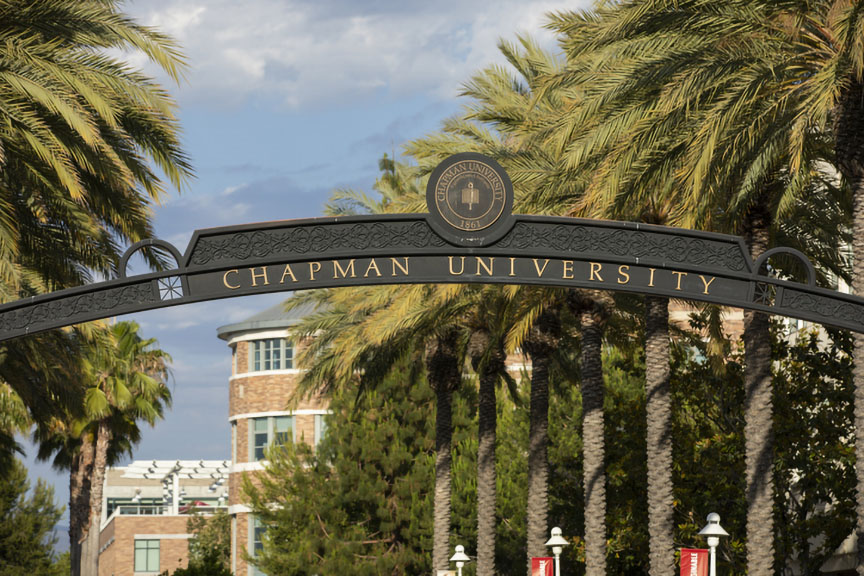
Chapman University’s Investment Committee of the Board of Trustees rejected a proposal to divest from companies that conduct business with Israel.

The Orange, California-based school said in a statement on Sept. 11, “As promised, Chapman University’s Investment Committee of the Board of Trustees agreed to consider proposals from students on the topic of divestment, which it heard at its Sept. 10 meeting. Leading up to the committee meeting, Chapman leadership met and engaged with students several times in the spirit of collaboration and learning.”

The statement continued: “The Investment Committee has declined to divest from its investments. Trustee Jim Burra, who chairs the committee, noted: ‘We have a fiduciary responsibility to preserve and grow the endowment, which directly supports the mission of the university. It is important that we make financial decisions based on risk and return.’”

According to The Panther, Chapman’s student newspaper, the vote was determined by a simple majority.

Chapman’s Students for Justice in Palestine (SJP) chapter had posted on Instagram that their proposal would have had the university “divest from companies involved in the military industrial complex and the apart/heid [sic] state of Israel” and increase investment transparency.

The Panther reported that SJP’s proposal had “gained momentum” after the anti-Israel group organized an encampment in the spring and had been in contact with university officials on the proposal during the summer. The university has also since announced a new policy that encampments are no longer permitted on campus, but those involved in the encampment will be given amnesty, per The Panther.

“In addition to the divestment proposal, SJP has advocated for other changes, including the creation of a Middle Eastern-North African (MENA) advocate position within the university’s Diversity, Equity and Inclusion (DEI) office. Bouchard confirmed that this position is expected to be filled by June 2025,” The Panther reported. “Other demands, such as ending study abroad programs in Occupied Palestine and discontinuing university-sponsored Birthright trips, remain under consideration and continue to generate debate within the university.”

The Chapman SJP chapter posted on Instagram that the vote is a “major disappointment by our institution” and will be holding a rally on Sept. 12 as a result.

Prior to the vote on the proposal, nearly 2,000 people had signed a petition launched by parents of Chapman Jewish students advocating against the proposal. “Moving Chapman University towards divestment and sanctions against Israel would only serve to exacerbate an already volatile situation, steering us away from a path of resolution and peace, while fostering an atmosphere of division and instability within our university,” the petition stated. “We firmly believe that our university’s resources should be used to promote knowledge, understanding, and cooperation, rather than being manipulated for political objectives.”

Anti-Israel Divestment Vote Fails at Chapman Read More »

A Bisl Torah – Reflecting Absence and Love

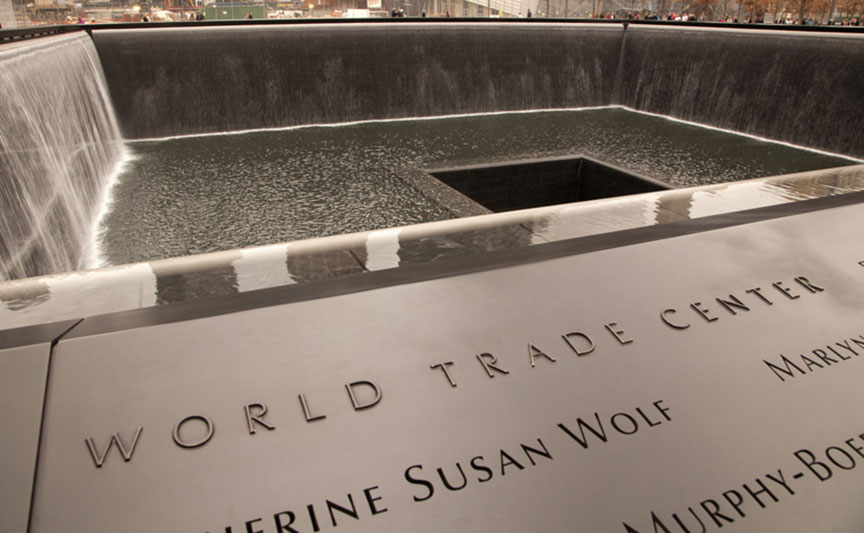
This summer we spent some time in New York City, visiting the 9/11 memorial. The memorial consists of two massive waterfall pools, the surrounding perimeter donning the names of those that died.

When we arrived we noticed one pool was completely empty while the other was in working order. The empty one revealed a sign, explaining that the pool was under repair.

The name of the memorial is: Reflecting Absence. In a way, I felt as if the working and “broken” pools, together perfectly conveyed this message. One pool beckoned onlookers, water streaming down into an abyss, tears that would eventually recycle into a continuously flow of anger, sorrow, memory and healing. With hundreds around the perimeter of the pool, it felt like an invitation to “fill” the absence with our own reflection. How do we each uphold the memories of the dead? What is our responsibility even years since that fateful day?

But it is the other pool that haunted me. Few walked closer. No water…nothing to see. But it wasn’t true. An empty pool wearing the names of the deceased felt like a hollow grave, asking us to understand the raw, aching emptiness felt by those that perished and the families that continue to mourn their loved ones. A heavy, suffocating expanse that needs constant repair and attention. Nothing to reflect upon or see through. Just an empty void to hold and attempt to comprehend.

The filled and empty pools convey the journey of grief. Sometimes grief is visible and noticed. Tears flowing, our hurting reflected in the eyes of those that hold us. Other times, grief is buried, invisible to the naked eye. Not seen by others but instead, we feel alone, a sense of emptiness growing within our veiled grief.

We recite Yizkor during Yom Kippur and the chagim. Yizkor is translated as “May God remember.” A continuous, ongoing process of remembering. Whether our grief is apparent or not, we request to be seen and held by the Holy One of Blessing.

Reflecting absence may be what we feel and internalize when visiting the 9/11 memorial but it’s not what we should model. Rather, may we learn how to emulate God, making room for those that grieve—the seen and unseen and instead, reflect upon them immeasurable compassion and an abundance of love.

Shabbat shalom


Rabbi Nicole Guzik is senior rabbi at Sinai Temple. She can be reached at her Facebook page at Rabbi Nicole Guzik or on Instagram @rabbiguzik. For more writings, visit Rabbi Guzik’s blog section from Sinai Temple’s website.

A Bisl Torah – Reflecting Absence and Love Read More »

Trees Rerooted, Dry Bones Revived and the Elephant in the Room

A plant’s root can become a stem,
and vice versa.
Though a human being’s terminus ad quem
is not his precursor,

his roots enable him to be at first
a sturdy branch,
and then the many stems that burst,
an avalanche

beneath which lie like slopes the years
it took to grow
the stems from hidden pioneers,
the roots below.

Though most humans do bear fruit,
they surely can’t
transform their stems into a root,
unlike a plant,

though possibly a mammoth may
become transplanted,
and in a neologistic way
re-elephanted.

Like hostages who’ve not survived,
Like bones once dry
we’ll be, as prophesied, revived,
rerooted, but won’t die,

and thanks to new routes we are taking,
will rebirth Israel,
uncompromised, not by mistaking
surrender-as-victory, and thus fail.

Jews, whom nations vilely doom
in the post-October 7 era,
are elephants in earth’s huge room,
who wish the world were fairer,

as God was to the Pharaoh whose
lust for Jews’ death wasn’t pardoned,
drowned in the Sea, unlike the Jews,
since his heart to the Jews had hardened.

A midrash though quite strangely claims
God saved him from this fate:
he lives on in holocaustic aims,
presaging Hamas’ hate.


In “Scientists Create Elephant Stem Cells in the Lab: The results could shed light on why the animals rarely get cancer. But the researchers’ ultimate goal of bringing back woolly mammoths is still aspirational,” NYT Science Times, 3/12/24, Carl Zimmer describes how, with the help of scientists like Eriona Hysollli at Harvad University, iPSCs (presomitic mesoderm cells) may enable the production of mammoths by transforming mature elephant cells into stem cells:…..

Eriona Hysolli, the head of biological sciences at Colossal, said that the cells could help protect living elephants. For example, researchers could create an abundant supply of elephant eggs for breeding programs. “Being able to derive a lot of them in a dish is important,” she said…….

In “Parashah and Politics Shoftim, September 7, 2024, Tikvah, Meir Soloveichik discusses Deut. 20:19-20:

כִּֽי־תָצ֣וּר אֶל־עִיר֩ יָמִ֨ים רַבִּ֜ים לְֽהִלָּחֵ֧ם עָלֶ֣יהָ לְתׇפְשָׂ֗הּ לֹֽא־תַשְׁחִ֤ית אֶת־עֵצָהּ֙ לִנְדֹּ֤חַ עָלָיו֙ גַּרְזֶ֔ן כִּ֚י מִמֶּ֣נּוּ תֹאכֵ֔ל וְאֹת֖וֹ לֹ֣א תִכְרֹ֑ת כִּ֤י הָֽאָדָם֙ עֵ֣ץ הַשָּׂדֶ֔ה לָבֹ֥א מִפָּנֶ֖יךָ בַּמָּצֽוֹר׃

When in your war against a city you have to besiege it a long time in order to capture it, you must not destroy its trees, wielding the ax against them. You may eat of them, but you must not cut them down. Are trees of the field human to withdraw before you into the besieged city?

רַ֞ק עֵ֣ץ אֲשֶׁר־תֵּדַ֗ע כִּֽי־לֹא־עֵ֤ץ מַאֲכָל֙ ה֔וּא אֹת֥וֹ תַשְׁחִ֖ית וְכָרָ֑תָּ וּבָנִ֣יתָ מָצ֗וֹר עַל־הָעִיר֙ אֲשֶׁר־הִ֨וא עֹשָׂ֧ה עִמְּךָ֛ מִלְחָמָ֖ה עַ֥ד רִדְתָּֽהּ׃ {פ}

Only trees that you know do not yield food may be destroyed; you may cut them down for constructing siegeworks against the city that is waging war on you, until it has been reduced.

Discussing Rabbi Joseph Soloveitchik’s explanation of the prohibition of destroying  fruit trees  during the course of warfare, Rabbi Meir Soloveichik, his nephew, writes:

We are presented with an ambiguous verse, with the Torah not making clear what it means. …. Either man is nothing like a tree, or man is exactly like one……  On the one hand, a human being is nothing like a tree, for human beings are mobile and possess the urge to explore.

Man is cosmic through his mobility. Man is a mobile being. He can easily detach himself from native surroundings and adapt himself to new environs. His adaptability to new conditions transcends that of the plant and the animal. The verse in Deuteronomy . . . contains a rhetorical question: “Is man like the tree of the field?” Is the tree as mobile as man? Certainly not! Man’s greatness and distinctiveness find expression in his ceaseless mobility. The tree is inseparable from the soil. Man can, and does, move away from home.

And yet, Rabbi Soloveitchik argues, we are also very much like trees: rooted to our origins, to our families, to places that give us meaning. The urge to explore notwithstanding, the formation of bonds, of roots, is essential to a flourishing life, and this too is built into our own nature. As he put it:

Man may roam along the charted and uncharted lanes of the universe, he may reach for the skies. Yet the traveler, the adventurer out to conquer infinity, will surely return home….  …. “Home is the sailor, home from the sea, and the hunter home from the hill”: these beautiful lines by Robert Louis Stevenson contain more than a nostalgic note.

For this aspect of humankind, there is a rootedness to our nature, and from this perspective, the verse seeks not to contrast human beings to fruit trees, but rather to compare them. Rabbi Soloveitchik adds:

Man is indeed like the tree in the field. In this context, the verse should be interpreted as an affirmative statement, not a rhetorical question. Man is indeed a rooted being, attached and committed to a homestead—no matter how far he may have traveled.


Gershon Hepner is a poet who has written over 25,000 poems on subjects ranging from music to literature, politics to Torah. He grew up in England and moved to Los Angeles in 1976. Using his varied interests and experiences, he has authored dozens of papers in medical and academic journals, and authored “Legal Friction: Law, Narrative, and Identity Politics in Biblical Israel.” He can be reached at gershonhepner@gmail.com.

Trees Rerooted, Dry Bones Revived and the Elephant in the Room Read More »

Who Wrote the Torah?

Dear all,

My most important meeting yesterday was when Maya and Eli came by Temple Akiba for a surprise visit. After raiding my candy jar, they found a small plastic children’s Torah.

As they unscrolled it, Maya asked, “Daddy, you wrote this, didn’t you?!”

”Um, no….” I responded.

”Then who wrote it?”

In that moment in time, I could have launched into a theological or spiritual or historical dissertation. All would have fallen flat. So I responded in a way that not only would resonate, but also might feed the imagination of these 5 year olds.

”Maya, and Eli, every day of your life, YOU are adding a page to our Torah. Your lives are the living story.”

I expected an “oh wow, daddy!”

But instead they responded, “Can we have more candy?”

Oh well! Perhaps, just perhaps they will think about this. But in the meantime, I hope that the interplay of Torah and sweetness will motivate them to keep exploring the answer!

Our lives truly can be a page of Torah. How will you live it?

With love and shalom,

Rabbi Zach Shapiro

Who Wrote the Torah? Read More »

Patriotism and National Responsibility in Israel and America

At 18, a dual American-Israeli citizen, I stood at a crossroads, a draft notice from the Israeli government in hand and a pivotal decision before me. Opting for a year of national service—a path common among religious women and Arab-Israelis—seemed like the key to cementing my place in Israeli society. What I didn’t foresee was how this experience would profoundly reshape my understanding of what it means to be not just Israeli but American—a realization that struck with undeniable clarity as I navigated an American university campus in the wake of October 7th.

Arriving at Yeshiva University just two months before a seismic October, I was struck by the dramatic contrast between American and Israeli civic engagement. While Israeli society wrestled with existential crises, American campuses outside of the Jewish sphere seemed mired in a bizarre, performative spectacle.

James Baldwin once cautioned, “As Americans, we must never overlook the possibility that the impetus for our most hostile reactions lies somewhere within our most deeply cherished illusions about ourselves.” Watching the fevered aggression of campus protests, I was struck by their emptiness. The eagerness to be inserted into a conflict to which they were strangers was matched only by their ignorance of its complexities. These debates were more than just misguided but devoid of any real stakes—a theater of activism performed by a cast of useful idiots; actors blind to their play’s true meaning. The “cherished illusion” driving this performance was that this was meaningful activism. But the legacy of civil rights and suffragettes has been reduced to a charade. True courage in confronting injustice had devolved into a parade of performative outrage, worn as a badge of honor. Earnest appeals for America to rise to its finest ideals have been replaced by slogans that besmirch the very patriotism that once fueled genuine fights for justice.

Living in Israel in 2023 and America in 2024—both marked by intense political turmoil —revealed firsthand the different values driving activism. In Israel, national and army service is a rite of passage, binding individuals to their nation’s forward march. The youth see themselves as stewards of a 2,000-year-old legacy, bearing both the weight of weapons and the responsibility of keeping their country alive. This sense of duty infuses even their political protests, elevating them into another catalyst towards progress. Meanwhile, American students “fight” to dismantle the very foundations for which their fathers sacrificed, without considering their own role in sustaining them. American 18-year-olds burn flags they’ve never had to defend, while their Israeli counterparts are buried in theirs.

Jewish tradition asks: Do we give to those we love, or do we come to love those to whom we give? Rav Eliyahu Dessler argues the latter, suggesting that investing pieces of ourselves – our time and resources, allows us to be reflected in those we serve. Service to one’s country becomes an act of self definition, transforming our sense of destiny, tethering it to the society we help build. This contrasts with American campus activism, which seeks to tear down rather than build up, fixating on disavowing history rather than harnessing it for progress. To this end, the Israeli culture of responsibility and community is fostered by a deep sense of giving, while in America, a pervasive sense of sanctimonious self entitlement threatens irrevocable damage to the national ethos.

This was illustrated in Prime Minister Netanyahu’s recent address to Congress. Where words are cheap, Netanyahu brought bodies: a group of soldiers, emblematic of the honor bound service that Israel instills. Among them was a soldier who was preparing to return to the front despite losing an arm and eye; another had run eight miles to join his platoon on October 7th. The group included an Ethiopian Jew and a Bedouin Muslim. I wondered if these young men, had they grown up on American soil, would have seen their potential for heroism stifled by a culture that seems to breed bitterness and fetishize grievance. Proudly American, it is to these Israeli men I look who embody President Kennedy’s call to “ask not what your country can do for you, but what you can do for your country.”

Israeli culture and national service has given me a renewed understanding of American identity. The values of patriotism and national responsibility that once defined America now seem to find their fullest expression abroad. Dissent is only courageous when the resolve to rebuild is stronger than the eagerness to tear down. If Americans are to reclaim a sense of responsibility and service, we must breathe these principles back into our political discourse. Only then can America reclaim its place as a beacon of civic virtue and collective purpose—a nation where ideals are not merely paraded, but lived through meaningful acts of service and sacrifice.


Adina Feldman is a Straus Scholar and Sophomore at Yeshiva University.

Patriotism and National Responsibility in Israel and America Read More »

Become Your BRAVE-ish Self!

Are you ready to change your thinking and live Brave-ishly?

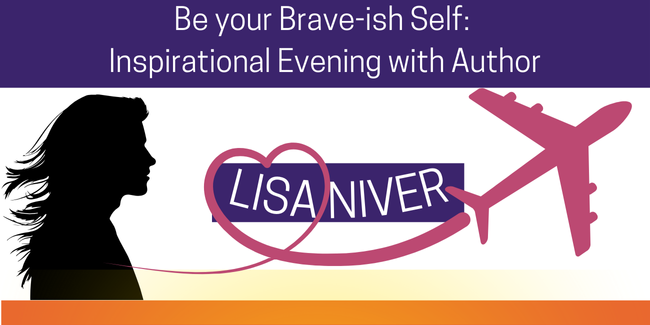
SEE YOU SEPTEMBER 19, 2024 at Small World Books, Venice Beach, California Join Adira Hadassah as we enjoy the evening with the inspiring and motivating award-winning author, Lisa Niver with giveaways worth over $700.

Ready to transform your mindset and embrace a Brave-ish life? Join us for an unforgettable evening with the inspiring and motivating award-winning author Lisa Niver, hosted by Adira Hadassah. We’re celebrating the 1st birthday of her empowering memoir, Brave-ish, on Thursday, September 19, 2024! Don’t miss this opportunity to meet Lisa, hear her incredible journey, and get your very own signed copy of Brave-ish. It’s more than just a book—it’s a guide to courage, growth, and living life to the fullest.Mark your calendar, bring a friend, and come celebrate with us. Let’s make this night one to remember!

DATE: Thursday, September 19, 2024

TIME: 6:00 pm to 8:00 pm

REGISTER: https://events.hadassah.org/LisaNiverauthorevent

Registration includes a copy of BRAVE-ish which Lisa will sign for you $36 Member • $40 Non-Member

LOCATION: Small World Books, 1407 Ocean Front Walk, Venice, CA 90291

QUESTIONS: email gayejacobs@gmail.com

over $700 in GIVEAWAYS:

    •  PADI e-Learning scuba class valued at up to $312. I absolutely LOVE scuba diving!
    • Travel Writer 101 class on Udemy valued at $150
    • Holocaust Museum LA  one year membership valued at $100
    • Ms. Magazine book: 50 years of Ms.
    • Jennifer Lang’s book: Places We Left Behind: a memoir-in-miniature –and SAVE THE DATE: Join me to talk about her new book, Landed, at Zibby’s Bookshop March 20, 2024.
    • Books from my publisher, Post Hill Press: Shanda by Letty Cottin Pegrebin, The Upstander by Jori Epstein, The Letters Project by Eleanor Reissa and Surviving the Survivor by Joel Z. Waldman

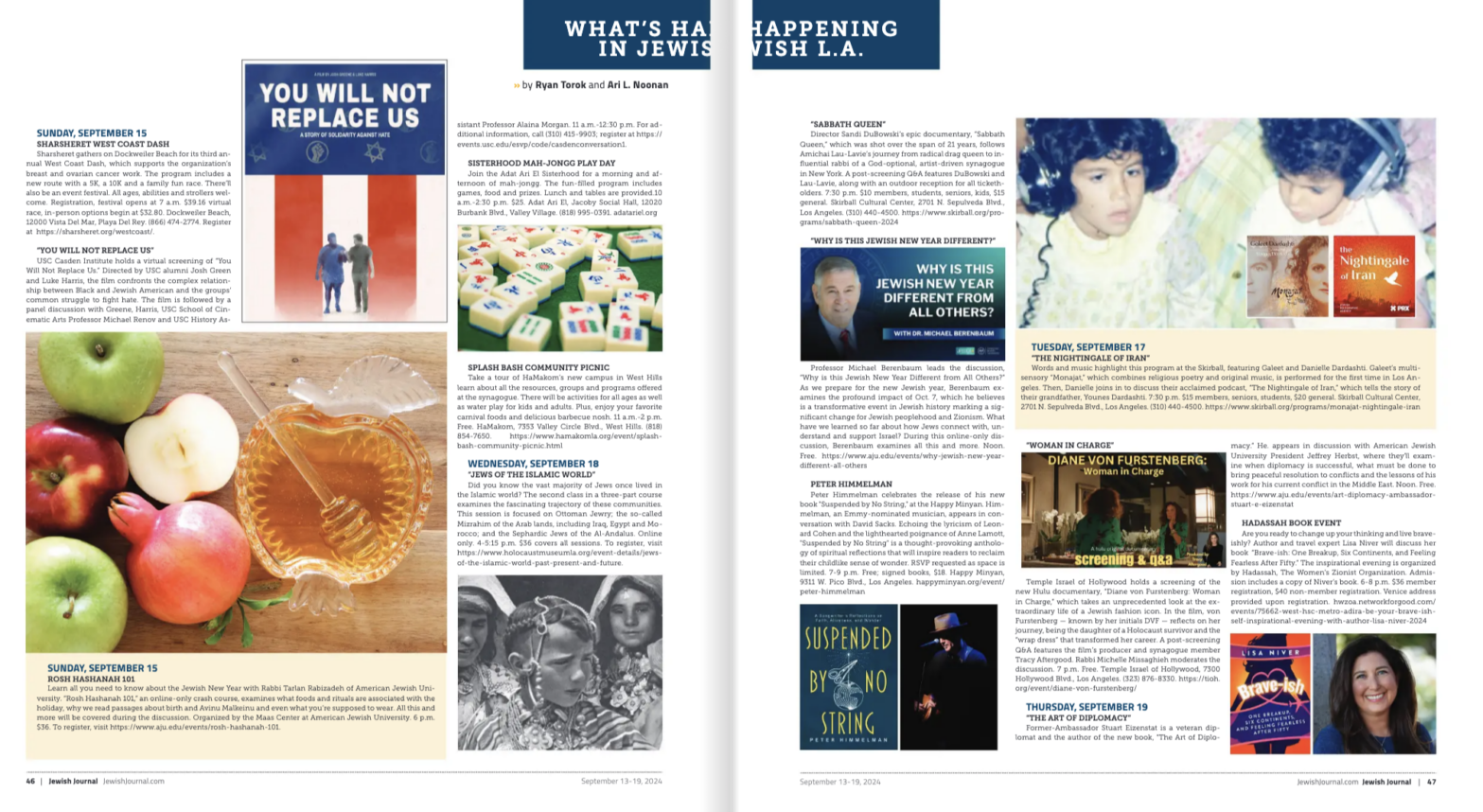
AS SEEN IN PRINT in the Jewish Journal Sept 13, 2024 on p 47

MORE ABOUT BRAVE-ish

Although Lisa Niver has traveled in far-off locales from Vanuatu to Nepal and received numerous accolades for both her writing and her top ranked website, what people don’t realize is that this began from the wreckage of a rotten romance.

Newlywed Niver was on the adventure of a lifetime. She had quit her job, rented out her condo, and was traveling around Asia. To the outside world, Niver was a woman living out her dreams of exploring ancient ruins in Cambodia and seeing orangutans in Borneo. In private, she was keeping a dark secret. But, when she found herself lying on a sidewalk in Thailand, looking up at the sky in severe pain, she knew things had to change. At age forty-seven, Niver found the courage to set course on a new life.

Feeling like a failure, pushing fifty, and moving home to her parents’ house to start again from scratch, Niver started taking one tiny “brave-ish” step at a time to take her life far away from the old one and into the adventurous world of travel writing. These small hurdles led to the challenge of trying fifty new things before turning fifty. From diving into shipwrecks, swimming with sharks, bobsledding at 3 Gs, to indulging in wild escapades, Niver found herself traversing the world on a journey of reinvention, personal growth, and discovering what it actually means to be “brave.”

While Brave-ish chronicles Niver’s inspiring expeditions to distant corners of the world including Myanmar, Cuba, Morocco, Kenya and Mongolia this is more than a travelogue. Niver’s story is a testament to the resilience of the human spirit and the power of perseverance. Brave-ish inspires readers to dream big, take risks, and embrace the unknown to create a life filled with wonder and excitement, even when courage seems elusive.

MORE EVENTS: https://lisaniver.com/events/ Sign up for Lisa’s class: TRAVEL WRITER 101 on Udemy

Become Your BRAVE-ish Self! Read More »