fbpx

August 14, 2024

Columbia President Minouche Shafik Resigns

Columbia University President Minouche Shafik announced on Aug. 14 that she is resigning from her position at the university.

In a message to member of the university community, Shafik wrote: “I have had the honor and privilege to lead this incredible institution, and I believe that — working together — we have made progress in a number of important areas. However, it has also been a period of turmoil where it has been difficult to overcome divergent views across our community. This period has taken a considerable toll on my family, as it has for others in our community. Over the summer, I have been able to reflect and have decided that my moving on at this point would best enable Columbia to traverse the challenges ahead. I am making this announcement now so that new leadership can be in place before the new term begins.”

Regarding her post-Columbia future, Shafik, an Egyptian-born British citizen, said she is “honored to have been asked by the UK’s Foreign Secretary to chair a review of the government’s approach to international development and how to improve capability,” she said. “I am very pleased and appreciative that this will afford me the opportunity to return to work on fighting global poverty and promoting sustainable development, areas of lifelong interest to me.”

Toward the end of her message, Shafik said that she has “tried to navigate a path that upholds academic principles and treats everyone with fairness and compassion. It has been distressing — for the community, for myself, colleagues, and students the subject of threats and abuse … I remain optimistic that differences can be overcome through the honest exchange of views, truly listening, and — always —-by treating each other with dignity and respect.” She concluded by saying that she believes “that Columbia’s future will be even more illustrious” going forward.

Columbia University, once a jewel in the crown of higher education, has been exposed as ground zero for campus antisemitism in NYC. I hope the new leadership will summon the moral clarity and the moral courage to confront the deep rot of antisemitism at Columbia’s core.” -Rep. Ritchie Torres (D-N.Y.)

The interim president will be Katrina Armstrong, CEO of the Columbia University Medical Center, reported the Columbia Daily Spectator.

Shafik has faced criticism and calls for her resignation for her handling of anti-Israel protests on campus — particularly regarding the encampment — as well as her April congressional testimony on campus antisemitism.

Washington Free Beacon reporter Aaron Sibarium noted in a post on X that “every Ivy League president who testified before Congress about anti-Semitism … has now resigned. And two of the three Ivy League presidents resigned in the wake of follow up scandals reported by the Free Beacon (plagiarism in the case of [former Harvard University President] Claudine Gay, texting-gate in the case of Minouche Shafik).”

“Texting-gate” is a reference to the three Columbia deans who resigned after the Free Beacon brought to light a series of text messages between the deans denigrating a panel on antisemitism. Preceding Gay’s resignation from Harvard was Liz Magill resigning from her position as president of the University of Pennsylvania after she was heavily criticized for her congressional testimony in December.

Rep. Elise Stefanik (R-N.Y.), who garnered headlines for her grilling of university heads, including Shafik, posted on X, “As I have said consistently since her catastrophic testimony at the Education and Workforce Committee hearing, Columbia University’s President Minouche Shafik’s failed presidency was untenable and that [it] was only a matter of time before her forced resignation. After failing to protect Jewish students and negotiating with pro Hamas terrorists, this forced resignation is long overdue. We will continue to demand moral clarity, condemnation of antisemitism, protection of Jewish students and faculty, and stronger leadership from American higher education institutions.”

Rep. Ritchie Torres (D-N.Y.) posted on X, “Columbia University, once a jewel in the crown of higher education, has been exposed as ground zero for campus antisemitism in NYC. I hope the new leadership will summon the moral clarity and the moral courage to confront the deep rot of antisemitism at Columbia’s core.”

Columbia student Eden Yadegar, president of the university’s Students Supporting Israel chapter, posted on X that people shouldn’t “think that this is a golden ticket to an instantly healed university. @Columbia is broken, and we will continue to hold them accountable. Let’s hope our next president is willing to do what Shafik wouldn’t: lead.”

Columbia President Minouche Shafik Resigns Read More »

Hamas = Fascist Jew-Hatred – But the Palestinian Arab Nationalism and Nazi Connection Goes Way Back

Israel-haters love to accuse Israelis of perpetuating and promoting the evil that Israel’s enemies exemplify.

On October 7, Hamas systemically raped Israeli men and women with the open support & even exuberance of the majority of Palestinian Arab society – and Israel-haters accuse the IDF of systemic rape and even post made-up surveys, which claim almost a majority of Israelis support rape as a tool of warfare.

Hamas & Palestinian Authority leaders/dictators regularly exhort the killing of Jews and call for removing millions of Jews from the land of Israel – and Israel-haters accuse Israelis of supporting ethnic cleansing.

Hamas & Palestinian Authority leaders/dictators, schools and media regularly refer to Jews as uniquely aberrant, evil, and dishonest – leading to over 90% of Palestinian Arabs living under the PA and Hamas having antisemitic beliefs – and Israel-haters claim it’s the Israelis who are the “racists” in this conflict.

Hamas & Palestinian Authority leaders/dictators abhor elections, don’t allow for any free press, free speech, or freedom of religion in favor of extreme authoritarianism – and Israel-haters accuse the elected Israeli government – in a country with freedom of religion, press, and assembly – of being “fascists.”

These are all examples of what psychologists refer to as “projection” (the act of subconsciously projecting onto others your own acts, thoughts, and feelings).

But nowhere is the projection engaged in by Israel-haters more profound, absurd, and ironic than when they accuse Israelis of being “Nazis” and try and associate the de facto democratic movement for Jewish self-determination (Zionism) with “Nazism.”

Plainly, for any fair-minded person with a modicum of knowledge about current events and history, the meaningful similarities between democratic Israel – a state where all citizens, regardless of their perceived race, ethnicity, or faith, have the same civil rights (and more rights than the citizens of any of Israel’s neighbors in the MENA) – and Nazi Germany, are non-existent. Meanwhile, the meaningful similarities between Gaza under Hamas control, and Germany under Nazi control, are as obvious as the similarities between Kim Jong Un-controlled North Korea and Stalin-controlled Russia.

Before 1933, it was well known in Germany that the Nazis were fascists, who rejected individual freedom, emphasized white supremacy, vilified homosexuality, and more than anything else, centered on Jew-hatred.

Despite (or perhaps because of) this hateful ideology, in the 1933 legislative elections in Germany, the Nazis received 44% of the votes; and within 18 months of Hitler becoming Chancellor, had seized complete control of Germany. Following this takeover, the Nazis moved every state institution and resource in line with and in support of their Jew-hating ideology.

Similarly, by 2006, Hamas’ deeply intolerant Islamist Supremacist ideology with violent Jew-hatred at its core was very well known.

Despite (or perhaps because of) this hateful ideology, in the 2006 legislative elections within the Palestinian Authority, Hamas received 45% of the overall vote and over 62% of the vote in Gaza, making it the largest party in the Palestinian Authority legislature. And in a manner similar to the Nazis’ violent seizure of power (because Israel had completely withdrawn from Gaza in 2005) in June of 2007, Hamas very violently seized absolute power in Gaza – killing and maiming thousands of Palestinian Arabs in the process.

Since then, Hamas has stayed true to its violent, fascist core beliefs. Hamas regularly murders political dissidents. Hamas murders Gazans for being gay. Hamas appropriated every resource and institution in Gaza in pursuit of its goal to “obliterate” Israel, including destroying Gaza’s water pipes to make rockets to attack Israel, while its leaders call for the mass-murder of all of the world’s Jews as they have been “educating” Gazans about the supposed conspiratorial evil of Jews and the necessity to kill Jews.

In 2014, the Hamas spokesman, Osama Hamdan, following a page straight from the Nazi chief propagandist Josef Goebbels, asserted to an audience on Lebanese TV that Jews enjoy killing children because “we [referring apparently to his audience] all remember how the Jews used to slaughter Christians in order to mix their blood in their holy matzos.” Hamdan also added, “This is not a figment of imagination or something taken from a film, it is a fact acknowledged by their own books and historical evidence.”

Of course, this vile antisemitic canard coming from a Hamas spokesperson should surprise no one, as the Hamas Charter itself (Article 7) provides: “The Day of Judgment will not come about until Muslims fight the Jews, when the Jew will hide behind stones and trees. The stones and trees will say O Muslims, there is a Jew behind me, come and kill him.” And that same Charter, in Articles 20 and 22, contains many of the same dangerous antisemitic tropes and sinister conspiracy theories grounded in Jew-hatred, which the Nazis promoted in Mein Kampf and later-on in Der Sturmer.

Article 22 is so crazy antisemitic, and fits so perfectly in the pages of Mein Kampf and Der Sturmer, it warrants quoting in full:

“For a long time, the enemies [Jews] have been planning, skillfully and with precision, for the achievement of what they have attained. They took into consideration the causes affecting the current of events. They strived to amass great and substantive material wealth which they devoted to the realization of their dream. With their money, they took control of the world media, news agencies, the press, publishing houses, broadcasting stations, and others. With their money they stirred revolutions in various parts of the world with the purpose of achieving their interests and reaping the fruit therein. They were behind the French Revolution, the Communist revolution and most of the revolutions we heard and hear about, here and there. With their money they formed secret societies, such as Freemasons, Rotary Clubs, the Lions and others in different parts of the world for the purpose of sabotaging societies and achieving Zionist interests. With their money they were able to control imperialistic countries and instigate them to colonize many countries in order to enable them to exploit their resources and spread corruption there.

You may speak as much as you want about regional and world wars. They were behind World War I, when they were able to destroy the Islamic Caliphate, making financial gains and controlling resources. They obtained the Balfour Declaration, formed the League of Nations through which they could rule the world. They were behind World War II, through which they made huge financial gains by trading in armaments, and paved the way for the establishment of their state. It was they who instigated the replacement of the League of Nations with the United Nations and the Security Council to enable them to rule the world through them. There is no war going on anywhere, without having their finger in it.”

Sadly, the obvious similarity between the Nazis’ fascism, authoritarianism, murderous intolerance for gay people, and virulent Jew-hatred grounded in antisemitic conspiracy theories, and that of Israel’s enemies (among the leaders of the Palestinian Arabs) did not begin with Hamas and its Islamist Supremacist leadership.

Well before the Arabs in Palestine began generally identifying as “Palestinian” and  certainly before Israel declared its independence from British rule, the Arabs living in British controlled Palestine were led by an outright, unabashed Nazi “super-fan,” Haj Amin el-Husseini.

Not only was el-Husseini the first de facto leader of the Arabs in British Mandatory Palestine, as the head of the Arab “Higher Committee,” he was an ally of the Nazis and honored guest in Berlin of Adolf Hitler. To this day, el-Husseini is a revered figure within Palestinian Arab society and particularly among the leadership in Hamas, the PLO, the PA, al Aqsa Martyrs Brigade, Islamic Jihad, etc.

Haj Amin el-Husseini’s Jew-hatred pre-dated his appreciation for and alliance with the Nazis. On May 1, 1921 Arabs incited to violence by Haj Amin al-Husseini’s lies about Jews trying to destroy Al Aqsa (the same lie Hamas used as its excuse for the October 7th Massacre) attacked Jewish residents in Jerusalem, Jaffa and in five Jewish rural communities. 47 Jews were killed and 146 were wounded in those May 1, 1921 attacks.

In 1929 (almost 40 years before any alleged “occupation”), Arab mobs – incited again by the lies and rhetoric of el-Husseini about Jews supposedly trying to destroy Al-Aqsa) – attacked Jews throughout British controlled Palestine. The most violent attacks were against old, established and largely defenseless Jewish communities in Hebron, Safed, Jerusalem, and Jaffa. During those attacks, 133 Jews were killed and 339 were wounded and the entire city of Hebron was ethnically cleansed of Jews – many of whom were raped and brutally tortured.

In 1936, el-Husseini incited yet another round of riots throughout British controlled Palestine. Riots that led to what has become known as the “Great Arab Revolt of 1936-1939 (ostensibly, against British rule, but which took over 500 Jewish lives).

By 1939, in order to escape British prosecution, el-Husseini took up residence in Iraq, where he, in coordination with the Nazi’s emissaries to Iraq, backed a pro-Nazi coup and they incited on June 1, 1941 in Baghdad (then home to one of the largest and most ancient Jewish communities in the MENA) a 3 day pogrom, known as the “Farhud.” During the Farhud, Arab rioters attacked numerous Jewish homes, businesses, and synagogues. By the time this pogrom was over, more than 180 Jews were killed and over 2000 were injured with incredible damage done to hundreds of Jewish homes and businesses.

After the Farhud, and the failure of the pro-Nazi coup in Iraq (which el-Husseini blamed on “the Jews”), el-Husseini escaped to and took up residence in Berlin as a guest of Adolf Hitler. During el-Husseini’s November 1941 meeting with Hitler, which took place as the Nazis were in the midst of invading Russia, Hitler committed to el-Husseini that Germany supported destroying the Jewish communities in the MENA, and of course would help destroy any effort of the Jews to obtain any sovereignty in Palestine.

Given their shared hatred for Jews and penchant for inciting antisemitic violence and murder based on crazy conspiracy theories, Hitler and the Nazis set up el-Husseini as the head of the Nazis’ Arabic-language propaganda network. As part of their collaboration with el-Husseini, the Nazis provided el-Husseini with a hefty budget, an office in Berlin, and dozens of employees who received salaries from the German foreign ministry.

From this office, el-Husseini led the Nazis’ efforts to enlist Arabs to the Nazi cause during WW2. Less than a year later, in anticipation of Nazi Germany defeating the British in North Africa, on July 7, 1942, the Voice of Free Arabism” led by el-Husseini, played a program titled, “Kill the Jews Before They Kill You.

Just like the violence incited against Jews in Israel in the 21st Century by the Palestinian Authority and Hamas leaders, this broadcast began with a lie: “A large number of Jews residing in Egypt and a number of Poles, Greeks, Armenians, and Free French have been issued with revolvers and ammunition” to fight “against the Egyptians at the last moment, when Britain is forced to evacuate Egypt.” The broadcast continued:

“In the face of this barbaric procedure by the British we think it best, if the life of the Egyptian nation is to be saved, that the Egyptians rise as one man to kill the Jews before they have a chance of betraying the Egyptian people. It is the duty of the Egyptians to annihilate the Jews and to destroy their property. … You must kill the Jews, before they open fire on you. Kill the Jews, who have appropriated your wealth and who are plotting against your security.

Arabs of Syria, Iraq, and Palestine, what are you waiting for? The Jews are planning to violate your women, to kill your children and to destroy you. According to the Muslim religion, the defense of your life is a duty which can only be fulfilled by annihilating the Jews. This is your best opportunity to get rid of this dirty race, which has usurped your rights and brought misfortune and destruction on your countries. Kill the Jews, burn their property, destroy their stores, annihilate these base supporters of British imperialism. Your sole hope of salvation lies in annihilating the Jews before they annihilate you.”

The G-dfather of Palestinian Arab nationalism was not, however, satisfied with only inciting Arabs to mass-murder Jews using Nazi race and conspiracy theories.  In the western Balkans, he recruited and helped to lead three SS divisions composed of Bosnian and Albanian Muslims who, along with German SS, helped mass-murder Jews in Croatia and Hungary. And in 1944 and 1945, towards the end of WWII, he helped to incite mass-murder riots targeting and murdering Jews in Egypt, Tunisia and Libya.

Notably, the Nazi collaboration and alliance with Arab nationalists did not end with Haj Amin el-Husseini. In October of 1944, 5 men parachuted into British controlled Palestine as part of a Nazi mission called “Operation Atlas.” The 5 Nazi spies, whose mission was to incite attacks against Jews, and even potentially poison the water-supply in Tel Aviv, were 3 German members of the SS and two Arabs, Thulkifl Abdul Latif and Hassan Ali Salameh (the father of Ali Hassan Salameh, who later became a leader of the Palestinian terrorist group Black September and was one of the architects of the Munich Olympics Massacre). And before Operation Atlas, Hassan Salameh worked with el-Husseini and the German Ambassador to Iraq to instigate the Farhud.

The man whom many historians consider to have been el-Husseini’s main competitor for the mantle of leader of the Arabs of Palestine during the British Mandate period,Fawzi al-Qawugji, was also an honored guest of Hitler during WWII. During the 1936-39 “Great Arab Revolt” al-Qawugji led forces separate from el-Husseini to attack and murder Jews. While during the 1930’s al-Qawugji and el-Husseini were rivals in Jew-killing in British controlled Palestine, they “buried the hatchet” when they were in Iraq and became allies in trying to put the Nazis in power in Iraq and when they helped to stage the “Farhud.”

When the Nazis coup in Iraq failed, al-Qawugji found refuge in Nazi Germany where he became a Colonel in the German Army. When WWII ended with the Nazis in defeat, al-Qawugji, apparently undeterred, made his way back to the Middle East and formed the “Arab Liberation Army” (ALA) in response to the UN Partition Plan of 1947. In July of 1947, al-Qawugji said: “the only option is the annihilation of every Jew – in Palestine and in every Arab state.” The ALA subsequently invaded Palestine in March of 1948 nearly 3 months before Israel even declared its independence, with al-Qawugji repeatedly vowing to destroy the Jews before they even dared to declare their independence.

Thankfully, Haj Amin el-Husseini’s, Hassan Ali Salameh’s, and Fawzi al-Qawugji’s close collaboration with the Nazis failed, as did their respective desires to murder the Jews in the land of Israel. But given the rather clear line between the totalitarianism grounded in raw-Jew-hatred that bound the Nazis and these men, as well as the role these men all played in the foundational ideologies of Fatah and Hamas – the two principle terrorist groups literally despotically controlling most Palestinians in the so-called West Bank and in Gaza – it’s truly the “pot calling the kettle black” (or the fascist totalitarian supporters calling Jews Nazis) when Israel-haters compare Israelis to Nazis or Israel to Nazi Germany.


Micha Danzig served in the Israeli Army and is a former police officer with the NYPD. He is currently an attorney and is very active with numerous Jewish and pro-Israel organizations, including Stand With Us and the FIDF, and is a national board member of Herut North America.

Hamas = Fascist Jew-Hatred – But the Palestinian Arab Nationalism and Nazi Connection Goes Way Back Read More »

Court Orders UCLA to Protect Jewish Students from Being Excluded from Campus Spaces

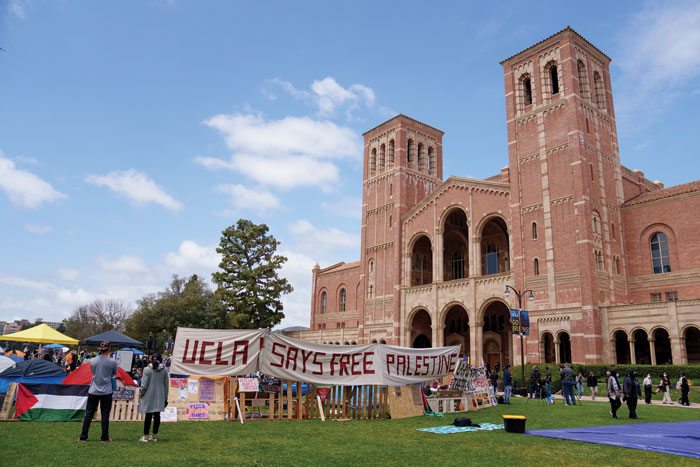
United States District Judge Mark C. Scarsi issued a preliminary injunction on Aug. 13 that UCLA has to protect Jewish students from any efforts to obstruct them from campus spaces.

“In the year 2024, in the United States of America, in the State of California, in the City of Los Angeles, Jewish students were excluded from portions of the UCLA campus because they refused to denounce their faith,” Scarsi wrote in the injunction. “This fact is so unimaginable and so abhorrent to our constitutional guarantee of religious freedom that it bears repeating, Jewish students were excluded from portions of the UCLA campus because they refused to denounce their faith. UCLA does not dispute this. Instead, UCLA claims that it has no responsibility to protect the religious freedom of its Jewish students because the exclusion was engineered by third-party protesters. But under constitutional principles, UCLA may not allow services to some students when UCLA knows that other students are excluded on religious grounds, regardless of who engineered the exclusion.”

This fact is so unimaginable and so abhorrent to our constitutional guarantee of religious freedom that it bears repeating, Jewish students were excluded from portions of the UCLA campus because they refused to denounce their faith. UCLA does not dispute this. – Judge Mark C. Scarsi

As previously reported by The Journal, a lawsuit was filed against UCLA by three Jewish students: Yitzchok Frankel, Joshua Ghayoum and Eden Shemuelian. Frankel, a law student and Orthodox Jew, alleged in the lawsuit that he and other students holding a peaceful pro-Israel rally nearby the encampment and were surrounded and targeted by anti-Israel protesters. Ghayoum alleged that he was blocked by members of the encampment from crossing through Royce Quad to meet a friend of his at Ackerman Union and that he missed four days of class because he felt unsafe on campus as a result of the encampment. Shemuelian, a law student and observant Jew, alleged that because she was forced to park near the encampment to go to class due to parking restrictions, she was forced to hear “antisemitic chants” and see “antisemitic signs” from the encampment and that her request for her to take her final exam off-campus due to safety concerns were ignored. Shemuelian also alleged that when she and other Jewish students were observing the encampment, numerous security members mocked them.

Scarsi noted that UCLA has taken action after the anti-Israel encampment was dismantled to address the matter, such as establishing an Office of Campus Safety and delegating daily campus safety to the Emergency Operations. However, Scarsi concluded that such actions were not enough to prevent future harm to Jewish students, pointing to there were subsequent instances of anti-Israel protesters disrupting campus activities on May 6, May 23 and June 10; on June 10, when the protesters attempted to set up another encampment, some students missed their final exams because they were unable to enter classrooms as a result of the protesters and other students had to be evacuated in the middle of their exams.

“While the May and June protests do not appear to have resulted in the same religious-belief-based exclusion as the prior encampment that gives rise to the Plaintiffs’ free exercise concerns, the Court perceives an imminent risk that such exclusion will return in the fall with students, staff, faculty, and non-UCLA community members,” wrote Scarsi.

The judge later added: “Under the Court’s injunction, UCLA retains flexibility to administer the university. Specifically, the injunction does not mandate any specific policies and procedures UCLA must put in place, nor does it dictate any specific acts UCLA must take in response to campus protests. Rather, the injunction requires only that, if any part of UCLA’s ordinarily available programs, activities, and campus areas become unavailable to certain Jewish students, UCLA must stop providing those ordinarily available programs, activities, and campus areas to any students. How best to make any unavailable programs, activities, and campus areas available again is left to UCLA’s discretion.”

Mark Rienzi, president of Becket Law of Religious Liberty and an attorney for the students, told The Journal in an email that this means that “UCLA can still apply its normal disciplinary rules to Jewish students. It doesn’t allow the decision-makers at UCLA to keep treating the exclusion of Jews as an acceptable ‘cost of doing business’ when deciding how to address activist disruptions on campus.” He also explained that under the injunction, “UCLA is still in charge of its own campus. But the court’s order means that however UCLA decides to manage its campus, allowing the exclusion of Jewish students is not an option on the table.” Additionally, the court “can take action if UCLA fails to comply,” said Rienzi.

The injunction will go into effect on Aug. 15.

According to a press release from Becket, the university is expected to appeal the injunction.

“UCLA is committed to fostering a campus culture where everyone feels welcome and free from intimidation, discrimination, and harassment,” Mary Osako, UCLA vice chancellor for strategic communications, said in a statement to The Journal. “The district court’s ruling would improperly hamstring our ability to respond to events on the ground and to meet the needs of the Bruin community. We’re closely reviewing the Judge’s ruling and considering all our options moving forward.”

“No student should ever have to fear being blocked from their campus because they are Jewish,” Frankel said in a statement. “I am grateful that the court has ordered UCLA to put a stop to this shameful anti-Jewish conduct.”

Rienzi said in a statement: “Shame on UCLA for letting antisemitic thugs terrorize Jews on campus. Today’s ruling says that UCLA’s policy of helping antisemitic activists target Jews is not just morally wrong but a gross constitutional violation. UCLA should stop fighting the Constitution and start protecting Jews on campus.”

Alex Morey, vice president of campus advocacy for the Foundation for Individual Rights and Expression (FIRE), told The Journal, “From a free speech standpoint, the law was already quite clear. UCLA is a public university with a binding constitutional obligation to protect both protest and counterprotest on campus. That includes a duty to address misconduct, such as removing protesters who are acting unlawfully, including by preventing their fellow students from accessing or moving around campus.”

UPDATE: UCLA has appealed the injunction.

Court Orders UCLA to Protect Jewish Students from Being Excluded from Campus Spaces Read More »

Cookies, Whiskey and Unshakeable Faith: How Some of the Wisest Jews are Comforting Themselves Today (Part One)

Did Jews invent Xanax? If not, perhaps we should have. 

Today, I know very few Jews who do not experience a daily torrent of worry over the totality of Israel’s existence, in light of some of the biggest threats that enemies such as Hezbollah and the Islamic Republic of Iran have ever made against the Jewish state (not to mention the ticking time bomb that characterizes the West Bank). 

I decided that one of the best ways to seek comfort at this moment of treacherous unknown was to ask some of the best Jewish minds around the world for some words of relief. I wanted to know their inner monologue — what they tell themselves at precisely the moment when their fears regarding Israel reemerge. 

Their words left me in tears, but for a good reason. And that included an unforgettable prayer that was offered by an Emmy and Golden Globe-winning television writer (David Sacks). Here are some of their powerful responses to the millennia-old Jewish challenge of taming our biggest fears:

“Jewish history tells us two things. The first is that [an] unimaginable catastrophe is possible. The second is that the Jewish people can survive any disaster. Israelis are mindful of both those two truths and that gives a hard edge to Israeli resilience. Even as we know that excruciating times are still ahead of us, we also know that we’ll pull through. That’s what I would call a uniquely Israeli form of optimism.” 

—Yossi Klein Halevi, American-Israeli author and journalist (Twitter/X: @YKleinHalevi)

“It’s normal to feel fear when you are being threatened with annihilation. Our human bodies automatically will respond with fight, flight, or freeze. But I look around Israel, this wondrous, reality-defying country, and our ancient, innovative, scrappy, stubborn, and dedicated people, and realize that Jews living in their indigenous homeland after thousands of years — is nothing short of a miracle. There is no conflict in feeling fear and hope at the same time. But ultimately, God has given us everything we need: Strong army, allies, and faith that He is always alongside us — the defender of Israel never sleeps.”

—Shira Lankin Sheps, MSW, published author, workshop facilitator, photojournalist, clinical editor, and the Executive Director of The SHVILLI Center, which helps process Jewish thoughts and feelings, and finds well-being in daily practice.

“I always draw on two elements: The resilience of the Jewish spirit, and our deep emunah and belief that the Jewish nation will be able to overcome any and all challenges that threaten our survival. The Jews have survived, prevailed and flourished under dire circumstances for thousands of years, even when the IDF did not exist. I attribute that to our indomitable Jewish spirit. A spirit, a calling deep inside every Jew of a strong collective mutual responsibility to each other. This was seen so clearly when worldwide Jewry rushed to Israel’s aid with an outpouring of love after Oct. 7, giving in every way, reaffirming once again, that every Jew needs to know they are not alone.”

—Israel Bachar, Consul General of Israel to the Southwestern United States (Bachar served in Israel’s elite Golani Brigade in Gaza in the 1990s)

“I’ve always believed in divine order — that everything happens for a reason. But witnessing the repeated carnage of Oct. 7 caused by barbaric terrorists makes me question that faith. So, when divine order falters, I turn to geopolitical order. The Abraham Accords and other normalization deals have shown us that the future of the region can be promising. 

“Moderate Muslim states are normalizing relations with Israel, recognizing threats from entities like Hamas, Hezbollah, and the Houthis just as much as Israel does. They, too, want to stop these forces from crossing their borders. Despite what we are seeing on our college campuses, regional partners see two clear sides — pro-terror or anti-terror. This regional consensus could lead to a future of peace and stability once radicalism is eradicated.”

—Lisa Daftari, journalist, foreign policy/national security expert, editor-in-chief at The Foreign Desk and a regular TV/radio commentator.

“In the morning prayers we ask G-d to ‘Sanctify Your name through those who sanctify Your name.’ By that we mean [that] G-d, Your name, ‘G-d’, is linked to us, and our name is linked to You. And what happens to us is a reflection of You. And so please G-d, save us so that Your name is magnified in the world. Because when people see the miracles that You make on behalf of the Jewish people, they’ll see that there is no power other than You in the entire world. And Your name will be made greater. So, G-d, sanctify Your name through Your people, Israel, who sanctify You, by granting us miracles and Divine protection. Amen.”

—David Sacks, Podcast Host, “Spiritual Tools for an Outrageous World”

“We don’t often think about it this way, but if you really stop and analyze some of the holidays that we all celebrate, including Purim, for example, I think you will realize that everything will be okay.

“We celebrate Purim, we drink, we get dressed up, we eat, but how many of us really think about the fact that Purim was the near genocide of the Jewish people? Achashverosh, he wasn’t just another king; he was the ruler of the world, of 127 countries. And he agreed to annihilate us.

“At the time, if I had told you that we would one day celebrate, you would have thought that is possibly the most insensitive thing I can say, given the circumstances. The same is true, of course, of all of our holidays, including Hanukkah. We were not winning that war. 

“There was no way we were winning that war, and yet here we are. So when we say Am Yisrael Chai, we have to understand that it is not just an empty phrase, but it is a historical reality, and a reality that has always been and will always be.

“How many Babylonians do you know? The bottom line is, we will get through this, as we’ve gotten through all of our hardships, and we will come out stronger on the other side. 

“We will dance again.”

—Hillel Fuld, tech columnist and Israel advocate (Hillelfuld.com)

I received so many profound responses that I decided to dedicate two columns to words of comfort and strength from Jews worldwide. Next week’s column will feature insights from Israeli leaders such as Natan Sharansky, the wisdom of rabbis such as Daniel Bouskila and David Wolpe, and touching insights from authors such as Sarah Tuttle-Singer, who lives in Israel and admits that when anxious, she resorts to whiskey and chocolate cookies on more than one occasion. 

Until next time. May this be a week of safety, positive decrees and tremendous peace.


Tabby Refael is an award-winning writer, speaker and weekly columnist for The Jewish Journal of Greater Los Angeles. Follow her on X and Instagram @TabbyRefael.

Cookies, Whiskey and Unshakeable Faith: How Some of the Wisest Jews are Comforting Themselves Today (Part One) Read More »

Shari Foos: The Narrative Method, Library Dinners and Cinnamon Surprise Cake

Shari Foos’s nonprofit, The Narrative Method, addresses the crisis of loneliness by connecting people to their stories and creative expression.

“[Before] reaching outside of your circle, invite yourself to think deeply, get clear on something that matters to you,” therapist Foos, MA/MFT/MS, told the Journal. “Then when you bring that very subject to someone else … it can really lead to rich conversations.”

Now in its tenth year, The Narrative Method offers free online salons five days a week and interviews with interesting people, programs for communities in need and more. One of the events they offer is called the library dinner, and it can happen at a library, in a public space or at someone’s home.

“Everyone meets at this space and goes away for one hour and learns something, anything,” she said. “[Then] everyone has a lovely dinner and goes around and shares what they’ve learned; it’s a fascinating experience of just exchanging what seems to be impromptu knowledge and information.”

Foos, a former punk rock musician, radio and TV writer, comedian, university professor and co-founder of IKAR-LA, added, “It’s really fun, and it’s a great way for people to get to know each other on a whole other level.”

At one of these events, Foos spent her time talking to a janitor in the hallway.

“It was something that happened organically, and it was a wonderful exchange,” she said. “Nothing makes me more excited than dealing with really diverse people who I wouldn’t have gotten to meet otherwise.”

These dinners also allow participants to skip the small talk and get right into the big ideas.

“It’s not, ‘What’s your favorite color?’ or anything like that, they just go right to the quick … questions that deal with really profound issues as well as funny issues,” she said. “That bonding, especially because it’s with a stranger, is really kind of a holy experience.”

When asked about where the food piece comes in, Foos said being Jewish is a huge part of it. The other part: “Now to brag, but I’ve been a really good eater throughout my life,” she said. “I love eating; I love what meals do.”

Foos has hosted “zillions” of dinners for the purpose of just sitting with people and having one conversation, She also started to create prompts to take people quickly and instantly into a deeper connection.

For a variety of reasons Foos doesn’t cook much. However, she shared a recipe for Cinnamon Surprise Cake, created by her son and his cousin in 2001. They were six and seven at the time. This inexact recipe, which you can find below, really illustrates the joy and creativity that can go into cooking and baking.

The recipe instructs you to, “Bake at 400 degrees for two games of Pac Man and six hand clapping games,” Foos said. “What I love about this recipe is not only that it’s really good, it’s so engaging in a way that only a child could imagine.”

While you can join one of The Narrative Method’s events, you can also create online and in-person experiences of your own.

“Invite a few friends and you can use our [prompts] or you can use [your own conversation starter] that gives everyone a chance to go around and share,” she said.

For example, take a quote that you find inspiring and ask everyone to introduce themselves by saying their first name and responding to it. This, as opposed to saying, “I grew up here and I’m this old and blah, blah, blah. and that’s my job,” she said.

The responses may surprise you by being incredibly profound, flip or emotional.

“Don’t jump in on them, don’t finish their sentences, don’t do anything; just be in a state of wonder,” she said. “An experience of your senses … enjoying [food and conversations] with other people… is such a thrill.”

Enjoy!

Learn more and sign up for their programs at TheNarrativeMethod.org and follow @TheNarrativeMethod.comon Instagram.

For the full conversation, listen to the podcast:

Henry & Zack Foos’ Cinnamon Surprise Cake

 (6/23/2001)

First Bowl: Mix apple sauce with melted butter. Add brown sugar and cinnamon

Second Bowl: Make icing by mixing melted butter and powdered sugar

Challah

Chocolate Chips

Cherries

Put the contents of the first bowl in holes between the braids in the challah. Cover with tin foil to prevent toasting.

Bake at 400 degrees for 2 games of Pacman and 6 hand-clapping games.

When out of the oven, ice the sides with frosting. Serve hot with whipped cream. Top with chocolate chips and cherries.


Debra Eckerling is a writer for the Jewish Journal and the host of “Taste Buds with Deb.Subscribe on YouTube or your favorite podcast platform. Email Debra: tastebuds@jewishjournal.com.

Shari Foos: The Narrative Method, Library Dinners and Cinnamon Surprise Cake Read More »

The Baggage of Exile: A Review of Maxim D. Shrayer’s “Immigrant Baggage”

In a world that grows smaller each day with the relative ease of migration and the blessing and burden of technology, it’s not particularly uncommon for a writer to see himself as inhabiting multiple identities simultaneously. We are no longer confined to one place only. In fact, it has never been easier for people to leave their home country in search of a new life. For writers and thinkers of the twentieth and twenty-first centuries especially, the marks of migration and movement are hallmarks of what it means to have the fullest understanding of being in the world at this particular moment. In Maxim D. Shrayer’s new book “Immigrant Baggage: Morticians, Purloined Diaries, and Other Theatrics of Exile,” Shrayer counts himself among those who have had the blessing or curse of being forced to trade one identity for another. But the question is always whether one ever truly leaves the remnants of a past identity behind. For Shrayer, the answer seems to be: no, one does not. And for the reader, the evidence of this is clear and its imprint can be found in each of the stories in this collection.

Shrayer is no stranger to narratives of exile and migration. And while the ease of travel and movement may be a sign of our times, it was not ease that characterized the emigration of the young Shrayer and his family from Soviet Russia. They spent eight years as refuseniks before finally immigrating to the U.S. in 1987. In his 2007 literary memoir, “Waiting for America,” which was the first book written in English to explore the experiences of Soviet Jews waiting to enter America after being released from Russia, he tells the story of his own coming-of-age. It’s a transition not just into adulthood but also into an understanding of what it will mean to carry the baggage that all exiles carry with them into their new lives.

It’s not uncommon to write about the balancing of dual or hyphenated identities; nor is it unheard of to write about leaving one place for another and learning to exist there as a kind of perpetual foreigner. But Shrayer’s take is unique in that he sees his experiences—from his origins as a Russian-Jewish child in Soviet Russia to his time in the pre-immigration holding space of Italy to, finally, his life as an accomplished scholar and professor in the United States—not as the ultimate defining factor in his identity but rather as a touchstone to something more critical. For Shrayer, “writers are not only products of their origins but also creative remakers of their identities.” It’s an insight that the war in Ukraine “brought into devastatingly sharp focus,” given that three of his grandparents were born there, although it’s something he says he has always known and tried to practice in his work.

A central question to Shrayer’s book is the question of what it means to write “translingualy,” which means to exist in or operate between multiple languages. “There’s more to translingualism,” he writes, “than working not just in one language but in two or more, simultaneously or consecutively.” That Shrayer did not simply trade one identity for another is apparent throughout his stories. If it’s not the American years “tucked under his Soviet-made belt” it’s the question implicit in each of the return trips he makes to his native Russia with his daughters: How can one become something else entirely, taking on a new cultural or national identity, when one’s most formative years transpired in an altogether different place? Shrayer’s identity, then, is one of movement, of pushing and pulling. Shrayer’s mother, for instance, questions why he would return year after year to the place their family worked to escape, but for Shrayer, it’s ”a return to [his] own childhood and youth—the lost joy of pure friendship. In the wrong place yet at the right time.” One doesn’t simply abandon one’s childhood it or discard it because of its geographical context. “I was still held captive by memories of my Soviet years,” he writes.

A central question to Shrayer’s book is the question of what it means to write “translingualy,” which means to exist in or operate between multiple languages.

Translingual writing is not something static and still but a body full of movement. It is the mode by which one describes a life spent “living in transit.”

Shrayer is a fully self-aware writer. At the beginning of “Yelets Women’s High School” he writes: “Blood vessels of Russian classical literature saturate this story the way capillaries do the vermillion border of human lips. And yet the American in me is having trouble with a traditional structure,” but as it turns out, “life’s raw material dictates its own rules of storytelling.” A writer’s origins and literary language are inseparable: yet another new language created to add to the translingual roster. But a life spent “living in transit” is still a life subject to the passage of time. And yet Shrayer muses: “Only time will show whether we’re bound to lose our Russian-American and Russian-Canadian voices tinged with a Jewish accent.”

It’s this accent, along with the merging of multiple languages, that ultimately comprises the “immigrant baggage” referred to in the book’s title. But Jews are not the only ones with such baggage, as a careful reading of Shrayer’s stories reveals.

Shrayer may wax poetic about “the pleasure of writing in tongues,” but it’s no surprise given that in nearly all of his stories he betrays a fascination for detailing the languages and accents of everyone with whom he interacts. The tongue, it turns out, tells all. In one story, a woman speaks a “rich beautiful slightly old fashioned Russian,” while in another the appearance and accent of a German doctor who witnesses a snowboarding accident in which Shrayer is hit, coincidentally, by another German doctor causes Shrayer to imagine that he is an “SS man in retirement.”

This particular story, “Ribs of Eden,” is in fact my favorite in the collection, not least because I have spent a good deal of time in the Dolomites and the autonomous region of Italy called Südtirol in German and Trentino-Alto Aldige in Italian, where the main events of the story take place. In this region there are three official languages: Italian, German, and Ladin. But the sense I always get is that German is the preferred language in this part of Italy. The restaurant menus are a testament to this preference. Rather than the expected pizza and pasta tourists in Italy dream of, German and Austrian-inspired foods like spaezli and goulash are more typical here. Not to mention the apple strudel, which is truly the best in the world according to my son. The setting is all alpine Deutschland-esque, but when I speak Italian there no one bats an eye, while every now and then a restaurant server can be heard speaking a language I can’t make out at all (Ladin): a strange and unsettling place indeed.

It’s almost ironic that this is the setting for an accident in which Shrayer is hit on the slopes by a German snowboarder, a man with a “frogskin face, shaved so clean that it looked as if it had been splashed with sulfuric acid.” Shrayer notes that the German speaks English immediately: “You made the wrong turn.” When the elderly “SS man in retirement” (who it turns out is a completely decent person) skis over, he speaks in German to the offending German snowboarder: “I saw everything. Entirely your fault.” The rest of the story is about Shrayer’s longing for “universal justice” and his dealings with German insurance companies which are ultimately fruitless because of a “lack of evidence.”

But what remains clear in this story, which is just one of the several snapshots in the book, is the “hidden texture of exile,” that sense of being inside and outside of places at once. And what of the baggage? In the preface Shrayer remarks on the few material items that were taken with them when they left Soviet Russia, but other than typewriters and a few books from the Moscow library little remains of the “material baggage.” But “as to the memory of our lives before emigration, it’s taken much longer to dispose of the immaterial baggage of exile.”

The Baggage of Exile: A Review of Maxim D. Shrayer’s “Immigrant Baggage” Read More »

Shabbat with Nova Survivors in Jerusalem

It was Friday night, and I sat at a table next to a lovely young woman. Her name is Emma, but the name she took after converting, a year ago, is Halleli, meaning “Praise God” as a command. It comes from the parsha (verse) in Tehilim 147:12, “Jerusalem, praise the Lord, praise your God, Zion.” Emma’s parents, a Jewish father and a non-Jewish mother, came from Russia in the 90s. Her father’s last name is Katz. “Cohen Tzedek” she says proudly.

Emma is one of more than 3,000 young people who were at the Nova music festival when their world exploded on Oct.7. 

Three hundred sixty-four of those at the festival were murdered and 40 were taken hostage to Gaza. Emma-Halleli and her close friend, Shir, are two of those who escaped.

Emma-Halleli and Shir were among 100 Nova survivors who were hosted by the Kesher Yehudi organization at the Ramada Hotel in Jerusalem, the Shabbat of Aug. 3. It was the second such Shabbat organized by the organization for survivors, but their ultimate goal, in addition to providing a warm, spiritual and loving Shabbat, one that is full of healing, was to have it culminate in the creation of long-term “havrutot,” partners in the learning of Torah topics. 

It is just as well that on Shabbat one cannot take notes, as one cannot write while crying. It was a Shabbat of laughter and tears, and tremendous inspiration. 

Kesher Yehudi, which began 13 years ago, says their mission is to be “a social movement bridging the gaps in Israeli society between religious and secular Jews by building friendships — two people at a time.” They hope those partnerships will be for life. Partnerships that are necessary now, more than ever.

Their bold move is to bring together not just any two groups of Jews, but those who define themselves, for the most part, as “secular” (though some of those are traditional) and those who one might imagine are the farthest from them — Haredi Jews.  Tzili Schneider, the founder, says she wanted to recruit those Haredi who are hardcore in their observance. The success of the endeavor indicates that they are softcore in their hearts.

Parents of two hostages were the honored guests at the Shabbat; Merav and Shlomi Berger, the parents of Agam, who was a ‘tazpitanit’ – an IDF lookout, and Sigi and Momi Cohen, the parents of Eliya, who had been at Nova. They were deeply moved by all the love showered upon them and blessings made for the return of their children. There were constant mentions of the hostages, and that the Shabbat was for the merit of their return.

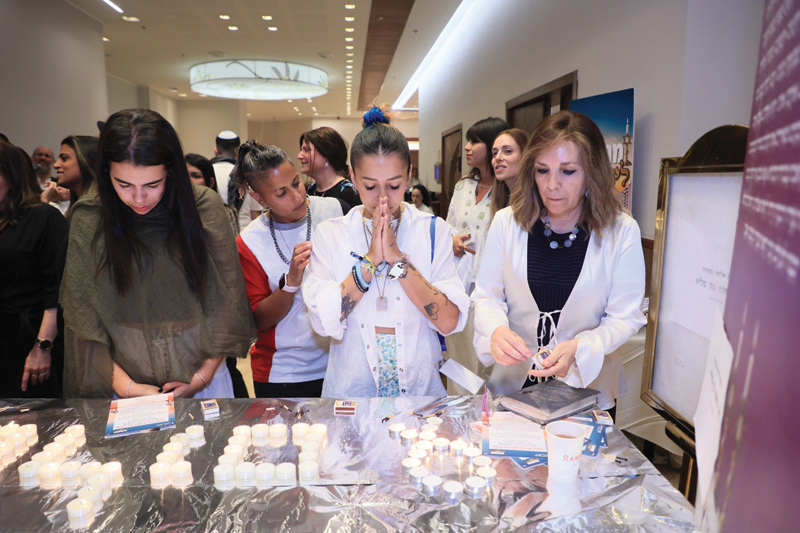
The line-up for the Shabbat indicated how important people think it is to reach out to those who suffered and are trying to find their way back to normalcy. The former Chief Rabbi, Yisrael Meir Lau, held a pre-Shabbat session at which he spoke and memorial candles were lit.

Yonatan Razel, a much beloved American-Israeli singer, writer and composer, spent the entire Shabbat with the program. He preceded the candle lighting with a musical Kabbalat Shabbat, with singing and dancing, led some of the Shabbat prayers, singing during the meals, and concluded the Shabbat with a musical Havdala, at which one of the Nova survivors pulled out a drum and all joined in the singing and dancing. 

Rabbanit Yemima Mizrachi, an iconic speaker who has appeared throughout the world, lit Shabbat candles with the guests, saying to them, “You need to pray for us now. Your prayers are even stronger than the prayers of Moses.” She placed her hands on the young women who came to her afterwards asking for blessings. “All those who were murdered for kiddush Hashem,” she said, before the candle lighting, “in the name of heaven [because they are Jews], are present with us now.” Offering new meaning to the accepted explanation of the “zachor” and “shamor” of two Shabbat candles, she said, “One candle we light will be ‘zachor,’ a candle of remembrance, and the other ‘shamor’ —  that those who remained after that Shabbat will stay safe.”

Sivan Rahav-Meir, one of Israel’s favorite journalists, said to the gathering on Shabbat afternoon, “You should not be called ‘the Nova survivors’ but ‘the Nova heroes.’ And you survived for a reason. You have a mission now.”

Sivan Rahav-Meir, one of Israel’s favorite journalists, said to the gathering on Shabbat afternoon, “You should not be called ‘the Nova survivors’ but ‘the Nova heroes.’ And you survived for a reason. You have a mission now.”

In many cases, when I asked survivors what their profession is, many of them replied that for now, “I am rehabilitating.” After hearing it several times, I began to understand that they are, fortunately, giving themselves the time they need to heal.

During Shabbat dinner, while I was getting to know Emma-Halleli and Shir, I asked them what they were up to now. Well, they said, we’re both going into reserve duty soon. Reserve duty? Wasn’t the army giving them a pass after what they had endured? In the course of the Shabbat, each time I heard the same responses from Nova survivors who were about to, or had already done, reserve duty since Oct. 7: “But I want to do reserve duty.” I was astonished. Only in one case did a young man say, “I was back in Gaza in reserves for a month and I told my commander, I can’t do any more of this right now, and he immediately let me off.” 

And what do Halleli and Shir, these 22-year-olds with the gentle demeanor and sweet smiles do on reserve duty? “We’re warriors,” said Halleli. “We’re in a unit called the Lionesses of Jordan, as we are stationed in the Jordan Valley.” They chase terrorists.

Schneider was a teacher in Bais Yaakov. She had grown up in Mea Shearim and remembered how, when she was six years old and the Old City of Jerusalem was liberated during the Six-Day War, soldiers and local residents danced together in the streets; she was carried on the shoulders of a soldier, who was then hoisted to the shoulders of one of the black-garbed Haredim. “So I was on the ‘third floor’,” she says, “and there was unity, there was tremendous shared joy. My mother raised us to think that there were not ‘camps’ among us – there were only two kinds of people: Jews, and the children of Noah.” Noah, who preceded Abraham and Judaism, was given seven commandments to uphold and all the world’s people emerged from him.

Schneider remembers how there were names of soldiers to pray for written on their refrigerator with markers and before Passover she wanted to clean the refrigerator and wipe off the names but her mother would not let her, because, she said, “These are holy people.”

After teaching for many years, Schneider reached a point in her career when she wanted something different. She told The Journal how she used to travel on a bus every morning to the school she taught at, and there was another woman on the bus with her who appeared to be secular, and for four years they saw each other and never spoke to each other. Schneider said this situation pained her and pursued her. “We came to Israel from somewhere in the world; we are living through intifadas and difficulties in the country, we put our kids in the preschool, get on the bus, pick them up at the end of the day, deal with challenges … how is it possible we haven’t spoken to each other? Are we two peoples? Don’t I want to know her, to know about her life, why she lives here, why in Jerusalem? Maybe she is also curious to know me. This made me think that something needs to happen here.”

She approached Rav Yosef Shalom Elyashiv, at that time the esteemed rabbinic leader of the Haredi community in Israel and abroad, with her idea that became Kesher Yehudi. He encouraged her and said that Am Yisrael has to be unified, to return to the way we were when we all stood at Sinai together, and that this is the way to save Am Yisrael.

But how does one take an idea and make it happen? 

“I was in Kupat Cholim [the local HMO]for a blood test. I had already decided that the axis of the Torah should be the connection between the two sides. I saw the secretary and she appeared hiloni and I asked her, ‘Are you interested in a learning havruta with a Haredi woman?’ and she said, ‘It sounds interesting.’ Then I asked the nurse who took my blood and she said, ‘Yes, I see a lot of Haredim in the clinic and I don’t know them.’ Then I went to the doctor and she was also interested. She said she has a lot of Haredi patients and they have different codes and she’s also interested.  

“I was on my way out and I saw the cleaning woman who told me, ‘Don’t walk here yet; it’s wet’ and I asked her the same question and she said, ‘Yes,’ so then and there was the possibility of four havrutot, each of whom is different, and all of them expressed interest. 

“It was my free day from teaching but I knew there would be a break soon so I took my son and went into the teachers’ room and I told them about the initiative and on the spot I got more than four teachers who said they are interested.”

Within a year there were more than 1,000 havruta couples, Schneider said. At this point, 13 years later, 17,000 havruta couples have been created. That is 34,000 Jews who are learning together and, more important, talking to each other even though they come from opposite ends of the spectrum.

I asked Schneider why she concentrates on Haredi and hiloni Jews, and doesn’t address those who are dati-leumi “nationalist-religious”– for want of a better term, those who in America would be called “modern Orthodox” though in Israel, there is also a term hardal which means “nationalist-Haredi,” strongly Zionistic yet closer to Haredim in their externals.

Because, she says, “The great disconnect in the nation is between Haredim and hilonim and I think that in order to solve it we need to take the two extremes and connect them; the middle will work out. Also in order to get total engagement on the part of the Haredi mainstream, those who (in the case of the men) are studying Torah all day, I need to be very clear about the framework. If I tell them it is a project of Haredim with hilonim I’ll get the top ones.”

Kesher Yehudi also works with 32 from among the 70 year-long pre-army preparation programs, called “mehinot.” They began as programs for the Orthodox community, that include Torah study, learning about faith, Israel’s history, building up one’s physical stamina and more. After a while, secular mehinot were also created. By enabling Kesher Yehudi to work with the secular mehinot, which are closely connected to the IDF, it indicates that they think it a worthwhile program. She describes how close they become and continue the relationship after the young peoples’ army service begins.

In the room, there was free-flowing wine on the tables, and bottles of liquor for a l’chaim before lighting candles and at Kiddush the next morning. The Nova music festival was a trance party, but there were also “regular” adults, and even married couples, who came for the music and dancing, leaving their children with the grandparents. One such couple described how they survived when the husband covered the wife with his own body, as they were hiding among the bushes while terrorists raged around them, killing everyone in sight. “I wanted my child to grow up with parents,” he said on Shabbat, “and if not with parents, at least with a mother.”

Several of the Nova survivors said the Hagomel blessing publicly for the first time since their survival. It Is a blessing one makes upon deliverance from danger. The “Amens” resonated throughout the dining hall at lunch and to the ends of the earth.

There was another surprise at lunch. Rav Yisrael Goldwasser of Bnei Brak brought a sefer Torah that was saved during the Shoah. It had been sneaked into a Nazi labor camp near the Czestoçhowa Ghetto and when the Jews reading it were discovered by the Nazi guards, they were cruelly beaten till blood ran. Somehow it was saved, and there are still blood stains on the parchment, on the Torah portion of Matot, the same Shabbat that we were in the hotel.He showed all the guests the bloodstains. “Our Simhat Torah was cut short this year,” he said, “so let us dance now.” The Nova survivors and others joined in, singing, “How greatly have I loved Your Torah…”

In the afternoon, newcomers were offered the option of beginning to study with new havrutot. I asked to see a copy of the booklet from which they were reading Jewish sources. Its topic title was: “Simcha.” Joy.

At the end of Shabbat, Nova survivors spoke of the Shabbat being an uplifting, powerful experience, saying that it was easier to keep Shabbat when they were together. One said, “I feel that the joy has returned to my life.” Another: “It’s like a honeymoon with God … we are leaving here with giant pride that we are Jews and that we were left alive for a reason …” Other comments were “I felt the light within my soul,” “This Shabbat, I finally felt connected to myself,” “I found my inner light, I felt joy in my soul, for the first time in such a long time…” “We experienced unity, love and how you care, and you don’t look down upon us for having gone to a party on Shabbat, you don’t think we are strange, you accept and love us and that is amazing.” One woman said,  “The light you provided here for so many Jewish souls you don’t understand what you’ve done, but it’s for many generations.”

“This Shabbat, I finally felt connected to myself,” “I found my inner light, I felt joy in my soul, for the first time in such a long time…”

After checking out, all the participants were given a wrapped parting gift. I asked Tamar Frei, a Kesher Yehudi staff woman, what it was. “A lamp,” she said. I opened it at home and saw it was a small emergency lamp that works on batteries, the kind one keeps in a safe room for light during a rocket attack, in case electricity is lost. It was a chilling return to reality, at the end of a glorious, spiritual Shabbat, filled with a different kind of light. 

And we are left with prayers that are the light of the Shabbat, that will accompany us all in the days to come.


The writer is an award-winning journalist and theater director and editor-in-chief of WholeFamily.com

Shabbat with Nova Survivors in Jerusalem Read More »

Rosner’s Domain | The Debate and the Deal

They call it “the last chance” but we know it is not the last chance. It is possibly an opportunity to somewhat advance the ongoing negotiations for a hostage deal. And of course, they call it “a hostage deal,” but many Israelis would call it “a deal of surrender” or just “a bad deal.” Because the hostage deal doesn’t include just an exchange of people – Israeli hostages in exchange for Palestinian prisoners. It includes much more. It includes the halt of war. 

The hostages are the pawns in this dreadful game. The war is the real issue. 

The U.S. and most moderate Sunni Arab countries want it to end, because of the human toll, and because of the growing potential for an eruption of a larger, regional war (as I write this column, the expected attack by Iran and Hezbollah on Israel has not yet materialized). 

Hamas wants it to end while still standing on its feet. And it does currently stand on its feet. Badly wounded, badly damaged, but it seems to still be able to restore its rule over Gaza. 

Israel wants it to end with Hamas out. But it doesn’t quite say what the alternative arrangement in Gaza would be. It mentions “a local Palestinian force” but has none to present as a potential candidate for the mission. 

As all parties gather to search for a path for a deal, Israel is the one who can’t quite clarify its position. Maybe it’s because the stakes for Israel are higher (compared to the mediators), maybe it’s because Israel is the bubbling democracy where all views get to be aired (compared to Hamas), and maybe because Israel is the one in which real differences of opinion exist. There’s the camp of “let’s get them back first and go back to worry about Hamas second,” and there’s the camp of “let’s keep our eyes on the ball – Israel must annihilate Hamas.” 

Both these schools of thought can present a rationale in support of their views, but both camps assume that the rationale of the other side is merely a mask behind which there is a layer of unstated objectives and sentiments. In the “hostages first” camp there are many who suspect that the right-wing coalition and the PM don’t much care about the hostages and want to prolong the war, because of – among other things – political considerations (the war is the glue that keeps the coalition together). In the “must win first” camp there are many who suspect that the center-left and the higher command of the IDF don’t have the spine needed for a win. They suspect that there are factions of people who no longer believe that victory is possible. 

This debate made itself visible in the most undesired fashion on Monday, when Israel’s Defense Minister and Israel’s PM – the two men managing the war – attacked each other while the nation watched in astonishment. Defense Minister Gallant mocked the “nonsensical” notion of “total victory” – the one PM Netanyahu vowed to achieve. The PM retorted with a statement blaming the Defense Minister for adopting “the anti-Israel narrative.” To say this is no proper way to run a war is stating the obvious. That the two men are barely on speaking terms is an established fact. We have proof, from March 2023, that they are stuck together because an attempt by the PM to replace the DM could wreak havoc. But they also disagree. Simply disagree. Netanyahu believes that Israel can keep pushing for a better outcome of the war, while Gallant believes that it is time to wrap it up and begin a process for restoring calm. 

They can both make their case, and both must face tough questions. Netanyahu isn’t clear about the meaning of victory and is even less clear about the arrangement he proposes for Gaza. His strategy could inflame a broader war – and not all Israelis believe such war would serve Israel’s long-term interests. And of course, there are the hostages. Bringing them home is a moral imperative. Then again, the Gallant path is also far from being smooth and clear. Can Israel end the war with Hamas still in power? Can it end the war with Hezbollah forces on its border? Is it realistic to believe that the deal will be just a phase after which the war could be renewed?

As we follow the “last chance” attempt to make a deal and its outcome, we must remember that while its clear that outcome is good for the hostages and their families, and while its clear what all of us must rejoice with the hostages and their families when they are released — it is more complicated to decide what outcome is good for the future of Israel. Our society is torn apart over the terms of a potential hostage deal. And while this looks like a political debate – because, for multiplicity of reasons, the two opposing camps seem to mirror the coalition and the opposition – it is not just that. It is also a substantial debate over the most difficult strategic dilemmas facing Israel.

Something I wrote in Hebrew

Israel’s Justice Minister proposed to his coalition colleagues to return to his controversial initiative from last year of reforming the legal system. Here’s what I wrote:

It is difficult to explain this development without degenerating into psychological explanations … of course — this is madness. Regardless of whether the coalition’s claims against the Attorney General and the courts are just claims (and some of them are), regardless of whether there is a need to reform (and there are things that need to be reformed), it is clear that anyone who wants to burden Israeli society with this additional controversy in a time of war … is not a conservative. He is closer to a Marxist. Conservatism means caution, means progress in measured steps… going back to the reform is the least prudent act that can be thought of in the circumstances of Israel today.

A week’s numbers

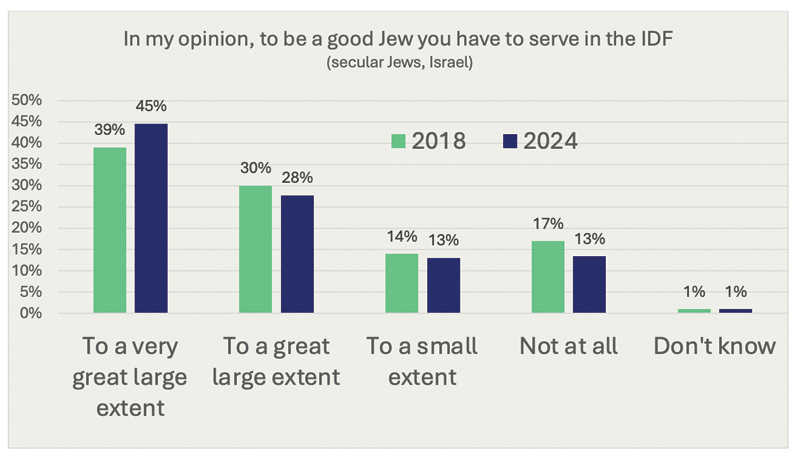
The monthly index of Israel’s society by JPPI demonstrates, among other things, the rise in attributing “Jewish value” to serving in the IDF among secular Israeli Jews.

A reader’s response:

Rafi Elihu asks: Do we know how many hostages are still alive? Answer: no, and it’s not clear if Hamas itself has an exact number. Most estimations you can find, by experts and officials, are between 30 and 70.  


Shmuel Rosner is senior political editor. For more analysis of Israeli and international politics, visit Rosner’s Domain at jewishjournal.com/rosnersdomain.

Rosner’s Domain | The Debate and the Deal Read More »

Zionism Is About Love

Rabbi Shai Held’s latest book, “Judaism Is About Love: Recovering the Heart of Jewish Life,” is the culmination of a career spent correcting a great misconception, namely that “Christianity is the religion of love” while “Judaism [is] the religion of law.”

“My aim is to tell the story of Jewish theology, ethics, and spirituality through the lens of love,” Held writes, “and thereby to restore the heart — in both senses of the word — of Judaism to its rightful place.”

A similar point could be made about Zionism. In the past year, anti-Israel protesters have been working to transform the word “Zionist” into a slur. “Zionism” is equated with racism, colonialism, and even terrorism. To be a Zionist is to be accused of supporting genocide. 

In response, Jews have tried to push our own definition, insisting that Zionism is simply the belief that Jews have the right to self-determination in their ancient homeland. 

It’s not a bad strategy or a bad definition, but this dry political formulation fails to capture why so many Jews around the world feel such a deep connection to Israel.

Before Theodor Herzl’s day, Zionists were known as Chovevei Tzion, lovers of Zion. Their Zionism was rooted primarily in profound love of place. In many ways it is a better term. An “ism” or an ideology lives in the head, but love is unbounded and experienced by the mind, the heart, the spirit and the senses.

We love Israel because we love the scent of rosemary in Jerusalem and night-blooming jasmine in Tel Aviv. We love Israel because we love the feel of Hebrew on our lips and the particular way a cucumber tastes here. We love Israel because of the kindness of the people, the beauty of winding streets, and the watchful gaze of the stray cats.

The nature of this love is somewhat mysterious to me. Do we love Israel because it is beautiful? Or is it beautiful because we love it? Would we feel this way about any Jewish state in the promised land simply because it is the realization of an ancient dream? Or is there truly something different about this place — some indefinable magic — that accounts for the effect that this country has on people? 

It’s impossible to know for sure, but I often wonder what the state of Zionism would be like if Israel were different — if the cities were dreary and lifeless, if the food was bland, if the people were less beautiful and charming, if it all felt like a hot, stultifying, cultureless shtetl instead of a vibrant, innovative, Hebrew civilization. 

The history of Israel’s founding is a story of unlikely successes. Despite great odds, a dead language was revived, seven foreign armies were defeated, and a nation was built. We rarely stop to consider, however, the most unlikely success of all — not that they built a Jewish state, but that they built one so very lovable. 

Today, the main emotion we might be feeling as we read headlines about Israel is sorrow, or dread, or frustration, or even anger at Israel’s enemies.  But if we are wondering what we can do for Israel from afar in this great moment of uncertainty, the answer is simple — we must cultivate the love at the heart of our connection to Israel.

Today, the main emotion we might be feeling as we read headlines about Israel is sorrow, or dread, or frustration, or even anger at Israel’s enemies.  But if we are wondering what we can do for Israel from afar in this great moment of uncertainty, the answer is simple — we must cultivate the love at the heart of our connection to Israel.

We can cook an Israeli recipe, or read an Israeli poet, or put on a favorite Israeli record. Such acts seem small or even kitschy responses to the intensity of this moment, but they are not. 

The love of the Chovevei Tzion built Israel.

The love of the Jewish people now will help to protect it.


Matthew Schultz is a Jewish Journal columnist and rabbinical student at Hebrew College. He is the author of the essay collection “What Came Before” (Tupelo, 2020) and lives in Boston and Jerusalem. 

Zionism Is About Love Read More »

Fateful Choices Mark Decisions in New Novel, ‘Our Little Histories’

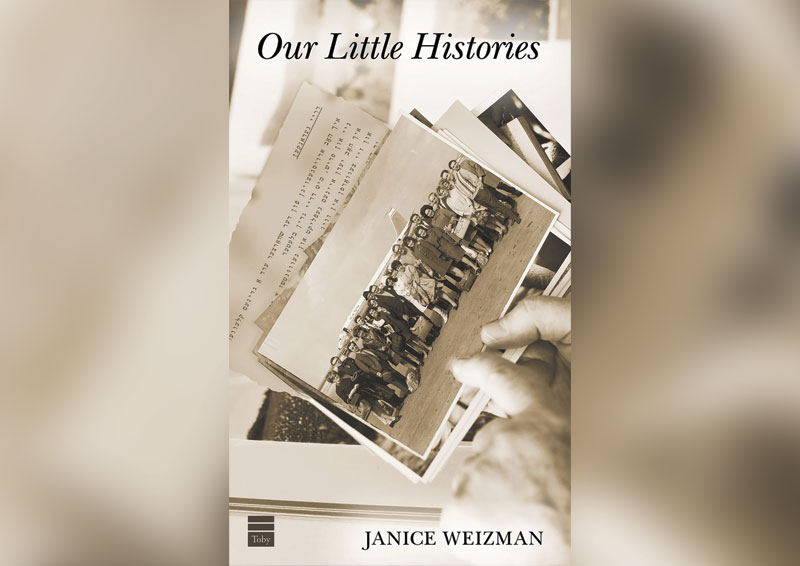
In Janice Weizman’s novel, “Our Little Histories,” a short, cryptic Yiddish poem continues to intrigue and puzzle members of one far-flung Jewish family for more than 150 years. When family ancestress Raizel Shulman wrote the poem in a shtetl in Belarus in 1850, she carefully tore its three stanzas into three strips of paper, giving one stanza each to her three sons. This mysterious poem becomes the connecting point linking six generations of her descendants.  

Moving back in time from 2015 to 1850, each chapter serves up one family member’s personal history. These stories reflect both geographic and philosophical migration, from shtetl life in eastern Europe to turn-of-the-century Minsk; pre-WWII Vilna; socialist kibbutz life in pre-Independence Israel; assimilated life in pre-WWII Chicago; and modern Tel Aviv. Only when readers reach the final chapter, set in Belarus in 1850, do we finally understand the heartrending meaning of the poem and the wrenching circumstances that motivated Raizel to put these words to paper.  

The opening history centers on Jennifer Greenberg-Wu, traveling in 2015 from Chicago to a small town in Belarus, where she has been hired by a Belarusian tycoon to create a “living installation” of traditional Jewish life. Jennifer’s observant Israeli cousins will enact authentic Jewish living behind glass in front of a live audience. An atheist married to a non-Jew, Jennifer recognizes the irony of her challenge. Despite months of meticulous research, she realizes that it’s impossible to recreate this past with authenticity. Looking at the copy of the family’s dusty old copy of the Yiddish journal with her ancestor’s poem published in it, she says, “The only thing that’s true are the words set down on the pages of this journal, this remnant of the world as it appeared to those who lived in it.” Unexpectedly, Jennifer’s moody, goth-inspired teenaged daughter, Cassie, finds herself drawn to the novelty of the Jewish ideas she encounters through the installation. When she learns that Judaism highlights the distinction between the sacred and the profane through the Havdalah service, she says, “It’s so cool, Mom.”

Each story illustrates trendlines in recent Jewish history. In the chapter “Comrades,” set on a kibbutz in 1946, we meet a great-aunt of Jennifer’s named Tamar, who left her family in Minsk in 1927 to help build the Zionist dream. Tamar’s family never escaped the European inferno, and she is haunted by the terrible knowledge of what must have happened to them:

“I cannot think about what happened. There is no other way to carry on. I must lock away all thoughts of my father, my mother, my jokey brothers, the courtyard of our apartment near the market in Minsk that always smelled of cabbage and onions, the view from our window, the bustling street below.” Tamar embraces her identity as part of “the new generation of Jewish socialists, building a new reality which would be a light to others …  showing how Jews could live as a modern people, creating a society unburdened by the outdated laws and rules that had kept us in the dark and prevented us from being part of the modern world.” 

Meanwhile, in Vilna in 1939, Tamar’s cousin, a literature instructor named Gabriel, can no longer deny the increasing peril of the Jews. After he and a good friend are attacked by drunken antisemitic thugs and his friend is permanently, horribly disabled, Gabriel finally agrees to Tamar’s prodding to write to another cousin in Chicago, the up-and-coming newspaper editor Nat, as a first step toward trying to emigrate. When Gabriel’s father shows him the journal with his great-grandmother’s poem in it, along with other stories, Gabriel muses, “It struck me that they were like forgotten snapshots, glimpses into a world that was fading into oblivion.”  

Weizman does an excellent job of painting characters who reflect their time and place. In 1938 Chicago, Nat worries from afar about the Jews still stuck in Europe but worries more directly about introducing his wealthy, fashion-forward, “south-side snob” girlfriend Sally to his dowdy, Yiddish-speaking immigrant mother. Nat and Sally’s Jewish friends understand that Hitler is crazy but don’t see what it has to do with them, and during dinner they quickly revert to more pleasant talk of upcoming parties. 

In these personal histories, nearly every family member has cast off whatever connections to Jewish religion they had. Gabriel’s father stopped believing after losing a son to World War I. Yoyne, a very young, devout, newly married man in rural Belarus in 1896, is shocked at how quickly he is drawn to the wider, more cosmopolitan, unrestrained world he encounters on a trip to Minsk, where his ailing father has sent him to meet with his uncles. It is there that the meaning of the poem, written by Yoyne’s grandmother, becomes clear.

In these personal histories, nearly every family member has cast off whatever connections to Jewish religion they had. 

These portrayals are all completely believable, the characters well drawn, but it was disappointing not to meet a single character who stood fast to faith. They were part of our personal histories, too, including religious Zionists who left Europe and took up farming on religious kibbutzim in the early 20th century, and some who kept the faith even in America, despite the temptations to discard it for an easier life. Still, each chapter is captivating, and the writing is outstanding.

Weizman, who made Aliyah at 19 from Toronto, teaches fiction writing in Israel and is also the author of “The Wayward Moon,” originally published in 2012 and reprinted by The Toby Press in 2023. Weizman told The Journal that “Our Little Histories” is all about questions of Jewish identity. “More specifically, it’s about the process in which the impoverished, persecuted Jews of Eastern Europe emerged from the shtetls and into the wider world. They were coming out of a communal, religious way of life, and had to negotiate their way into modernity, and that meant redefining their identity as Jews. The book traces that process, and shows what happened to their ancestors. The question of Jewish identity continues to be urgent and important in the lives of young Jews today, and it is something every Jew has to wrestle with.”


Judy Gruen is the author of “Bylines and Blessings,” “The Skeptic and the Rabbi,” and several other books. She is also a book editor and writing coach. 

Fateful Choices Mark Decisions in New Novel, ‘Our Little Histories’ Read More »