fbpx

July 3, 2024

Amy Rogers: Food Appreciation, Everything Seasoning and a Recipe for Writing a Recipe

“I always say my favorite recipe is anything someone else makes for me,” food writer Amy Rogers told the Journal. “I am a passionate food appreciator, but at the end of the day, it all comes down to the simple things.”

While Rogers said she enjoys a fancy meal as much as the next person, for her the most heartfelt memories and the most satisfying food experiences are around the things she grew up with, such as roast chickens and noodle kugels. And she can still make an amazing matzo ball!

“I watched my mother and my grandmothers do it so many times,” she said. “And there were no secrets to it: it was just about being patient. chilling the dough and making sure that all of your matzo balls are the same size.”

If they’re not all the same size when they start to puff up, some of them will cook faster than others, she explained. If you cook them too long, they’ll fall apart. If you cook them not long enough, they’ll be soft on the outside, but they’ll be raw on the inside.

“Roll those little matzo balls into the little walnut size,  put them right in the boiling water and try to get them all in as close to each other at the same time as you can, so they all cook at the same rate.”

Some of Rogers’ earliest memories were cooking with her family and gathering around food,  whether it was for a holiday meal or a bagels and lox brunch on a weekend.

As a writer, she explained, it was inevitable that her passion for food and stories would meet.

“I’d been working as a journalist for a pretty long time, and one day I sat down and I noticed that food kept showing up in my stories,” she said.

For example, she was writing about what it’s like to raise a family on minimum wage. The biggest challenge for the family she was profiling was having enough good, healthy, appealing food. Other times, Rogers would start an assignment that had nothing to do with food and it ended up a food story. For example, she was profiling a family who had moved to the US from Serbia in search of medical care for their children, and they ended up opening a bakery.

When she started embracing that angle, the food writer label started to stick.

“I will always tell people that I’m not a chef and I’m not a fancy cook; I’m just someone who appreciates good food,” she said.

During the pandemic, when everyone was trying to make do with whatever was in their pantry, Rogers discovered the one ingredient that makes everything delicious: everything bagel seasoning.

“So much of Jewish cooking, whether it’s European based or Middle Eastern based or even just American based, has in it garlic. onion, salt, pepper and sometimes sesame seeds,” Rogers, who makes her own combinations, said.

It’s terrific on a bagel, of course, but you can put it on your toast with butter, pasta, green beans, almost anything. Mix it with oil and vinegar and you have a salad dressing.

“I used it as a rub on some chicken … a little paprika and bagel seasoning; it became such a thing,” she said. “It has all the flavor profiles … it’s my favorite one-size-fits-all flavoring.”

Rogers, who also teaches workshops on “how to write a recipe,” said a recipe can be as simple or complicated as you want.

“Most people have in their family legacy, a person who … made the best pie or made the best something, even if they didn’t write it down,” she said. “So there’s already a process of handing down stories from generation to generation within our families and within our faith communities and within our ethnic communities.”

A great place to start with food writing is “My favorite food growing up was …” or “I remember my family making this.”

“Those kinds of little snapshot recollections become very, very meaningful,” she said. “You don’t have to go out there and taste a bunch of fancy wine or learn about restaurant food to really be engaged in writing about food from the angle of storytelling.“

Rogers’ recipe for writing a recipe is below.

Learn more at AmyRogers.net.

For the full conversation, listen to the podcast:

Amy Rogers’ Recipe for “How to Write a Recipe”

A recipe is more than a mere list of ingredients. The best recipes share delicious details of what makes them special. They’re a great way to preserve and pass down traditions. Perfect for family historians, genealogy aficionados and home cooks. No experience necessary!

What you need to write a recipe:

– An interesting title. Instead of “Blueberry Compote,” I make “Elaine’s Best Ever Blueberry Dessert.”

– Details about why it’s good, who made it and when (these are called headnotes).

– List of ingredients and their measurements.

– List of equipment.

– Instructions and times for cooking, chilling, etc.

– How to serve and store.

– How many servings it makes.

For example:

“Elaine’s Best Ever Blueberry Dessert”

Photo by Amy Rogers

Each summer when I was a child, my mother prepared a rich yet effortless dessert that remains my favorite to this day. I can still picture her in the kitchen of our house on Long Island. She’s wearing her summer ensemble of white slacks, a sleeveless blouse and sunglasses on top of her head, where she left them after shopping at the farm stand nearby.

1 pint of blueberries, washed, drained, and chilled

1 small container of sour cream

1 handful or more of brown sugar

Put the blueberries in a pretty glass bowl or divide them into two bowls. Top with sour cream and sprinkle generously with brown sugar. Serve immediately.

Makes 2 servings, enough for one mother and daughter.


Debra Eckerling is a writer for the Jewish Journal and the host of “Taste Buds with Deb.” Subscribe on YouTube or your favorite podcast platform. Email Debra: tastebuds@jewishjournal.com.

Amy Rogers: Food Appreciation, Everything Seasoning and a Recipe for Writing a Recipe Read More »

Go Ahead: Be Bored

“Mommy, I’m so bored!” my 4-year-old daughter yelled to me. “Can I watch TV?”

This was the fourth time that day that my daughter complained how bored she was. She’d already colored, painted, rode her bike and played with her little sister. 

“It’s OK to be bored sometimes,” I told her. “Just relax.”

This is a normal conversation I have with my daughter. If she doesn’t have something to do for five minutes, she starts with the whining. It’s my job, as a parent, not to coddle her during this time. Instead, I let her know that you don’t need something to do every single second of every single day.

However, I understand where she is coming from. When I was a child, I was usually bored. This was way before social media and smartphones and streaming TV – basically the Stone Age of the late ‘90s.. 

I would sit on the couch and try to think of something to do. There were only so many cartoons I could watch on Nickelodeon. I’d seen all the episodes of my favorite shows, anyway. I had to get creative. 

I ended up writing my own children’s books, building websites on America Online, learning the choreography for Britney Spears’ latest music videos, going to the local playground to jump off the swings and calling up my friends to have a sleepover. 

Some of my best memories came from being bored. 

One summer afternoon, my older sister Rebecca and I drove around in her car because we didn’t have anything better to do. As we were cruising, we saw an open fire hydrant, so we pulled over, jumped out of her car and gleefully danced in the water.  

In middle school, my friends and I were so bored late at night that we tried to walk through the drive-thru at our local fast-food joint. Though we couldn’t get any food because we weren’t in a car, we laughed our heads off trying. 

These days, nobody wants to be bored anymore. When we stop at a red light, we immediately pull out our phones. We can’t wait in line without answering our emails or scrolling on social media. When we watch movies, we Wikipedia the actors’ bios. That’s right: We’re so bored that we are on two screens at once. 

Here’s a little tip for life: You don’t need to be stimulated 24-7. As soon as you wake up, you do not need to check your phone. You can sit at a stoplight or wait in line or eat dinner with your spouse or friend without having your phone next to you.

It’s time to embrace boredom.

Thankfully, some are seeing the value in this. There’s a new trend where people are recording themselves doing nothing on a flight – they just stare at the travel map ahead of them or out the window – for hours on end. They then post the video on social media. These videos have millions of views, and people are eager to be bored on flights. I believe it’s because we are finally reaching a point where we are sick of being overstimulated. 

Sitting and doing nothing can be a great thing. We can go into our heads and work out issues we’re having. We can relax and meditate and think about who we really are and what we want out of life. We can reconnect with ourselves, and with God.

Sitting and doing nothing can be a great thing. We can go into our heads and work out issues we’re having. We can relax and meditate and think about who we really are and what we want out of life. We can reconnect with ourselves, and with God.

I do this on long Shabbats in the summer. On Saturday, Shabbat isn’t over until around 9 p.m., so that gives me a lot of time to be bored. I try to embrace it as much as I can. It’s my one time of the week where I’m free from my phone and all other distractions. It’s an incredible feeling.

This week, I challenge you to be bored.

You never know what you will discover about yourself or what it could lead to. Sit, stare, do nothing. I promise you: Your boredom will set you free.


Kylie Ora Lobell is an award-winning writer and Community Editor of the Jewish Journal. You can find Kylie on X @KylieOraLobell or Instagram @KylieOraWriter.

Go Ahead: Be Bored Read More »

“Anti-Palestinian Racism” Is Coming Soon to a School Near You

If you thought that the adoption of “liberated” ethnic studies in California was bad for Jews, the latest mutation of this ideology coming out of Canada, “anti-Palestinian racism,” should have you worried. Like a virus, these radical pedagogies know no boundaries. What began in Canada is spreading throughout the United States. First stop, I predict: the Golden State.

On June 20th, the Toronto District School Board (TDSB) incorporated the term “anti-Palestinian racism” in its “Combating Hate and Racism Student Learning Strategy” as well as professional development seminars for school administrators and educators.

What is “anti-Palestinian racism?” Well, the TDSB did not bother to define it. However, the framework of “anti-Palestinian racism (APR)” has been most fully expressed by the Arab Canadian Lawyers Association (ACLA), which originally promulgated the curriculum.

According to ACLA, APR “silences, excludes, erases, stereotypes, defames or dehumanizes Palestinians or their narratives.” This may be done by denying the “Nakba” (the supposed catastrophe of Israel’s creation), “justifying violence against Palestinians,” “defaming Palestinians and their allies with slander such as being inherently antisemitic, a terrorist threat/sympathizer or opposed to democratic values,” and denying Palestinian indigeneity to “occupied and historic Palestine.”

ACLA is careful to state that the definition they provide is not exhaustive. In other words, APR is a broad tent under which every possible grievance might find a home.

Yet even this “non-exhaustive” list has horrifying implications. Take, for example, “Nakba Denial.” For ACLA, “Nakba Denial” includes “claims that there are no such people called Palestinians or no state of Palestine exists … denial that Palestinians were ethnically cleansed (along with accompanying crimes) to create the state of Israel; rejecting the inalienable rights of Palestinian refugees including the right of return.”

Under such a framework, teachers will be obligated to ignore the multi-causal factors that led to Arabs leaving Israel before and during 1948. Teachers will be obliged to recognize the “right of return”—the right of all Palestinians to immigrate to Israel even though the “right of return” has never been included in any contemplated peace deal, as it would mean the end of Israel as a Jewish state. It will prevent teachers from talking about the failed peace initiatives between Israel and the Palestinians. And it will preclude Jewish students from expressing their views about the right of Jewish self-determination in our ancestral homeland.

And it will preclude Jewish students from expressing their views about the right of Jewish self-determination in our ancestral homeland.

ACLA argues that “equating the oppressed with the oppressors or blaming the oppressed for the actions of the oppressor or rationalizing the use of violence against Palestinians”  is APR. This understanding of APR minimizes, legitimizes and rationalizes the history of Palestinian terrorism while viewing any response to Palestinian terror and violence as illegitimate. How might a teacher lead a discussion on the Israel-Hamas war, for example, and how might students feel free to craft arguments or express themselves if the fear of accusations of racism loom over them?

Like so much radical ideology in schools, the framework of “anti-Palestinian racism” is something that activists sneak in through the back door by first normalizing the term and then insisting that everyone must agree with the entire framework. And as with so much of the radical ideology, claims of “anti-Palestinian racism” will be used as yet another weapon in the arsenal to influence curriculums across the country.

And normalization of APR has begun. Rashida Tlaib accused Donald Trump of engaging in “anti-Palestinian racism” for his comments about Joe Biden in the debate. This year alone, the San Diego State University Senate passed a resolution condemning instances of APR, the San Francisco Bay Area office of the Council on American-Islamic Relations used the term in its press release on the Department of Education investigation into the Berkeley Unified School District, and the Massachusetts Teachers Association, through their anti-racism taskforce, held a webinar on “anti-Palestinian racism.”

The implications for the Jewish community, freedom of expression and the quality of education are staggering.

What happened in Toronto was just the trailer—it’s coming soon to a theater near you. We’ve seen this film, and we don’t want to sit through it again. Push back hard now or we’ll be stuck with “Liberated Ethnic Studies: The Sequel.”


Mika Hackner is the Senior Research Associate at The Jewish Institute for Liberal Values.

“Anti-Palestinian Racism” Is Coming Soon to a School Near You Read More »

Elder Abuse

Nearly three-quarters of Americans believe that President Biden, 81, is no longer fit to serve in office, according to a new CBS poll. This was clear to many of us four years ago. Perhaps because I was watching my father’s decline into dementia, I could better read the signs. But they were there then, just as they were magnified at last week’s embarrassing presidential debate. 

I’m not a doctor. I don’t know if it’s dementia or Alzheimer’s or something else. Which only begs the question: Who are the doctors who have lied to the world about Biden’s mental acuity? Who are the handlers, and for what reason are they willing to put the U.S. at such great risk? And how does his wife not just allow but push for one of the greatest humiliations of any U.S. president?

Jill Biden, 73, is obviously quite aware of his deteriorated condition. After the debate, she rushed to his side and helped him walk offstage. Later that night, she praised his efforts, with words typically used with a toddler: “Joe, you did such a great job! You answered every question, you knew all the facts!” 

Jill has played a key part in deceiving the country about her husband’s fitness for office, shielding him from heavy media scrutiny and lashing out at aides who she believes fail to prevent some of his gaffes. 

In a rare moment of honesty, the New York Times editorial board described Biden as “the shadow of a great public servant.” “More than once, he struggled to make it to the end of a sentence.” Running again is a “reckless gamble.” “The greatest public service Mr. Biden can now perform is to announce that he will not continue to run for reelection.”

The New York Times editorial board described Biden as “the shadow of a great public servant.” Running again is a “reckless gamble…The greatest public service Mr. Biden can now perform is to announce that he will not continue to run for reelection.”

How does a wife of 47 years allow her husband to get into this humiliating position? The answer isn’t hard to find: She pushed Biden to run in 2020, at the age of 77. In joint appearances, she often spoke after he did, acting in the “closer” role. 

As Fox News contributor Lisa Boothe put it: “Encouraging your husband to embarrass himself like this is not love.”

No, it is not. It’s called opportunism.  

This opportunism is a direct consequence of the mythology of second wave feminism: Women are not just equal to men, we are exactly the same as men. We now see the result of a denial of femininity, of biology, of bell curves. It’s also becoming the most common explanation for the narcissism of millennials: Their mothers ran back to work and then spoiled them relentlessly to compensate.

Is it because so many leftist women loathed their own feminine biology that they can easily accept the ridiculous “gender assigned at birth” fiction that is destroying another generation of kids? Perhaps. 

What is beginning to come out is the role former President Barack Obama played in all of this. If he is indeed the one pulling Biden’s strings — which would certainly explain the decision to refund Iran’s diabolical regime — we have much bigger problems than wives who don’t act like wives.

Meanwhile, the right is not dealing with this very humanely either. Within hours of the debate, memes of Biden’s vacant stare became a staple on their social media feeds. You can say he’s not fit for office; you can be angry at the Democratic Party and leftist media for hiding this. But mocking someone’s physical/mental decline is not cool. In fact, it’s immoral.

Did social media make them like this, or did they always mock the elderly and handicapped?

All of this falls under decency — humanity. How odd that the party of “compassion” and the party of “morality” so easily lost both. Joe Biden’s sad humiliation will forever represent the absence of decency in the 21st century.

And the vast majority of blame is on one person, ironically someone who has instructed teens with emotional disabilities at a psychiatric hospital: his wife.


Karen Lehrman Bloch is editor in chief of White Rose Magazine.

Elder Abuse Read More »

A Shabbat in Detroit

Here’s something you’ve not heard in a while. I recently enjoyed spending three-and-a-half glorious days in Detroit. The weather was in the 20s and 30s, but thankfully, there was no snow or wind.

If you watch TV news, you know that Detroit is often portrayed as a horrible place where you’re likely to be robbed and murdered, but not necessarily in that order. However, if you ask members of the local Jewish community, they might tell you differently. The people I spoke with were positive about living in The Motor City. Yes, Detroit has problems and crime, but they seem to feel that Detroit is trying to improve. It’s a reasonable place to live, and it has four seasons. 

Detroit has the largest Arab Muslim population outside the Middle East, and Rashida Tlaib (D-Mich.) represents many of the Orthodox Jews there.  The people I spoke to are aware that the Arab Muslim community is not supportive of Jews. Still, they mentioned that they are not bothered by antisemitism (unlike in California where, just a few blocks from my home, “Death to the Jews,” was spray painted on a new apartment building). 

Some Detroiters told me they don’t even lock their doors. When I discovered which houses were unlocked, I considered robbing them but realized it was not Shabbosdik.  On the other hand, living in Los Angeles, I have gates on my doors and bars on my windows, and I’m considering purchasing an Israeli tank and howitzer for my front yard.

Some Detroiters told me they don’t even lock their doors. When I discovered which houses were unlocked, I considered robbing them but realized it was not Shabbosdik.  

I visited Detroit to perform at the banquet and honor my friend Rabbi Alon Tolwin, a teacher at Aish HaTorah who was retiring. Do Torah teachers ever truly retire?  Not the good ones like Rabbi Tolwin. 

I first met the rabbi over 30 years ago when he lived in Los Angeles, and although years have passed without us speaking, I always considered him a friend. I flew in on Thursday, and Rabbi Tolwin met me at the airport. 

Because we are Jews in our 70s, after a quick hello, we immediately delved into medical issues. He told me about his ailments, and I said, “Oh, I also have that.” I told him, “Next time I see you, bring your X-rays to compare.” It’s nice to bond. He believes his doctor is the greatest in the world. As Jackie Mason said, “Every Jew thinks he has the best doctor.” 

I stayed at the home of his son, Rabbi Simcha Tolwin, and his wife, Rebbetzin Estie, two amazing people. Because Alon was being honored on Sunday, people flew in for the banquet and stayed over Shabbat. So there were about 13 of us staying in the house. Orthodox women, especially the Rebbetzins, run the equivalent of a free bed and breakfast. It’s rare when someone isn’t staying over or having a Shabbat meal. 

The day before I arrived, Rabbi Simcha had just returned from his fourth or fifth trip to Israel since the war started. And yet, despite all that is going on in Israel and Gaza, and the antisemitism around the world, Jews are still able to celebrate Shabbat and be thankful to God.

Staying with a religious Jewish family over Shabbat is something I enjoy and consider a real privilege. I’ve stayed with families at least a dozen times and all over the world.  Rabbi Simcha and Estie were incredible hosts. 

Since I’m an annoying California vegan, Estie made me a vegan cholent and provided water challah. 

Rebbetzins are always reading something interesting. Estie lent me “Soul Construction” by Ruchi Koval, a book on character shaping and a handbook on becoming a better person. Should I take the hint? These people made me feel so comfortable; I felt like part of their family. 

Rabbi Simcha and Estie were busy organizing the yearly gala honoring his father. Putting a gala together requires a tremendous amount of work. Yet, there wasn’t much talk, if any, over Shabbat. It was Shabbat. There was great food, Torah study, synagogue, napping, children playing, and adults reading and talking. The conversation was both profound and very funny. It was a perfect Shabbat. I felt like I was in the presence of people doing God’s work.


Mark Schiff is a comedian, actor and writer, and hosts, along with Danny Lobell, the ‘We Think It’s Funny’ podcast. His new book is “Why Not? Lessons on Comedy, Courage and Chutzpah.”

A Shabbat in Detroit Read More »

Entering Uncharted Waters

Those of us who follow presidential politics recently witnessed the worst and the third-worst presidential debate performances of the television era. Without a doubt, Joe Biden was the least effective and most alarming debater that any living American had ever witnessed in a presidential contest. By the time the dust had settled, pollsters found that almost three-quarters of Americans now have doubts about Biden’s mental and cognitive capabilities.

But Donald Trump’s night was almost as bad. The former president’s numerous falsehoods have been well-chronicled, but Trump was also notable for his inability or unwillingness to answer numerous questions about various matters of public policy, his ongoing defense of his and his supporters’ actions on Jan. 6, 2021, and his refusal to commit to honoring the outcome of this year’s elections. Had he not been sharing a stage with Biden during the worst night of that man’s political career, the former president would have been pilloried for his own abject failure to make a case for his own election.

In the annals of presidential debates, previous disasters were either a result of stylistic shortcomings (such as Richard Nixon’s lack of makeup or Al Gore’s condescending sighs), glaring substantive errors (like Gerald Ford’s gaffe regarding Soviet domination of Eastern Europe or Rick Perry forgetting the Cabinet offices he had promised to eliminate) or overall attitudinal misalignments (Ronald Reagan’s vagueness or Barack Obama’s emotional distance). 

But most of these failings were fleeting moments or isolated incidents that overshadowed otherwise credible presentations. By contrast, Biden and Trump both embarrassed themselves throughout their entire 90 minutes. Only their most loyal supporters were able to point to moments where the two men rose briefly to instances of adequacy. But neither of the nation’s two most recent presidents was able to coherently offer a defense of their records or attempt to outline an agenda for the future.

Biden’s failures were worse than Trump’s, and the challenges he faces going forward are more difficult. Biden became the Democratic nominee four years ago because his party’s members made a cold-eyed strategic decision to set aside their emotional allegiances to more progressive candidates like Bernie Sanders and Elizabeth Warren and select Biden as the best candidate for them to run against Trump. Trump has an emotional hold on his party’s true believers that Biden will never match. As a result, Trump’s loyalists see his weaknesses as strengths. Most Democrats see Biden’s weaknesses as … weaknesses.

The party’s decision process today is cold and calculating: Do they stand a better chance of beating Trump with a deeply flawed incumbent or an equally risky replacement?

At the moment this was written, the risk-averse faction of the party leadership appears to be holding firm. For the first few days after the debate, Biden’s team did an admirable job of projecting strength and continuity. But the doubters are not going away. And while few of even the most audacious gamblers see Vice President Kamala Harris as a wager worth making, there is no shortage of Democratic donors and pundits willing to roll the dice on an even less-tested governor or Cabinet member.

It would be surprising if the Biden doubters prevailed. There is no precedent for such a last-minute scramble for a presidential nomination in the television era (even the convention fights of 1960, 1968 and 1976 featured candidates who had been running against each other for months). Add the cacophony of cable news, digital platforms and social media and it’s impossible to overstate the potential for chaos. For American voters who crave stability, such a fracas might not send a reassuring message.

Every day between now and Nov. 5 is a potential senior moment for the senior president. Another unsettling performance could be catastrophic. 

But if the risk of entering such uncharted waters is significant, the potential payoff is even greater. Every day between now and Nov. 5 is a potential senior moment for the senior president. Another unsettling performance could be catastrophic. Biden must now prove to the American people that he is cogent. If he demonstrates that attribute every day for the rest of the campaign, he will win reelection. If he falls short again, even once, the odds against him grow more daunting.


Dan Schnur is the U.S. Politics Editor for the Jewish Journal. He teaches courses in politics, communications, and leadership at UC Berkeley, USC and Pepperdine. He hosts the monthly webinar “The Dan Schnur Political Report” for the Los Angeles World Affairs Council & Town Hall. Follow Dan’s work at www.danschnurpolitics.com.

Entering Uncharted Waters Read More »

Chosen Links by Boaz – Episode 2: University Student Extravaganza

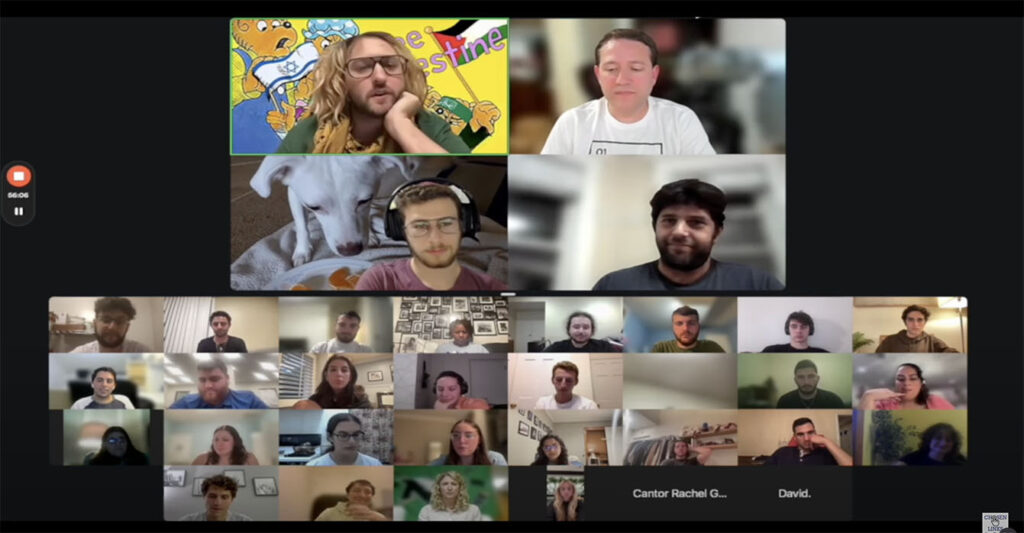
I proudly present “Chosen Links: Episode 2 – University Student Extravaganza!”

Over 35 students from 35 schools were gathered from across the country, to discuss antisemitism and Israel hatred on campus. I did things, let’s just say…differently!

Part 1 – Game Show (not a typo)

Part 2 – Q&A with Carly Gammill, Legal Rep from StandWithUs

Part 3 – Round Table

Thank you to my Instagram collaborators StandWithUs, CAMERA on Campus, Israel on Campus Coalition,End Jew Hatred, We Are Tov, and of course The Jewish Journal.

Thank you to the following students for their invaluable and brave participation:

Ada Hepner, Adam Saar, Adam Thaw, Aden Kosoi, Alana Goldman, Alex Rosenblum, Alexandra Ahdoot, Allison Stone, Angelina Palumbo, Ari Haim, Aron Goodman, Abi Nosrati, Avram Plager, Brandon Meyer, Cara Lopatin, Charlie Leeds, Darius Gross, Edan Levy, Ethan Hamid, Ethan Winterstein, Ezra Landman-Feigelson, Fanya Fenton, Gabriel Gaysinsky, Gideon Askowitz, Nani Chung, Jake Rendler, Jake Kaplan, Joe Gindi, Joslyn Reile, Max Bray, Maya Ungar, Noa Fay, Noah Rinsler, Noah Rubin, Sam Rappoport, Sami Ilan, Sammy Shiff, Sari Eisen, Sophie Bulkin, Topaz Gal-Zur, Yasi Ohebsion, Yuval Jacobi, Shabbos Kestenbaum

And thank you to Cantor Rachel Goldman Ruiz and L.E. Staiman for their appearances, David Kopp for last minute camerawork, and Chad Rubel for his editing expertise.

Chosen Links by Boaz – Episode 2: University Student Extravaganza Read More »

Let’s Blame the Jews

Over 100 masked Hamas supporters laid siege to a synagogue in Pico 10 days ago, but for The Los Angeles Times article analyzing the event, it was the Jews who instilled fear. It began its story not by explaining the shock of the Jewish community seeing a synagogue attacked, but by stressing the anxiety of one of the masked  protesters who was quoted, “This was probably the scariest protest I’ve been to” said this person, “a physician based in L.A., who requested anonymity for the fear of reprisals.”  

We’ve seen it before over the centuries: First you have the pogrom and then you blame the Jews. And The LA Times laid the blame squarely at the hands of the Jewish community who attempted to repulse the invasion of sacred ground. It asserted ludicrously that “the protest was not spurred by antisemitism, but by a real estate event.” Really. Imagine whites, their faces  covered with masks trying to seize  Beverly Hills  City Hall screaming, “No blacks can buy homes here.” Alas, the to The Times, if Jews want to buy houses in its historical homeland it’s a different story. One justice for all and another for Jews, That’s what we call antisemitism.  

Alas, to The Times, if Jews want to buy houses in their historical homeland it’s a different story. One justice for all and another for Jews. That’s what we call antisemitism. 

Of course The Times added a few quotes from politicians condemning  pro-Hamas supporters. But the thrust of the piece was simple: “You’ve got to blame the Jews.”

Three reporters — Summer Lin, Karen Garcia, and Tyrone Beason — collaborated on this article. These are some questions they could have asked the Palestinian  supporters they interviewed. 

Do you support Hamas?

Do you agree with the Hamas Charter that calls for the destruction of Israel and the genocide of every Jew in the world?

Do you condemn the attack of Oct. 7?

Do you condemn the rape of women and kidnapping of children by Hamas?

Do Jews have a right to live in their historical homeland, Israel?

In Israel Arabs and Jews can buy property, but in Jordan there is a death penalty for an Arab who sells land to a Jew. Is this fair?

If you believe in your cause, why do you hide your face?

Is blocking a synagogue an act of violence?

Don’t you think that attempting to block and invade the sacred space of the synagogue is antisemitism ?

Wasn’t your protest designed to instill fear and intimidate the Jewish community?

To top it off the article quotes the head of CAIR-LA, Hussam Ayloush, as an authority.They could have asked him a few questions also:

Why did you say that Israel does not have the right to defend itself against Hamas and compare Israel to Nazi Germany?

Do you support the national executive director of CAIR, Nihad Awad, who lauded the invasion of Oct. 7?

The Biden administration cut off all connection to CAIR because of its support of Hamas. How can you claim to be a spokesman for civil rights when you have a history of supporting terror?

The real question is why The Times reporters do not ask any of these questions. Was it because they don’t understand the issues? Or do the reporters have an agenda, one that we have seen for centuries? “Let’s blame the Jews for being attacked. They must have done something wrong.” We know exactly that that is. It’s called antisemitism, and we have seen it time and again. Now it’s the new style of the woke left: “Of course it’s the oppressor Jews.“

One thing is clear: this is not the quality of  journalism that The Times had prided itself on in the past. Simply put, this article is an insult to the readers who expect a basic level of balance and integrity.


Rabbi Eliezrie is the President of the Rabbinical Council of Orange County, his email is rabbi@ocjewish.com 

Let’s Blame the Jews Read More »

The Audacious Joy of Judea Pearl

Joy: That wonderful and precious emotional state that was elusive before Oct. 7, and that seems like an unattainable myth after that catastrophic day.

With 1,200 Israelis dead and over 100 still in captivity for over 250 days; thousands of Palestinian casualties due to a raging war that Hamas began; and violent, rage-fueled antisemitism at our doorstep, do Jews dare to express, let alone feel, joy at this traumatic moment?

My friend, Dr. Judea Pearl, is one of the most joyful Jews I have ever met. And given his pain, that means everything. 

In 2002, Judea and his late wife, Ruth, z’l, lost their beloved Danny — The Wall Street Journal reporter Daniel Pearl, whose murder at the hands of Islamist terrorists in Pakistan horrified the world, including Jews in Los Angeles, from which Danny and his family hailed. 

When I was first introduced to Ruth and Judea at an Israel-related event just three years later, I shook their hands cautiously, wondering whether it was appropriate to make small talk with what could only be described as two survivors who had endured the worst injustice and heartbreak a person could know. 

Before I could utter a few innocuous words about the latest heat wave, Judea pushed his tilting glasses upward, as he is apt to do, and told an uproarious joke. The best part of that joke, which I have since forgotten because Judea has told so many jokes over the years, was how loudly he laughed when he arrived at the punchline. 

For her part, Ruth, who passed away in 2021, was the elegant water to Judea’s fire — a fire-in-the-belly that must have rendered him a favorite among the neighborhood kids in Mandatory Palestine-era Bnei Brak, where he spent his childhood (he was born in 1936 in Tel Aviv because at the time, Bnei Brak lacked a hospital).

Ruth and Judea had a commonality that was visible to anyone who knew them, even briefly: Together, the two had unabashedly chosen life. Nowhere was that more visible than in their creation of The Daniel Pearl Foundation, which they established the same year that Danny was murdered. Its mission is to foster mutual understanding between people of different faiths and backgrounds through Danny’s two loves: journalism and music. 

Over the years, I have been privileged to spend time with Judea, and to also have written an October 2021 cover story for this newspaper that profiled his legendary contributions in the field of artificial intelligence, as well as his selfless advocacy on behalf of Jewish and pro-Israel students, particularly at UCLA, where he joined the School of Engineering in 1970. In 2011, Judea received the Turing Award, known as the Nobel Prize of computing. 

During one interview for that cover story, I gently asked Judea how he was spending his time. Ruth had passed away three months earlier and summer had just ended. With the self-deprecation of a genius, Judea said, “I get up every morning with a smile on my face because there are so many things to do and I’ve psyched myself into believing I’m useful.”  

“I get up every morning with a smile on my face because there are so many things to do and I’ve psyched myself into believing I’m useful.” – Judea Pearl 

Last week, I saw Judea at the end of a long and emotionally exhausting day in which a rage-filled, antisemitic mob descended on Pico Boulevard in West Los Angeles, blocking the entrance to a local synagogue. I was not present at the scene, but there were violent clashes with Jewish counter-protesters, and the terrible whirring of police helicopters that I heard from my home still rang through my ears when I arrived at the historic Millennium Biltmore Hotel to attend the 66th Annual Southern California Journalism Awards, presented by the Los Angeles Press Club. 

I was weary and retriggered from a certain fanaticism I thought I had left behind after escaping Iran decades ago. I needed a jolt of strength, and a large serving of clarity — the kind of clarity that is derived from lived experience and resilience. I needed the audacious joy of Judea Pearl. 

I arrived at the table and leaned in to give Judea a hug. And that’s when I heard it: a low, pleasant voice. Amid hundreds of chatting, black-tie-clad guests, Judea, dressed to the nines in a black suit with a yellow pin on his lapel in support of the Israeli hostages in Gaza, was humming a tune to himself. And he was smiling. The tune he was humming over and over was, “Hallelujah.”

I heard it in my ears as we hugged. And I heard it in my ears an hour later, when he left our table and walked on stage to present the annual Daniel Pearl Award for Courage and Integrity to a reporter who writes for the same outlet as his beloved Danny. Sadly, the recipient was not there to receive his award. That’s because the award was for Evan Gershkovich, the Wall Street Journal reporter who has been wrongfully detained in a Russian prison for over a year. 

Here are Judea’s words, which he spoke before hundreds who work in local journalism, including nearly every newspaper and TV outlet, from the largest and best-known, to the smallest: 

“Friends, colleagues and fellow journalists,

“It is a great honor for me to present the LA Press Club Daniel Pearl Award for Courage and Integrity in Journalism to Evan Gershkovich, who is currently awaiting justice in a Russian jail, a jail that has known no justice. I hope this award is communicated to him, and offers him and his family hope and encouragement toward his quick release.

“It is in the nature of things that press clubs have no armies to defend journalists, nor do they have drones to attack jails. Yet press clubs represent millions of readers and viewers in the free world, who empower them with the audacity to send stern messages to governments and NGOs, reminding them of press freedom and journalists rights.

“Armed with this audacity, the Daniel Pearl Award was given, the past 22 years, to legendary fearless journalists like Jesús Blancornelas in Mexico, Anna Politkovskaya in Russia, Raif Badawi in Saudi Arabia, and to rebel journalists like Khaled Abu Toameh of The Jerusalem Post and Bari Weiss of The Free Press.

“As we draw parallels between Daniel Pearl and Evan Gershkovich, we must note that, apart from both working for The Wall Street Journal, and both becoming icons of press freedom and truthful reporting, there is a fundamental difference between the two ordeals. Danny was kidnapped by a nameless jihadist gang, while Evan was detained by a government that claims legitimate membership in the international community.

“And there is also a reason why Vladimir Putin might be thinking he can get away with holding a journalist hostage in the year 2024 — it is the year when the West appears to have lost its will to fight back.

“Let’s be honest about it. If Putin were to observe how some American media outlets have joined the global war on the West and the all-out assault on a life-clinging Israel, how they embrace and support college students shouting ‘Houthis, Houthis, turn another ship around,’ ‘From the River to the Sea,’ or ‘Kill another Zionist today,’ he would surely conclude that the West has lost its moral compass and its will to live.

“Consequently, he would surely come to believe that the West has surrendered its resolve to uphold its sacred principles of democracy, coexistence, and freedom of the press.

“To dispel any such misreading, the award given today to Evan Gershkovich sends a clear message to Putin’s government: Beware! Despite attempts to disrupt world order and destroy American education, the free world still holds the safety of journalists and their right to pursue truth as sanctuaries of civilized society.

“Thank you all for being part of this message.”

I should note that when Judea held American media accountable for misrepresenting the current war in the Middle East, I bit my lip in fear of a disruption. But none came. It was as if everyone in that lovely ballroom knew exactly what Judea Pearl had endured to stand on the stage and present that award year after year. 

When he again took his seat next to me, I felt as though I was in the comforting presence of a courageous father. That’s Judea for you. He immediately makes you feel safe, and yet, at this moment, he trusts very few people to actually uphold the values he embodies. 

I welcomed him back with a heartfelt “Chazak u’Baruch” (“strong and blessed” in Hebrew). He pushed his tilting glasses upward, straightened the small, yellow ribbon pin on his lapel, and said that in his speech, he only spoke what seemed right and necessary. And then, he proceeded to tell me a hilarious joke.


Tabby Refael is an award-winning writer, speaker and weekly columnist for The Jewish Journal of Greater Los Angeles. Follow her on X and Instagram @TabbyRefael.

The Audacious Joy of Judea Pearl Read More »