fbpx

March 30, 2023

A Lamb Recipe from Larache

Every Pesach, my Spanish Moroccan grandfather would she’cht (slaughter) a lamb. My grandmother would make a tagine style roast with the shanks. One of the lamb shanks would be displayed on the Seder plate to represent the ancient ritual of the Paschal lamb sacrifice, while my mother and her family would chant the Haggadah in Hebrew and Spanish.

Rabbi Moshe Bensabat was my mother’s father and the only rabbi in the ancient port city of Larache. He conducted the holiday services; he performed all the wedding ceremonies and was the mohel at all the Brit Milahs. Whenever the religious needs of the community became too hectic, they would bring in a Rabbi from the nearby cities of Tétouan or Tangier. When my mother’s brother Uncle Salomon became a Rabbi, they both served the community. Then my grandparents made Aliyah to Israel in the early 1950’s. (When they left Larache, my newlywed parents moved to Casablanca with my mother’s sister Clara and her new husband Menasse.) In Israel, Rabbi Salomon served as the secretary to the second Sephardic Chief Rabbi of the State of Israel, the revered Rav Yitzhak Nissim (son of former Knesset Member Moshe Nissim). Later, in a reprise of my grandfather’s role in Larache, Rabbi Salomon was the sole clergy for the burgeoning community of Barcelona. After serving 30 years as a beloved Rabbi, he retired to Israel in the 1980’s.

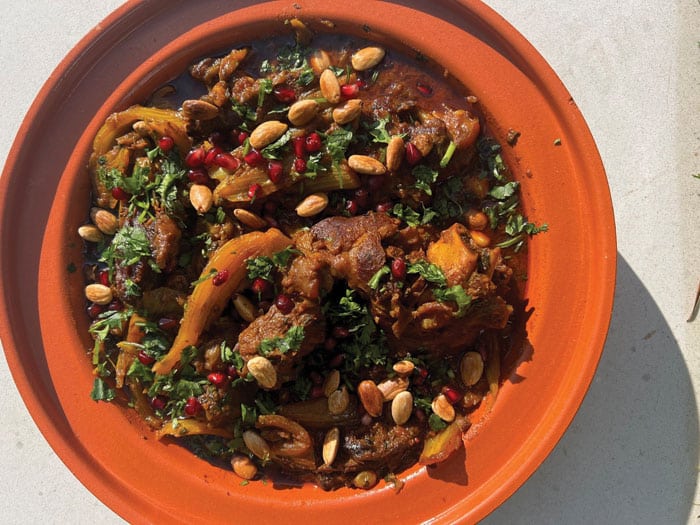
Every Pesach, I still follow the lamb shank recipe passed down by my grandmother Simcha to my mother Rica. Her recipe results in the most delicious tender glazed lamb shanks you’ve ever tasted. The dried apricots add a tangy brightness and the prunes add a deep honey caramel which contrasts so well with the robust flavor of the lamb.

My mother always rubbed the lamb shanks with lemon, then she soaked them in water infused with a dash of lemon juice for an hour. This was her trick to mellow out the gamy flavor of the lamb.

My mother always rubbed the lamb shanks with lemon, then she soaked them in water infused with a dash of lemon juice for an hour. This was her trick to mellow out the gamy flavor of the lamb. After hours of slow cooking on the stove top or in the oven, the lamb is soft and tender and falling off the bone.

Recently, I purchased a cast iron tagine on Amazon and so far, I’ve been incredibly impressed by the way it enhances the flavors of my food.

I only make this dish once a year in honor of Pesach. It brings back incredible memories and reinforces my belief in tradition and connects me to the ancient wisdom of our religion.

The lamb shanks look very impressive and the deep, sweet and savory flavors will truly wow your family and guests. The secret is all in the technique of slow cooking. The slower, the better. After all, that’s how our grandmothers did it. Perhaps we all need to take a lesson from our grandparents, to just slow down and enjoy our food, our family and our friends.

Here’s to creating new memories.

—Rachel

Lamb Shank Tagine

Marinade:
½ cup olive oil
2 tsp salt
2 Tbsp sweet paprika
2 Tbsp turmeric
1 tsp cumin
1 Tbsp fresh ginger, grated or ginger
powder
8 cloves garlic, grated
1 cup chopped cilantro

Tagine:
3-4 lamb shanks
¼ cup olive oil
1 large onion, grated
½ cup golden raisins, divided
½ cup whole pitted prunes
½ cup whole dried apricots
2 cinnamon sticks
1 Tbsp turmeric
1 Tbsp cinnamon powder
1 big pinch saffron
2 fennel bulbs, cut into 4 wedges
½ cup red wine
¼ cup cilantro
Cilantro, pomegranate arils and skinless
almonds for garnish

In a large bowl, combine ½ cup oil, salt, paprika, turmeric, cumin, ginger, garlic and cilantro.
Add the lamb shanks and coat all sides in marinade. Let sit for one hour.
In a tagine or Dutch oven, warm ¼ cup oil over medium heat.
Sauté grated onion for 5 minutes, then add half the raisins, prunes, apricots and cinnamon sticks.
Add the turmeric and stir well. Cover the pot and cook for 5 minutes Add half of the quartered fennel, and the lamb shanks on top, sprinkle the cinnamon and saffron, add the rest of the fennel quarters in between and on top of the lamb.
Add wine
Add reserved raisins
Cover and simmer for 2-3 hours depending on your pot. If juices dry up, add water, simmer until lamb is tender and falling off the bone.
Top with cilantro
Optional toppings — pomegranate arils toasted or fried whole peeled almonds


Sharon Gomperts and Rachel Emquies Sheff have been friends since high school. The Sephardic Spice Girls project has grown from their collaboration on events for the Sephardic Educational Center in Jerusalem. Follow them on Instagram @sephardicspicegirls and on Facebook at Sephardic Spice SEC Food. Website sephardicspicegirls.com/full-recipes.

A Lamb Recipe from Larache Read More »

Orange and Silan Chicken

If I close my eyes, I am five years old, it is early afternoon and the bright Australian sunshine is streaming into my grandparents’ home in Rose Bay. My grandmother’s kitchen is pristine. There are large pots on her stove top. On her counter there are small crystal bowls filled with Iraqi charoset—crushed walnuts on top of Silan, her homemade dark brown date syrup. There are piles of washed bright green romaine lettuce. Two dozen eggs wait to be boiled and hungrily devoured after a blessing of “Zecher l’korban chagiga,” symbolic of the Paschal sacrifice that can no longer be brought to the Holy Temple. 

My grandmother takes me upstairs and bathes me and then she takes me to her bed and we take a nap together. She wants me to stay awake at the Seder for as long as possible. 

To this day, I cannot imagine how she was able to take a nap Erev Chag. In those days, there was no catered food. They bought square boxes of matzo and those cans of macaroons. The rest was on her. And the crazy part is that she was younger than I am now. 

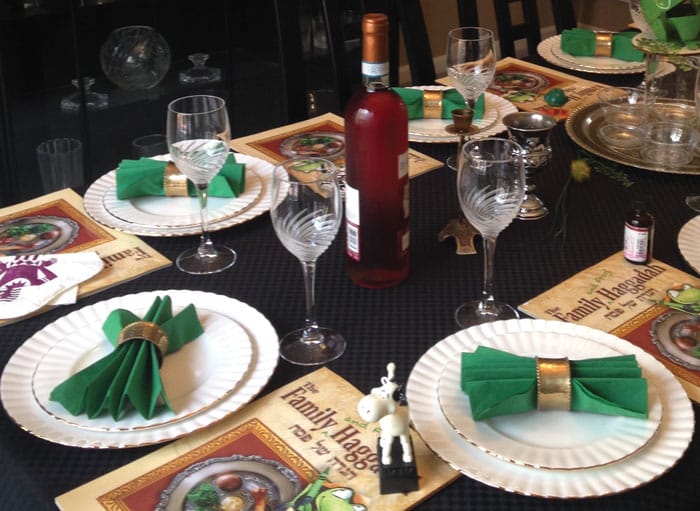
The long dining room table is set with her fine-bone English China. The small glasses are filled with wine and grape juice for my brother Rafi and I. My grandfather makes kiddush and everyone begins singing from the yellowed, wine-stained copies of the Haggadah. Parts are written in Judeo-Arabic and Aramaic and those parts are joyously sung by my parents and my aunts and uncles and the guests. I cannot read Hebrew but I know these words by heart. When it is time for Maggid, my grandfather ties one of my grandmothers brightly colored silk scarves with a piece of matzo inside around the chests of my brother and I. My youngest aunt who is 11 and my youngest uncle who is 15 leave the dining room with us and we make a show of being tired and weary and hobble back in to cries of “Where have you come from?” It is our job to recount the Exodus story, as though we ourselves truly had been freed from bondage in Mitzrayim. 

My grandmother made the best food I have ever tasted. She spent hours preparing in her kitchen. Especially for Pesach. Just making the Silan takes hours and hours. Boiling the dates and squeezing them through muslin and boiling again, making sure the date honey caramelizes but doesn’t burn. If you’ve ever tasted Silan, you know how good it is. The jars of organic 100% date syrup are a wonderful, easy alternative to the homemade version, but don’t tell my mother I said that. My mother still stands for hours making Silan. And she also loves to make the complex recipes from her mother’s kitchen. 

I, on the other hand, try to spend as little time in the kitchen as I can. Don’t get me wrong—I take my kitchen duties very seriously. I love feeding my family delicious, healthy food. I routinely host 30 people for Shabbat meals. But how do I get there faster? Truthfully, I have a lovely housekeeper to help me peel and clean and amazing daughters who love to chop salads and make the desserts. But key for me are simple recipes that don’t require too much thinking.

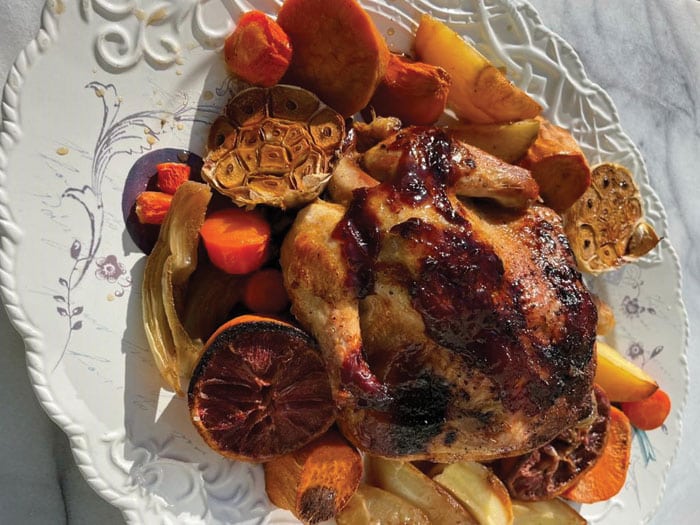
The flavors of the Silan, the spices, the fresh oranges, the garlic and onion, those are all my grandmother’s favorite ingredients. But there’s nothing more Aussie than roasting a whole chicken with potatoes and sweet potatoes.

This easy but flavorful recipe for Orange Silan Chicken is an ode to my grandmother and to my childhood in Australia. The flavors of the Silan, the spices, the fresh oranges, the garlic and onion, those are all my grandmother’s favorite ingredients. But there’s nothing more Aussie than roasting a whole chicken with potatoes and sweet potatoes. 

I hope that you are blessed with a healthy, happy kosher Passover with lots of delicious food, laughter and amazing memories. 

—Sharon 

Orange and Silan Chicken

1 large 4-pound chicken
2 medium oranges, cut in half
8 tablespoons extra virgin olive oil,
divided
2 Tbsp Silan date honey
3 tsp sweet paprika
2 tsp turmeric
2 tsp garlic powder
4 tsp kosher salt, divided
Freshly ground black pepper
1 large onion, peeled and cut in 6 wedges
1 head of garlic, cut in half
2 celery stalks, washed and cut into 2-inch
pieces
5 medium potatoes, peeled and cut into
wedges
2 large sweet potatoes, peeled and cut into
2-inch rounds

Preheat oven to 375°F.
Line a large baking dish with parchment paper. Place chicken breast side in the center of the dish. Lightly squeeze some juice over the chicken.
Place two orange halves in the cavity of the chicken. Place two orange halves on either side of the chicken.
Combine 4 tablespoons of olive oil, the Silan, paprika, turmeric, garlic powder, 2 teaspoons of kosher salt and black pepper in a bowl and whisk to blend. Pour over the chicken.
Place the onion, garlic and celery around the chicken.
Place the potatoes and sweet potatoes in the bowl and toss them with the remaining olive oil and salt, then place around the chicken.
Roast the chicken for 1 hour. Lower temperature to 325°F and continue roasting for another 20-30 minutes. Juices should run clear and chicken should be at 165°F in the thickest part of the thigh.
Remove pan from the oven and loosely tent with aluminum foil.
When ready to serve, carve the chicken and serve with the potatoes, sweet potatoes, oranges and other vegetables. Pour any juices over the chicken.


Sharon Gomperts and Rachel Emquies Sheff have been friends since high school. The Sephardic Spice Girls project has grown from their collaboration on events for the Sephardic Educational Center in Jerusalem. Follow them on Instagram @sephardicspicegirls and on Facebook at Sephardic Spice SEC Food. Website sephardicspicegirls.com/full-recipes.

Orange and Silan Chicken Read More »

The Perfect Ratatouille

We always joke that when my husband Alan married me, he converted to Sephardic Judaism. People ask him if it was difficult to adapt to Sephardic minhagim. In his dry South African tone and a straight face, he says that he’s accepted the sacrifice of eating rice on Passover.

The irony is that his family is originally from Spain and their name was Gomes y Peres. After the expulsion of 1492, they found refuge in Amsterdam and their name changed to the more Germanic Gomperz. From Amsterdam, they travelled to London where the name was Anglicized to Gomperts. Around the turn of the century, an enterprising diamond cutter great grandfather traveled to South Africa when diamonds were discovered there.

The Jewish community in South Africa was settled by Lithuanian and Latvian Jews, so his family traditions are very Ashkenazi. He loves to talk about Grandma Queenie’s patchar, a jelly made from cows’ feet that has hard boiled eggs and green olives set in the middle of the mould. Jewish holidays in the Gomperts family feature sweet chopped herring and kichel, chopped liver, a good brisket and a deliciously light sponge cake. The good thing is that I like Ashkenazi food and Alan loves all the Iraqi and Sephardic food that my family eats. Our mixed marriage works.

While Ratatouille is not a Sephardic dish, it has everything that Sephardim love. 

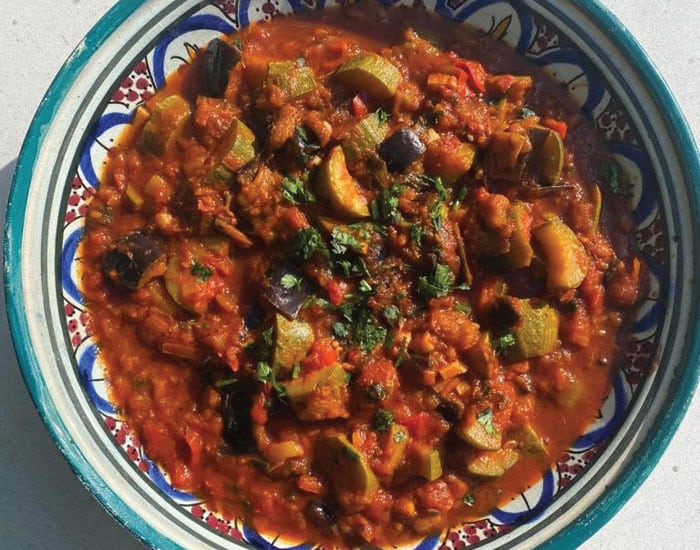
Every year for Passover, I make a huge pot of ratatouille and it has become Alan’s favorite. While Ratatouille is not a Sephardic dish, it has everything that Sephardim love. It’s a bright chunky stew made with eggplants, zucchini, red and yellow peppers, lots of tomatoes, onions and garlic and it’s seasoned with seasoned with paprika and lots of fresh basil, parsley and herbs de Provence.

Ratatouille is the perfect recipe to make for Passover because it is so versatile. Make a big batch and serve it as a hot side or a cold salad. Use leftovers to poach fish or chicken breast or serve it with eggs, Shakshuka style.

Ratatouille is so delicious; you’ll forget that it’s healthy. Though I doubt you’ll forget that it’s Passover.

—Sharon

Ratatouille

2 medium eggplants, chopped in a 2-inch dice
1 tsp. kosher salt
1 cup extra-virgin olive oil, divided
2 large onions, finely chopped,
10 cloves, garlic, minced,
2 red peppers, seeded and diced
One yellow pepper, seeded and diced into
a thin 1 inch strip
1 Tbsp sweet paprika
2 Tbsp. herb de Provence
1/2 tsp. freshly ground black pepper
6 Roma tomatoes, finely chopped
8 zucchini squash
1 28 ounce can crushed tomatoes
1 cup Italian parsley, finely chopped
1 small bunch fresh baby basil, stems
removed

Preheat oven to 400°F.
Place eggplant in a colander and sprinkle with 1 teaspoon kosher salt. Allow to drain for one hour.
Arrange eggplant on a parchment lined baking tray and drizzle with 1/2 cup of olive oil.
Roast for 20 to 30 minutes until eggplant has softened and is slightly golden. Set aside.
Warm remaining olive oil in a large pot over medium heat. Add the onions and sauté for 5 to 7 minutes until the onion has softened.
Add the garlic, red pepper, yellow pepper, paprika, and black pepper and sauté for 5 minutes.
Add the tomatoes and continue to sauté for 3 minutes.
Add the zucchini and sauté for 3 minutes, then add the roasted eggplant.
Pour the crushed tomatoes into the pot, stir well and cook for 5 to 7 minutes until sauce begins to bubble slightly.
Add the parsley and basil. Cover the pot and reduce heat to low. Allow to simmer for 1 hour.
Ratatouille can be stored in an airtight container for up to 5 days.


Sharon Gomperts and Rachel Emquies Sheff have been friends since high school. The Sephardic Spice Girls project has grown from their collaboration on events for the Sephardic Educational Center in Jerusalem. Follow them on Instagram @sephardicspicegirls and on Facebook at Sephardic Spice SEC Food. Website sephardicspicegirls.com/full-recipes.

The Perfect Ratatouille Read More »

Orange Blossom Almond Cake

For centuries, Sephardic women soaked almonds and ground them in order to make almond cakes. But if I were to suggest a recipe that required grinding almonds by hand, I’m pretty sure 99% of our readers wouldn’t be bothered make it. And the truth is, that neither would I. Luckily for us, ground almond meal is readily available.

Perhaps because I am Moroccan, I love anything made with almonds. And I’m obsessed with the sweet, fragrant scent of orange blossom water. 

This is the cake recipe I make most often for Shabbat. It’s an easy, one bowl recipe that doesn’t even require a mixer. Perhaps because I am Moroccan, I love anything made with almonds. And I’m obsessed with the sweet, fragrant scent of orange blossom water. It elevates the flavor of every and any dessert, whether it’s a sorbet, a cookie or a sponge cake. To be honest, orange blossom water is an acquired taste. If you are not a fan, no worries — adding the zest of a lemon or orange is the best grandma trick in the book. Try it in your cakes and you will notice your family smiling after the first bite.

You can easily adjust the flavor profile of this cake recipe by adding any combination of ingredients, such as vanilla extract, chocolate chips, cinnamon, dried fruit and chopped nuts. This past Shabbat, I decided I had way too many blueberries, so I kept the almond extract, added lemon zest and a cup of fresh blueberries. The combination was so bright and juicy. It was a major hit. No matter what else I include in the batter, I always like to keep the almond extract because it sends home the message — this is an almond cake! – Rachel

Orange Blossom Almond Cake Recipe

4 large eggs
1/2 cup sugar
1 large orange, zested
1/2 cup coconut or avocado oil
1 tsp almond extract
1 tsp orange blossom water
2 cups almond flour
1/4 cup sliced almonds
Confectioners’ sugar, for garnish

Preheat oven to 350°F.
In a large mixing bowl, whisk the eggs and slowly add the sugar. Beat to a creamy consistency.
Add the oil and orange zest and mix well.
Add almond extract, orange blossom water and almond flour and mix to a smooth batter.
Pour the batter into a 9-inch cake tin lined with parchment paper.
Sprinkle almonds over the top of the cake.
Bake for 20 to 25 minutes until cake is a golden color.
Let cool, then sprinkle with confectioners’ sugar.


Sharon Gomperts and Rachel Emquies Sheff have been friends since high school. The Sephardic Spice Girls project has grown from their collaboration on events for the Sephardic Educational Center in Jerusalem. Follow them on Instagram @sephardicspicegirls and on Facebook at Sephardic Spice SEC Food. Website sephardicspicegirls.com/full-recipes.

Orange Blossom Almond Cake Read More »

Why is this Haggadah Different from All Others?

Passover is a special time of year. Families and friends gather to retell the story of Exodus in a seder that can last anywhere for a few minutes to several hours. These days, there’s a Haggadah for everyone. Here are some to consider.

Traditional

Looking for a traditional Haggadah? Try “A Different Night, The Family Participation Haggadah.” Originally published by the Shalom Hartman Institute in 1997, this Haggadah by David Dishon and Noam Zion is a user-friendly, traditional seder with art, commentaries and conversation starters. The new edition has 32 additional pages of Passover stories.

Another option is “The Jonathan Sacks Haggada,” written by Rabbi Jonathan Sacks, the late former chief rabbi of the United Hebrew Congregations of the Commonwealth in the United Kingdom. This Haggadah, which was updated in 2022, offers a refreshing and insightful commentary to the “Koren Haggada,” along with illuminating essays (including “Pesach, Freud and Jewish Identity” and “Pesach and the Rebirth of Israel,”) on the themes and motifs of the Festival of Freedom.

Gathering to retell the story of Passover is what the holiday is all about.

Fun for Kids

Rabbi Ron Isaacs’ “The Family (and Frog) Haggadah” and “Seder in Motion: A Haggadah to Move Body and Soul” are family friendly and tons of fun.

“The Family (and Frog) Haggadah” has traditional text and vibrant artwork, along with the songs, prayers, fun facts, activities for the seder and a hopping frog on its pages to keep the story interactive and fun. 

“Watch Frog find a piece of toast (chametz), run away from Pharaoh’s army, mistakenly eat a locust (that he thought was a fly) and more,” Karen Rostoker-Gruber — the ventriloquist who created the book’s Frog the book voices him at events with Rabbi Ron — told the Journal. “There’s puns and frog fun on every page and that’s what makes this Haggadah family-friendly.”

“Seder in Motion” encourages participants of all ages to engage all the senses for a seder that combines the traditional text with creative activities that connect emotionally and get participants moving.

“This Haggadah is great for all ages and engages participants through mindfulness and motion,” Leora Isaacs, who co-wrote this Seder with her husband, told the Journal.

Shakespeare 

Martin Bodek’s “The Shakespeare Haggadah” is the latest in his series of contemporary versions of the instruction manual for the Passover seder ritual. He is also the author of “The Coronavirus Haggadah,” “The Emoji Haggadah” and “The Festivus Haggadah.”

This Shakespeare-quote/Haggadah-text mashup displays the full ritual text in Hebrew, and also includes the English translation in faux-Elizabethan style. Peppered with copious and relevant Shakespeare quotes — at least one quote from each play — the Haggadah also has funny stage directions for the seder leader. 

Re-enacting the story of the Exodus from Egypt is a popular activity at many seders (especially with children),” Bodek told the Journal. “So referencing the greatest playwright of the English language is a natural.

Make Your Own 

Haggadot.com enables users to make their own, customized Haggadah, using a template and/or mixing and matching elements from the website. The largest online resource for the Passover Haggadah, the website — which is a nonprofit — has thousands of options for blessings, art, translations, songs, activities and more. 

To get started, create an account. Click “new Haggadah” to start one from scratch or use one of the templates, and then add and remove clips. To save a clip to your Haggadah, browse the Clip Library and select the “Add to Haggadah” button. Since personalization is key, a user can also upload or scan in original writings and artwork for any section of the Haggadah. To create a clip of your own, log into your Haggadot.com account, then select the “Submit a Clip” link in the top navigation. 

Once you create a Haggadah, it will be added to your My Library link on the top right of the screen. At the final stage, you can create a PDF and print unlimited copies at home for seder guests, all at no charge.

Song-Filled Seder

For those seeking a song-filled Seder, go over to HebrewSongs.com. Aura Lipski’s free, printable song sheets are perfect for using at any seder, either along with your Haggadah or instead of. 

If you have guests who don’t know all the songs, or people from other faiths who are joining you, you can send them a link beforehand, so they can listen to the songs and “study.”

The words are transliterated in large font as pdfs, and the sheets are categorized; one before the meal, one for after the meal. “Our readers come from 90 countries and it always stuns me how many use them and actually play the songs at their Seders,” Lipski told the Journal.

Haggadah meet AI

“Haggad.AI: The First AI Haggadah,” edited by Royi Shamir and Yitzchak Woolf, was just published in March. Combining the power of artificial intelligence with the beauty of Jewish text and art, it includes original commentary, midrash and divrei torah created by ChatGPT, and over 30 stunning images created by Midjourney.

“We created the character of Rabb.AI, an AI Rabbi which serves as our guide for the Haggadah,” Woolf told the Journal. “Rabb.AI gives his original and unique commentary and midrashim at the bottom of the page separated from the traditional Haggadah text. Although some of Rabb.AI’s commentary is entirely unprecedented and unverifiable, they hold significance, and we recognize the AI’s good intentions.”

The authors also incorporated navigation tabs on the outer margins of the Haggadah to help readers determine their current stage in the seder.

“The chapter system is located on the left-hand side, while the wine cup iconography can be found on the upper right, indicating the appropriate times to fill and empty the cup,” Woolf said.

Why is this Haggadah Different from All Others? Read More »

Can We Bring Civility Back?

As we all watch with trepidation what’s happening in Israel, where the arguments over the judicial over-haul have been ugly and divisive, and as the political rhetoric here continues to escalate with a former president issuing death threats, many of us are no doubt wondering how we’re going to get through our Passover seders if we’re seated between those who may consider us enemy combatants.

It’s not an unreasonable concern. With the 24/7 news cycle, the media — and many politicians — have learned to shout “fire” every five seconds to get our attention. Added to this is social media, which is primed to trigger our fight or flight reactions. We’ve become conditioned to see no distinction between our personal and political identities, so everything becomes immediately personal 

We’ve become conditioned to see no distinction between our personal and political identities, so everything becomes immediately personal.

Many of us have become more intolerant and judgmental in general. Living in cities like New York and Los Angeles, we’ve been traumatized by the past three years in ways we’re just beginning to understand. Everyone’s nerves are frayed. Arguments can break out over the smallest things. New Yorkers coped with the lockdowns and riots by spending as much time as possible in Central Park. But even there we weren’t free from the rage of the triple-masked hurling insults at toddlers whose masks just happened to drop below the nose for a second or two.

Many have accepted anti-civility as the new normal. In fact, those on the extremes of both sides have convinced themselves that perpetual rage is the norm. For them, this culture war is actual war — and they will say and do whatever it takes to win. 

Sometimes we don’t realize how bad things have gotten until we are forced to remember how life used to be. My son and I recently took a vacation with two other families. Somewhat of a miracle happened: politics were barely mentioned for an entire week. At a time when you typically can’t get through a dinner or even a phone call without a political argument breaking out, we all went the entire week and talked about — gasp! — other things. And no one tried to inappropriately politicize those other things. 

When a political incident occurred in the news, we calmly discussed it. Our reactions were roughly the same; if somebody felt differently, he or she didn’t feel the absolute need to voice that opinion, let alone crucify the rest of us for not agreeing. 

It was all very last century, and in stark contrast with what’s going on in the rest of our lives. 

Wherever each of us stands on today’s distorted political spectrum, we all have multiple reasons to be angry right now — from the lies and cover-ups of the pandemic to woke illiberalism infiltrating many aspects of our lives. And for Jews, facing an alarming level of antisemitism from all sides, even more so.

Civility — including civil discourse — is essential for a functioning democracy. It’s not icing on the cake: It’s part of the cake itself. And when civility is lost, so is a part of our humanity.

But what’s been lost in all of this is that civility — including civil discourse — is essential for a functioning democracy. It’s not icing on the cake: It’s part of the cake itself. And when civility is lost, so is a part of our humanity.

What do we do? First we need to understand how significant this is — both for a democracy and our own emotional health. In the midst of writing this essay, I found out that a friend from Facebook had passed away at 43. I knew he struggled with various issues, so I checked in on him a lot. But we had disagreed over something in the late fall, so I wasn’t checking in as often as I had. I will never forgive myself for allowing that argument to affect our friendship.

Fixing the problem is twofold: one, understanding the Enlightenment principles that have been undermined in the past couple of decades, allowing outrage and tribalism to dominate. And two, accepting that it is up to each of us — not the government — to do the fixing.

With rights come responsibility

One of the most important principles to disappear is: with rights come responsibility. Sure, we have the right to free speech — but that comes with the responsibility of civil discourse. Just because we can do something — publicly humiliate anyone who goes off narrative, for example — doesn’t mean we should.

Sure, we have the right to free speech — but that comes with the responsibility of civil discourse.

The Founders viewed adult Americans as adults: Able to self-regulate both our speech and behavior. The assumption was that only a small minority would not be able to interact like responsible adults. One can only imagine what the Founders would think of Twitter.

The personal is not political

The second principle is that our lives are not defined by our politics: the personal is not political.

The phrase “the personal is political” emerged in the late ‘60s as part of second-wave feminism. Every aspect of a woman’s life was declared political. By the ‘90s, the mainstream declared that every aspect of life in general is political — from art and film to food and sports. 

This extreme politicization corroded society. By making everything political, by turning our politics into our identities, everything became ripe for argument and every disagreement felt like a personal attack. Another even more destructive aspect has arisen in the past couple of decades: all change needs to be mandated by the government. And there’s been nothing too personal to mandate — from pronoun usage to removing parental control over our kids’ bodies. 

By mandating every aspect of our lives, there’s been a natural response of anger. The right now politicizes everything as much as the left. And the far right has now begun to weaponize that anger, often against Jews. Extremism breeds extremism.

Individuality

The third principle that’s been lost is individuality. We are each unique and complex — as different from each other as leaves on a tree. Individuals are part of larger identities, of course, but we remain individuals nonetheless. 

The corollary is that parties or identities are not cults: we can disagree. Much of today’s left completely misunderstands this aspect of classical liberalism. Classical liberalism is based on a set of principles, and we can derive different opinions and policies from those principles: it’s called pluralism.

Being able to criticize someone in your own party or identity is a key step. It was during the Obama years that everything became an all-or-nothing package. Even if you voted for Obama — and continued to like him — you weren’t allowed to voice any criticism. Voicing even the smallest criticism came to mean that you were against him and thus racist.

The stronger we become in our own uniqueness, the less likely we are to rely on our group identities or political parties for self-esteem. And once we make that giant step back to individuality, the less we will take criticism of our groups or parties personally — and lash out in response.

The stronger we become in our own uniqueness, the less likely we are to rely on our group identities or political parties for self-esteem. And once we make that giant step back to individuality, the less we will take criticism of our groups or parties personally — and lash out in response.

Look inward

Thus, the first step in restoring civil discourse is to look inward. Would things get a lot better quickly if social media disappeared and a certain ex-president realized that for the good of the country he needs to exit the political stage? Of course. But, sadly, neither is going to happen. So that means each of us has to find and strengthen our best selves to be able to deal with the continued extremism with grace and dignity. 

When COVID first hit, I was the calm person in the room. Having just been through an ugly divorce, I had no emotional energy left to be stressed or neurotic. As the restrictions mounted and the riots tore through NYC, that soon changed. And then my dad, the rock of my life, passed away. I began to realize just how much I had leaned on him for strength. It was finally time to develop my own. 

Stoic resilience is in fact what the “Greatest Generation” is known for. Duty, responsibility, discipline — all took precedence over their own emotional needs. Indeed, control of one’s emotions was considered essential for the greater good of the country.

What we’ve been living through is measurably different from a major depression and a world war, but not by much. Have we become weaker — as a people — in the past 70 years? Or have certain factors, aside from social media, made us more susceptible to indulging our worst instincts? There’s no question that the decline of religion and spirituality has played a major role. Religion for many offered a way to act, to talk, to be.

In Judaism, our character and how we relate to each other is primary. A single act of chessed  — lovingkindness — is believed to have the power to change a life forever. 

There’s also been a decline of manners — mores — in general. As our culture continues to dip into vulgar mode — from nude selfies to crotch-grabbing Super Bowl shows — the way we behave has taken a nosedive. Narcissism is trendy. In New York, we often stare in disbelief at how some young people in particular deal with the outside world. The most basic manners — from giving your seat to an elderly person to not slamming a door into a stroller — appear to be missing from their repertoire.

Finally, there’s the cyclical relationship between self-esteem and rage. The need to politicize and argue about everything, to take everything to its illogical extreme — ruining friendships and familial relationships in the process — stems in good part from social media, which encourages hyperemotional reactions, but it also stems from low self-esteem. We all know that bullies of any age are the most insecure. Verbal bullies are no different: the more insecure the ego, the less it can tolerate differences.

The principles of nature

In the first few months of the lockdowns, my son and I would spend long hours in Central Park. He would marvel at how well the birds and the squirrels dealt with the breadcrumbs he offered them. Why didn’t they get into constant fights, he would ask. I began to explain my theories about the underlying principles of nature; he listened, not having much choice in the matter. Theories about nature typically get reduced to “survival of the fittest.” That’s one aspect, but what rarely gets discussed are the elements that lead to that and often supersede it. 

We studied the trees quite a bit and discussed the expression “wisdom of the trees.” 

Trees weather the seasons by being well grounded with a solid trunk: strong, unwavering, resilient. Their branches are more susceptible to breaking — but a broken branch doesn’t lead to a broken tree. And their leaves — each one unique — show us the beauty of individuality.

As humans, we have no choice but to solidify our own “trunks.” Contrary to hip woke ideology, our self-esteem doesn’t come from the color of our skin or the causes we champion. We have to build it the old-fashioned way, through acts of kindness and work that builds self-respect.

What’s not commonly known is that dignity is an extension of the Enlightenment concept of inalienable rights: the right of each person to be valued and respected for his or her own sake, and to be treated ethically. 

What does all of this add up to? Dignity. What’s not commonly known is that dignity is an extension of the Enlightenment concept of inalienable rights: the right of each person to be valued and respected for his or her own sake, and to be treated ethically. The flip side, again, is responsibility: being treated with dignity presupposes that we each act with the responsibility to be dignified with others.

After spending innumerable hours in Central Park, I’ve come to believe that nature offers us the most cogent path forward. Surviving in nature isn’t defined by just a killer instinct. It also implies an ability to coexist — no matter how ugly the weather or the dearth of food. Now humans have to relearn how to coexist with people who are different from us, no matter how ugly the politics or the dearth of reason and truth.

Nourish the soul

To help elevate each of us — to bring out our best selves as individuals — we need to also begin to renourish our souls. You can have a strong trunk, but as humans if our souls aren’t nourished that strength can go south. 

It’s not a coincidence that precisely what nourishes the soul — creativity, spirituality, appreciation of beauty, values, morals — is missing today.

A nourished soul creates inner peace. It allows for faith — trust, hope in G-d — and gratitude. It helps us accept our own imperfections, life’s imperfections, and the imperfections of others: we become less judgmental. 

It allows us to aim for meaning and joy, not superficial happiness.

All of this helps us to become the best versions of ourselves, and when we feel good about ourselves we have no need for external validation — no need to rage, defame others, or take incessant selfies.

Respectful dialogue

The elephant in the room — social media — is literally geared to bring out the worst in us. Hyperbole — an easy way to get attention — provokes extremist ideas and impulsive, rageful reactions. Twenty-four/seven usage creates addiction leading to isolation. Filtered selfies cause depression and self-harm among young women. 

The more time you spend on social media, the more reactive and in need of external validation you become. Since it is very hard to rise above these instincts, limiting our time on social media is essential. Or using it to focus on art or nature and steering clear of politics. 

But what about those of us who want to defend Israel, classical liberal values, our country? How do we engage without becoming consumed? Disengaging with anyone unwilling or incapable of arguing respectfully is key. And the disengagement does need to be immediate, before our fight instincts kick in. 

When the Trump/Kanye/Fuentes episode went down, many of us were faced with a new frontier in the ideological war we’ve been fighting for sanity. Diehard Trump fans viciously attacked us for the misdeed of saying an ex-president shouldn’t have broken bread with two raging antisemites.

Maybe it was the way they had attacked — mean, trolling attempts to humiliate — but I began to see the attackers as insecure kids who need to demean others to feel better about themselves. I began to respond to the venom unemotionally. I respectfully asked for respectful discourse — I calmly used phrases like “I think you’re misunderstanding my view.” But most couldn’t tone down their verbiage, so I simply disengaged from them. 

It was liberating. I didn’t have to spend hours arguing with people who had no intention of engaging in civil discourse. The few who were able to “agree to disagree” are still in my life; the others are not. Not coincidentally, their incessant need to prove their superiority mirrors Trump’s juvenile name-calling and rants. 

Lack of bravery — an obsession with status and conformity — also stems from insecurity. When I first began to defend Israel publicly in 2014, I was quickly disappointed, less with virtue-signaling leftists than with people who I knew were “private Zionists” but refused to say anything publicly. Because many of them were in positions to reverse the tide — professors, editors, writers — I became increasingly frustrated with their lack of courage. I tried every possible way to inspire them to be brave, but nothing worked.

I was rewarded for my efforts by being blocked by friends of 20-plus years. I was essentially told by these status-obsessed friends that by publicly defending Israel I was “embarrassing” them — being friends with me could hurt their chances of getting invites to important cocktail parties. 

The Talmud instructs us to judge everyone favorably. It is certainly a good starting point, and knowing that verbal bullying typically stems from low self-esteem allows us to feel some level of compassion for the bullies.

But compassion doesn’t mean that we have to be their victims. Just as with physical abuse, the only healthy response to people incapable of civility is to disengage. It won’t stop them from abusing others, but if everyone begins to disengage, they soon will be left to rant alone, which will hopefully lead to some level of introspection. Arguing respectfully begins with thinking before you speak or write. That pause allows your brain to override your emotions. 

The next step, which, again, can only be done with someone who equally desires civil dialogue, is to try to understand the other side, even if you already understand and disagree. Politely ask questions. Perhaps, most importantly, make sure that your perspective is steeped in facts. 

Facts are not popular these days. We moved from objective truth to subjective truth to partisan truth to anti-truth. But one of the first rules of opinion journalism is that you can’t make an argument without facts. In a sense, we’ve all become opinion journalists. And as all young writers used to be told, if you don’t have facts to back up your argument, you shouldn’t be arguing. 

Facts prevent sweeping generalizations. Facts allow you to not make anything personal, or to take things personally. Facts enable you to detach emotionally. As Ben Shapiro now famously put it, “facts don’t care about your feelings.”

We need to relearn how to agree to disagree. You can vehemently disagree with someone — but, as the Talmud teaches us through the epic debates between Hillel and Shammai, you don’t need to show that vehemence. Because your self-esteem is not tied to “winning” this argument.

Should there be a “don’t talk politics with family” rule? I think it depends on the family. Some people, especially right now, are going to be incapable of civil discourse — to discuss political issues unemotionally. And if that’s the case, it is far better to not engage. 

Finally, accept people’s limitations. I had to accept that some people — who might be very successful in their careers — are not brave. Yelling at them to speak up not only doesn’t work, it’s counterproductive.

The wisdom of the trees

In the old days, manners and civil discourse began in the home and were then reinforced at school and places of worship. It’s also believed that clothing — uniforms or simply elegant suits and dresses — served as guideposts to maintain a more elegant demeanor. It was rare to see someone dressed elegantly, especially in an elegant environment, behave uncivilly.

But today, no matter how rigorously we discipline our children, they are inundated with anti-civil videos, songs, and speech. My son, now 13, talks “gangsta” with his friends. It’s an uphill battle to get him to switch gears but not impossible. Without guideposts, the job of parents today is not only harder but more important.

Children still learn the most from the role models closest to them. If they hear us talk in condescending tones, demean others in discussions or arguments, they will too.

One of the more disturbing things I noticed about the bullies on the right is a latent sexism. I was called “honey,” and multiple times the bullies insinuated that  — as a woman — I’m just not smart enough to understand. I can only imagine how they talk to their wives and kids.

But sometimes, when you least expect it, kindness emerges, perhaps to remind us not to lose hope. In our apartment building, one never expects anyone under a certain age to, for instance, hold the elevator door open for you. The other night, I was struggling with three bags of groceries when an arm reached out of the elevator to hold it open. That arm belonged to a young man who smiled gently at the shocked expression on my face when I thanked him. “Some people are good people,” he said, with the soulful wisdom of a rabbi. Indeed, though I’m eager to ask his parents the secret to raising a gentleman in today’s cultural chaos.

So what are our new guideposts? I’m all for bringing back elegant clothing and elegant interiors, but that’s not going to happen anytime soon. One thing we can focus on are the public figures who are able to maintain dignity. Nikki Haley comes to mind, as does Barack Obama. But there are simply too many Marjorie Taylor Greenes, eager to bring out the worst in everyone. 

So how do we get civility to trend? Calling for a revolution always gets attention — but I think it’s going to be hard to make civility look cool when mores of any kind are considered old-school, corny, and even a sign of “white” oppression.

So I return here to nature — to the wisdom of the trees. Confidence, a solid, resilient trunk, tends to naturally lead to civility, and it’s self-reinforcing. 

So I return here to nature — to the wisdom of the trees. Confidence, a solid, resilient trunk, tends to naturally lead to civility, and it’s self-reinforcing. When you act with dignity, you not only feel better about yourself, you also feel closer to G-d. And that feeling is the strongest possible reinforcement there is.


Karen Lehrman Bloch is editor in chief of White Rose Magazine.

Can We Bring Civility Back? Read More »

A Bisl Torah – Beloved Rabbi and Friend

This week we are mourning the passing of our dear rabbi, colleague and friend, Rabbi Zvi Dershowitz. For fifty years he served Sinai Temple. The overarching theme of those that shared at his funeral and shiva was that Rabbi Dershowitz was consistently part of our stories.

I explained at the funeral that he and I would share a Shabbat routine. As the Torah procession came close to his makom kavua, his permanent shul seat, I would linger for a moment. Leaning towards him I asked, “Rabbi, how are you feeling today?” With a twinkle in his eye, he’d respond, “Well I’m still here, aren’t I?” And each Shabbat, he’d tease me with the same refrain. But perhaps he didn’t realize the Torah I’d carry from those moments.

For his nearly 95 years, Rabbi Dershowitz was always there. There for our life cycles. There for counseling and pastoral guidance. There as a mentor. Even weeks before his passing, still offering to lead shiva or meet with a congregant in distress. He looked at each day on this earth as a gift. Taking each opportunity to teach, preach, and exemplify joyous Jewish living.

He ushered me into Sinai Temple as I began my journey as a rabbi. It is surreal ushering him from one world to the next. But his story doesn’t end with this lifetime. The clergy will continue his legacy, welcoming those in need and striving to bring Jews closer to God.

May Rabbi Zvi Dershowitz’s memory forever be a blessing.

Shabbat Shalom

P.S. Feel free to join us this Shabbat, April 1, at Sinai Temple as we recognize those that have been fortunate to have Rabbi Dershowitz officiate at one of their life cycles. We will celebrate his life and honor his memory.


Rabbi Nicole Guzik is a rabbi at Sinai Temple. She can be reached at her Facebook page at Rabbi Nicole Guzik or on Instagram @rabbiguzik. For more writings, visit Rabbi Guzik’s blog section from Sinai Temple’s website.

A Bisl Torah – Beloved Rabbi and Friend Read More »

Getting That Man Beethoven Out of My Hair

In the Testament of 1802,

written in despair, Heiligenstadt,

Beethoven complained he couldn’t do

felo da se before the final cut

that Father Time makes with his scythe. Like Flor-

estan, he called for freedom and escaped,

no prisoner of deafness, through the door

that he unlocked with music he had shaped.


Affability and kindness were

not his strong suits. By deafness soured,

while every sound for him was just a blur,

when by music he was empowered

he looked just like a wizard, and enraptured

the demons whom he clearly overpowered

and the audience which his music captured.


As famous for his deafness as his hair,

notoriously wild and badly brushed,

he, deaf man, looked distinguished, debonair

while he romantically writing music rushed.

Conclusions drawn from others’ hair aren’t true,

and claims that he was alcoholic should be hushed,

like, based on a femme fatale’s hair, that he was a Jew.


In “DNA From Beethoven’s Hair Unlocks Medical and Family Secrets,” NYT, 3/22/23,  Gina Kolata writes:


https://www.nytimes.com/2023/03/22/health/beethoven-death-dna-hair.html

In 2007, authors of a paper in The Beethoven Journal, a scholarly journal published by San Jose State, speculated that the composer might have been inadvertently poisoned by medicine, wine, or eating and drinking utensils.

That was where matters stood until 2014 when Tristan Begg, then a masters student studying archaeology at the University of Tübingen in Germany, realized that science had advanced enough for DNA analysis using locks of Beethoven’s hair.

“It seemed worth a shot,” said Mr. Begg, now a Ph.D. student at Cambridge University.

William Meredith, a Beethoven scholar, began searching for other locks of Beethoven’s hair, buying them with financial support from the American Beethoven Society, at private sales and auctions. He borrowed two more from a university and a museum. He ended up with eight locks, including the hairs from Ferdinand Hiller.

First, the researchers tested the Hiller lock. Because it turned out to be from a woman, it was not — could not be — Beethoven’s. The analysis also showed that the woman had genes found in Ashkenazi Jewish populations.

Dr. Meredith speculates that the authentic hair from Beethoven was destroyed and replaced with strands from Sophie Lion, the wife of Ferdinand Hiller’s son Paul. She was Jewish.


Gershon Hepner is a poet who has written over 25,000 poems on subjects ranging from music to literature, politics to Torah. He grew up in England and moved to Los Angeles in 1976. Using his varied interests and experiences, he has authored dozens of papers in medical and academic journals, and authored “Legal Friction: Law, Narrative, and Identity Politics in Biblical Israel.” He can be reached at gershonhepner@gmail.com.

Getting That Man Beethoven Out of My Hair Read More »