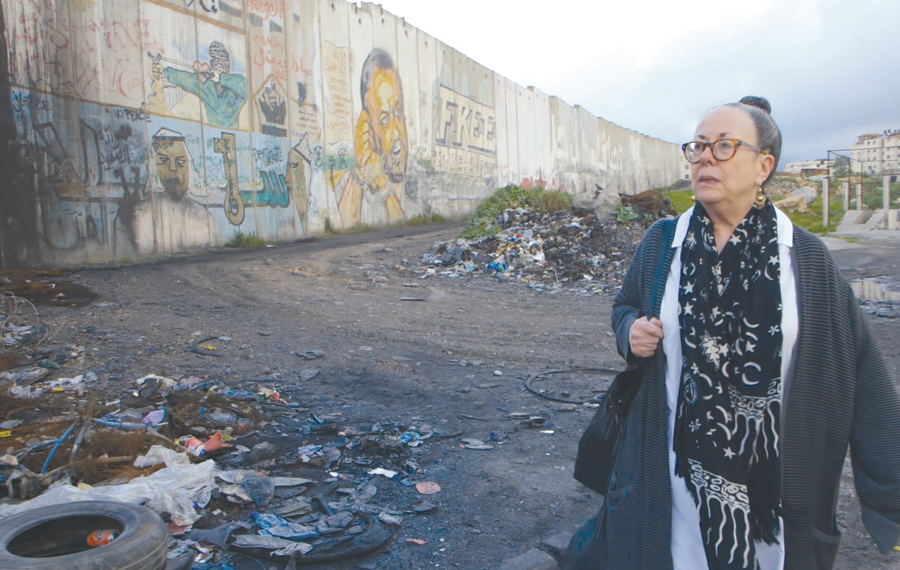
In a time of extreme divisiveness and escalating hate, filmmakers often look to history for answers. In her provocative documentary “Afterward,” Jerusalem-born, American-based psychoanalyst and first-time filmmaker Ofra Bloch explores the narratives of deep-seated hatred behind the Holocaust and the Israeli occupation. During on-camera interviews with survivors, former neo-Nazis, Israelis and Muslims, Bloch uncovers truths about herself.
“The Holocaust has played a major role in my life. It has become an obsession,” said Bloch, whose practice focuses on treating trauma victims. Her great-uncle was a survivor, as is her husband, and she vividly remembers listening to the 1961 trial of Adolf Eichmann, one of the architects of the Holocaust, on the radio. “She was raised to hate Germans and thought talking to some might help her sort out those feelings. In 2013, she flew to Germany, where she did seven interviews and she came away with the realization that she was brought up to fear and hate Palestinians as well.”
Over the next few years, she sought out subjects and had varying success. There were people who agreed to talk and changed their minds. Others suddenly disappeared. Ultimately, she did seven additional interviews with Palestinians, among them a peace activist who co-founded a bereaved parents’ organization after the death of his daughter, and a woman who believes that any form of resistance to the Israeli occupation is justified. For Bloch, listening to the latter was as challenging as being in the same room with the former leader of a neo-Nazi movement, but the circumstance was quite different. As a Jew in Germany, she was the victim. But to Palestinians, she represented the Israeli oppressor.
“The distance between being a victim and a victimizer is very small. Each of us has the capacity to be a victimizer under certain conditions,” Bloch said. “Here I was, filling both roles. I’ve lived in the United States for almost 40 years, but I realized my complicity in the occupation and it was shocking.Israel is no longer my home but the umbilical cord is not cut. I can’t pretend that I haven’t been part of it.”
In presenting a balanced story, Bloch had some concern that Jews would think she was equating the Holocaust and the Nakba (literally “catastrophe,”), which the Palestinians commemorate after the 1948 establishment of the State of Israel and the subsequent expulsion and/or fleeing of their people from their homes during the war that ensued.
“I don’t believe in forgiveness. You can’t forgive the unforgiveable. But we can put that aside and reach a place of reconciliation. People are dying for land on both sides. If we don’t learn to share it, we will all meet in the cemeteries.”
“I don’t believe you can measure or compare suffering,” she said. “There is no scale. The two events appear in the film because one had an impact on the other and are part of the collective identities of two groups of people. I think we can discuss the suffering of another people without taking away from the importance of the Holocaust.”
Bloch’s approach to the interviews was that of an “active listener. I didn’t go there to argue or challenge. I wanted to emphasize the experience of learning something new and being listened to,” she said. “Ignorance is the basis of every conflict. If we just listen to each other without judgment, without evaluating, the fences can come down. When that happens on both sides, there is a mutual acknowledgement and dialogue can begin.”
Bloch believes in the capacity for change and the possibility of peace in the Middle East. “I don’t believe in forgiveness,” she said. “You can’t forgive the unforgiveable. But we can put that aside and reach a place of reconciliation by lowering the expectations a little bit. People are dying for land on both sides. If we don’t learn to share it in one form or another, we will all meet in the cemeteries.”
The daughter of Zionist secular Jews, Bloch was raised with what she calls “Jewish humanistic values: love thy neighbor as thyself. I’ve tried to live accordingly,” shesaid. She doesn’t have her next project lined up, but one idea she’s considering involves American politics. “In this country there’s such a divide between Democrats and Republicans. There’s no communication. People are just angry and don’t try to understand. You have to have the courage to listen to what you don’t want to know.”
Meanwhile, Bloch hopes to reach young people by showing “Afterward” in schools and colleges. “I want the next generation to realize they can do something, and not take things as they are,” she said. “We have to unlearn the stories we were told and not be bystanders. We should be fighters for peace. At this time of rising anti-Semitism and racism, we must learn from the past,” she emphasized. “In terms of the Holocaust we say ‘Never again,’ but that cannot be limited to Jews. It should be applied to everybody.”
“Afterward” opens Jan. 20 at the Laemmle Royal, Playhouse 7 and Town Center 5. Ofra Bloch will participate in a Q&A after the screening at the Royal at 7:30 p.m. Jan. 20.
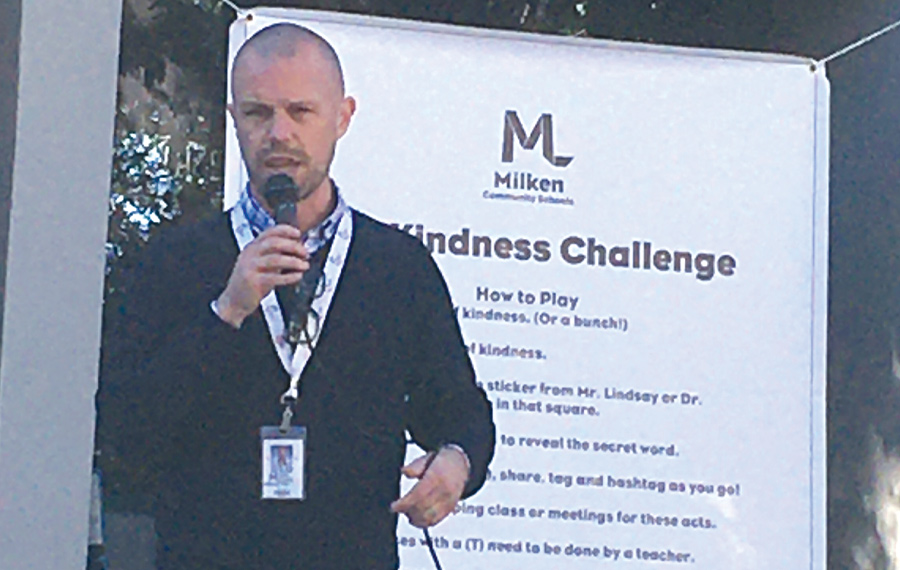
Alongside their basic classes covering subjects ranging from geometry and American history to AP chemistry and art, Milken Community Schools Upper School students also can take a class on positive psychology.
Nick Holton is in his fourth year of teaching the class. When the Michigan native started at Milken a dozen years ago, he taught world history. But he had long wondered how he could best help people become better versions of themselves.
He said his interest was piqued when he was in sixth grade. His little sister was on a soccer team but according to Holton, was “other skilled.” Soccer, however, was Holton’s thing. So one day, in front of their house, he showed his sister a couple of moves. That afternoon, his sister had a great game.
“It gave me the feeling of helping somebody be better at what they wanted to be better at, to go a couple [of] rungs up in terms of their potential,” Holton said. “I think that feeling stuck with me.”
And so, while still teaching at Milken, Holton, went back to school. “It was in my PhD program where I first got exposed to the term eudaemonia: the happiness we experience from being engaged and experiencing personal growth,” he said. “That’s where I really started to think what I’m most interested in is how we cultivate and leverage the world’s greatest resource: human potential.”
“Positive psychology is not just sunshine and rainbows. … It’s the science of thriving … feeling like your best self and functioning as your best self.” — Nick Holton
Holton said he felt confident he could teach positive psychology and that it very much applied to education. After all, he said, positive psychology — which was started by Martin Seligman about 20 years ago — is “not just sunshine and rainbows. … It’s the science of thriving, not just being happy, but crushing it; feeling like your best self and functioning as your best self.”
With the support of the Milken administration, and inspiration from the Geelong Grammar School in Victoria, Australia, and the book they produced, “Positive Education: The Geelong Grammar School Journey,” Holton created a positive psychology curriculum.
Milken junior Talia Byrnes took the class last year before Tiferet, a four-month program in Israel. “I had heard from other kids that time flies [during the program], and that you don’t remember everything,” Byrnes said. She wanted to do whatever she could to mitigate those effects and thought studying positive psychology might help.
“The class was about understanding how the brain has a negative bias and
being able to become aware of the good and appreciate the good in order to counteract the negativity bias we have,” she said. “It’s not a class that is going to make you happy,” she added. Rather, “it gives you the tools to enhance your life in general and appreciate things more.” Among the “tools” Byrnes tried in class was keeping a gratitude journal, something she continued in Israel. “Looking back at that journal, it takes me back to those little things that happened,” she said.
She also practiced mindful eating and meditation as part of the class, finding the latter particularly helpful. And she wrote gratitude letters. “It was one of the most meaningful things I’ve done,” she said.
Shortly after Holton began teaching the class, he heard from parents who also wanted to take the course. So last year he offered a shorter version online and in person for adults, something he has continued during this school year. It’s been popular with current parents and alumni.
Holton is not Jewish but he says positive psychology “happens to really overlap with what I have learned to be a lot of Jewish values,” such as chessed or kindness and gratitude. “We talk a lot about purpose and meaning, the importance of community and relationships,” he said. “The phrase I use every week from “Ethics of the Fathers,” 1:14, is, ‘If I am not for myself, who will be for me?’ But if I am only for myself, who am I?’ You need to fill your cup so you can pour into others.”
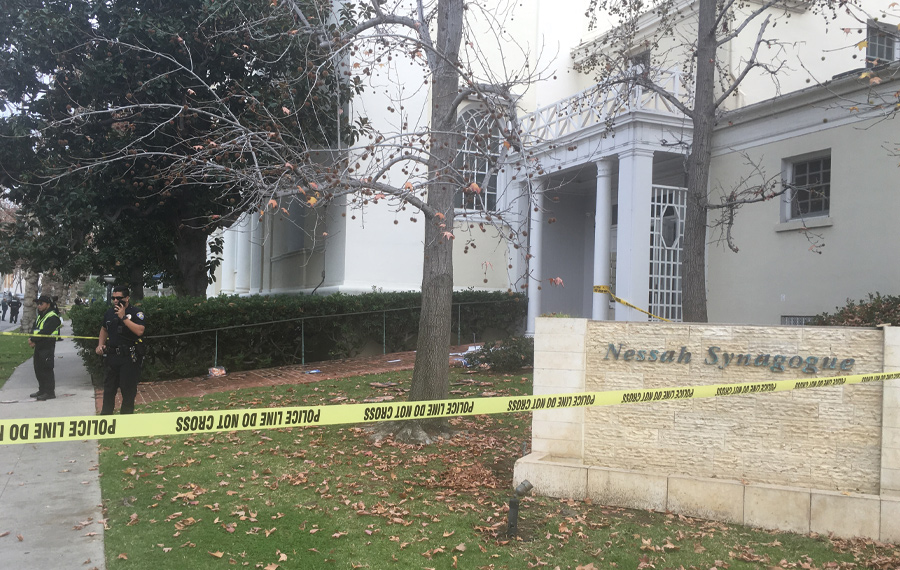
The attack on Nessah Synagogue in Beverly Hills on Dec. 14, coupled with an increase in anti-Semitic incidents around the country, has seen the Anti-Defamation League, The Jewish Federation of Greater Los Angeles and the Beverly Hills Police Department (BHPD) working together to increase the safety of religious institutions and schools.
“We are committed to continuing to work closely with our faith-based institutions on crime prevention, security assessments and safety,” BHPD Police Chief Sandra Spagnoli said in a Dec. 31 statement.
She added the department is also “conducting high-visibility patrols, security checks and foot patrols. We also offer security assessments and safety training to mitigate threats and provide situational awareness as part of our crime prevention efforts.”
Anton Nathaniel Redding, 24, of Pennsylvania was charged with vandalism of religious property, commercial burglary and a hate crime penalty enhancement after breaking into Nessah Synagogue in the early hours of Shabbat morning Dec. 14 and ransacking the sanctuary, damaging Torah scrolls and other religious items and leaving the relics on the floor.
The following weekend, Nessah held a “Unity Shabbat Service.” Among the local leaders who attended were Rabbi Marvin Hier, dean and founder of the Simon Wiesenthal Center, and Beverly Hills Mayor John Mirisch.
Nessah member George Haroonian told the Journal that while there were concerns over how the suspect managed to break into the congregation — including one congregant who wanted to know why he felt more secure in his place of business in South Los Angeles than he did in Beverly Hills — the community is largely grateful the synagogue did not experience more serious damage.
“What he did was an anti-Semitic act,” Haroonian said, “there’s no question about that, but it doesn’t sound like he was part of a group or anything.”
Daniel Babajoni, head of Nessah’s young professionals division, LeDor VaDor, was on a NewGround: A Muslim-Jewish Partnership for Change retreat when the attack occurred.
“I’m at Nessah literally five days a week; it is my second house,” Babajoni told the Journal in a phone interview. “It was a shock, to be honest, that it happened to us. Everyone was in shock it could happen to Nessah, especially because of the location. People think Beverly Hills is the safest place in the world [but] when it happened in Beverly Hills, people thought it could happen anywhere.”
Asked what steps the Nessah community could take to ensure its safety, Babajoni called for increased unity among the congregants.
“I think people need to protect themselves and be more unified,” he said. “The more unified they are, the less chance there is of something happening. God gave you two eyes. Use one for yourself and one for someone else.”
“I think people need to protect themselves and be more unified. The more unified they are, the less chance there is of something happening. God gave you two eyes. Use one for yourself and one for someone else.” — Daniel Babajoni
The Nessah incident took place just days after the Dec. 10 deadly shooting at a kosher supermarket in New Jersey and two weeks before a stabbing attack at a rabbi’s home in Monsey, N.Y., on Dec. 28.
Ivan Wolkind, the chief financial and operating officer at Federation, which runs the Community Security Initiative (CSI), a single point of contact for more than 520 Jewish institutions, including schools, synagogues and summer camps, said his recommendations for the community were the same as always: Be mindful of anything appearing to be a threat.
“One of the things that we always recommend is that Jewish institutions remain cognizant of the general situation in the city, the country and internationally and adjust their security stance appropriately,” Wolkind said in an email. “This is obviously a time of heightened anxiety for the Jewish community based on some real threats, some of which have already manifested in violence against Jews.”
He added,“We do put out bulletins regarding the situation and have advised that institutions should be at a high level of vigilance. Having said that, unfortunately this is exactly the kind of situation for which we have been training the community for a number of years and we do feel that the L.A. community is more security-conscious and better
prepared than most communities in America.
“The general advice is to always remain vigilant, to always be thinking about the training received and to act on anything that seems out of place or suspicious,” Wolkind said. “Maybe now more than
ever before.”
The first time I went to Italy, I road-tripped in with some Italians I’d met while backpacking around Europe. We crossed over from the French Alps into the beautiful Valle d’Aosta in the far north of Italy, a snowy region known for skiing, castles and rustic mountain cuisine. Their friends had a house there, and we decided to bunk up and enjoy the area. Our first day, we went on a beautiful hike in the foothills and picked local mushrooms to make a delicious lasagna that our hosts cooked.
The next day, my new friends looked at me strangely. They eventually explained that in the middle of the night, I had rolled over in bed and beaten the girl who was sleeping beside me. Normally I’m good for hogging the sheets — but not violence. Two of the other guests had thrown up. The lesson: Be very careful with wild mushrooms.
That’s my most memorable experience in northern Italy because I’ve spent most of my time in Tuscany, Rome and the south. When I taught a slow-cooking class, I wanted to make a chicken dish that would honor that region — and the poor girl I nearly pummeled to death in the night.
Ski Chalet Chicken with mushrooms, herbs and red wine reduction
1 bottle red wine
1 bunch thyme
1 bunch marjoram
1 bunch rosemary
1 bunch sage
2 bay leaves
1 ounce dried mushrooms (such as porcini, shiitake, oyster or cremini)
1 tablespoon kosher salt, plus more for browning
3 pounds bone-in chicken thighs and drumsticks
2 to 3 tablespoons extra-virgin olive oil
2 medium onions, sliced
4 portobello mushrooms, stems removed and cut into 1/2-inch slices
60 grinds of the pepper mill
Pour wine into medium saucepan and place over medium-high heat. Add a third of the herbs, including bay leaves. Reduce wine to about one cup. Set aside.
Break up dried mushrooms into smaller pieces and place in a small bowl. Add a cup of warm water and soak mushrooms for at least 30 minutes.
Brown chicken: heat braiser, Dutch oven or heavy-bottomed pan (must be fitted with lid, which will be used later) over medium-high heat; let it get hot for 7 minutes. Dry and salt chicken parts. Add olive oil to cover bottom of pan, and add chicken skin-side down, ideally without pieces touching. Brown skin until dark golden, about 15 minutes. Remove chicken and set aside.
Add onions and cook in remaining fat (don’t let onions burn). Stir every so often, then lower heat to medium low for another 15 minutes. Onions should be sweet and partially caramelized.
Return chicken parts to pan, skin-side up.
Add wine reduction with the remaining fresh herbs. Add dried mushrooms and their liquid, portobello mushrooms and 1 tablespoon salt and pepper. Bring to a boil, cover and lower heat to medium low.
If using white meat, remove breasts after about 30 minutes. Keep cooking dark meat for another 30 to 40 minutes or so, until meat starts to fall off the bone. (Alternatively, you can bake chicken in oven at 350 F for about an hour and a half.)
Serve chicken with mushrooms, onions and pan juices. Serves 4.
One verse, five voices. Edited by Salvador Litvak, Accidental Talmudist
[Jacob said,] “The Angel who has redeemed me from all harm — Bless the lads. In them may my name be recalled, And the names of my fathers Abraham and Isaac, And may they be teeming multitudes upon the earth.” –Genesis 48:16
How could Yaakov be praying to an angel? Isn’t this idolatry? The traditional answer is that the angel was really a messenger of God, and since a halachic messenger is an extension of the sender, Yaakov really was praying to God. Yet the commentator Shadal offers a very different and poignant alternative.
In the name of his own father, Shadal teaches that there was in fact no angel involved at all. Rather, the word “malach” refers to the one receiving the blessing, not the one giving it. He explains that Yaakov nicknamed Yosef “the angel who redeemed me from all harm” because finding out that his beloved son Yosef was still alive gave Yaakov a second chance at life and happiness. Yosef was thus Yaakov’s redeemer. And so Yaakov’s blessing asks that not only Menasheh and Ephraim be blessed but that Yosef be blessed too.
Any parent can imagine giving a child such an epithet, “my daughter, my son, who makes my life worth living, who makes all of the obstacles until now worth it.” But truthfully, epithets like this can apply in all of our relationships. And so, as we read this timeless blessing, let’s take the opportunity to reflect: Who are the “angels” in my life? Who would I describe as “the angel who redeemed me from all harm” and do they know I feel that way? May we be inspired to not only bless those who have been our angels but to become angels to one another.
Jacob was on his deathbed and Joseph brought his two sons to receive their grandfather’s blessings. Menashe and Ephraim, raised in Pharaoh’s perverted, idol-worshipping Egypt, remained unaffected. Jacob wanted to confer his legacy of being a people apart, to guide and protect them throughout future Diasporas. Jacob conveyed a formula that would bind the Jewish future with its eminent past.
Foremost, Jacob knew that God’s protective providence, expressed as His guardian angel, was essential for Jewish existence.
To be worthy of God’s providence, Jacob invoked that the names of Abraham, Isaac and himself should be declared in them, the children. By these means, their children after them would identify with their predecessors’ mission and then take up their role in their eternal heritage.
Living Judaism’s religious heritage stokes the fire of one’s soul. Judaism, axiomatically, is a matter of the spirit, but it needs to be nurtured in daily life. Jewish consciousness can lie dormant for only a few generations. Without it, of course we survive as persons. But from the viewpoint of a “people with a mission,” it makes little difference whether a division is exterminated or disperses into the hills and casts off its uniforms. Jacob concluded: If they carry on the mission, they would then be worthy of flourishing as Jews in the midst of the lands, wherever they would find themselves in future millennia.
Jacob’s blessing sums up the essence of Jewish continuity: We will have no future unless our past is vitally present.
As Jacob confronts death and his lack of sight, like his father before him, he knows it is time to bless his children. He begins with Joseph and his two sons, Ephraim and Manasseh. Reunited with his beloved son Joseph and the double blessing of grandsons, he now trusts God’s promise, “I will make you fruitful and numerous. … I will give this land to your offspring …” He calls upon God, who “shepherded me from my inception until this day,” and God’s redeeming messenger, “HaMalach,” to bless these boys and that he and his forefathers, Isaac and Abraham, be remembered through them.
As a grandparent, I understand Jacob’s desire for their continued protection and welfare. The greatest fulfillment is to see one’s child experience the love and optimism that moves them to bring life into the world. A grandchild, more than anything, represents the future. Jacob, who knew firsthand the protective and shielding presence of God’s messenger, first in his dream of angels climbing and descending the ladder at Beit Eyl (House of God) and then later wrestling with a stranger and receiving the new name Yisra-Eyl (Wrestler with G-od) at P’ni-Eyl (Face of God). Throughout his life, this redeeming angel accompanied him and now he calls the same guidance upon his family foreshadowing, as well, that the people will also receive this gift, “I send an angel before you to protect you …” (Exodus 23:20)
May each one of us recognize HaShem’s presence in the many angels in our lives.
Rabbi Aryeh Markman Executive director, Aish LA
Are we going underground with rising anti-Semitism? Are we dressing differently, naming our children using only contemporary designations, and dropping our Jewish jargon? Hide in plain sight? Maybe some of us already have.
But not if you are the family of Jacob.
This week’s verse is the source of our custom to bless our sons on Friday night to be like Ephraim and Menashe, the sons of Joseph, Jacob’s grandchildren. They were the first Jews to grow up in exile, Egypt, the world’s superpower. They remained strong in their observance and Torah outlook and did not assimilate.
They lived under the tutelage of Joseph, the second most powerful person in the world, who had unbridled access to power and wealth and refrained from it. Their self-restraint was as great as the other tribal antecedents (Reuven, Shimon, etc.) who were raised from Day One under the watchful eye and spiritual influence of Jacob, our Patriarch.
Ephraim and Menashe did not change their outward appearance. They proudly defined themselves as “the other” even though marooned from the center of Jewish life. And what gave their father, Joseph, the ability to live in such an environment and not be harmed? Joseph’s fidelity to God and guarding his eyes; never looking at anything inappropriate, which is an ancient Jewish discipline.
While you might think now is the time to drop our Jewishness, it’s precisely the time to embrace our Judaism. Our faith in God is where all blessings emulate and where refuge can be found.
Rabbi Michael Barclay Spiritual leader, Temple Ner Simcha in Westlake Village
When Jacob blesses his grandchildren Ephraim and Manasseh, he does not ask that God bless the boys, but rather that the “angel who redeemed” him bless them. This angel is obviously important to Jacob, but what can we learn about an angel that redeems? Redemption, by definition, means that there was an “exile” of some sort. What kind of harm or exile had Jacob experienced that he calls upon his redeeming angel at the time of blessing his descendants?
Rabbi Shlomo Carlebach (z”l) taught in a commentary on Vayechi that “exile” means we’ve stopped thinking and feeling. True exile and harm occur when we stop growing psychologically, emotionally and/or spiritually, and become numb. Jacob experienced numerous challenges in his life: his exile from Canaan and Esau’s wrath; his escaping from Laban; his powerful dreams. But Jacob’s greatest harm occurred when he felt exiled from life itself upon hearing of Joseph’s death. The story of that son’s death understandably distanced him from any feeling or thinking.
But Jacob was redeemed in each of his challenges, especially when he learned that Joseph was actually still alive. “His spirit was revived” (Genesis 45:27). In blessing his grandchildren, Jacob calls upon all of us to be messengers of redemption, and to never stop feeling and thinking. We must always experience life fully … and be revived.
May we all be angels of redemption; keep each other aware on every level; and think, feel and inspire others to never get lost in the exile of numbness.
Moshe Arens was known for his measured expression of hawkish views. He died at age 93 a year ago this week. As Israel’s defense minister in the early 1990s, Arens believed Israel erred in not retaliating against then-Iraqi President Saddam Hussein after the Tel Aviv bus bombing in 1994. Arens’ boss, Prime Minister Yitzhak Shamir, made the difficult choice of restraint after a request byPresident George H.W. Bush not to disrupt the unity of the coalition against Iraq. The coalition included Arab countries that had agreed to fight a war against a fellow Arab regime but likely would defect if Israel were to join in.
What a world that was. The U.S. was celebrating the “end of history” by becoming a sole superpower and making new rules for the geopolitical game. Syria was a member of the anti-Iraq coalition. Saudi Arabia still looked at Israel as a problem rather than an ally in a fight much bigger than the one against Iraq. The American president was a measured, methodical, respectable —oftentimes boring — leader. Benjamin Netanyahu was just taking his first steps as a politician under the guidance of Arens. During the Persian Gulf War, Netanyahu became the main spokesman for Israel, especially beloved by emerging media powerhouse CNN.
Israelis my age remember the winter of 1991 when Scud missiles hit their cities, somewhat nostalgically. There were sirens, a lot of rain, confusion, scary moments — and a lot of laughs. We laughed at Hussein and at the way we looked wearing gas masks. We laughed at the empty streets, abandoned by citizens who wanted a secure place close to a shelter or a sealed room (against the gas), and at the ridiculousness of it all. Iraq invaded Kuwait and Israelis were punished. Luckily, we had only a few casualties. Hence, our ability to have a nostalgic reminiscence, devoid of great trauma.
Now, we have been warned another war soon may break out.
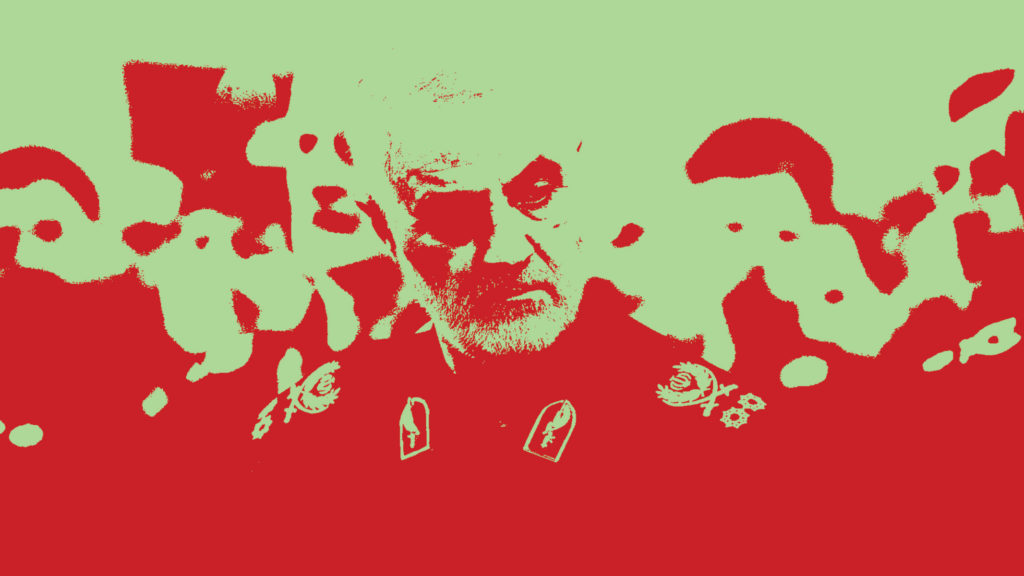
Two weeks ago, Gen. Amos Gilad, former director of Policy and Political-Military Affairs at the Ministry of Defense, told me that in 2020, the probability of war with Iran would increase. Warnings about the prospect for war between Israel and Iran started before the Jan. 3 killing by U.S. forces of Iran’s Gen. Qassem Soleimani, head of that nation’s elite Quds Force, at Baghdad International Airport.
Then, the warnings became more concrete. On Jan. 6, former Gen. Amos Yadlin, former chief of military intelligence, told Israeli President Reuven Rivlin, that there was an increased likelihood of war. Yadlin is the director of the Institute for National Security Studies (INSS), a think tank and research institute affiliated with Tel Aviv University, and his presentation to the president was an updated version of the institute’s national strategic assessment for 2020. Updated not because of the need to include the possibility of war —that possibility already was included — but because neither Yadlin nor Gilad nor any other general could have guessed that Soleimani would be killed. They couldn’t foresee the altered calculations of the U.S. and Iran.
If there’s any lesson to be learned from what happened in recent days in the Middle East, it’s beware of the forecasts of experts.
If there’s any lesson to be learned from what happened in recent days in the Middle East, it’s beware of experts’ forecasts. Former and current generals, reporters and pundits, political operatives and strategic thinkers were thinking one thing on Jan. 2 and another thing the next morning. One decision by one administration, whose actions are unpredictable, changed the calculus of the region and made the projections of experts dubious, if not obsolete.
In one of the last-minute additions to the INSS assessment, the institute said, “The Soleimani elimination … creates a new context and holds the potential for strategic turnaround, the scope and dimensions of which are still too early to be evaluated.” That is a polite way to say we have no clue. “The key question,” the document continues, “is whether the elimination indicates a fundamental shift in U.S. policy toward a proactive military campaign against Iran’s regional activities, or is it a more concrete act aimed at preventing and deterring the imposition of a heavy toll on a series of pro-Iranian actions.”
Indeed, that is the question — to which even more confusion was added on Jan. 7 when Defense Secretary Mark Esper and Chairman of the Joint Chiefs of Staff Gen. Mark Milley were prompted to call an urgent news conference to deny reports suggesting U.S. forces are on their way out of Iraq.
So, does anyone have an answer?
Arens, active until the end of his long life, penned many articles dealing with the threat of Iran. In one of his last, he criticized the nuclear agreement that enabled Tehran to continue its expansive policies in the region. “While focusing on Iran’s nuclear development,” Arens wrote, “the U.S. and the other signatories missed the main target: Iran’s aggressive plans in the Middle East. They did not understand who they were dealing with.”
Arens was right. If he were alive, perhaps he would feel some sense of satisfaction that the tables have turned on Iran. This time, it was Iran’s leaders who didn’t understand with whom they were dealing.
Perhaps their mistake emanated from reading too many analyses by too many experts — American experts, Israeli experts, European and Arab experts. Until a week ago, most of those experts held pretty much the same view.
Maybe Iranian leaders were listening to Eugene Robinson of The Washington Post when Robinson said President Donald Trump has a “very strong instinct against taking military action.” Maybe they believed Ilan Goldenberg of the Center for a New American Security when he explained, “Again and again, Trump has shown himself to be all talk and no action.” Maybe they listened to Emily Meierding, an author and assistant professor of national security affairs at the Naval Postgraduate School, who wrote “the Trump administration seems to have gradually recognized the political price it could pay for conflict escalation.”
Oops.
The experts have had to reverse course.
Of course, the jury is still out on Trump’s decision. Yet, instead of explaining why all-talk-no-action Trump is a no-substance president, we now have to explain how Trump just showed he can be an all-talk-all-action president.
“While focusing on Iran’s nuclear development,” Arens wrote, “the U.S. and the other signatories missed the main target: Iran’s aggressive plans in the Middle East. They did not understand who they were dealing with.”
Trump’s unpredictability is predictable. In fact, it was a campaign promise — one of many he kept amid the puzzlement of people accustomed to politicians who never do what they say they’ll do.
A protest outside the U.S. Consulate on Jan. 5 in Istanbul, Turkey. Photo by Chris McGrath/Getty Images
In April 2016, in a rare campaign speech addressing foreign policy, Trump said, “We must, as a nation, be more unpredictable. We are totally predictable. We tell everything. We’re sending troops. We tell them. We’re sending something else. We have a news conference. We have to be unpredictable. And we have to be unpredictable starting now.”
For the next three years, Trump — predictably — pulled out of the nuclear agreement with Iran, then — unpredictably — refrained from acting against Iran after a series of provocations. But then he ordered the killing of a top Iranian general. Reportedly, his team was surprised by his decision. Perhaps Soleimani thought he was immune to assassination. Perhaps Iranian leaders thought the United States no longer had the will to take a risk in the fight against them.
Trump took that risk. His critics, who say the decision to kill Soleimani might lead to war, aren’t wrong. Iran could test the resolve of the U.S. by retaliating. Trump might surprise them by showing he has the resolve they thought he lacked. This could lead to a war no one intended.
Is resolve a cause of war or a foundation of stability? Sometimes it’s one and sometimes it’s the other. Is unpredictability a cause of war or a foundation of stability? Sometimes it’s this and sometimes it’s that. The Cold War was an era of greatly needed predictability, lest miscalculation lead to nuclear war. Hence, the first Bush, a Cold War era graduate, was a predictable president. He told Iraq what he was going to do next every step of the way — then responded to Iraq’s invasion of Kuwait in a predictable fashion.
As defense minister, Arens argued that Israel’s failure to respond to Iraqi Scud missiles would erode Israel’s power of deterrence against its neighbors. As far as I can tell from conversations I had with him over the years, he continued to believe the war indeed harmed Israel’s deterrence. Arens and the leaders of Israel’s military wondered during and after the war if Iraq indeed had any chemical or biological weapons capable of reaching Israel. If so, why didn’t Hussein use them? Was he deterred by Israel’s rumored weapons of mass destruction and afraid to cross a line?
It is not easy to measure the degree to which deterrence is effective.
Iran probably isn’t worried about a possible U.S. invasion. But it likely is worried today more than it was a week ago, and must consider its next moves much more carefully. Trump’s surprise was an act of deterrence and like every such act, it carries risks. If the enemy is not deterred, one must double down or back down. When one doubles down, one exposes oneself to overreach. Documents seized in Iraq after the 2003 U.S. invasion demonstrated how Hussein deterred and erred. He wanted the world (especially Iran) to believe he had weapons of mass destruction. His success in his quest to deter Iran opened the door for the invasion of the American-led coalition.
In April 2016, in a rare campaign speech addressing foreign policy, Trump said, “We must, as a nation, be more unpredictable.”
Yet, all concerned parties who rightly worry about the prospect of war ought to remember that the U.S. is much stronger than Iran. Iran should be more worried about possible miscalculation and unexpected escalation of hostilities. The president has said he isn’t seeking to fight a war in the Middle East but is prepared to act. The more Iran’s leaders believe retaliation against the U.S. might lead to war, the less likely they are to respond. The best way for the U.S. to avoid war is to lead Iran to think it’s prepared to fight, which is what Trump stated.
Ironically, Trump’s Democratic rivals inadvertently helped him send the same message to Iran. When Sen. Bernie Sanders (I-Vt.) said this week, “I believe the first course of action is for the Congress to take immediate steps to restrain President Trump from plunging our nation into yet another endless war,” he essentially told Iran to hold back. His message to Iran could be taken as: Wait for us and get better terms of negotiation; wait for us and get a more predictable policy; wait for us because we are much more opposed to war than Trump.
Oddly, this also is a message that might give Iran a reason to avoid retaliation. Why retaliate now and risk escalation before the November election?
What is the U.S. trying to achieve by deterrence? Trump doesn’t want Iran to attack U.S. forces. That’s a good reason to send a decisive signal that retaliation is unacceptable. But what if Iran avoids action against American forces? Would that be enough to calm the Trump administration?
[Bernie Sanders’] message to Iran could be taken as: Wait for us and get better terms of negotiation; wait for us and get a more predictable policy.
The United States puts pressure on Iran through economic sanctions and that pressure seems to be working. Iran’s economy is hobbled; Iranians have protested fuel hikes and their leaders, starting last fall in multiple cities. Still, Iran isn’t backing down. It announced that it no longer is committed to the limitations of the nuclear agreement (after Soleimani’s death, European Union leaders aren’t hopeful the pact can be saved). It keeps its operations running in Yemen, Iraq, Syria, Lebanon and elsewhere. If deterrence means it can still do all these things, as long as it doesn’t hurt Americans, that’s a path Iran might take.
However, there needs to be more than that if the goal is to curb Iran’s disruptive policies of expansionist radicalism. There needs to be action against Iranian forces and programs. Israeli leaders are worried about Iran’s Precision Missile Project. This project aims to make the next war — the one that could come in 2020 — much more painful than the one in 1991. At that time, Iraqi missiles were primitive, inaccurate and in most cases, ineffective. Today, Iran’s missiles likely will be accurate and effective. They will hit their targets, killing and maiming thousands of Israelis, making the war traumatic and more like the 1973 Yom Kippur War than the 1991 Persian Gulf War.
The INSS, in somewhat cryptic language, recommended Israel “reduce the gap of expectations of the public about the characteristics of the war and its possible consequences.” In a conversation with intelligence expert professor Uri Bar Joseph three weeks ago (available on my podcast on jewishjournal.com), the language was more direct: Bar Joseph believes Israelis aren’t ready for war. They think a war against Iran will be like the Persian Gulf War, or like an operation against Hamas in Gaza — some disruption to life, but just a few casualties from incoming missiles. He believes the actual war and its high cost will shock Israelis to the core.
The leaders of Iran thought the United States no longer had the will to take a risk in the fight against them.
So what is next?
Iran must decide if, how and when to respond to the Soleimani killing.
Trump must decide what happens if Iran escalates, and what happens if it doesn’t. In this case, options are clearer, as they are with Israel and other Arab countries that must decide how to act if Iran doesn’t escalate and moves forward with its programs of expansion, missile accuracy and nuclear development.
As senior officials in Jerusalem and Washington, D.C. ponder their next moves, their calculations are based on the assumption that Iran — as academic and writer Walter Russel Mead defined it from his conversation with Secretary of State Mike Pompeo — “is in a box.” The United States and Israel believe the combination of America’s moves to exclude Iranian oil from world markets, Israel’s constant harassment of Iranian forces, and the proved effectiveness of U.S. sanctions forces Iran to make hard choices as it struggles to live in this box. They also believe that what Trump did last week will somewhat deter Iran from trying violent means to release itself from this box.
In the Middle East, a thick plot only thickens.
Shmuel Rosner is senior political editor. For more analysis of Israeli and international politics, visit Rosner’s Domain.
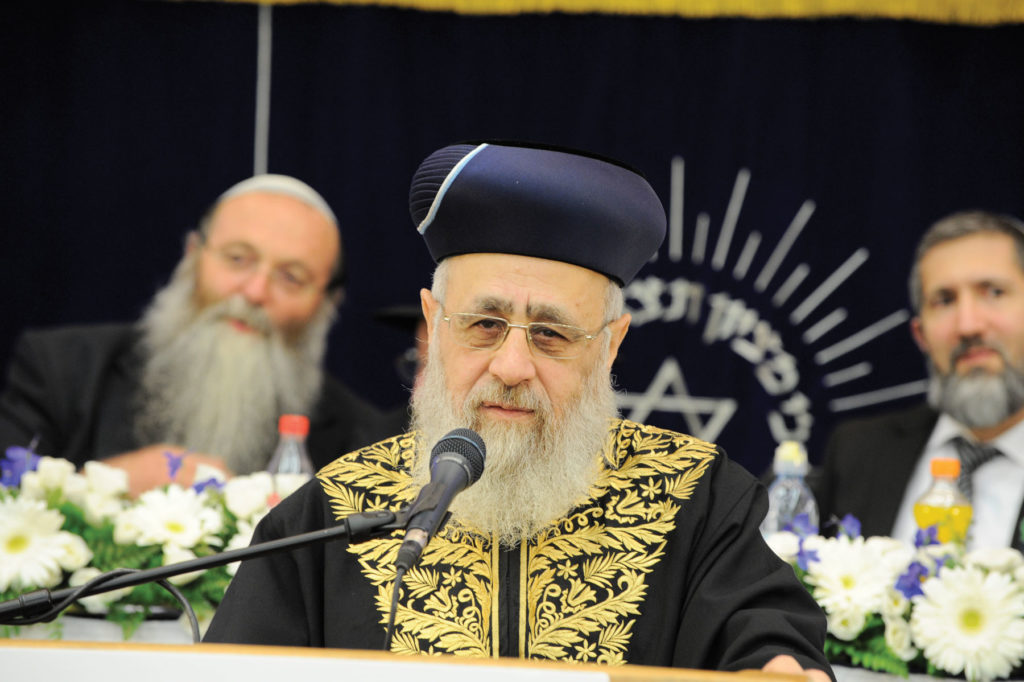
Israel’s Chief Rabbi Yitzhak Yosef probably isn’t a complete idiot although at times what he says might imply he is. On Jan. 7 Israelis woke up to discover its rabbi used harsh language to smear an entire category of the population. “Hundreds or tens of thousands of gentiles came to Israel because of the law of who is a Jew,” the rabbi said, referring to the Law of Return.
He continued, “There are many, many non-Jews here, some of them communists, hostile to religion, haters of religion. They are not Jews at all. Gentiles. Then they vote for parties that incite against the ultra-Orthodox and against the religion.”
Condemnation immediately rained down on his head. He deserved every bit of it and then some. Prime Minister Benjamin Netanyahu called his words “outrageous,” and said, “Immigration from the former Soviet Union is a huge boon to the State of Israel and the Jewish people.” Benny Gantz, the leader of the Blue and White Party said the rabbi should apologize for his hurtful language.
However, I’d like to say a word in his defense. Well …not in defense of him and his statement but of a necessary discussion the chief rabbi intentionally or unintentionally prompted.
No doubt the rabbi compromised his position by making a divisive and tactless statement. He also proved to be ignorant of many important and relevant facts if a serious discussion is to take place. The law is not “who is a Jew,” immigrants are not “communists” and most of them don’t hate religion. Israel didn’t invite them in, as he claimed, as a “counterweight to Charedis.” Yet, he said something that merits consideration. He said many of the immigrants who come to Israel under the Law of Return are not Jewish; according to his interpretation of Jewishness, that is true. This raises the question: Does this law still serve its original aim? Is this law that allows for an immigration of a grandchild of Jews still crafted in a way that makes sense?
These are not easy questions that can be dismissed by cries of xenophobia and bigotry. The rabbi has an opinion: He wants immigration of Jews. The initiators of the Law of Return had similar intentions. They wanted Israel to be a haven for Jews. They wanted Israel to have a majority Jewish population. To have that, one must have at least an idea, a working definition, of who is a Jew.
But Israel has no such thing and some of its leaders, including institutions that must deal with aliyah, are concerned with this problem.
The chief rabbi has a definition he deems the only legitimate definition of Jewishness. The Israeli public’s opinion — outcry and fury aside — is closer to the rabbi’s definition than you might think. Although the Law of Return largely is supported as a concept, the details make it less consensual. Nine out of 10 Israelis want Jews to make aliyah and get immediate citizenship and rights, but only about half (53%, according to the Guttman-Avi Chai survey) support this option for non-Jewish spouses of Jews; even fewer Israelis support a law that benefits the non-Jewish grandchildren of Jews — the current law.
This goes back to the question: Is a grandchild of a Jew also Jewish? What if his or her mother isn’t Jewish? What if he or she admits they aren’t Jewish?
Does the Law of Return still serve its original aim?
Israel’s history with questions concerning the definition of Jewishness is unflattering. There always is a rabbi who issues inflammatory statements; a politician who attempts to capitalize on the debate to gain a few more votes; a decision maker under pressure of his coalition; a think tank offering advice (you usually can guess it will be based on the identity of its funders); a Jewish luminary from the United States who gets offended; a delegation of Jewish machers on an emergency mission (but who stays at a nice hotel); and an article in an important international paper calling Israel racist.
Election time is the worst season to start such a discussion. When a Russian party (Yisrael Beiteinu) fights ultra-Orthodox parties (Shas and UTJ), you can’t expect anything other than political rhetoric. But not having a discussion isn’t a solution either. Not having a discussion only means an unhealthy situation of unclear purpose will not change. Not having a discussion means important questions concerning the identity and future of Israel will be decided by the wrong institutions — the bureaucracy and the courts — rather than the people.
Shmuel Rosner is senior political editor. For more analysis of Israeli and international politics, visit Rosner’s Domain.
Juliet Taylor is a Tel Avivian version of Mary Poppins, complete with the British accent. She swoops in with a confidence that gives listeners the impression she can handle things, and does so with unconditional acceptance and a warm smile.
As the nursery school education director for CityKids, an English-language education center in the Old North neighborhood of Tel Aviv, Taylor manages a team of teachers, “helping them bring their best for the kids.”
Largely unregulated in Israel, programs and centers for newborns through children kindergarten age often are regarded as baby-sitting. While there are many government-and/or nongovernment organization-sponsored frameworks, they aren’t free and parents often opt for a mishpachton — a nursery in a private home. Taylor is part of a group of early childhood education professionals on a mission to modernize and professionalize this field.
That group is called Early Childhood Educators in Israel, which began as a Facebook group. The group recently held a two-day conference in Tel Aviv to “change the definition of excellence in early childhood education in Israel,” Taylor said.
“Kids are little human beings,” she explained. “They are whole in that sense and our job as educators is not just to fill them like empty vessels, but to light the fire they already have inside them; to empower them.” She went on to say the current model of early childhood education has not changed much since it was first developed during the Industrial Revolution and that it’s only in the past three or four decades that scientists have started to research and analyze babies and children’s brain development.
According to Taylor the world — not just Israel — is “at this tipping point. People recognize the importance of early childhood education. It’s more than baby-sitting, more than daycare.”
“Kids are little human beings. Our job as educators is not just to fill them like empty vessels, but to light the fire they already have inside them; to empower them.”
With years of experience in British public schools before she made aliyah seven years ago, Taylor said she is aware that there are challenges in embracing this viewpoint. “There’s so much bureaucracy and that children have to be put into boxes, that we somehow lose this special window of time in their lives that they can be free to really find out who they are.”
At CityKids Taylor sits with a teacher and addresses each individual child’s unique capabilities, personality and needs. “We’re supporting kids to find their own voice,” she said. “They need to be loved, to be nurtured, to be appreciated and recognized for who they are, for all of their idiosyncrasies.”
Taylor seems like a natural leader, but she said she wouldn’t be leading the charge if she were back in London. “There’s something about Israel that pushes you to push yourself,” she said. “Here we are hard-wired to innovate and look for the changes that need to be made. There’s something about being Israeli that keeps you striving forward, and what better field than early childhood?”
“But you’re not listening. You do not get to tell Jews what it means to be Jewish and what it means to experience anti-Semitism.”
This was the upshot of the pleas my Jewish friends and I offered to a colleague in Communications and Disability Studies, whose work centers on listening to the voices of marginalized communities. She was not listening to our voices. After a 24-hour flare-up on Facebook sparked by President Donald Trump’s executive order to combat anti-Semitism, I discovered my self-proclaimed anti-racist colleague harbored her own bigotry: She was an anti-Semite.
Like many Jewish studies scholars, I entered the social media fray over Trump’s Dec. 11 executive order on “Combating Anti-Semitism,” which adds Jews to the list of communities protected by Title VI from discrimination “based on an individual’s race, color, or national origin.” Alarmed by the uptick in anti-Semitism in recent years, I welcomed the news — notwithstanding my distrust of Trump, who unquestionably has ulterior motives. But good policy can emerge from bad administrations, and I berated my fellow Jews who rejected it, some absurdly viewing this as an ominous step toward the classification of Jews as racial aliens, much as Stalin had stamped “Jew” (“Evrei”) as “nationality” in the passports of Soviet Jewry.
Predictably, I received pushback. Jews argue; that is what we do and as generations of comedians have kibitzed, it is intrinsic to our identity and keeps us healthy as a people. However, I was not expecting a rebuke from a non-Jewish colleague, a white, Christian female who teaches social justice and disability studies. She resented my claim that Jews constitute a community that can be classified with the criteria we use for defining “race,” “ethnicity” and “nationality.” She insisted Jews are a religious community and contending otherwise demeans minorities of color.
“Jews are not merely a religion,” I countered. Our communal identity is rooted in kinship, common descent and shared culture, irrespective of religious practice. Moreover, for centuries, white supremacist anti-Semites have targeted Jews as a sinister, non-European race deserving elimination. I brought up the Holocaust but she contended Nazi Germany persecuted the Jews because they were a “different religion,” oblivious to the fact Jews who had converted to Christianity still were exterminated precisely because anti-Semites believed Jewishness flowed through their “noxious” blood. Besides, she retorted, the Nazis’ definition of race was irrelevant; it was objectively wrong, unlike the one used in the United States today for social justice.
I usually try to reason with non-Jews who don’t understand Jewishness and anti-Semitism, even when they engage in haughty “goysplaining” — a benighted arrogant act of telling Jews what they are. Determined to get my point across, I asked her to read two pieces I published in The Forward on Jewishness and race. My encounters with anti-Semitism framed one of these stories. My colleague ridiculed my essay, insisting my claims of discrimination were trivial, that it oozed with “white privilege” and was harmful to people of color and their struggles. Had she read my story carefully, she would have noticed I acknowledge benefiting from white privilege and the perverse legacy of Jim Crow. Apparently, she was uninterested.
“Oozing with privilege.” She kept saying it. It reverberated in my head. This was not merely about white skin. Jews “have higher incomes, education and life expectancy than whites as a whole,” she repeatedly stated, insisting it has been proven statistically — but she produced no corroborating data. For good measure, she offered mock sympathy for my daughter having “to endure Christmas carols in her [school] cafeteria,” snubbing Jewish concerns over the alienating ubiquity of this exclusionary Christian holiday and its impact on our children, which I had expressed a few days before. This had little to do with being white; it was about my being a certain kind of white person: a Jew, stereotyped for undeserved wealth and lack of gratitude for “inclusion” in white Christendom, a space where our concerns with socially ascribed difference were frivolous.
Some of my Jewish Studies colleagues were distressed by her incendiary rhetoric and they stepped in. When they tried to reason with her, she skirted the issue. Perhaps she realized she was wrong. Or maybe she didn’t. Instead, she chose to double down by unexpectedly switching her discursive strategy, claiming I had a history of belittling the struggle for the rights of marginalized communities. “I am a disabled person with a gender nonconforming son,” she proclaimed — a fact she had expressed many times, but now speciously linked to a polemic about Jews —and my alleged “repeated attacks” on disability and LGBT advocates was a “threat” to her and her family.
“My defense of Israel made me a political reactionary by definition in the eyes of someone who identifies as a social justice warrior.”
Why was I a threat? Is it because I am a Zionist who has written against the boycott, divestment and sanctions movement against Israel? The anti-Zionist left has adopted the pernicious tactic of inserting Palestinian liberation into virtually every domestic cause. “Palestine is a disability issue”; “no walls from Mexico to Palestine”; “you can’t be pro-LGBT if you support the occupation” are omnipresent, facile and utterly illogical slogans one now hears at demonstrations and on college campuses.
Apparently, their strategy is working; my defense of Israel made me a political reactionary by definition in the eyes of someone who identifies as a social justice warrior, even though, by her own admission, she knows little about the conflict in the Middle East. But Palestine is a “social justice issue” and by her logic, you cannot be against oppression in America if you are for Israeli “war crimes.” As a supporter of Jewish self-determination in our ancestral homeland, I was a threat to the disabled.
I have a mentally disabled son with limited prospects. Most of my colleagues do not know about him. I do not discuss it in the classroom or on social media. I do not begin my sentences with, “As a parent with a mentally disabled son. …” His condition has caused enormous hardship and heartache for my family. When she accused me of hurting the struggle for disability rights, it struck deep into my heart, particularly because she knows him. I demanded she produce evidence of my ableist and transphobic bigotry, and failing that, she should apologize.
She did neither. Instead, my colleague in communications — who, ironically, has won teaching awards for listening to the voices of “marginalized communities” —suggested we “stop conversing.” But we had never been conversing. She was not even listening to me.
Much of the anti-Semitism on the left is rooted in misguided enmity toward Israel because of the ways in which Palestinian advocates have insinuated their cause into every facet of the domestic progressive agenda, a practice exhibited with unusual clarity by activist Linda Sarsour’s defamatory speech at the American Muslims for Palestine conference in late November.
However, the problem runs far deeper. Remarks about Jews “oozing with privilege” echo nearly two centuries of anti-Semitic rhetoric disseminated by virulent Jew-haters and by those who are casually clueless about Jews. It is found across the political spectrum in the United States, Europe and in more recent decades, Muslim countries.
However, such anti-Semitism also is a product of the intersectionalist paradigm propagated as religious dogma by activists and professors on the left. The notion that skin color and economic wealth are the sole factors in determining ethno-racial vulnerability in the United States simply does not work for Ashkenazi Jews. It belittles our concerns, undermines our security and marginalizes our identity.
When the shots were fired on Oct. 27, 2018, in Pittsburgh’s Tree of Life synagogue, those who hate the Jews as a race decided it was time to come for us; neither our skin color nor our alleged economic affluence prevented them from finding us and gunning us down in our sanctuary. Having white privilege does not mean one is secure from racial discrimination.
There is a term for people who refuse to accept this even after it has been painstakingly explained to them by actual Jews: anti-Semite.
Jarrod Tanny is associate professor and Charles and Hannah Block Distinguished Scholar in Jewish History at the University of North Carolina, Wilmington. He is the author of “City of Rogues and Schnorrers: Russia’s Jews and the Myth of Old Odessa” (Indiana University Press).
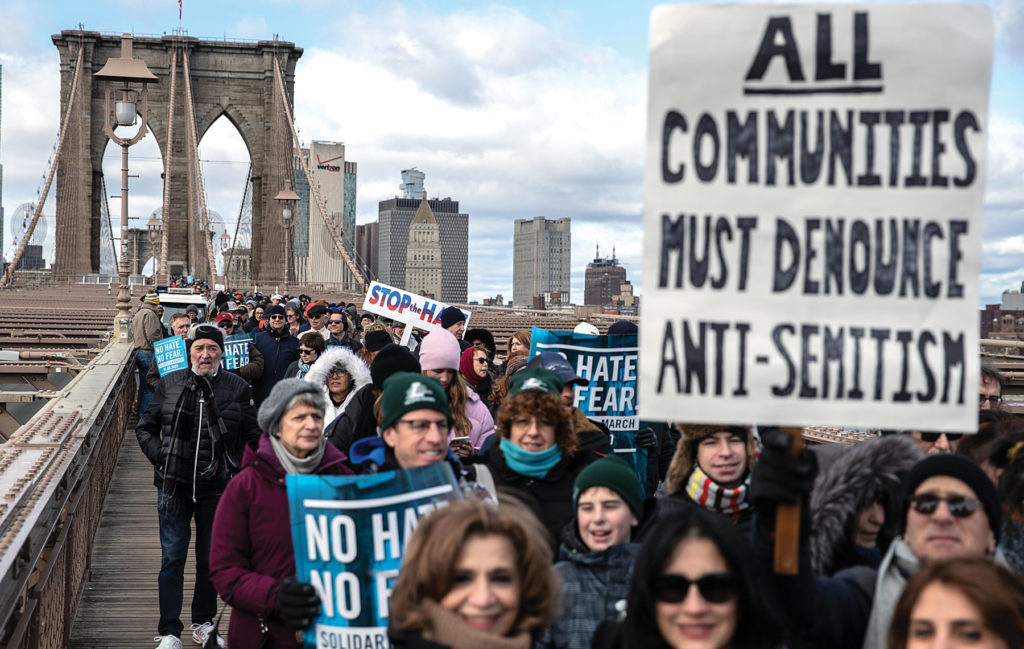
The recent “No Hate, No Fear” march brought together 25,000 people, who took to the streets of Brooklyn, and likely was the most massive demonstration on behalf of Jewish safety in modern history. However, the event was extraordinary not just because of its size, nor even its ability to unite Jews across the religious and political spectrum — despite our notorious culture of intracommunity disagreement.
What really made the “No Hate, No Fear” event monumental was that in these past three years, no one has wanted to march with the Jews.
The Women’s March, which is the largest single-day protest in the history of the United States, went from spectacle to debacle because of its leaders’ refusal to disassociate with notorious anti-Semites. Rhetoric from the march’s co-chairs inflamed this controversy: Linda Sarsour told 95% of American Jews they could not be feminists; Tamika Mallory responded to anti-Semitism allegations by claiming she had the same enemies as Jesus; Bob Bland scapegoated an Islamophobic attack that killed 51 on the “American Jewish Establishment.”
By the 2019 incarnation of the Women’s March, countless Jewish women did not feel like they could join the crowd, even if it was rallying around their rights.
When it came to excluding Jewish activists, the Women’s March was no lone wolf.
In 2017, a march for racial justice was planned on Yom Kippur, making it near impossible for observant Jews — even the many who experience racism as well as anti-Semitism — to join in. Given this decision was made less than a month after white nationalists overtly rallied against Jewish Americans in Charlottesville, this was “grave and hurtful oversight on our part,” admitted its organizers.
This pattern continued as local movements isolated LGBTQ Jews, particularly queer women. In 2017, Jewish lesbians were tossed out of the Chicago Dyke March for carrying a Pride flag with a Star of David on it. Why? The image, which has an emblem of faith that dates back thousands of years, reminded the March’s organizers of an Israeli flag.
After Jews across the country were horrified, the organizers tweeted, “Zio tears replenish my electrolytes,” using an explicitly anti-Semitic slur coined by leaders of the KKK. Then, as if starring in a parody of an out-of-touch activist stereotype, they campaigned for $5,000 for a “self-care retreat.”
In these past three years, no one has wanted to march with the Jews.
The Chicago SlutWalk, which advocates against rape culture, stood in solidarity with its local Dyke March instead of Jewish survivors of sexual assault and also banned similar Jewish symbols. In response to the latter’s controversy, the walk retweeted claims that the “Magen David was always a Zionist symbol and could not be claimed as a symbol of Jewish pride outside of the context of Zionism.”
After backing off its initial denunciation of the most recognizable Jewish symbol, SlutWalk still ostracized Jewish activists. The organizers went so far as to cover up marchers who wore Jewish pride shirts and carried signs with the image of a woman wearing a Star of David necklace with an umbrella.
This pattern carried into 2019, when the Washington, D.C., Dyke March also banned rainbow flags with a Star of David on them. The organizers argued the most recognizable symbol of queer Judaism looks too much like Israeli flags; therefore, they are just a symbol of “violent nationalism.”
The same behavior greeted 2020. Amid anti-Semitic violence in Brooklyn and the same day as the “No Hate, No Fear” march, an anti-war rally in New York City became a tirade against Israel. While the protest was billed as advocacy for peace with Iran, one speaker made a point to call out the “racist monstrous state that sits on the land of Palestine that is known as Israel.”
This rhetoric crosses the line from criticism of the Jewish state into anti-Semitism by demonizing Israel and making it the boogeyman in an unrelated conflict. The demonstration was a sharp reminder that others always will scapegoat the Jews, whether it is for people murdering us or others.
In these foggy waters of inclusion, the “No Hate, No Fear” march is a lighthouse. The protest is a radical act of rebellion. In a time where many see Jews as sitting ducks, this rally was the beacon of light that kept us moving, paddling toward a better shore.
Jews have begged other marches to disassociate with those who demonize us. There’s a reason why every time Jews are excluded or outright removed from a feminist, pro-LGBTQ or anti-racist protest, there is an uproar: We want to be there. We want to champion gender equality, queer rights, and fight against police brutality, white supremacy and systemic racism.
Our Jewishness does not exclude us from wanting these causes to come to fruition. We are the dykes, women and victims of white nationalism. We need these movements just as much as the activists who refuse to march beside us. That is why — despite this pattern of rejection — Jews keep showing up to these spaces and for marginalized people. Not only do we love them, we are them.
The “No Hate, No Fear” march broke the cycle of Jews being the latchkey children of social justice movements. For the first time, Jews stopped asking social justice movements to march for us or pleading for permission to march at all. We just got out there and marched.
Jews are done asking for a seat at the table. We are building our own.
Ariel Sobel is a screenwriter, filmmaker and activist.