
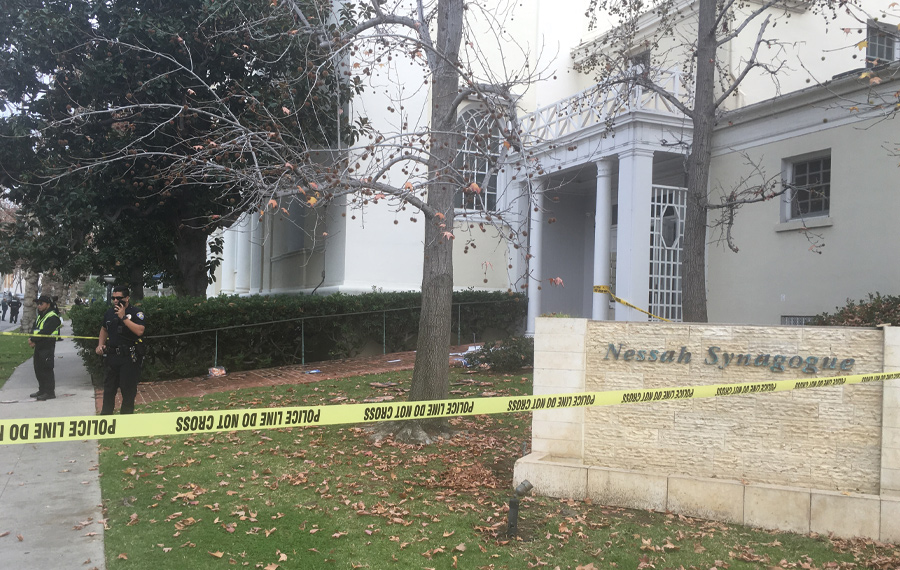
The attack on Nessah Synagogue in Beverly Hills on Dec. 14, coupled with an increase in anti-Semitic incidents around the country, has seen the Anti-Defamation League, The Jewish Federation of Greater Los Angeles and the Beverly Hills Police Department (BHPD) working together to increase the safety of religious institutions and schools.
“We are committed to continuing to work closely with our faith-based institutions on crime prevention, security assessments and safety,” BHPD Police Chief Sandra Spagnoli said in a Dec. 31 statement.
She added the department is also “conducting high-visibility patrols, security checks and foot patrols. We also offer security assessments and safety training to mitigate threats and provide situational awareness as part of our crime prevention efforts.”
Anton Nathaniel Redding, 24, of Pennsylvania was charged with vandalism of religious property, commercial burglary and a hate crime penalty enhancement after breaking into Nessah Synagogue in the early hours of Shabbat morning Dec. 14 and ransacking the sanctuary, damaging Torah scrolls and other religious items and leaving the relics on the floor.
The following weekend, Nessah held a “Unity Shabbat Service.” Among the local leaders who attended were Rabbi Marvin Hier, dean and founder of the Simon Wiesenthal Center, and Beverly Hills Mayor John Mirisch.
Nessah member George Haroonian told the Journal that while there were concerns over how the suspect managed to break into the congregation — including one congregant who wanted to know why he felt more secure in his place of business in South Los Angeles than he did in Beverly Hills — the community is largely grateful the synagogue did not experience more serious damage.
“What he did was an anti-Semitic act,” Haroonian said, “there’s no question about that, but it doesn’t sound like he was part of a group or anything.”
Daniel Babajoni, head of Nessah’s young professionals division, LeDor VaDor, was on a NewGround: A Muslim-Jewish Partnership for Change retreat when the attack occurred.
“I’m at Nessah literally five days a week; it is my second house,” Babajoni told the Journal in a phone interview. “It was a shock, to be honest, that it happened to us. Everyone was in shock it could happen to Nessah, especially because of the location. People think Beverly Hills is the safest place in the world [but] when it happened in Beverly Hills, people thought it could happen anywhere.”
Asked what steps the Nessah community could take to ensure its safety, Babajoni called for increased unity among the congregants.
“I think people need to protect themselves and be more unified,” he said. “The more unified they are, the less chance there is of something happening. God gave you two eyes. Use one for yourself and one for someone else.”
“I think people need to protect themselves and be more unified. The more unified they are, the less chance there is of something happening. God gave you two eyes. Use one for yourself and one for someone else.” — Daniel Babajoni
The Nessah incident took place just days after the Dec. 10 deadly shooting at a kosher supermarket in New Jersey and two weeks before a stabbing attack at a rabbi’s home in Monsey, N.Y., on Dec. 28.
Ivan Wolkind, the chief financial and operating officer at Federation, which runs the Community Security Initiative (CSI), a single point of contact for more than 520 Jewish institutions, including schools, synagogues and summer camps, said his recommendations for the community were the same as always: Be mindful of anything appearing to be a threat.
“One of the things that we always recommend is that Jewish institutions remain cognizant of the general situation in the city, the country and internationally and adjust their security stance appropriately,” Wolkind said in an email. “This is obviously a time of heightened anxiety for the Jewish community based on some real threats, some of which have already manifested in violence against Jews.”
He added,“We do put out bulletins regarding the situation and have advised that institutions should be at a high level of vigilance. Having said that, unfortunately this is exactly the kind of situation for which we have been training the community for a number of years and we do feel that the L.A. community is more security-conscious and better
prepared than most communities in America.
“The general advice is to always remain vigilant, to always be thinking about the training received and to act on anything that seems out of place or suspicious,” Wolkind said. “Maybe now more than
ever before.”

































