Last February, a class of 17 retirees jumped at the chance to pursue a Jewish rite of passage bypassed in their youth by circumstance or cultural rigidity.
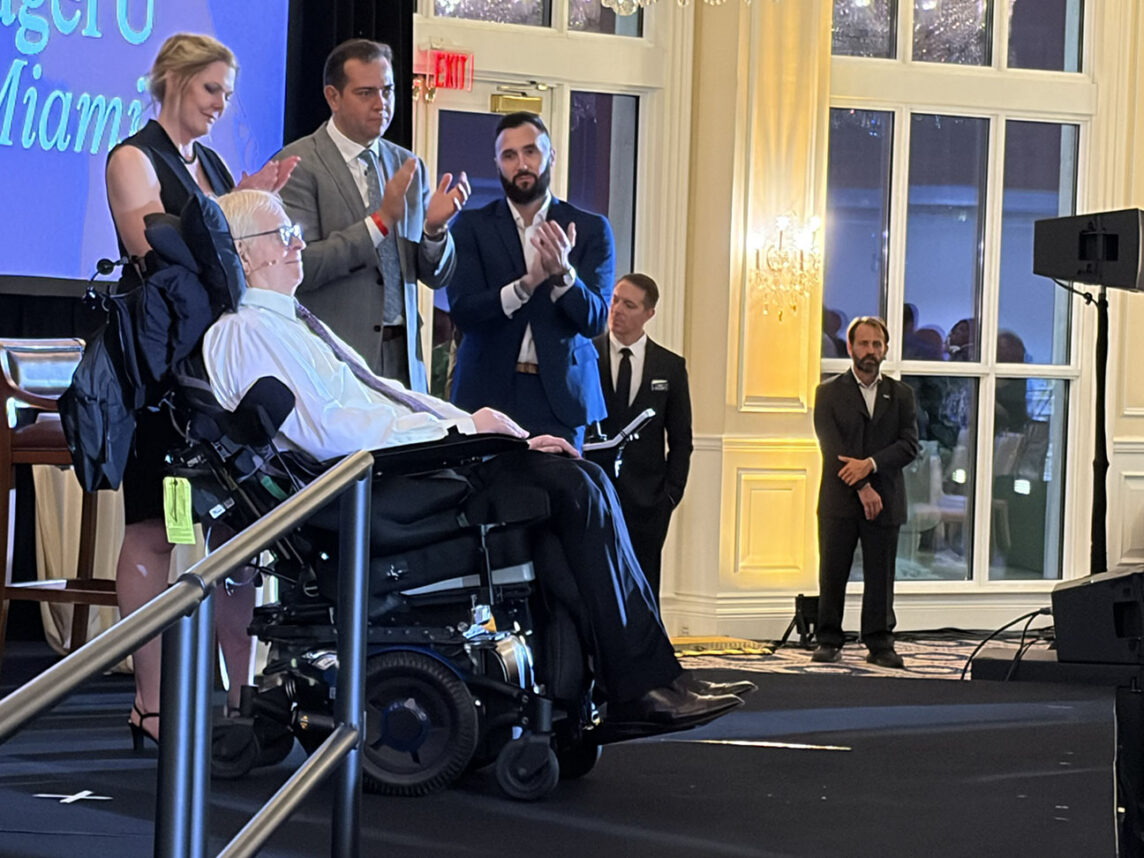
One student was 90; the youngest, 63. One is a Holocaust survivor; another uses a wheelchair. Since sessions commenced, one student died, another was stricken by cancer and a third dropped out after an extended vacation.
The 14 who persevered conducted an unusual joint b’nai mitzvah service on Aug. 14 at Laguna Woods’ Temple Judea, near the retirement community where they all reside. Proudly intending to wear their newly earned fringed trophies to High Holiday services this month, most anticipate experiencing the holiest days of the Jewish year with a new sense of entitlement. For others, their achievement yields a palpable connection to previous generations that eluded them over a lifetime.
Entering synagogue used to feel like a foreign experience to Roslyn Fieland, 76, a lifelong New Yorker who moved to Leisure World five years ago.
"I felt I was in a place I didn’t belong, an immigrant," she said. "Without a doubt, the holidays will be more meaningful. I’ll have much more understanding than I’ve ever had before. Now, I’m comfortable."
Fieland’s formal Jewish education ended at age 9 when she and her sibling were expelled from religious school. She had grabbed a ruler from a teacher, who had slapped it across her brother’s face, still tender from surgery.
Her single mother arranged for a Hebrew tutor, but just for her brother.
"Girls didn’t matter," Fieland said. She retained that meager schooling and ended up tutoring some classmates in the b’nai mitzvah class because of her ease relearning Hebrew.
"Here, I have a closeness to my religion I never felt before," Fieland said.
After learning and rehearsing the proper delivery of transliterated Hebrew, the class was divvied up into foursomes that took turns at the pulpit, reciting their selection of the morning Sabbath service in unison. Laura Feigenbaum, 63, dutifully attends High Holiday services. But she expects to absorb a different spiritual pitch this time. She can picture herself at services draped with a hard-earned tallit.
"Now, I’ll feel like I’m a bigger part of it," said Feigenbaum, who suggested the b’nai mitzvah class to the chair of Temple Judea’s religious committee, Ed Fleishman. The last b’nai mitzvah class at Judea — a multidenominational synagogue of 1,000 members, whose average age is 68 — was offered in 1995. Their instructors were congregants Rachel Jacobs and Jack Falit, the Torah reader at the synagogues’ Monday and Thursday minyans.
Feigenbaum, née Levitt, was raised in the Toronto home of her grandparents, whose level of observance included cutting toilet paper before Shabbat. As a child, she learned Yiddish in an after-school class. Although when Hebrew was introduced, she was banished. As an adult, she felt a similar sense of exclusion at the synagogues where her children were enrolled.
"I always felt like an outsider," she said.
Her hunger for Jewish rituals began in Judea’s welcoming environment.
"When we came here," she said, referring to her husband, Paul, "we were taken in like family."
Faithfully rehearsing her prayer portion even while vacationing this summer in Europe, Feigenbaum said becoming a bat mitzvah intensified her Jewish identify and fulfilled an unrealized longing to belong.
"Now, I feel part of the religion," she said. "I’m going to start Hebrew classes next. That’s the last link in the chain. I think we need it."
Toby Weiner, 66, also never felt at home in synagogue.
"I felt like I didn’t belong because I didn’t understand," said Weiner, who quit attending temple out of anger over the death of her husband, Harold, in 1986. Her own family was secular.
Thrilled at the opportunity to at last learn the sanctuary rituals, she is looking forward to the High Holidays with new pride in her own traditions.
"The reason we do rituals, I’m learning why and asking questions I never did before," Weiner said.
The class’s only male member was Arthur Oaks, who dropped out of religious school at age 13, the same year his grandfather died. His mother thought continuing would be disrespectful to his grandfather’s memory. Growing up in a Jewish neighborhood in Philadelphia, Oaks recalls feeling he missed a milestone. As an adult, he’s been called to the Torah many times since.
"At age 76, I’m finally coming of age," said Oaks, who read directly from the Torah during the b’nai mitzvah service, which is more traditional. "I never thought I would have the opportunity. When they announced the class, I jumped at the chance."
Maryan Feingold, 90, suffered a stroke six months ago and was told she wouldn’t walk again. Defying the dire forecast, Feingold ascends the bimah with unsteady legs and pronged cane in hand. She said: "I’m taking the class to thank God I’m walking and talking again."