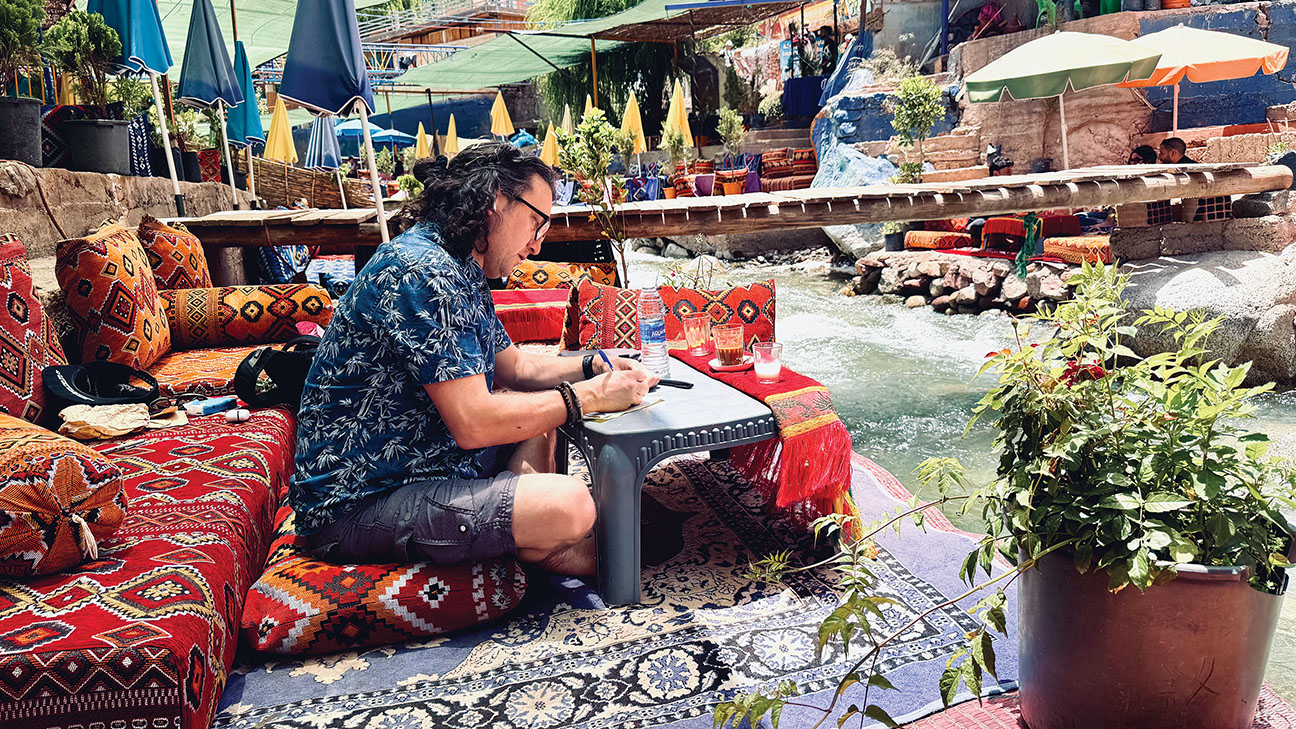

Comedian Dan Ahdoot has a special relationship with food, more so than most.
Growing up in New York to parents who fled from Iran to Israel, and then to New York in the early 1970s, the way he connected to his immigrant parents and grandparents was primarily through food.
This was particularly the case with his father, who “raised us speaking French, drinking wine before our bar mitzvahs, and eating stinky, illegal, unpasteurized cheeses he would smuggle into the States,” Ahdoot writes in his new book, “Undercooked: How I Let Food Become My Life Navigator and How Maybe That’s a Dumb Way to Live.”
But when Ahdoot’s older brother Solly passed away, his father became more religious and strictly kosher.
That caused a rift between him and his father and the rest of his family. So Ahdoot did whatever he could to fill that void by rebelling — eating non-kosher and learning how to cook in a Michelin-starredkitchen. Ahdoot also took up hunting for his food — a self-described hunter-gatherer.
This also led to some destructive social habits, including writing off potential romantic partners just because of their dietary restrictions.
Ahdoot started writing the book in 2021 while filming season five of “Cobra Kai,” where he has been a series regular since season one. “Undercooked” will make you re-examine your own journey with food and question the red flags that may be sabotaging their relationships.
Ahdoot’s irreverent writing style is laugh out loud funny: “I texted a finance buddy who did coke. I know, oxymoron.”
It’s an enjoyable read for anyone who considers food more than just sustenance. The Journal spoke with Ahdoot about “Undercooked,” and he continued to share his impeccable recollection of culinary details and willingness to get dirty in self-reflection.
JEWISH JOURNAL (JJ):
What was the hardest thing to write about?
DAN AHDOOT:
“The hardest thing was talking about my grandparents’ relationship. As first-generation Americans, especially from the Iranian community, we want to make it seem that everything’s always fine. I always say if I was going to write a one-man show about Persian culture, it would be called ‘Everything Is Fine, The Funeral Is Tomorrow.’ So I think that talking about my grandparents in an honest way — all the great things about their relationship and the flaws about their relationship —it’s not a popular thing to do. I have a feeling people in my family might not love that I did that, but I think it paints such an amazing picture of the two of them. A lot of people said ‘what’s your mom going to think?’ And I said, ‘their story’s not my mom’s story, their story is my story as well. We all have access to their stories.”
JJ: You said writing “Undercooked” was the hardest thing you’ve ever done. Why is that?
DA:
“As comedians, our job is to take all the mess of our lives and hide that and just bring out the funny. The mess might have brought you to the funny, but you leave the mess at home and you bring the funny to the table. This is the opposite: you’re bringing some funny, but you’re also bringing all the mess and you’re just putting a microscope on it. I’ve never really done anything like that. It’s very strange and it’s a lot more vulnerable in a different way. I do think stand-up is also vulnerable. Stand-up is taking the painting and putting it into a shiny, fun frame. Whereas writing a book is taking the painting and leaving it frameless. It just has to stand on its own.”
JJ:
What’s a “Cobra Kai” story you can share with us?
DA:
A fun Iranian-Jewish story for ‘Cobra Kai’ is that I was attacked on Twitter at once by someone, and she was like, ‘Really, Netflix? You couldn’t hire a South Asian person to play a South Asian character?’ She was blasting my character. Little did she know the name of my character, Anoush Norouzi is a Persian-Jewish last name. The reason the character has that last name is because Josh Heald, one of the creators, married a Persian-Jewish woman, Debbie. And Debbie Norouzi was her maiden name. So they named me an Iranian-Jewish character. So I went back on Twitter, and said, ‘just so you know, the character has an Iranian-Jewish last name. Iranian Jews are probably .0001% of the world’s population. And I’m an Iranian Jew. Are we cool now? Am I allowed to play the role?’
JJ:
Do you identify as a hunter now?
DA:
I know I give off more of a gatherer vibe, but [hunting has] become something that I’m into. I didn’t get into it because I want to kill animals. I got into it because I want to eat animals. And I thought, what better way of getting the best ingredients than the most local locally-sourced — as in it’s literally 20 feet away from me — and organic, [the target is] eating whatever berries and shrubs are around in the forest.
JJ:
You went through the entire thought process of the red flags that come up when it comes to dating.
DA:
I used to be so dogmatic about that stuff, about if someone’s kosher, I can’t go out with them. I also got into bad relationships because food is all I cared about. I was engaged to a chef, but that didn’t work out because that wasn’t enough to keep it going. Then I had a girlfriend who was gluten-free, and she was amazing. But that ended up causing such a rift. If your options are eating with somebody or eating alone, it’s better to eat with somebody who has dietary restrictions. It’s going to be okay.
JJ:
If she eats humans, are you cool with that?
DA:
If she eats humans, it depends. If it’s a grass-fed human, yeah, then that’s okay. Free-range, grass-fed human, yes.
JJ:
In the last decade, which three restaurants do you think you’ve been to the most in Los Angeles?
DA:
Number one is Nanban-Kan, a yakitori place in West LA. Another one is the restaurant Horses, which is a new restaurant that’s become my regular joint. The third one would be Here’s Looking at You. I love that restaurant. And then Honorable Mention — I’ve probably PostMated more from Sugarfish than anyone in the world has.
JJ:
Is food the answer to finding peace between warring peoples in the world?
DA:
It’s the easiest way to find common ground. If you hate a culture but then you have their food and you’re like, ‘damn, this is good,’ that automatically brings you down a peg and brings you closer to sitting down at their table. It’s hard to hate someone if you like their food. It’s hard to hate someone if they make you laugh. And when I was touring colleges as a comedian, my whole thing was, it was right after 9/11, and I didn’t want to beat people over the head with, ‘be nice to Middle Eastern people.’ I’m just going to be funny. Then they’ll realize that I’m Middle Eastern afterwards, and they’ll maybe expand their mind a little bit. Like, ‘oh wow, they’re not all terrorists. Some of them have good dick jokes too.’
Dan Ahdoot’s “Undercooked” is available anywhere books are sold. You can find his tour dates and listen to his podcast, “Green Eggs & Dan” on his website, https://www.standupdan.com/