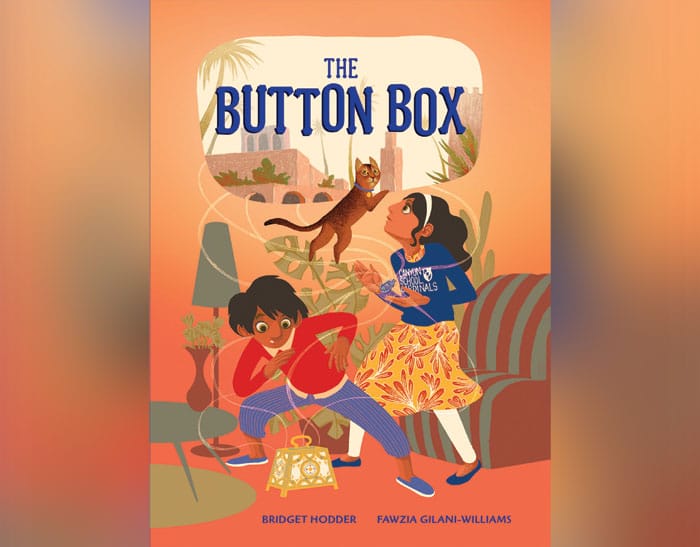
In “The Button Box,” a new middle grade novel, a Muslim-Jewish friendship is at the center of an exciting time-travel tale.
Ava, a Sephardic Jewish girl, and her cousin and best friend Nadeem, who is Muslim, are bullied at school because of their religions. When the two girls go to their Granny Buena’s home to talk to her about the incident, they discover a magical button that sends them back in time to ancient Morocco.
It’s in that colorful and lively setting that they meet their ancestors and embark on a thrilling adventure. “The Button Box” is based on real events that took place during the convivencia period in medieval Spain, where Jews, Muslims and Christians lived together in peace.
The book was co-written by Bridget Hodder, a Sephardic Jew and the daughter and granddaughter of Holocaust survivors, and Fawzia Gilani-Williams, who is Muslim.
“Fawzia and I are very much aware that as our communities face increasingly emboldened acts of violence and hatred, and Leviticus 19:16 calls upon us to not stand idly by,’” said Hodder. “‘The Button Box’ is, in part, an answer to that call.”
Hodder wrote the first draft of the book with the support of an Author Incentive Award from PJ Library and the Harold Grinspoon Foundation. But when she finished it, she felt like it was missing something.
“The book needed not only a Sephardic Jewish main character, but a Muslim one as well.” – Bridget Hodder
“It turns out the ‘something missing’ was Fawzia,” she said. “I had always known that the history of the Sephardim in Golden Age Spain and Morocco, where the adventures in ‘The Button Box’ take place, was deeply intertwined with Muslim history. But for some reason, I hadn’t thought it through. The book needed not only a Sephardic Jewish main character, but a Muslim one as well.”

Gilani-Williams had previously written an interfaith picture book called, “Yaffa and Fatima: Shalom, Salaam,” which is about two neighbors – one is Jewish and one is Muslim – who are best friends.
“[Gilani-Williams] was the authentic, beautiful voice I’d been waiting for,” said Hodder. “Once we started working together, we never looked back.”
It was important to Hodder to write a book that’s focused on Sephardic Jewish culture because of her family background. Her grandmother was born in the Ottoman Empire, in the Jewish city of Salonica; the Greeks handed over the Jews to be exterminated by the Nazis in World War II.
“Even the homes and graves of the Jews of Salonica have been razed and built over,” she said. “But our spirit will not die.”
She hopes that readers will learn about why it’s appropriate to step up and defend themselves from harm in the face of bullying.
She hopes that readers will learn about why it’s appropriate to step up and defend themselves from harm in the face of bullying. There are also many fun aspects of Sephardic culture they can dive into in the pages of the book, including descriptions of Mediterranean, Baltic and Middle Eastern food and old sayings.
“[A lesser known] Sephardic custom is quoting old sayings at any opportunity, a habit I’ve inherited,” said Hodder. “You’ll find them throughout the book, including sayings in Ladino, the Sephardic language based on archaic Spanish. It’s our parallel for Yiddish.”
Hodder and Gilani-Williams want to educate children in the United States about Jewish and Muslim beliefs with their book, too.
“How can they stand up and counter hateful nonsense about Jewish conspiracy theories, for example, when they have no actual facts?” said Hodder. “With this in mind, we provided a brief general information section in the back of the book, which should give non-Jewish and non-Muslim readers some basic tools for knowing and spreading truth. We hope it ends up in classrooms.”
Through exciting storytelling and a classic friendship tale, the authors strive to entertain readers while opening their eyes to new information at the same time.
“The best books are always the ones where you pick up wisdom along the way, without feeling ‘taught,’” said Hodder. “So first and foremost, we hope readers enjoy the adventure so much that they don’t realize they’re learning while they read.”
“The Button Box” is available through Kar-Ben Publishing.