
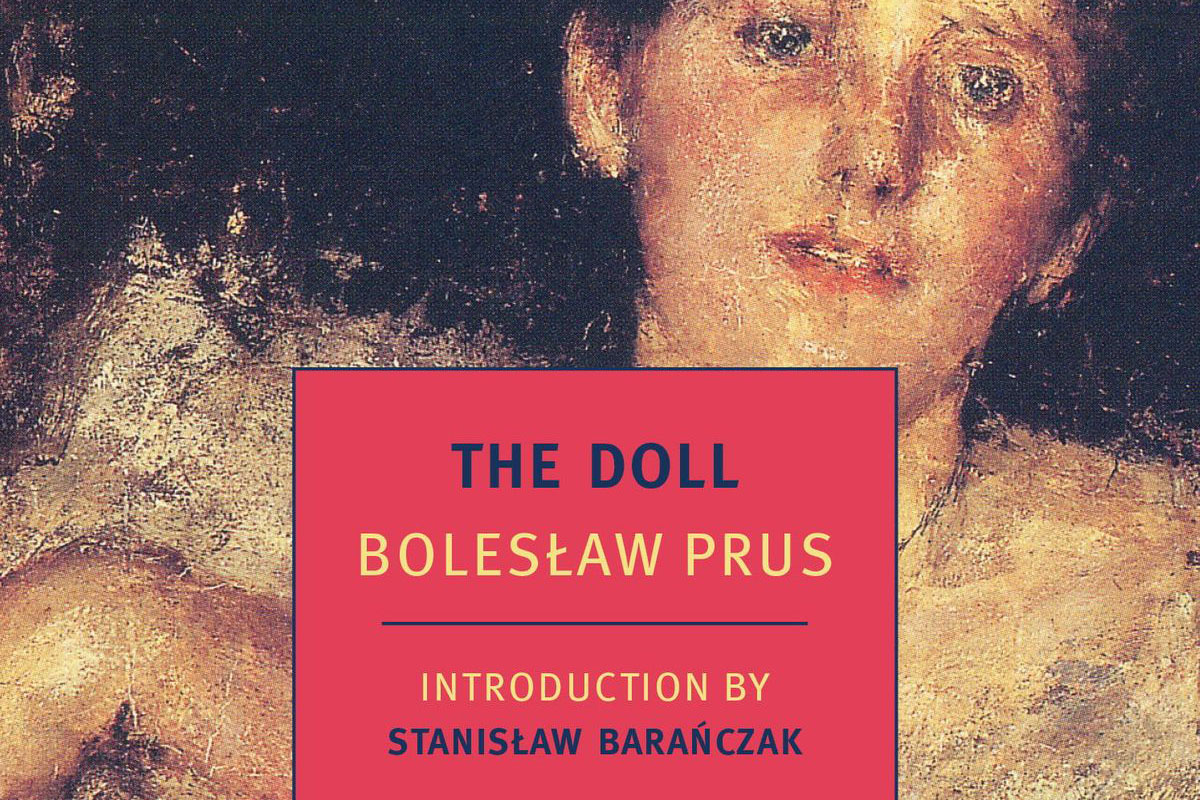
“The Doll,” published in 1890 (republished with NYRB, trans. David J. Welsh, 1996), is Polish master writer Bolesław Prus’s long, sweeping, fin-de-siècle work that collects all the shiny literary objects of the 19th century, in good magpie style, and displays them between its pages. We have the Dickensian court cases, full of humorous asides, and slapstick pranks. There is the ill-used lover lying down, in despair, on the train tracks, along with the battles of the Napoleonic wars, both in the tradition of Tolstoy. We encounter the “Woman Question” as debated in the oeuvres of Eliot and the Brontës, Turgenev, and Tolstoy again; the imagining of a future world, full of flying machines, as in Verne’s science fiction; and the class system and attendant figure of the upstart, or as it was called, the parvenu (a topic still popular decades later—think of Gatsby!). But for our purposes, I want to highlight one of Prus’s strongest preoccupations—not only his, but so many of his generation: the Jewish problem.
On the surface, Jews have no meaningful role in “The Doll,” which recounts, primarily, the story of Stanisław Wokulski, a generous and ambitious man who, from his early days as a server in a restaurant, makes his way up the ranks to become a great entrepreneur, a millionaire who entertains duchesses and countesses but can never convince the love of his life that he is worthy of her. The titular “doll” is the love interest of Wokulski; Izabela is beautiful, shallow, impoverished, and haughty, a picture of the dying aristocracy. Although Izabela is not in any way stupid—in fact, the back-cover blurbs are misleading, with Phillip Lopate’s description of Izabela as an “airhead” saying more about Lopate’s gender politics than Prus’s—she, like the class she represents, would rather disappear into oubliettes of history than wed with the humble working man. Below a tradesman like Wokulski there is only one creature more base, more feared, more reviled: the Jew.
Below a tradesman like Wokulski there is only one creature more base, more feared, more reviled: the Jew.
We must then ask the question: Is “The Doll” a work of antisemitism? Surprisingly, the answer is no, not really, despite the ungenerous portrayal of Jews throughout. After all, there is a distinction between antisemitic writing and writing about antisemitism. From the second page of “The Doll” on, we hear Warsaw residents grumbling that “only the Germans and the Jews get rich from Army trade.” The working class wonder “which is worse—the Jews or the nobility?” A new employee at Wokulski’s store is instantly liked when his colleagues see how fervent an antisemite he is. Repeatedly, we read complaints about the pungent, garlicky odor of Jews, their greasiness, their ability to attract fleas. They are accused of being money-hungry, which is a great irony in a novel full of money-obsessed characters (only the Jews are disdained for their materialism).
Rzecki—Wokulski’s employee and friend, whose diary entries are interspersed in the narrative—does his best to be fair-minded. He observes that the “dislike of the Hebrews is increasing; even people who, a few years ago, called them Poles of the Mosaic persuasion, now call them Jews. And those who recently admired their hard work, their persistence, and their talents, today only see their exploitation and deceit.” Rzecki writes about Warsaw’s blood libels; a one-time fighter in the Napoleonic wars for liberté, egalité, fraternité, Rzecki, hearing these rumors, stops to wonder “whether my youth was a dream.”
Of his colleague Szlangbaum, Rzecki has sympathy, admitting Szlangbaum is a “decent citizen in the fullest sense, yet no one likes him since he has the misfortune to be a Hebrew.” Ultimately, however, Rzecki also turns against Szlangbaum, who buys the store from Wokulski and hires fellow Jews to run it. The ending of the novel (spoiler alert), in which the aristocracy, failing to give Wokulski his due, realizes they have traded the devil they know (the Christian parvenu) for the devil they don’t (the Jew), suggests that at heart “The Doll” is a cautionary tale. Watch out, or the Jews will rule the world. And yet.
Of his colleague Szlangbaum, Rzecki has sympathy, admitting Szlangbaum is a “decent citizen in the fullest sense, yet no one likes him since he has the misfortune to be a Hebrew.”
Still, Wokulski, the hero, appears to be devoid of antisemitism. His retorts to anti-Jewish sentiment are sharp and consistent. And importantly, so too, it seems, is the omniscient narrator—which tells us that Prus’s novel is more engaged with chronicling rising antisemitism than (re)producing it (indeed the narrative ends just before the wave of pogroms that swept through Poland in the early 1880s, instigating large-scale immigration to the U.S.). Moreover, if Jews “worm” (to use a verb favored by Rzecki) their way into every plotline and nearly every page of the novel, it is mainly because they offer such a good metaphor for the primary focus of the novel—the parvenu. This is perhaps not surprising. The figure of the parvenu was, in the nineteenth century, tinged with Jewishness; one might even say Jews were the parvenus of parvenus.
Over a hundred and thirty years after its initial publication, “The Doll” remains an interesting artefact of life in the late-nineteenth century. Ironically, the “self-made millionaire” is now almost entirely without controversy (if anything, more people admire Oprah Winfrey and Elon Musk than, say, the British royals). The figure of the Jew, however, remains an ideological battlefield.
Karen E. H. Skinazi, PhD, is a senior lecturer and the director of Liberal Arts at the University of Bristol (UK) and the author of Women of Valor: Orthodox Jewish Troll Fighters, Crime Writers, and Rock Stars in Contemporary Literature and Culture.