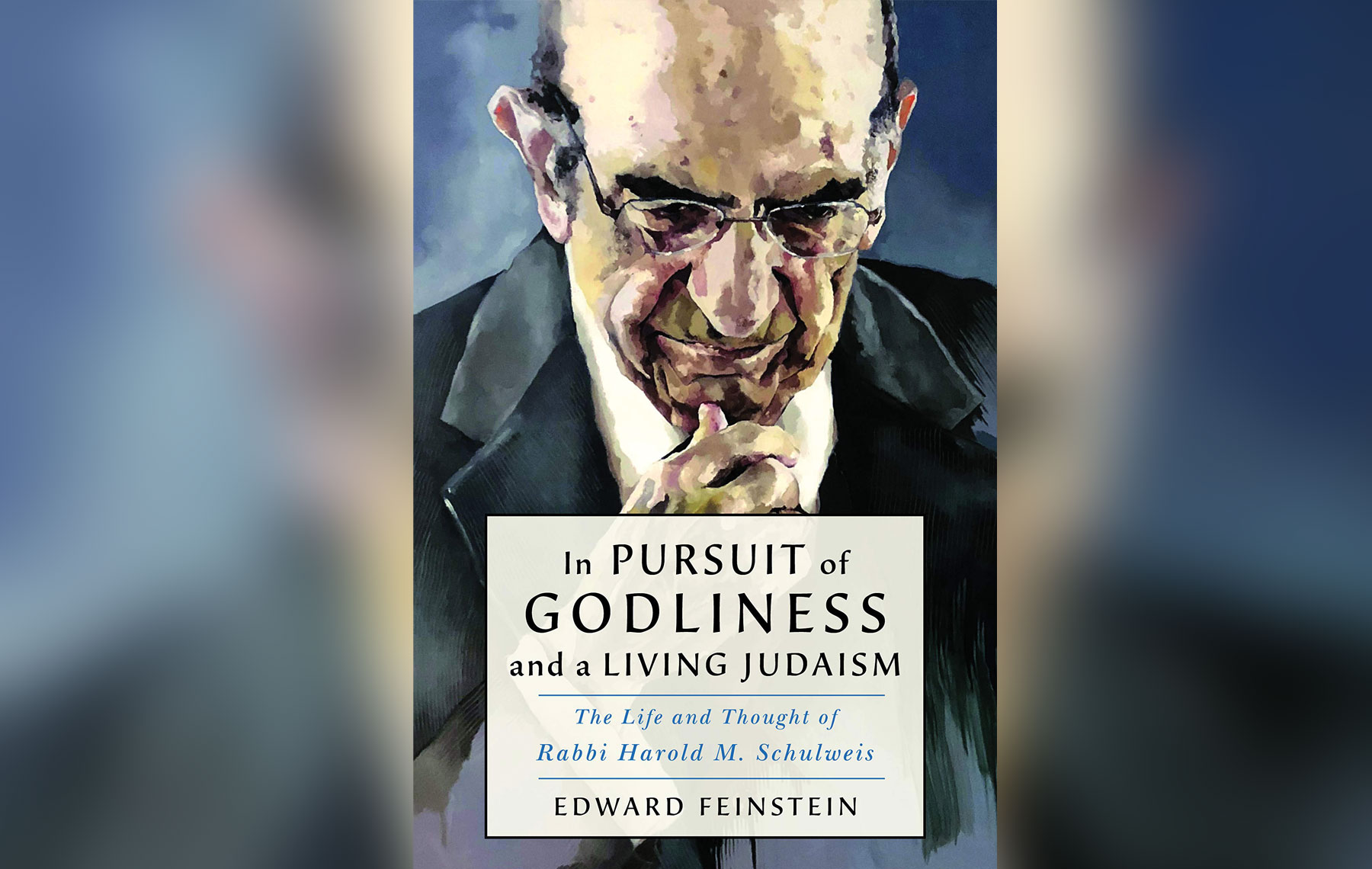
Harold M. Schulweis was one of America’s most revered rabbis. He was succeeded in the pulpit of Valley Beth Shalom by Rabbi Edward M. Feinstein, who has been described as Schulweis’ “devoted disciple.” So we should not be surprised to find that Feinstein has taken it upon himself to celebrate his mentor. At the same time, since Schulweis was a relentless truth-seeker, neither should we be surprised that Feinstein does not overlook Schulweis’ “critics and flaws.”
“In Pursuit of Godliness and a Living Judaism: The Life and Thought of Rabbi Harold M. Schulweis” (Turner Publishing Company) is only incidentally a biography. To be sure, Feinstein wants us to know what experiences and relationships shaped Schulweis’ heart and mind, but Feinstein devotes two-thirds of his book to exploring in depth what Schulweis believed, said, wrote and did as “the most successful and influential pulpit rabbi of his generation.”
We learn, for example, that Schulweis’ father had been an actor in Warsaw before immigrating to New York, where he contributed to the pages of the Forward. “The Schulweis home was a refuge for Yiddish writers, poets, musicians, artists, thinkers and cultural vagabonds who shared visions of the coming Jewish renaissance,” Feinstein explains. “Young Harold grew up surrounded by iconic images of Jewish dreamers and revolutionaries.”
Feinstein puts Schulweis in the generation that followed a certain “golden age,” which he describes in illuminating detail as an era that “indelibly changed the American rabbinate, the American synagogue, and the Judaism embraced by American Jews.” Born in 1925 and ordained in 1950, Schulweis followed such now-legendary rabbis as Stephen S. Wise and Abba Hillel Silver to the pulpit, but he “fully embraced the freedom to author his own rabbinate” and “to shape the roles and tasks he would fulfill as rabbi in answer to the demands of his historical moment,” as Feinstein puts it.
Surely, the single most decisive moment in the moral education of Harold Schulweis came in 1945, when the Union of Orthodox Rabbis formally excommunicated Rabbi Mordecai Kaplan for “atheism, heresy, and disbelief in the basic tenets of Judaism.” Kaplan’s crime was based on precisely those innovations in Judaism that most appealed to young Schulweis: “Kaplan’s relentless pursuit of truth, his ferocious rejection of religious mediocrity, and his dauntless openness to new thinking.” Kaplan became “Schulweis’ intellectual godfather.”
Feinstein punctuates his discourse with provocative phrases that catch the reader’s eye and compel us to pause and consider what Schulweis believed and taught: “Torah is entirely the product of culture.” “Prayer is not magic.” “The Holocaust mocks my faith.”
Schulweis’ first pulpit was a synagogue in Oakland, where his two decades of service spanned the most tumultuous events of the 1960s. He discovered, for example, that Jewish values were entirely consistent with the aspirations of a generation that did not trust anyone over 30 — a seder that Schulweis conducted for the young people in Haight-Ashbury represented an escape “from mindless materialism to Jewish moral idealism.” And when Schulweis arrived in Encino in 1970 to become the spiritual leader of Valley Beth Shalom, his intention, Feinstein insists, was “to marshal the community’s intellectual and spiritual resources toward the project of reinventing modern Judaism and reimagining Jewish life.”
Schulweis, according to Feinstein, deserves to be called a rebel who rejected the staid traditions of “quotational Judaism.” But he was also “an extension of the history and culture of American Jewish life” who sought to avoid “the dangers of fractured Judaism.” He warned against “a Judaism of superficial ethnic pride with no moral foundation.” At the heart of his theological message was a call to faith: “Belonging, Schulweis argued, rests upon a foundation of believing,” writes Feinstein. “Otherwise Judaism is likely to collapse into a hollow ethnic ‘Jewishness’ of kitschy Yiddish phrases, bagels and lox, songs from Fiddler on the Roof, but little else.”
Indeed, Feinstein puts Schulweis into an intellectual and philosophical context that draws deeply on Jewish values and wisdom and, at the same time, challenges the reader to consider new ways of understanding what has gone before. “Schulweis liberates religion from the epistemological puzzles of supernatural revelation,” writes Feinstein. “Revelation is an empirical process of learning and teaching carried on by human beings over the course of history.” And Feinstein punctuates his discourse with provocative phrases that catch the reader’s eye and compel us to pause and consider what Schulweis believed and taught: “Torah is entirely the product of culture.” “Prayer is not magic.” “The Holocaust mocks my faith.”
At one point in his book, Feinstein recalls an interview that Schulweis gave to the Jewish Journal shortly before his death in 2014. Asked to name the most significant of his accomplishments, Schulweis responded: Jewish World Watch, which started as a small circle of congregants at Valley Beth Shalom and grew into “a coalition of some sixty-two synagogues, churches, and schools dedicated to fighting genocide through education, political advocacy and humanitarian intervention.” And Feinstein quotes what Schulweis said at Jewish World Watch’s annual Walk to End Genocide.
“Today, we remember ten communities who share a tragic kinship of suffering,” Schulweis said, sounding, according to Feinstein, “every bit the prophet.” Schulweis also said, “We have found each other. We must not let go of each other.”
When Rabbi Schulweis uttered those poignant words, he was referring specifically to the places where genocide was (and is) happening in our own times. After reading Rabbi Feinstein’s book, so intellectually commanding and yet so deeply heartfelt, a somewhat different meaning emerges. Schulweis spent his life in search of a meaningful connection with Judaism and the Jewish people, and Feinstein shows us that he found what he was searching for. Thanks to Feinstein’s book, we have found each other, and we must not let go.
Jonathan Kirsch, author and publishing attorney, is the book editor of the Jewish Journal.